[Vietnam War]Biblio.com
133 résultats
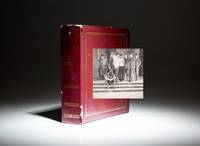
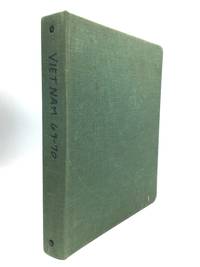
74627Fascinating album concerning an officer's dealings with the hill tribes in the mountains around Vietnam the Montagnards an umbrella term coined by the French for the indigenous mountain people. Quarto three-ring binder. It contains 85 black and white photographs and 20 color photographs of Lt. Col. Frank F. Shelby in his interactions with the Montagnards and with his own unit. Binder and photographs both in very good condition.<br /> <br /> Shelby b.1929 grew up in Lexington Missouri. He joined the army in time to serve in the Korean War where he was with the 5th Regimental Combat Team. It was in Korea that he met his wife Jean who was also in the Army serving in the Women's Army Corps. He eventually ended up in Vietnam and was assigned to the U.S. Military Assistance Command Vietnam MACV a joint-service command of the United States Department of Defense. It was first implemented to assist the Military Assistance Advisory Group MAAG Vietnam controlling every advisory and assistance effort in Vietnam but was reorganized on May 15 1964 and absorbed MAAG Vietnam to its command when combat unit deployment became too large for advisory group control. He and Jean retired in 1973 and soon opened a Sambo's restaurant in the Cordova Mall in Pensacola.<br /> <br /> The Monochrome photographs are generally 5 ½†x 3 ½†except for about five 8†x 10†and document Shelby’s military service in 1969-70. He seems to have been a liaison of sorts with the Montagnard troops fighting with the Americans. But unlike other war albums his seemed to be a mission of coercion and diplomacy. There are no vivid photographs of napalm burning or helicopters crashing. Rather almost the whole album shows him relating to the Montagnards. He visited many Montagnard encampments distributing food and resources smoking ceremonial pipe with the elders arranging concerts etc. Much of the album are photographs portraits of solitary Montagnards.<br /> <br /> Also includes a printed multicolor "Giay Thong-Hanh" pass. It states "Safe-conduct pass to be honored by all Vietnamese Government agencies and allied forces" and consists of a yellow slip with lettering in English and Vietnamese bearing images of the flags of all the allied troops. In the margin Shelby has written "These are passed out in Villages and dropped from planes. All part of the PSYOP program. unknown
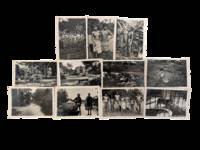
1950231831950. Vietnam photographs of Indigenous highland communities urban street life and Western contact likely made in the 1950s or early 1960s before the large-scale arrival of American combat troops in 1965. The group belongs most plausibly to the early U.S. advisory period when American personnel were present in Vietnam from 1950 and increasingly active in South Vietnam after 1955 but still long before the main combat escalation of the war. The juxtaposition of images highlight both upland Indigenous people posed in village or forest-edge settings and small urban views of southern Vietnam in which colonial architecture animal-drawn transport fishing labor and everyday street movement remain visible within the late French and early postcolonial landscape.<br /> <br /> Photo archive of 11 silver gelatin photographs each 2.25" x 3" Vietnam likely South Vietnam circa 1950s to early 1960s. Several photographs show Indigenous men women and children standing in open grass or along wooded edges wearing wrapped garments bead necklaces and basketry or carrying poles with one image showing women beside woven baskets in shallow water and another showing a figure working in dense vegetation. Exact ethnic identification is not secure from the photographs alone but the upland dress body adornment and basket forms are consistent with communities from Vietnam's Central Highlands or adjacent southern uplands possibly Jarai Ede or Rhade Bahnar Mnong or Stieng all part of the broader grouping often described in French and later English sources as Montagnard or Degar peoples. Other photographs turn to city and urban scenes with one image showing two women fishing another of a man in an ox-drawn carriage a zoo setting with large cats behind fencing and a formal boulevard view centered on a French colonial civic building that is likely the Saigon Municipal Theatre. The city scenes also fit Saigon where the long-established Saigon Zoo and Botanical Gardens opened to the public in 1869 formed part of the colonial urban core.<br /> <br /> The posed views of Indigenous highland people and the street scenes of fishermen cart drivers and city residents preserve the way local communities entered the visual record of American presence as subjects observed approached and documented by outsiders attached to the expanding U.S. role in South Vietnam during the 1950s and early 1960s. Light surface wear and minor corner and edge wear; overall very good condition. The combination of Saigon views with photographs of Indigenous upland communities gives the group particular force as a compact record of pre-combat American encounter in southern Vietnam. unknown
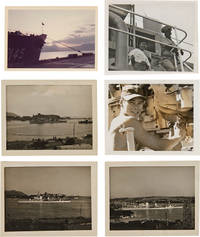
1963WRCAM55578Hong Kong Saigon Da Nang Pago Pago and other places 1963. Eighty-seven photographs most in color most about 3 1/2 x 3 1/2 inches including twelve slightly larger photographs laid in. Narrow quarto. Photograph album of black textured cloth gilt label on front board. Photographs in generally nice condition. Very good. An interesting collection of color and black- and-white vernacular photographs taken by an unidentified Navy Midshipman or Marine serving in southeast Asia in the early years of American involvement in Vietnam. Twenty- four images are captioned on the verso often identifying the time and place of the photographs some of which were taken on ship and others on the ground. The majority of the photographs emanate from 1963 either from the caption or a date stamp in the margin of the photographs. They feature street scenes and various buildings in Hong Kong and Vietnam views from the serviceman's ship shots of servicemen gathered in the mess hall views of fishing and various buildings in Pago Pago and more. <br> <br> The captions provide a good cross-section of the nature of the photographs a sampling of which read: "President Diems & Madame Nhus Palace being constructed - They were working on it when I came Feb 1963 August"; "Boulevard going towards Saigon August 63"; "Boats at river front Saigon August 63"; "Company Area V.T.T. Heli. Co. August 1963"; "Da Nang - S. Viet Nam"; "Chinese painting the ship - this is in Hong Kong"; "Bura boat alongside the ship selling goods in Hong Kong"; "One of the boats people live on in Hong Kong. Notice the laundry drying on the top"; "Governor's Home Pago Pago"; "Ships boat fishing party Pago Pago"; and others. The loose photographs feature naval subjects such as the hospital ship U.S.S. Sanctuary an officer named "Hamilton" and two shots of a young man onboard the ship who might be the compiler of the present album. <br> <br> A nice collection of early Vietnam War vernacular photography with useful annotations. hardcover books
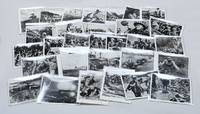
1965159096China: Xinhua she 1965-1974. An arresting collection of Vietnam war press photographs most dated between May 1965 and December 1967 taken by photographers from the official Chinese and North Vietnamese news agencies. One photograph showing North Vietnamese fishermen drilling with weapons has been annotated by an editor showing how this type of photograph and the accompanying officially approved wording were used by local newspapers to substantiate propaganda copy filed from the front line. Also included are two press dispatches profiling two soldiers commended at the First Awards Ceremony for Heroes of the Liberation Army of South Vietnam each with a portrait photograph. 65 photographic prints each approximately 110 x 150 mm all but one with title and caption serial number and date printed on verso in Chinese. Together with two printed sheets text recto only both 200 x 150 mm and folded horizontally as issued each with c. 120 x 80 mm portrait photograph tipped-in on verso. Housed in grey archival box. Some contemporary red pencil check marks. Photographs bright a few with light staining to white border occasional pinholes and slight creasing lower half of one printed sheet browned. A well-preserved collection. unknown
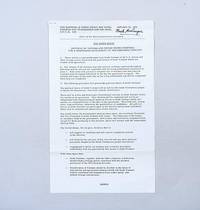
162762Washington DC: The White House 25 January 1972. There will be a total withdrawal from South Vietnam of all U.S. forces The White House press release issued to coincide with Nixon's 25 January 1972 address to the nation in which he revealed that Kissinger was negotiating with the North Vietnamese. This copy has the ownership signature of Clark MacGregor 1922-2003 a senior aide in the Nixon White House. Nixon's speech affirmed America's willingness to withdraw all of its forces within six months of any agreement release POWS and not interfere in free and fair elections in South Vietnam. "The President did not mention that he was proposing a cease-fire-in-place that would leave North Vietnamese troops occupying and governing South Vietnamese territory. Nor did he mention what Kissinger had told Chinese premiere Zhou Enlai at their first meeting: 'If the South Vietnamese government is as unpopular as you seem to think then the quicker our forces are withdrawn the quicker it will be overthrown. And if it is overthrown after we withdraw we will not intervene'" Hughes. Before serving in the White House MacGregor spent a decade in Congress. In 1972 he took over from John Mitchell as head of Nixon's re-election campaign. 2 xeroxed leaves 355 x 220 mm each printed one side only. Old horizontal creases light toning: very good. Ken Hughes "Nixon's Telephone Tapes: 1972" Miller Center University of Virginia. unknown
1968125181968. Photograph Album. Hardcover. Very good. Unpublished Vietnam War correspondent photographs depicting military personnel prisoners of war battle zones and various graphic scenes of Vietnam in the late 1960s. 123 black and white photographs. Housed in red leatherette three-ring binder with gilt borders and bands measures 11" x 11" x 2.5". Images affixed to self-adhesive magnetic photo sleeves. Wear and rubbing to binder secure metal rings. A few loose photos some mylar peeling on sleeves. Some photographs with war department publication information on verso. Includes numerous captions written for professional publication reporting on various attacks and military operations throughout Vietnam. Features photographs taken for the United States Army United States Marines Royal Australian Regiment Royal New Zealand Artillery and the Southeast Asia Pictorial Center. The Vietnam War 1954-1975 is considered the first "living room war" due to its daily appearance on television and in the press. The war's controversial and polarizing nature only further propelled its publicity and detailed documentation as seen in this example. The majority of these photos are from late 1967 and early 1968 on location in Hue Nui Dat an Australian base now a part of Ba Ria Saigon and Long Binh/Bien Hoa outside Ho Chi Minh. Multiple images refer to Operation Coburg an Australian and New Zealand military action against the North Vietnamese and the Viet Cong over the Lunar New Year festivities of 1968. It was the first time the Australian Task Force was deployed beyond its Tactical Area of Responsibility which set a precedent for later operations that extended beyond the assigned province of Phuoc Tuy. hardcover
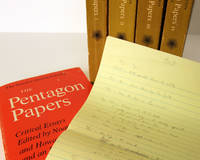
21291<p>William Bundy's 5-volume set of the <i>"Senator Gravel Edition"</i> of the <i>Pentagon Papers</i> with annotations marginal notes and two legal-size pages with handwritten notes arranged chronologically.</p> <b>VIETNAM WAR.</b>Books. <i>The Pentagon Papers</i>. Boston: Beacon Press 1971-1972. First Editions. Five paperback books volumes I-IV in green printed covers volume V in orange. 5¾ x 9 inches each. Pages varies by volume. Volume V <i>Critical Essays</i> edited by Noam Chomsky and Howard Zinn has a Beacon Press review copy slip taped to the half-title and an address label paperclipped to the same page. The label is addressed to Bundy as editor of <i>Foreign Affairs</i> and has a handwritten date <i>"9/25/72."</i><p><b><br /></b></p><p><b>Historical Background</b></p><p>Defense Secretary Robert McNamara commissioned a massive study later called the <i>Pentagon Papers</i> in 1967 and appointed Pentagon arms control director Leslie Gelb as the project's supervisor. Gelb hired 36 military officers civilian policy experts and historians to write the study's monographs. The <i>Pentagon Papers</i>included 4000 pages of actual documents from the years 1945–67. Daniel Ellsberg with the aid of his friend Anthony Russo leaked most of the <i>Pentagon Papers</i> to <i>New York Times</i>reporter Neil Sheehan who began publishing excerpts on June 13 1971. Ellsberg later said that the documents "demonstrated unconstitutional behavior by a succession of presidents the violation of their oath and the violation of the oath of every one of their subordinates." Portions of the "Papers" were subsequently published by Beacon Press. The present copy is William Bundy's set of that edition.</p><p>The <i>Pentagon Papers</i> revealed steps the Johnson and Nixon administrations had taken to escalate the war in Vietnam without informing the public. President Nixon argued that Ellsberg was guilty of felony treason under the 1917 Espionage Act because he had no authority to publish classified documents. Though the <i>Times</i> had been advised not to publish they did so claiming the First Amendment right to publish information essential to citizens' understanding of their government. Nixon's Attorney General John Mitchell obtained a federal court injunction forcing the <i>Times</i> to cease publication. After the <i>Times</i> appealed the case reached the Supreme Court. A separate case involving the <i>Washington Post's</i>publication of articles based on Ellsberg's leaks also reached the highest court. In June 1971 the Supreme Court ruled 6-3 that the injunctions were unconstitutional. As Senator Mike Gravel writes in the introduction "We were told that we had to fight on the continent of Asia so that we would not have to battle on the shores of America. One can accept these arguments only if he has failed to read the Pentagon Papers."</p><p><b>William Putnam Bundy</b> 1917-2000 graduated from Yale University and worked as an analyst at the Central Intelligence Agency in the 1950s. He had a long distinguished service government in the CIA and in the Defense Department. He was appointed Assistant Secretary of State for Far Eastern Affairs in March 1964. His brother McGeorge Bundy was Special Assistant for National Security Affairs to Kennedy and Johnson from 1961-1966. Both are considered primary architects of America's involvement in Vietnam. In <i>The Best and the Brightest</i> David Halberstam stated that during the Kennedy and Johnson administrations William Bundy's name "would probably be on more pieces of paper dealing with Vietnam over a seven-year period than anyone else's." The publication of <i>The Pentagon Papers</i> represented something of a personal defeat for Bundy who at the time had a 1100-page unfinished manuscript in which he selectively paraphrased from classified papers in his possession. The manuscript was rendered unpublishable by the appearance of these volumes.</p><p><b>McGeorge Bundy</b> 1919-1996 brother of William Bundy was one of President Kennedy's closest advisors on national security and he continued to fill that role for President Johnson during the period of escalation of the Vietnam War. He left government service in 1966 to head the Ford Foundation and then returned to university teaching and writing in 1979.</p><p><b>Condition</b></p><p>Very Good. Some wear to covers.</p> paperback
197121291<p>William Bundy's 5-volume set of the <i>"Senator Gravel Edition"</i> of the <i>Pentagon Papers</i> with annotations marginal notes and two legal-size pages with handwritten notes arranged chronologically.</p> <b>VIETNAM WAR.</b>Books. <i>The Pentagon Papers</i>. Boston: Beacon Press 1971-1972. First Editions. Five paperback books volumes I-IV in green printed covers volume V in orange. 5¾ x 9 inches each. Pages varies by volume. Volume V <i>Critical Essays</i> edited by Noam Chomsky and Howard Zinn has a Beacon Press review copy slip taped to the half-title and an address label paperclipped to the same page. The label is addressed to Bundy as editor of <i>Foreign Affairs</i> and has a handwritten date <i>"9/25/72."</i><p><b><br /></b></p><p><b>Historical Background</b></p><p>Defense Secretary Robert McNamara commissioned a massive study later called the <i>Pentagon Papers</i> in 1967 and appointed Pentagon arms control director Leslie Gelb as the project's supervisor. Gelb hired 36 military officers civilian policy experts and historians to write the study's monographs. The <i>Pentagon Papers</i>included 4000 pages of actual documents from the years 1945–67. Daniel Ellsberg with the aid of his friend Anthony Russo leaked most of the <i>Pentagon Papers</i> to <i>New York Times</i>reporter Neil Sheehan who began publishing excerpts on June 13 1971. Ellsberg later said that the documents "demonstrated unconstitutional behavior by a succession of presidents the violation of their oath and the violation of the oath of every one of their subordinates." Portions of the "Papers" were subsequently published by Beacon Press. The present copy is William Bundy's set of that edition.</p><p>The <i>Pentagon Papers</i> revealed steps the Johnson and Nixon administrations had taken to escalate the war in Vietnam without informing the public. President Nixon argued that Ellsberg was guilty of felony treason under the 1917 Espionage Act because he had no authority to publish classified documents. Though the <i>Times</i> had been advised not to publish they did so claiming the First Amendment right to publish information essential to citizens' understanding of their government. Nixon's Attorney General John Mitchell obtained a federal court injunction forcing the <i>Times</i> to cease publication. After the <i>Times</i> appealed the case reached the Supreme Court. A separate case involving the <i>Washington Post's</i>publication of articles based on Ellsberg's leaks also reached the highest court. In June 1971 the Supreme Court ruled 6-3 that the injunctions were unconstitutional. As Senator Mike Gravel writes in the introduction "We were told that we had to fight on the continent of Asia so that we would not have to battle on the shores of America. One can accept these arguments only if he has failed to read the Pentagon Papers."</p><p><b>William Putnam Bundy</b> 1917-2000 graduated from Yale University and worked as an analyst at the Central Intelligence Agency in the 1950s. He had a long distinguished service government in the CIA and in the Defense Department. He was appointed Assistant Secretary of State for Far Eastern Affairs in March 1964. His brother McGeorge Bundy was Special Assistant for National Security Affairs to Kennedy and Johnson from 1961-1966. Both are considered primary architects of America's involvement in Vietnam. In <i>The Best and the Brightest</i> David Halberstam stated that during the Kennedy and Johnson administrations William Bundy's name "would probably be on more pieces of paper dealing with Vietnam over a seven-year period than anyone else's." The publication of <i>The Pentagon Papers</i> represented something of a personal defeat for Bundy who at the time had a 1100-page unfinished manuscript in which he selectively paraphrased from classified papers in his possession. The manuscript was rendered unpublishable by the appearance of these volumes.</p><p><b>McGeorge Bundy</b> 1919-1996 brother of William Bundy was one of President Kennedy's closest advisors on national security and he continued to fill that role for President Johnson during the period of escalation of the Vietnam War. He left government service in 1966 to head the Ford Foundation and then returned to university teaching and writing in 1979.</p><p><b>Condition</b></p><p>Very Good. Some wear to covers.</p> paperback books