Vietnam WarABAA
133 résultats
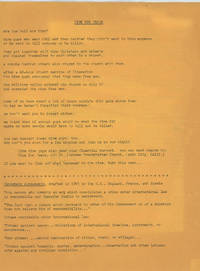
73826A double-sided flyer explaining the purpose of peaceful vigil in support of nine Vietnam War deserters who were arrested by military police on July 17 1968 inside Howard Presbyterian Church in Marin City California where they were chained to priests. "Nine for Peace . who the hell are they" the flyer reads. "Nine guys who went AWOL and then decided they didn't want to hide anymore or be sent to kill someone or be killed."<br/><br/>Photomechanically reproduced on an 8 ½" x 11" sheet of goldenrod paper the flyer sought financial support for the conscientious objectors. The verso of the undated flyer lists the names of the nine men and their status. For example Chuck Jones George Dounis and Keith Mather were being held in the Presidio stockade: "They've tried to fight inside as well as out. Some of them won't wear a uniform. Some won't do KP. So far they've gotten visitors: clergymen lawyers and sometimes relatives but there are no guarantee about future visits."<br/><br/>Mather then a graduate of Capuchino High School in San Bruno told the San Francisco Examiner he left the service because "I am opposed to the war and I don't believe in killing my fellow man. I was forced by being drafted to compromise my ideals."<br/><br/>It's estimated that approximately 50000 American servicemen deserted during the Vietnam War and many more avoided the draft by migrating to Canada and Sweden where they were given asylum. In fact there were so many deserters that President Gerald Ford established the Presidential Clemency Program on September 17 1974 offering Vietnam-era draft evaders and military deserters the opportunity to return to American society without criminal prosecution under certain conditions.<br/><br/>Some light wear and a bit of toning; otherwise very good. Scarce. unknown books
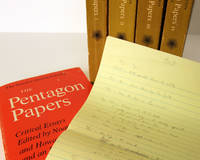
197121291<p>William Bundy's 5-volume set of the <i>"Senator Gravel Edition"</i> of the <i>Pentagon Papers</i> with annotations marginal notes and two legal-size pages with handwritten notes arranged chronologically.</p> <b>VIETNAM WAR.</b>Books. <i>The Pentagon Papers</i>. Boston: Beacon Press 1971-1972. First Editions. Five paperback books volumes I-IV in green printed covers volume V in orange. 5¾ x 9 inches each. Pages varies by volume. Volume V <i>Critical Essays</i> edited by Noam Chomsky and Howard Zinn has a Beacon Press review copy slip taped to the half-title and an address label paperclipped to the same page. The label is addressed to Bundy as editor of <i>Foreign Affairs</i> and has a handwritten date <i>"9/25/72."</i><p><b><br /></b></p><p><b>Historical Background</b></p><p>Defense Secretary Robert McNamara commissioned a massive study later called the <i>Pentagon Papers</i> in 1967 and appointed Pentagon arms control director Leslie Gelb as the project's supervisor. Gelb hired 36 military officers civilian policy experts and historians to write the study's monographs. The <i>Pentagon Papers</i>included 4000 pages of actual documents from the years 1945–67. Daniel Ellsberg with the aid of his friend Anthony Russo leaked most of the <i>Pentagon Papers</i> to <i>New York Times</i>reporter Neil Sheehan who began publishing excerpts on June 13 1971. Ellsberg later said that the documents "demonstrated unconstitutional behavior by a succession of presidents the violation of their oath and the violation of the oath of every one of their subordinates." Portions of the "Papers" were subsequently published by Beacon Press. The present copy is William Bundy's set of that edition.</p><p>The <i>Pentagon Papers</i> revealed steps the Johnson and Nixon administrations had taken to escalate the war in Vietnam without informing the public. President Nixon argued that Ellsberg was guilty of felony treason under the 1917 Espionage Act because he had no authority to publish classified documents. Though the <i>Times</i> had been advised not to publish they did so claiming the First Amendment right to publish information essential to citizens' understanding of their government. Nixon's Attorney General John Mitchell obtained a federal court injunction forcing the <i>Times</i> to cease publication. After the <i>Times</i> appealed the case reached the Supreme Court. A separate case involving the <i>Washington Post's</i>publication of articles based on Ellsberg's leaks also reached the highest court. In June 1971 the Supreme Court ruled 6-3 that the injunctions were unconstitutional. As Senator Mike Gravel writes in the introduction "We were told that we had to fight on the continent of Asia so that we would not have to battle on the shores of America. One can accept these arguments only if he has failed to read the Pentagon Papers."</p><p><b>William Putnam Bundy</b> 1917-2000 graduated from Yale University and worked as an analyst at the Central Intelligence Agency in the 1950s. He had a long distinguished service government in the CIA and in the Defense Department. He was appointed Assistant Secretary of State for Far Eastern Affairs in March 1964. His brother McGeorge Bundy was Special Assistant for National Security Affairs to Kennedy and Johnson from 1961-1966. Both are considered primary architects of America's involvement in Vietnam. In <i>The Best and the Brightest</i> David Halberstam stated that during the Kennedy and Johnson administrations William Bundy's name "would probably be on more pieces of paper dealing with Vietnam over a seven-year period than anyone else's." The publication of <i>The Pentagon Papers</i> represented something of a personal defeat for Bundy who at the time had a 1100-page unfinished manuscript in which he selectively paraphrased from classified papers in his possession. The manuscript was rendered unpublishable by the appearance of these volumes.</p><p><b>McGeorge Bundy</b> 1919-1996 brother of William Bundy was one of President Kennedy's closest advisors on national security and he continued to fill that role for President Johnson during the period of escalation of the Vietnam War. He left government service in 1966 to head the Ford Foundation and then returned to university teaching and writing in 1979.</p><p><b>Condition</b></p><p>Very Good. Some wear to covers.</p> paperback books
19761345Herndon Historical Society 1976. Paperback. Very good. No dustjacket as issued. Cover has some wear and a small stain in upper left front. Herndon Historical Society paperback
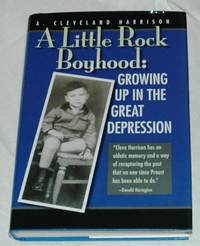
20051092Avocus Publishing 2005. Hardcover. Very good. No dustjacket as issued. Cover has light wear. Signed and dated by the author on title page. Avocus Publishing hardcover
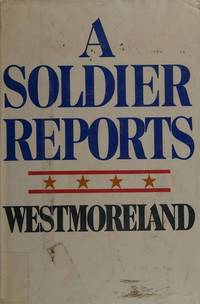
1976012519New York NY U.S.A.: Doubleday 1976. 446 pages with some b&w photographs. Endpaper maps. inscribed by General Westmoreland.".on half-title page. Book has light wear to edge of cover. This is a personal account of a life and career that in the course of almost 40 years of service to include command of US forces in Vietnam. Exceptional memoir by a general who served his country both on and off the battlefield with the highest distinction. Clean. Inscribed by the Author. First Edition. Hard Cover. Very Good/Very Good. 8vo - over 7¾" - 9¾" tall. Doubleday Hardcover
1976007798New York NY U.S.A.: Doubleday 1976. 446 pages with some b&w photographs. Endpaper maps. inscribed by General Westmoreland.".Book has light wear to edge of cover. This is a personal account of a life and career that in the course of almost 40 years of service to include command of US forces in Vietnam. Exceptional memoir by a general who served his country both on and off the battlefield with the highest distinction. Clean. Inscribed by the Author. First Edition. Hard Cover. Very Good/Very Good. 8vo - over 7¾" - 9¾" tall. Doubleday Hardcover
199959005458Ramsey NJ: Huey Co Inc 1999. Bound in tan and blue cloth with matching dust jackets. A superb two volume set both signed by the author and Colonel Kenneth T. Mertel limited to 500 copies in the first edition. 124 pp. / 164 pp.TIght clean "as new" copies. . Signed by the Author. First Edition. Hard Cover. Fine/Fine. 4to - over 9¾" - 12" tall. Limited Edition. Huey Co Inc Hardcover
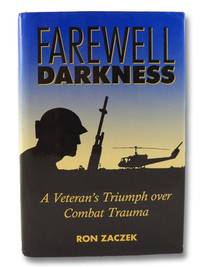
19942041255Naval Institute Press 1994. First Edition. Hard Cover. Very Good/Very Good. First edition. 1/4 inch tear to jacket corner owner bookplate with name inked out on front endpaper. 1994 Hard Cover. xiv 344 pp. 8vo. From the jacket: ''I want to give something back' the author insisted. His counselor at the Vet Center suggested 'You can give the guys in treatment hope. You know what PTSD looks like from both sides. You can tell these guys what it's like and what's different when you get beyond it.' Ron Zaczek had been a good crewchief. He was 'Zack' then: Marine Observation Squadron Three '66-'68; Phu Bai Dong Ha Khe Sanh; 393 missions in Huey medevacs and gunships; 19 Air Medals and a Bronze Star. He'd succeeded in college and in industry. Good marriage two fine kids. Then things began to fall apart. Too much anger depression. Thoughts of suicide. So many missions of mercy and death returning in nightmare and flashback out of control: 'You gotta get us out Scarface. We're burning up!' Marine crewchiefs never lost control! Control was survival and Zack was trained to survive. He entered the Vet Center Outreach Program as a last resort not believing it could help. Farewell Darkness is a probing personal look at war's psychological toll. Told with a vision of healing and hope Zaczek's story captures the passion and idealism he felt as a 19-year-old Marine new to war his pride in doing a job well his fear and perseverance in the face of enemy fire his grief over the loss of friends and the anger and sadness of his homecoming. The reader lives Zaczek's brutal honest journey through war as well as his treatment for post-traumatic stress disorder. Naval Institute Press hardcover books