353rd Infantry Regimental SocietyBiblio.com
505 résultats
0365553999.Ghardcover. Good. Access codes and supplements are not guaranteed with used items. May be an ex-library book. hardcover
1333689519.Gpaperback. Good. Access codes and supplements are not guaranteed with used items. May be an ex-library book. paperback
0331597187.Ghardcover. Good. Access codes and supplements are not guaranteed with used items. May be an ex-library book. hardcover
178039506X.Gpaperback. Good. Access codes and supplements are not guaranteed with used items. May be an ex-library book. paperback
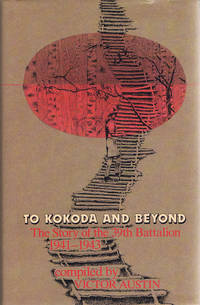
1988133289Melbourne: Melbourne University Press 1988. Pp. xviii268last blank 12 plates full page maps and plans appendices index; dust wrapper; date stamp 25 Mar 1988 on upper free endpaper; Melbourne University Press Melbourne 1988. First edition. The 39th Australian Infantry Battalion was formed in late 1941 and existed as a unit for less than two years. Almost immediately the largely untrained battalion found itself in the front line of Australia's defence in Port Moresby just after the Japanese attack on Pearl Harbour. Melbourne University Press unknown
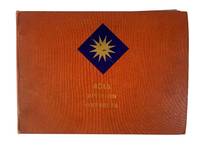
1944220931944. 40th Infantry Division Pacific campaign photograph album documenting combat operations and daily military life of U.S. Army forces during World War II. The 40th Infantry Division served extensively in the Southwest Pacific Theater participating in campaigns across New Guinea New Britain and the Philippines as Allied forces advanced against Japanese defensive positions. The photographs record amphibious landings artillery operations destroyed towns and the collaboration between American troops and Filipino guerrilla forces during the campaign to liberate the Philippines. The album therefore documents the operational environment of Pacific warfare including jungle terrain fortified Japanese defensive networks and the logistical systems required to sustain prolonged combat across island battlefields.<br /> <br /> Photograph album containing approximately 200 original black and white photographs documenting operations of the 40th Infantry Division during the Pacific campaigns of World War II. Each photograph is sequentially numbered in white ink at the lower corner and corresponds to descriptive entries in a photographic index within the album. Early images depict American Red Cross workers disembarking from landing craft and greeted by U.S. soldiers illustrating the presence of female support personnel assigned to medical and relief operations. Additional photographs record amphibious landing scenes aerial views of destroyed towns in Luzon artillery and tank operations and soldiers operating mounted machine guns overlooking jungle valleys. Several images depict Japanese military casualties reflecting the intense close combat that characterized fighting across the Pacific islands. A printed military map within the album shows Japanese tunnel and cave fortifications in the Zambales Mountains illustrating defensive positions encountered during operations in the Philippines.<br /> <br /> The album also documents logistical and civilian dimensions of the campaign. Photographs show ships unloading cargo Filipino guerrilla units marching through urban streets and groups of local porters assisting Allied forces in moving supplies through mountainous terrain. Weapons and equipment visible in the images include field artillery pieces mortars and armored vehicles such as the M4 Sherman. One photograph depicts African American soldiers accompanied by scout dogs operating in jungle terrain illustrating the presence of Black servicemen serving within the segregated structure of the wartime U.S. Army. Other photographs show tent encampments mess areas interactions with local populations and the recovery of prisoners of war following combat operations. The photographs collectively present a visual record of combat logistics and daily military life during the Pacific campaigns. Album contains approximately 200 photographs with indexed numbering. Light handling wear visible to album and photographs consistent with wartime field compilation. Overall condition very good. unknown
1946mon0003554016Army and Navy Publishing Company 1946T. hardcover. Good. . shows minor wear and foxing. Army and Navy Publishing Company hardcover
195273990Atlanta Ga.:: Albert Love Enterprises 1952. First edition. publisher's embossed cloth. Colorful hotel label on front pastedown; slight tanning to endsheets; light use to cloth at extremities. Tight and sound. Folio. Illustrated throughout from photographs. Albert Love Enterprises], hardcover
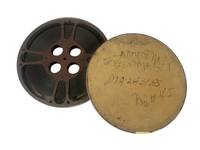
1945232061945. Capra Frank. Japanese-Americans a 1945 wartime military screen magazine segment film reel highlighting Japanese American service in the U.S. Army's information and morale boosting film distributions during the final year of World War II. Produced for exhibition to servicemen as part of Army-Navy Screen Magazine No. 45 the segment is also an example of the wartime contributions of legendary Italian-American filmmaker Frank Capra one of Hollywood's most influential directors best known for It Happened One Night Mr. Smith Goes to Washington and It's a Wonderful Life. During World War II Capra became a major figure in official U.S. military filmmaking directing or supervising films that translated government policy and Allied war aims into accessible emotionally forceful cinema for soldiers and civilians. Here his Army film work presents Nisei troops not as an isolated human-interest subject but as participants in a broader program joining military projection democratic rhetoric and controlled public acknowledgment of Japanese American loyalty after mass incarceration. The film's focus on the 100th Infantry Battalion the 442nd Regimental Combat Team battlefield casualties and a widow receiving the Silver Star shows how Capra's wartime production apparatus helped frame Japanese American military service for uniformed audiences in 1945.<br /> <br /> Capra Frank producer. Japanese-Americans. Segment from Army-Navy Screen Magazine No. 45. U.S. Army Signal Corps Army Pictorial Service 1945. Black and white sound film reel 16mm. Present on a large reel in metal can the lid handwritten in grease pencil "ARMY/NAVY SCREEN MAG." and "NO #45." The identified segment shows a spokesman in Hawaii praising Japanese Americans in the U.S. Army a war widow receiving a Silver Star scenes of Nisei troops in the Italian campaign the 100th Infantry Battalion entering Livorno wounded men being evacuated and General Mark Clark citing soldiers of the 34th Infantry Division. The physical reel remains tightly wound; the present housing and handwritten can notation directly support identification to issue no. 45.<br /> <br /> Issued at a time when Japanese Americans were serving in segregated units even as many of their families remained confined under wartime exclusion policy the segment shows how Capra's Army film production participated in reconciling racial tension and patriotic messaging to American servicemen. Japanese American servicemen are honored here as heroes and patriots. Light wear and dust to can; reel housed and tightly wound; surface inspection only. A strong piece of World War II military film notable both for its Japanese American subject matter and as a sample of Frank Capra's influential wartime propaganda work for the U.S. Army. unknown
194650501Baton Rouge Louisiana: Special Troops of the 4th Infantry Division. 1946. Hardcover. Good. 1946 first edition. Black hardback covers. Shelf wear and rubbing to the spine edges and corners. The corners are bumped. There are several small rubbed and stained spots on the covers. A very scarce World War II unit history. The 4th Infantry Division participated in the Normandy D-Day invasion and landed at H-Hour on D-Day at Utah Beach. An excellent unit history. ; 178 pages . Special Troops of the 4th Infantry Division hardcover
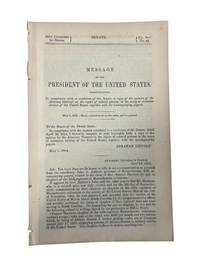
1864214721864. Lincoln Abraham. Message of the President of the United States. on the Rights of Colored Persons in the Army 1864 documents federal policy and legal interpretation concerning the status and compensation of African American soldiers and officers during the Civil War and provides direct evidence of how the U.S. government addressed racial inequality within the Union Army. Transmitting Attorney General Edward Bates' formal opinion the document centers on the case of Reverend Samuel Harrison chaplain of the 54th Massachusetts Volunteer Infantry and addresses the broader question of whether Black service members were entitled to the same recognition and pay as their white counterparts. Issued during active wartime mobilization of United States Colored Troops the pamphlet supports research into African American military service Civil War law and the evolving federal stance on racial equality within military institutions.<br /> <br /> Lincoln Abraham. Message of the President of the United States Communicating. a Copy of the Opinion of the Attorney General on the Rights of Colored Persons in the Army. Washington: Government Printing Office 1864. Disbound pamphlet 9 pages. The text includes the full opinion of Attorney General Edward Bates affirming that "Mr. Harrison was the lawfully appointed and qualified chaplain of the 54th Massachusetts regiment" and therefore entitled to full compensation. The case arose when Harrison despite his commissioned status was paid only ten dollars per month and one ration under interpretations of the July 17 1862 law governing Black enlistment. Bates rejects this limitation stating that denial of proper pay would constitute "a plain violation of the purpose of Congress." Accompanying documents include War Department orders issued by Secretary of War Edwin M. Stanton authorizing the recruitment of African American regiments under Governor John A. Andrew of Massachusetts as well as a muster-in roll confirming Harrison's official appointment.<br /> <br /> Issued at a moment when the Union relied increasingly on African American troops this document records the tension between discriminatory policy and federal efforts to formalize Black military service within established legal frameworks. The case of Samuel Harrison connected to the 54th Massachusetts one of the most prominent Black regiments of the war highlights both institutional inequities and the mechanisms through which they were contested at the highest levels of government. The inclusion of legislative interpretation executive transmission and military documentation within a single publication makes it a concentrated record of how civil rights questions were adjudicated during wartime illustrating the gradual expansion of legal recognition for African American service members. Light toning and minor edge wear from disbinding; overall condition very good. unknown
0259175153.Gpaperback. Good. Access codes and supplements are not guaranteed with used items. May be an ex-library book. paperback
73-00108Taylor Publishing Company. Hardcover. Good. Good condition. Cover shelf wear. Clean inside. Taylor Publishing Company hardcover
19485394H84107Philadephia PA: 6th Infantry Battalion USMCR. January 26 1948 Volume 1 Number 9 Circulation 430. stapled legal paper size. Looks to been used as a recruiting tool. . Very Good. No Binding. 1948. 6th Infantry Battalion, USMCR unknown
1985055554Fort Benning GA: Dept.of Army-Headquarters 75th Infantry Ranger Regiment 1985. Paper Back. Very Good/No Jacket. 8vo - over 7¾" - 9¾" tall. chapt.pag.; SC staple-bound; blue w/blk.-pic.cover; rubbed w/PON&inkcover; 1"tear @ top staple; corner-fold; cleantight pgs. "Purpose: a. To standardize the conduct of airborne operations within the 75th Infantry Ranger Regiment. b. To facilitate the planning and preparation for administrative tactical and combat airborne operations. <br/> <br/> Dept.of Army-Headquarters, 75th Infantry (Ranger) Regiment unknown
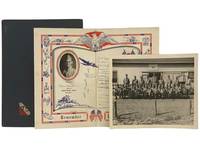
19462340808Baton Rouge: The 75th Infantry Division / Army & Navy Publishing Company 1946. First Edition. Large Hardcover. Very Good/No Jacket. 0x0x0. Rowe John S. Signed by author. Original platoon photograph signed by dozens of members of the 75th Infantry Division and noting their home towns laid in along with a Remember Pearl Harbor soldier 'diary' detailing the service of a soldier in the division. A couple faint spots to boards otherwise an excellent copy. Soldiers who signed included: Pearson C. Schiller; Sgt. Chitwood; Domenico J. Scatena; George T. Wingard Jr.; Mike Stirling Jr.; Paul Toman; Joe LaPointe; Lowell E. Murphy; 'myself' probably Nathan Hena who signed the Pearl Harbor sheet; Jack M. Reese; Robert N. Dugal; Joseph A. Buzogany; Robert T. Berkebile; Joseph W. Lasley; Grover E. Hardy; Douglas Huff; William C. Woodward; Ivan C. Else; Francis Quinn; G.L. Mae; Calvin W. Hood; Howard L. Marshall; Chester Kalm; Delwyn P. Goodyear; Sgt. Adams; Walter J. Clausius Jr.; John J. Long; Morton L. Plesser; Ridley W. Meek; Richard H. Phillips; Jerry H. Steward; Harry S. Singer; William H. Fleming; Platton Sgt. Smith the sergeants' names are all in pencil in the same hand so they were probably written in by the owner of the book. Some names are numbered to correspond with the photo others are marked as 'not present for picture'. 1946 Large Hardcover. Unpaginated. Black-and-white photographs throughout depicting the service of the 75th Infantry Division toward the end of World War II. The 75th Infantry Division / Army & Navy Publishing Company hardcover
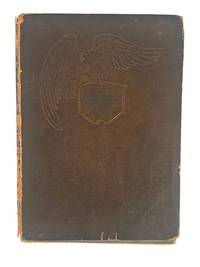
1919216951919. Victory: History of the 805th Pioneer Infantry by Paul S. Bliss published in 1919 documents the service of an African American regiment of the American Expeditionary Forces during the final year of World War I. The volume records the organization deployment and wartime duties of the 805th Pioneer Infantry a Black regiment formed during the rapid expansion of the United States Army in 1918. Composed of African American enlisted soldiers serving under white officers in a segregated military structure the regiment deployed to France during the closing phase of the war and performed engineering construction and logistical work in areas affected by active combat operations. Regimental histories such as this were produced soon after the war to preserve the institutional record of individual units and to commemorate the contributions of the soldiers who served within them.<br /> <br /> Bliss Paul S. Victory: History of the 805th Pioneer Infantry American Expeditionary Forces. St. Paul Minnesota: Paul S. Bliss 1919. First edition. The book presents rosters portraits and photographs documenting the regiment's organization and activities while serving in France. The 805th Pioneer Infantry was organized at Camp Funston Kansas in July 1918 and deployed overseas during the Meuse Argonne campaign. Although classified as a pioneer unit responsible for construction and engineering tasks the regiment often worked in forward operational areas exposed to enemy fire. Photographs in the volume depict companies of the regiment in formation including an image titled "Company C at Brieulles sur Meuse" along with scenes of soldiers repairing damaged structures posing with captured German artillery and assembling for inspection during a visit by General John J. Pershing. Portrait collages identify numerous enlisted men and officers of the regiment while an illustrated frontispiece portrays African American soldiers advancing with fixed bayonets across a shell damaged battlefield landscape.<br /> <br /> Regiments such as the 805th Pioneer Infantry formed part of the broader mobilization of African American soldiers during World War I when more than 350000 Black men served in the United States Army in segregated units. Pioneer infantry regiments were frequently assigned labor and engineering duties supporting front line operations including road construction trench repair and logistical supply work. Printed regimental histories produced after the war served as commemorative records preserving the service of these units and documenting the participation of African American soldiers in the American Expeditionary Forces. Volume bound in original embossed leather boards with gilt and blind stamped decoration and heavy card stock leaves printed on recto only. Includes color printed pages depicting regimental and national flags. Spine worn and partially split with rubbing to board edges and scattered foxing and toning to leaves; contents remain intact. Overall good condition. The book provides an extensive visual and documentary record of an African American regiment serving in the United States Army during World War I. unknown
0265612004.Ghardcover. Good. Access codes and supplements are not guaranteed with used items. May be an ex-library book. hardcover
194575454MTOUSA Mediterranean Theater of Operations United States Army Information and Education Section 1945. Presumed First Edition First printing. Pamphlet. Good. 95 1 pages. Illustrations. Maps including of Po Valley. Drawings. DORNBUSCH 1653. Approximately 4.75 inches by 6.75 inches. Cover has some wear and soiling. Cover says: We Were There: From Gruber to the Brenner Pass. Front Cover is illustrated. Rear Cover has a poem entitled Wotan's Call by Pfc. Frank Kennegot Headquarters Company 349th Infantry. Statement at bottom of title page "Material in this story has been passed by the U.S. censor and may be mailed home". This pamphlet was given to troops of the 88th. As is typical with such 'in theater' publications there are some pages which have some variation in printing but pages are legible. There are a couple of minor ink stains noted. The 88th Infantry Division was an infantry division of the United States Army that saw service in both World War I and World War II. It was one of the first of the Organized Reserve divisions to be called into federal service created nearly "from scratch" after the implementation of the draft in 1940. Previous divisions were composed of either Regular Army or National Guard personnel. Much of the experience in reactivating it was used in the subsequent expansion of the U.S. Army. By the end of World War II the 88th Infantry fought its way to the northernmost extreme of Italy. In early May 1945 troops of its 349th Infantry Regiment joined the 103d Infantry Division of the VI Corps of the U.S. Seventh Army part of the 6th Army Group which had raced south through Bavaria into Innsbruck Austria in Vipiteno in the Italian Alps. MTOUSA (Mediterranean Theater of Operations United States Army), Information and Education Section unknown
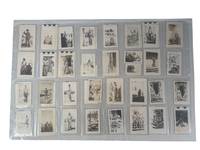
1943214881943. African American MilitaryWWII African American U.S. Army soldiers photo archive from Fort Huachuca Arizona 1943 documenting the lived experience of segregated military training during World War II. The archive shows Black army soldiers in training for the 93rd Infantry Division one of only two African American infantry divisions organized during the conflict. While the division is not explicitly named in the photographs contemporary handwritten annotations identify Fort Huachuca and the 1943 date strongly suggesting the men pictured were a part of that unit.<br /> Archive comprises 46 original black and white snapshot photographs measuring approximately 2.5 x 3.5 inches to 3.25 x 5 inches several bearing manuscript identifications of location and named soldiers. The images depict Black servicemen in standard World War II U.S. Army dress including M 1941 and M 1943 field jackets wool service uniforms garrison caps and M1 steel helmets. Rank insignia are clearly visible across multiple photographs including private first class corporal technician fifth grade staff sergeant and other non commissioned officer grades. Identified individuals include Sgt. Aaron C. Morton Sgt. William U. Dean Sgt. Lockleau and Sgt. Asbury the latter humorously photographed overturned on a barracks railing with a caption noting his antics. Several images show non commissioned officers posed with younger recruits underscoring internal mentorship and command structure within segregated companies. One photograph captures a soldier manning an M1919 Browning .30 caliber machine gun reflecting weapons training and infantry preparedness. Other images depict barracks life informal camaraderie saluting poses and interactions that convey unit cohesion during stateside training.<br /> <br /> Fort Huachuca functioned as a central site for Black military training during the years of segregation prior to the Korean War. The 93rd Infantry Division would later deploy to the Pacific Theater where elements engaged in security operations and combat patrols under conditions shaped by discriminatory assignment practices. These photographs document the formative training phase preceding overseas service capturing visible evidence of rank progression technical specialization and heavy weapons instruction within Black units. The presence of named non commissioned officers enhances the archive's value for regimental research. Minor curling and light edge wear to several photographs; manuscript annotations remain legible; overall very good. A substantial visual record of African American military service within the segregated U.S. Army during World War II mobilization. unknown
190001110712Cincinnati: The Ohio Valley Press 1900. Regimental history of the 94th Ohio Infantry Regiment part of the 14th Army Corps which fought extensively with Sherman's army. Gilt lettering on the front cover with a red acorn the 14th Corps badge on deep blue cloth. 166pp. Moderate wear extremities. Penciled owner's name on second ffep. 1 1/2" edge tears on pages 2 and 165. Ex-library with usual markings. A solid clean example of the original edition of this scarce title. Nd ca. 1900. Hard Cover x-library. VG-/No Jacket as Issued. Large Octavo. Book. The Ohio Valley Press Hardcover
01110085Cincinnati: The Ohio Valley Press This unit was part of the 14th Army Corps and fought extensively with Shermans army. It fought in the Army of the Cumberland from Perryville on they were with Sherman in the Atlanta Campaign on his famous march in Georgia and through the Carolina Campaign. Gilt and red titles on blindstamped deep blue cloth. 166pp. Owner's handstamp name on rear free end paper otherwise unmarked. An especially nice example of this scarce history. Hard Cover. Very Good/No Jacket. Large Octavo. The Ohio Valley Press Hardcover
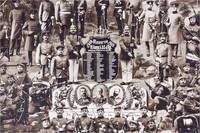
3733807<p>Metz Alsace-Lorraine German Empire: Gebrüder Notton Römerstr. 10 1908. Composite silver process photograph. Mount: 18¾ x 23½ inches. Image: 14¼ x 17¾ inches. Light rubbing to edges of mount with minor wear at bottom right; margins foxed; small mark at bottom extending faintly into image; very good.</p> <p>This is a rich and complex composite photograph from 1908 captioned with the words “Zur Erinnerung an Meine Dienstzeit†which translates to “In remembrance of my service time.†It was created for the 10th Company 8th Württemberg Infantry Regiment Grand Duke Frederick of Baden’s Regiment—possibly light infantry as in “Jäger infanterieregiment.†This regiment was based in Strasbourg in Alsace-Lorraine and served within the Imperial German Army. </p> <p>The surnames of these men are: Baibel Baierl Bauer Berger Jos. Burger Joh. Bumb Büchel Dirr Dirschedl Echtler Feibler Forster Fuchs Gaibl Ganslmeier Gundel Habender Hagl Haub Haüselmeier Herzog Hiemer Huber Jacob Janker Keim Kirchbauer Klemm Knott Kopp Kraus Kreckl Kübel Laubhardt Laubenbacher Lautner Lippert Maier Joh. Maier Seb. Merkel Miehling Moosburger Petermann Pfeilschifter Pflug Prior Rachl Rauschecker Ries Rommel Schmid Schmidt Schnabel Scholz Schraudolf Schweiber Stegmeier Sutter Ulm Weber Weindl Wenniger Wohlfarth Zieringer Zeilinger Zirngibl.</p> <p>The photograph presents a multitude of uniformed soldiers in a staged setting designed to resemble a military encampment or a gathering. The arrangement of soldiers is not casual but highly structured with officers shown with swords and details prominently positioned in the foreground. Many of the men are shown hoisting enormous beer steins with rather serious expressions.</p> <p>The photograph also features regimental flags and other military regalia which were symbols of pride and unity for the unit. The arrangement of soldiers in rows with some seated and others standing is typical of military portraiture of the time intended to display the order and discipline of the troops.</p> <p>The backdrop of the photograph features a bucolic scene a blend of a real outdoor setting and painted backdrops. This kind of photography allowed for the superimposition of studio-taken images onto a different background giving the impression that all individuals were present at a single location. Such methods were used to create cohesive unit photographs when it was not possible to gather everyone at once.</p> <p>The inclusion of phrases like “Mit Gott für König und Vaterland†With God for King and Fatherland reinforces the patriotic sentiment of the era and the soldiers’ commitment to their country and monarch. Other phrases such as “Die Well ist grofs Die Welt ist schön; Wer weifs ob wir uns wiedersehn!†“The world is big the world is beautiful; Who knows if we will see each other again!†reinforce the romanticism of military service.</p> <p>From a photographic history perspective the image represents the advancements in photo montage techniques at the turn of the 20th century. The image quality clarity and composition indicates that the photographers Gebruder Notton used a large-format camera which was capable of capturing detailed group portraits.</p> <p>A rather remarkable photograph encapsulating the military ethos of the German Empire during a period of intense nationalism and militarism leading up to the First World War.</p> unknown
1904827901904. WISCONSIN REGIMENTAL. 12th WISCONSIN INFANTRY. Reunion of the Company E Association at Kilbourn Sept. 20 and 21 1904. 1st ed. 8vo. 18 pp. Orig. wrappers. Light toning to the extremities of the wrappers else fine. Dornbusch I WI-111. One of a series of reunions of Company E. Obituaries of those who'd passed. All the publications are scarce in commerce. unknown
1988144168Ringwood East: 2/5 Battalion Association 1988. First Edition. Hardcover. Very Good/Fine. Ringwood East 2/5 Battalion Association 1988. Quarto 423 pages with 145 illustrations from photographs and 16 colour maps. Papered boards very lightly bumped and rubbed; an excellent copy with the fine dustwrapper. 2/5 Battalion Association hardcover