505 résultats
190933777Columbia MO: E. W. Stephens Publishing Company 1909. First Edition. Hardcover. Good. Octavo. 1 181 pages 1. Frontispiece photograph of the author. A couple of illustrations in the book. Blue cloth hardcover with gilt title on the front cover and spine. Light soil to the cloth. Light edge wear to the cloth extremities. Previous owner illustrated bookplate on the front paste down. <br /> <br /> A small handful of articles related to Walker including an article in 1988 about Actor Ed Harris portraying Walker in a film are laid inside the book. From wikipedia: William Walker May 8 1824 – September 12 1860 was an American physician lawyer journalist and mercenary who organized several private military expeditions into Mexico and Central America with the intention of occupying the local nations and establishing slave-hold colonies an enterprise then known as "filibustering". Walker usurped the presidency of Nicaragua in July 1856 and ruled until May 1 18571 when he was forced out2 of the presidency and the country by a coalition of Central American armies. He returned in an attempt to re-establish his control of the region and was captured and executed by the government of Honduras in 1860. E. W. Stephens Publishing Company hardcover
1962031907Fort Benning GA: U.S. Army Infantry School 1962. Paper Back. Very Good/No Jacket. 4to - over 9¾" - 12" tall. 99pp.; SC staple-bound w/5-holes&no title on spine; blue w/blk.; slight rub w/sun on edges; cleantight pgs. "This handbook covers the principles of clear logical effective writing. It contains specific information on how to apply these principles to the type of writing required in the preparation of staff papers and an aritlcle for publication." bttm.last pg.reads: "34606 Army-Ft.Benning Ga. 9 Jul 62 5500" rare. <br/> <br/> U.S. Army Infantry School unknown
7009690Short description: In Russian. Infantry Lidia Trofimovna. Strawberries. Leningrad: Lenizdat 1975. The image is provided for reference only. It may reflect condition of one of the available copies or only help in identifying the edition. Please feel free to contact us for a detailed description of the copies available. SKU7009690 unknown
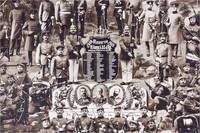
3733807<p>Metz Alsace-Lorraine German Empire: Gebrüder Notton Römerstr. 10 1908. Composite silver process photograph. Mount: 18¾ x 23½ inches. Image: 14¼ x 17¾ inches. Light rubbing to edges of mount with minor wear at bottom right; margins foxed; small mark at bottom extending faintly into image; very good.</p> <p>This is a rich and complex composite photograph from 1908 captioned with the words “Zur Erinnerung an Meine Dienstzeit†which translates to “In remembrance of my service time.†It was created for the 10th Company 8th Württemberg Infantry Regiment Grand Duke Frederick of Baden’s Regiment—possibly light infantry as in “Jäger infanterieregiment.†This regiment was based in Strasbourg in Alsace-Lorraine and served within the Imperial German Army. </p> <p>The surnames of these men are: Baibel Baierl Bauer Berger Jos. Burger Joh. Bumb Büchel Dirr Dirschedl Echtler Feibler Forster Fuchs Gaibl Ganslmeier Gundel Habender Hagl Haub Haüselmeier Herzog Hiemer Huber Jacob Janker Keim Kirchbauer Klemm Knott Kopp Kraus Kreckl Kübel Laubhardt Laubenbacher Lautner Lippert Maier Joh. Maier Seb. Merkel Miehling Moosburger Petermann Pfeilschifter Pflug Prior Rachl Rauschecker Ries Rommel Schmid Schmidt Schnabel Scholz Schraudolf Schweiber Stegmeier Sutter Ulm Weber Weindl Wenniger Wohlfarth Zieringer Zeilinger Zirngibl.</p> <p>The photograph presents a multitude of uniformed soldiers in a staged setting designed to resemble a military encampment or a gathering. The arrangement of soldiers is not casual but highly structured with officers shown with swords and details prominently positioned in the foreground. Many of the men are shown hoisting enormous beer steins with rather serious expressions.</p> <p>The photograph also features regimental flags and other military regalia which were symbols of pride and unity for the unit. The arrangement of soldiers in rows with some seated and others standing is typical of military portraiture of the time intended to display the order and discipline of the troops.</p> <p>The backdrop of the photograph features a bucolic scene a blend of a real outdoor setting and painted backdrops. This kind of photography allowed for the superimposition of studio-taken images onto a different background giving the impression that all individuals were present at a single location. Such methods were used to create cohesive unit photographs when it was not possible to gather everyone at once.</p> <p>The inclusion of phrases like “Mit Gott für König und Vaterland†With God for King and Fatherland reinforces the patriotic sentiment of the era and the soldiers’ commitment to their country and monarch. Other phrases such as “Die Well ist grofs Die Welt ist schön; Wer weifs ob wir uns wiedersehn!†“The world is big the world is beautiful; Who knows if we will see each other again!†reinforce the romanticism of military service.</p> <p>From a photographic history perspective the image represents the advancements in photo montage techniques at the turn of the 20th century. The image quality clarity and composition indicates that the photographers Gebruder Notton used a large-format camera which was capable of capturing detailed group portraits.</p> <p>A rather remarkable photograph encapsulating the military ethos of the German Empire during a period of intense nationalism and militarism leading up to the First World War.</p> unknown
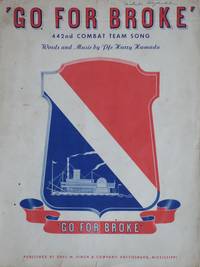
1944List2436Hattiesburg: Earl M. Finch 1944. Sheet music measuring 12 x 9 inches 4 pp. Signature of a Nabuko Hayashida on front cover. Slight tears at fold some toning two small pinholes very good overall quite attractive. Very Good. In Hawaii in May 1942 a battalion of Nisei volunteers was assembled for service in World War Two despite earlier failures of efforts to recruit Japanese-Americans due to the Army’s labeling of Nisei recruits as 4-C enemy aliens. Designated as the 100th Infantry Battalion they were deployed to North Africa in June 1943 integrating with the 34th Division in active combat. Their subsequent deployment to Italy in September 1943 exposed them to intense warfare earning them the moniker of the "Purple Heart Battalion" due to their notably high casualty rate.<br /> <br /> In January 1943 the U.S. War Department officially declared the establishment of the segregated 442nd Regimental Combat Team RCT which was comprised of Nisei volunteers originating from Hawaii and the mainland. The culmination of this initiative transpired in June 1944 when the 442nd RCT merged forces with the 100th Infantry Battalion in Europe subsequently absorbing the latter into its structure. The notable achievements of Nisei soldiers in combat operations prompted the reinstatement of the draft in January 1944 specifically targeting Nisei detainees to augment the ranks of the 442nd. Over time the 442nd RCT expanded to encompass the 2nd 3rd and 100th Battalions; the 522nd Field Artillery Battalion; the 232nd Engineering Company; the 206th Army Band; Anti-Tank Company; Cannon Company; and Service Company. <br /> <br /> Offered here is a very scarce piece of sheet music entitled “Go For Broke†which was written by the Hawaiian musician Harry Hamada reflecting the slogan of the 442nd and performed by Shelby and others during the war as part of efforts to boost morale. Hamada would feature in the 1951 movie “Go For Broke†as Masami alongside several other veterans of the 442nd. This publication of “Go For Broke†is from 1944 seven years before the movie’s release. The piece is dedicated to Colonel C.W. Pence. Hamada was a Hawaiian musician who performed with a band called the Shelby Hawaiians or the Shelby Serenaders. They performed as early as 1943. The Hattiesburg Mississippi merchant Earl M. Finch who ran an Army and Navy store close to Camp Shelby befriended Hamada and other members of the 442nd and acted as a sponsor for the group and eventually published this version despite his business being a dry goods merchant house and not a publishing house. The group with the support of Finch performed throughout the country to lift morale. At some point Hamada penned this composition likely in 1944 as we find no reference to it in 1943 articles and Finch published it - Hamada’s composition would become the theme song of the 442nd and Hamada would perform at the Halloran General Hospital in New York and the Walter Reed Hospital in Washington D.C. in 1944 likely performing this composition. Another composition called “Go For Broke†exists as well and it is unclear to what degree Hamada’s work caught on among the regiment. <br /> <br /> We find two records of Finch’s published version of the composition one listed as part of an online remembrance of the 442nd by the Smithsonian Institution https://americanhistory.si.edu/explore/stories/day-remembrance-70-years-after-executive-order-9066 which appears to have been on loan from the National Japanese American Historical Society and another copy held at Stanford though not listed in OCLC. Finch’s story is also interesting and is the subject of a remembrance on a 100th Battalion History page online https://www.100thbattalion.org/history/stories/earl-finch/. We find no copies listed in OCLC. Overall a very scarce piece of Japanese-American wartime history. Earl M. Finch unknown