21 résultats
190219890San Bernardino CA: Times Index Press 1902. First Edition. Softcover. Good. 130 pp in original wrappers. Illustrated by Constance Farris. A very good copy but for the fact that there are two small holes of unknown origin that go through the entire book see images. These are relatively inoffensive but odd. Includes chapters on the missions first Christian settlement in the Valley the Indians social and ceremonial life early land grants Mexican pioneers etc. Rocq 7052. Times Index Press paperback books
1902302558San Bernardino Cal. Times-Index Press 1902. 1902. First edition. 8vo. Frontispiece portrait; illustrations. Original gray wrappers stamped in gold tape repair to spine; front cover lower corner chipped; back cover detached. Good. 130 pages. Ex-library copy with the usual markings. Includes chapters on Father Serra land titles Mormons etc. Howes C-1; Rocq #7052; Cowan p. 91. 1st Edition. Soft cover. Good. San Bernardino, Cal., Times-Index Press, 1902. paperback books
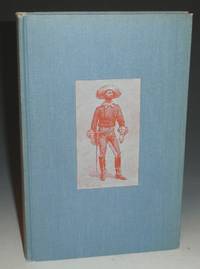
1957013054Portland Oregon: Champoeg 1957. Limited Edition. Octavo. Limited to 1000 copies. 74p. Edited by Edgard I. Stewart and Jane R. Stewart with a note on the Kicking Bear Pictography by Carl S. Dentzel. index. notes. folding maps Yellowstone and Missouri River Areas and Lt. Godfrey's Map of the Battle of Little Big Horn. Photographs illustrations etc. Subtitle of book continues: ". when Brigadier General Alfred H. Terry left Fort Abraham Lincoln Bismarck Dakota Territory until the return of the battered regiment a few days after September 24 1976 to the same place. Bound in blue cloth pictorial illustration mounted to upper board spine lettering gilt. A very good copy. Champoeg unknown books
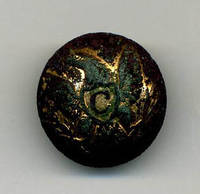
8440One Dug Civil War Gilted Eagle "C" Cavalry Button with shank in Coat size. Nice smooth chocolate brown patina with no dents pushes or repairs with nice upright shank . Gold Gilt outlining design. It does have some ground action but still a nice looking Cavalry button. Dug at battle site. unknown books
47519as recorded in an autograph manuscript signed 31 March 1850. Folio. 1-page recording clothing for 24 " non-commissioned officers musicians & privates." Jones was killed in the Shenandoah at Piedmont in 1864. Folded; some browning but very good. <br/><br/> hardcover books
1902228743<p>First edition. 8vo. Frontispiece portrait over 20 b/w illustrations from drawing by Constance Parris. 2 page introductory essay by Amy Dudley. Original stiff black printed wrappers. Very good. 130 pages. Scarce. No signatures or bookplates. Includes chapters on Father Serra land titles Mormons etc. Howes C-1; Rocq #7052; Cowan p. 91.</p> Times-Index Press paperback books
1807222466London: Printed for the War-Office by T. Egerton at the Military Library 1807. Sixth edition. Table and 13 folding plates at rear. xvi 374 pp. 1 vols. 8vo. Full contemporary calf maroon leather spine label. Joints cracked but firm; a Very Good copy. Contemporary booklabel of Robert B. Taylor Norfolk and his signature on ffep. Sixth edition. Table and 13 folding plates at rear. xvi 374 pp. 1 vols. 8vo. Printed for the War-Office by T. Egerton, at the Military Library unknown books
1892WRCAM52035Rockland Me.: First Maine Cavalry Association 1892. Nine issues several with plates plus two supplements. Original printed wrappers mostly detached and chipping heavily. A few chips to initial leaves of one issue otherwise internally very good. A significant run nine of fourteen total issues with two additional supplements of a periodical for Civil War veterans of the First Maine Cavalry. "Published four times a year and will contain the proceedings of the yearly reunions of the First Maine Cavalry matters of historic value to the regiment and items of personal interest to all the members." The volunteer cavalry regiment served with the Army of the Potomac for the duration of the war and participated in many of the critical battles including Brandy Station the largest cavalry engagement of the entire Civil War. First Maine Cavalry Association unknown books
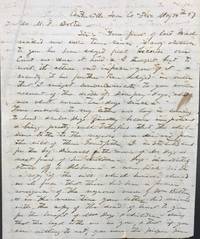
416424to. 4 pages approximately 650 words. Folded for mailing with some wear at the folds. In part: ".some account of the death of Dempsey Hays who was shot some ten days since . Hays was arrested by a constable with a posse of 7 men including Hardin the defendant in a suit Hays had initiated & some of his well known followers. He was arrested at a neighbor's house & went off with the company to show them where the principals in the alleged theft were concealed. Shortly afterwards two or three guns were heard & after a while the company returned & reported that Hays had jerked a gun from one of the crowd and fired at them & upon that they had shot him." <br/><br/> unknown books
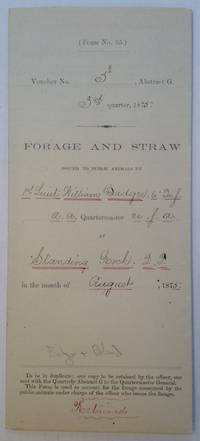
1875243423Standing Rock 1875. unbound. Partly printed military document signed 6th Infantry seven months before Little Big Horn 16.75 x 10.75 inches Standing Rock Nov. 1 1875 "A Statement Of Forage and Straw Issued to and Consumed by the Public Animals under my direction at Standing Rock Dakota Territory during the month of October 1875" for transient animals from Fort Rice signed by Captain and Commander of Post James S. Poland an officer who served under Major Reno at the Little Big Horn and was erroneously reported as "Killed In Action" when severely wounded in the back. At the time this document was signed Poland was ordered to cease his sale of rifles and ammunition to Indians at the Standing Rock Reservation as the recipients were closely connected with Sitting Bull's band. One month later the Commissioner of Indian Affairs called for the use of troops against those Indians. Also signed by Lieutenant William Badger a close friend of Custer who survived the Black Hills Campaign. His son Tom who filled out the body of this document became General Custer's personal secretary in 1876 and was killed at Little Big Horn. Also included: a Xerox of a rare photograph of the 7th cavalry 6th infantry in uniform with accoutrements all identified including Custer Badger and Poland. Partial tearing along one of the folds; otherwise near fine condition.<br/><br/> unknown books
18755905Dakota Territory 1875. unbound. 2 pages Dakota Territory August 1875. This document -- a Statement of Forage and Straw -- is signed by Captain James S. Poland "J.S. Poland" who served under Reno at Little Big Horn and by Lt. William Badger "W. Badger" a close friend of General Custer and survivor of the Black Hills Campaign. The document lists the amount of oats corn barley hay fodder and straw consumed by the animals at the Standing Rock Reservation in The Dakota Territory. The front cover measures 8.5 x 3.75 inches and folds out to the inner page with lists measuring 16.75 x 11 inches. Natural folds and slight creasing in one spot; near fine condition.<br/><br/> unknown books
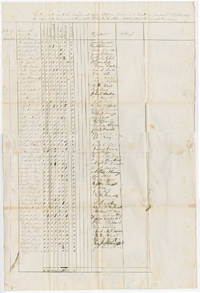
186223879.02<p><b>COMPANY D 1st VERMONT CAVALRY. CIVIL WAR.</b> Manuscript Document Signed June 1862: List of clothing distributed to 54 men including 25 caps 24 blouses 50 trousers 66 flannel shirts 15 drawers 19 bootees 69 stockings and 3 blankets. <b>Each row signed by the soldier who received the items</b>. 1 p. 15½ x 23¾ in. </p><p>"<i>We the undersigned Non Commissioned Officers Artificers Musicians & Privates of Company 'D' 1st Vt Cavalry do acknowledge to have received of Capt. A. W. Preston the articles of Clothing set oposite our respective names</i>"</p><p><b>Soldiers included:</b></p><p>Jacob Trussell Rodney Eames</p><p>Harrison B. Michell James Esdon</p><p>Josiah H. Moore Samuel L. Higgins</p><p>George P. Blair Orin S. Hendrick</p><p>George C. C. Clemment Azro H. Kinerson</p><p>Horace Ide Harvey A. Marckres</p><p>Barney Decker Arthur Murray</p><p>George A. Austin John Morse</p><p>Dan Adams Henry A. Moore</p><p>Harvey Bickford Kyron Morrill</p><p>William Buck Warren Norris</p><p>B. H. Bard Elijah C. Page</p><p>Bartlett S. Bard Francis Rowell</p><p>John A. Beaton L. S. F. Reed</p><p>George F. Bennett Curtis L. Stacy</p><p>Austin A. Bailey Edwin W. Southworth</p><p>C. W. Clifford Martin V. B. Vance</p><p>Ansen L. Chandler John Woodard</p><p>Loren Chase Jr. William Woodard</p><p>Antipas H. Curtis signed with mark John Woodbury</p><p>Milo J. Corliss Fernal H. Webber</p><p>Consealer F. Durlam William Wheaton</p><p>John S. Coombs Mark M. Wheeler</p><p>James Davis James Wright</p><p>John C. Gracy Darwin J. Wright</p><p>Joseph W. Gordon Died J. Hale Powers</p><p>Patrick C. Gilligan Charles Knapp</p> books
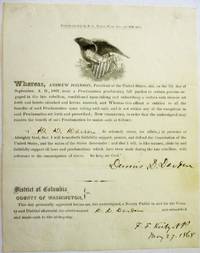
186836564Washington D.C.: R.A. Waters Penn. Ave. cor. 13th Street 1868. Broadside 8" x 10". Printed document with illustration of American Eagle and Shield completed in ink manuscript with signature of Darden and Notary Public Kirby. Notary's blindstamp at bottom blank left corner. Two small pinholes at upper blank margin from prior mounting. Very Good. <br/> <br/> A presidential pardon was required in order for former Confederates to regain their citizenship and voting privileges. The Oath which Darden took in this Proclamation was a precondition to President Johnson's grant of a Pardon to him. <br/> Dennis Dawney Darden c.1833-1883 born in Washington D.C. enlisted in October 1863 as a Private in Co. B Mosby's Cavalry Regiment Partisan Rangers. Captured at Upperville Virginia on 14 October 1864 he was sent to Old Capitol Prison; transferred on 8 February 1865 to Fort Warren MA; and was one of about sixty Confederate prisoners released on 13 June 1865. <br/> He signed the Oath of Allegiance on the day of his release. John W. Munson a comrade of Darden's later credited Darden with helping Munson escape from Old Capitol Prison; Darden stayed behind. Munson's Memoir states that Darden had been "in the secret service department of the government" before the War. Census records show him as a druggist both before and after the War. Munson: Recollections of a Mosby Guerrilla 1906. <br/> In August 1871 Darden was accused of murdering gambling house operator John McCarthy. During a gambling-related altercation defense witnesses said McCarthy drew a derringer on Darden but that the gun misfired; McCarthy then hit Darden over the head. When officers arrived Darden was firing a gun at McCarthy and shot him dead. <br/> The New York Times reported that "the entire gambling fraternity here who bore bitter animosity to McCarthy have been very active in Darden's behalf and he has not lacked for either money or friends." Darden was acquitted; at trial's end a doctor declared Darden insane from McCarthy's beating. He was ordered to an insane asylum. Later he moved to Tennessee with his sisters. The Darden-McCarthy case exposed the police graft system and resulted in the removal of corrupt policemen. <br/>Baltimore Sun 8/16/1871 p.1 and 1/18/1883 p.4; Washington Post 8/18/1912 p.9; Evening Star Washington DC 10/3/1871 p.4; The New York Times 10/3/1871 p.8; Munson J.W.: Recollections of a Mosby Guerilla 1906. R.A. Waters, Penn. Ave., cor. 13th Street unknown books
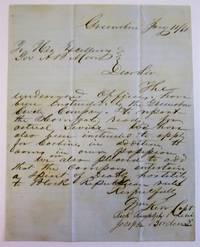
186136904Greensboro Alabama 1861. 4to sheet folded to 4 pp. Written in ink on first page only. Lined paper old folds Very Good.<br/><br/> The Letter is in the hand of Captain Kerr its first signatory. The Greensboro Cavalry Company from the west central Alabama town of Greensboro had been established before the War. Its officers pleaded for increased membership after the Harper's Ferry invasion. A local newspaper published the following notice: "The recent nefarious attempt at Harper's Ferry to get up an insurrection among the slaves though it proved a signal failure - not one slave it has been asserted having joined Brown and his confederates - should prove a warning to the South to be always prepared to meet such emergencies. And the cheapest and most efficient plan for accomplishing this object is to organize efficient Volunteer Companies." Greensboro Beacon December 2 1859.<br/> Written on the day of Alabama's secession Captain Kerr's Letter reads in full:<br/> "The undersigned Officers have been instructed by the Greensboro Cavalry Company to report the Company ready for actual service-- We have also been instructed to apply for Carbines in addition to arms in our possession. <br/> "We are also pleased to add that the Company entertain a spirit of Deadly hostility to Black Republican rule.<br/> "Respectfully Wm. Kerr Capt. Rich Randolph 1 Lieut Joseph Borden 2 Lieut. unknown books
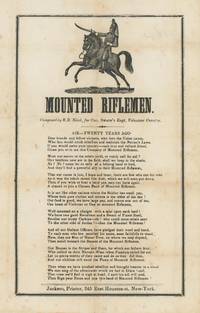
1860LIST026New York: Jackson 1860. First Edition. An unrecorded recruitment broadside for the 11th New York Cavalry. Col. James Swain led the regiment which was first organized on Staten Island in late 1861. Most troops came from New York City the site of robust recruitment in the early years of the conflict largely from Irish and German immigrants. The regiment saw service throughout the South. The verse in small part: "Must our nation to the rebels yield or vainly call for aid / Our brethren now are in the field shall we keep in the shade. that our cause is just I hope and trust there are few who can but own / As if was the rebels raised this dust which we will soon put down. / Then if you wish to bear a hand you might not have again / A chance to join a chosen band of Mounted Riflemen." <br /> <br /> We find no record of the verse's author R.B. Nicol. Curiously though this broadside is unrecorded a broadside with the same song was published in Washington D.C. by G.F. Hardwick in 1864. A very good copy well preserved with some light creasing and hints of foxing. Jackson unknown books
188258456Fort Laramie WT 1882. 4to. Three pages approximately 275 words in part: "There is not to my mind outside of Divine Writ so convincing an evidence of the immortality of the soul as is furnished by the growth and development of the mind and character of this greatest of American Presidents to meet the exigencies of the direction and control of a great Revolution on the successful issue of which depended the happiness of one fifth of the world . as his career differed from that of the other heroes of history in that he lived and strove for reforms that would benefit mankind though his own life should be the price in so far is Abraham Lincoln the greatest of Reformers the noblest of Patriots the ablest of men." This essay was published along with other tributes to Abraham Lincoln in The Lincoln Memorial NY 1882. Very good. Folded. #6317. Wesley Merritt graduated from West Point in 1860 serving briefly in the West before returning east for Civil War service in the Union cavalry attached to the Army of the Potomac participating in its major campaigns and battles through Appomattox ending the war commanding a division as a Major General. Following the war he commanded the 9th Cavalry in Texas for eight years; promoted to colonel in 1876 he took command of the 5th Cavalry in Wyoming participating in the Custer campaign and other actions against the Indians and serving in that capacity until 1882 when he was appointed to a five-year posting as superintendent of West Point. He commanded the 1898 expedition to the Philippines during the Spanish-American War. <br/><br/> unknown books
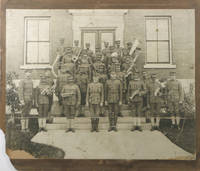
1910List304Fort Ethan Allen 1910. Gelatin silver print mounted to board 16 ¼ x 14 ½ inches. Fair to Good. The 10th Cavalry was one of the original "Buffalo Soldier" regiments of the post-Civil War segregated U.S. Army first seeing action in the Indian Wars. Their band is shown here most likely during their stint at Fort Ethan Allen in Vermont. They are wearing a mix of insignia from 1902 to 1908 and some are shown in civilian clothing which suggests the picture was taken in Vermont as this was during the time the Army used a vast mix of insignia and the brick architecture of the background also matches that of the fort. <br /> <br /> They were exposed to some racism during their time in Vermont - the soldiers were punished for associating with neighboring white women with some of the offenders being confined to the guardhouse for punishment which fits with the strictly segregated Army policies of the time. The soldiers did also record positive aspects of their time at the fort including studying at the fort's library and playing nightly games of the newly-invented sport of basketball. These amenities provided some positive contrast to the previous assignments of the regiment who had been mostly stationed on the frigid plains where the army believed racial tensions would be kept to a minimum. <br /> <br /> The picture shows the band with the normal marching band instruments of clarinets tubas and sousaphones as well as an alto clarinet oboe and what appears to be a baritone saxophone. We find no other examples of the 10th Cavalry Band and the picture shows the regiment at a relatively calm time as they would soon be sent to the Mexican-American border in 1913 to deal with rising tensions. The picture has condition issues with damage to the mount some damage to the bottom left corner and a crease along the bottom third of the image along with closed tears and chipping to the title label. It remains in fair to good condition attractive and worthy of preservation. unknown books
537244to. One page approximately 100 words in part: For $200 paid to one Abner Best "We bind ourselves to give said negro man named George good & sufficient winter & summer clothing a pair of shoes in summer & a pair of boots & socks in winter. attend him properly in sickness pay taxes and his doctor bills and we are to lose all lost time." Two associates signed the slave hire with Shelby. Folded. Some foxing but very good. 801. <br/><br/> hardcover books
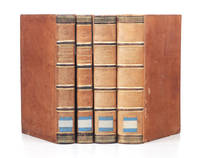
4858Plate vols.: Two folding engraved titles four engraved leaves of music & 93 fine folding engraved plates. Text vols.: xv 1 501 pp. one leaf of errata; xix 1 360 pp. one leaf of errata. Four vols. 8vo cont. polished sheep spines gilt text vols. with a.e.g. Munich: Rösl 1828. First edition and very rare of the official book of instruction and regulations for the Bavarian cavalry chevauleger. This is a richly illustrated work: the plates depict uniforms of different members of the cavalry; their weapons swords lances and rifles; sword techniques; horse tack including saddles stirrups bridles etc.; the anatomy of the horse and their hooves; and many tactical formations. Fine and handsome set from the Wittelsbach library of the dukes and kings of Bavaria. Upper cover of Vol. II of text slightly wormed. unknown books
186351386Mobile: S. H. Goetzel 1863. First edition 16mo 3 parts in 1; pp. 2 ii 220; 104; 47 1; 97-108 Bugle Signals; xiv index 2 ads; 38 engraved plates 8 folding; original paper-covered boards rebacked in blue cloth sometime in the 20th century; boards worn text occasionally dampstained and foxed without the front free endpaper and hinges with old archival paper repair; but in all a good sound and compelling copy of a poorly made book. Parrish & Willingham 5116. <br/><br/> S. H. Goetzel hardcover books
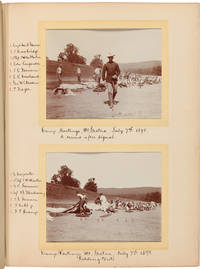
1898WRCAM54683Various places including Pennsylvania Virginia at sea New Jersey and Puerto Rico 1898. 171pp. with 342 photographs. Four large quarto photograph albums. Matching contemporary three-quarter crimson morocco and cloth front covers gilt. Minor shelf wear and some rubbing. Images in overall very good condition. An amazing assemblage of photographs documenting the Spanish-American War experiences of the First Troop Philadelphia City Cavalry which was at that time the oldest volunteer military unit in continuous service to the United States. The photographs are arranged chronologically in four contemporary photo albums with the images occasionally annotated in a contemporary hand and including the identification of numerous members of the Troop. <br> <br> The first volume opens with images of Mt. Gretna Pennsylvania "where troops were sworn into U.S. service May 7th 1898 by Maj. Thompson U.S.A." The photographs record field exercises camp building and tent organization at Camp Hastings cavalry drills an image of "Capt. Groome reading the Articles of War to Troop June 1898" a "first arrival of government horses" several shots of men training and "throwing" their horses shooting practice "Capt. Groome assigning Government horses to Troopers" and various shots of the men at work and even some play. Over the course of the album the names of numerous soldiers are recorded below several of the photographs. <br> <br> The second album opens with several photographs of the Troop striking their tents in preparation for leaving Camp Hastings at Mt. Gretna headed for Camp Alger at Dunn Loring Virginia. Here the Troop was ordered to increase their enlistment numbers. At Camp Alger the Troop was also fitted out with federal supplies and assigned to the Second Army Corps commanded by Maj. Gen. William Graham who is pictured here. Other photographs capture the camp scene at Alger "the First Troop picket line" the Troop receiving their federal-issue khaki uniforms the Troop at roll call and some shots featuring African-American helpers. <br> <br> In late July the Troop was sent to Newport News and several photographs record their brief time there with about a dozen shots of their temporary camp. On July 28 1898 the Troop left Virginia on the transport ship MASSACHUSETTS bound for Puerto Rico. Several images here capture the frenetic loading of the troops and their horses onto the ship with the remaining half dozen or so shots recording the Troop's time on board. <br> <br> The third album picks up where the second left off with the First City Troop embarked on the transport ship MASSACHUSETTS headed for Guanica Puerto Rico. Shipboard activities captured here include a few shots of groups of men being showered with water hoses. Several shots record the arrival of the men in the port of Guanica where they encounter the hospital ship NUECES which reports of the news of the "surrender of Ponce." After the men disembark they pitch their camp around Cathedral Virgin del Carmen on August 5. The next day several photographs record the unloading of horses and stores in the harbor at Ponce. The remaining thirty-eight photographs in this volume record scenes in the interior of Puerto Rico and are the most heavily annotated of the four albums. The images record scenes from the "road from Port of Ponce to Ponce" several scenes capturing a market day in Ponce and recording numerous native islanders the Troop's "temporary camp about 2 miles beyond Ponce" the "Troop wagon leaving camp beyond Ponce to join wagon train for Guayama" on August 8 a shot of the Troop's wagon "on road to Guayama in a Porto Rico mudhole" images of the wagon train to Guayama with the H Troop 6th U.S. Cavalry the "Point of Advance Guard entering Guayama within the lines" the Troop itself "entering Guayama passing General Brooke's Headquarters" a "View of First Troop Phila. City Cavalry U.S.V. Camp at Arroyo August 10th to 6A.M. Aug. 13th 1898" with the last ten images recording the camp or the streets at Arroyo. <br> <br> The fourth album documents the Troop's voyage home to Philadelphia. This time they take passage on the transport ship MISSISSIPPI and about half of the images record their voyage on board. On Sept. 10 1898 they reach Jersey City in New York harbor where they camp for a short time before returning to camp in Pennsylvania where the album ends. A couple of months later all three officers and the ninety- eight enlisted men of the First City Troop were mustered out of federal service for the Spanish-American War. <br> <br> Originally founded in 1774 by twenty-eight Philadelphia patriots as the "Light Horse of the City of Philadelphia" the First Troop of Philadelphia Cavalry is the oldest mounted military unit operating in continuous service to the American republic being the first volunteer cavalry troop organized in defense of the colonies. Among the Troop's original founders was John Dunlap printer to Congress from 1778 to 1789 publisher of the first American daily newspaper and the first printer of the Declaration of Independence. Most of the earliest members were similarly notable professional men of Philadelphia. The Troop served with valor in the American Revolution the War of 1812 the Mexican- American War the Civil War the Spanish- American War and every major American war through the Korean War. <br> <br> The present albums present a unique and important visual record of the First City Troop's activities before during and on the way home from the Spanish-American War. hardcover books