184 résultats
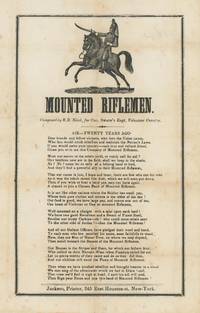
1860LIST026New York: Jackson 1860. First Edition. An unrecorded recruitment broadside for the 11th New York Cavalry. Col. James Swain led the regiment which was first organized on Staten Island in late 1861. Most troops came from New York City the site of robust recruitment in the early years of the conflict largely from Irish and German immigrants. The regiment saw service throughout the South. The verse in small part: "Must our nation to the rebels yield or vainly call for aid / Our brethren now are in the field shall we keep in the shade. that our cause is just I hope and trust there are few who can but own / As if was the rebels raised this dust which we will soon put down. / Then if you wish to bear a hand you might not have again / A chance to join a chosen band of Mounted Riflemen." <br /> <br /> We find no record of the verse's author R.B. Nicol. Curiously though this broadside is unrecorded a broadside with the same song was published in Washington D.C. by G.F. Hardwick in 1864. A very good copy well preserved with some light creasing and hints of foxing. Jackson unknown books
188258456Fort Laramie WT 1882. 4to. Three pages approximately 275 words in part: "There is not to my mind outside of Divine Writ so convincing an evidence of the immortality of the soul as is furnished by the growth and development of the mind and character of this greatest of American Presidents to meet the exigencies of the direction and control of a great Revolution on the successful issue of which depended the happiness of one fifth of the world . as his career differed from that of the other heroes of history in that he lived and strove for reforms that would benefit mankind though his own life should be the price in so far is Abraham Lincoln the greatest of Reformers the noblest of Patriots the ablest of men." This essay was published along with other tributes to Abraham Lincoln in The Lincoln Memorial NY 1882. Very good. Folded. #6317. Wesley Merritt graduated from West Point in 1860 serving briefly in the West before returning east for Civil War service in the Union cavalry attached to the Army of the Potomac participating in its major campaigns and battles through Appomattox ending the war commanding a division as a Major General. Following the war he commanded the 9th Cavalry in Texas for eight years; promoted to colonel in 1876 he took command of the 5th Cavalry in Wyoming participating in the Custer campaign and other actions against the Indians and serving in that capacity until 1882 when he was appointed to a five-year posting as superintendent of West Point. He commanded the 1898 expedition to the Philippines during the Spanish-American War. <br/><br/> unknown books
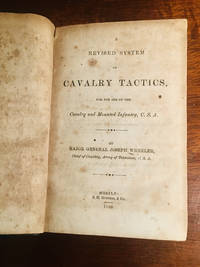
18631214<p>Rare Confederate Imprint:</p><p>24 mo. 5 1/2 by 3 3/4 inches 1 preliminary leaf ii </p><p>Three parts in one volume: "Cavalry Tactics For Single Line Formation" 220 pages</p><p>"Evolutions of a Regiment" 104 pages</p><p>"Skirmish Drill for Mounted Troops" 47 pages</p><p>"Bugle Signals" pages 97-108 among them: "To Arms" "The Charge" "Reveille" "Retreat" "Dinner Call" and "Tattoo" all with musical notation</p><p>"Table of Contents" plus Index and "Skirmish Drill For Mounted Troops" xiv pages</p><p>38 plates some folded: diagrams tables and charts.</p><p>Good condition collated perfect in green paper covered boards old blue cloth re-backing with worn black paper label mild foxing to some pages – not affecting contents.</p><p>"Fighting Joe" Wheeler was a cavalry general in the Confederate States Army. He was the senior cavalry general in the Army of Tennessee and fought in most of its battles in the Western Theater.</p><p>He earned his nickname on the Western frontier where he distinguished himself in skirmishes against Native Americans.</p> S. H. Goetzel, & Co. hardcover
18632604050021United States Army 1863. First Edition. Manuscripts & Paper Collectibles. Very Good. Signed. Large two sided document. Printed with manuscript names filled in. The first name listed is Colonel Eli Long. This document shows the Colonel Captains Sergeants Lieutenants and the privates. This document shows the pay from October 31st 1863 to December 31st 1863. <br> According to NPS: "On February 23 1863 Long was appointed colonel of the 4th Ohio Cavalry a regiment which recently had surrendered to the Confederate raider Brigadier General John Hunt Morgan. Long improved the morale of the regiment and led it in the Tullahoma Campaign. He commanded the regiment's brigade the 2nd Brigade 2nd Division Cavalry Corps of the Department of the Cumberland between March 1863 and August 20 1864 including service at the Battle of Chickamauga. Long was wounded in the left side at the Battle of Farmington Tennessee October 7 1863. He was distinguished in the Atlanta Campaign where he suffered a head wound at the Battle of Jonesboro Georgia August 20 1864 and wounds in the right arm and right thigh at the Battle of Lovejoy's Station Georgia August 21 1864. Long received brevet grade appointments as major lieutenant colonel and colonel in the Regular Army of the United States for "gallant and meritorious services" at the Battle of Farmington and Battle of Fort Sanders Knoxville in Tennessee and Battle of Lovejoy's Station in Georgia respectively. Between November 16 1864 and April 2 1865 Long commanded the 2nd Division of the Cavalry Corps of the Military Division of Mississippi under Major General James H. Wilson. On April 2 1865 during Wilson’s Raid Long was severely wounded in the head at the Battle of Selma Alabama. During that battle he led the 2nd Division in a charge upon the entrenchments that resulted in the capture of that town. During the Civil War Long was wounded five times and also cited for gallantry five times. On January 13 1866 President Andrew Johnson nominated Long for appointment to the brevet grade of major general of volunteers United States Army unknown
186351386Mobile: S. H. Goetzel 1863. First edition 16mo 3 parts in 1; pp. 2 ii 220; 104; 47 1; 97-108 Bugle Signals; xiv index 2 ads; 38 engraved plates 8 folding; original paper-covered boards rebacked in blue cloth sometime in the 20th century; boards worn text occasionally dampstained and foxed without the front free endpaper and hinges with old archival paper repair; but in all a good sound and compelling copy of a poorly made book. Parrish & Willingham 5116. <br/><br/> S. H. Goetzel hardcover books
186351386Mobile: S. H. Goetzel 1863. First edition 16mo 3 parts in 1; pp. 2 ii 220; 104; 47 1; 97-108 Bugle Signals; xiv index 2 ads; 38 engraved plates 8 folding; original paper-covered boards rebacked in blue cloth sometime in the 20th century; boards worn text occasionally dampstained and foxed without the front free endpaper and hinges with old archival paper repair; but in all a good sound and compelling copy of a poorly made book. Parrish & Willingham 5116. S. H. Goetzel unknown
1865List2438Camp Low 1865. Original partially printed document 26cm x 77cm. Printed on both sides of the sheet completed in manuscript. Darkening at folds from old tape repairs; partial splits to folds and extremities; complete and quite Good. Docketed verso signed in ink by Lieutenant Morgan Owen. Lists twelve enlisted soldiers most with Spanish surnames two with French surnames. Fine. The formation of the California Native Cavalry in 1863 marked a significant chapter in the state's history. Comprising primarily Mexican-American individuals colloquially referred to as "native" Californians the California Native Cavalry unit was formed 1863. Initially commanded by Maj. Andreas Pico a distinguished hero from the Mexican-American War and later under Salvador Vallejo the regiment drew its ranks from diverse backgrounds. Recruitment efforts began with vaqueros from southern California expanding to include individuals from San José and San Francisco. The unit boasted a varied composition encompassing not only Mexican-Americans but also Chilenos California and Yaqui Indians and even French legionnaires.<br /> Company "B" a contingent largely recruited from the northern part of the state is reflected in the existing muster roll. The company assembled at Camp Low near San Juan Bautista in 1865 making a striking entrance into the town. Described as "gay and gallant Spanish lancaroes" the cavalrymen presented a formidable sight with lances in hand and flags flying leaving a lasting impression on the townspeople who had never before encountered soldiers."The gay and gallant Spanish lancaroes sic came dashing through the town with the lances in their hand a flag flying from each of them. I assure you that they presented a war like appearance the people here had never seen a soldier in their lives – Yes Sir!." letter Maj. Michael O'Brien to Gov. Frederick Low January 1865; quoted in Prezelski "Lives of the Californio Lancers: the First Battalion of Native California Cavalry" in Journal of Arizona History v.40 no.1 Spring 1999. <br /> Under the command of Capt. Porfirio Jimeno Company B swiftly engaged in a critical mission: dismantling the notorious Mason-Henry Gang that had terrorized the San Juan region in the preceding months. Despite successfully wounding John Mason in early April 1865 the gang persisted for another month until Mason met his demise at the hands of a miner he sought to kidnap.<br /> However Company B faced challenges including low morale and a high rate of desertions with over 40 men leaving the company in 1865 alone. Transferred to Tubac Arizona Territory to confront the Apaches the company encountered further desertions along the way. The muster roll listing only twelve soldiers alongside Capt. Porfirio Jimeno reflects this tumultuous period. Overall the muster roll provides scarce documentation of the role of Mexican-Americans in the Civil War with few other examples in the trade or institutionally. unknown
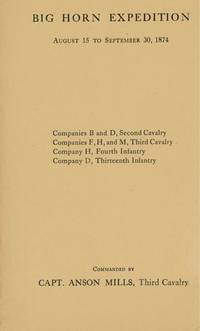
187453597N. P.: Privately printed n. d. ca 1874. 1874. WYOMING TERRITORY. First edition. 8vo. Original printed wrappers 15 pp. large fold-out map. The map traces the route of the Big Horn Expedition. "The Big Horn Expedition of 1874 was a significant military operation involving the United States Army against the Lakota Sioux and Cheyenne Indians in the Wyoming and Montana Territories. This expedition was part of the broader conflicts between the U.S. government and Native American tribes during that period. The operation aimed to assert control over the region and respond to Native American resistance against U.S. expansion and settlement. The discovery of gold in the Black Hills by soldiers under Lieutenant Colonel George A. Custer in 1874 intensified these conflicts as the U.S. sought to acquire the land from the Sioux. The expedition solidified Lakota Sioux and Northern Cheyenne resistance against the United States attempt to force them to sell the Black Hills and live on a reservation beginning the Great Sioux War of 1876." This is an account of an expedition in which Buffalo Bill was along as a scout. They were trailing an Indian war party and comment upon seeing buffalo and other types of game. Also included is a tragic account of a private being mauled by a bear. The man died shortly thereafter from his injuries. Spine neatly repaired else a fine bright copy housed in a quarter leather and marbled paper over boards clamshell case with titles stamped in gilt on the spine. This is a rare item and seldom offered for sale. Privately printed, n. d. (ca 1874). hardcover
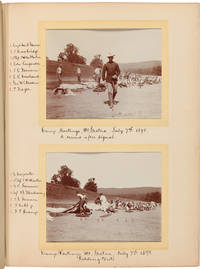
1898WRCAM54683Various places including Pennsylvania Virginia at sea New Jersey and Puerto Rico 1898. 171pp. with 342 photographs. Four large quarto photograph albums. Matching contemporary three-quarter crimson morocco and cloth front covers gilt. Minor shelf wear and some rubbing. Images in overall very good condition. An amazing assemblage of photographs documenting the Spanish-American War experiences of the First Troop Philadelphia City Cavalry which was at that time the oldest volunteer military unit in continuous service to the United States. The photographs are arranged chronologically in four contemporary photo albums with the images occasionally annotated in a contemporary hand and including the identification of numerous members of the Troop. <br> <br> The first volume opens with images of Mt. Gretna Pennsylvania "where troops were sworn into U.S. service May 7th 1898 by Maj. Thompson U.S.A." The photographs record field exercises camp building and tent organization at Camp Hastings cavalry drills an image of "Capt. Groome reading the Articles of War to Troop June 1898" a "first arrival of government horses" several shots of men training and "throwing" their horses shooting practice "Capt. Groome assigning Government horses to Troopers" and various shots of the men at work and even some play. Over the course of the album the names of numerous soldiers are recorded below several of the photographs. <br> <br> The second album opens with several photographs of the Troop striking their tents in preparation for leaving Camp Hastings at Mt. Gretna headed for Camp Alger at Dunn Loring Virginia. Here the Troop was ordered to increase their enlistment numbers. At Camp Alger the Troop was also fitted out with federal supplies and assigned to the Second Army Corps commanded by Maj. Gen. William Graham who is pictured here. Other photographs capture the camp scene at Alger "the First Troop picket line" the Troop receiving their federal-issue khaki uniforms the Troop at roll call and some shots featuring African-American helpers. <br> <br> In late July the Troop was sent to Newport News and several photographs record their brief time there with about a dozen shots of their temporary camp. On July 28 1898 the Troop left Virginia on the transport ship MASSACHUSETTS bound for Puerto Rico. Several images here capture the frenetic loading of the troops and their horses onto the ship with the remaining half dozen or so shots recording the Troop's time on board. <br> <br> The third album picks up where the second left off with the First City Troop embarked on the transport ship MASSACHUSETTS headed for Guanica Puerto Rico. Shipboard activities captured here include a few shots of groups of men being showered with water hoses. Several shots record the arrival of the men in the port of Guanica where they encounter the hospital ship NUECES which reports of the news of the "surrender of Ponce." After the men disembark they pitch their camp around Cathedral Virgin del Carmen on August 5. The next day several photographs record the unloading of horses and stores in the harbor at Ponce. The remaining thirty-eight photographs in this volume record scenes in the interior of Puerto Rico and are the most heavily annotated of the four albums. The images record scenes from the "road from Port of Ponce to Ponce" several scenes capturing a market day in Ponce and recording numerous native islanders the Troop's "temporary camp about 2 miles beyond Ponce" the "Troop wagon leaving camp beyond Ponce to join wagon train for Guayama" on August 8 a shot of the Troop's wagon "on road to Guayama in a Porto Rico mudhole" images of the wagon train to Guayama with the H Troop 6th U.S. Cavalry the "Point of Advance Guard entering Guayama within the lines" the Troop itself "entering Guayama passing General Brooke's Headquarters" a "View of First Troop Phila. City Cavalry U.S.V. Camp at Arroyo August 10th to 6A.M. Aug. 13th 1898" with the last ten images recording the camp or the streets at Arroyo. <br> <br> The fourth album documents the Troop's voyage home to Philadelphia. This time they take passage on the transport ship MISSISSIPPI and about half of the images record their voyage on board. On Sept. 10 1898 they reach Jersey City in New York harbor where they camp for a short time before returning to camp in Pennsylvania where the album ends. A couple of months later all three officers and the ninety- eight enlisted men of the First City Troop were mustered out of federal service for the Spanish-American War. <br> <br> Originally founded in 1774 by twenty-eight Philadelphia patriots as the "Light Horse of the City of Philadelphia" the First Troop of Philadelphia Cavalry is the oldest mounted military unit operating in continuous service to the American republic being the first volunteer cavalry troop organized in defense of the colonies. Among the Troop's original founders was John Dunlap printer to Congress from 1778 to 1789 publisher of the first American daily newspaper and the first printer of the Declaration of Independence. Most of the earliest members were similarly notable professional men of Philadelphia. The Troop served with valor in the American Revolution the War of 1812 the Mexican- American War the Civil War the Spanish- American War and every major American war through the Korean War. <br> <br> The present albums present a unique and important visual record of the First City Troop's activities before during and on the way home from the Spanish-American War. hardcover books