5 536 résultats
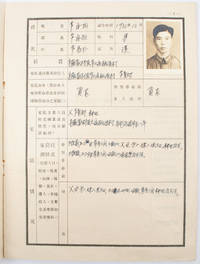
1956171561No place of publication.: 中國人民解放軍總幹部部.Zhongguo ren min jie fang jun zong gan bu bu. 1956. Scarce 1950s Curriculum Vitae or dossier of a Chinese Reserve Force Officer dated on 15th September 1956 with official stamp from the 中國人民解放軍通信第六團 "No. 6 Regiment of Communications Department People's Liberation Army". Officer's ID black and white head and shoulders portrait photograph laid down first page of the dossier 16pp original wrappers light staple stains occasional creasing mainly on corners overall very good. Text in traditional Chinese. 24.8 x 18.4cm. This dossier is for 芦再排 Lu Zaipai born in Anhui Province in 1932 his courtesy name 芦昌仁 Lu Changren. His family background were considered good as he was a peasant before joined the revolution although his maternal uncle was forced to join the Kuomintang in 1941 and was liberated in 1949. The form says Lu Zaipai was enlisted in 1951 and his experience from 1938 till 1951 was given and verified by four different referees. Lu joined the Chinese New Democracy Youth League in February 1954. Lu was a corporal in January 1956 and later promoted to <br>second lieutenant of the reserve force in September same year. . 中國人民解放軍總幹部部.[Zhongguo ren min jie fang jun zong gan unknown
19561585031st Edition 2nd Printing. 1956. 1950s Chinese Nuclear Science Poster set incomplete 15 posters of 30 in colour. Each poster is numbered and depicts a detailed image for example a variety of types of nuclear weapons and defence construction with explanative notes. <br> <br>This broken set comprises poster numbers 6 8 9 10 11 12 13 14 15 21 22 23 24 25 and 26 of the 30 issued in this set. The posters in this group vary from being in reasonable secondhand condition to poor condition. Each shows signs of wear creasing closed tears and some with loss mainly on edges and corners. Most posters are torn with considerable loss at one corner and in two cases this has caused loss to the image. Many have been mended with tape on the reverse along some edges there is some marking mainly on reverse though in one case on the poster itself. On the reverse of poster 23 there is an amateur painting and some painted text. Text in Chinese. The poster sizes vary ranging approximately from approximately 55 x 77 to and 77 x 53cm. An interesting collection of posters which clearly shows that China was as deeply concerned about nuclear war during the Cold War as it's neighbours Russia and the United States across the Pacific. <br> <br>Poster no. 6 shows details of the lethality and destruction factors of the atomic explosion including shock weaves radiation and radioactive contamination. <br> <br>Poster no. 8 shows the materials to be used to build nuclear protection trenches as well as the construction methods. <br> <br>Poster no. 9 displays the images of the type of bomb shelter known "below chest-level bulletproof shelter" giving its floor plans with information on an estimated time to build and materials to use. <br> <br>Poster no. 10 shows images of the type of bomb shelter known "light bomb shelter" and a floor plan with information about its accommodation capacity 8-10 people estimated time to build 15 days and materials to use. Also it suggests every infantry platoon should install one of these shelters. <br> <br>Poster no. 11 shows images of the type of bomb shelter known "heavy bomb shelter" and a floor plan with information about an estimate time to build 35 days and materials to use. The heavy bomb shelter is used as a command office when needed. <br> <br>Poster no. 12 includes 9 images showing different nuclear protection bunkers built for various weapons and equipment such as 57 x 85cm cannon 122 x 152cm howitzer rocket artillery tank self-propelled artillery trucks and communication equipment. The poster also shows floor plans for each type of the bunkers an estimate time to build and materials to use. <br> <br>Poster no. 13 includes 8 images showing different nuclear protection field war warehouses to store materials and equipment such as ammunition mines explosives fuel barrels PT-10 and PT-25 fuel tanks and army provisions. The poster also shows floor plans with information about an estimate time to build and material to use. <br> <br>Poster no. 14 includes two images showing special squads for detecting radition levels on the upper section of the poster together with action plans below the images. A legend on the lower section shows correspondent names for the coloured routes. Detailed plans designed for searching nuclear contamination source and safe routes to take within the contamination zone. The routes are shown and numbered. Each squad consists of one squad leader. <br> <br>Poster no. 15 features an image of the special squad for detecting radiation level and very detailed information on their responsibility and action plans. An inset includes three images showing how to extract contaminated soil and a legend showing correspondent names for the coloured routes lower right section. <br> <br>Poster no. 21 includes 9 images showing different ways to remove radiative contamination on the roads and on battle field. Two blue charts in the middle section one chart showing different types of vehicles to remove contamination on the roads the other various warning signs according to radiation levels. <br> <br>Poster no. 22 shows images of different types of water supply wells cistern etc. and ways to protect the water supply from radioactive contamination. An image featured in the centre shows the layout of a water plant and how it processes contaminated water. The instruction above the image suggests that processed water shall be consumed only when no clean water is available. Four images with detailed instruction lower section show various water purifying methods distilling filtering and ion exchanging <br> <br>Poster no. 23 displays images of soldiers disinfecting radiation contaminated food with package or without and containers for food storage. <br> <br>Poster no. 24 features a Soviet Union made AN-1-A radiac set left section and two images right section of soldier measuring radiation level and soldier carrying the set. <br> <br>Poster no. 25 shows a circuit diagram of the AN-1-A radiac set with a legend showing different coloured current circuits. <br> <br>Poster no. 26 features another Soviet Union made AN-11-A radiac set. The parts of the set are highlighted upper section. Front view and back view of the set are shown lower section. A small image of the set in use upper right section. . unknown
1970158580北京.Beijing.: No publication details. circa1970. Coloured Chinese Air Defence poster incomplete set consisting of 9 posters each poster is numbered. The set includes poster numbers 4 8 10 11 12 13 14 15 and 16. These posters are in secondhand condition. The posters show some creasing with a number of small tears particularly at margins some mending on reverse with tape. Two posters are considerably torn at margin affecting the image slightly in one case. There is some browning and staining and there is considerable annotation on the reverse of poster number 8. Text in Chinese. Sheets measure appoximately 53.9 x 77.9cm. Poster no. 4 depicts 9 images of different types of simple air defence shelters trenches caves etc. Brief descriptions of each type of shelter are provided below the images. Three images in the lower section suggest that when selecting the site for air defence shelters one should not build too close to buildings flammables and electric wire. <br> <br>Poster no. 8 includes 9 images showing the alternative shelters when air raids happen and no nearby air defence shelter available. Alteratives suggested include basements beneath a bridge the corner of a wall and under solid staircases as good alternative shelters. <br> <br>Poster no. 10 shows 3 methods to use to fire at enemy aeroplanes each with detailed instructions. The speed and size of the aeroplane and shooting angles and distance are all taken into consideration. A chart in the centre gives the calculations required to be prepared in advance to successfully shoot down an aeroplane. The calculations require taking into account the plane's size and distance. <br> <br>Poster no. 11 includes 3 images to demonstrate methods to fire at enemy paratroopers with detailed instructions. A chart in the centre gives the calculations for advance preparation taking into account the person's height and distance from the invading paratroopers. <br> <br>Poster no. 12 depicts 5 images showing various anti-aircraft firing positions. They are: a position where a single person lifts and stabilises the rifle while the other person aims; position aided by fortification; position aided by tree branches; position aided by walls; and kneeling position. <br> <br>Poster no. 13 is illustrated with 5 images showing two squads rifle shooting squad and machine gun shooting squad who are in charge of the anti-aircraft placement and three main targeted aircrafts bomber military cargo aircraft and helicopter to shoot. <br> <br>Poster no. 14 shows 10 images of self-rescue and first aid for other people after air raids with detailed instructions. Self-rescue actions featured are emergency bleeding control and fire evacuation; first aid treatment introduced are treatment for bone rapture CPR and transport the wounded. <br> <br>Poster no. 15 depicts 5 images demonstrating methods to extinguish fire bombs. Methods include: burying or covering the burning objects with sand and soil; covering the burning objects with soaking wet quilts or sack bag; throwing the burning objects into water containers with iron shovel; and using a fire extinguisher extinguishing powder or carbon nitride. <br> <br>Poster no. 16 includes 6 images showing plans and actions of rescue urgent repair and maintance of law and order with detailed instructions. It suggests: to report to the relevant government agency and evacuate nearby civilians when unexploded bombs are discovered; during air strikes lay down perimeters around shops to prevent from looting; to restore transportation by clearing roads immediately after air raids; to urgently repair damaged electric wires and water pipes; it gives the major patrol sites as the factory shops warehouses dams bridges and power station and urges the viewer to arrest suspects if necessary; to put out fire immediately and to make sure the safety of the civilians is paramount. <br> <br>中國人民解放軍總參謀部動員部Mobilization Division of People's Liberation Army General Staff Department was first formed in 1954 and later joined with 中国人民解放军总参谋部军务部 Military Division of People's Liberation Army General Staff Department to form a joint division in 1969. The Division returned to its original name in 1975. . No publication details. unknown
1970158618北京.Beijing.: No publication details. circa1970. Coloured Chinese Air Defence broken run of 5 posters. Each poster in this small collection is numbered. The collection is made up of poster numbers 10 11 12 13 and 16. <br> <br>The posters are in secondhand condition. Two are poorer condition than the others as there is loss along a margin of each although this loss does not affecting the images themselves. There is creasing and wear and tear particularly at edges and one poster is damp stained. There are some tape repairs on the reverse one Text in Chinese. Poster sheets measure appoximately 54 x 77.5 cm. Poster no. 10 shows 3 images which demonstrate the methods which could be used to fire at enemy aeroplanes. The images are accompanied by detailed instructions. The speed and size of the aeroplane and the angle from which the shot is taken and the distance from the target are all taken into consideration. A chart in the centre gives details of how to prepare in advance for shooting an enemy aircraft. The chart gives details of how to calculate the plane's length taking into account its size and distance to make sure of an accurate shot. <br> <br>Poster no. 11 shows 3 images which demonstrate methods to fire at enemy paratroopers again with detailed instructions of how to do this. A chart in the centre gives details of how to prepare in advance for shooting an enemy aircraft. The chart gives details of how to calculate the plane's length taking into account its size and distance to make sure of an accurate shot. <br> <br>Poster no. 12 depicts 5 images showing various anti-aircraft firing positions. They are: position for one person to lift and stabilise the rifle while the other person aims; position aided by fortification; position aided by tree branches; position aided by walls; and kneeling position. <br> <br>Poster no. 13 includes 5 images showing two squads rifle shooting squad and machine gun shooting squad who are in charge of the anti-aircraft placement and the three main targeted aircraft bomber military cargo aircraft and helicopter which these squads wish to shoot. <br> <br>Poster no. 16 includes 6 images showing plans and the actions required to rescue perform urgent repairs and maintain law and order. Each with detailed instructions. It suggests: to report to the relevant government agency and evacuate nearby civilians unexploded bombs are discovered; during air strikes lay down perimeters around shops to prevent from looting; to restore transportation by clearing roads immediately after air raids; to urgently repair damaged electric wires and water pipes; the major patrol sites: factories shops warehouses dams bridges and the power station and to arrest suspects if necessary; to put out fire immediately and to make sure the safety of the civilians are the most important. <br> <br>中國人民解放軍總參謀部動員部Mobilization Division of People's Liberation Army General Staff Department was first formed in 1954 and later joined with 中国人民解放军总参谋部军务部 Military Division of People's Liberation Army General Staff Department to form a joint division in 1969. The Division returned to its original name in 1975. . No publication details. unknown
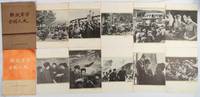
1970215493Circa1970. Set of 10 Revolutionary black and white photographs of PLA soldiers interacting with the people including a slightly browned title page all inserted in the original brown paper envelope. A collectable set in very good condition 26.5 x 19cm. This collection of black and white photographic illustrations show PLA soldiers in different contexts; being taught class consciousness studying Mao's little red book together learning from workers and farmers and so on provided for the use of military units. . unknown
1970158619北京.Beijing. Circa1970. Coloured poster no.11 of the Chinese Air Defence poster set. Damp staining horizontal and vertical creases where poster has been folded closed tears several of which have been repaired with tape on reverse. Text in Chinese. Poster measures 53.8 x 77.4cm. This poster shows three methods which can be used to fire at enemy paratroopers - each with detailed instructions. A chart in the centre gives useful information regarding the shooting distance required to hit enemy paratroopers based on a multiplication of the shooter's height. <br> <br>中國人民解放軍總參謀部動員部Mobilization Division of People's Liberation Army General Staff Department was first formed in 1954 and later joined with 中国人民解放军总参谋部军务部 Military Division of People's Liberation Army General Staff Department to form a joint division in 1969. In 1975 it returned to its original name. . unknown
1970158620北京.Beijing.: No publication details. Circa1970. Coloured poster no. 12 of the Chinese Air Defence poster set. Lightly stained along upper edge brown stain with a little minor loss tape repairs in several places along the upper edge on the reverse of the poster. Good copy. Text in Chinese. Poster measures 53.9 x 77.7cm. This poster depicts 5 anti-aircraft firing positions. They are: one person lifts and stabilises the rifle while the other person aims; position aided by fortification; position aided by tree branches; position aided by walls; and kneeling position. <br> <br>中國人民解放軍總參謀部動員部Mobilization Division of People's Liberation Army General Staff Department was first formed in 1954 and later joined with 中国人民解放军总参谋部军务部 Military Division of People's Liberation Army General Staff Department to form a joint division in 1969. In 1975 it returned to its original name. . No publication details. unknown
1978Alibris.0034971民美術出版社 China Fine Arts. 1978. Trade paperback. Good. wear & some discoloration to cover pages dog-eared. 59 p. Includes illustrations. 民美術出版社 [China Fine Arts... paperback
1916000483<p>Istanbul: TanÄ«n 1916.<br />Book. As new. Hardcover. 8vo over 7¾–9¾ in.<br />An official report issued by the Ottoman Fourth Army under Jamal Pasha concerning the proceedings of the Supreme Court Martial Tribunal convened at Ê¿Ä€liyah Aley Lebanon established to prosecute alleged Arab separatists and Pan-Arabist movements in Syria and Egypt during the First World War.<br />The report claims that the names of prominent Arab nationalists were discovered by the Ottoman authorities among documents seized from the French Embassy in Beirut reportedly placed under the safekeeping of the American Embassy following the outbreak of war. These documents formed the evidentiary basis for the tribunal's investigations.<br />125 pages of Arabic text accompanied by over 50 facsimile plates issued as a supplement reproducing original documents and correspondence between the accused Arab nationalists and other related parties examined by the tribunal.<br />Preserved in a modern hardcover binding.<br />A significant and controversial contemporary Ottoman publication providing rare primary documentation on wartime military justice Arab nationalist movements and Ottoman intelligence practices during the final years of the empire.</p><p>An important Arabic political and legal work presenting the Arabic version of La Vérité sur la Question Syrienne addressing the investigations and proceedings of the Ottoman Martial Law Tribunal DÄ«wÄn al-Ḥarb al-Ê¿UrfÄ« convened in Ê¿Ä€liyah Aley during the First World War.<br />The work constitutes a contemporary defense and documentary clarification of political accusations brought against Syrian and Lebanese figures shedding light on:<br />Ottoman wartime judicial procedures<br />political repression and accusations of separatism<br />and the broader Syrian Question in the late Ottoman period.<br />As the original Arabic edition this publication is a key primary source for the study of Ottoman military justice Arab political movements and Syro-Lebanese intellectual history during the final years of Ottoman rule.<br />A scarce and historically significant work particularly sought after in collections relating to the Arab provinces of the Ottoman Empire World War I Middle Eastern politics and constitutional and legal history.</p> Tanine hardcover
19981303244PN. New. 1998. Soft Cover. Date is original print. This is a reprint edition . PN paperback
19981303242PN. New. 1998. Soft Cover. Date is original print. This is a reprint edition . PN paperback
19981303246PN. New. 1998. Soft Cover. Date is original print. This is a reprint edition . PN paperback
19572091502135403114Beijing Music Publishing House 1957. Soft Cover. Fine. Number of books: 1 Beijing Music Publishing House paperback
19842092902141205047shanghai people 1984. Soft Cover. Fine. Volume: 1 shanghai people paperback
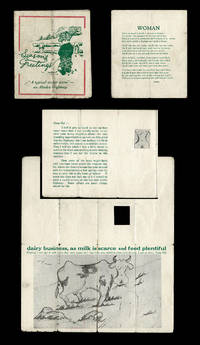
19424346Alaska: n.p. Army Corps of Engineers 1942. Ephemera. Acceptable. Shortly after the bombing of Pearl Harbor the Army Corps of Engineers started and finished building 1600 miles of highway to Alaska. The 10000 strong Corps did it in just over eight months with much help from Canadians. This humerous Christmas greeting was likely sent shortly after it's completion. A 9.25 x 8 inch printed sheet folded 2 times to make a humerous Christmas greeting gag card. A cutout provides the gag of a cow's face being transformed into a naked woman with a dairy business as the punchline. Card is complete w. soil folds and tears. It was obviously carried around in a workman's pocket to provide comic relief. An uncommon piece of Alaska Highway ephemera. n.p. [Army Corps of Engineers?] unknown
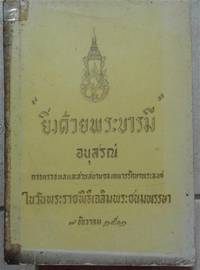
1959T26528Bangkok: White Lotus 1959. Paperback. Good/no dj. 1.00. Thai Army. Ying Duay Phra Baramee- Uniforms of Thai Officers for King Chulalongkorn Vakoravidj Chulachomklao and for Other Royal Guards White Lotus paperback
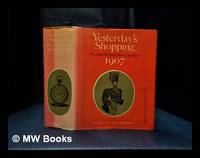
1980333474Newton Abbot: David & Charles 1980. New Impression. Hardcover. Near fine cloth copy in a very good if slightly edge-nicked and dust-dulled dust wrapper now mylar-sleeved. Remains particularly well-preserved overall; tight bright clean and strong. Physical description: 6 lxiii 1282 pages chiefly illustrations form maps 2 plans 26 cm. Subjects: Army & Navy Co-operative Society. Manufactures; Catalogues. Army-Navy stores England; Catalogues. Manufactures. Department store; Catalogues. Department stores Great Britain History. Manufactures England Catalogues. Manufactures; Catalogues. Commercial catalogues Great Britain 20th century. Genre: Catalogue. Illustrated. Newton Abbot: David & Charles hardcover
1945ZB1155812NY: United States Army 1945. volume 4 nos. 1-28 complete volume last published each issue in original pictorial paper wrappers with small mailing label well illustrated with halftones cartoons & drawings text tanned minor marginal chipping else good . - If you are reading this this item is actually physically in our stock and ready for shipment once ordered. We are not bookjackers. Buyer is responsible for any additional duties taxes or fees required by recipient's country. NY: United States Army unknown
19442092902138201426Asahishinbunsha 1944. Soft Cover. Fine. Number of pages: 227 pages Size: B5 size Number of books: 1 volume Asahishinbunsha paperback
1970KFZZQ100589National Museum of Modern Art 1970. Soft Cover. Fine. KFZZQ100589 National Museum of Modern Art paperback
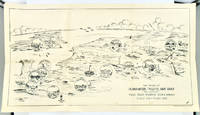
19452442Bad Wildungen Germany: Tac Echelon HQ 12th Army Group 1945. First Edition. Single Sheet Paper. Very Good Plus/4-mil clear mylar envelope. This is an ORIGINAL folded MAP showing the travels of the "Tac Echelon" Headquarters 12th Army Group in WWII through England France Luxenbourg Belgium and Germany from 15 July 1944 through 9 May 1945. On the verso of the map is the description of the "VICTORY IN EUROPE" Dinner Dance presented in honor of General Omar N. Bradley by the Officers of Tac Echelon Headquarters 12th Army Group at the Hotel Furstenhof in Bad Wildungen Germany on 12 May 1945; i.e. 4 days after the Surrender of Germany. The document is SIGNED in ink by General Omar Bradley "O N Bradley". The map measures 11 1/2" x 20" opened and 6 3/4" x 5 1/2" folded.<br /> <br /> One of the MOST REMARKABLE MAPS of WW2 the map was hand-drawn by an artist who signs his name RWD in the print. The document was produced by "Engr. Repro. Det. 12 A Gp." The map shows the various locations of the Headquarters 12th Army Group during its progress in combat in WWII from the "Staging Area" in England to Bad Wildungen Germany. Beverages are described for most of the locations ending in "V-E Specials" for Germany. We believe this map was distributed at the dinner dance celebrating the "Victory in Europe" just 4 days after the War in Europe ended and was signed by General Bradley at the dinner. The 12th Army Group was the largest military formation of the United States in the history of the Country. The 12th Army Group was deactivated shortly afterward on July 12 1945 upon General Bradley’s departure to become Director of the Veterans Administration. <br /> <br /> NOTE: This map will be accompanied by a CERTIFICATE OF PROVENANCE dated and signed by Debbie Chapman Luckinbill certifying that the map was brought home as a souvenir by her aunt the late Helen Chapman who was a member of Red Cross Clubmobile Group C which served in Europe during WW2. Red Cross Clubmobiles were large food trucks which were driven by Red Cross women to troop assembly areas where the women would open up the sides and serve doughnuts coffee and snacks to the fighting men. <br /> <br /> We have not found this map anywhere on the internet or other research. The map is foldedrubbed and lightly soiled from handling but is Very Good or better and now in a 4mil clear mylar protective envelope. Tac Echelon, HQ 12th Army Group unknown
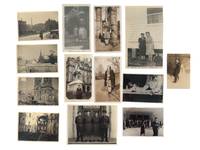
1945214301945. WWII era Women's Army Corps photo archive documenting servicewomen including two African Americansand four partially identified individuals. Creation of the WAC in 1942 marked the first permanent institutional incorporation of women into the U.S. Army placing female personnel into administrative communications intelligence and logistical roles across both domestic bases and overseas commands. One photograph identified on the verso as "Gynnie Polly Corsica '45" provides additional documentation of Black women serving overseas in segregated Army units during the final year of the war.<br /> <br /> Archive of 18 silver gelatin photographs from W.W.II. Photographs measure approximately 3 x 2 inches to 6 x 3.5 inches. The images depict American servicewomen in a range of wartime contexts including official uniform portraits informal snapshots and scenes taken in European cities damaged by combat. Several photographs show women wearing standard WAC dress uniforms with garrison caps and enlisted insignia while others depict personnel wearing British style battledress associated with American administrative units stationed in Europe. One photograph shows three uniformed personnel two women and one man standing at attention before a formal government building likely in Britain. Another image places a uniformed American servicewoman before the gilded equestrian statue of Joan of Arc in Paris a landmark associated with Allied presence in liberated France. Additional photographs depict ruined urban landscapes with bombed churches and collapsed structures suggesting scenes from Germany or France shortly after liberation. A photograph inscribed "Chattanooga Tenn." shows a woman standing in civilian clothing at the entrance of a home indicating a stateside context connected to the servicewoman's life before or after deployment. Another photograph labeled "Ann & Lillie Mother" shows two women standing outside a residence likely relatives of one of the servicewomen. <br /> <br /> Women's military service expanded rapidly during World War II as the War Department created organizations such as the Women's Army Corps and the Navy's WAVES to address labor shortages across the armed forces. Overseas deployments placed WAC personnel in newly liberated European cities and military headquarters throughout the Allied command structure. Light toning minor edge wear and occasional handling marks. Overall very good condition. Although African American women served within segregated units their participation in overseas assignments including Mediterranean theater postings marked a significant shift from earlier military policy which had typically limited Black women's service to domestic assignments within segregated support units. unknown
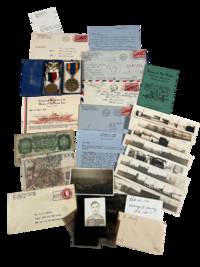
1945229161945. WWII Lt. Colonel Henry L. Hively U.S. Army Air Forces correspondence and war archive 1945 comprising medals letters documents photographs negatives and ephemera including Panama Canal Zone tourist booklet wartime train-journey photo strips through France namely Grenoble and Valence aerial transport photographs and extensive emotional correspondence from Oakland and San Francisco at the end of World War II. Archive includes 4 letters 5 envelopes two foreign currency bills a Panama tour guide a donation certificate six medals and ribbons and over 30 very small photographs. This substantial personal archive documents the long U.S. Army career of Lt. Colonel Henry L. Hively 1915-2010 beginning with his formative early-career service tied to the U.S. Army's border militarization and expeditionary presence in Mexico during the opening decades of the twentieth century when American forces pursued Pancho Villa and asserted federal authority along the U.S.-Mexico border. That experience-rooted in mobile warfare logistics and hemispheric military infrastructure-prefigures the global operational networks that would later define American power during World War II. Hively's career thus bridges early twentieth-century expeditionary service in Mexico with his later World War II service across the European and Pacific theaters and the immediate postwar demobilization period.<br /> The archive is anchored by an extraordinary run of intimate 1945 letters from Hively's girlfriend Mrs. Dorothy "Dottie" Rishel a civilian hospital worker at Green's Eye Hospital in San Francisco and later Oakland. Her correspondence chronicles daily life wartime anxiety women's labor Bay Area domestic arrangements and-most critically-the immediate civilian reaction to the atomic bomb and the end of the war. On August 10 1945 Rishel wrote: "I'm so confused over the state of affairs regarding the war and probable termination of it I don't know what to say. Without reservation Hank what's your personal opinion of this atomic bomb Its destructive power absolutely floors me." Only one day later as news of Japan's surrender became imminent she added "Allow me to say 'Happy V-J Day to you.' The war will absolutely be over tomorrow so the radio says. Golly I'm so thrilled I can't even concentrate on anything." These letters provide rare real-time reactions from a young working woman confronting the moral and emotional consequences of nuclear warfare.<br /> <br /> Materially the archive includes Hively's medals-among them a boxed Army of Occupation Medal ribbon bars and a boxed U.S. Air Medal-alongside his wartime photographic portrait labeled "Henry L. Hively 2nd Lt. Sig C." The photographic material consists of mostly very small vernacular silver-gelatin prints about 1' x 1" in rows of about 5 with a few larger images and a few negatives. several stamped on the verso "March 1945" showing Hively with other U.S. soldiers during the final months of the war including soldiers disembarking from U.S. Army aircraft traveling by rail through Europe gathering around Army jeeps and socializing outdoors. One image records a street-level view of a building in Grenoble France situating the archive geographically within southeastern France during the Allied occupation period. Additional prints show European landscapes rivers military encampments and aircraft on runways. Also present is the USO pamphlet Panama in Your Pocket: What to Do Where to Go While on the Isthmus reflecting the Pacific transit network anchored by the Canal Zone alongside foreign currency from France and England and photographic negatives documenting off-duty military life. A later handwritten note identifying "Ret Lt. Col. Henry L. Hively 1915-2010 - 94 yrs old" aligns with his published obituary confirming his long military career and postwar administrative service. The correspondence between Hively and Rishel forms the emotional core of the archive documenting female wartime labor emotional resilience and the uncertainty of demobilization. Rishel's account-"The work here in the hospital is absolutely fascinating. this hospital has been doing an awful lot of experimental work on cornea transplantation"-captures women's medical labor during WWII while her September 21 1945 letter reflects anxiety surrounding separation and discharge: "they have decided to send all eligible officers to their separation centers sometime in the next two months." Together these materials articulate the psychological and social transition from global war to fragile peace. Letters well preserved and legible with expected toning and folds; envelopes present with postmarks and Army Postal Service stamps. Photographs and negatives crisp some very good and a few over exposed. Medals well kept in original boxes with ribbons and devices. Overall very good condition. unknown
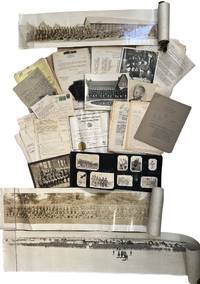
1917190211917. WWINational GuardWWII Primary-source archive documenting U.S. Army transportation command operations supporting Allied logistics following the Normandy landings centered on the development of Cherbourg as a critical supply hub. Assembled from the career of Lieutenant Colonel George C. Sullivan the collection spans World War I mobilization through World War II and into postwar reserve service with particular emphasis on mid-twentieth-century military infrastructure and coordination. The archive comprises hundreds of pages of official documents correspondence and service records alongside a substantial photographic component including large-format panoramic rolls depicting assembled training formations and unit organization at scale. Together the materials provide detailed evidence of the administrative and logistical systems that sustained Allied operations in Europe situating individual service within broader frameworks of wartime transportation supply distribution and postwar military restructuring.<br /> <br /> Archive comprises hundreds of pages of military documents dated primarily from the 1940s through the 1950s; three panoramic photographic rolls from World War I service; one photograph album containing 83 photographs from 1917-1918; four loose photographs; and three letters dated 1945-1948. The World War I album depicts training at Fort Sill Oklahoma mounted artillery drills including a three-inch field gun mounted cavalry movement across desert terrain doughboy uniformed infantry and a Peace Parade in Lawton Oklahoma in November 1918. Sullivan's own written service summary records his federal call-up transfers promotion to corporal commissioning and discharge in December 1918. The panoramic rolls measuring approximately 44 to 56 inches in length show large assembled formations at Camp Cody New Mexico and officer training at Camp Taylor Kentucky including the 25th Battery Central Officers Training School. World War II and postwar materials include commendations transfer requests rosters promotion records certificates and administrative correspondence. A 1949 silver gelatin photograph of Headquarters Company 371st Support Group summer training personnel includes a roster naming forty-eight officers among them First Lieutenant Catherine M. Henry documenting the integration of women officers in postwar reserve structures.<br /> <br /> Sullivan's World War II documentation centers on transportation command responsibilities essential to sustaining Allied operations in Normandy and the rapid development of Cherbourg as a logistical hub following D-Day. The archive traces the evolution of the United States Army from early twentieth-century National Guard mobilization to logistics work in World War II. Postwar papers reflect Sullivan's continued reserve duty into the mid-1950s and his civilian engagement in the sale of military surplus goods in Seattle Washington illustrating the reintegration of career officers into postwar commercial life. Documents generally clean and legible with occasional edge wear; panoramic photographs show some cracking but remain intact; photograph album well preserved; loose photographs with light handling wear. Overall very good condition. Extensive archive chronicling four decades of a United States Army officer's career. unknown
1962031907Fort Benning GA: U.S. Army Infantry School 1962. Paper Back. Very Good/No Jacket. 4to - over 9¾" - 12" tall. 99pp.; SC staple-bound w/5-holes&no title on spine; blue w/blk.; slight rub w/sun on edges; cleantight pgs. "This handbook covers the principles of clear logical effective writing. It contains specific information on how to apply these principles to the type of writing required in the preparation of staff papers and an aritlcle for publication." bttm.last pg.reads: "34606 Army-Ft.Benning Ga. 9 Jul 62 5500" rare. <br/> <br/> U.S. Army Infantry School unknown