[NEW LEFT - GRAPHICS] [COHEN, Peter G]; Vietnam Veterans Against the War Defense CommitteeBiblio.com

333 résultats
197341784N.p.: Vietnam Veterans Against the War 1973. First Edition. Original offset lithographed poster in colors 56cm x 43cm 22" x 17". Fine fresh apparently unused example. Poster sold as a fundraiser for the defense of the Gainesville Eight a group of Florida Vietnam veterans who were accused on dubious evidence of conspiracy to disrupt the 1972 Republican National Convention in Miami Beach. All eight defendants including the reputed ringleader Scott Camil were eventually acquitted. A rare poster and this is a lovely fresh example. Not catalogued in OCLC; we note only one institutionally-held copy Library of Congress. Vietnam Veterans Against the War unknown
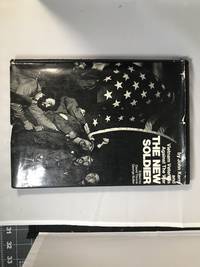
197108-29-2022-10This hardcover has black boards with a fine detailed silver gilt image with the US flag and Vietnam Veterans from a photo by George Butler. All lettering and image in silver is in fine condition. All pages and the numerous photos are clean and unmarked.<br />INSCRIBED on the title page as seen in photo. <br />we believe that the David Putnam to whom the inscription is dedicated is or was a Massachusetts friend of Mr. Kerry but we are unable to verify this.<br /> DJ condition is Good-. Chipping along top and bottom margins Two tiny closed tears repaired with tape several others untaped. She creases in DJ flaps. Not price clipped.<br /> This work is a photographic essay of the Anti-War movement and the Vietnam Veterans that culminated in a march of the Capital Building in 1971. An important text for anyone interested in American History and the climate of the Country during the Vietnam War. The Macmillan Company hardcover
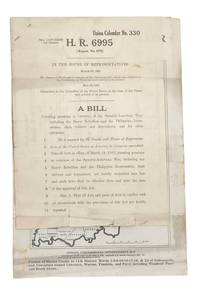
1935233301935. Law and PolicyIndianaSpanish-American War U.S. Congress and local government document archive of five pieces concerning Indiana politics in 1935 on veterans' care social welfare legislation and the domestic aftermath of U.S. colonization in the Caribbean. The archive centers on a March 25 1935 bill proposing pensions for veterans of the Spanish-American War including the Boxer Rebellion and the Philippine Insurrection their widows and dependents and the accompanying House report dated May 22 1935 extending that claim into committee language cost projections and Veterans' Administration statistics. The documents connect federal pension policy to state electoral geography through August G. Mueller's Indiana congressional apportionment map and to campaign messaging through tabulated votes on the AAA TVA Gold Bill Silver Bill Securities Exchange Act Norris-HOLC Amendment Navy Construction Act Housing Bill and Labor Disputes Bill.<br /> <br /> Five documents stapled at top left corner. 1935 chiefly Indiana with federal legislative and campaign material extending to Iowa Kansas Kentucky Louisiana Oklahoma Oregon and Pennsylvania. 16 pages in total. Documents comprised of one official House bill one official House committee report one Indiana congressional district map one Indiana newspaper clipping of candidates by district and one multi-page ballot-style voting-record leaflet.<br /> <br /> 1 Mueller August G. Gus. Indiana Congressional Apportionment Map. Indiana ca. 1935. One page. Large printed map headed "August G. Gus Mueller / Secretary of State" showing Indiana's twelve congressional districts with county boundaries and population figures. Lower text notes the "Apportionment of 1931 based on the census of 1930" applicable to elections beginning in 1932 and specifically identifies the portion of Marion County in the 11th District tying the archive's pension and campaign material to the district structure within which Indiana candidates were contesting office.<br /> <br /> 2 United States House of Representatives. H.R. 6995. In the House of Representatives March 25 1935. One sheet two pages. Official printed bill for the 74th Congress 1st Session titled "A Bill Granting pensions to veterans of the Spanish-American War including the Boxer Rebellion and the Philippine Insurrection their widows and dependents and for other purposes." The bill states that laws in effect on March 19 1933 granting such pensions were to be reenacted making the document a direct record of New Deal era restoration and enlargement of benefits for aging veterans of the 1898 war and subsequent U.S. campaigns in China and the Philippines.<br /> <br /> 3 Newspaper clipping. Indiana candidates by congressional district ca. 1935. Narrow printed clipping listing Indiana candidates district by district including names such as Andrew J. Hickey in the Third District David Hogg in the Fourth Gerald W. Landis in the Seventh Charles F. Werner in the Eighth Chester A. Davis in the Ninth Clarence M. Brown in the Tenth Don Roberts in the Eleventh and Homer Elliott in the Twelfth. In this file the clipping functions as the electoral counterpart to the pension and voting documents showing the candidate field to which these legislative issues were being attached.<br /> <br /> 4 United States House of Representatives. Report No. 974 To Accompany H.R. 6995. Washington D.C. May 22 1935. Four pages on one sheet bifolded. House report submitted by Mr. Smith of Washington from the Committee on Pensions recommending passage of the bill and giving the most detailed policy language in the archive. Its "General Statement" specifies that the bill would extend benefits to those who served between April 21 1898 and July 4 1902 gives the average monthly payment then being received as $32.17 proposes an average monthly pension award of $42.85 states the average age of such veterans as "61 years and 8 months" and includes a May 9 1935 letter from Frank T. Hines to Allard H. Gasque discussing the estimated surviving veteran population and projected fiscal effect.<br /> <br /> 5 Voting-record leaflet ca. 1935. Eight page ballot-style political leaflet tabulating senators' and representatives' votes across several states with photographed sections for Indiana Iowa Kansas Kentucky Louisiana Oklahoma Oregon and Pennsylvania. The tables reduce congressional politics to a usable campaign matrix marking "Y" "N" "NR" and "PF" across measures including the Emergency Banking Act National Economy Act 1933 Independent Offices Bill Beer AAA TVA 1933 Gold Bill CWA continuance 1934 Revenue Bill Veterans' Compensation Bill Bill to Reduce Tariff Securities Exchange Act Norris HOLC Amendment Navy Construction Act Housing Bill and Labor Disputes Bill; accompanying text summarizes selected measures such as the Civil Works Administration continuance Cotton Control Bill Silver Purchase Act and Tariff Act of 1934.<br /> <br /> The two federal pension papers form the archive's documentary center because they preserve the precise legislative language by which Congress revisited the status of veterans of the Spanish-American War the Boxer Rebellion and the Philippine Insurrection in 1935 decades after those campaigns had extended U.S. power into the Caribbean and Pacific. The supporting Indiana documents show how that policy landscape was translated into district-based electoral work while the voting leaflet widens the view to a national New Deal contest over social provision public spending agriculture currency housing labor and veterans' compensation. Folded and stapled as assembled with pronounced creasing moderate toning and scattered staining to edges; complete and legible. Overall good condition. A snapshot of U.S. policy in the Midwest in 1935 preserving legislation on veteran's pensions New Deal vote-tracking and Indiana electoral geography. unknown
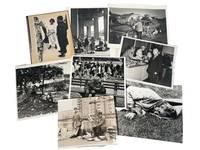
1950201161950. Homelessness press photography archive 1951 to 1990s documents displaced people in American cities through images of soup kitchens public sleeping spaces roadside survival emergency shelters and encampments. The archive provides primary visual evidence for the study of urban poverty public welfare veteran reintegration housing insecurity and the changing visibility of homelessness in the second half of the twentieth century. Its strongest historical value lies in the range of settings recorded: postwar charitable food assistance men sleeping in parks and public spaces Vietnam veterans gathered beneath highway infrastructure shelter-based aid and women living in vehicles with personal belongings and pets.<br /> The archive consists of eight black-and-white silver gelatin press photographs from the United States dated from 1951 to the 1990s most measuring approximately 7.25 x 9 inches with several retaining original press captions or newspaper clippings mounted on the verso. The earliest image shows a 1951 soup kitchen scene assisting homeless residents. Later photographs show Vietnam veterans beneath an underpass using mattresses and boxes for seating; a Queens New York veterans' shelter where an African American veteran shops for clothing with a staff supervisor; and Gabrielle Mendosa resting on a mattress near the Miami River beside the encampment identified as "Tent City under the Xway." Additional images show men sleeping on park benches or lawns including a scene associated with the Boston Freedom Trail Walk for the Homeless two men attempting to sell recovered household appliances by the roadside and a woman identified as Lynn living in her car with her belongings and dog while seeking assistance.<br /> The photographs are significant because they record homelessness not as a single condition but as a set of lived circumstances shaped by food insecurity military afterlives public space shelter access informal economies and the absence of stable housing. The retained press captions and clippings connect the images to their original journalistic use showing how homelessness was presented to newspaper audiences across several decades. Minor edge wear light handling marks and typical press-photo surface wear; verso caption material and clippings present on several photographs; images remain clear and usable; overall very good. Concentrated documentary archive showing American homelessness from institutional relief to street encampment with particular strength in veteran homelessness and urban public visibility. unknown
1987ZB622103Chicopee: Civil War Veterans Historical Association 1987-2006. title varies slightly volumes 1-20 lacks vol. 12#3-4 else all complete volumes quartos illustrated in original stapled self wrappers very good PRICE IS FOR THE LOT:. - If you are reading this this item is actually physically in our stock and ready for shipment once ordered. We are not bookjackers. Buyer is responsible for any additional duties taxes or fees required by recipient's country. Photos available upon request. Chicopee: Civil War Veterans Historical Association unknown
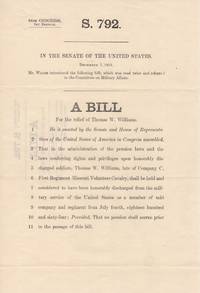
1922List2720Butte Montana 1922. Approximately 113 pieces: fifty-one letters to Thomas Williams; thirteen to various politicians mainly members of Congress; and twenty to Williams’ advocates mostly from Congresspeople; fifteen miscellaneous items including Grand Army of the Republic materials and Williams’ citizenship document; and fourteen empty envelopes. Materials date from between 1911 and 1922. Near fine with normal wear. Thomas W. Williams 1845–1931 was born outside of Swansea Wales and died in a Soldier’s Home in Los Angeles California. According to his obituary he came to the United States in about 1857 as a very young boy briefly left to learn blacksmithing in Toronto Canada and then returned stateside. He enlisted with the Union army at the outbreak of the Civil War shortly before he turned 16 and served in the 1st Missouri Cavalry of Volunteers Company C. After the war he was a resident of Butte Montana to or from which many of these letters are written.<br /> <br /> Offered here is a large lot of materials relating to Williams’ efforts late in life to secure a veteran’s pension for his service – or at least to have his 1864 dishonorable discharge expunged from his record. Williams enlists a number of people to help him with this task including fellow 1st Cavalry veteran Abraham Brokaw several local attorneys and the mayor of Butte. Their letters on Williams’ behalf are mainly addressed to congressmen mostly from Montana whose replies start out with polite deferrals—they would of course love to do anything in their power to help but these matters are difficult and now is simply not the right time—but devolve into accusations and firm denials.<br /> <br /> According to Williams he had served with Company C until his honorable discharge in May of 1864 at which point he immediately reenlisted. He received a thirty-day furlough on reenlistment and decided to visit his uncle in Hamilton Ontario as he had no other family on the continent. On attempting to return to his post:<br /> <br /> “As I was not of age my uncle held me and prevented me from returning to my command. I tried to get away so as to get back ran away twice but was recaptured twice my uncle having a letter from my mother instructing him to hold me as I would only be 19 on Sept 15 1864. I was branded as a deserter when I applied for a copy of my discharge.†December 11 1919<br /> <br /> His record prior to this he claims had been stellar as he lays out in an eleven-page notarized statement as part of his appeal May 3 1922. He describes being sent as a member of General Frémont’s bodyguard into the First Battle of Springfield:<br /> <br /> “we were sent to lexington to drive Price and the Rebels out of Mo. we camp about 20 miles away in a viliage before we reached Springfield and General Freemont called the Body guard out at 2 oclock in the morning for volenteers we came out . we did not know where we were going. after we had gone a few miles we had a fight with the Rebels pickets and whiped and drove them away and we went two or three miles towards Springfield . we made the charge and drove the rebels out there were 2200 of them. we laid out in the prairies all night without Hat Coat or Blanket to keep us warm and Held our Horses by the Bridel all nightâ€.<br /> <br /> The men “formed a camp near Springfield and you can see cut in a large rock the name of Camp Bliss which I cut and the dait of the year.†When Frémont was ordered back to Washington he ordered a dispatch sent from Springfield to Sedalia which Williams carried<br /> <br /> “132 miles from 8 oclock in the morning on our same Horses. and only one drink of water for our selves our Horses from the time we left camp that night untill 11 oclock when we arrived in Seidailia we then returned to Springfield with General Hunters comand escorted General fremont to Rollaâ€.<br /> <br /> The men go on “to Levenworth Kansas and the Bushwackers fought us all the wayâ€. They winter in Leavenworth and are then sent to “Independence Mo to drive Quantrell and his gang out of North Mo†– that is William Quantrill and his Raiders an infamous pro-Confederate guerilla group. Williams writes:<br /> <br /> “We left the Sargent of Co E. in Kansas City to get our mail and a citizen and his son was with him Quantrell gang captured them and striped the both and placed them in a fence corner and killed them Both and placed fence rail over them and Burned them up and left the Boy see them do this he came to our Captain Miles Kehoe who sent us out in squads on all the roads and we captured 9 of the Rebles Captain line them up and told the Boy to pick out the man that killed his father . they coart Marcheled him and Hanged him the next morning at 8 oclock Capt Kehoe let the others go and told them if they were caught in any thing But a fair fight he would Hang them tooâ€.<br /> <br /> Quantrill’s men heed Keogh’s warning and go much easier on six of the company’s men who are captured while searching for more feed for the horses:<br /> <br /> “Quantrals gang caught them after disarming took them to a farm house gave them supper and sent some of his men around and collected all the young ladies they could get and an old Mo fidler they danced all night and then Quantral gave them Brekfast and sent them to there camps this was the last trouble we had with him and his gangâ€.<br /> <br /> At this point Williams does admit to running into some trouble himself: another soldier “started to curse queen Victoria and I hit him . my Welch Blood could not stand to hear himâ€. Williams asks the soldier what he “would do to a man if he damned presedent Lincoln†and the soldier<br /> <br /> “went and swore I damned the president and I was Coart Marceled and sent to Alton then a Military Prison and at the Cort Marshal they did not alow me to say one word to protect myself when I arrived at Alton I explained the whole afair to the officer who had charge of this prison he advised me to write to president Lincolnâ€.<br /> <br /> Williams is shortly released from prison and sent back to his post at Little Rock; in later tellings of the story by Williams’ advocates including in a resolution of the Grand Army of the Republic Lincoln personally ordered Williams released. Willliams’ company fights in the Battle of Prairie D'Ane and then camps with “a comand of Jenensons coulered troopsâ€â€”probably Colonel Charles Jennison—who were “attacked by the rebles†and “shot at them and then went at them with Bainets and drove them for miles it was a Sight to see the dead rebles how they were Killedâ€. Shortly before his initial discharge Williams’ company goes on to Camden where:<br /> <br /> “some of our troops were on picket and those not on guard were asleep around a fire and the rebles made a charge and shot the Boys around the fire after that the Boys took logs and put Hats and overcoats on the logs and the Rebles tryed the same game But was caught in a trapâ€.<br /> <br /> Finally Williams is discharged reenlists and is furloughed and heads to Canada where his troubles begin.<br /> <br /> He first appeals to fellow 1st Missourian Abraham Brokaw since Brokaw could act as a witness to his claims. In their correspondence Brokaw sometimes recalls interesting anecdotes from the war including the “dirty irishman thief and libertine†Kelley “who the boys you will call to mind was going to hang at Little Rock for steeling our postals†April 18 1912 and a “band of gurillas from Ark. that had captured and was holding the little town†of Ozark Missouri who “had got word of our coming and left for parts unknown a few hours before our coming†January 26 1915.<br /> <br /> The letters to Williams and his advocates are frustrating – what he’s told is inconsistent and he makes little progress. First he has to get confirmation of his first honorable discharge which he seems to receive around September of 1916. Then he applies for a pension; however the office of the Bureau of Pensions writes to him the following year that his pension “claim was rejected November 13 1916 on the ground that you were never honorably discharged from the only contract of service you entered into during the Civil War†August 31 1917. A month later the Missouri Adjutant General writes a certificate of his service which “clears your record both here and in Washington†and congratulates him “on receiving at last your just due as a Veteran so richly merited†September 20 1917. By the end of the year though he is still trying to clear the desertion charge and has now resorted to trying to pass a bill in congress to do so. Montana Senator Thomas Walsh writes that “I have tried very hard to secure a favorable report . but have been unable to induce the Military Committee to take action thereon†December 11 1917.<br /> <br /> The congressmen to whom he appeals—including Senators Walsh Tom Stout and Henry Myers and Representatives Frank W Mondell Carl W Riddick and Henry Z Osborne—are less than helpful. They often claim that there is insufficient time remaining in the current congressional session remind him that such bills are difficult to pass even in favorable circumstances and ask him to furnish them with the same information he has already provided. After years of this Senator Myers suddenly tells Charles Juttner one of Williams’ advocates a very different story about Williams’ service:<br /> <br /> “The report of the War Department shows that in March 1863 Mr. Williams was tried by court-martial on a long list of serious charges and that he was found guilty on all of them; that he was sentenced to imprisonment at hard labor for the duration of the war or at least until his term of enlistment should expire and that other penalties were assessed against him one of which was that at the expiration of his term of imprisonment he should be dishonorably discharged from the Army. It appears however that after having been imprisoned nearly a year the remainder of his sentence was remitted and that he was allowed to rejoin his company and that he did rejoin it in February 1864. The records of the War Department however show that July 4 1864 at St. Louis while on furlough Mr. Williams deserted and never rejoined the army.†July 18 1921<br /> <br /> A letter from the War Department Adjutant General adds the details that he “was found guilty . of conduct prejudicial to good order and military discipline and of disobedience to orders†and that his sentence had included “a ball and chain weighing twelve pounds attached to his leg†and the forfeiture of all present and future pay and allowances January 16 1922.<br /> <br /> It is difficult to say which account is true. Myers however had given some telling further reason that Williams’ bill might have been rejected:<br /> <br /> “There is an intense prejudice in Congress against such bills. . The senators and representatives seem to think that such a bill is merely a prelude to an application for a pension and the expenses of the government are now so enormous and the expenses of providing for the veterans of the World War are so great . that there seems to be a general disposition in Congress not to increase the Civil War pension list any more by a single dollar.â€<br /> <br /> Overall a record of one veteran’s experience dealing with the federal government. Of interest to scholars of the American Civil War and postbellum civilian life both for its firsthand accounts of engagements in the trans-Mississippi theater and for the look it offers at the treatment of veterans. unknown
191630880Stillwater Minnesota: Easton & Masterman Printers 1916. First Edition. Hardcover. Fair. Octavo. 8 508 pages. Illustrated with 3 folding maps one map in text and 11 illustrations including the frontispiece photograph of Gov. Ramsey. Blue cloth hardcover with gilt title on spine. Cloth is split down the rear joint and chipped head and base of spine. Light shelf wear to the cloth covers. Front hinge once repaired is cracked. Rear hinge is also cracked. Soiling to the gutters of the first 40 pages. An old tape repair bottom corner page 14. Faded W.S.A. initials written top and bottom of the text block. Several pages of underlining and notes in the text mostly in the appendices and roster. <br /> <br /> Previous owner's signature "We Stevens Abbott" written vertically on front paste down. This copy has two added orders and a bookplate on the right front flyleaf see description below. Scattered pencil underlining and marginalia on front end sheets inside text and on the roster section. Old news clipping regarding Lincoln's 125 Birthday and New England Cavalry facsimile advertisement laid in between pages 190-191 resulted in a brown shadow stain. <br /> <br /> Dornbusch I MN. Not in Nevins. This copy owned by a relative of soldiers from the 1st Regiment contains several short personal hand written notes in text and roster section. Two added "Orders" were placed inside the book. On the front paste down is a printed copy of Gen. Washington's General Order Aug. 3 1776 & Gen. McClellan's General Order September 6 1861. Written underneath the order in pencil - "This was in John Hoblitt's Knapsack." Next to the note is a question in pencil - "Who had it". W. Stevens Abbott name is written in pen on the front paste down next to the order. On the right front flyleaf is the bookplate of Sydney C. Kerkis author and Civil War historian. <br /> <br /> A pencil inscription written underneath the bookplate reads "John Hoblitt Corporal Co. "D" 21 years old. Died of Disease 11/20/1861 - There were Three Stevens Four Abbotts and Two Hoblitts in the Regiment." The second order is tipped in before added page 1. This is a two page printed copy of "Lieut. Col. C. P. Adams' Last Order." Adam's order is loose and contains some pencil underlining and a hard to transcribe note - "I ga McClellans f at Beverly Post gar." An interesting note on the last page of Chapter 30 - "The First Minnesota at Fredericksburg" page 275 reads: "Soon after this time Papa was mustered out transferred to Washington D.C. to take charge of Secy. Stanton's private printing - enlisting for that purpose in regular army as U.S. Hospital Steward." <br /> <br /> The Roster section contains several notes check marks underlining etc. Some of the notes refer to relatives in the 1st Regiment. The 1st Minnesota Regiment was one of the first to volunteer for service. Governor Ramsey is credited for being the first Governor to volunteer troops for the Union. He happened to be in Washington D.C. at the time of the outbreak of the War. The 1st Minnesota Regiment suffered heavy causalities during its three year service. Easton & Masterman Printers hardcover
1913000743Washington State WA ALASKA AK. Good. 1913. On offer is a remarkable reference treasure trove and artifact of the Civil War - a 1913-1932 ledger of 225 certificates of application for membership to the Daughters of Union Veterans of the Civil War 1861-1865. The book a 'Horn' Gum Stub File relates to Tent No. 4 The Department of Washington and Alaska. Each woman has listed the soldier's being their father's or in some cases their grandfather's names their length of service from call up to mustering out battalions regiments company reasons for discharge current address of relatives . The women that filled out these certificates were applying for membership and were required to provide handwritten information on their relations. All forms are detailed and such information included; soldiers dying in Andersonville disabilities for wounds and amputations service till the end of the war discharged by Secretary of War etc. etc. Each certificate is attached in the book by itself and not affecting any other certificate. The book proper is approx. 9 x 11 inches and each certificate is approx. 7 x 9 inches. Usual folds age blemishes small splits edge wear and the like associated with old paper. Overall G. ; Manuscript; 4to - over 9¾" - 12" tall; CIVIL WAR HANDWRITTEN MANUSCRIPT DOCUMENT LETTER AUTOGRAPH KEEPSAKE WRITER HAND WRITTEN DOCUMENTS SIGNED LETTERS MANUSCRIPTS HISTORICAL HOLOGRAPH WRITERS AUTOGRAPHS PERSONAL MEMOIR MEMORIAL PERSONAL HISTORY AMERICANA ARCHIVE WAR BETWEEN THE STATES BROTHER AGAINST BROTHER UNION VETERANS WASHINGTON ALASKA AUTOGRAPHS UNION SPOKANE YAKIMA SEATTLE BELLEVUE . unknown