Zouaves Pontificaux CanadiensBiblio.com
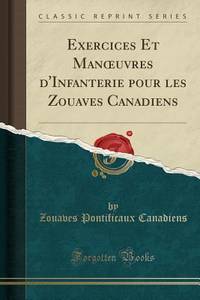
7 résultats
1391331451.Gpaperback. Good. Access codes and supplements are not guaranteed with used items. May be an ex-library book. paperback
1396204733.Ghardcover. Good. Access codes and supplements are not guaranteed with used items. May be an ex-library book. hardcover
1016931484.Ghardcover. Good. Access codes and supplements are not guaranteed with used items. May be an ex-library book. hardcover
1396556389.Ghardcover. Good. Access codes and supplements are not guaranteed with used items. May be an ex-library book. hardcover
1918137570La Maison française d'Art et d'Edition 1918. Paperback. <b>Livre en français</b>. Couverture souple. Broché. 165 pages. Papier bruni. Rousseurs à la couverture. <i>ref. 137570</i> La Maison française d'Art et d'Edition paperback
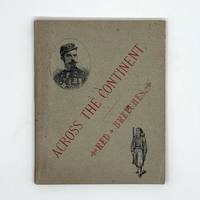
1886370849Elizabeth NJ: Cook & Hall 1886. First edition. Illustrations. 66pp. 12mo. Original wrappers with a portrait of Drake and title in red "Across the Continent. Red Breeches. First edition. Illustrations. 66pp. 12mo. In January 1867 under Commander James Madison Drake veterans of the Civil War were organized into the Veteran Zouaves of Elizabeth. They became a company of the National Guard of New Jersey and were active in the G.A.R. Grand Army of the Republic. The Veteran Zouaves of Elizabeth under Drake were part of Ulysses S. Grant's funeral procession in New York on August 8 1885.<br /> <br /> Among the most traveled ceremonial military unit of their time the Veteran Zouaves went cross-country in 1886 to attend the 20th National Encampment of the G.A.R. in San Francisco. The present pamphlet records their train journey to the Encampment via St. Louis Kansas City Topeka and Los Angeles their role in the grand parade and the return trip. Includes a roster of members. OCLC records but 5 copies. Cook & Hall unknown
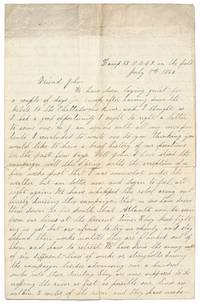
1864438776Atlanta Georgia 1864. Very Good. Autograph Letter Signed. Folio. 4pp. Partial splitting at the edges of one vertical and two horizontal folds about very good. A detailed and historically important long letter written in the field by Union soldier Harvey Rodgers just two weeks before he was killed at the Battle of Atlanta on July 22 1864.<br /> <br /> Rodgers was mustered into service in 1861 as a Corporal in the 54th Regiment Ohio Volunteer Infantry Zouaves Company A commanded by 1st Lt. Judson McCoy referred to as “Jud†in the letter. In the letter written to his “Friend John†on four easily legible folio pages Rodgers describes Confederate and Union Army maneuvers and skirmishes immediately after the Battle of Kennesaw Mountain fought from June 19 – July 2 1864 during the lead-up to the Battle of Atlanta which began on July 21st:<br /> <br /> “… Well John I have stood the campaign well this Spring … We have whipped the rebel army out finely … that is we have drove them so far South that Atlanta can be seen from our lines … I suppose you have heard about our making a charge on the 27th June … I do not wish to be in anymore such places … we lay in camp until the 2nd of July when our Division moved … very near due south of the Kennesaw mountain. That night Jud with our Company was on picket. We heard the cars very plain but did not think they the rebel army were evacuating the mountain and falling back … Next morning … We did not move forward until two o’clock when we advanced our lines two miles finding a small force of Cavalry in our front which we routed by charging them. The Regt. lost 1 killed 14 wounded …â€<br /> <br /> He describes a second skirmish on July 4th at which his Company fought in support of the Union army’s 16th Corps to advance Union lines and continues:<br /> <br /> “… On the 5th we were moved back again and brought further around on the right where we now lay. Our front lines are two miles further on. The rebels have a line of works between them and the Chattahoochee river … I expect we will have a pretty hard time before we get there and a hard time to cross the river …â€<br /> <br /> The Battle of Atlanta commenced on July 21 1864. Both Harvey Rodgers and Union Maj. Gen. James B. McPherson were killed during the battle on July 22nd. Rodgers' letter thus ends poignantly:<br /> <br /> “Well John my time is fast rolling around now and I begin to think I will soon get home again. Only two months and 8 days more … Still in that short time there are many dangers to undergo. I may be called on to go into several more charges. Perhaps of some one not to come out alive … There has not more than half a dozen days passed since the 10th of May but what we have been under the sound of artillery. The troops appear to be pretty well worn out and wish for the campaign to close yet they all want to get into Atlanta first …â€<br /> <br /> A compelling and ultimately heartbreaking eye witness account of General Sherman’s Atlanta campaign during the summer of 1864. Longer quoted extracts from the letter are available. unknown