19 résultats
16479448DB1647. Utrecht Halm 1647. 2 Bl. 12 S. Geheftet. Mit gestochener Titelvignette. Letzte 3 Bl. mit kleinen Fehlstellen kein Textverlust. Durchgehend leicht braunfleckig sonst ein sehr gut erhaltenes Exemplar. unknown
167249633A Paris chez la veuve de Charles Savreux 1672. Bonded Leather. <b>Livre en français</b>. Couverture rigide. Traduits en françois avec une explication tirée des SS. Pères et des auteurs ecclesiastiques. Reliure plein veau d'époque mors fendus coiffes manquantes plats frottés. 783 pages. <i>ref. 49633</i> A Paris, chez la veuve de Charles Savreux hardcover
1681LA - HAY007391681. Paris chez Pierre Le Petit Imprimeur & Libraire ordinaire du Roy. relié plein veau de ce temps là avec 2 fermoirs en laiton complets. Coiffes absentes mors en bon état dos craquelé avec motifs estompés ; page de titre recoupée en marge sinon bonne reliure et intérieur très frais. fort pt in-8. orné d'une vignette en page de titre de bandeaux et lettrines ; dos à 5 nerfs avec caissons ornés de motifs et titre dorés. unknown
1684LA - HAY007381684. Paris chez Pierre Le Petit Imprimeur & Libraire ordinaire du Roy. relié plein veau de ce temps là avec 2 fermoirs en laiton complets. Coiffes absentes mors en bon état dos craquelé avec motifs estompés ; page de titre recoupée en marge sinon bonne reliure et intérieur très frais. fort pt in-8. orné d'une vignette en page de titre de bandeaux et lettrines ; dos à 5 nerfs avec caissons ornés de motifs et titre dorés. unknown
163170298-Kast 5Soest: Davaco 1631 / 1971. Half leren groot folio band met ribben en vergulding. Vele platen. 13 86 pp. Facsimile ed. van de oorspronkelijke editie bij C. Dankerts 1631. In uitstekende staat band heeft heel lichte gebruikssporen. Inleidende tekst in het Engels. Davaco unknown
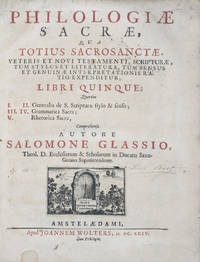
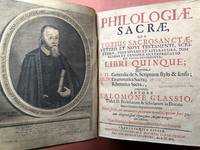
169443223Amstelaedami Amsterdam: Apud Joannem Wolters 1694. Later edition. Hardcover. poor to g. Quarto 10 x 8". 72 1001 103pp. Contemporary blind-stamped full calf with gold lettering to spine. Raised bands. Engraved frontispiece portrait of the author unsigned. Title page in red and black lettering. Title vignette. Decorative initials and tailpieces. <br /> <br /> Originally published in 1623 Salomon Glass' magnum opus "Philologia sacra" marks the transition from the earlier views on questions of biblical criticism to those of the school of Spener.<br /> <br /> Binding darkened and rubbed along edges. Both covers detached but present. Front free endpaper missing. Engraved frontispiece portrait of Salomon Glass detached but present. Contemporary previous owner's name on title and initials at verso of title page. Moderate to heavy foxing and age-toning throughout. Clear water-staining along fore-edge of very first leaves and at lower margin of pp. 337-352. Text in Latin with some Hebrew and Greek. Binding in overall poor interior in fair to good condition. Salomon Glass 1593-1656 was a German theologian Hebraist and biblical critic. Apud Joannem Wolters hardcover
1691H3758Frankfurt and Leipzig: Apud Christophorum Davidem Fleischerum 1691. Hardcover. Very Good. Published 1691 small quarto 8.75 inches 22 cm old full vellum very good light splitting along front outer joint signs of a label removal to spine probably not institutional but private contents moderately tanned throughout. An impressive looking tome 80 1495 137 pp. This is the author's principal work published first in 1623 and considered a turning point in Biblical studies and criticism moving the entire field in the direction of Lutheran theologian Phillip Spener the Father of Pietism the principal arguments of which is to place individual faith and piety as central to Christian theology and pedagogy. Glassius also was a linguist and did much work on Hebrew especially its variations and various cognates. Apud Christophorum Davidem Fleischerum hardcover
169415551Amsterdam: Apud Joannem Wolters 1694. Hardcover. Good. Amsterdam 1694 1653. Heavy vellum binding. Spine labeled in contemporary ink. Chip to front endpaper. A tight copy in good-very good vellum binding. Text is also good with a few marginal notes. Small former owner notes on margins of title page. 1495 oages and INDICES Speciales TTOTIUS PHILOLOGIAE S.: I. Locorum Scripturae; 2. Verborum & rerum praecipuarum; 3. Vocum Graecarum & Ebraearum. Salomon Glass 1593-1656 was a German theologian Hebraist and biblical critic.He played a role in the Syncretistic Controversy. His principal work Philologia sacra 1623 marked the transition from the earlier views on questions of biblical criticism to those of the school of Spener. It was more than once reprinted during his lifetime. As a student of theology under Johann Gerhard he directed his attention especially to Hebrew and the cognate dialects; in 1619 he was made an “adjunctus” of the philosophical faculty and some time afterwards he received an appointment to the chair of Hebrew. Apud Joannem Wolters hardcover
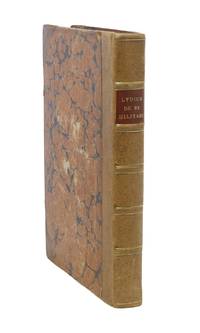
1698128079Dordraci Dordrecht: apud Cornelium Willegardum Bibliopolam 'apud Nicolaum Vries' to rear 1698. First Edition. Hardcover. Very Good. 19th-century marbled paper-covered boards and tan calf corners recently rebacked in tan speckled calf with raised bands and dark red morocco gilt label edges very lightly sprinkled red. Boards rubbed corners worn nonetheless in very good shape and showing well. Contents generally clean and bright just a couple of small closed marginal tears; a very minor paper flaw at the bottom edge of pp.89-90 not affecting text; some very occasional spotting a few small stains to engraved title and some very light marginal smudges. Also: there's an old Oxford University bookplate to front paste-down. Size: 4to 250mm x 200mm; collation: pp. xxviii 338 56 xxviii 12 plates 4 of which are folding. Additional engraved title-page woodcut device to title-page and further woodcut head- and tail-pieces and initials generous margins. Thus a very presentable First edition of Lydius's 1610-79 posthumously published work on ancient military science. Brunet 29046. apud Cornelium Willegardum Bibliopolam ('apud Nicolaum Vries' to rear) hardcover
169828791698. : 75 . 2 Blank pages / 1 Blank pages / 34 NNP / 338 Pages / 56 Pages / 28 NNP / 2 Blank pages / 8 Engraved Plates / 4 Folding Plates Binding: Contemporary Half Leather Octavo 8vo Height cm: 225 CM Width cm: 18 CM Thickness cm: 35 CM hardcover
166448776Nürnberg Endter & Wolfgang 1664. Folio. Contemp. full calf. Raised bands spine richly blindtooled titlelabel. A tear to fronthinge at upper compartment. Some scratches to covers. Firt inner hinge broken and inner backhinge weak. halftitlepage with a tear no loss of text. Engraved titlepage. Printed titlepage in red/black. 141834 pp. Indexes. Internally clean. hardcover
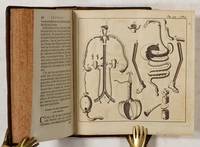
1684540221684. Journal des Scavans 11. - A Amsterdam Chez Pierre le Grand M.DC.LXXXIV 1684 404 18 pp. 12 z.T. gefalt. Kupferstichtafeln Halbledereinband d.Zt. First Edition! The first material model of the blood circulation was produced by the German Salomon Reisel 1625-1701. "Let's examine Reisel's Statua more closely probably the most spectacular item in the list. As it appears from his 1693 essay in Miscellanea curiosa unlike Jacques Vaucanson with his duck Reisel wished to build the Statua but he did not actually do so; rather he discussed the most appropriate materials for its construction such as the skeleton of wood or iron the blood vessels near the heart of elder- tree and as Luigi Belloni has emphasized the pineal gland of conical glass or crystal held by a silk thread inside a spherical glass globe. Reisel's remarkable plates show the kidneys bladder sphincter penis and larynx. Reisel discussed digestion and the filtration of urine but his primary aim was to convince the skeptics of the truth of the circulation of the blood which he illustrated with the detail of blood squirting out of openings in the foot and hand. It would be reductive to take Malpighi's examples as mere marvels or even instantiations of anatomical structures. It has not been sufficiently appreciated that Malpighi framed his examples as part of a general reflection on pathology as well as physiology thus extending the notion of nature's uniformity from machines to organs and from healthy to diseased states. Malpighi's anatomical publications and medical consultations display his chymical and mechanical thinking in understanding many of the operations described by Reisel's machine and of the related diseases. In De polypo cordis for example he reported several experiments based on aspersing different chemical on blood poured in a vessel in order to ascertain their properties. Malpighi was especially concerned with the change of color and fluidity of blood arguing that those chemicals making the blood more fluid would be potentially effective against affections decreasing the blood's fluidity such as the plague. His experiments pointed to a therapy though one none of use would be eager to test. Similarly in a medical consultation of 29 March 1687 for a case of gout he sought to explain what happens inside the body the cause of the disease being an excess of acids in the chyle. Then he also stated: "All this can be seen in proportion also mechanically mixing spirit of vitriol or another acid that is especially austere with different fluids." In this passage Malpighi used the term "mechanically" rather broadly in conjunction with a chymical operation. It is especially significant from our perspective that he reproduced in vitro processes occurring inside the body in order to investigate disease and to devise suitable therapies. This consultation echoes Malpighi's description of Reisel's Statua thus providing strong evidence that he envisaged it as a material device and interpreted it - unlike Reisel himself - from a pathological and medical standpoint as well." Machines and the Body between Anatomy and Pathology Domenico Bertoloni Meli Reisei Salomon. "Mediziner. 24. 10.1625 Warmbrunn Schlesien t 21.11.1701 Stuttgart; studierte 1645-52 in Straßburg und Basel praktizierte 1652-55 in Ottweiler bei Saarbrücken und war 1655-60 Hofarzt in Saarbrücken unter Graf Johann Ludwig von Nassau-Saarbrücken sowie Erzieher des ältesten Grafensohnes. 1657 wurde er in Basel promoviert. 1660-68 war er Leibarzt in Buchsweiler unter Graf Friedrich Kasimir von Hanau dann Hof- und Leibarzt in Hanau. 1674-79 Stadtphysikus in Worms. 1679-1701 Leibarzt und Rat der württembergischen Herzoge in Stuttgart. 1674 wurde er in die Deutsche Akademie der Naturforscher Leopoldina aufgenommen. Reisel war latrophysiker und früher Anhänger William Harveys. Er wurde durch seine Suitmi hunuma circuUituria 1674 bekannt. ein erstes Modell des Blut- und Säftekreislaufs das er aus dem Prinzip des Siphons Hebers entwickelte." Deutsche Biographie unknown
1685JLOebSOL70Amsterdam: '5445' ie. 1684 or 1685. 1685. folio. ff. 224. Hebrew title within elaborate woodcut border. woodcut ornaments & title vignette. 2 columns. Hebrew text. contemporary vellum overlapping fore-edges lacking rear endleaves Hebrew title repaired at lower & gutter edge some light browning. Third Edition including the second edition of the super-commentary Leket Shikchah first printed in the 1660-61 edition by Jacob Abendana Haham of the Spanish and Portuguese Synagogue London 1681-85. Amsterdam: '5445' [ie. 1684 or 1685]. hardcover
16646997Rouen: The Hague: Elzevier Lo¸ys du Mesnil 1664. 12mo 5 x 2æ in.; approx. 13 x 7 cm. 288pp. Bound by Chambolle-Duru signed and dated 1865 in full red morocco the covers framed by triple gilt fillets with ornamental corner sprays of scrolling volutes dots and star tools; spine in six compartments with five raised bands lettered and decorated in gilt. Title with woodcut ornament woodcut initials and typographical head-pieces; early armorial bookplate of Comte Joseph de Lagonde. Doublures in striking citron oak-toned / light mustard morocco richly inlaid with shaped red and green morocco onlays and elaborately tooled in gilt with interlaced strapwork volutes dots and stars; marbled endpapers and fly-leaves; all edges gilt. Tabarin was the stage name of Anthoine Girard c.1584ñ1633 the famed Parisian street performer whose comic dialogues circulated widely in pirated editions. This Rouen issue is a pirated reprint of the Geuffroy 1627 text notable for the first appearance of the second part of the Farces Tabarinques and the inclusion of Les Avantures et Amours du Capitaine Rodomont while omitting the Rencontres of Gratelard. Housed in a later marbled board slipcase with morocco front edges. A crisp jewel-like example of late 19th-century Parisian decorative binding. Fine. [The Hague: Elzevier] Lo¸ys du Mesnil unknown
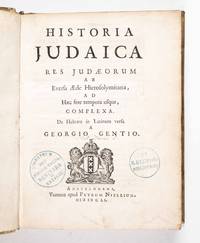
165149175Amsterdam: Pieter Niellius 1651. First edition. Hardcover. Very Good. Small quarto. aster.-2aster.4 A-3M4 = 240 leaves. 16 464pp. Contemporary Dutch vellum very slightly bowed panelled in blind with central stamped vignette spine with raised bands and elegant calligraphic title. Title vignette depicting the arms of Amsterdam. A few old marginal annotations. Various old library stamps at title and bottom margins of two text leaves that on the final leaf bleeds through to text on recto. A very good copy text clean and fresh throughout attractively bound.<br /> <br /> First Latin edition of this late medieval chronicle of Jewish history "one of the outstanding achievements of Hebrew literature in the Renaissance" Enc. Jud. reprinted in 1680 under the Hebrew title Shevet Yehudah The Tribe of Judah. First published in Hebrew at Adrianople in 1554 it was followed by various Hebrew or Yiddish Judaeo-German editions prior to Gentius' version; a Spanish version appeared at Amsterdam in 1640.<br /> <br /> During the 1520s Solomon ibn Verga 1460-1554 wrote his Shevet Yehudah The Tribe of Judah a compilation of accounts of the persecutions undergone by Jews from the destruction of the Second Temple until his own day. At times the author intersperses the historical account with disputations and deliberations of which some are authentic and others imaginary. The author drew his historical material from Josippon the Sefer ha-Kabbalah of Abraham ibn Daud from the narrative of Nathan ha-Babli and from Maimonides’ letters including Iggeret Teiman. He also utilized a brief Hebrew chronicle dealing with the general expulsions and religious persecutions probably that of Profiat Duran and consulted the writings Isaac Abrabanel. For his own period he mentions some of the events which he heard of or witnessed and for which he is sometimes the only source. The work has special importance in the annals of Jewish historical thought. The thoughts and reflections which the author interweaves in his imaginary discussions that is in the literary and not the historical section of the work reflect his dissatisfaction with the traditional outlook and opinions of the Middle Ages.<br /> <br /> The Orientalist and diplomat Georg Gentius 1618-1687 was born in Dhame Saxony and came to study with Heinsius De Dieu Golius and L'Empereur in Leiden as well as the rabbis of Amsterdam. Among the latter Menasseh ben Israel respected Gentius for the courtesy he displayed in his scholarly and personal dealings with the Jews and asked him to complete a Latin translation of the Shevet Yehudah which he himself had begun. With this publication dedicated to the Hamburg consuls Gentius created a larger public for one of the most fascinating historical works of the Hebrew Renaissance and heralded a new era in Jewish history by its critical and empirical approach to the phenomena of history.<br /> <br /> Provenance: old entry of “Nicol. Nonnea D.†at title leaf. References: EJ 8:1203-05 noting the various editions along with Steinschneider 6982. Fürst 3:474. A. Katchen Christian Hebraists and Dutch Rabbis esp. 247-68: Discussion of Gentius leads into Shevet Yehudah. A.A. Neuman “The Shebet Yehudah and Sixteenth Century Historiography†in: Louis Ginzberg Jubilee Volume English Section NY 1945 253-73. Pieter Niellius hardcover
1619781P24Francofurti: Lucam Jennis 1619. Vellum. Good. 6" by 4". Not Stated. A Latin heraldic work on the insignia of European rulers a notable copy from the library of William Beckford the important English novelist. In the original Latin.From the library of William Beckford. In pencil above the bookplate 'Mr. Beckford's copy from sale of his library - 1883'. As per 'The Hamilton Palace Libraries Catalogue of the Third Portion of the Beckford Library Removed From Hamilton Palace' this book was sold as lot 63 referenced on page 5 of the volume.William Beckford was an English novelist who is best known for his Gothic novel 'Vathek' and for his buildings now lost Fonthill Abbey and Lansdown Tower which is also known as Beckford's Tower in Bath. He was a noted patron of the arts well regarded for his beautiful art collection.The basis for Beckford's library at Fonthill Abbey came when he purchase the complete library of the historians and politician Edward Gibbon.Illustrated with two-hundred in-text engraved emblems.Collated complete.A fascinating study on the insignia of European rulers before the seventeenth century a concise work on the emblems and heraldic devices.By Salomon Neugebauer.Derived from an earlier work by Jacobus Typotius.Bookplate of Hubert John Elliot to the front paste down.Blindstamp of Neatham Mill Library to the rear paste down. In the original limp vellum binding. Externally with some discolouration and marks as is usual with vellum. Ink to the backstrip. Boards have sprung. Bookplate and pencil note to the front paste down. Blindstamp to the rear paste down. Prior owner's ink inscription to the recto to the front endpaper. Internally firmly bound. Pages are lightly age-toned and generally clean with some spots. Small chip to the tail of leaf Y1. Good Lucam Jennis hardcover
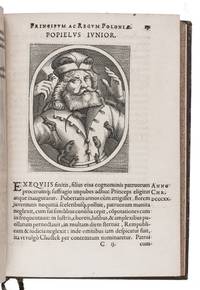
1620D7RBORMFQHCTFrankfurt am Main: Jacob de Zetter Hartman Palthenius 1620. 18th-century gold-tooled calf red sprinkled edges. Small 4to 20 x 14.5 cm. With an engraved title page and engraved portraits in the text. 3 works in 1 volume. With:2 SICCAMA Sybrand editor. Lex Frisionum sive antiquae Frisiorum leges a reliquis veterum Germanorum legibus separatim aeditiae & notis illustratae.Franeker Johannes Lamrinck 1617.3 VENICE. Risposta in difesa delle ragioni del. ser.mo Arciduca Ferdinando contra il manifesto publicato per la Republica di Venetia per occasione della presente guerra. Con l'oratione di Lodovico Eliano oratore di Lodovico XII. re di Francia havvta da lui contro la medesima Republica in augusta nel convento de' Prencipi di Germania alla presenza dell' imperatore Massimiliano I l'anno 1510. Italy Con Licenza de' superiori 1617. Three works from the early 17th century bound together. The first work is a popular illustrated history of Poland with portraits of monarchs theologians and emperors each with a short biography added by Salomon Neugebauer 1611-1654.The second work is the first edition edited by the jurist Sybren Siccama 1571-1622 of a legal work with the laws of Friesland. The first edition based on a now lost manuscript was printed in 1557.The third work is a rare anti-Venetian pamphlet in Italian written on the occasion of the Uskok War 1615-1618. This war was waged by Venice against a group of Balkan pirates Uskoks or Croatian-Habsburg soldiers which was stationed by the Habsburg ruler Archduke Ferdinand of Styria 1578-1637 later Ferdinand II along its frontiers as part of its military borders. The Venetian-Habsburg conflict eventually involved troops from all-over Europe with Venice the Dutch United Provinces and England on one side and the Austrian and Spanish Habsburgs on the other. The pamphlet includes an anti-Venetian Latin oration given in Rome by the French diplomat Louis Hélian in 1510.Tear in one leaf of the second work otherwise in very good condition.l Ad.1: BLC STC German 17th cent. N-136; Czapnik Rare Polonica 340; Hoskins 694; VD17 23:247745G; ad 2: cf. V.d. Aa XVII p. 645; NNBW VI col. 1239; ad 3: WorldCat 6 copies. Jacob de Zetter, Hartman Palthenius, unknown
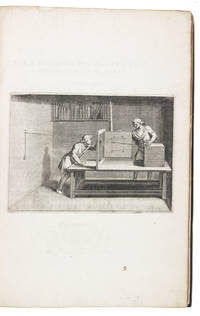
161214945London 1612. Royal folio 52 x 28.5 cm. John Norton printed partly by Jan Mommaert the elder in Brussels and partly by Richard Field in London Contemporary dark brown calf. Rebacked restored and with new endpapers. With an engraved architectural title page with Athena and Hermes representing wisdom and commerce a male and female satyr flanking the title four putti at the top with a sphere made from 12 stars arranged like the sides of a dodecahedron the authors device shown alone in the last illustration the 5 geometric solids and drafting and measuring equipment and 80 etched and engraved illustrations: 64 on otherwise blank pages mostly on integral leaves 2 across double-pages further mostly full-page and 16 on the text pages from small to half-page. The book has no letterpress page or leaf numbers but when a large engraving appears on a recto it usually has an engraved leaf number not a plate number that counts the books leaves beginning with the second leaf of quire a. Further with woodcut head- and tailpieces and dozens of woodcut decorated initials 6 series. engraved title 5 49 16 ll. including engravings. First edition of a famous and original treatise on perspective by the prominent mathematician Salomon de Caus 1576-1626 here in the very rare issue with the imprint of John Norton in London alone in 1612 with the name and date revised in the title-plate. The ESTC records 1611 London and 1612 London/Frankfurt issues of Caus's Perspective but not the present 1612 London issue.Caus was renowned as an inventor of mechanical devices both utilitarian and entertaining. His present work clearly explains and illustrates all aspects of perspective drawing including intricate projections optical illusions shadows anamorphic images and the mirroring of objects. With 2 contemporary perspective construction drawings in the foot margin of one page and some manuscript annotations. One plate has two small abrasions in the corner but the book is further in very good condition with only some small marginal tears and minor marginal water stains. Binding rebacked and restored so structurally sound. A very rare issue of the first edition of a classic work on perspective with 81 beautiful engravings.l Berlin Kat. 4706 not noting the Frankfurt imprint but listed in ESTC as the London/Frankfurt issue; ESTC S124665 1611 London issue & S122163 London/Frankfurt issue; STC 4868.7 1611 London issue & 4869 London/Frankfurt issue; Vagnetti EIIIb7: opera molto chiara splendid work the present 1612 London issue; VD17 1:080353E London/Frankfurt issue; not in BAL; Fowler; Millard but mentioning the London/Frankfurt issue under British 268. ABE CAT Art History unknown
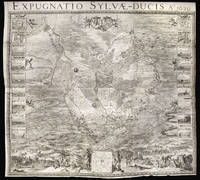
163114959Amsterdam: H.J. Van Wouw 1631. 1274 by 1405mm. 50.25 by 55.25 inches. Engraved wall map on six sheets joined eighteen inset views of the battle and siege works to left and right of the map. Large separately published six sheet map of the Siege of 's-Hertogenbosch during the Eighty Years War. <br/><br/>Hostilities between the Habsburg Empire and the Dutch Republic resumed in 1621 following the ending of the Twelve Years' Truce. The Habsburgs tried to punish the rebellious Dutch Republic by cutting it off from its hinterland by a land blockade. The blockade caused an economic crisis for the Republic and it reacted by trying to harm Spain in its colonies. In 1628 one of the many schemes undertaken met with spectacular success when Admiral Piet Hein of the Dutch West India Company captured the Spanish treasure fleet. With this windfall from the Stadtholder Frederick Henry decided to break the Habsburg blockade by launching a campaign against 's-Hertogenbosch. <br/><br/>'s-Hertogenbosch also known as moerasdraak swamp dragon was the main fortress in the Spanish blockading line and enormous sums of money had been poured into the improvement of its defences. As the ground surrounding the city was a marsh the city was generally deemed to be impregnable as the water-saturated soil seemed to make an application of current siege methods such as trench-digging and undermining impossible. <br/><br/>The Siege <br/><br/>Frederick Hendrik laid siege to the city in April 1629 with an army of 24000 infantry 4000 cavalry and 4000 peasants. He quickly set up a circumvallation and ordered the diverting of the two main streams feeding the swamps the Dommel and the Aa around the city by means of a forty kilometer long contravallation consisting of a double dike which completely enclosed the fortress; having thus created a polder he began to drain it by the use of horse drawn mills. After the soil had sufficiently dried out his siege trenches could begin to approach the city walls. So impressive were the siege works that noblemen travelled from throughout Europe to see them. <br/><br/>Attempts by the Habsburgs under the command of Hendrik van den Bergh Frederik's cousin to relieve the city proved unsuccessful as the circumvallation proved too strong and Frederik's forces dug themselves ever closer to the city along the southern road from the direction of Vught continuously bombarding the defences. During the siege 28517 cannonballs were fired. On 18 July the large Fortress Isabella fell followed the next day by Fort Anthony. Despite repeated sallies by the 2500 men of the garrison the attackers slowly worked their way to the southern city gate. There they undermined Bastion Vught; in the early hours of 11 September a massive explosion caused a large breach in the ramparts. On 14 September its military governor Anthonie Schetz surrendered the city. <br/><br/>The fall of 's-Hertogenbosch was an enormous blow to the prestige of the Spanish monarchy and the worst defeat in the North since the Spanish armada in 1588.3 As a result their position in the North would soon crumble and Frederick Henry encouraged by the success would start a series of other sieges assisted by his cousin Van den Bergh who changed sides after being accused of treason. <br/><br/>The Map <br/><br/>The map on six sheets provides a complete narrative of the siege; to the left and right are 18 inset views nine on each side for seige works dikes and principal forts. To the foreground two figures of Mars and a river god hold up a plan of the city. A group of figures to the lower right depict from right to left Frederick Hendrik surveying the battle field the artist Adriaan van de Venne who turns his head to the viewer and was responsible of the figurative work on the map and the military engineer and author of the map Theodoor Niels who is shown seated consulting a map. Beyond the immediate foreground several battle scenes are shown depicted various stages of the siege. To the centre of the map 's-Hertogenbosch is shown surrounded by the extensive siege works the circumvallation line is clearly marked - a chain of small and larger fortifications connected with a continuous parapet - designed to withstand a relief attempt from the outside and the smaller contravallation line and dike which Hendrick used to drain the swamp. Prominence is given to the Dutch camp at Vught south of the city. The intricate trench works so vital for victory are meticulously delineated and the breaching of the city wall is clearly marked. All prominent landmarks and aspects of the siege are marked by a number that correlated with an explanatory text which accompanied the map. <br/><br/>The author of the map was Theodoor Niels a military engineer in the Dutch army. Niels together with Jan Adriaansz Leeghwater whose water mills and dike work had managed to dry the land surrounding the city were the leading military engineers at the siege. Niels was principally responsible for the construction of the extensive trench network which meant spending a great deal of time on the frontline; a fact that almost cost him his life when on the night of the 22nd June 1629 the defenders exploded a mine under one of his trenches burying him alive. Assumed death he was only rescued when his head and hands were spotted poking out from beneath the rubble. He was fated as a hero and awarded a gold medal for his bravery. Unfortunately his luck would eventually run out when in 1633 he was killed during the battle of Rijnbeek. <br/><br/>On December 7th 1629 the States General recognized Niels vital role by not only awarding him a gold medal and a substantial cash sum but also granting him a privilege of four years in order to produce a great map of the battle. <br/><br/>To enable him to complete the task Niels employed some of the leading artists and engravers working in Amsterdam at the time. These included: the figure and genre painter Adriaan van de Venne who was responsible for the scenes in the foreground and whose sketches would be engraved by Salomon Savery; the plan of the siege would be completed by Balthasar Florenz van Berckenrode whose monumental wall map of Amsterdam published in 1625 had met with such great praise and whose map of Breda of 1637 bears striking similarity to the present work. <br/><br/>Rarity <br/><br/>We are only aware of four institutional examples all of which are located in the Netherlands: Leiden University Library; Amsterdam Rjksprentenkabinet; Dordrecht Museum Simon van Gijn; and Rotterdam Atlas van Stolk. H.J. Van Wouw, unknown