Umkreis Salomon Gessner:Livre Rare Book

243 résultats
17501828AGum 1750. Öl auf Leinwand. 15,2 x 23,2 cm.
1799CLL-773Paris, Antoine-Augustin Renouard, 1799 4 volumes in-8 de XII, 319 pp. - (2) ff., 282 pp. - (2) ff., 264 pp., (1) f. - (2) ff., 295, (1) pp., maroquin rouge à grain long, plats ornés d'un décor de filets dorés, de pointillés et de fleurons dorés, dos lisses ornés au centre d'un décor à mille points et en tête et en queue d'étoiles dorées petites et grosses, coupes et bordures décorées, tranches dorées (reliures de l'époque).
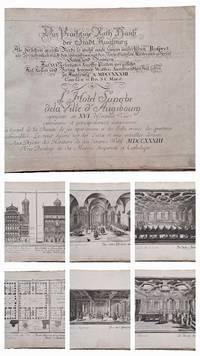
17331602202271<p>Kleiner Salomon / Pintz Johann Georg engraver.</p><p>Das Prachtige Rath-Hauss der Stadt Augsburg / L'Hôtel Superbe de la Ville d'Augsbourg.</p><p>Augsburg: Jeremias Wolff's Heirs 1733.</p><p>Folio approx. 29 × 42 cm. Complete with engraved title and 16 finely executed copper plates.</p><p>Magnificent architectural suite depicting the celebrated Augsburg Town Hall one of the most beautiful civic buildings of the German Baroque. The engravings executed by Johann Georg Pintz after drawings by Salomon Kleiner 1700–1761 present the exterior and richly decorated interiors of the Rathaus including the famed Goldener Saal Golden Hall and princely chambers. Parallel German and French text engraved throughout.</p><p>Collation of plates complete 16 total:</p><p>1. Engraved title page German–French</p><p>2. I. Prospect des schönen Rath-Hauses zu Augsburg General View</p><p>3. II. Zwey Profille des schönen Rath-Hauses zu Augsburg Two Cross Sections</p><p>4. III. Grund-Riße von dreyen Etagen des Rath-Hauses zu Augsburg Three Floor Plans</p><p>5. IV. Das untere Pfletsch oder Saal Entrance Hall with Staffage</p><p>6. V. Die Fürsten-Stube gegen dem Perlach-Platz Princely Chamber toward Perlach Square</p><p>7. VI. Die Fürsten-Stube gegen St. Peters Kirchen Princely Chamber toward St. Peter's Church</p><p>8. VII. Die Gericht-Stuben Courtrooms</p><p>9. VIII. Die Bau-Stuben / Daß Pfleg-Ampt Construction and Administration Rooms</p><p>10. IX. Daß Vor-Zimmer / Die Steuer-Stuben Antechamber and Tax Offices</p><p>11. X. Der große so genandte Guldene Saal auf dem Rath-Hauß zu Augsburg The Great Golden Hall folded plate</p><p>12. XI. Der große Guldene Saal im Grundriß mit A. bezeichnet Golden Hall Plan A</p><p>13. XII. Der große Guldene Saal im Grundriß mit B. bezeichnet Golden Hall Plan B</p><p>14. XIII. Die Erste Fürsten-Stuben First Princely Chamber</p><p>15. XIV. Die Andere Fürsten-Stuben Second Princely Chamber</p><p>16. XV–XVI. Die Dritte und Vierte Fürsten-Stuben Third and Fourth Princely Chambers</p><p>Condition: Complete copy. One plate misplaced bound out of order. Small expert restoration of a pinhole in one plate. Some plates lightly dusty; minor water staining to upper right corner not affecting image areas. Binding worn and requires restoration or replacement but the interior plates are generally clean well-printed and strong impressions throughout.</p><p>References: Katalog der Ornamentstichsammlung Berlin 2118; Schefold Bayerisch Schwaben p. 184; Thieme/Becker XX 452 f.</p><p>A complete and well-preserved example of this rare and important architectural series — one of the most impressive engraved monuments to Baroque civic architecture in southern Germany.</p> Jeremias Wolff’s Heirs
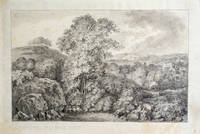
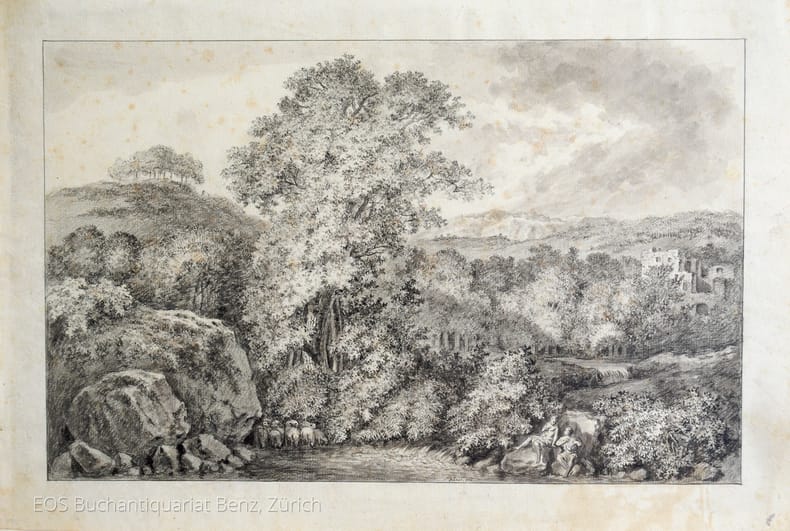
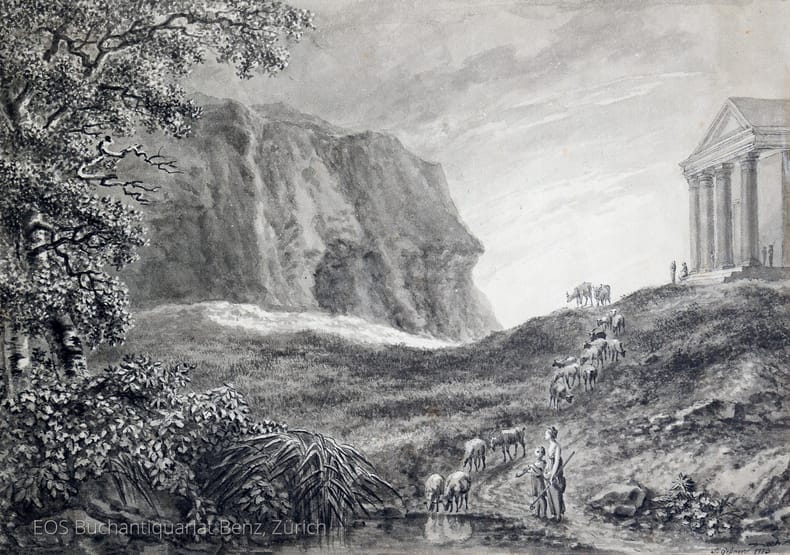
17751821AG1775. 1775. Lavierte Tuschzeichnung. Blattformat: 324 x 478 cm. Tuschzeichnung: 264 x 418 cm. Unten in der Mitte vom Künstler signiert «S. Gessner. 1775». Das Papier etwas stockfleckig. Kunsthaus Zürich 1930 Katalog-Nr. 741 Tafel XVI. unknown
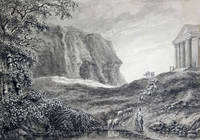
17731823AG1773. 1773. Lavierte Tuschzeichnung mit weiss gehöht. 224 x 32 cm. Unten rechts vom Künstler signiert «S. Gessner f.». Leemann 1930 S.322 Antike Berglandschaft. unknown
17751821AG1775. Lavierte Tuschzeichnung. Blattformat: 32,4 x 47,8 cm. Tuschzeichnung: 26,4 x 41,8 cm.
17731823AG1773. Lavierte Tuschzeichnung mit weiss gehöht. 22,4 x 32 cm.
172549774Augsburg 1725. Wahrhaffte und genaue Abbildung sowohl der Keyserl.Burg und Lust-Häuser als andere Fürstl. und Gräfl.Paläste u.schöne Prospecte.Pars secunda Vorsatzbl. Knittrig Johann Andreas Pfeffel Quer-2°. Hldr. Oesterreich unknown
178056257Providence & Philadelphia: March 31 1780. Large folio manuscript approx. 12½" x 36" on 3 conjoined sheets; neat professional repair on the verso at several previous folds else near fine. Signed in the lower left corner by Charles Stewart Esq. Commissary General of Issues Philadelphia; and in the lower right corner by Solomon Southwick D.C.G. dated Providence March 31 1780 "errors excepted." The document is in tabular form with vertical columns listed for flour bread loaf and hard salt beef salt pork fat cattle dry fish rice beans & peas roots molasses rum soap candles salt vinegar neats tongues hams pickled fish onions sheep coffee and sugar with monthly distributions for each six months inclusive for the last quarter of 1779 to the end of the first quarter in 1780 in casks barrels half-barrels pounds bushels gallons kegs quarts bags etc. A second table using the same criteria is underneath the first and accounts for a General return of provisions & stores sent from one post to another in the Rhode Island Department. On June 10 1777 Congress passed a bill outlining how the army of the United States was to be supplied with provisions. One Commissary General and three Deputy Commissaries General of Issues were appointed by Congress and the Deputy Commissaries General had the authority to appoint as many assistant Commissaries to act under them as necessary. Solomon Southwick the Rhode Island printer was acting here as a one of Deputy Commissaries General. The Journals of Congress June 10 1777 article XXXII note: "That each deputy Commissary general of issues shall from the monthly returns of the assistant commissaries make out a general return for the district specifying what remained in the magazines or stores at the last return; what has been received since; the number of rations and quantity of provisions issued and what remains in store distinguishing the several posts places magazines and regiments of corps as aforesaid; one to be sent to the Board of War one to the commander in chief one to the commander of the department one to the commissary general of purchases and one to the commissary general of issues." Solomon Southwick II 1731-1797 was the father of the erstwhile Newport and later Providence printer and newspaper editor Solomon III. He also was a printer and the publisher of the Newport Mercury which he had purchased from the heirs of James Franklin. He was a member of the first graduating class of the College of Philadelphia now the University of Pennsylvania. In 1778 he was appointed Deputy Commissary General responsible for obtaining and distributing food clothing and other supplies to Continental Army soldiers in Rhode Island. <br/><br/> March 31 hardcover books
178632947-1233Paris l'Auteur des Estampes Veuve Hérissaut & Barrois l'ainé 1786-93. With 2 engr. frontispieces 3 engr. titles 72 engr. plates and 70 vignettes engr. after Le Barbier by Bacquoy Dambrun Godefroy a.o. XII pp. 1 leaf 215 pp.; 182 pp.; 236 pp. Large 4to. Contemp. calf gilt lettering on spine all edges gilt marbled endpapers slightly rubbed. Paris l'Auteur des Estampes Veuve Hérissaut & Barrois l'ainé 1786-93. One of the most beautiful 18th-century de luxe editions in France of Salomon Gessner's 1730-1788 complete works with the charming illustrations by Barbier. Gessner's friend Michael Huber 1727-1804 Henri Meister and Bruté de Loirelle were responsible for the translation. At the end of volume three are two letters by Gessner addressed to Barbier concerning the illustrations and the translation. Barbier had dedicated this work to Madame de Genlis and Gessner expressed his pleasure about this gesture. - Nice copy. - Leemann-van Elck Gessner p. 691; Cohen/de Ricci 433; Lewine 209; Sander 786. LITERATURE: FRENCH ; HELVETICA: ALLGEMEIN ; LITERATUR: FREMDSPRACHIGE ; Paris, l'Auteur des Estampes, Veuve Hérissaut & Barrois l'ainé unknown
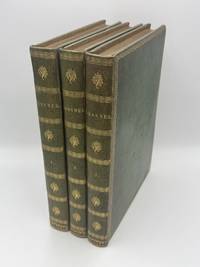
178688943la veuve Herissant Barrois l'aîné | Paris 1786 - 1793 | 22 x 30.4 cm (Grd. In-4) | 3 volumes reliés
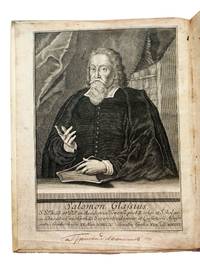
17431935Lipsiae Leipzig: Apud Jo. Fridericum Gleditschium By Johann Friedrich Gleditsch 1743. 18 6-32 16 2138 columns i.e. 1069 pp. 107 pp. Quatro 23 x 18 cm. Edition novissima New edition. Copper engraving of the author's portrait on the frontispiece. Period vellum with embossed gilt spine. Engraved decorative headpieces tailpieces initials. In Latin some Hebrew and Greek.<br /> <br /> Good condition. Slight damage to the top of the spine. Bookplate pasted down to the front endpaper. Library number in ink on the title pre-revolutionary library stamp on the title and cols. 43-45 305-306 589-590 793-794 1037-1038 1293-1294. Ink and pencil numbers on the front and back endpapers. Minor foxing. Owner's marks on the first pages. Marginalia in ink on col. 1915.<br /> <br /> The inscription on the bottom margin title p. 1 3 5 7. reads Ex libris Nicolai Chanenko Signiferi Generalis i.e. From the books of Mykola Khanenko the Grand Standard-Bearer.<br /> Mykola Khanenko 1693 - 1760 was a prominent Ukrainian politician scholar and writer. Starting his military career at 17 under Peter the Great Khanenko rose from a scripture to the one of the most respected titles in the army. He became what is known as khorunzhiy an officer responsible for bearing the standard for the Getman's army. Grand Standard Bearer was an official title in the Zaporozhian Cossack army and was a high official rank.<br /> Khanenko meticulously studied for years - first in Kyiv Academy in Lviv later on his own: he was a proponent of something known today as lifelong education. He became a polyglot keen in Latin wrote poetry in different languages and translated Latin books into Russian.<br /> This attentiveness and encyclopaedic education made him a person close to the Getman figure: he was akin to procurator for both Ivan Skoropadsky and Pavel Polubotok. Polubotok and Khanenko were imprisoned by Peter the Great for a number of years after submitting a plea to choose a new Getman in a democratic way. Freed in 1726 Khanenko took part in the Russian-Turkish war in Crimea.<br /> <br /> Later Khanenko switched to compiling the Ukrainian Malorossian law codex. His activities and interests do show the reality of Cossack officers: a tough but educated democratic and self-governing community.<br /> Khanenko also left one of the first ever written memoirs on Ukrainian life of the era. He consistently wrote a diary from 1719 to 1754 and it was published a century later Chteniya v Imperatorskom Obschestve. Moskva: V Universitetskoi tipografii 1858. // Diariusch ili Zhurnal. His love for books and interest in religious studies was in detail reviewed by some scientists among which an article inquired in great detail describing the presumably personal library of Khanenko of at least 150 books. His diary notes dozens of Latin books: bought gifted sent for binding translated. Most of those are historical scientific and religious editions Bilokin' S. Knyzhni interesy Mykoly Khanenka // Ï€Ïοσφώνημα. Istorychni ta filolohichni rozvidky. no. 5 pp. 117-124. L'viv 1998. Later the volume left Khanenko family library and for some time was a part of the Novgorodseverskaja gimnazia library. This is shown by the rubber stamp visible across different pages and a librarian inscript - both clearly dated as pre-1917.<br /> The library inscript in walnut ink runs through the bottom margin of the frontispiece p. 1 and p. 3 stating the book "Belongs to Novgorodseverskaja gimnazia". The Novgorod-Seversk gymnasium was a Russian Empire secondary school active 1808-1918 within the modern Chernigov region of the Western Ukraine. The gymnasium is considered one of the oldest schools situated within the historical Ukraine territory with Ukrainian classic writer Panteleimon Kulish 1819-1897 and teacher Konstantin Ushinskiy 1823-1870 among its pupils.<br /> Closer to the modern days during the 20th century the book was a part of Prof. Jurgis BaltruÅ¡aitis 1903-1988 collection. BaltruÅ¡aitis was a son of a known symbolist poet and Lithuanian ambassador in Soviet Russia. He was an art historian specialising in the styles and spiritual phenomena of the Middle Age thus the book suited his collection well. The bookplate depicts his satirical self-portrait.<br /> <br /> Salomon Glass 1593-1656 was a German theologian Jena professor since 1620's specialising in Hebraism. Editor of the Nuremberg Bible. This encyclopaedic Philologia sacra is his major work. With the 1st edition of the 1st vol issued in 1623 the five vols. present in this book were completed by 1636 and subsequently reissued a number of times.<br /> <br /> The work is divided into five parts. Glassius looks into philology as a tool to understand the Holy scripture and describes the methods to use this tool. He provides a system of biblical literature and examines different languages used in them including literal and figurative meanings of the tropes. This systematic approach is considered a great example of the new research practices in theology and the encyclopedia became a classic. Apud Jo. Fridericum Gleditschium [By Johann Friedrich Gleditsch] unknown
178688943Paris: la veuve HerissantBarrois l'aîné 1786. Fine. One of the finest illustrated books of the 18th century bound in contemporary full green morocco. la veuve Herissant Barrois l'aîné Paris 1786 - 1793 22 x 30.4 cm Grd. In-4 3 volumes reliés Deluxe edition superbly illustrated with 3 engraved titles a portrait a frontispiece and 72 figures 4 vignettes and 66 tailpieces all by Le Barbier and engraved by Alix Baquoy Dambrun Delignon Gaucher Giraud le jeune Godefroy halbou Langlois jeune Le Beau Lépine Le Villain de Longueil Pauquet Petit Ponce Taxier Thomas Trière and Viguet. The first plates are numbered and within frames with captions in the lower margin the following ones bear pagination indications. Some plates are dated from 1782 to 1792. Fine printing on vellum. Contemporary full green morocco binding. Smooth spine decorated with 4 cornucopia tools and roulettes. Frame roulette on the boards. Roulette on the leading edges and interior. Pink paper on pastedowns. Edges gilt. Traces of rubbing. Darker areas on the boards of volume 2. Spine uniformly lightened. Scattered foxing. Salomon Gessner; poet painter and engraver rapidly acquired great renown throughout Europe for his Idylls and particularly in France. His lively and simpler prose renewed the genre and the baroque language. He himself published most of his books in his printing house and also illustrated them himself. Besides the Pastorals songs and others the edition contains a selection of letters and a short essay on landscape a genre in which Gessner excelled. The great care brought to the printing to the engravings and the remarkable execution of Le Barbier's drawings have contributed to making this work one of the finest of the 18th century. At the end of volume 3 are found 2 letters from Gessner addressed to Barbier regarding the illustrations the author also expressing his pleasure with Barbier's dedication to Madame de Genlis. la veuve HerissantBarrois l'aîné hardcover
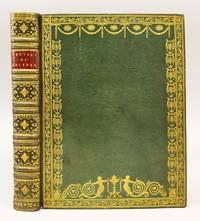
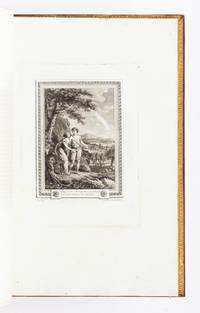
1777ST14864Zurich: Chez l'auteur 1777. First French Quarto Edition. 270 x 200 mm. 10 1/2 x 8". 4 p.l. 184 12 subscribers pp. 1 leaf advice to binder 1 leaf blank 190 pp. 1 leaf advice to binder. Two volumes bound in one. Translated from the German by H. Huber. <br/> EXCEPTIONALLY ATTRACTIVE EARLY 19TH CENTURY GREEN STRAIGHT-GRAIN MOROCCO GILT IN A NEOCLASSICAL STYLE IMITATING THAT OF KALTHOEBER covers with scrolling vine frame central panel with sunbursts and swags across the top palmette tools along the sides and a variant of Kalthoeber's mermaids-and-urn tool at foot raised bands spine compartments with central patera surrounded by small tools leaf frond and volute cornerpieces red morocco label marbled endpapers all edges gilt. In a modern green morocco-lipped slipcase. With two engraved titles 40 engraved vignettes and 20 FINE ENGRAVED PLATES BY GESSNER. Front flyleaf with ink inscription to "Henry S. Pakenham / from his friend / Henry H. Evans" see below. For the binding: Compare and contrast Foot Henry Davis Gift II 189; Maggs 1075 no. 219 and 1212 no. 164; Oldaker Collection 21; British Library Database of Bookbindings Shelfmark Davis194. ◆Spine uniformly sunned to olive brown joints and extremities very slightly rubbed a half dozen small indentations to front board occasional faint foxing to edge of margins but an excellent copy of an extremely handsome book clean fresh and bright with ample margins and rich impressions of the engravings and in a well-preserved binding glistening with gold.<br/> <br/> This is a desirable copy of an important late 18th century French illustrated book a happy marriage of fashionable poetry and beautiful engravings in a binding that carefully imitates the Neoclassical designs and tools of master binder Christian Kalthoeber. Gessner 1730-88 was a painter and poet from Zurich who hoped to renew the ancient genre of the eclogue. According to Britannica he was "the most successful and typical representative of a literary rococo movement. His pastorals were translated into 20 languages including Welsh Latin and Hebrew." He was also an equally talented artist and the preface to this book is quick to note that all the etchings are of his own imagination and executed by his own hand. Gessner's close attention to detail and liberal use of dense crosshatching give each plate an intensity that is almost tactile with the pale figures in high relief against the deeply etched dark backgrounds. <br /> <br /> The binding is an excellent imitation of the work of German émigré binder Christian Kalthoeber "considered during his day to be the finest binder in the world" according to Maggs Catalogue 966. One of Kalthoeber's most recognizable designs used on at least seven bindings employed a roll-tool border enclosing a central panel with garlands and pateras across the top palmettes along the sides and at the foot two mermaids with curling tails flanking an urn. Examples of this can be seen in the sources cited above. Here the mermaids are thicker and less refined in form and the tool has been applied at a very slight angle rather than with the precision characteristic of the master. The urn and palmettes too are less expertly engraved and applied and the complex pateras of varying sizes are replaced with simpler one-size starburst ornaments. Our binder was talented enough to produce an imitation that would stand up to all but the most careful scrutiny; until one sees the binding side-by-side with a genuine Kalthoeber it is hard to register the differences. Perhaps our binder had apprenticed with Kalthoeber for he had certainly had the opportunity to study the tools very closely and he had been trained in a workshop that schooled its apprentices in fine workmanship--if not in professional ethics. <br /> <br /> The inscription notes that this copy once belonged to Henry H. Evans 1836-1917 a member of the Illinois House and Senate who made a name for himself in the ice cream and restaurant business and eventually went on to found two railways following the Civil War. The present item is appealing for its internal and external aesthetics and for the light it sheds on the binding industry and its practices at the turn of the 19th century. Chez l'auteur unknown
17933612Paris: chez Defer de Maisonneuve 1793. Contemporary gold-tooled brown and green mottled calf with red morocco title label lettered in gold gold-tooled board edges and turn-ins gilt edges marbled endpapers. Large 4to. With a stipple-engraved colour-printed frontispiece and 5 stipple-engraved colour printed plates by Colibert Casenave and Clément after the designs of Nicolas Moniau. First edition of Hubert's prose translation of Gessner's celebrated poem Der Tod Abels which was first published in German in 1758. Salomon Gessner 1730-1788 known throughout Europe for literary works of pastoral themes and his rococo style was a bookseller's son and started his career as an apprentice to the bookseller Spener in Berlin. Giving up this employment he lived for a time by painting and engraving. In 1750 he settled in Zurich continuing to live by painting including painting on porcelain. Later he was also a town councillor and a forestry superintendent who also ran an important publishing house from which he published his books with his own excellent etchings. He began to write idylls in poetic prose beginning with Daphnis 1754 and his Idyllen 1756-72 achieved nation-wide success. In Der Tod Abels 1758 he attempted to write an epic in prose in five "chants" quickly becoming his most renowned work and making him the most successful and typical representative of a literary rococo movement. In his idylls Gessner is indebted to Theocritus and Virgil creating an idealized orderly almost horticultural state of nature. The beautiful stipple engraved plates are after the drawings by Nicolas Monsiau. Nicolas-André Monsiau 1754-1837 was a Parisian who attained some reputation as a painter of both classical and modern subjects. He was elected to the Academy in 1789. These scenes were engraved by Colibert Casenave and Clément and printed in colour in one run through the press. The six plates in this copy are in their first state before numbers; two have the artist's and engraver's name; 3 have only the engraver's name.With a small paper library labels on the front board "B 8" and "6" and foot of the spine "207". Further with an inscription on recto of the first blank flyleaf in French and a small oval blue stamp of the library of the St. Elisabeth convent in Heythuysen Limburg The Netherlands on the title-page and p. 91. The binding shows some scratches on the boards the spine is worn but all without affecting the integrity of the binding. Some occasional minor water staining in the top margin otherwise in good condition. A large-paper copy of a rare colour-printed plates-book.l Brunet II 1568; Burch p. 93; Cohen-de Ricci col. 436; Fürstenberg 122 and 205; Ray The Art of the French Illustrated Book pp. 151-2; Sander 780. chez Defer de Maisonneuve, unknown
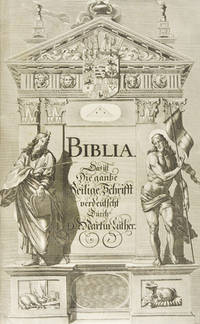
176820419Nürnberg Nuremberg: In Verlegung der Johann Andrea Endterischen Handlung 1768. Later edition. Hardcover. Very good. Three parts folio 17 3/4 x 12". 4: engraved title; main title 12: Preface to the 1736 Second Edition 2: Note to the Christian Reader on this New 1768 Edition 16: Preface to the 1640 i.e. 1641 Edition 2: List of Saxony's Electors pages 11 full-page engraved portraits of the Electors 1: full-page portrait of Martin Luther leaves 8: Short Introduction and Instruction Regarding the Holy Scriptures 2: Calendar 13: General Index 26: Name Index 11: Chronology 1: Personalities in the Maccabean and Herodian Eras 7: Explanations on the Old Testament 5: Charts of calandars weights money measures and distance in biblical times 4: Chronological Order of the Books of the Bible 7: Register/Table of the Old Testament 3: Martin Luther's Preface to the Old Testament; 740 Pentateuch; Former Prophets; Writings; 512 Latter Prophets and Apocrypha; 472 New Testament 473-480 Gospel Harmony 14: Creeds and Augsburg Confession pages. Text in German Gothic script; text within ruled borders marginal column for printed side notes; woodcut initials and ornaments; elaborate woodcut half titles in imitation of calligraphy at verso of initial text leaves for the second and third parts Prophets and New Testament. Complete with 48 copperplate engravings: 12 full-page portraits in the preleminaries Electors and Martin Luther; a full-page depiction of the construction of Noah's Ark; 27 full-page sectional illustrations 20 vignette compositions; 9 portraits of Prophets and Evangelists; 8 double-suite plates biblical lands from Egypt to Babylonia; Egypt and Canaan noting tribal allotments; Canaan in the New Testament era; Greece and Asia Minor with vignettes of the Temple; encampment of the Israelite tribes in the wilderness; bird's eye view of Jerusalem after Adrichem; view of Jerusalem in the New Testament era; Diet of Augsburg with legend.<br /> <br /> Contemporary calf lightly rubbed at extremities with some light scratching at rear board elaborately tooled in gilt depicting a neo-classical sanctuary on both boardsTetragrammaton in pediment on the front a cross in pediment on the rear; exquisite gauffered fore-edges ornamented in gilt against forest green wash depict a sunburst with architectural motifs; gilt turn-ins. Rebacked retaining original spine; endpapers renewed. 15 cm clean tear through text at leaf C4 in the New Testament reparable; final text leaf chipped at bottom edge not affecting text; tears at Diet of Augsburg plate and final text leaf expertly repaired at versos. Overall pages crisp and fresh with mild intermittent toning very occasional light stains and smudges and just a touch of damptstain at fore-edge in later leaves of the New Testament. A very good copy with clean plates in a beautiful magnificent binding complete with the folding plate of the Diet of Augsburg often lacking. Housed and protected in a modern custom red cloth slipcase.<br /> <br /> Final edition of the sumptuously illustrated Kurfürstenbibel Electors' Bible with a full apparatus of introductory and historical materials. Also known as the Weimar Bible it was compiled under the auspices of Ernst I Duke of Saxe-Gotha and Altenburg. Beginning in 1641 all editions were published by the prominent German printing dynasty of Endter. The maps views and illustrated divisional titles by Jacob van Sandrart and others made their first appearance in the edition of 1686. In this latest version the illustrated sectional titles are signed by Johann Chrisopher Claussner and most of the other views lack the signatures found in the 1686 edition. The earlier forewords by Salomon Glass ed. 1641 and Ernst Solomon Cyprian ed. 1736 are reprinted in the present edition.<br /> <br /> The preliminaries feature eleven full page engravings of Saxony's Electors from Friedrich III to Bernhard der Große followed by an engraved portrait of Martin Luther. Often lacking the final fold-out engraving depicts the Holy Roman Emperor and representatives of the German states in a large reception hall during the Diet of Augsburg. Participants are identified in the legend on the facing page. The conference was assembled by Charles V so that the Princes and Free Territories in Germany might explain their religious convictions in an attempt to restore religious and political unity in the Holy Roman Empire and rally support against the Turkish invasion. The consensus of the assembly is expressed in the Augsburg Confession the primary confession of faith of the Lutheran Church and one of the most important documents of the Reformation era. Written in both German and Latin the Confession was presented at the Diet of Augsburg on 25 June 1530; it is the fourth document contained in the Lutheran Book of Concord. References: Bibelsammlung Stuttgart E777; Delaveau & Hillard 16; Cf. Darlow & Moule 4217 note on ed. 1641; 4234 ed. 1736.<br /> <br /> Full title: Biblia Das ist die gantze Heilige Schrift Altes und Neues Testaments. Verdeutscht von Herrn Doctor Martin Luther: Und auf gnädigste Verordnung Des Durchlauchtigsten Fürsten und Herrn Herrn Ernsts Herzogen zu Sachsen Fülich Kleve und Berg von etlichen reinen Theologen dem eigentlichen Wort-Verstand nach erkläret wie hiervon weiter in der Vorrede gehandelt wird. daher über die gewöhnliche mit Fleiß verbesserte Biblische Register unter anderem zu finden ein Bericht von Vergleichung der Jüdischen und Biblischen Monden Maaß Gewicht Müntz und Elen mit den Unserigen: Sowohl auch eine Beschreibung der Stadt Jerusalem samt unterschiedlichen neuen Land-Tafeln und andern schönen Kupffer-Figuren und derselben Beschreibung: Welches alles dem Christlichen Leser zu mehrerm Verstand der Schrifft gute Anleitung geben kan. Zu Ende ist auch nebst den Christlichen Haupt-Symbolis die unveränderte Augspurgische Confession mit beygedruckt worden. Von neuem mit Fleiß übersehen durch fernere sowohl den Verstand als Lutheri Ubersetzung betreffende Anmerckungen erläutert auch mit einer kurzen Anweisung zur Erklärung der Heil. Schrift und andern Einleitungen vermehret. Mit königl. polnischem und Chur-Fürstl. Sächsischem Privilegio. In Verlegung der Johann Andrea Endterischen Handlung hardcover
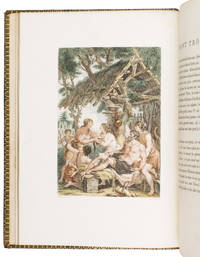
1786ST19671Paris: Chez l'Auteur Veuve Hérissant et Barrois l'aîne 1786-93. First Edition with these Illustrations. 485 x 340 mm. 19 x 13 1/2". Three volumes. <br/> ELEGANT RED STRAIGHT-GRAIN MOROCCO BY BOZERIAN signed in gilt on front free endpaper covers framed by gilt fillets double raised bands separated by a strip of black morocco tooled with gilt chain spine gilt in compartments with a rose or a musical instrument at center turn-ins with gilt arches roll Culot 18 green endpapers all edges gilt. 147 FINE ILLUSTRATIONS AFTER DESIGNS BY JEAN-JACQUES-FRANÇOIS LE BARBIER: three engraved title pages four vignettes 66 tailpieces and 74 leaves of plates including frontispiece portrait of Gessner engraved by Alix Baquoy Dambrun de Longueil et al. ALL IN FIRST STATE those in volumes I and III with original tissue guards. A Large Paper Copy. Cohen-de Ricci 433; Ray 39. For the binding: Culot "Jean Claude Bozerian" roulette #18. ◆Just a hint of rubbing to upper joint of first volume small indent to front cover of volume II occasional mostly marginal mild foxing more frequent in volume II but QUITE A FINE SET clean and fresh internally with beautiful impressions of the engravings and enormous margins in lustrous bindings with few signs of wear.<br/> <br/> This is a sumptuous set approaching 20 inches tall that epitomizes the best in 18th century French book arts: a Large Paper Copy of a book that in Ray's opinion "represents one of the happiest of all collaborations between artist and writer"--all of this in a graceful binding by the preeminent Paris atelier of the day. Gessner 1730-88 was a painter and poet from Zurich who hoped to renew the ancient genre of the eclogue. In his imagined neoclassical world all the shepherdesses are beautiful virtuous and sensitive and the shepherds are always honest and respectful. This struck a chord with illustrator Jean-Jacques-François Le Barbier 1738-1826 who wrote in the dedication "the charm of Gessner's poems filled my imagination and transported it to the happy centuries of the world's innocence." It also inspired him to collaborate with Gessner on this present work. Le Barbier 1738-1826 was one of the first great French neoclassical illustrators and this work is both an important early success in that style and in Ray's words the "most sustained and accomplished series of illustrations" by the artist. Most of Le Barbier's designs for this work are set in the classical world--the exception being "Le Mort d'Abel" based on the story of Cain and Abel in the Bible. There are nymphs fauns and other fantastical creatures mingling with humans in bucolic settings. While Le Barbier illustrates many love scenes they are romantic and wistful rather than passionate; he was a master of nudes but those depicted here seem innocent rather than erotic. As Ray says "Le Barbier's emphasis is on simplicity and naturalness. We are in a different world from the witty gallantry and sophisticated sentiment of the rococo pastoral illustrations." The engravings are characterized by the clarifying use of softly radiant light and by a restrained animation and the book as a whole is "a work of harmonious distinction which admirably realizes the ideals of its author and illustrator." Ray The elegant binding by Bozerian is notable for its refinement and it continues the motif of noble simplicity set by author and illustrator. Jean-Claude Bozerian 1762-1840 was the elder of the Bozerian brothers François is referred to as "le jeune" and was active in Paris from 1795 to about 1810. He began his career in Lyon as an apprentice bookseller printer and bookbinder eventually deciding to focus on the latter craft. Marriage to the widow of binder Pierre Boulier allowed him to establish a binding workshop in Paris where he was joined by his brother. His bindings were soon much in demand by French bibliophiles who appreciated their superior materials tasteful design and flawless execution. A rich man by age 50 he decided to retire and enjoy his leisure turning his business over to his nephew Lefebvre. Gessner's "Oeuvres" typically appears in quarto; Large Paper Copies like this one are very rare especially with all of the plates in first state which according to Cohen-de Ricci is recognizable by the lack of numbering to the plates and their appearance on bluish paper. It would seem next to impossible to imagine a book with margins as wide as are seen here. Chez l'Auteur, V[eu]ve Hérissant et Barrois, l'aîne unknown
174041460Augsburg: Heirs of Jeremias Wolff 1740. Folio. 12 9/10 x 19 4/5 inches. First edition. 2 works bound in one volume. 11 engraved calligraphic title pages in French and German 10 in first work one in second text in French and German one engraved dedication leaf at beginning of first work 102 fine engraved plates after Kleiner 90 in the first work with 9 folding and 12 in the second work. Late nineteenth-century brown half Morocco over wood-grained paper boards gilt-framed spine compartments.<br/> <br/> First edition with 102 fine plates of a masterpiece of Baroque architecture: the Belvedere Palace and Gardens in Vienna brought to life by Salomon Kleiner's unequaled engravings. Together with the wonderful illustrations of the Prince's menagerie.<br/> <br/> These fine engravings depict a masterpiece of Baroque architecture: the Belvedere Palace and Gardens in Vienna summer home of Prince Eugene of Savoy. The masterwork of architect Johann Lukas von Hildebrandt Belvedere is displayed here in all its glory in artist Salomon Kleiner's detailed engravings of the exterior the garden and the many splendid rooms. The second work is a charming view of the Prince's menagerie filled with exotic animals and plants. Born into a noble French family and rumored to be the illegitimate son of Louis XIV Eugene 1663-1736 was thwarted in his military ambitions by the Sun King's disfavor. Consequently he moved to Austria and offered his services to the Holy Roman Emperor. He became Field Marshal of the Austrian army and teacher of Frederick the Great. The rewards Eugene received for his military success enabled him to become a patron of Baroque architecture; the Belvedere planned and constructed by the most distinguished architects engineers landscapers and decorators was the grandest of his residences and a worthy rival to his nemesis Louis XIV's Versailles. Kleiner's scenes show the beautiful palace and grounds enlivened by fashionable figures of the sort Prince Eugene entertained at his many hunting parties. This delightful menagerie established in 1717 comes to life in Kleiner's engravings which depict chatty parrots stately elk exotic birds mischievous apes and a regal and rather disdainful lion.<br/> <br/> Berlin Katalog 2117. Brunet III.674. Goldschmidt XX.8.24. Graesse IV 28. Jessen 1060. Lewine p. 263. Lipperheide 686. MMA Bulletin 1929.XXIV pp.322-326. Nissen ZBI 2212 second work only. S.K.B. 2117. Univ. Cat. I.999. Heirs of Jeremias Wolff unknown