15 résultats
1778461651778 PARIS, Sans date (177?) - Grand in-8 - Broché - Tiré à part - Frontispice - 58 pages - Léger manque de texte en page 1/2 - Propre
1758LA - HAY369041758- 1ère édition. A Paris et se vend A Lyon chez Jean-Marie Bruyset Libraire. relié plein-veau marron moiré de l'époque. Le dos a été restauré dans sa moitié inférieure mais sans ornements et avec un cuir froissé dont le pied est absent sur 1 cm. ; les plats sont victimes de petites épidermures les coupes et coins par endroit sont frottés avec usure du cuir sinon bonne reliure d'usage et intérieur texte et planches en excellent état ; ouvrage introuvable pour cet ouvrage en état correct. pt in-8. bien complet des 25 planches dépliantes illustrées de gravures ; avec quelques bandeaux et des culs-de-lampe ; dos lisse orné de caissons dans sa moitié supérieure avec filets et motifs floraux dorés ainsi qu'une pièce de titre avec caractères dorés ; toutes tranches rouges. unknown
1774GF322031774 Chambery - Gorrin - 1774 - 1 volume in8 de 286 pages + feuillet d'errata + 4 planches dépliantes - Reliure pleine basane d'époque - Accroc à la coiffe supérieure - coiffe inférieure arasée - dos cinq nerfs - Bon état -
17788060Chez Grange 12,5 x 20 Amsterdam / Paris 1778 In-8, reliure plein moucheté de l'époque, dos lisse orné de frises de filets et de motifs floraux dorés, pièce de titre de maroquin rouge, titre doré, mince filet noir à froid encadrant les plats, tranches marbrées, filet doré sur les coupes, gardes de papier bleu, 244-[2] pp. Vignette de titre et planche hors texte sur la manière de greffer. Première édition de la traduction due à Etienne-François Turgot (1721-1788) des articles tirés du "The Gardener's Dictionary" du botaniste d'origine écossaise Philip Miller -1691-1771). Dans son avant-propos, Turgot, ancien gouverneur de Guyane, botaniste et membre de l'Académie des Sciences, justifie son choix et évoque les limites des travaux de Duhamel de Monceau dans ses Traités "des arbres et arbustes" paru en 1755 ou "des semis et plantations" publié en 1760. L'ouvrage s'articule autour de deux parties : la première traite "des principes généraux de culture", la seconde est un véritable petit dictionnaire d'une centaine de notices par ordre alphabétique de l'Acacia des jardiniers (Robinia) à Yucca (Aloës de Virginie). Les deux derniers feuillets sont consacrés à "Un précis d'observations sur les effets de l'hiver 1776" faites en Normandie (Turgot réside au château de Bons dans le Calvados), qui fut aussi rude que celui de 1709. Les deux ex-libris manuscrits, Mde Renée d'Angerville" et "Le vte d'Angerviller" sont intrigants car il semble renvoyer directement à la famille normande de Turgot, dont une des filles Marie-Victoire (1758-1841) avait épousé Henry René d'Angerville (1478-1789). Agréable reliure. Très bon exemplaire. rare.(PelBbis1) PHOTOS NUMERIQUES DISPONIBLES PAR EMAIL SUR SIMPLE DEMANDE-DIGITAL PHOTOGRAPS MAY BE AVAILABLE ON REQUEST
1758019989Lyon: Jean Marie Bruyset 1758. FIRST EDITION first printing. Original hardcover with hand written title on the spine. Heavily worn with the binding split. 23 of 25 plates but otherwise complete. This is a binding copy only. . First Edition. Disbound. Poor. 8vo - over 7¾" - 9¾" tall. Hardcover. Jean Marie Bruyset Paperback
1795790Couverture rigide Benjamin Gottlob Hoffmann 1795 Hambourg 18,5x11,5 cm
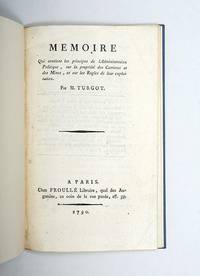
1790152275Paris: Chez Froullé Libraire 1790. First separate edition of Turgot's tract on French mining law first published in extract in volume 7 of the 1767 Ephémérides du Citoyen. "Turgot's unwearied efforts to promote the welfare of the people rendered him truly popular. Particular occasions upon which it became necessary for the government to consult him drew from his able pen reports in which the great lines of important economic principles were boldly laid down. Such are his memoir on mines and quarries the economic and legal aspects of free mining and his study of the laws of interest a defence of free trade in capital" Palgrave III pp. 591-2. Octavo 198 x 122 mm. Recent green quarter morocco spine lettered in gilt blue paper-covered sides. Binding fine; slight running chip at head discreetly restored not affecting text minor loss at fore edge of pp. 1/2 not affecting text contents otherwise fresh; a very good copy. Goldsmiths' 14558; not in Einaudi or Kress. unknown
1780129392Paris: Chez Barrois 1780. Defence of usury First edition. The work is assigned by Barbier to Pierre Rulié a parish priest of Saint Pierre de Cahors with the text then revised by J. L. Gouttes and by Turgot. The treatise serves to justify the commercial loaning of money at interest and instigated various refutations by the clergy incensed by its defence of usury. Turgot's 1770 paper on lending money at interest is quoted extensively. Uncommon with Library Hub listing copies in six British institutions. Duodecimo 163 x 96 mm. Contemporary mottled sheep smooth spine tooled in gilt red morocco label marbled endpapers red edges. With the half-title and privilege leaves. Very minor insect damage to sheep marbling of front free endpaper peeling contents a little toned. An attractive copy. Barbier 17786; Goldsmiths' 12046; Kress B.319. unknown
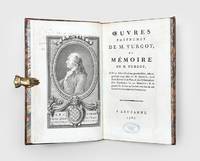
1787175389Lausanne: no publisher 1787. First edition published by Honoré Gabriel Mirabeau the son of Victor de Riquetti. The work was originally drawn up by Du Pont de Nemours in 1776 under the title Mémoire sur les municipalités after a draft left by Turgot. The Lettre which begins on page 99 was written by Du Pont de Nemours and the Observations p. 113ff. by Brissot de Warville. The work was reprinted in 1788 under the title Des administrations provinciales. Turgot was opposed to the summoning of the states-general advocated by Malesherbes possibly on the ground that the two privileged orders would have too much power in them. His own plan is found in the Mémoire which was submitted informally to the King. This copy has a manuscript note on the blank recto of the frontispiece: "Cet ouvrage n'est pas de M. Turgot. Il est de M. dupont qui a pris quelqu'unes de ses idées; je suis certaine de ce que j'avance M. Turgot n'ayant rien écrit sur ses operations." Octavo 192 x 118 mm pp. Engraved portrait frontispiece. iv 5-167 1. Contemporary mottled calf red morocco label flat spine richly tooled in gilt single blind rule border to boards flower cornerpieces marbled endpapers and edges. Ownership stamp of the Château de la Roche Guyonne to title page with their gilt coat of arms stamped in the first compartment of the spine; annotation to blank recto of frontispiece and occasional marginal marks in ink to the contents; pale mostly marginal damp mark to first few gatherings; a very good copy. Einaudi 1668; Goldsmiths' 13504; INED 1614 bis; Kress B.1203. hardcover
179121429Paris: Pierre-Samuel Dupont 1791. 19th-century half calf gold-tooled spine. 8vo. With a small woodcut decoration on the title page. First separate edition of a revolutionary treatise on the relations between the American colonies and the colonising countries by the French economist Anne Robert Jacques Turgot 1727-1781. He explains his theory that the colonising countries should withdraw from the colonies on a friendly basis allowing the colonies to have their own government and trade with other countries independently. If the colonising countries would grant the colonies independence they could still have the benefit of trading and settling there. Turgot had composed the treatise already in 1776 at the request of King Louis XVI who solicited his ministers' opinions regarding the proper French policy toward the American Revolution. It was first published as Reflexions rédigées. in Mazzei's Recherches historiques et politiques 1788.A very good copy with only a few small spots.l Goldsmith 14728; Kress B2230; Sabin 97456. Pierre-Samuel Dupont, unknown
1755127430London i.e Paris: Fletcher Gyles 1755. Turgot's first work First edition in French of the second part of Tucker's Reflections on the Expediency of a Law for the Naturalization of Foreign Protestants 1752 translated by Turgot in his first published piece on economics. Tucker wrote the first part of his tract in 1751 in support of Robert Nugent's bill to relax British naturalisation laws against foreign protestants a bill which had had a stormy passage and subsequently failed. It was in the present second part published the following year in which Tucker "developed the established theory that a concentrated industrious population generated economic success. The opposition to the naturalization bill was generated he believed by both bigotry and entrenched monopolistic vested self-interest" ODNB. Turgot's translation of this part of the treatise was appended with his own notes which are significant for several reasons: "in the first place because several of this notes once more reveal at this still early stage of his career the tremendous importance of free competition and free trade in the development of Turgot's economic thought. Further they reveal the fact that thanks to Gournay Turgot's economics came under the influence of English economics to a far greater extent than that of his French contemporaries who were followers of Quesnay" Groenewegen The Economics of A. R. J. Turgot p. xiv. Turgot is also known to have later translated another of Tucker's works on trade wars but his translation was not published and is now lost. Duodecimo 185 x 107 mm. Uncut in original marbled wrappers. Housed in a custom blue cloth box blue morocco label to spine. Half-title present. 20th-century bookplate to inner front cover. Spine backing absent possibly as issued the expected fraying around peripheries. A remarkable survival in the original state in exceptional condition. ESTC T135323. hardcover
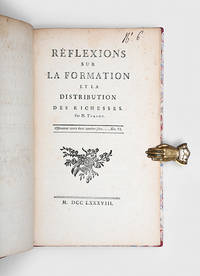
1788172184No place: no printer 1788. Wealth in the ancien regime First edition in book form of Turgot's most substantial work a milestone in the history of economic thought and a major influence on Adam Smith. Réflexions is a wide-ranging study of the production and distribution of wealth in the ancien régime drawing on Turgot's experience as chief administrator of Limoges. While the work shares several concepts with the Wealth of Nations including the division of labour Turgot goes beyond Smith in his absolute insistence on minimal government intervention in market forces. Turgot's conclusions that land is the source of wealth accord with those of the physiocrats; it was only his repugnance to all "sects" that kept him from the inner circle of the school. The editor of this posthumous edition is unknown although Condorcet and Du Pont are known to have republished several of Turgot's major economic writings at this time. The Réflexions were written in 1766 and serialized in the Ephémérides du Citoyen from 1769 to 1770. Octavo 195 x 119 mm. Engraved vignette to title page head- and tailpieces. Recent red quarter morocco smooth spine lettered in gilt marbled paper sides. Small ink numerals to half-title and title page. Slight bowing to boards minor browning and foxing to endpapers and contents: a very good copy. Einaudi 5772; En français dans le texte 165; Goldsmiths' 13536; INED 4362; Kress B.1506; Mattioli 3673. hardcover
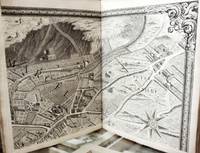
1739B3268Paris: Michel Turgot c. 1739. A fine copy plates are generally very clean and crisp and the atlas is in superb period binding. Edition: First Edition. Binding: recent red full morocco with the coats of arms of Paris. <br><br> Notes: This is the most beautiful and celebrated plan of the city of Paris. Turgot’s maps were designed and engraved with scroll borders to the extreme edges so that the entire twenty plates could be assembled to form one complete map of Paris 8 ½ x 10 ½ feet. Each arrondissement is shown from a birds-eye view; not only are the streets named and portrayed in detail but all of the houses hotels churches monuments private gardens and city parks are delineated in panoramic perspective such that the architectural ornamentation of the buildings can be identified. Size: Tall folio 560 x 455 mm Illustration: Complete with 20 double-page engraved panoramic maps and double-page index plan. References: Berlin Katalog 2506; Boutier 219 Pages: P. 21 double-page plates. Category: Book Atlas & Cartography; Book Europe France; Book Plate Books General; Michel Turgot unknown
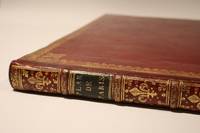
173948765Paris 1739. First Edition. Hardcover. Very Good. Turgot's Monumental Plan of Paris With Excellent Provenance. Elephant Folio 56.5 x 45.5 cm. A magnificent and complete example of the celebrated Plan de Paris commonly known as the Turgot Map housed in a handsome contemporary red Morocco binding with gilt borders spine compartments and bands. The arms of the city of Paris are gilt-stamped to both boards. Neatly rebacked; light rubbing and minor scuffing to the leather. Internally excellent: the sheets are remarkably bright clean and free from repair or loss with only some very faint marginal staining and a couple of spots throughout and the large folding spread with some light discolouration to a couple of the folded corners. Includes the full set of 20 engraved sheets with sheets 18 and 19 joined at the center and folded as issued. The title appears within the ornate cartouche on the key map. A small bookseller's ticket from the famed French antiquarian Pierre Berès is affixed to the upper fore-edge corner of the front paste-down. This is a superbly preserved example of one of the most extraordinary cartographic accomplishments of the 18th century. Commissioned in 1734 under the direction of Michel Étienne Turgot then Prévôt des Marchands Provost of the Merchants of Paris and a senior official in Louis XV's administration the map was designed to glorify the French capital as the political cultural and architectural heart of the kingdom. Louis Bretez a skilled draftsman and member of the Royal Academy of Painting and Sculpture was granted exclusive access to the interiors courtyards and rooftops of the city. Working in a dramatic bird's-eye axonometric perspective Bretez rendered the streets gardens landmarks and even individual buildings in intricate three-dimensional detail. The engravings were executed by Claude Lucas and the full project was completed in 1739 resulting in a masterwork of urban representation. Unlike conventional maps the Turgot Plan was conceived not merely as a geographic tool but as a grand artistic vision: part city portrait part political statement. It remains an unrivaled view of Paris under the Ancien Régime just decades before the French Revolution would transform the urban and social landscape. Widely distributed across France and to the royal courts of Europe the Turgot Map was intended to impress dignitaries scholars and ambassadors alike with the power and refinement of the French capital. Today complete copies in such fine condition are exceedingly scarce. This example with its contemporary binding and provenance would be a great addition for any serious collection of cartography Parisiana or French Enlightenment-era printing. Provenance: A Montreal family purchased from Christie's Canada with Montreal Book Auctions 1970. The Property of the Hon. Madame Georges P. Vanier. With a letter from the auction house and a letter from Parisian dealer Pierre Beres addressed to the buyer confirming this as the copy he sold to General Charles de Gaulle to present to the Governor General Vanier. hardcover