81 résultats
1782WRCAM28213Providence: Bennett Wheeler 1782. 40pp. 16mo. Self-wrappers stab-stitched. Slight browning. Overall very good. The present edition of the NORTH-AMERICAN CALENDAR. is most notable for its inclusion of the complete Articles of Confederation which had passed into law upon Maryland's agreement to ratify on March 1 1781. Published by Benjamin West noted astronomer and founder of what was to become the NEW ENGLAND ALMANAC produced on Providence's first printing press in 1762. Although most remembered for his astronomical skills and numerous almanacs West also worked fervently to supply the Continental army with clothes and later served on the faculty of Rhode Island College later Brown University. EVANS 17432. DAB XX pp.5-6. Bennett Wheeler hardcover books
18012688lParis: chez Janet 1801. <p>24mo binding size 95 x 63 mm. Nested quires composed from the outside in of: a  fold-out letterpress Gregorian calendar in columns with woodcut vignettes engraved title with stub 6-leaf engraved Republican calendar 24 pages engraved text interleaved with 12 engraved plates 6 bifolia and 24 pp. letterpress text a quire of 12 leaves signed A. Embroidered binding of ivory silk covers with metallic ribbon border enclosing oval cartouche of leafy branches alternating with roundels of sequin and purl enclosing on upper cover a bow arrow and quiver with flowering sprig and on lower cover a flowering plant both embroidered in variously colored threads and sequins; pink satin liners gilt edges. Losses to metallic borders and to some threads of cover designs. Bookplate of Carlo de Poortere.<br /><br />A charming almanac with 12 engravings and in an embroidered binding unknown to Grand-Carteret. This is a typical production of Pierre-Etienne Janet who in 1789 acquired the shop and bindery of his father-in-law Pierre Jubert relieur-doreur and path-breaking almanac publisher. In around 1790 Janet set up shop in the rue St. Jacques and began systematically publishing almanacs most with 12 plates. As usual for the Jubert and early Janet almanacs this little book was built up from "nested quires." In a formula that both repeated often the fold-out letterpress traditional calendar folds around the outside; next is the engraved title with conjugate stub then a 6-leaf unsigned letterpress quire with the Republican calendar for l'An IX starting with Vendémiaire Sept. 1800 which encloses 12 bifolia i.e. 24 leaves of engraved text and illustrations in which each text bifolium alternates with an illustrated bifolium. The illustrated bifolia are printed on one side only; thus 6 plates that appear before the fold are all printed on the versos while the 6 plates following the fold are on the rectos. At the center of all is an unpaginated 12-leaf letterpress quire signed "A" containing lyrics for songs titled "Ariettes nouvelles."<br /><br />Not in Grand-Carteret. OCLC cites only an unidentified Danish location Danish Union Catalogue.</p> chez Janet unknown books

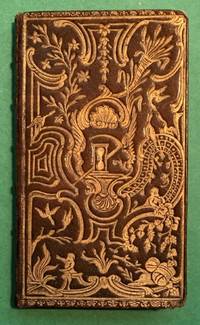
17422866Paris: de la boutique de M. Jouenne chez Durand rue S. Jacques à S. Landry et au Grison 1742. 32mo binding size 99 x 57 mm. 64 pp. Engraved frontispiece additional engraved title double-page engraved map of France at end. Contemporary emblematic binding of gold-blocked brown goatskin both covers with a panel stamp incorporating at center a scythe and hourglass framed in curving lines drawer-handle ornaments leaf plants monkeys flitting birds garlands and sprigs; pink satin liners gilt edges small chip to head of spine corners scuffed. Provenance: later 18th-century marginal note "Ma naissance" next to the date 12 August on calendar page for August; late 18th-century inscription at front identifying the note as that of the writer's mother born 12 August 1743 and stating that she kept this little book her entire life. A long-running Paris almanac in a contemporary binding with a pleasingly asymmetrical rococo decor mixing chinoiserie elements monkeys and Western memento mori motifs.The Etrennes mignonnes were published with changing subtitles from 1716 to ca. 1845. The engraved title and frontispiece varied from year to year up to 1750 after which none were used and the map alternated between an ecclesiastical civil or military map of France or a map of the Paris region. This issue has a special frontispiece showing the audience given by the King to the Ottoman Emperor in January 1742. Grand-Carteret 107; cf. Cohen-de Ricci 51. de la boutique de M. Jouenne chez Durand rue S. Jacques à S. Landry et au Grison unknown books
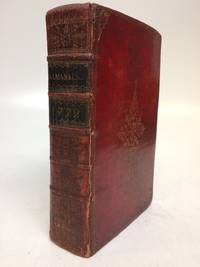
1772260710London: Various 1772. First. hardcover. very good. Rubricated text throughout. Illustrated with many charts and some woodcut diagrams. Thick 12mo contemporary red calf gilt leather label a.e.g. London: various publishers for The Company of Stationers 1772. First editions. An interesting collection in a very good attractive period binding<br/><br/> Titles include: Remarkable News from the Stars; The Gentleman's Diary & Mathematical Repository; The Ladies' Diary; Vox Stellarum; Merlinus Liberatus; Parker's Ephemeris; The Coelestial Diary; Poor Robin; The English Apollo; Speculum Anni; Olympia Domata; The Coelestial Atlas. Various printers.<br/><br/> Various unknown books
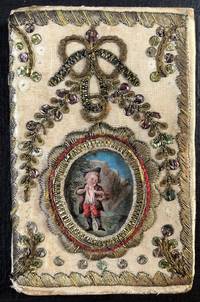
17954083Amsterdam: M. Schalekamp 1795. 36mo binding size 97 x 62 mm. 71 1 pp. Title and text within type-ornament borders. Four double-page engraved plates two signed by W. J. Strunck. Contemporary embroidered binding of beige silk over binder's board both covers with an outer wavy border of gold satin stitch enclosing a gouache and watercolor medallion under glass each cover with a different scene within an oval relief frame of goldwork red thread and satin stitch the medallion suspended from a ring hanging from a ribbon and flanked with sprigs the design composed of couched and separate colored and gold pailletes silver-gilt thread purl and goldwork spine plain with two silver-gilt rectangles pale orange silk liners preserving original wrappers of orange block-printed patterned paper with sprigs and dots gilt edges. Loss of 5 sequins on upper cover and 3 on lower cover. Provenance: Robert de Beauvillain bookplate.A literary almanac in a possibly Netherlandish embroidered binding with watercolor miniatures. The painting on the front cover shows a young man wearing a tricorne standing jauntily in a mountainous landscape and that on the rear cover two shepherds at dusk. This "Poetic Almanac or choice of Heroic epistles Tales Theatrical and other Poetic Pieces" was published in Amsterdam and sometimes also sold in Utrecht from 1771 to the late 1790s. The almanac includes a 12-page tabular calendar with Saints'days moon phases and eclipses a schedule of the ringing of the Amsterdam city bells and tales and poems some adapted from classical mythology. The romantic double-page engravings by Strunck show Mirtil and Chloe Daphne's children Hero and Leander in a dramatic scene of roiling seas and lightning a pastoral love scene and a woman in a dungeon with snakes illustrating the final poem "Elane Romance." OCLC locates a single copy of a different year in the US at the Grolier Club; that copy of the 1781 issue is also in an embroidered binding with a floral design and no miniatures. On Strunck cf. Thieme-Becker 32:217. M. Schalekamp unknown books
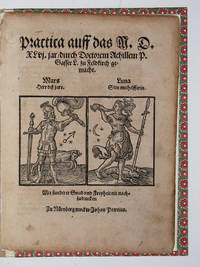
154540844to. 20.5 x 15.4 cm 12 ff. With two title woodcuts of Mars and Luna. Patterned paper over boards with vellum spine; title-plaque on front cover; some expert reinforcement and minor repairs at gutter. Paper has even browning some faint waterstaining with marginal notations on one leaf.<br /><br /><p>The <b>s</b><b>ole known copy</b> of a prediction pamphlet <i>mein Almanac</i> Gasser calls it f12 recto for the year 1546 with <b>the first extended reference to Copernicus printed in a vernacular language German -- </b>an "enthusiastic hymn of praise" for the great astronomer Burmeister addressed not specifically to an international community of scholars but to lay readers of a humble German language almanac whose daily activities "revolve" around the sun. Gasser further acknowledges here heliocentrism as a "hypothesis… demonstratively proven among mathematicians" i.e. a physical fact – a stance virtually unique among astronomers who were generally cautious with their approbations of Copernicus' calculations and methodology in the early years on the road towards its gradual positive reception.</p><p>Achilles Gasser was intimately connected with the dissemination of heliocentrism through his patronage of Georg Rheticus Copernicus' student who initiated and oversaw the 1543 publication of <i>De Revolutionibus</i>. Gasser was one of very few recipients of the <i>Narratio Prima</i> intended to drum up support for Copernicus' work and wrote the preface to the 1541 edition of it. Gasser also owned a copy of <i>De Revolutionibus</i>Gingerich I.99 printed by Johann Petreiuswho not coincidentally also published the present pamphlet. Alongside Rheticus' <i>Narratio Prima</i> of 1540 and Gasser's preface to the second edition of that work in 1541 the <i>Practica</i> offered here represents one of the very earliest published expressions of support for Copernican heliocentrism in any language.</p><p>The extended reference to Copernicus appears in Gasser's dedicatory letter to Caspar Joachim Täntzl a Tyrolean nobleman and mine owner. Gasser takes pains to heap praise upon <i>the most learned and wonderful man Dr. Nicolaus Copernicus</i> who <i>away off in Prussia has taken up the task with such seriousness diligence and steadfastness that for the establishment and restoration of astronomy he has had to lay an utterly and completely new foundation unheard of before or rather has been compelled to posit hypotheses not employed by other scholars…namely that the Sun is a light for all creation and stands unmoved in the midst of the whole universe; that this earthly realm… variously courses round between the planets Venus and Mars. and thus has not only<b> demonstratively proven his theory among the mathematicians</b> and with great pains restored the portrait of Astronomy but has also immediately been regarded as having perpetrated a heresy and indeed—by many others incapable of understanding this matter—is already being condemned</i> see the complete Danielson translation of the epistle below.</p><p>Numerous scholars penned prediction tracts or almanacs in this era including another Petreius author Johannes Schöner; Gasser wrote one for each year from 1544 and 1547. He makes general predictions for the luckiest days of 1546 B4v—as well as specifics relevant for mine owners like Täntzl— for example the relative value of precious metals B3. Part farmer's almanac and part horoscope Gasser's predictions depend on the movement of celestial bodies. His investment in propagating the importance of heliocentrism in this seemingly modest tract should therefore come as no surprise.</p><p>According to Dennis Danielson in the article cited below Gasser also penned on the same day and year a Latin version of the present almanac with a different dedicatory epistle addressed in this case to Rheticus in which he urges the acolyte of the great astronomer to continue his efforts to prove the truth of the Copernican hypothesis. He tells the younger scholar in a manner of speaking that his job isn't finished yet and to get on with it. Several printed copies of this Latin version exist in German institutions but none in America.</p><p>Offered here a well-preserved <b>unique copy</b> of the earliest example of vernacular Copernican ephemera. This present sole known copy now recorded in VD16 as ZV 28055 with 'Martayan Lan New York' as the source was only 'discovered' in the late 1990s by the respected historian of science Karl Heinrich Burmeister through the late Zurich bookdealer Jörg Schäfer.</p><p><b>TEXT OF EPISTLE </b>folios 1v-2r</p><p>To the noble and worthy Caspar Joachim Tantzl of Tratzberg etc. his most gracious and beloved master Achilles Pirmin Gasser of Lindau doctor of natural and medicinal arts extends his willing service and best regards.</p><p>Noble worthy and gracious master Your Worthiness doubtless still remembers the disputation that you often engaged in with me not without exceeding amazement concerning astronomy while I was in your service in Schwatz last year and above all the conversation in which – with the help of a small book I had with me eventually to be printed – I expressed my desire for a large lodestone whereby the course of the Sun and also the disposition of the firmament which in the schools we call the Primum Mobile though we know not where of what it is would here on Earth be rendered calculable and thoroughly perceptible in such a way that no more defects so frequent until now should appear.</p><p>Moreover as I then indicated to Your Worthiness the greatest masters of this art have continuously for seventeen hundred years found the movement of the stars and planets rather incongruous and imperfect according to their instruments and calculations indeed even according to their daily experience. For this reason one after the other they always kept on hoping to adjust improve and remedy this situation by means of clever contrivances and ingenious speculations as is evident in Hipparchus Ptolemy Al-Zarqali Al-Bitrui Cusanus Regiomantanus and finally Werner with each on correcting the other now inventing new spheres then discarding the old ones and thinking up something else and on and on with no end of cycles epicycles and theoricae – until now so recently in our own day also the most learned and wonderful man Dr. Nicolaus Copernicus away off in Prussia has taken up the task with such seriousness diligence and steadfastness that for the establishment and restoration of astronomy he has had to lay an utter and completely new foundation unheard of before or rather has been compelled to posit hypotheses not employed by other scholars namely that the Sun is a light for all creation and stands unmoved in the midst of the whole universe; that his earthly realm together with the other three elements and the circuit of the Moon variously courses round between the planets Venus and Mars; and also that the heavens beyond Saturn in which are seen the fixed stars all together stand fast and unmoved with no other spheres encompassing them etc. and thus has not only demonstratively proven his theory among the mathematicians and with great pains restored the portrait of Astronomy but has also immediately been regarded as having perpetrated a heresy and indeed – by many others incapable of understanding his matter – is already being condemned.</p><p>Since now Your Worthiness has for the benefit of this art and sundry other things promised to extract and provide me with a large lodestone from your mine I have a good will to see progress in this matter and am moved to put these my <i>Practica </i>for the coming year 1546 into writing for as Your Worthiness has no meagre capacity in astrological predictions to make discriminations and record nature's signs – which however must be derived solely from the courses of the planets and their position or placement relative to the other stars – You may easily weigh how very necessary it is that he who can help advise and give impetus to such an undertaking should do so in order that it can actually be brought to fruition.</p><p>So I hoped to in particular that I might in part accomplish this by means of a large lodestone. I would like therefore to ask Your Worthiness to execute the specificied transaction and to be gracious to accept this my published dedication in your honour for I remain ever willing whenever I may to demonstrate to Your Worthiness my love and service. </p><p>May God in heaven be with us and likewise ever protect your noble and virtuous wife and dear children.</p><p>Feldkirch Monday 27 July 1545.</p><p>Burmeister "'Mit subtilen fündlein und sinnreichen speculierungen.'". Die 'Practica auff das M.D.XLvj. jar' des Achilles Pirmin Gasser im Umfeld zeitgenössischer Astrolgen" <i>Montfort</i> 55 2003; Danielson "Achilles Gasser and the Birth of Copernicanism<i>" Journal for the History of Astronomy</i> 35/2004 457-74.</p> J. Petreius hardcover books