660 résultats
201180989Los Alamos NM: Department of Energy National Nuclear Security Administration Los Alamos Site Office 2011. Presumed unique compilation. DVD. Very good. CD/DVD Contains LASO WQAP LASO Institutional QAP LASO Functions Responsibilities and Authorities FRAs and LASO Quality Assurance Management Procedures. Quality assurance QA is a way of preventing mistakes and defects in manufactured products and avoiding problems when delivering products or services to customers; which ISO 9000 defines as "part of quality management focused on providing confidence that quality requirements will be fulfilled". This defect prevention in quality assurance differs subtly from defect detection and rejection in quality control and has been referred to as a shift left since it focuses on quality earlier in the process i.e. to the left of a linear process diagram reading left to right. When properly implemented the principles and requirements form a management system to plan perform assess and improve work. The requirements are performance oriented and offer implementation flexibility. The DOE quality management system moves beyond the traditional quality assurance requirements that had become narrowly focused on compliance and inspections. The management system is designed to link with an organization's strategic plan to support mission achievement and the delivery of products and services. The Department's commitment to environment safety and health relies upon work being conducted within an effective management system. DOE line managers and contracting officers must ensure the QA Order and QA Rule are specified in each major contract. The Weapon Quality Assurance FAQS establishes common functional area competency requirements for all National Nuclear Security Administration NNSA Weapon Quality Assurance personnel who provide assistance direction guidance oversight or evaluation of contractor activities that could impact the production maintenance and design of nuclear weapons. The technical FAQS has been developed as a tool to assist NNSA program and field offices in the development and implementation of the TQP in their organization. The NNSA Management System Assessment MSA is an activity sponsored by Quality Management. The assessments are conducted to fulfill Quality Management's responsibilities and cited requirements under DOE O 414.1D Quality Assurance NAP-26 Quality Management System and ISO 9001:2015 Quality Management System. MSAs are conducted by trained and certified ISO auditors and involve onsite management system reviews at the NNSA Headquarters HQ facilities in Washington DC Germantown MD Albuquerque NM and the field offices. MSAs are a check at a point in time of an organization's management system to verify whether it is properly implemented maintained and whether mission-related processes are being planned documented executed and subjected to periodic management review. The MSA objective is to strengthen accountability by ensuring that procedures are established and followed. MSAs also enhance risk management resource stewardship and governance across all NNSA federal organizations. These MSAs will be conducted in accordance with an assessment plan and schedule that is developed by the NNSA Management Systems Board MSB. The plan will be approved by the NNSA Management Council. NNSA has developed documented implemented and maintained its Quality Management System QMS to ensure it aligns with select and applicable principles of ISO 9001. With this alignment the NNSA QMS is based upon an approach that: • Identifies the processes needed for the management system; • Determines the sequence and interaction of processes; • Establishes the criteria and methods required to ensure effective operation and management of processes; • Ensures the availability of resources and information necessary to support processes; and • Monitors measures and analyzes processes to achieve planned results and continual improvement. Department of Energy, National Nuclear Security Administration, Los Alamos Site Office unknown
2018020337Avotek 2018. Book. VG. Soft cover. 4to - over 9¾ - 12" tall. Large formate soft covers. Clean tight and unmarked. Volume 1 and Volume 2 paginated by Sections with Glossary and Index Illustrated with photos diagrams and charts. . Avotek Paperback
200533256NY: Russell Sage Foundation. Fine in Fine dust jacket. 2005. Hardcover. 0871543400 . First printing. Fine in a fine dust jacket. . Russell Sage Foundation hardcover books
200533256NY: Russell Sage Foundation. Fine in Fine dust jacket. 2005. Hardcover. 0871543400 . First printing. Fine in a fine dust jacket. . Russell Sage Foundation hardcover
201186082Houston TX: National Aeronautics and Space Administration Johnson Space Center 2011. Presumed First Edition First printing of multiple originals. Single sheet printed on both sides. Very good. The format is approximately 8.5 inches by 11 inches. This is a single sheet with printing/imagery on both sides in a plastic sleeve. On the front side is a large color photograph of the four astronauts/Shuttle Crew members. On the other side are primarily four columns of text one column for each of the crew members with a small one-column spread with a picture of the four crew members at the top left corner and a larger two-column spread with an illustration of the STS-135 Mission Patch and a text description. The four crew members were Commander Christopher J. Ferguson Captain United States Navy ret. Pilot Douglas G. Hurley Colonel U.S. Marine Corps Mission Specialist Sandra H. Magnus Ph.D. and Mission Specialist Rex J. Wallheim Colonel U.S. Air Force ret. The STS-135 patch represent the Space Shuttle embarking on its mission to resupply the International Space Station. The Shuttle is centered over elements of the NASA emblem depicting how the Space Shuttle has been at the heart of NASA for the previous 30 years. The Patch also pays tribute to the entire NASA and contractor team that made possible all the incredible accomplishments of the Space Shuttle. Omega the last letter in the Greek alphabet signifies that this mission is the last flight of the Space Shuttle Program. STS-135 ISS assembly flight ULF7 was the 135th and final mission of the American Space Shuttle program. It used the orbiter Atlantis and hardware originally processed for the STS-335 contingency mission which was not flown. STS-135 launched on July 8 2011 and landed on July 21 2011 following a one-day mission extension. The four-person crew was the smallest of any shuttle mission since STS-6 in April 1983. The mission's primary cargo was the Multi-Purpose Logistics Module MPLM Raffaello and a Lightweight Multi-Purpose Carrier LMC which were delivered to the International Space Station ISS. The flight of Raffaello marked the only time that Atlantis carried an MPLM. Although the mission was authorized it initially had no appropriation in the NASA budget raising questions about whether the mission would fly. On January 20 2011 program managers changed STS-335 to STS-135 on the flight manifest. This allowed for training and other mission specific preparations. On February 13 2011 program managers told their workforce that STS-135 would fly regardless of the funding situation via a continuing resolution. Until this point there had been no official references to the STS-135 mission in NASA documentation for the general public. During an address at the Marshall Space Flight Center on November 16 2010 NASA administrator Charles Bolden said that the agency needed to fly STS-135 to the station in 2011 due to possible delays in the development of commercial rockets and spacecraft designed to transport cargo to the ISS. "We are hoping to fly a third shuttle mission in addition to STS-133 and STS-134 in June 2011 what everybody calls the launch-on-need mission. and that's really needed to buy down the risk for the development time for commercial cargo" Bolden said. The mission was included in NASA's 2011 authorization which was signed into law on October 11 2010 but funding remained dependent on a subsequent appropriations bill. United Space Alliance signed a contract extension for the mission along with STS-134; the contract contained six one-month options with NASA in order to support continuing operations. The federal budget approved in April 2011 called for US$5.5 billion for NASA's space operations division including the shuttle and space station programs. According to NASA the budget running through September 30 2011 ended all concerns about funding the STS-135 mission. The reduced crew size also allowed the mission to maximize the payload carried to the ISS.20 It was the only time that a Shuttle crew of four flew to the ISS. The last shuttle mission to fly with just four crew members occurred 28 years earlier. The Multi-Purpose Logistics Module MPLM Raffaello made up the majority of the payload. This was Raffaello's fourth trip to the International Space Station since 2001 and the 12th use of an MPLM. Unlike previous MPLM missions that delivered large compartments and devices to outfit the space station laboratories STS-135 delivered only bags and supply containers. The MPLM was filled with 16 resupply racks which is the maximum that it could handle. Eight Resupply Stowage Platforms RSPs two Integrated Stowage Platforms ISPs six Resupply Stowage Racks RSRs and one Zero-G Stowage Rack ZSR which sits above another rack during transport. On flight day 4 Raffaello was lifted out of Atlantis's payload bay using the station's Canadarm2. It was berthed to nadir port of the Harmony node. After completing the cargo transfers to the ISS Raffaello was loaded with almost 5700 pounds of unneeded equipment and station waste to be brought back to Earth. On flight day 11 the MPLM was detached from Harmony and was secured in the cargo bay of the shuttle. National Aeronautics and Space Administration, Johnson Space Center unknown
200486160Houston TX: National Aeronautics and Space Administration Johnson Space Center 2004. Presumed First Edition First printing one of multiple originals. Single sheet printed on both sides. Very good. The format is approximately 8.5 inches by 11 inches. This is a single sheet with printing/imagery on both sides in a plastic sleeve. On the front side is a large color photograph of the seven astronauts/Shuttle Crew members. On the other side are primarily four columns of text with text for each of the crew members with a small two-column spread with a outline with names of the seven crew members at the top center and a half-column spread at the bottom of the fourth column with an illustration of the STS-114 Mission Patch and a text description. The STS-114 patch signifies the return of the Space Shuttle to flight and honors the memory of the STS-107 Columbia crew. The Shuttle rising above Earth's horizon includes the Columbia constellation of seven stars echoing the STS-107 patch and commemorating the seven members of that mission. The crew of STS-114 carry the memory of their mission back into Earth orbit. The dominant design element of the STS-114 patch is the planet Earth which represents the unity and dedication of the many people whose efforts allow the Shuttle to safely return to flight. Against the background of the Earth at night the blue orbit represents the International Space Station ISS with the EVA crewmembers named on the orbit. The red sun on the orbit signifies the contributions of the Japanese Space Agency to the mission and to the ISS program. The multi-colored Shuttle plume represents the broad spectrum of challenges for this mission including Shuttle inspection and repair experiments and International Space Station re-supply and repair. STS-114 was the first "Return to Flight" Space Shuttle mission following the Space Shuttle Columbia disaster. The crew members were Commander Eileen M. Collins Colonel USAF Pilot James M. Kelly Lieutenant Colonel USAF Mission Specialist Soichi Noguchi JAXA Astronaut Mission Specialist Stephen K. Robinson Ph.D. Mission Specialist Andrew S. W. Thomas Ph.D. Mission Specialist Wendy B Lawrence Captain USN and Mission Specialist Charles J. Camarda Ph.D. Discovery launched at 10:39 EDT 14:39 UTC July 26 2005. The launch 907 days approx. 29 months after the loss of Columbia was approved despite unresolved fuel sensor anomalies in the external tank that had prevented the shuttle from launching on July 13 its originally scheduled date. The mission ended on August 9 2005 when Discovery landed at Edwards Air Force Base in California.2 Poor weather over the Kennedy Space Center in Florida hampered the shuttle from using its primary landing site. Analysis of the launch footage showed debris separating from the external tank during ascent; this was of particular concern because it was the issue that had set off the Columbia disaster. As a result NASA decided on July 27 to postpone future shuttle flights pending additional modifications to the flight hardware. Shuttle flights resumed a year later with STS-121 on July 4 2006. STS-114 marked the return to flight of the Space Shuttle after the Columbia disaster and was the second Shuttle flight with a female commander Eileen Collins who also commanded the STS-93 mission. The STS-114 mission was initially to be flown aboard the orbiter Atlantis but NASA replaced it with Discovery after improperly installed gear was found in Atlantis' Rudder Speed Brake system. During OMM for Discovery an actuator on the RSB system was found to be installed incorrectly. This created a fleet wide suspect condition. The Rudder Speed Brake system was removed and refurbished on all three remaining orbiter vehicles and since Discovery's RSB was corrected first it became the new Return to Flight vehicle superseding Atlantis. Seventeen years prior Discovery had flown NASA's previous Return to Flight mission STS-26. The STS-114 mission delivered supplies to the International Space Station. However the major focus of the mission was testing and evaluating new Space Shuttle flight safety techniques which included new inspection and repair techniques. The crewmembers used the new Orbiter Boom Sensor System OBSS - a set of instruments on a 50 feet extension attached to the Canadarm. The OBSS instrument package consists of visual imaging equipment and a Laser Dynamic Range Imager LDRI to detect problems with the shuttle's Thermal Protection System TPS. The crew scanned the leading edges of the wings the nose cap and the crew compartment for damage as well as other potential problem areas engineers wished to inspect based on video taken during lift-off. STS-114 was classified as Logistics Flight 1. The flight carried the Raffaello Multi-Purpose Logistics Module built by the Italian Space Agency as well as the External Stowage Platform-2 which was mounted to the port side of the Quest Airlock. They deployed MISSE 5 to the station's exterior and replaced one of the ISS's Control Moment Gyroscopes CMG. The CMG was carried up on the LMC Lightweight Multi-Purpose Experiment Support Structure Carrier at the rear of the payload bay together with the TPS Repair Box. National Aeronautics and Space Administration, Johnson Space Center unknown
200786117Kennedy Space Center FL: National Aeronautics and Space Administration Kennedy Space Center 2007. Presumed First Edition First printing. Wraps. Very good. The format is approximately 8.25 inches by 11 inches. 8 pages. Illustrations some in color. This includes information on STS-114 STS-121 STS-115 and STS-116 the 17th 18th 19th and 20th Space Station flights The write-ups include mission highlights EVAs Launch and Landing. A latter version of Volume 3 had 12 pages and included two more missions into 2007. This variant is now quite scarce having been superseded. The International Space Station ISS is the largest modular space station in low Earth orbit. The project involves five space agencies: the United States' NASA Russia's Roscosmos Japan's JAXA Europe's ESA and Canada's CSA. The ownership and use of the space station is established by intergovernmental treaties and agreements. The station serves as a microgravity and space environment research laboratory in which scientific research is conducted in astrobiology astronomy meteorology physics and other fields. The ISS is suited for testing the spacecraft systems and equipment required for possible future long-duration missions to the Moon and Mars. The Space Shuttle was a partially reusable low Earth orbital spacecraft system operated by NASA the National Aeronautics and Space Administration. Its official program name was Space Transportation System STS taken from a 1969 plan for a system of reusable spacecraft of which it was the only item funded for development. Operational missions launched numerous satellites conducted science experiments in orbit and participated in construction and servicing of the International Space Station ISS. The first of four orbital test flights occurred in 1981 leading to operational flights beginning in 1982. From 1981 to 2011 a total of 135 missions were flown all launched from Kennedy Space Center KSC in Florida. During that time period the fleet logged 1322 days 19 hours 21 minutes and 23 seconds of flight time. The longest orbital flight of the Shuttle was STS-80 at 17 days 15 hours while the shortest flight was STS-51-L at one minute 13 seconds when the Space Shuttle Challenger broke apart during launch. The cold morning shrunk an O-Ring on the right Solid Rocket Booster causing the external fuel tank to explode. The shuttles docked with Russian space station Mir nine times and visited the ISS thirty-seven times. The highest altitude apogee achieved by the shuttle was 386 milrd when deploying the Hubble Space Telescope. The program flew a total of 355 people representing 16 countries and with 852 total shuttle fliers. The Kennedy Space Center served as the landing site for 78 missions while 54 missions landed at Edwards Air Force Base in California and one mission landed at White Sands New Mexico. The first orbiter built Enterprise was used for atmospheric flight tests ALT but future plans to upgrade it to orbital capability were ultimately canceled. Four fully operational orbiters were initially built: Columbia Challenger Discovery and Atlantis. Challenger and Columbia were destroyed in mission accidents in 1986 and 2003 respectively killing a total of fourteen astronauts. A fifth operational orbiter Endeavour was built in 1991 to replace Challenger. The Space Shuttle was retired from service upon the conclusion of STS-135 by Atlantis on 21 July 2011. National Aeronautics and Space Administration, Kennedy Space Center paperback
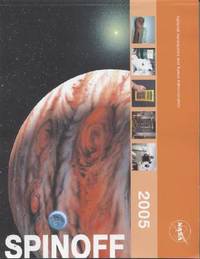
200586140Washington DC: National Aeronautics and Space Administration NASA Center for AeroSpace Information CASI Publications and Graphics Department 2005. Presumed First Edition First printing of this annual report. Trade paperback. Very good. Lynette Cook Front cover art. The format is approximately 11 inches by 8.5 inches. 167 1 pages. Illustrations most with color. Annual report on technology transfer or "technology twice used" inventions from NASA. Since 1976 Spinoff has profiled technologies that benefit from NASA investment and expertise. These developments have transformed into commercial products and services that are used throughout daily life from your cell phone camera to the memory foam in your mattress. When Congress created NASA it mandated the agency disseminate its innovations as widely possible. To that end the Technology Transfer Program was created in 1964 and it has functioned ever since making it NASA’s longest continuously operated mission. Early publications about NASA inventions made available to the scientific and engineering communities resulted in feedback indicating a broad interest in the private sector in adapting NASA technology for commercial uses. As products began to emerge NASA began preparing annual reports on these successes to present at congressional budget hearings. Spinoff has been published in a four-color editionand it has been released every year since 1976. All together since its first edition NASA has shared the stories of more 2000 products and services that began as or have benefited from NASA technology. In addition to the general public NASA sends copies of Spinoff to politicians representatives at the United Nations economic decision makers company CEOs academics scientists engineers professionals in technology transfer the news media and many others. The early black-and-white Technology Utilization Program Reports published in 1973 and ‘74 generated so much public interest that NASA decided to turn them into an attractive publication for a general audience. NASA SPINOFF now features dozens of success stories annually online and in its print publication demonstrating the wider benefits of America’s investment in its space program. The 2005 edition highlights Partnership Benefits in Health and Medicine Transportation Public Safety Consumer/Home/Recreations Environment and Resources Management; Computer Technology and Industrial Productivity/Manufacturing Technology. National Aeronautics and Space Administration, NASA Center for AeroSpace Information (CASI), Publications and Graphics Departmen paperback
201174113Amarillo TX: National Nuclear Security Administration Pantex Plant c2011. Presumed First thus. Patches. Very good. The patch is about 3.5 inches by 3.5 inches but the top is rounded so it is more like an arched window than a full square. It has a black border. The center has the image of the bomb a big dog and the text "B53" and "Last of the Big Dogs. On an orange border in black letters is "NNSA SS-21 Dismantlement DOE Pantex LANL LLNL SNL Y12 OST" From Wikipedia: The Mk/B53 was a high-yield bunker buster thermonuclear weapon developed by the United States during the Cold War. Deployed on Strategic Air Command bombers the B53 with a yield of 9 megatons was the most powerful weapon in the U.S. nuclear arsenal after the last B41 nuclear bombs were retired in 1976. The B53 was the basis of the W-53 warhead carried by the Titan II Missile which was decommissioned in 1987. Fifty B53s were retained during that time as part of the "hedge" portion of the Enduring Stockpile. The last B53 was disassembled on 25 October 2011 a year ahead of schedule. Development of the weapon began in 1955 by Los Alamos National Laboratory based on the earlier Mk 21 and Mk 46 weapons. In March 1958 the Strategic Air Command issued a request for a new Class C bomb to replace the earlier Mk 41. A revised version of the Mk 46 became the TX-53 in 1959. The Mk 53 entered production in 1962 and was built through June 1965. It entered service aboard B-47 Stratojet B-52G Stratofortress and B-58 Hustler bomber aircraft in the mid-1960s. From 1968 it was redesignated B53. Some early versions of the bomb were dismantled beginning in 1967. The B53 was also intended to be retired in the 1980s but 50 units remained in the active stockpile until the deployment of the B61-11 in 1997. At that point the obsolete B53s were slated for immediate disassembly; however the process of disassembling the units was greatly hampered by safety concerns as well as a lack of resources. In 2010 authorization was given to disassemble the 50 bombs at the Pantex plant in Texas. The process of dismantling the last remaining B53 bomb in the stockpile was completed in 2011. It was intended as a bunker buster weapon using a surface blast after laydown deployment to transmit a shock wave through the earth to collapse its target. Attacks against the Soviet deep underground leadership shelters in the Chekhov/Sharapovo area south of Moscow envisaged multiple B53/W53 exploding at ground level. It has since been supplanted in such roles by the earth-penetrating B61 Mod 11 a bomb that penetrates the surface to deliver much more of its explosive energy into the ground and therefore needs a much smaller yield to produce the same effects. The B53 was intended to be retired in the 1980s but 50 units remained in the active stockpile until the deployment of the B61-11 in 1997. At that point the obsolete B53s were slated for immediate disassembly; however the process of disassembling the units was greatly hampered by safety concerns and a lack of resources. The last remaining B53 bomb began the disassembly processes on Tuesday 25 October 2011 at the Energy Department's Pantex Plant. National Nuclear Security Administration, Pantex Plant unknown
200882252Washington DC: National Nuclear Security Administration 2008. Presumed First Edition First printing thus. Single sheet printed on both sides. Very good. This is an approximately 8.5 inch by 11 inch sheet of stiff card paper folded at the center to create four 5.5 by 8.5 inch panels. Illustrations are on the front and back panels. Text is on all panels. Marty was born February 191953 in St. Louis Park Minnesota. He was a graduate of Montgomery High School in 1971 the U.S. Naval Academy in 1975 and the George Washington University in 1981. Marty was a U.S. Naval officer for 20 years and civil servant for 20 years with 8 of those years in the Senior Executive Service of the U.S. Department of Energy. He retired for the third time in April 2018 after 4 years at Honeywell. Marty honorably served his country in a number of Uniformed Service civilian and private sector career. This event program marked his departure from the Office of Defense Programs to take on a critically important Department of Energy position at the United States Embassy in Beijing People's Republic of China where he was the Secretary's Representative and Senior DOE representative in China. Copies of such event programs rarely survive the event itself. Presiding at the departure event was Deputy Administrator for Defense Programs Robert L. Smolen and making the major presentation was Thomas P. D'Agostino Administrator of the National Nuclear Security Administration. The senior representative of the United States Department of Energy at the U.S. Embassy in Beijing China is responsible for leading a team to advance U.S. security and economic interests in the areas of energy science and technology and nuclear security and nonproliferation. In this role the senior representative is responsible for developing analyses and recommendations for the Secretary on key strategic initiatives with China related to the overall energy relationship. The representative is responsible for conducting in-depth analyses for comprehensive energy policy planning and strategic decision making on international energy policy and investment and trade issues. The representative provides insights briefings and other comprehensive analyses on key energy issues in China and Asia more broadly including on the issues of energy security clean energy development and deployment energy efficiency clean energy technology innovation and bilateral and multilateral cooperation initiatives among others. National Nuclear Security Administration unknown
200179902Washington DC: National Nuclear Security Administration Office of Defense Nuclear Nonproliferation 2001. Presumed First Edition First printing thus. Wraps. Very good. 19 13 pages. Mostly printed on both sides of a sheet. Sheets/project posters on several IPP projects are included at the back of this document. This year's report covers a year that involved a number of exciting developments in the Initiatives for Proliferation Prevention IPP program. The program receives a significant vote of confidence for its commercialization focus with for successful IPP projects attracting $56 million in private venture capital funds. These funds were in addition to the already substantial contribution from U.S. industry partners who more than match U.S. government funding on each new IPP project. The IPP program also resumed operation in Kazakhstan and Ukraine adding the scientific talent of these countries to the technology resource base now available to U.S. industry partners. The program's nonproliferation objectives are met with increasing success as a growing number of former Soviet weapons scientists are engaged both in the course of ongoing work as well as in the jobs that are being created by successfully completed IPP projects. Preventing the proliferation of weapons of mass destruction is a central part of US national security policy. A principal instrument of the Department of Energy`s DOE`s program for securing weapons of mass destruction technology and expertise and removing incentives for scientists engineers and technicians in the newly independent states NIS of the former Soviet Union to go to rogue countries or assist terrorist groups is the Initiatives for Proliferation Prevention IPP. IPP was initiated pursuant to the 1994 Foreign Operations Appropriations Act. IPP is a nonproliferation program with a commercialization strategy. IPP seeks to enhance US national security and to achieve nonproliferation objectives by engaging scientists engineers and technicians from former NIS weapons institutes; redirecting their activities in cooperatively-developed commercially viable non-weapons related projects. These projects lead to commercial and economic benefits for both the NIS and the US IPP projects are funded in Russian Ukraine Kazakhstan and Belarus. This booklet offers an overview of the IPP program as well as a sampling of some of the projects which are currently underway. National Nuclear Security Administration, Office of Defense Nuclear Nonproliferation paperback
201875546Washington DC: National Nuclear Security Administration Office of Safety Infrastructure and Operations 2018. Presumed First Edition First printing. Spiral bound. Very good. 58 pages. Illustrations color. Map. Acronyms. Clear plastic sheets at front and back covers. This 2018 Master Asset Plan MAP lays out the National Nuclear Security Administration's NNSA infrastructure vision and highlights strategic investments being made to achieve it. It is an update to the first-ever 2017 MAP which described how NNSA's infrastructure supports it's unique mission requirements and the gaps and mission risks inherent in that infrastructure. Safe reliable and modern infrastructure at NNSA's national laboratories and production plants is absolutely essential to accomplish our vital national security mission and ensure the well-being of our workforce. As the 2018 Nuclear Posture Review states there is no margin for further delay in improving the state of NNSA's infrastructure. Significant and sustained investments will be required during the next quarter century to recapitalize and revitalize the nuclear security enterprise. The Master Asset Plan assembles data into a single report that presents an integrated view of NNSA's infrastructure strategy. National Nuclear Security Administration, Office of Safety, Infrastructure, and Operations unknown
201474295Washington DC: United States. Department of Energy. National Nuclear Security Administration. Office of Safety and Health 2014. Review draft. Binder clip at upper left corner. Very good. Approximately 200 sheets printed on one side only. Acronyms and Organizational Designations. Format is approximately 8.5 inches by 11 inches. The final version of this supplemental directive was issued/dated 11-17-14. The evaluations described in this Supplemental Directive comprise a formalized approach to ensuring the nuclear explosive safety NES of all nuclear explosive operations NEOs performed by the National Nuclear Security Administration NNSA and its contractors. This approach requires that all new approved current and proposed changes to NEOs and associated supporting infrastructure receive a commensurate level of review and analysis. The Nuclear Explosive Safety Evaluation Process is a key mission responsibility of the National Nuclear Security Administration and the Office of the Deputy Administrator for Defense Programs. Among the topics and activities covered are: Nuclear Explosive Safety Studies NESS Operations Safety Reviews Contractor Nuclear Explosive Safety Change Evaluations Secure Transportation Security Operations Study Group Technical Advisors Post-Evaluation Process Change Control Process Deliberation Topics Findings Information Evaluation Finding Disposition Qualification Requirements Nuclear Explosive Operations. United States. Department of Energy. National Nuclear Security Administration. Office of Safety and Health unknown
200967232Moffett FIeld CA: United States National Aeronautics and Space Administration 2009. Reprint. Second Printing. Wraps. Very good. Includes: illustrations diagrams. Various paginations approximately 125 pages. References. From Wikipedia: "The Stratospheric Observatory for Infrared Astronomy SOFIA is a joint project of NASA and the German Aerospace Center DLR to construct and maintain an airborne observatory. NASA awarded the contract for the development of the aircraft operation of the observatory and management of the American part of the project to the Universities Space Research Association USRA in 1996. The DSI Deutsches SOFIA Institut manages the German parts of the project which are primarily science and telescope related. SOFIA's telescope saw first light on May 26 2010. SOFIA is the successor to the Kuiper Airborne Observatory.SOFIA is based on a Boeing 747SP wide-body aircraft that has been modified to include a large door in the aft fuselage that can be opened in flight to allow a 2.5 meter diameter reflecting telescope access to the sky. This telescope is designed for infrared astronomy observations in the stratosphere at altitudes of about 41 000 feet about 12 km. SOFIA's flight capability allows it to rise above almost all of the water vapor in the Earth's atmosphere which blocks some infrared wavelengths from reaching the ground. At the aircraft's cruising altitude 85% of the full infrared range will be available. The aircraft can also travel to almost any point on the Earth's surface allowing observation from the northern and southern hemispheres. Once ready for use the expectation is for observing flights to be flown 3 or 4 nights a week for the next 20 years. SOFIA is now based at NASA's Dryden Aircraft Operations Facility at LA/Palmdale Regional Airport California while staff at NASA Ames Research Center in Mountain View California operate the SOFIA Science Center where astronomical observation missions are planned for the flying observatory. The NASA logo reflected in SOFIAs 2.5-meter primary mirror. SOFIA uses a 2.5-meter reflector telescope which has an oversized 2.7 meter diameter primary mirror as is common with most large infrared telescopes. The optical system uses a Cassegrain reflector design with a parabolic primary mirror and a remotely configurable hyperbolic secondary. In order to fit the telescope into the fuselage the primary is shaped to an f-number as low as 1.3 while the resulting optical layout has an f-number of 19.7. A flat tertiary dichroic mirror is used to deflect the infrared part of the beam to the Nasmyth focus where it can be analyzed. An optical mirror located behind the tertiary mirror is used for a camera guidance system. The telescope looks out of a large door in the side of the fuselage near the airplane's tail and will initially carry nine instruments for infrared astronomy at wavelengths from 1 655 micrometres and high-speed optical astronomy at wavelengths from 0.3 1.1 micrometres. The main instruments are the FLITECAM a near infrared camera covering 1 5 micrometres; FORCAST covering the mid-infrared range of 5 40 micrometres and HAWC which spans the far infrared in the range 42 210 micrometres. The other four instruments include an optical photometer and infrared spectrometers with various spectral ranges. SOFIA s telescope is by far the largest ever to be placed in an aircraft. For each mission one interchangeable science instrument will be attached to the telescope. Two groups of general purpose instruments are available. In addition an investigator can also design and build a special purpose instrument. On April 17 2012 two upgrades to HAWC were selected by NASA to increase the field of view with new detector arrays and to add the capability of measuring the polarization of dust emission from celestial sources. The open cavity housing the telescope will be exposed to high-speed turbulent winds. In addition the vibrations and motions of the aircraft introduce observing difficulties. The telescope was designed to be very lightweight with a honeycomb shape milled into the back of the mirror and polymer composite material used for the telescope. United States, National Aeronautics and Space Administration paperback
200652774Washington DC: U.S. Department of Energy 2006. very good. 21 wraps color illus. figures. Inscribed by NNSA Administrator Linton Brooks on front cover. DOE/NA-0013. U.S. Department of Energy paperback
201875547Washington DC: U.S. Department of Energy National Nuclear Security Administration and U. K. Ministry of Defence 2018. Presumed First Edition First printing. Wraps. Very good. 3 38 3 plus covers. Timeline. Illustrations many in color. Maps. The 1958 US-UK Mutual Defense Agreement or UK-US Mutual Defence Agreement is a bilateral treaty between the United States and the United Kingdom on nuclear weapons cooperation. The treaty's full name is Agreement between the Government of the United States of America and the Government of the United Kingdom of Great Britain and Northern Ireland for Cooperation on the uses of Atomic Energy for Mutual Defense Purposes. It allows the United States and the UK to exchange nuclear materials technology and information. While the US has nuclear cooperation agreements with other countries including France and some NATO countries this agreement is by far the most comprehensive. Harold Macmillan called it "the Great Prize". The treaty was signed on 3 July 1958 after the Soviet Union shocked the American public with the Sputnik crisis on 4 October 1957 and the British hydrogen bomb programme successfully tested a hydrogen bomb in the Operation Grapple test on 8 November 1957. The Anglo-American Special Relationship proved mutually beneficial although it was never one of equals; the United States was far larger than Britain both militarily and economically. Britain soon became dependent on the United States for its nuclear weapons as it lacked the resources to produce a range of designs. The treaty allowed American nuclear weapons to be supplied to Britain through Project E for the use by the Royal Air Force and British Army of the Rhine. The treaty provided for the sale to the UK of one complete nuclear submarine propulsion plant plus ten years' supply of enriched uranium to fuel it. Other nuclear material was also acquired from the United States under the treaty. including 7.5 tonnes of highly enriched uranium although much of the highly enriched uranium was used as fuel for the growing fleet of UK nuclear submarines. The treaty paved the way for the Polaris Sales Agreement and the Royal Navy ultimately acquired entire weapons systems with the UK Polaris programme and Trident nuclear programme using American missiles with British nuclear warheads. The treaty has been amended and renewed nine times. The most recent renewal extended it to 31 December 2024. U.S. Department of Energy, National Nuclear Security Administration and U. K. Ministry of Defence paperback
2012DADAX1616086971Skyhorse 2012-08-14. 1. paperback. New. 8.50x0.50x11.00. Buy with confidence. Excellent Customer Service & Return policy. Skyhorse paperback
20101-1422051757Progressive Management 2010. DVD-ROM. New. 5.50x4.80x0.40 inches. Progressive Management unknown
2013G0806346167I4N10Genealogical Publishing Company 2013. Paperback. Very Good. Former library book; May have limited writing in cover pages. Pages are unmarked. ~ ThriftBooks: Read More Spend Less.Dust jacket quality is not guaranteed. Genealogical Publishing Company paperback
2020__1619549646Aviation Supplies & Academics 2020. Paperback. New. pck pap/ps edition. 672 pages. 10.75x8.25x1.35 inches. Aviation Supplies & Academics paperback
2012SONG1607964848www.bnpublishing.com 2012-07-12. paperback. Used: Good. 8.50x0.95x11.00. Buy with confidence. Excellent Customer Service & Return policy. www.bnpublishing.com paperback
20032-1560275014Aviation Supplies & Academics Inc 2003. Paperback. New. 792 pages. 10.75x8.25x1.75 inches. Aviation Supplies & Academics Inc paperback
2024x-151078019XSkyhorse Pub Co Inc 2024. Paperback. New. 544 pages. 11.00x8.50x1.36 inches. Skyhorse Pub Co Inc paperback
20172-1642270482Historic Publishing 2017. Paperback. New. 562 pages. 9.69x7.44x1.27 inches. Historic Publishing paperback
2007DADAX1596410426Janaway Publishing Inc 2007-03-30. paperback. New. 8.50x0.70x11.00. Buy with confidence. Excellent Customer Service & Return policy. Janaway Publishing, Inc paperback