46 résultats
1799312691 affiche au format 42 x 34 cm, Chez Briflot, A Bar-sur-Ornin, s.d. (circa 1799) : Avis aux Citoyens. L'Administration centrale du Département de la Meuse prévient ses Concitoyens, que la Foire de Beaucaire est fixée au 4 Thermidor de chaque année [ Publicité pour la foire de Beaucaire, Gard, affichée en 1799 dans la Meuse ] "Les Autorités constituées du département du Gard promettent aux Citoyens, que leur comerce appellera à cette foire tranquillité, sûreté & protection pour leur personne & leurs propriétés"
1798605362Wien, Camesina, 1798. XXXII, 518 S., 1 Bl. Mit Stahlstichporträt von Sonnenfels nach Graff, "Geätzt von Leicher". Einfacher Pappband d. Zeit (etwas berieben u. fleckig, Ecken bestoßen, Rücken gebräunt, Bezug an den Gelenken eingerissen). [3 Warenabbildungen]
178913091789 Chez Laurent, Paris, 1789. In-12, brochage moderne muet, 2 parties de 114 et 95 pages.
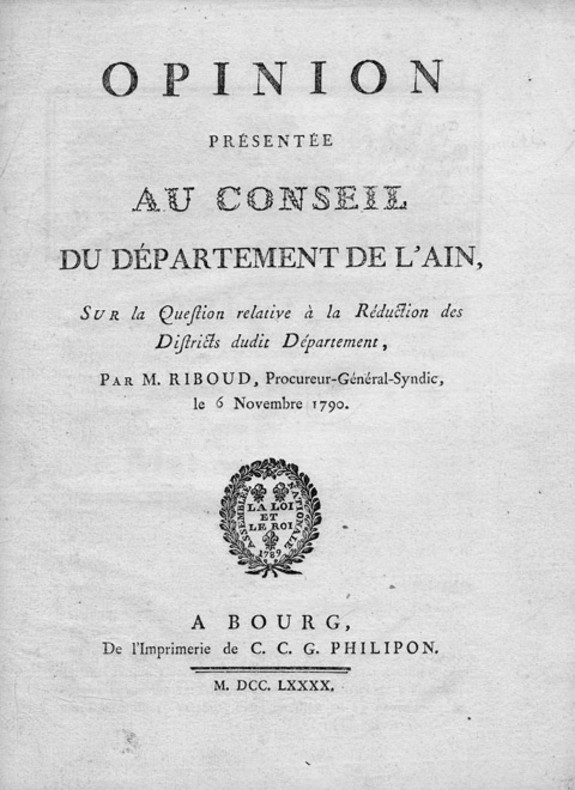
17907344Bourg, C.C.G. Philipon, 1790. SUIVI DE : Mémoire sur les principaux objets de l’Administration dans le département de l’Ain, lu à l’Assemblée administrative, par M. Riboud, Procureur général Syndic, le 7 juin 1790, et imprimé par ordre de l’Assemblée. Bourg, C.C.G. Philipon. Deux fascicules reliés en un volume in-4 ; bradel demi-papier vert, faux nerfs dorés, pièce de titre grenat, plats de papier marbré (reliure très légèrement postérieure) ; 42 pp. ; (1) f. blanc, 38 pp., (1) f. blanc.
178512392s.l. s.e. 1785 Un volume in-8 demi veau brun, dos lisse orné de filets et fleurons dorés, titre doré, 293 pages et table, un tableau dépliant. Mouillure claire en marge sur quelques feuillets, néanmoins bon état.
1785RO80061640A LONDRES. 1785. In-12. Relié demi-cuir. Etat d'usage, Couv. défraîchie, Dos satisfaisant, Intérieur acceptable. 260 + 182 pages. Titre et roulettes dorés sur le dos cuir marron. Petit manque de papier sur le 2nd plat. Tranches des plats frottées.. . . . Classification Dewey : 350-Administration publique
1728PHO-2208Paris, Pierre-Jean, Mariette, 1728, in-4 (25,5x20cm), pagination par édit, veau marbré époque, dos à nerfs ornés, tranches mouchetées, frottements et épidermures, débuts de fentes, coins usés, coiffe arasée, manque la pièce de titre.
173131541.1Edinburgh: Printed by Robert Fleming and Company 1731. 1st edition thus. Bound in later red cloth covered card stock covers with each gathering staggered in the binding such that it is extended length-wise to 8". 1933 pos to ffep. Period pos to t.p. top margin. Very Good. xi 7 46 pp. Head- tailpieces. 8vo: A - D8. 8" x 5-1/4" <br/><br/>The Merchant Maiden Hospital was founded in 1695 for the education of daughters of decayed merchant burgesses of Edinburgh. The chief contributor was Mary Erskine after whom one of Edinburgh's schools is now named. She purchased the original house and garden-grounds near Bristo Park. The school later moved to a building situated beside the Meadows which was begun in1816. It is of Grecian character and accommodated about 80 girls between the ages of seven and seventeen. The building included sleeping accommodation three school-rooms a meeting room a kitchen washing house laundry and a chapel. The highest floor consisted of a series of rooms extending the whole length of the building used for drying clothes during the winter months. Mary Erskine later went on to found the Trades' Maiden Hospital in Edinburgh. This copy bound with other material on Maiden Hospital see TavBooks ID #39863. Price is for this one volume containing all Maiden Hospital material. Printed by Robert Fleming and Company hardcover books
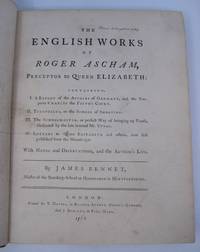
1761071095London: Printed for T. Davies in Russel-Street Covent-Garden And J. Dodsley in Pall-Mall 1761. Hardcover. Very Good. 10.5" x 8.5" x 1.25. The first printing of this book was in 1761 and second in 1767. This copy appears to be a mix of the two. It is dated 1761 but has the publishers Davies and Dodsley of the second printing and it has only four pages of subscribers rather than five. Ascham wrote mostly about education politics and archery. Included here is "Toxophilus or the School of Shooting" which is the first English book on archery. Roger Ascham was tutor to Queen Elizabeth I. Author James Bennet was Master of the Boarding-School at Hoddesdon in Hertfordshire. Likely original binding. Hardcover. Bound in half calf leather and marbled paper boards. Hubbed spine bears five raised bands with red leather label stamped in gilt lettering. Printed on laid paper. Wide margin surrounds text. Contains a list of subscribers. xvi 395 pp. Overall VG. Covers are worn. Boards are strongly attached and binding is sound. Bookplate from previous owner's library is affixed to the front pastedown. Discoloration is present within endpapers yet primary textblock is quite free from foxing. Occasional antiquarian notation in both pencil and pen throughout. Pages turn effortlessly and appear complete. A nice copy. Full refund if not satisfied. Printed for T. Davies, in Russel-Street, Covent-Garden, And J. Dodsley, in Pall-Mall hardcover
1755SB-22877Leipzig, Carl Ludwig Jacobi, 1755. 2 Bl., S. 809 - 2024, 2 Bl. Hardcoverband der Zeit mit zeittypischem Buntpapierbezug und dreiseitigem Rotschnitt. Grundlagenwerk des Braunschweiger Ökonomen Georg Heinrich Zincke (1692 - 1768) zur sich konstituierenden Disziplin der Kameralwissenschaften. Zincke hatte von 1740 an einen Lehrauftrag an der Universität Leipzig in diesem neu gegründeten Fach inne. Da er die zu diesem Zeitpunkt vorliegenden Lehrbücher als ungenügend erachtete, gab er 1742 zunächst einen "Grund-Riß einer Einleitung zu denen Cameral-Wissenschaften" heraus. 1745 folgte er einem Ruf Herzogs Karls I. an die Universität Braunschweig auf einen Lehrstuhl für Kameral- und Polizeywissenschaften. Hier bemühte er sich in der Folgezeit um die Differenzierung und wissenschaftliche Systematisierung der neuen Disziplin. Seine 1755 herausgegebenen "Anfangsgründe der Cameralwissenschaft" zeigen seinen Versuch, das Fach als Wissenschaft umfassend zu etablieren; erstmals auch wurden hier Problem der Betriebswirtschaftslehre, die erst viel später von Eugen Schmalenbach (1873 - 1955) zur eigenständigen Wissenschaft geformt werden sollte, in die ökonomische Gesamtbetrachtung einbezogen. Zincke darf damit nicht nur als Nestor der Kameralwissenschaft, sondern auch als einer der ersten Wirtschaftswissenschaftler in Deutschland gelten. Der hier vorliegende Band gliedert sich in drei Abteilungen: I. Erdenbau (Wald-, Forst- und Holzwesen; Schmelz- un d Siedwerk; Grabe-, Bruch- und Bergwerke). II. Landwirtschaftliche Viehhaltung (zahmes Haushaltungsvieh; Federvieh; Jagd, Vogelfang und Fischerey). III. Stadtwirtschaft und Policey (Stadtwirtschaft und Städte; Wissenschaft, Künste, Schulen; Handwerke, Manufacturen,, Fabricen; Handlungs- und Kramgeschäfte; Stadtmühlenwesen).
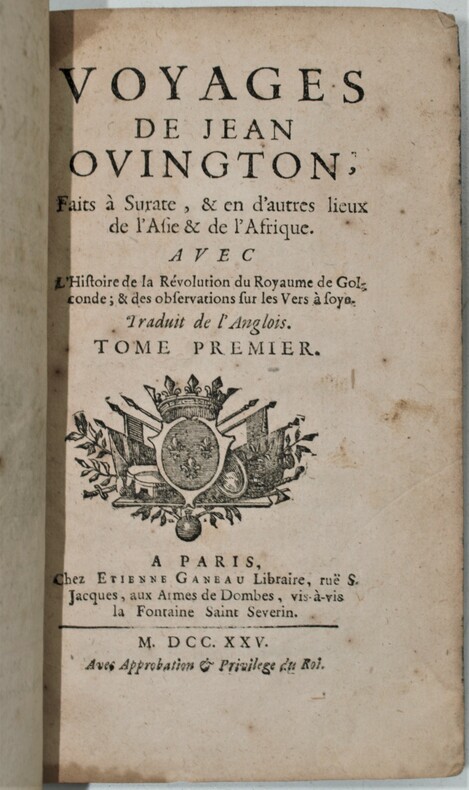
1725PHO-1251Paris, Étienne Ganeau, 1725. 2 volumes in-12, (160x100), xxiv-323p-errata , vi-318p . Relié plein basane marbré , dos lisse orné, pièces de titre et de tomaison rouges, tranches marbrées , dos frotté avec manque des pièces de titre et tomaison tome 2, coins , charnières et coiffes usés , petites rousseurs.
1800PHO-1521Paris, imprimerie de Poignée,1800. 3 volumes in-8 (4), relié pleine basane, dos lisse orné avec pièce de titre rouge et tomaison verte titre et tomaison, une coiffe accidentée, petites rousseurs XXXVIII pp., 302 pp. - 2 ff., 410 pp. - 2 ff., 362 pp..
1775265758G.B. Teubner Leipzig 1775. Hardcover Französisch und Deutsch. Zustand: keine Beschädigungen eine Namenseintragung. Rücken Ecken Kanten bestoßen. G.B. Teubner, Leipzig, hardcover
172937768London: Not Attributed. Very Good with no dust jacket. 1729. Hardcover. Portrait; .Written by . James Duke of York under his administration of Lord High Admiral . Published from his Original Letters etc. First collected by Lord F. Howard. A brief history of the Restauration etc. Scarce 5 copies at auction since 1884. Contemporary patterned leather spine scraped front cover detached. Contents clean and bright with a little printing offset to 5 pages 146-150. . Not Attributed hardcover
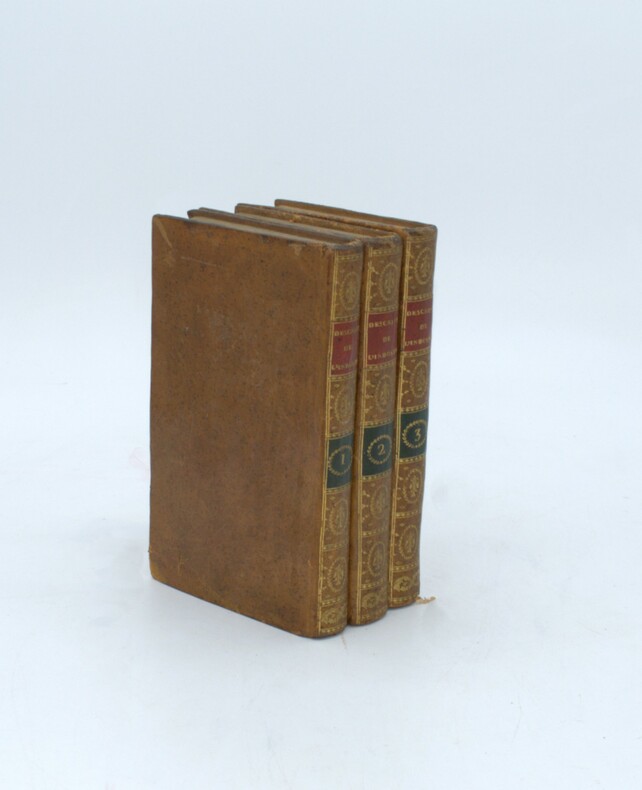
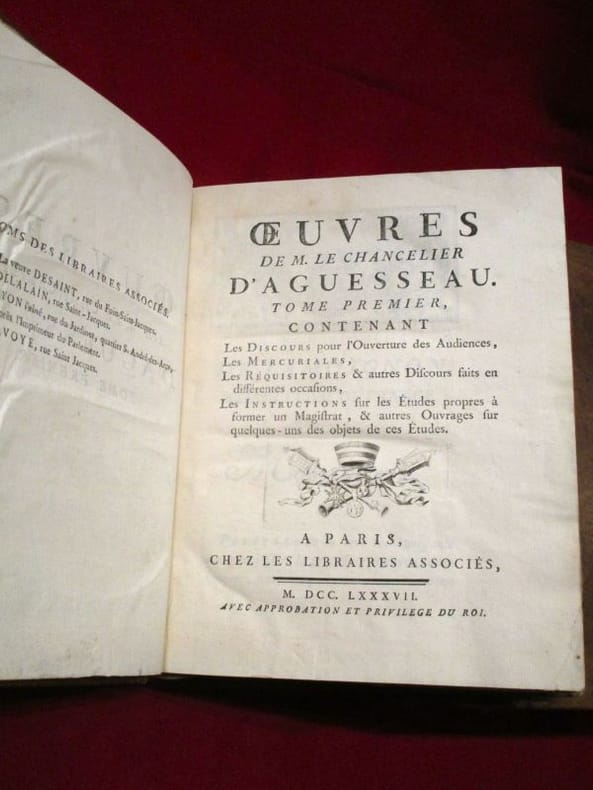
1787117544Desaint, Delalain, Nyon, Savoye 1787-1789 13 in-4 A Paris, Chez les Librairies associés, 1787-1789, 13 volumes in-quarto de 195x250 mm, CXLVIII, 622 pages - XXVIII, 688 pages - XX, 782 pages - XXIV, 731 pages - XXXII, 752 pages - XVI, 772 pages - XLVIII, 685 pages - XXIV, 711 pages - XX, 731 pages - XVI, 460, XII, 316 pages - XVI, 677 - XXVIII, 648, XLIX pages - LXXXVIII, 704 pages. Pleine reliure racinée, dos lisse portant titres et tomaisons dorés sur pièces de cuir respectivement rouges et bleu foncé, dos richement ornés de fers dorés, roulette dorée sur les coupes, gardes de papier marbré caillouté. Coins frottés, des épidermures sur les plats, des traces de mouillures (principalement sur les tranches et en marges des feuillets) sur plusieurs tomes, sinon bel exemplaire, état satisfaisant.
1718PHO-1706Amsterdam, la Compagnie, 1718. 2 tomes en un volume in-4, relié plein veau (19eme), dos à nerfs orné, pièce de titre rouge, de la bibliothèque du Comte de Glendall avec son ex-libris en page de garde, armes en tête, tranches cailloutées, 15ff.-188pp., 1f.-208pp.-8ff., illustré de 89 planches h.t. et 46 gravures dans le texte, manque 1 plat, coiffes usées, mouillure par intermittence, frottement au dos, fente au mors,
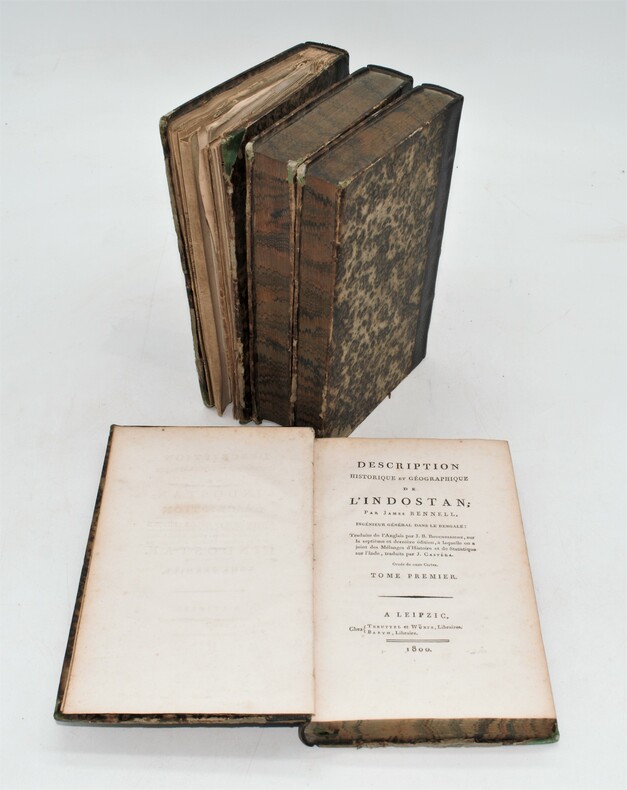
1800P2-8BLeipzic, Treuttel & Wurtz ,1800. 4 volumes in-8 , relié demi basane , dos à nerfs avec auteur , titre et tomaison , tranches et gardes peignées , coupes et coins usés , petites rousseurs . Complet en 3 volumes de texte et 1 volume d’Atlas , de XXXVIII pp., 302 pp. - 2 ff., 410 pp. - 2 ff., 362 pp. - Atlas, 39 pp., 11 cartes dépliantes. Première édition française, traduite par Jean-Baptiste Boucheseiche sur la septième édition anglaise. Elle est illustrée de 11 cartes repliées réunies dans un atlas séparé
1777268064Frankfurt und Leipzig 1777. Hardcover mit Pergamentrücken. Zustand: Die Ecken sind stark angefräst mit Fehlstelle der Innenblock ist aber auch an den Rändern intakt Rücken komplett intakt Kanten vorne am Karton berieben aber ohne Verletzungen. Frankfurt und Leipzig, hardcover
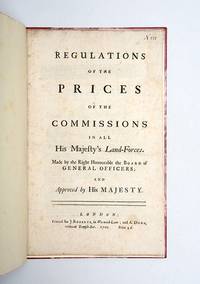
1720160753London: J. Roberts and A. Dodd 1720. A price list for the purchase system - commissions in the C18th British army First edition of the first formalized listing of the terms and prices applying to the purchase of military commissions a system which obtained in the British Army or equivalent from around 1660 until removed in the Cardwell Reforms of 1871. Rare ESTC has four copies in the UK Library Hub adds National Library of Scotland World Cat locates eight copies in North America and one at the University of Queensland. This is a window onto a complex and contentious area of debate not least because the practice was illegal for large parts of its operation; "The 'system' comprehending purchase and sale was constrained by a range of laws warrants orders rules custom and connived at abuses. Sale of commissions for significant periods of its vigourous life was specifically and incontrovertibly contrary to law even including the Royal Prerogative. The same prohibition was matched by indubitably established official recognition acceptance or condonement. Further and perhaps not surprisingly few conclusions of principle can be adumbrated without fear of contrary evidence" Scouller p. 217. A system which required each of the advancing officers to pay the officer stepping down that proportion of the commission price that represented the difference between their new and old ranks see Scouller p. 223 was surely nigh on impossible to administer and how far the list prices were adhered to tends to be transactionally and anecdotally obfuscated. The largest "tariff" noted here is £9000 for the purchase of the colonelcy of Lord Irwin's Regiment the King's Regiment of Horse a sum which if factored against the wage of the average worker at the time comes to a staggering £20 million today. The "acquisition of colonelcies. is neither so widely known nor as well documented" as for ranks up to and including lieutenant-colonel and was something that George I had attempted to stop at the very beginning of his reign - "that Evil Practice" - but was only eventually eradicated under his great-grandson George III Hayes p. 3. The circumstances of Irwin's purchase of the regiment from Lord Lumley in 1717 with its valuation at £9000 - the secretary-at-war had noted in broaching the subject that "no regiment can be in better condition" Hayes p. 8 - is the best documented of any such transaction due to the survival of a large tranche of correspondence between Irwin and his agent Richard Worthington. Irwin gathered the funds to cover purchase with 3000 guineas from his colonelcy in the 16th Foot a loan of £1500 each from his agent and from the government and a further £1500 from the sale of stock. The rest was offset in a slightly unseemly fracas over "off reckonings" allowances made for regimental clothing and equipment between Worthington and Lumley to include a payment of £500 "for to buy Hatts gloves & odd Matters ye Ensueing Year" and also giving "ye Lordship the Trumpetters Horse & other considerations". This is a scarce piece which offers insight into an elusive and important subject. Folio 322 x 195 mm pp. 8. Twentieth-century red half morocco gold vein overprint on Turkish pattern marbled boards lettered in gilt longitudinally bulked with blanks. Very light shelf-wear contents lightly toned and a little creased a very good copy. Goldsmiths' 5747. James Hayes "The Purchase of Colonelcies in the Army 1714-63" in the Journal of the Society for Army Historical Research 39 157 1961; R. E. Scouller "Purchase of Commissions and Promotions" in the Journal of the Society for Army Historical Research 62 252 1984. hardcover
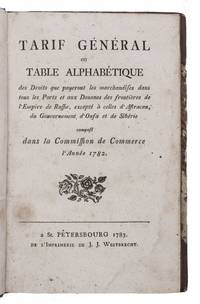
178318774St. Petersburg: J.J. Weitbrecht 1783. Contemporary half calf marbled sides sprinkled edges. 8vo. Second known copy of a commercial publication of statutes promulgated in French by the Russian Empress Catharine the Great concerning import duties for commercial merchandise in Russian ports and at other frontiers of the Russian Empire as they were determined and accepted in 1782. There is an exception for Astrakhan a major port and market city in southern Russia at the head of the Volga river which was under the government of Siberia which apparently maintained its own commercial regulations.This publication is very rare WorldCat lists only 1 copy Kress Library of Business and Economics Harvard University. Other libraries worldwide have only the microfilm of the Kress copy.A faint stain and one tiny hole in the margin of the first 20 pp. Cover slightly rubbed. Otherwise in good condition.l Goldsmiths'-Kress 12431.16. J.J. Weitbrecht, unknown
1704(LCPCECO-0004)(Un précieux manuscrit calligraphié sur vélin, sans doute destiné à un membre très éminent de la Chancellerie Royale de Louis XIV) "TARIF DES DROITS DU SCEAU, TANT DE 1672, 1674, 1691, QUE DE L'AUGMENTATION DE 1704, QUE LE ROY DE L'ADVIS DE MONSIEUR LE CHANCELIER VEUT ESTRE LEVEZ A L'AVENIR SUR LES LETTRES ET EXPEDITIONS QUI SERONT SCELLEES EN LA GRANDE CHANCELLERIE...". s.d. (vers 1704) 4 parties en 1 volume in-12° (175x125 mm) (dimensions pages 169x114 mm) (7) ff. b. de papier, (1) f. b. de vélin, (48) ff. de vélin, (1) f. b. de vélin, (7) ff. b. de papier. Reliure de l'époque en maroquin noir. Encadrement de triple filet doré sur les plats avec fleurons dorés aux angles et fleurs de lys dorés en écoinçons. Dos à cinq nerfs avec compartiments décorés avec fleurs de lys et titre en lettres dorées. Roulette intérieure dorée. Tranches dorées. Précieux et rarissime manuscrit sur vélin, parfaitement calligraphié, dans sa reliure du temps en maroquin noir aux fleurs de lys, sans doute destiné à un des membres les plus éminents de la haute administration royale. A l'époque le Chancelier en charge (de 1699 à 1714) était le M.is Louis Phélypeaux, C.te de Maurepas et de Pontchartrain (1643-1727), qui "redonna à la chancellerie une importance et un éclat oubliés depuis la vieillesse de Pierre Séguier". Manques aux coiffes et partie inférieure du mors du premier plat fendu sur 3 cm, mais très bel exemplaire avec intérieur frais et magnifiquement conservé. Le texte est divisé en quatre parties. La première présente les tarifs par actes et par offices ; vient ensuite la liste des archevêchés et des évêchés ; suit un état de ce que doivent payer les chancelleries supérieures ; et, enfin, un "Tarif des droits de la Chancellerie de Paris et des chancelleries près de nos cours présidiaux...". Cette dernière partie semble ne pas être reprise dans l'édition de 1704. Ce rarissime manuscrit sur les droits de la Chancellerie royale et leur augmentation de 1704 est le précieux témoignage de la période fort troublée des dernières années du règne de Louis XIV. Nous sommes en pleine guerre pour la succession au trône d'Espagne, déclenchée en 1701 à la suite du décès de Charles II (le 1er novembre 1700), mort sans descendance. C'est le grand conflit qui oppose la France des Bourbons, qui soutient le Duc d'Anjou (futur Philippe V d'Espagne), deuxième fils du Grand Dauphin et petit-fils de Louis XIV, à l'Autriche des Habsbourg, qui soutient Charles, second fils de l'Empereur Léopold Ier. En 1702 l'Angleterre, le Saint-Empire romain germanique et les Provinces-Unies déclarent la guerre à la France, une guerre qui durera douze ans et qui épuisera toute l'Europe jusqu'à 1713 et aux signatures des Traités d'Utrech et de Rastatt (1714). Le coût des armées françaises est faramineux et l'augmentation des droits de chancellerie est un des premiers moyens employés pour remplir les caisses de l'Etat. Mais cela ne suffira pas. La France sera particulièrement frappée par la crise financière de 1709, étroitement liée à l'inflation causée par les colossales dépenses de guerre et aggravée par la plus terrible famine de son histoire, celle de l'hiver de la même année (avec 600.000 décès, le prix du blé multiplié de six à dix fois dans de nombreuses villes du royaume et le Roi obligé à mettre ses pierreries en gage de la monnaie royale). Les conséquences de cette crise enorme tourneront la France de la Régence (après la mort de Louis XIV en 1715), toujours en très grave déficit, au système de Law. Le présent manuscrit fut sans doute rédigé par un copiste professionnel ou maître en écriture. Nous avons pu localiser seulement 4 autres exemplaires en reliure identique ou similaire : Institut de France (1 vol. in-fol., 1ère partie réalisée en 1691, les deux suivantes en 1704, provenant de la collection Godefroy : dans les collections publiques parisiennes depuis 1760 (170x110 mm et 175x120 mm), BNF (acquis dans les années 1960 (170x120 mm)), Ranbervillers (168x112 mm) et Nevers (don à la bibliothèque en 1851 (170x110 mm)). Le texte fut imprimé à Paris chez la V.ve Laurent Raudet au format in-4°. (LCPCECO-0004) (5.500,00 €)