US Food AdministrationBiblio.com

4 232 résultats
261343New York: M.B. Brown Printing and Binding Company. Original poster. Color lithograph. 21.5 x 14 inches.<br/> <br/> WWI era slogan. This poster is vivid blue with white text. Good condition with collection inventory number in margin.<br/> <br/> M.B. Brown Printing and Binding Company unknown
191813158Boston MA: Houghton Mifflin Company 1918. fair. 379 map ftnotes refs index sm damp stains in margins no pgs stuck ink name ins fr flylf bds quite soiled sm holes spine. Board corners threadbare and slightly bumped some wear to board and spine edges. Part I covers food and the war; Part II is a laboratory manual of food selection preparation and conservation. Houghton Mifflin Company unknown
1396237771.Ghardcover. Good. Access codes and supplements are not guaranteed with used items. May be an ex-library book. hardcover
1391118324.Gpaperback. Good. Access codes and supplements are not guaranteed with used items. May be an ex-library book. paperback
295372Cincinatti New York: Strobridge Litho Co. PAUS Herbert Andrew. Original poster. Color lithograph. Page measures 35 1/2" x 56 1/2".<br/> <br/> Homefront poster from World War I encouraging Americans to save food. This vividly colored lithograph depicts a Red Cross nurse a wounded soldier a mother and infant and other people in need standing in front of a Iron Cross and pointing to a quote by John Greenleaf Whittier. Folded as issued some cracks along folds. Repair to right margin. Mounted on linen. Beautiful colors.<br/> <br/> Strobridge Litho Co unknown
1484020510.Gpaperback. Good. Access codes and supplements are not guaranteed with used items. May be an ex-library book. paperback
1396173692.Ghardcover. Good. Access codes and supplements are not guaranteed with used items. May be an ex-library book. hardcover
139617396X.Gpaperback. Good. Access codes and supplements are not guaranteed with used items. May be an ex-library book. paperback
1396692606.Ghardcover. Good. Access codes and supplements are not guaranteed with used items. May be an ex-library book. hardcover
0260022969.Ghardcover. Good. Access codes and supplements are not guaranteed with used items. May be an ex-library book. hardcover
197542156Washington DC: ERDA 1975. Draft Edition. good. Approx. 600 wraps 2-vol. set illus. appendices covers somewhat worn soiled and some edge tears. ERDA-1542. Includes summary sheet for the Draft Environmental Statement. Volume 2 is the Appendices. This is a major assessment related to the nuclear power industry nonproliferation export control and environmental protection. It is unusual for draft documents such as this to become available as they are often destroyed when the final version is published. These drafts often have significant changes from what is finally printed and the analysis of the changes can provide an unusually clear insight into internal agency deliberations and technical and policy issues. Activities are assessed through the year 2000. ERDA paperback
197652825Place_Pub: Washington DC: ERDA 1976. good. Approx. 150 wraps illus. glossary references staple holes in front cover covers somewhat worn/soiled small tear at top of spine. Date time stamp on rear cover distribution memo laid in. ERDA-1546. This final environmental statement has been prepared in compliance with the National Environmental Policy Act to support the Energy Research and Development Administration project to design and construct positron-electron colliding beam storage ring PEP facilities at the Stanford Linear Accelerator Center SLAC at Stanford University in Stanford San Mateo County California. ERDA paperback
197758541Washington DC: Energy Research and Development Administration 1977. Presumed First Edition First printing thus. Wraps. Good. Various paginations approximately 3/4 inch of material. Glossary. References. Name of previous owner present. Cover has some wear and soiling. An environmental impact statement EIS under United States environmental law is a document required by the National Environmental Policy Act NEPA for certain actions "significantly affecting the quality of the human environment". An EIS is a tool for decision making. It describes the positive and negative environmental effects of a proposed action and it usually also lists one or more alternative actions that may be chosen instead of the action described in the EIS. Several U.S. state governments require that a document similar to an EIS be submitted to the state for certain actions. For example in California an Environmental Impact Report EIR must be submitted to the state for certain actions as described in the California Environmental Quality Act CEQA. Energy Research and Development Administration paperback
1976057718Washington D.C.: US Energy Research & Development Administration Div.of Physical Research 1976. Paper Back. Very Good/No Jacket. 4to - over 9¾" - 12" tall. 76pp.; SC staple-bound; paleorange w/blk.; slight rub w/lt.stain; 'bureau of mines' stamp&staple holesft.cover; cleantight pgs. Summaries from different divisions. ERDA-76-114 UC11 <br/> <br/> US Energy Research & Development Administration, Div.of Physical Research unknown
197641967Washington DC: ERDA 1976. First Edition. First Printing. good. Wraps 2-vol. set illus. footnotes appendices covers somewhat worn and soiled summary sheet laid in. ERDA-1542. Volume 2 is contains Appendices and Comment Letters. This Statement represents an analysis of the U.S. nuclear power export activities from the inception of the Atoms for Peace program in 1953 through the year 2000. The analysis addresses generic issues relating to a continuation of U.S. nuclear power export activities through the year 2000 at various projected levels and to reasonably available alternatives. The Statement analyses the potential environmental impacts on the U.S. and the high seas resulting from U.S. nuclear power export activities conducted within the U.S. or on the high seas. This is a major analysis and forecast taken before the events at Three Mile Island. ERDA paperback
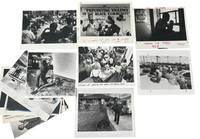
1970231521970. War on Drugs Press photographs of drug enforcement addiction treatment and anti-violence intervention in Houston New Orleans and El Paso 1970-1992 documenting how the War on Drugs functioned across policing rehabilitation public messaging and newspaper circulation. Several prints retain typed caption slips assignment sheets and Houston Chronicle stamps locating the group within newsroom and wire-service use rather than private snapshot production. The strongest images show not only arrests and seized evidence but the wider apparatus surrounding narcotics policy: the U.S. Drug Enforcement Administration's El Paso Intelligence Center U.S. Customs canine inspection work in Houston a New Orleans anti-drug and anti-violence rally at the Desire Housing Project and rehabilitation scenes tied to Bridge House and Charity Hospital detox with Black urban communities especially central to the visual language of late 1980s coverage.<br /> <br /> Photo archive of 12 silver gelatin press photographs all 8 x 10 inches Houston El Paso and New Orleans 1970-1992. The group includes a February 16 1970 press image identified as "Dope Raid" showing officials examining a crate of seized drug paraphernalia; a 1971 "Drug raid" photograph; and a 1979 image of the control center of the U.S. Drug Enforcement Administration's El Paso Intelligence Center with consoles screens desks and seated staff in a surveillance-heavy operations room. A likely 1975 evidence display isolates a syringe spoon folded packet and narcotics sample against a dark ground with an attached caption describing a "$5 package of cocaine" and a glassine of heroin; another early 1970s image bears a clipping caption about Drug Enforcement Administration agents seizing a tug and a large marijuana cache. Late period photographs shift toward street-level enforcement and public intervention: a 1990 Houston image captioned "Drug Traffic Houston" shows U.S. Customs using a dog named Magnum to search vehicles; a 1992 Houston Chronicle photo records Sgt. G.U. Rodriguez inspecting a Corvette after a chase connected to a drug dispute involving fake drugs and real guns; one image marked "Operation Crackdown" shows a Texas officer handcuffing a young Black man on the lawn outside an apartment building; another captioned "Crowd at service ctr. made into booking desk" shows a packed intake scene around tables and paperwork. The New Orleans photographs are especially strong: one print shows Dr. Keith C. Ferdinand speaking beneath a banner reading "Preventing Violence in the Black Community" at an anti-drug and violence rally at the Desire Housing Project in 1988; another shows a group discussion at Bridge House captioned on verso as "John speaking about crack addiction;" a third presents Ron identified on verso as "a crack addict seeking rehabilitation" seated in silhouette by a wired window at Charity Hospital detox with a wall poster reading "Charity is a Winner!"<br /> <br /> The group traces American drug policy imagery from early raid and evidence photographs in 1970s press usage through the institutional expansion of intelligence coordination neighborhood sweeps addiction treatment and anti-violence campaigns during the crack era. These photographs depict both the scale and the impact of the War on Drugs: federal intelligence and customs work local police enforcement medical detox residential recovery and public-facing community rhetoric all appear here in concrete captioned form. Editorial markings stamps clipping residue light creasing and surface wear from newsroom handling; overall good condition. The concentration of captioned Texas and Louisiana press images reveal how narcotics policy was staged enforced and narrated in the urban Gulf South as well as depicting the community response and its notable effect on African American communities. unknown
199720050U.S. Dept. of Transportation Federal Aviation Administration 1997. Paperback. Very Good. Spiral-bound softcover light shelfwear to covers. Contents clean and tight. 90 pages bibliography color and b&w photos and illus. U.S. Dept. of Transportation, Federal Aviation Administration paperback
61-02234US Government Printing Office. Paperback. Good. Good condition with wear and marking. US Government Printing Office paperback
19812092902141501828Hara shobo 1981. Soft Cover. Fine. Size: 46 size Hara shobo paperback
2022SKU1737831Independently published 2022-12-22. paperback. New. 8x1x11. New Textbook Ships with Tracking Independently published paperback
200514195Washington D.C. U.S.A.: United States Govt Printing Office 2005. Very large hardback in fine condition with fine dust jacket. Hardcover. Fine/Fine. Washington, D.C., U.S.A.: United States Govt Printing Office Hardcover
200652774Washington DC: U.S. Department of Energy 2006. very good. 21 wraps color illus. figures. Inscribed by NNSA Administrator Linton Brooks on front cover. DOE/NA-0013. U.S. Department of Energy paperback
200475764Knoxville TN: U.S. Department of Energy National Nuclear Security Administration 2004. Presumed First Edition First printing thus. Hardcover. Very good. Title from front cover. Various paginations approximately 225 pages. Illustrations some with color. Abbreviations and Acronyms. Includes CD on URPR Program Implementation and Task Plans dated January 2007 located inside the front cover. The University Research Program in Robotics URPR Implementation Plan is an integrated group of universities performing fundamental research that addresses broad-based robotics and automation needs of the NNSA Directed Stockpile Work DSW and Campaigns. The URPR mission is to provide improved capabilities of robotics science and engineering to meet the future needs of all weapon systems and other associated NNSA/DOE activities. The participants included University of Florida University of Michigan University of New Mexico University of Tennessee at Knoxville and University of Texas at Austin. This plan describes the purpose goals planning assumptions technical approach risks integration with other programs campaigns and sites and the estimated funding requirements for each year. The URPR mission is to provide improved capabilities of robotics science and engineering to meet the future needs of all weapon systems and other associated NNSA/DOE activities. The IRIS Lab's current areas of research are in scene building scene description and data visualization. The combination of these different fields gives rise to robust usable systems and advanced developments in the underlying technologies. U.S. Department of Energy, National Nuclear Security Administration hardcover
200288245Las Vegas NV: U.S. Department of Energy National Nuclear Security Administration Nevada Operations Office 2002. Presumed to be one of some limited number of multiple originals produced. CD in a paper envelope with a clear plastic face. Very good. This disc has no distribution limitation information on its front. This CD contains one file with an approximately 70 page document that has color illustrations tabular data and briefing slides at the end. There may be a hardcopy version of this given the DOE/NV number. The content addresses the then current test readiness maintaining current posture enhancing test readiness and provided several appendixes including Threshold Test Ban Preparations and Authorization Basis including Underground Nuclear Test Standards Safety Basis Safety Management and a Device-Specific Nuclear Explosive Safety Study. Table 4 is a summary of the cost study results in Millions. The Department of Energy submitted a report to the Senate Armed Services Committee on May 20 calling for the United States to shorten the time it would take to conduct a nuclear test to 18 months in order to provide a "reasonable level of flexibility" for the Bush administration. Congress requested the report in November 2002 instructing Secretary of Energy Spencer Abraham to draw up plans that would enable the department to test within six 12 18 or 24 months. Currently the United States can conduct a nuclear test within 24-36 months of a presidential directive to do so. Congress also asked Abraham to determine in consultation with the secretary of defense which readiness period would be optimal. The 18-month recommendation "reflects what is achievable and cost effective" according to the report which was prepared by the National Nuclear Security Administration NNSA a semiautonomous agency within the Energy Department. The report indicated that 18 months is the minimum amount of time needed to evaluate a problem identified in the U.S. nuclear stockpile propose a solution and "execute a test that would provide the information needed to certify the ‘fix.'" The recommendation is "consistent with realistic testing schedules" established during previous U.S. nuclear testing which ceased in 1992. By contrast shortening test readiness to six or 12 months would require a "substantial diversion of personnel and facilities at the laboratories" according to the report. That would "represent a major redirection of the stockpile stewardship program" which is intended to maintain the nuclear arsenal in the absence of testing. Adopting a testing posture of a year or less would be "most relevant.if the President might direct that testing resume for political reasons." The report also noted that the shorter readiness period would be considerably more expensive. The transition to shorten the current 24-36 month readiness posture expected to take three years is already underway. NNSA conducted an Enhanced Test Readiness Cost Study in July 2002 to determine the steps and funding required to shorten the readiness posture and the Nuclear Weapons Council a consultative group of officials from the Energy Department and the Pentagon approved the plan to transition to an 18-month readiness window in September 2002 according to the report. The Bush administration asked for funds to begin moving to a shorter test readiness posture in its fiscal year 2004 budget request. Charles Anson Franklin NNSA spokesman said that the current readiness posture of 24-36-months was "a policy decision of the previous administration. This administration has made a policy decision of an 18-month readiness period." He added "It's been out there—it's not been a surprise.We've been talking about moving to an 18-month readiness posture since 2001." The changes will be fully implemented by the end of fiscal year 2005 and will cost $83 million with an additional $25-30 million needed annually to sustain the heightened state of scientific technological and personnel preparedness according to the report. The report examined a speedier transition but concluded that reaching the 18-month readiness posture sooner would cost more and disrupt other programs because of the limited number of nuclear weapons personnel. U.S. Department of Energy, National Nuclear Security Administration, Nevada Operations Office unknown
200247207Washington DC: U.S. Department of Energy 2002. very good. Approx. 500 wraps 2-vol. set illus. maps appendices references glossary index. Complete title: Final environmental impact statement for the proposed relocation of Technical Area 18 capabilities and materials at the Los Alamos National Laboratory. Volume I contains chapters 1 through 11; Volume II contains Appendices A through K references and glossary. U.S. Department of Energy paperback