Work Progress AdministrationBiblio.com
4 232 résultats
A9781639140015Paperback / softback. New. paperback
A9781639140022Paperback / softback. New. paperback
A9781639140008Paperback / softback. New. paperback
A9781639140046Paperback / softback. New. paperback
B9781639140046Paperback / softback. New. paperback
59139Paperback. Fine. Spacesuit guidebook HOW TO BUILD A SPACESUIT paperback
198974608Lyndon B. Johnson Space Center Houston TX: National Aeronautics and Space Administration 1989. Presumed First Edition First printing. Wraps. Good. vii 1 44 pages plus covers. Illustrations most in color. Cover has some wear and soiling with edge tear at back. Format is approximately 8.5 inches by 11 inches. The Spacelab Life Sciences 1 SLS-1 mission originated with a call to the scientific community for experiments in 1978. Accepted experiments involved humans primates rodents amphibians and plants. The original payload configuration was reduced to include human passive rodent and basic biology experiments and engineering evaluations. Human experiments will address effects of micro-gravity on various physiological parameters during and postflight. Investigations with nonhuman subjects will study microgravity effects on the cardiopulmonary cardiovascular and musculoskeletal systems on the regulation of blood volume and erythropoiesis and on calcium metabolism and gravity receptors. SLS-1 was to serve as a stepping stone in establishing capabilities for flying nonhuman subjects and performing in-flight manipulations on these subjects without jeopardizing the crew environment. Fundamental technology incorporated in the animal holding facilities and laboratory work bench will be used in subsequent missions and in the future Space Station. Space Life Science-1 SLS-1 launched aboard Space Shuttle Orbiter Columbia STS-40 on June 5 1991 was the first Spacelab mission dedicated solely to life sciences research. The laboratory for the research took place in a module shown here carried in the cargo bay of the Columbia. The purpose of the mission was to study the mechanisms magnitudes and time courses of certain physiological changes that occur during space flight to investigate the consequences of the body's adaptation to microgravity and readjustment to Earth's gravity and to bring the benefits back home to Earth. The mission was designed to explore the responses of the heart lungs blood vessels kidneys and hormone-secreting glands to examine the causes of space motion sickness and study changes in the muscles bones and cells. Many studies started during SLS-1 provided data that served as the foundation for investigations on the International Space Station. National Aeronautics and Space Administration paperback
195988472Washington DC: U. S. Government Printing Office 1959. Presumed First Edition First printing. Wraps. Good. The format is approximately 10.5 inches by 8.5 inches. 32 pages plus covers. Wraps. Illustrations photographs and drawings. Diagrams. Tabular Data. Some wear and soiling to covers. On July 29 1958 President Eisenhower signed an act of Congress creating the National Aeronautics and Space Administration. The act declared "that is is the policy of the United States that activities in space should be devoted to peaceful purposes for the benefit of mankind." On October 1 1958 this new agency was established. This 1959 initial publication there were later editions/versions is thus one of the earliest official NASA publications. This work briefly presents a historical perspective then discusses Sounding Rockets Satellites and Space Probes Manned Space Flight Human Factors and Future Explorations. NASA traces its roots to the National Advisory Committee for Aeronautics NACA. Despite being the birthplace of aviation by 1914 the United States recognized that it was far behind Europe in aviation capability. Determined to regain American leadership in aviation the United States Congress created the Aviation Section of the U.S. Army Signal Corps in 1914 and established NACA in 1915 to foster aeronautical research and development. Over the next forty years NACA would conduct aeronautical research in support of the U.S. Air Force U.S. Army U.S. Navy and the civil aviation sector. After the end of World War II NACA became interested in the possibilities of guided missiles and supersonic aircraft developing and testing the Bell X-1 in a joint program with the U.S. Air Force. NACA's interest in space grew out of its rocketry program at the Pilotless Aircraft Research Division. The Soviet Union's launch of Sputnik 1 ushered in the Space Age and kicked off the Space Race. Despite NACA's early rocketry program the responsibility for launching the first American satellite fell to the Naval Research Laboratory's Project Vanguard whose operational issues ensured the Army Ballistic Missile Agency would launch Explorer 1 America's first satellite on February 1 1958. The Eisenhower Administration decided to split the United States' military and civil spaceflight programs which were organized together under the Defense Department's Advanced Research Projects Agency. As the United States' premier aeronautics agency NACA formed the core of NASA's new structure by reassigning it its 8000 employees and three major research laboratories. NASA also proceeded to absorb the Naval Research Laboratory's Project Vanguard the Army's Jet Propulsion Laboratory JPL and the Army Ballistic Missile Agency under Wernher von Braun. This left NASA firmly as the United States' civil space lead and the Air Force as the military space lead. U. S. Government Printing Office paperback
195980605Washington DC: National Aeronautics and Space Administration c1959. Presumed First Edition First printing. Booklet. Good. Format is approximately 10.5 inches by 8 inches. 32 pages plus covers. Illustrations. Reference was found on page 21 to selection of candidates having begun in early 1959. Other references to early 1959 and 1958 noted. This work starts out with a brief history of the scientific inquiry into space and space travel. It the discusses sounding rockets Satellites Spacecraft Space Probes Jupiter C Vanguard I Juno II Tracking Station Manned Space Flight Human Factors Project Mercury and space exploration. This is an early NASA general audience publication. The National Aeronautics and Space Administration NASA is an independent agency of the U.S. Federal Government responsible for the civilian space program as well as aeronautics and space research. NASA was established in 1958 succeeding the National Advisory Committee for Aeronautics NACA. The new agency was to have a distinctly civilian orientation encouraging peaceful applications in space science. Since its establishment most US space exploration efforts have been led by NASA including the Apollo Moon landing missions the Skylab space station and later the Space Shuttle. NASA is supporting the International Space Station and is overseeing the development of the Orion spacecraft the Space Launch System and Commercial Crew vehicles. The agency is also responsible for the Launch Services Program which provides oversight of launch operations and countdown management for uncrewed NASA launches. National Aeronautics and Space Administration unknown
1508722633.Gpaperback. Good. Access codes and supplements are not guaranteed with used items. May be an ex-library book. paperback
1508722633New. Brand new and still unused unknown
23710525like new. unknown
23710525-nnew. unknown
B9781508722632Paperback / softback. New. paperback
197546110Washington DC: NASA 1975. First Edition. First Printing. fair. 859 wraps illus. diagrams references covers worn and soiled slightly cocked damp staining at edges. This was prepared at Goddard Space Flight Center. The Symposium was held in Silver Spring MD and was sponsored by the Institute of Environmental Sciences The American Institute of Aeronautics and Astronautics The American Society for Testing and Materials and the National Aeronautics and Space Administration. NASA paperback
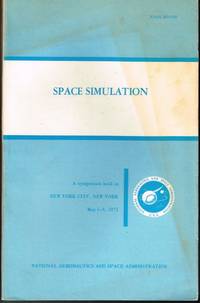
197246119Washington DC: NASA 1972. First Edition. First Printing. good. 23 cm 1071 wraps illus. references covers somewhat worn and soiled some edge soiling. This symposium was sponsored by the Institute of Environmental Sciences The American Institute of Aeronautics and Astronautics; The American Society for Testing and Materials; and the National Aeronautics and Space Administration. NASA paperback
197241200Washington DC: NASA 1972. First Edition. First Printing. fair ex-lib. 1071 illus. references usual library markings front flyleaf removed "withdrawn" stamp on title page bds worn/soiled/faded. NASA SP-298. This symposium was sponsored by the Institute of Environmental Sciences The American Institute of Aeronautics and Astronautics The American Society for Testing and Materials and the National Aeronautics and Space Administration. These proceedings are the sixth of a series of conferences. NASA unknown
1481036246.Gpaperback. Good. Access codes and supplements are not guaranteed with used items. May be an ex-library book. paperback
201086124Washington DC: National Aeronautics and Space Administration 2010. Xerox-style reproduction. Assume relatively few copies made for media representatives. Stapled at upper left corner. Very good. ii 104 pages plus front cover. No rear cover. Illustrations. Three-hole punched. Logo of the United Space Alliance on the front cover. Includes STS-132/ULF4 Mission Overview; STS-132 Timeline Overview; Mission Profile; Mission Objectives; Mission Personnel; STS-132 Crew; Payload Overview; Rendezvous & Docking; Spacewalks; Experiments; History of Space Shuttle Atlantis; Shuttle Reference Data; Launch and Landing; Acronmyns and Abbreviations; Media Assistance; Public Affairs Contacts. STS-132 ISS assembly flight ULF4 was a NASA Space Shuttle mission during which Space Shuttle Atlantis docked with the International Space Station on May 16 2010. STS-132 was launched from the Kennedy Space Center on May 14 2010. The primary payload was the Russian Rassvet Mini-Research Module along with an Integrated Cargo Carrier-Vertical Light Deployable ICC-VLD. Atlantis landed at the Kennedy Space Center on May 26 2010. STS-132 was initially scheduled to be the final flight of Atlantis provided that the STS-335/STS-135 Launch On Need rescue mission would not be needed. However in February 2011 NASA declared that the final mission of Atlantis and of the Space Shuttle program STS-135 would be flown regardless of the funding situation. Also on board Atlantis was a 4-inch long wood sample of Sir Isaac Newton's apple tree. The piece from the original tree that supposedly inspired Newton's theory of gravity along with a picture of Newton were taken into orbit by astronaut Piers Sellers. The wood is part of the collection of the Royal Society archives in London and was returned there following the flight. Additionally a flag from Clarkson University Potsdam New York flew on board shuttle Atlantis. It was there in honor of STS-132 lead shuttle flight director Michael L. Sarafin who is an alumnus of the Clarkson University. The STS-132 mission patch was designed by NASA artist Sean Collins working with astronaut Garrett Reisman. The patch shows Atlantis flying towards a sunset landing with the names of the STS-132 astronauts around the border. During the standard post-flight inspection of Atlantis a United Space Alliance inspector found a STS-132 mission decal accompanied by an inscription "The first last flight of Atlantis left Earth on 14 May 2010 from Pad 39A" together with the crew's signatures. The worker had found it tucked away on the upper side of Locker A-16 while scanning the area with a mirror. Moreover he said the note must have been written in orbit since otherwise the author would have had to stand on their head to write it. At the time the note was written STS-132 was the last planned mission of Atlantis. However one further mission was ultimately approved for the shuttle: STS-135 which was to be the last flight of both Atlantis and the Space Shuttle program. National Aeronautics and Space Administration unknown
200986136Washington DC: National Aeronautics and Space Administration 2009. Xerox-style reproduction. Assumed only a few copies were made for media representatives. Stapled at upper left corner. Very good. ii 110 pages plus covers. Illustrations. Three-hole punched. The contents include STS-129/ULF-3 Mission Overview; STS-129 Timeline Overview; Mission Profile; Mission Objectives; Mission Personnel; STS-129 Crew; Payload Overview; Rendezvous & Docking; Spacewalks; Experiments; Shuttle Reference Data; Launch and Landing; Acronym and Abbreviations; Media Assistance and Public Affairs Contacts. STS-129 ISS assembly flight ULF3 was a NASA Space Shuttle mission to the International Space Station ISS. Atlantis was launched on November 16 2009 at 14:28 EST and landed at 09:44 EST on November 27 2009 on runway 33 at the Kennedy Space Center's Shuttle Landing Facility. It was also the last Shuttle mission of the 2000s. STS-129 focused on staging spare components outside the station. The 11-day flight included three spacewalks. The payload bay carried two large ExPRESS Logistics Carriers holding two spare gyroscopes two nitrogen tank assemblies two pump modules an ammonia tank assembly a spare latching end effector for the station's robotic arm a spare trailing umbilical system for the Mobile Transporter and a high-pressure gas tank. STS-129 was the first flight of an ExPRESS Logistics Carrier. The STS-129 mission patch was designed by Tim Gagnon and Dr. Jorge Cartes. The unusual shape of the patch resulted from the crew's desire for the patch to signify the mission's payload two ExPRESS Logistics Carriers providing equipment ensuring the longevity of the ISS. The insignia incorporates a number of design elements not typically incorporated into a single patch: the Sun Moon Mars NASA's astronaut symbol the ISS the Shuttle orbiter and the continental United States. The 13 stars on the patch represent the crewmembers' children and the Moon and Mars represent the future of space exploration. The names of the crew members are denoted on the outer band of the patch. The primary payloads were the Express Logistics Carriers designated ELC-1 and ELC-2 for the International Space Station ISS. The units carried a variety of tools and equipment designed to augment and enhance experimentation aboard ISS. Docking between Atlantis and ISS occurred on November 18 2009. Undocking occurred on November 25 2009. There were three spacewalks during the mission. The first spacewalk was conducted on November 19 2009 and lasted 6 hours 37 minutes. Astronauts Foreman and Satcher installed a spare antenna and a bracket for ammonia lines outside ISS. They also performed maintenance activities on the ISS Japanese robotic arm. The second spacewalk was conducted on November 21 2009 and lasted 6 hours 8 minutes. Astronauts Foreman and Bresnik installed the Grappling Adaptor to On-Orbit Railing GATOR to the ISS Columbus Laboratory plus an additional ham radio antenna. They also installed an antenna for wireless helmet camera video and relocated the Floating Potential Measurement Unit which takes electrical measurements outside ISS. The third spacewalk was conducted on November 23 2009 and lasted 5 hours 42 minutes. Astronauts Satcher and Bresnik installed an oxygen filled High Pressure Gas Tank on the ISS Quest Airlock. They also installed experiments to ELC-2 as well as a number of other maintenance activities. National Aeronautics and Space Administration unknown
200786117Kennedy Space Center FL: National Aeronautics and Space Administration Kennedy Space Center 2007. Presumed First Edition First printing. Wraps. Very good. The format is approximately 8.25 inches by 11 inches. 8 pages. Illustrations some in color. This includes information on STS-114 STS-121 STS-115 and STS-116 the 17th 18th 19th and 20th Space Station flights The write-ups include mission highlights EVAs Launch and Landing. A latter version of Volume 3 had 12 pages and included two more missions into 2007. This variant is now quite scarce having been superseded. The International Space Station ISS is the largest modular space station in low Earth orbit. The project involves five space agencies: the United States' NASA Russia's Roscosmos Japan's JAXA Europe's ESA and Canada's CSA. The ownership and use of the space station is established by intergovernmental treaties and agreements. The station serves as a microgravity and space environment research laboratory in which scientific research is conducted in astrobiology astronomy meteorology physics and other fields. The ISS is suited for testing the spacecraft systems and equipment required for possible future long-duration missions to the Moon and Mars. The Space Shuttle was a partially reusable low Earth orbital spacecraft system operated by NASA the National Aeronautics and Space Administration. Its official program name was Space Transportation System STS taken from a 1969 plan for a system of reusable spacecraft of which it was the only item funded for development. Operational missions launched numerous satellites conducted science experiments in orbit and participated in construction and servicing of the International Space Station ISS. The first of four orbital test flights occurred in 1981 leading to operational flights beginning in 1982. From 1981 to 2011 a total of 135 missions were flown all launched from Kennedy Space Center KSC in Florida. During that time period the fleet logged 1322 days 19 hours 21 minutes and 23 seconds of flight time. The longest orbital flight of the Shuttle was STS-80 at 17 days 15 hours while the shortest flight was STS-51-L at one minute 13 seconds when the Space Shuttle Challenger broke apart during launch. The cold morning shrunk an O-Ring on the right Solid Rocket Booster causing the external fuel tank to explode. The shuttles docked with Russian space station Mir nine times and visited the ISS thirty-seven times. The highest altitude apogee achieved by the shuttle was 386 milrd when deploying the Hubble Space Telescope. The program flew a total of 355 people representing 16 countries and with 852 total shuttle fliers. The Kennedy Space Center served as the landing site for 78 missions while 54 missions landed at Edwards Air Force Base in California and one mission landed at White Sands New Mexico. The first orbiter built Enterprise was used for atmospheric flight tests ALT but future plans to upgrade it to orbital capability were ultimately canceled. Four fully operational orbiters were initially built: Columbia Challenger Discovery and Atlantis. Challenger and Columbia were destroyed in mission accidents in 1986 and 2003 respectively killing a total of fourteen astronauts. A fifth operational orbiter Endeavour was built in 1991 to replace Challenger. The Space Shuttle was retired from service upon the conclusion of STS-135 by Atlantis on 21 July 2011. National Aeronautics and Space Administration, Kennedy Space Center paperback
B9781481036245Paperback / softback. New. paperback
1502989530.Gpaperback. Good. Access codes and supplements are not guaranteed with used items. May be an ex-library book. paperback
1993261668PN. New. 1993. Soft Cover. Date is original print. This is a reprint edition . PN paperback