Livre Rare Book
121 résultats
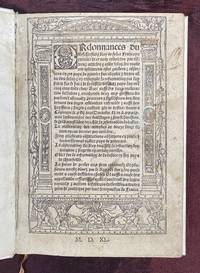
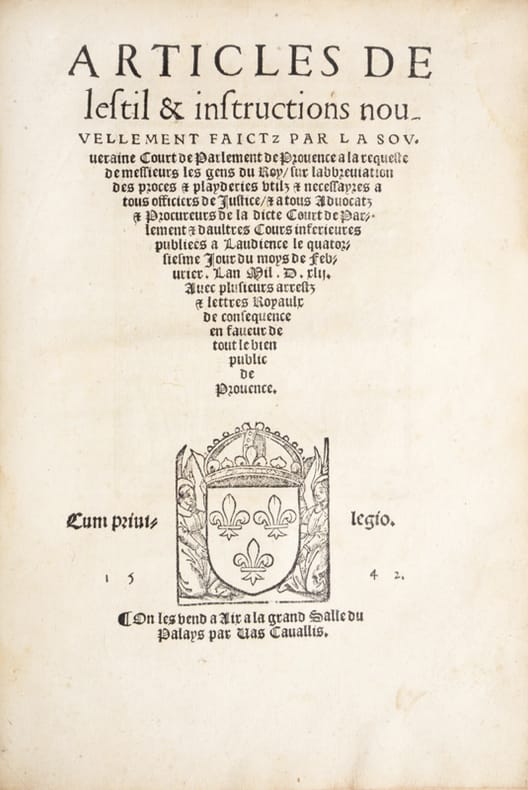
153942759Sans lieu, , 1539. In-4 gothique de (24) ff. (sign. a-f4). Relié avec : 2. [Provence. Ordonnances]. Ordonnances du très chrestien Roy de France Françoys premier de ce nom réduictes par tiltres & articles & ordre selon les matières ordonnées estre gardées & observées en ces pays de Provence, Forcalquier & terres adiacentes selon s'en ensuyvant la réformation par luy faicte sur le faict de la iustice desdictz pays lan mil cinq cens trente cinq (....) . Avignon, Jean de Channey, août 1536. In-4 gothique de CV-(9) ff. (sign. A-T6), table, titre dans un encadrement gravé. 3. [Provence. Articles]. Articles de lestil & instructions nouvellement faictz par la souveraine court de Parlement de Provence à la requeste de messieurs les gens du Roy, sur labbréviation des procès & playderies utilz & nécessayres a tous officiers de justice & a tous advocatz & procureurs de ladicte Court de Parlement & daultres Cours inférieures, publiées à l'audience le quatorziesme jour du moys de febvrier. Lan mil D. XLII. Avec plusieurs arrestz & lettres royaulx de conséquence en faveur de tout le bien public de Provence. Cum privilegio. On les vend à Aix en la grand salle du Palays par Vas Cavallis 1542. In-4 gothique de 16 ff. (sig. A-D4), armes de France au titre, bois représentant saint Louis au verso du titre.Les trois pièces reliées en 1 vol. in-4, vélin dur, dos à nerfs, titre manuscrit à l’encre noire sur le dos, triple filet d’encadrement et fleur de lys à froid dans les angles (reliure de l’époque).
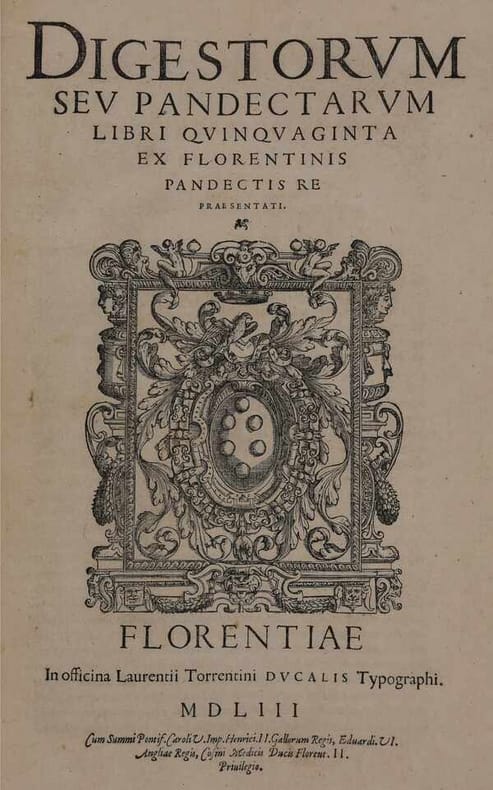
1553030664Florentiae , Florence 1553 In officina Laurentii Torrentini Ducalis Typografi , L. Torrentinus Full-Leather 1st Edition
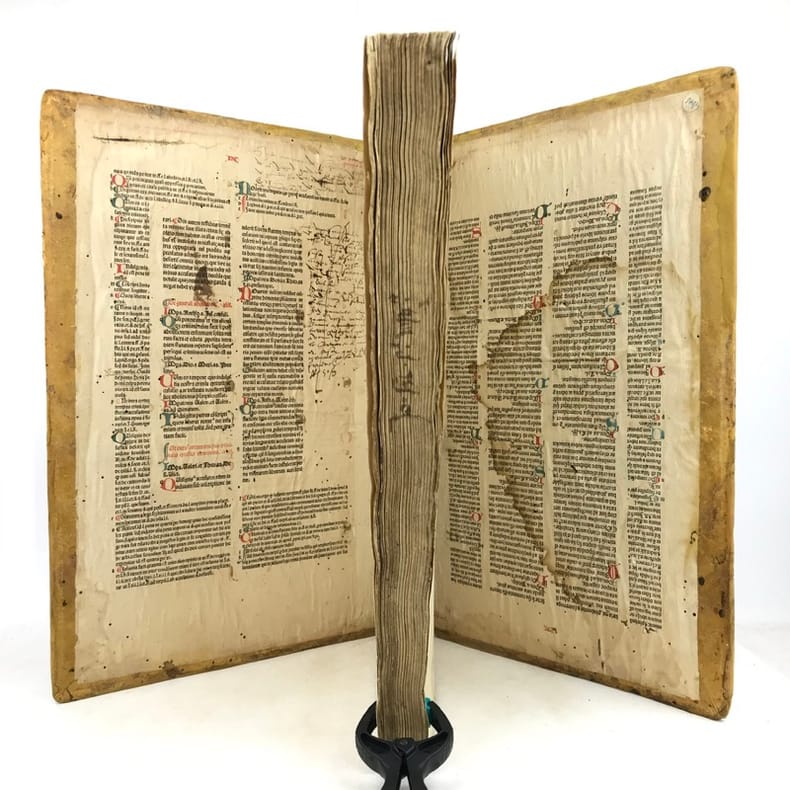
150464018CBLugduno [Lyon], 1504. 2°. 44 x 30 cm. [26] Blatt. 2 Holzschnittinitialen. Restaurierter Holzeinband im Stile der Zeit, als Halbband auf 5 Bünden mit blindgeprägtem Pergamentbezug in Platten- und Rollendruck sowie Lederriemenschließen mit verzierten Hakenverschlüssen aus Messing und privat appliziertem Daumenregister in Leder. [10 Warenabbildungen]
15135661513 Lyon, Jacob Maréchal, 1513.
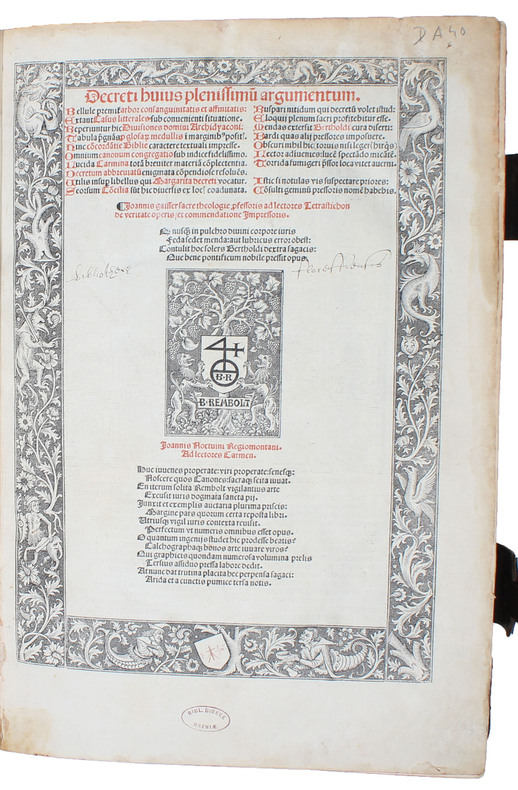
1528AMO-4518Parisiis, ex officina Claudii Chevallonii sub sole aureo in dia ad divum Jacobum. 1528 mense Aprili. [Paris, Claude Chevallon, avril 1528] 1 fort volume in-folio (39 x 28 cm) de 28 feuillets non chiffrés, CCCCLIX fol. chiffrés (le folio CCLXXIX manque), XLVI fol. chiffrés et 1 fol. non chiffré. Titre imprimé en rouge et noir dans un encadrement gravé sur bois, marque de B. Rembolt sur le titre. Grande gravure sur bois au verso du folio I (L'auteur présentant son ouvrage). Grande gravure sur bois au verso du folio CCCCXVIII (Arbor consanguinitatis) et autre grande gravure au recto du feuillet suivant (qui n'est pas chiffré). Le dernier feuillet contient le registre. Texte imprimé en rouge et noir pour la plupart des feuillets, le plus souvent sur 4 colonnes avec différentes tailles de caractères, le tout en caractères gothiques. Reliure ancienne (probablement du début du XVIIe siècle) en veau brun. Reliure usagée encore solide. Manque de cuir au dos, mors fendus. A restaurer. Intérieur assez frais. Quelques mouillures sans gravité à quelques feuillets. Mouillure avec petit manque de papier dans la marge inférieure des derniers feuillets, sans atteinte au texte. Comme indiqué plus haut le folio 279 manque (trace d'arrachage dans la marge intérieure), sinon tous les autres feuillets sont présents. Superbe mise en page avec de très nombreuses grandes lettrines historiées.
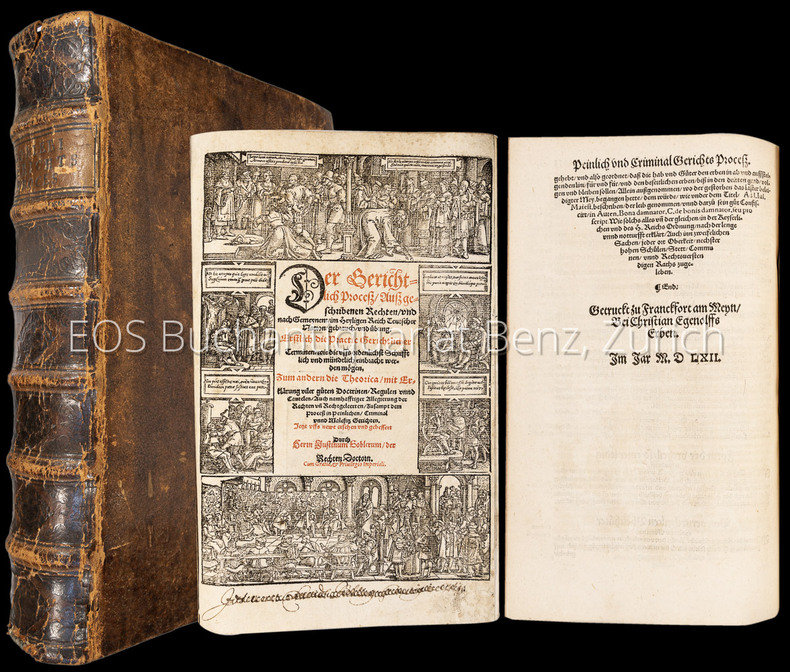
15627634BBFrankfurt am Main, Christian Egenolff Erben, 1562. Folio. (6) Bl., 157 Bl. Titel in rot und schwarz, mit reicher figürlicher Holzschnitt-Einfassung. Auf Verso Porträt-Medaillons mit den Bildnissenvon Gobler und Egenolff. Kalbldr. d. 18. Jh., Rücken mit Blindprägung. + Wichtig: Für unsere Kunden in der EU erfolgt der Versand alle 14 Tage verzollt ab Deutschland / Postbank-Konto in Deutschland vorhanden +, A|B|C [3 Warenabbildungen]
15627634BBFrankfurt am Main, Christian Egenolff Erben, 1562. Folio. (6) Bl., 157 Bl. Titel in rot und schwarz, mit reicher figürlicher Holzschnitt-Einfassung. Auf Verso Porträt-Medaillons mit den Bildnissenvon Gobler und Egenolff. Kalbldr. d. 18. Jh., Rücken mit Blindprägung.
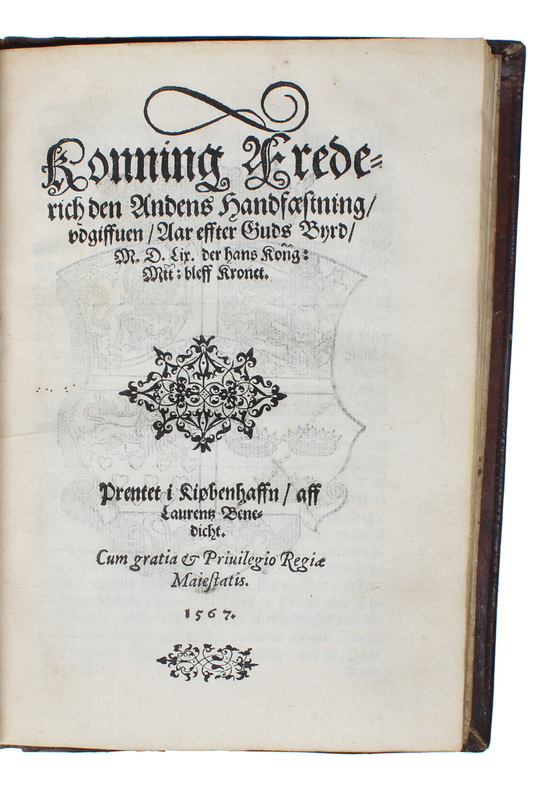
156754328Kiøbenhaffn, Lorentz Benedicht, 1567. 4to. Indbundet i et ganske velbevaret samtidigt hellæderbind af brunt kalveskind med blindtrykte rammer i streg, en bred blindtrykt ramme med symbolske figurer og portrætter. Midterfeltet omgivet af en smallere dekorativ blindtrykt ramme. I midterfeltet med blindtrykt pladestempel ""Prudenc"", alle dyders moder. Den blanke ramme mellem de blindtrykte, er forsynet med spredte håndstempler, stjerner og rosetter, som oprindeligt har været forgyldte. I den brede blindtrykte ramme på bindets bagside findes bogbinderens signatur ""D L"". Ryggen med 3 ægte bind. Lette reparationer på forpermens kanter og hjørner samt reparation på øverste og nederste rygfelt.Ad 1. Titelbladet trykt i rød/sort. 40 blade (sidste tomt). Blad 1b med stort træstukket rigsvåben. De 4 første blade med kantreparationer, her og der med tab af nogle bogstaver. På titelbladet er der tab af ""mectigste"" i Stormectigste. Annoteret i marginer og nogle tekstunderstregninger, alle i gl. hånd. Ellers velbevaret.- Ad 2. 16 blade. Blad 1b træstukket rigsvåben. Enkelte annoteringer. Velbevaret. - Ad 3. 14 blade. Blad 1b træstukket rigsvåben. Velbevaret. - Ad 4. Titelbladet trykt i rød/sort. 30 blade. Blad 1b træstukket rigsvåben. Velbevaret. Alle de 4 forordninger er trykt på godt papir, gennemgående rene og velbevarede.
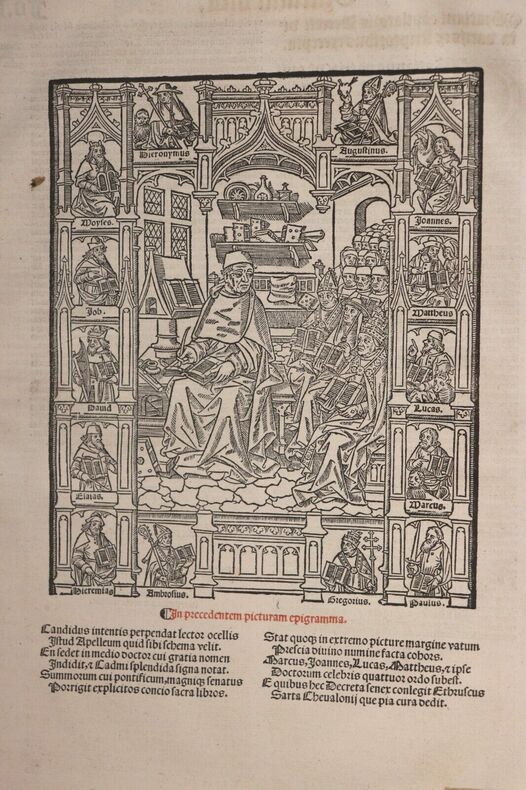
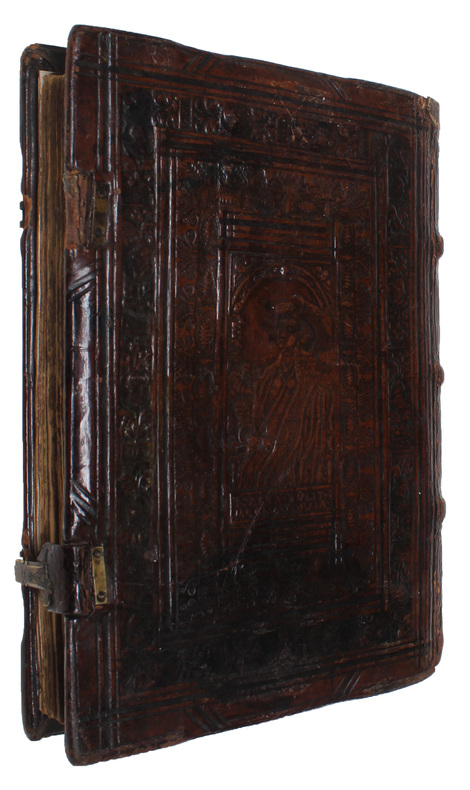
151151294Paris, B. Rembolt, 1511. Large folio. (40x30 cm.). Contemp. full brown calf over wood, richly blindtooled covers. Later rebacking. 5 raised bands. Brass clasps and catches. Leather on clasps renewed. Brass edges on covers. Fol. 459,(27),46,(1). Lacking Folios in Index (Fol. 41-43). Title-page printed in red/black within woodcut border and with printers woodcut device. Text throughout printed in red/black. Large woodcut on Fol. 1 verso (biblical figures, church fathers and Gratian in the middle). Numerous figurative woodcut initials throughout. Internally very fine and clean, a few leaves with a faint dampstain to margins. On fine thick paper. On the renewed spine is with letters in gold printed 1507 (it should be 1511).
154143462Paris, Charlotte Guillard, 1541. Petit in-8 réglé de (8)-216 ff. (sign. aa8 a-z8 A-D8), index, vélin doré à recouvrement, dos lisse titré orné de filets et fleurons, double filet en encadrement, armoiries avec légende dans un médaillon au centre des plats, tranches dorées, traces de fermoir (reliure de l'époque).
157656695(Colophon:) Kiøbenhaffn (Copenhagen), Matz Wingaardt, 1576. 4to. Pragtfuldt samtidigt hellæderbind af kalveskind over træ med skråtskårne kanter og 2 lukkestroppe med messingbeslag (det ene hængsel løst), antageligt udført af en dansk bogbinder. 3 ophøjede ægte bind på ryggen og med blindtrykte stregbordurer. Permer med dobbelte stregrammer og 2 brede rammer udført med ruller og stempler. Midtfelterne med stort pladetrykt billede af Justitia, på bagpermen et billede af Justinian ?. Kapitæler med mindre reparationer. Titelbladet med en træsnit illustration af den danske konge med rigsvåbnet. Kolofon med Gotfred af Ghemens trykkermærke i træsnit. 111 unummerede blade. Indersiden af forpermen har notater i gl. hænder vedrørende bogens indhold. Fra Oscar Wandels bogsamling med hans exlibris. Da bogen ikke er ombundet foreligger den her i dens opsrindelige størrelse med pænt brede marginer. Få spredte brunpletter. Nogle blade med en svag skjold nederst på siderne. De første 6 blade (incl. titelbladet) er noget restaurerede med senere omkantning. Titelbladet har en smule tab af stregrammen omkring kongen, blad 2 recto har tab af et ord i nederste linie (tagher). Trykt på svært papir.
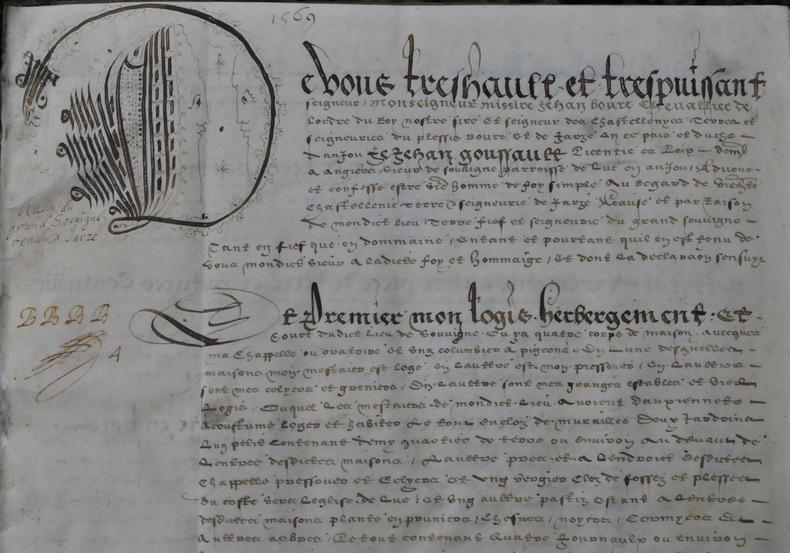
156946404968, 1569 ; grand in-4, cartonnage de l’époque recouvert de soie à motif de rayures, étiquette manuscrite. (cartonnage ancien) 20 ff. non chiffrésDocument soigneusement calligraphié sur peau de vélin avec en tête des parties 5 belles initiales cadelées ornées de visages.Le sieur Goussault fait allégeance à son suzerain, Jehan Bouré, afin d’entrer en possession du domaine du Grand Souvigné à Lué (aujourd’hui Lué-en-Baugeois).“De vous très haut et très puissant seigneur, Monseigneur missire Jehan Bouré chevalier de l'ordre du roy notre sire et seigneur des chastelleynies terres et seigneuries du Plessis Bouré et de Jarzé en et pais et duché d'Anjou. Je Jehan Goussault licencié es loix – dem. à Angiers, sieur de Souvigné paroisse de Lué en Anjou,(...) et confesse estre vostre homme de foy simple au regard devôtre chastellenie terre et seigneurie de Jarzé de céans et par raison de mondict lieu terre fief et seigneurie du Grand Souvigné tant en fief que en dommaine entant et pourtant qu'il en est tenu de louer mondict sieur a ladicte foy et hommaige et dont la declaration s'ensuyt.”Suit la description du bien en commençant par le bâti constitué de quatre corps de maison, d’une chapelle ou oratoire, d’un colombier, logement du métayer, granges, grenier, pressoir et divers autres bâtiments, vergers de pruniers, noyers, etc. Suit, sur 4 pages, la description des terres, en 18 item : prés, cultures, maisons des fermiers. Suivent les “hommaiges qui me sont dus a cause de mondict fief de Souvigné”. “En premier demoiselle Marguerite Moreau fille du defunct noble somme René Moreau (...) fief, domaine et seigneurie (...) de La Perraudière (...) ” puis une liste en 19 item listant les tierces parties en indivis (5 pages et demi).“S’ensuivent les cens rentes et debvoirs dudict fief de La Perraudière” 2 pp. et demi de cens et rente. en 6 item. Puis “Andrée la Gouesloue est ma femme (...) ” qui verse annuellement à son mari neuf sols tournois de revenus provenant de son bien de La Viennière. Jehan Poullain, François Besnard et Françoise du Plessis pour son domaine de La Burelière lui versent également une rente. La situation de damoiselle Françoise du Plessis et la description du domaine de La Burelière (à Tiercé) occupe une page, suivie de 4 pp. et demie énumérant les terres et dépendances de ce domaine en 15 item. Suit la liste des “choses tenues tant à foy et hommaige” attachés au domaine de La Burelière ainsi que les “cens et debvoirs” attachés à ce domaine qui donne une liste de 32 familles concernées. Enfin, “S’ensuivent les cens rentes et debvoirs” payés à la seigneurie de Souvigné avec la liste des 22 personnes ou familles concernées.Le document porte 9 signatures parmi lesquelles celle de Goussault, d’un certain M. de La Fontaine, ainsi qu’un timbre sec aux armes du duché d’Anjou. Quelques annotations postérieures dans les marges (noms des domaines concernés). Bords de la toile recouvrant le cartonnage usagés.
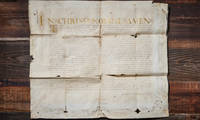
15852363525/09/1585. <blockquote><p>The Renaissance was a period of crucial cultural artistic social and financial development in late Medieval and Renaissance Italy and particularly the affluent cities of Florence Venice Genoa and Padua.</p></blockquote><p>The Holy Roman Empire spanned central Europe in one form or another for the span of a millennia. For much of that time it contained vast swaths of Italy mainly in the north and included the Italian city of Padua which would become a hub in the Renaissance in that country and a major university center. As the Middle Ages bled into the period of the Renaissance the Empire slowly lost direct control over Italy. It managed to maintain its power into the 16th century in part via old established orders that maintained local control.</p><p>Among these Holy Roman imperial titles was the ""comes palatinus caesareus"" or the imperial count palatine. The office of imperial count palatine was hereditary and the emperors seem to have used it to create an Italian aristocratic class loyal to the empire. In 1357 the Emperor Charles IV added the power of conferring licenses and doctorates of civil law to those of the counts palatine. Later on they acquired the power to confer doctorates in general. In 1363 Charles himself bestowed this honor to Giacomo Santacroce. His heir to this title and power given by it which was significant was Giovanni Santcroce who in addition to being the benefactor for religious and cultural efforts in the region was a businessman.</p><p>The Facino or Facini family was a prominent one from the town of Feltre. The Ioannes Baptista Facinus namd in the document was prominent in the cultural community. There remains today a church bearing the crest of this family constructed shortly before his birth.</p><p>Francisco Fabriano and Andreas Tinto were important functionaries and notaries of the period in Padua.</p><p><strong>Document signed</strong> September 25 1585 in Latin using the Latin names of the people involved including The Holy Roman Emperor Charles signed by important figures of the late Italian renaissance. In it <em>""Ioannes Sancta Cruce""</em> bestows the position of <em>""comes palatinus caesareus""</em> on <em>""Ioannes Baptista Facinus""</em> and all his male heirs. The document is witnessed and signed not only by Santa Cruce himself described as <em>""the most excellent lawyer lord count soldier knight horseman of the Court of Caesar""</em> but also by Fabriano and Tinto. The document is likely in the hand of Tinto himself.</p><p>Such Italian Renaissance documents are very uncommon. The most direct comparable was acquired by J.P. Morgan and is now in the Morgan Library.</p><p>There is an extended portion in the middle about Holy Roman Emperor Charles IV who it describes in 1357 added the power of conferring licenses and doctorates of civil law to the position.</p><p><img class=""alignnone wp-image-23609 size-post-window"" src=""https://cdn.raabcollection.com/wp-content/uploads/20231204153244/Folder-site-6-1600x1327.jpg"" alt="""" width=""1600"" height=""1327"" /></p> unknown
15212954Mainz: Johann Schöffer 1521. Bound with: Undergerichts ordnung des Ertzstiffts Meyntz. Mainz: Johann Schöffer 23 May 1534. 2 vols. in one small folio 278 x 193 mm. 1 23 leaves of 24 final blank removed. Woodcut title border composed of ten blocks. incorporating whimsical scenes ornamental borders and at bottom the arms of the Archbishop-Elector Albrecht of Brandenburg gothic types two typographic Fraktur initials. Bound at end is a leaf with a one-page contemporary manuscript commentary wider than the text block and folding. Title-leaf rehinged slightly darkened and with effaced marginal inscriptions initial on A2r hidden in gutter initial on A2v shaved quire E with a couple of small corner repairs. 2 35 leaves of 36 final blank removed. Large woodcut white-on-black pointillé opening initial Fraktur initials throughout. Marginal dampstaining last quire on a guard. Early 20th-century pastepaper over boards manuscript spine label.First Edition of the judicial statutes of the Electorate of Mainz the largest ecclesiastical province of Germany and one of the most prestigious and powerful states of the Holy Roman Empire; bound with the First Edition of the statutes of the lower court of the Mainz Prince-Bishopric or Erzstift. The archbishops under the Holy Roman Empire wielded secular as well as pastoral power. Part of the Emperor's program of consolidation of the far-flung empire was the codification and standardization of provincial laws. Both these procedural codes explicitly adopted the ius commune gemeines Recht a combination of Roman and canon law. Both establish precise rules for court procedure and include copious down-to-earth details including where the courts reside who should serve in them and how trials are to be conducted. As is common for German law books these editions are handsomely printed.1 The Mainz Hofgerichts Ordnung was drawn up in 1516 by Albrecht of Brandenburg Archbishop and Elector of Mainz and by his chancellor Johann Fürderer and approved in 1521 by the Emperor Charles V. The latter's ratification is printed at the beginning and end of the statutes. These cover the location of the court required functionaries a judge and a jury of at least 11 members of the nobility although a Doctor or university graduate would suffice duties of other judicial administrators including the court scribes frequency and timing of sessions and jurisdiction by subject and area. Also included are a dozen varieties of oaths for different court officials including the scribe and for special segments of the population e.g. poor people witnesses legal representatives and Jews for whom there is a special preface to the oath itself in which the Jewish defendant or witness must swear that should he not be telling the truth he must renounce all rights to the Holy Land or to participation in the coming of the Messiah. One statute establishes the right of the poor to legal representation which must be covered by the court. Procedural instructions are provided for every activity and eventuality including the recording of testimony of plaintiffs and witnesses fines and punishments for those who don't show up at court proper written documentation and forms rules for appeals execution of sentences and payment of attorneys. OCLC lists three copies in the US Harvard Law LC and Indiana U. VD 16 M 262; Otto Stobbe Geschichte der deutschen Rechtsquellen 1860-64 2: 410-11.  2 The 1534 lower court rules prescribe further details for the conduct of court business. These include how to handle the "law books" i.e. the court records which are to be maintained in "two volumes with locks kept in a safe place." f. 4r; more procedures to follow for uncooperative defendants a long section: evidently a common occurrence; bonds and bail; more oaths; and formularies for various charges appeals and judgments. These Mainz laws were adopted in 1538 by the archdiocese of Cologne and influenced other lower court statutes including those of Württemberg issued in 1555 Stintzing.OCLC locates one US copy Harvard Law. VD 16 M 273; Stobbe 2: 258 note & 411; Stintzing and Landsberg Geschichte der deutschen Rechtswissenschaft 1880 I:543. Johann Schöffer unknown books
1567171<p>Folio 30.5 x 19.5 cm 10 ff. 307 i.e. 308 13 ff. including woodcut title showing Ferrara and Este arms and full-page woodcut portrait of the printer Rossi on EEEviii v. Bound in 18th-century stiff vellum title stenciled on spine. Some minor staining in scattered leaves and some trivial worming in margin but generally a broad-margined and fresh copy excellent. Rare and most likely the earliest acquirable edition of the municipals laws of Ferrara one of the richest and most cultivated of Northern Italian courts published shortly after the concluding session of the Council of Trent 1563. The work contains one of the earliest portrait of a printer in a book he himself produced see below. The work significantly revises the previous publication of local statutory law and is signed by a committee of local jurists 3v-4r. The statutes govern all aspects of civil and criminal law from the buying and selling of goods and property marriage testaments to criminal procedure. The work is of interest for containing a portrait of the printer. Note: Rossi had no editorial or authorial part in the work; he is expressly designated "Typographus" printer in the identifying legend. This is of interest to historians of the book for it showing the developing confidence and prestige enjoyed by 16th-century printers and is analogous though considerably more assertive to putting an element of the printer's process or trade in a publisher's device. "Rossi was near the end of a career as a printer at Ferrara that covered more than 50 years and certainly justified the use of his portrait in this volume" Mortimer I.261. Although it should be regarded as a form of self-indulgence and did not catch on-as say the author portraits on which it is based obviously did-it nonetheless remains an interesting bit of evidence for the elevated status of Italian printers. There is no repertory of examples and we know of no study of the subject but in querying colleagues we have located only two earlier analogous portraits: Rossi pictured himself in smaller format in the colophon to another book he published: Giovanni Maria Verrato's 1561 response to critics of the Council of Trent: Contra responsiones et protestationes. And Francesco Priscianese pictured himself in a Latin grammar published in 1540. Also Prof. Anthony Grafton draws our attention to the portraits of the illustrators in the Historia Stirpium of Leonhart Fuchs 1542. Further searching would doubtless turn up a few other examples but it is clearly an isolated phenomenon The statutes received an incunable edition in 1476 published by Severino da Ferrara BMC VI.609 the only copy we have been able to locate: this edition is not in Goff and we locate no American copy. The next edition was published by Rossi in 1534 with a less elaborate version of the title cut and without the portrait. The present edition is next making it third. According to Mortimer the hypothetical issue points raised by F. Berlan in his Bibliografia degli statuti municipali ed inediti di Ferrara Rome 1878 pp. 21-7 are in need of substantial copy-checking. There are no copies of the editio princeps or the 1534 edition in America; for the present edition OCLC lists Kansas Minnesota and the Waseda Library to which should be added the Harvard copy described by Mortimer. Mortimer Italian 182; Adams F266; Fumagalli Lexicon p. 128 fig 45 portrait; L. Manzoni Bibliografia degli statuti ordini e leggi dei municipali italiani I.2 Bologna 1876 pp. 177-78.</p> Francesco Rossi hardcover
1567171<p>Folio 30.5 x 19.5 cm 10 ff. 307 i.e. 308 13 ff. including woodcut title showing Ferrara and Este arms and full-page woodcut portrait of the printer Rossi on EEEviii v. Bound in 18th-century stiff vellum title stenciled on spine. Some minor staining in scattered leaves and some trivial worming in margin but generally a broad-margined and fresh copy excellent. Rare and most likely the earliest acquirable edition of the municipals laws of Ferrara one of the richest and most cultivated of Northern Italian courts published shortly after the concluding session of the Council of Trent 1563. The work contains one of the earliest portrait of a printer in a book he himself produced see below. The work significantly revises the previous publication of local statutory law and is signed by a committee of local jurists 3v-4r. The statutes govern all aspects of civil and criminal law from the buying and selling of goods and property marriage testaments to criminal procedure. The work is of interest for containing a portrait of the printer. Note: Rossi had no editorial or authorial part in the work; he is expressly designated "Typographus" printer in the identifying legend. This is of interest to historians of the book for it showing the developing confidence and prestige enjoyed by 16th-century printers and is analogous though considerably more assertive to putting an element of the printer's process or trade in a publisher's device. "Rossi was near the end of a career as a printer at Ferrara that covered more than 50 years and certainly justified the use of his portrait in this volume" Mortimer I.261. Although it should be regarded as a form of self-indulgence and did not catch on-as say the author portraits on which it is based obviously did-it nonetheless remains an interesting bit of evidence for the elevated status of Italian printers. There is no repertory of examples and we know of no study of the subject but in querying colleagues we have located only two earlier analogous portraits: Rossi pictured himself in smaller format in the colophon to another book he published: Giovanni Maria Verrato's 1561 response to critics of the Council of Trent: Contra responsiones et protestationes. And Francesco Priscianese pictured himself in a Latin grammar published in 1540. Also Prof. Anthony Grafton draws our attention to the portraits of the illustrators in the Historia Stirpium of Leonhart Fuchs 1542. Further searching would doubtless turn up a few other examples but it is clearly an isolated phenomenon The statutes received an incunable edition in 1476 published by Severino da Ferrara BMC VI.609 the only copy we have been able to locate: this edition is not in Goff and we locate no American copy. The next edition was published by Rossi in 1534 with a less elaborate version of the title cut and without the portrait. The present edition is next making it third. According to Mortimer the hypothetical issue points raised by F. Berlan in his Bibliografia degli statuti municipali ed inediti di Ferrara Rome 1878 pp. 21-7 are in need of substantial copy-checking. There are no copies of the editio princeps or the 1534 edition in America; for the present edition OCLC lists Kansas Minnesota and the Waseda Library to which should be added the Harvard copy described by Mortimer. Mortimer Italian 182; Adams F266; Fumagalli Lexicon p. 128 fig 45 portrait; L. Manzoni Bibliografia degli statuti ordini e leggi dei municipali italiani I.2 Bologna 1876 pp. 177-78.</p> Francesco Rossi hardcover books
1586126541586 1 À Paris, pour Thomas Mallard marchand libraire demeurant à Rouën, 1586, in-4° de 10 ff.n.ch. (2 bl., titre "aux léopards", 7 ff. d'Epistre) - 120 ff. chiffrés - un arbre de consanguinité replié (non mentionné par Frère) - 43 ff. de Procès-verbal - 2 ff.n.ch. (table, feuillet de la marque "aux léopards" du libraire Martin Le Mégissier) ; reliure de vélin souple à recouvrement d'époque, dos lisse, lacets postérieurs ; manque angulaire de vélin au second plat, coins inférieurs de la page de titre et des 4 premiers feuillets restaurés, de même les cinq derniers feuillets restaurés, quelques traces de mouillure marginales.
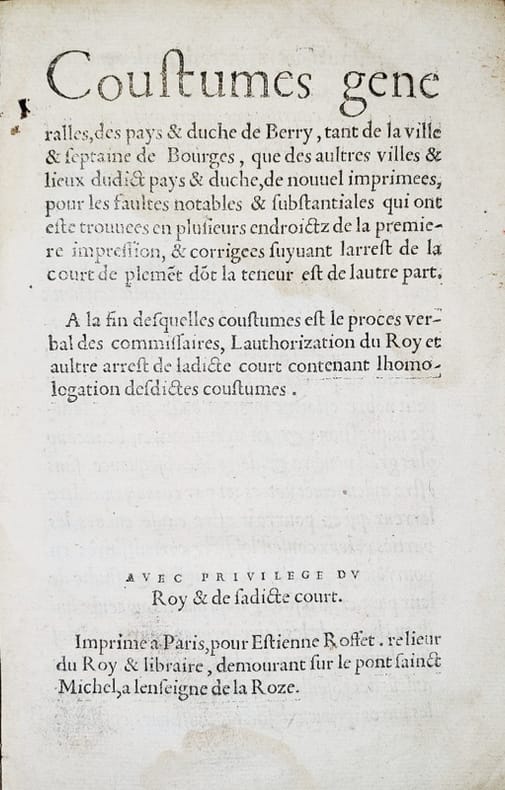
154144716Paris, Estienne Roffet, 1541. In-8 de 151 ff. chiffrés et 1 f. non chiffré, veau brun, dos à nerfs (reliure du XVIIe siècle).
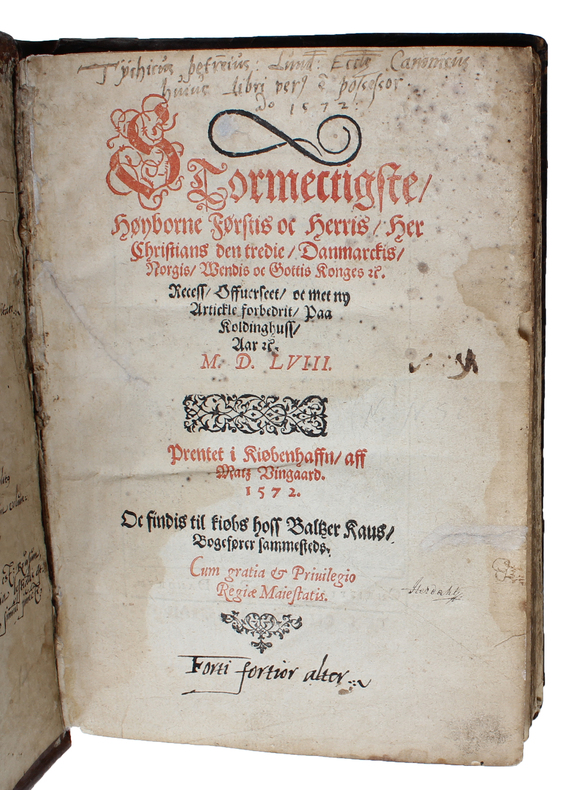
157257663Kiøbenhaffn, Matz Vingaard, 1572. 4to. Indbundet i et velbevaret samtidigt hellæderbind af brunt kalveskind, permerne med blindtrykte rammer i streg og smalle og brede rullestempler i form af symbolske figurer og portrætter. Midterfeltet med forgyldte blomsterstempler og bjælkerne forsynet med forgyldte rosetter, (forgyldningen slidt). Ryggen har let ophøjede bind og er repareret i øverste og nederste rygfelt.Ad 1. Titelbladet trykt i rød/sort. 40 blade (sidste tomt). Blad 1b med Christian III's træstukne portræt. Nogle marginer med svage skjolder. Enkelte samtidige marginalnoter. Titelinddelinger tilføjet i rødt og blåt. - Ad 2. 16 blade. Blad 1b træstukket rigsvåben. Enkelte annoteringer i marginer i gl. hånd. Kapitelinddelinger i rødt. - Ad 3. 14 blade. Blad 1b træstukket rigsvåben. Svag skjold på de sidste blade. Kapitelinddelinger i rødt. - Ad 4. Titelbladet trykt i rød/sort. 30 blade. Blad 1b træstukket rigsvåben. De sidste blade lettere brunplettede. Kapitelinddelinger i rødt. Alle de 4 forordninger er trykt på godt papir. På forpermens inderside talrige gl. ejernavne og tilskrifter. På første titelblad ""Tychinos Befriius Lund Eccle Canonicus huius libri perf & possesor. Ao 1572"".
1587YRG-507In-quarto, 2 parties en 1 volume : [viii] + 308 pp. + [viii] + 329 pp. + Index, Plein vélin d'époque, à rabats, dos lisse titre manuscrit, Galerie en marge basse sur plusieurs cahiers, quelques rousseurs. manque les lacets , tache et petites fissures sur les plats , petites fissure au plat arrière Guillelmum Laemarium, Genève.
159355259(Slesvig, Nicolai Wegener), 1593. 4to. Helpergamentsbind fra 1600-taller. Ved ombindingen er bagerst indsat ca. 100 blanke blade. Forgyldt titeletiket i skind på ryg. Etiketten med lidt tab. Gl. ejernavn Bille Brahe (Hvedholm). 129 blade. På titelbladet er 2 linier, som var trykt med rødt overskrevet med sort. Blad 1b med stort træsnit af Danmarks våben. Blad 2a med helsides træsnit, Christian IV's portræt. Gl. ejernavn på titelbladet. Rent eksemplar trykt på kraftigt skrivepapir og med talrige samtidige tilskrifter i en net hånd.
152932012Paris, apud Galliotum Praetensem, 1529. Groß 8°. Beschädigter, wohl späterer Halbledereinband. [5 Warenabbildungen]
1553110491553 3 tomes reliés en un volume, reliure janséniste en vélin blanc parcheminé in-quarto (jansenist's binding full vellum in-4) (17,5 x 24,7 cm), reliure d'époque, titre manuscrit à l'encre brune sur le dos (handwritten title on the spine), plats muets (cover without text), dos long (spine without raised band), tranches lisses (edges smoothes), titre en rouge et noir, Texte en Latin, Impression rouge et noire sur 2 colonnes encadrée de gloses (Johannes Andreae). (Baudrier VII-338)., orné d'un superbe bois (engraving-wood) (full page engraving) en noir en frontispice face à la page 1 intitulé "Bonifacius Octavius" + deux planches hors-texte (full page engraving) gravée sur bois (engraving-wood) en noir insérée entre la page 330 et 331 intitulées : "Arbor Afinitatis" et "Arbor Consanguinitatis" pour le SEXTUS. Liber decretalium, une planche dépliante gravée sur bois (engraving-wood) hors-texte (full page engraving) en noir intitulée : "Arbor Feu Figura Declarativa Titul. De jure Patro" pour le CLÉMENT V. Constitutiones , pas d'hors-texte pour le JEAN XXII. Extravagantes, les trois tomes sont ornés de superbes lettrines (dropped initial) gravées sur bois (engraving-wood), [(36)-463 pp] + [(16)-191 pp] + [(14) pp, (1) f. bl., 262 pp.] pages, 1553 Lyon, Hugues de La Porte & Antoine Vincent Editeurs,
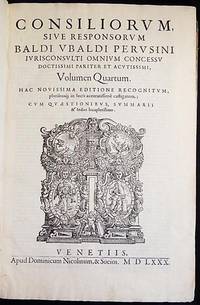
1580003503Venice: apud Dominicum Nicolinum & Socios Domenico Nicolino 1580. Hardcover. Very Good . Vols. 4 & 5 of 5 only. 2 volumes in 1. "Hac novissima editione recognitum pluribusq; in locis accuratissime castigatum; cum quaestionibus summarii & indice locupletissimo." 117 leaves 234 p. 139 leaves 278 p.; 37 cm. Signatures: A-P8 -P7 -P8 A-R8 S4 last leaf blank folio. Original parchment over boards. Five spine compartments between raised bands; hand-written title in first compartment. Handwritten identification also on lower page edges. Large and elaborate printer's device on title pages which combines the earlier printer's device of Domenico Nicolino a woman holding a wreath with three others presumably of the partners Socios referred to in the imprint. In Very Good Condition: original parchment over boards rubbed and soiled with loss of parchment at ends of spine and over raised bands; loss at lower corner of front board; small stain along lower edge of 5:2-22 not impacting text; minor soiling along lower edge of 5:42 verso and 5:43 recto; marginal worming in vol. 5; otherwise clean and bright. apud Dominicum Nicolinum, & Socios [Domenico Nicolino] hardcover
15403843Avignon and Lyon: Jehan de Channey and reissued in Lyon by Thibaud Payen 1540. Good. Small 4to. Collation: A-T6 lacking two leaves at end including colophon on T6v. Foliation: cv 7 of 9 ff. Woodcut title-border and initials throughout see below. Bound in modern Italian full vellum title in calligraphic manuscript on spine in red and black marbled endpapers edges at one time stained red. Title-page with two small worm tracks in lower blank margin diminishing through first two gatherings; verso of title with contemporary MS title and early ownership inscription abrasions suggest the removal of something that had been pasted down at one time; upper and outer margins closely cropped with frequent loss of headlines and shoulder notes; foxing and blemishes throughout; fol. K6 with large tear. A washed copy and strongly and inexplicably pungent. Preserved in a marbled slipcase tipped with citron morocco. With stated faults and priced accordingly. VERY EARLY FRENCH PROVENCAL LAWS AND STATUTES A RARE AND IMPORTANT EDITION BEAUTIFULLY PRINTED IN AN ELEGANT BATARDE TYPE WITH THE TEXT IN HIGH RENAISSANCE FRENCH AND A WOODCUT TITLE BORDER ATTRIBUTED TO GUILLAUME LEROY. <br /> <br /> This is a significant collection of royal ordinances and edicts promulgated by Francois I for Provence more specifically for the town of Forcalquier and adjacent lands. The original sheets were printed in 1536 in the Papal city of Avignon by Jehan de Channey with a privilege; the work was then reissued with a new title-page in 1540 either in Lyon by Thibaud Payen ut Bechtel or by Channey's son Bernard ut Betz. "Perhaps the priviledge might have been usurped or contested because the true first edition of the Ordonnances was printed in Lyon by Denys de Harsy in 1536 with a privilege of three years . Thus the edition of Channey could well be only a counterfeit favored by the political position of Avignon a dependence of the Papal States" M. Rouard in the 1860 Bulletin du bibliophile p. 1404 "Note sur les editions de la 'Meygra Entrepriza' d'Antoine Arena". <br /> <br /> Francois I ordered to be printed this collection of Provencal laws which sought to consolidate his authority as king of Provence which was subject to the incursions of Emperor Charles V and to bring regional justice closer to "common" i.e. Parisian forms. The collection shows that the king wished to appease Provencal legal custom by not modifying the existing Privileges or administrative frameworks; nonetheless the entire Provencal legal system was effectively brought under his control. <br /> <br /> Every aspect of the Provence law is addressed; of particular interest:<br /> <br /> -- The ordinance of Is-sur-Tille an edict intended to curb the abuses of Provencal magistrates by forbidding them among other things to use Latin during trials i.e. Villers-Cotterets ordinance.<br /> -- The edict of Joinville - 5 September 1535 which carries out a reform of justice and administration by strengthening the powers of parliament.<br /> -- Ordinance on the of the Navy -- January 17 1517 -- one of the first of its kind.<br /> -- Ordinance of Dijon 23 November 1535.<br /> -- Ordinance on wheat.<br /> -- Ordinance of King Rene of September 4 1438 against imperial and apostolic notaries<br /> -- Ordinance of King Rene prohibiting imperial and apostolic notaries if they were not invested with the royal investiture.<br /> -- Ordinances of Louis XII 1501 and 1502 an edict establishing the Parliament of Aix.<br /> -- Ordinance on the Gendarmerie - Bordeaux July 15 1530.<br /> -- Ordinance of Saint Germain -- July 24 1534.<br /> -- Edict establishing the 7 legions of "Gendarmerie" or footsoldiers an ordinance on tolls and repair of highways - Fontaine September 1535.<br /> -- Edict on "reforming the justice system" of Marsailles dated in manuscript "1535".<br /> -- Table of Ordonnances of Provence our copy lacks the final two leaves of the Table. <br /> <br /> Provence was not annexed to France until 1486 but even then was preserved as a separate administrated organization. Francois I strengthened royal authority through a series of reforms to control and optimize the management of the state and its territory. It was for these purposes that he had the Villers-Cotterets ordinance drawn up in 1539 certainly the best known and most enduring of his reign. He instituted French as the exclusive official language of the administration and initiated its civil status. The Montpellier Ordinance issued in 1537 gave rise to the legal deposit of printed publications from the Kingdom. <br /> <br /> The colophon on T6v which is not present in our copy reads: "Ces presentes ordonnances ont este imprimees en Avignon par Jehan de Channey l'an de grace 1536 au moys Daoust." Other copies of the 1540 reissue have additional works bound with it e.g. the Berkeley Law Library copy which collates A-T6 V4 2A-D4 E2. These added works are considered discrete bibliographical units. <br /> <br /> BIBLIOGRAPHIC NOTES: Judging from the title-page transcription in HOLLIS our Jehan de Channey edition must have a different title-page than that of Harvard Law Library; their transcription begins: "Ordonnances du treschrestien roy de frãce Francoys premier" etc. The cataloguer informs us that the 1540 edition is "the same as the 1536 Avignon edition except for a new t.p. and leaves 69142750. The son of the original printer reissued this; cf. Panzier." <br /> <br /> Whereas our copy lacks two leaves and has faults as stated we note with interest that the Friedlaender copy of the Denis de Harsy 1536 edition bound with two other works sold in 2001 at Christie's for $11162; a similar Sammelband was offered and sold by Messrs Sokol for EUR 11315. <br /> <br /> Baudrier vol. IX p. 303. Bechtel O-220. Collection des ordonnances des rois de France: Catalogue des Actes de Francois Ier" Vol. 9 p. 374. Repertoire bibliographique des livres imprimes en France au seizieme siecle I Avignon pp. 244-246 no. 50. Fairfax Murray / Davies French 411. USTC 22905. <br /> <br /> CENSUS: Bibl. Mejanes Aix-en-Provence; Bibl. municipale Livree Ceccano Avignon; Bibl. municipales Grenoble; Bibl. municipale Lyon; Univ. de Paris Bibl. Cujas; Arsenal; BnF; Berkeley Law; Harvard Law; Iowa University; UPenn; GWU. <br /> <br /> Further literature cited by Odysee Bibliotheque patrimoniale Aix / Marsaille Universite: Isambert Decrussy and Armet Recueil general des anciennes lois francaises depuis l'an 420 jusqu'a la revolution de 1789 1827 tome 9 p. 422-432 et p. 437 and tome 12 p. 137-148; p. 346-349; p. 355-356; p. 390-400; p. 414-491. Roger Aubenas Etude sur le notariat provencal au Moyen-age et sous l'Ancien Regime Aix 1931. Sylvain Soleil "L'ordonnance de Villers-Cotterets cadre juridique de la politique linguistique des rois de France" in: Langues et Constitutions Economica PUAM 2004 p. 19-34. Jehan de Channey (and reissued in Lyon by Thibaud Payen) unknown