Léon WALRAS - William JAFFELivre Rare Book
BEUGNOT (Comte)Livre Rare Book
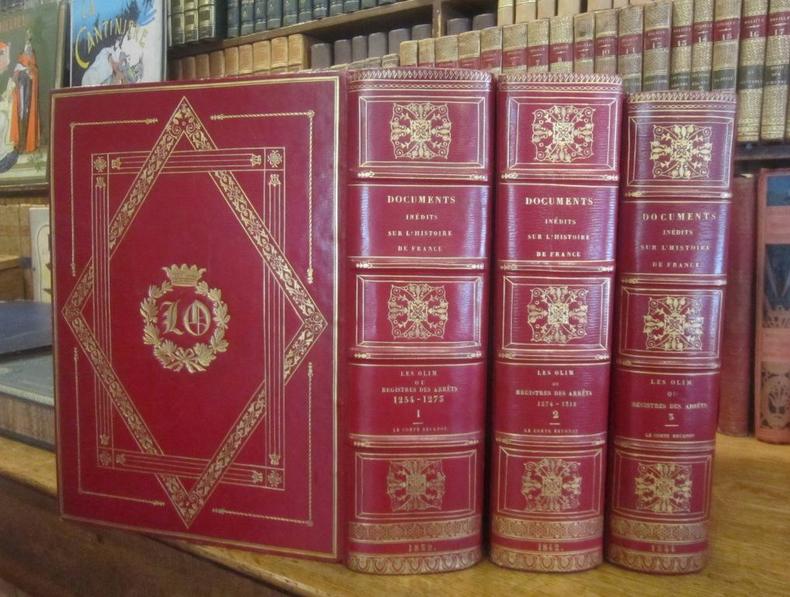
Les Olim ou registres des arrêts rendus par la Cour du Roi..
1839001064Paris Imprimerie Royale 1839
Henri Picard et Fils · Paris, France10 000,00 €
6 889 résultats
188785181S. n. | s. l. 1887 | divers | 11 pages sur 7 feuillets pour les manuscrits + 4 feuillets pour la transcription
1839001064Paris Imprimerie Royale 1839
180989238S.n. | s.l. 1809 | 25.5 x 39.3 cm | Relié
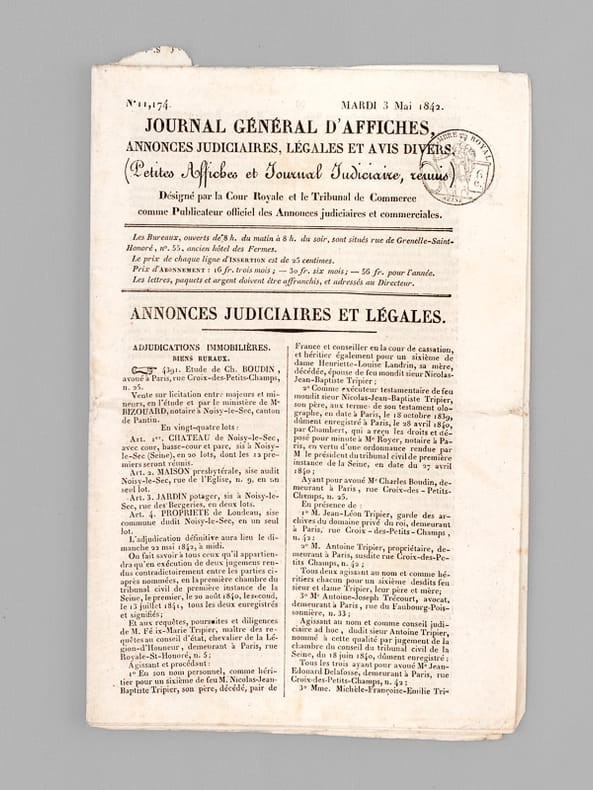
1804ABC_48704Paris 1804. 12mo. Louis Courcier; Angoulême Adrien Marrot; Bordeaux Thiron and Sigal Contemporary gold-tooled calf with a black morocco title label on the spine lettered in gold marbled endpapers. 2 parts in 1 volume. 2 329 1 blank; 4 268 pp. Very rare early edition only one copy found in WorldCat of this famous French civil code published in two volumes in 1804 the year in which also the first edition appeared Paris Imprimerie de la République An XII - 1804. In 1807 its title was changed into Code Napoléon Napoleonic Code under which it is commonly known today.The initiative for drawing up a civil code of laws was taken by Napoleon Bonaparte 1769-1821 in 1800 at that time First Consul of France. The text was drafted by a commission of four eminent jurists under the presidency of the French lawyer Jean Jacques Régis de Cambacérès 1753-1824 who had made a first attempt in 1793 to concipiate a codification of French civil law. In France civil law was mainly based on customary law which differed greatly from each other in various parts of the country. With a single set of laws the traces of feudal law could also be eliminated as a consequence of the French Revolution.This legal code is divided into three parts comprising 36 laws and 2.281 articles written in a clear and concise style. It is known that the famous French writer Stendhal pseudonym of Marie Henri Beyle 1783-1842 read a few pages of it every day to obtain its qualities of clarity and simplicity. The first part is mainly concerned with family law the second part mainly with the property of goods and the third part mainly with contracts. After the publication in 1804 a series of new French codes of law followed: in 1806 the Code de procédure civile Code of civil procedure in 1807 the Code de commerce Commercial code in 1808 the Code dinstruction criminelle Code of criminal procedure and in 1810 by the Code pénal Criminal code. Due to Napoleons occupations to Germany Italy the Low Countries and Poland the French civil code became highly influential in European legal history. It still leaves its mark in private law particularly in the field of contract law family law and property law.With traces of use binding slightly worn along the extremities two corners of the back cover slightly damaged first free endpaper missing owners entry in black ink on the title-page of the first part a few text pages loosening occasionally slightly soiled/browned. Otherwise in good condition. unknown
181053914Translated from the original Latin of Cornelius Van Bynkershoek, 1 vol. 8vo, original full leather binding, Published by Farrand & Nicholas, Philadelphia, also by Farrand, Mallory & co, Boston, P. H. Nicklin & Co, Baltimore, D. Farrand & Green, Albany; Lyman, Mallory & Co, Portland, and Swift & Chipman, Middlebury, Fry and Kammerer, Printers, 1810, 1 f. blanc, 1 f. n. ch., xxxiv-218 pp. , pp. 249-251 (Index from another book) et 1 f. blanc
18252575Mexico City 1825. Still very good. Two volumes in one. 2xxvi221xi2; 2xviii190xviiiiii pp. Contemporary quarter calf and paper boards spine gilt. Light rubbing and a pair of small perforations to spine leather. Edges worn; corners bumped. Light tanning scattered foxing. A handsome copy of an early Mexican imprint that Lathrop Harper described succinctly as the "First edition of the first decrees of the first independent Mexican Congress." This collection of decrees issued for the first and second sessions of the Mexican Congress established after the promulgation of independence in 1821 contains a wealth of information relevant to the founding of the country. These include the act relating to the "coronation of D. AgustÃn de Iturbide the hereditary successor to the throne†formalizing that “the acts of his government are declared invalid." <br /> <br /> Of particular interest are two decrees directly relating to Anglo-American settlement in Texas. The first of these dated April 11 1823 begins “Que el gobierno si no encuentra inconveniente acceda a la solicitud de Estevan Austin sobre que se confirme la concesión de establecer 300 familias en Tejas.†Roughly translated this decree states that "the government if it finds no objection agrees to Estevan Austin's request for confirmation of the concession to establish 300 families in Texas.†Stephen F. Austin's "Old Three Hundred" families were the foundation of Anglo-American settlement in Texas and here the nation of Mexico authorizes their emigration.<br /> <br /> The second decree dated September 29 1823 is titled “Esención de derechos por siete años a los efectos que se introduzcan en Tejas.†The text of the decree reads in full: “El Soberano Congreso mexicano tomando en consideracion el deplorable estado a que las hostilidades de los barbaros han reducido a la provincia de Tejas y para ocurrir en parte a la miseria de sus habitantes civilizados ha venido en decretar y decreta. Que todos los efectos de cualquiera clase nacionales o estrangeros que se introduzcan en la provincial de Tejas para el consume de sus habitants sean libres de derechos; durando esta esencion siete anos contados desde su publicacion en aquella capital.†This second decree effectively extended the term for duty-free trade allowed to the Texas settlers as recompense for the troubles they experienced at the hands of the local "barbarians" i.e. the indigenous native peoples who had lived on the land for centuries.<br /> <br /> Of course the works also stand alone as a significant document of the first independent Mexican government and contains many important details on the early organization of the new country the Constitution of 1824 and the first presidential elections amongst much else. The two works present here were printed simultaneously but were issued separately and are not always found together as here. The first compilation of laws governing the fledgling nation of Mexico with early Texas colonization content. <br /> Palau 56388. Lathrop Harper 220:116. unknown
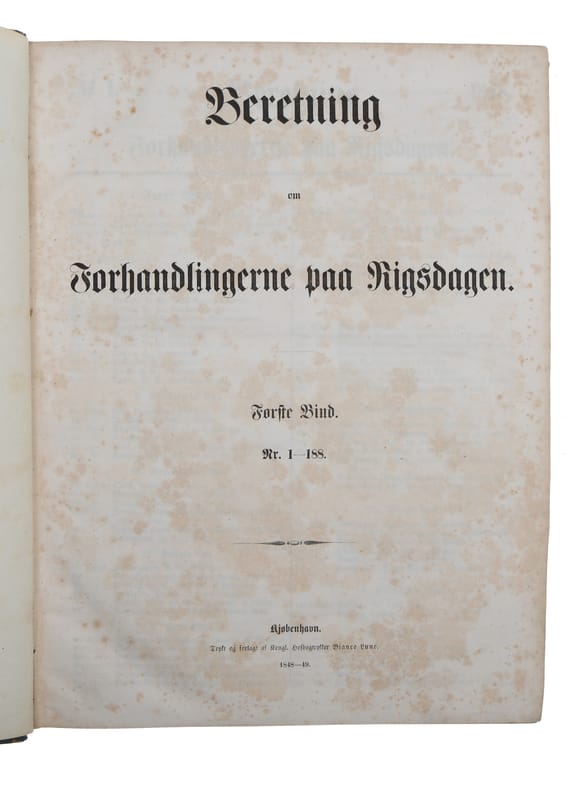
184961592Kjøbenhavn, Bianco Luno, 1848-49 + 1849. 4to. Two volumes, both in the original blue boards with paper title-label to spine. Wear to extremities, hinges and edges of boards with loss of the blue paper, primarily affecting vol. 2. Inner hinge on vol. 2 split. Occassional brownspotting throughout. 3906, LXVI columns. (= 1986 pp.).
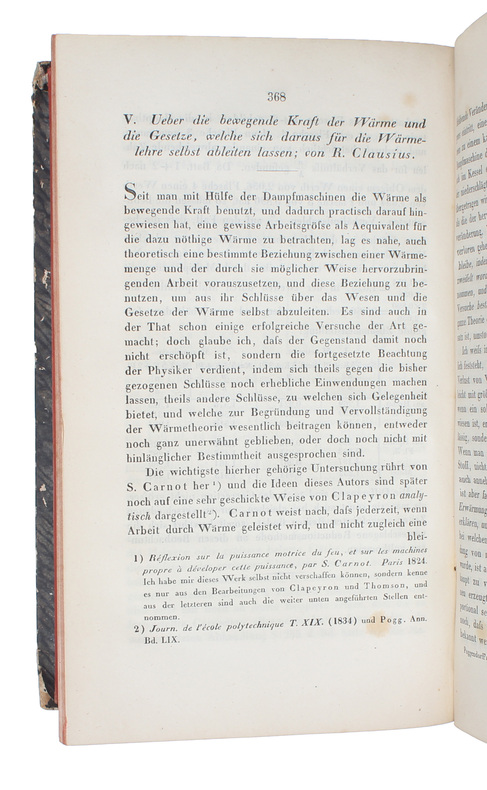
185053436Leipzig, Johann Ambrosius Barth, 1850. Contemp. marbled boards. Gilt spine, titlelabel with gilt lettering. Light wear to spineends, corners and edges. Stamps on title-page (Gusstahlfabrik Fried. Krupp). In ""Annalen der Physik und Chemie"", Dritte Reihe, 19. Band (79. Band der ganzen Reihe). IX,(1),580 pp. and 3 folded engraved plates. (Entire volume offered). Endpapers and the first and last few leaves with brownspots. Clausius's paper: pp. 368-397 a. pp. 500-524. Internally clean.
185053436Leipzig Johann Ambrosius Barth 1850. Contemp. marbled boards. Gilt spine titlelabel with gilt lettering. Light wear to spineends corners and edges. Stamps on title-page Gusstahlfabrik Fried. Krupp. In "Annalen der Physik und Chemie" Dritte Reihe 19. Band 79. Band der ganzen Reihe. IX1580 pp. and 3 folded engraved plates. Entire volume offered. Endpapers and the first and last few leaves with brownspots. Clausius's paper: pp. 368-397 a. pp. 500-524. Internally clean. <br/><br/><em>First edition of this monumental famous paper in thermodynamics in which Clausius for the first time states the Second Law of Thermodynamics one of the most importent laws of Nature having a huge impact on the development of physical theory cosmology communications and information theory. The law states that a the energy of the Universe is constant and b the Entropy of the Universe tends to a maximum."Clausius' contribution to thermostatics is comparable to those of Newton and Maxwell to mechanics and electromagnetism respectively. In the obituary J.W. Gibbs remarked that Clausiu's first memoir "marks an epoch in the history of physics."" Chowdhury and Stauffer in "Principles of Equilibrium Statistical Mechanics".In "The Nature of the Physical World" Eddington writes: "The Law that entropy increases - the Second Law of Thermodynamics - holds I think the supreme position among the laws of Nature. If someone points out to you that your pet theory of the Universe is in disagreement with Maxwell's equations - then so much the worse for Maxwell's equations. If it is found to be contradicted by observation - well these experimentalists do bungle things sometimes. But if your theory is found to be against the Second Law of Thermodynamics I can give You no hope; there is nothing for it but to collapse in deepest humiliation.".Parkinson "Breakthroughs" 1850 P. </em> hardcover
1840188261Wien, Moesle, 1792-1840. M. 12 gest. Front. u. zahlr. Tab. In 48 uniformen Lwdbdn. m. goldgepr. Rtit. u. Rsign. Einbde. teilw. etwas gelockert, angeschmutzt u. stockfl. Einige Bde. m. geringer Nässespur. M. zahlr. St. Teils gebräunt u. braunfl. Es fehlen: Bd. 7 Tit. u. Front, 55 S. 527/528, 10 u. 31 jeweils Repertorium. Bde. 36/37 u. 50/51 als Doppelbd.
18029239Didot l’aîné 1802 3 volumes in-folio plein veau marbré, dos lisse, tranches dorées, filets, dentelles et fleurons, pièces de titre et de tomaison, triple filet sur les plats, roulettes sur les coupes et contreplats. I : 2 ff.- frontispice - VI- 36 pp.- 9 gravures hors-texte - 272 pp. - 68 gravures hors-texte 1 à 68. II : 2 ff.- frontispice - pp. 273 à 580 - 76 gravures hors-texte de 69 à 144. III : 3 ff. - frontispice - 123 pp. 60 gravures hors-texte. Coiffes absentes, charnières fendillées. Quelques rousseurs marginales sur les planches. Bon exemplaire.
1810710341810. Paris 1810. Quarto. Interleaved and annotated. Paris 1810. Quarto. Interleaved and annotated. Interleaved 1810 Printing of the French Code of Criminal Procedure with Contemporary Annotations France. Criminal Law. Code d'Instruction Criminelle. Edition Originale et Seule Officielle. Paris: De l'Imprimerie Imperiale 1810. ii 310 pp. Interleaved. Quarto 10" x 7-3/4". Contemporary quarter calf over marbled boards gilt spine with lettering piece. Moderate rubbing with wear to spine ends and corners joints starting at ends hinges cracked front free endpaper lacking. Light toning somewhat heavier in places light foxing in a few places light edgewear to preliminaries and final leaves light soiling to title page. Occasional annotations to interleaves and text in neat contemporary hand. $3750. Third printing. The 1808 Code d'Instruction Criminelle a code of criminal procedure was one the four codes of civil and criminal law issued under Napoleon's direction after the Code Napoleon Code Civil 1804. The annotations the latest dated 1827 range from a few words to several interpretive paragraphs. Most of these note modifications to the articles by imperial decrees or court decisions. The most extensive annotations which fill three full interleaves in a tiny hand concern juries. They are interleaved with first eleven articles of Chapter V "Du Jury et la Maniere de la Former" pp.133-136. unknown books
182897115Paris: impr. Dezanche and impr. Pihan Delaforest and Delangle Freres 1828-1835. 1828-1835. Fair. - Octavo 8-1/4 inches high by 5-1/4 inches wide. Four pamphlets bound into early brown calf with an elaborate floral device embossed in blind at the center of both the front and rear covers within an elaborate outer gilt ruled frame with formal decorations. All edges are marbled. The rubbed & worn covers are detached and the spine has perished and thus lacking. The pagination is as follows: i-xii 1-96 pp.; 5 6-45 1 pp.; 5 folding plates; 5 6-66 pp.; 4 pp. 1-82. There is foxing throughout.<p>The ownership name of James Stewart and the faded date of "1881" is penned on the front blank. In what appears to be his hand the statement "From Pierre Soule" is penned along the top of the verso of the front endpaper. Additionally the attractive sienna-toned ex-libris bookplate of "R.G.S." is mounted on the front pastedown. <p>Stated to be from the library of Pierre Soule with his name signature at the head of the first pamphlet. Soule 1801-1870 was the French-born New Orleans attorney and Louisiana Senator.<p>The lawyer involved in these 4 cases Gustave Louis Chaix d'Est-Ange 1800 - 1876 was the son of the attorney general at the court of criminal justice of Reims. As a lawyer his oratorical talent was noted at the Paris bar where he practiced. He was entrusted with a number of important cases and from 1842-1844 was president of the Paris Bar Association.<p>1 Plaidoyer et réplique de Me Chaix-d'Est-Ange dans le procès d'Émile de La Roncière précédés d'une Note de M. le lieutenant-général Clément de la Roncière d'Esquisse préliminaire de M. Eugène Roch et d'une lettre de M. Émile de La Roncière adressée à "l'Observateur des tribunaux". Paris: De L'Imprimerie De Dezauche 1835. The sensational trial of Emile de La Ronciere 1803 - 1874 was most recently memorialized by John Fowles in his novel "The French Lieutenant's Woman". In chapter 28 of the novel he discusses the trial of the young cavalry officer who was accused of raping Marie the sixteen-year-old daughter of his commanding General Baron de Morell. The trial itself revolved around a series of anonymous letters threatening the Morell family and signed "E. de La R.". La Ronciere was found guilty and sentenced to ten years in prison. The verdict was controversial and has been debated for many years. In the pamphlet at hand is included the text of a letter to the l'Observateur des Tribunaux written by La Ronciere's father Clement de La Ronciere on August 25 1835 and one written by the imprisoned La Ronciere himself on September 10 1835. These are followed by a preliminary outline by Eugene Roch. The text from the trial is based on reporting in l'Observateur des Tribunaux journal des documens judiciaires. It begins with the plea of La Ronciere's attorney Chaix d'Est-Ange. Although misbound later in this collection of pamphlets facsimiles of items used as evidence in the trial are included. These include 4 folding facsimiles on which are printed 8 samples of handwriting of La Ronciere and of Marie de Morell. Also included on a fifth folding plate is a remarkable plan of the home of the Morells with a view of the floor where Marie's room was located.<p>2 Plaidoyer de Me Chaix-d'Est-Ange pour M. le ministre du Commerce et des Travaux publics intervenant contre M. Victor Hugo. Paris: Imprimerie De Pihan Delaforest 1832. Victor Hugo's play "Le Roi s'amuse" was the basis for the libretto of Verdi's opera Rigoletto. The opening of the play on November 22 1832 was highly anticipated. The opening night box office receipts were an enormous success but the play was not. Both the audience and the critic's responses were negative. However the most devastating response came from the Minister of the Interior. He saw the play as an attack on the royal family and ordered it suspended i.e. banned. In the Charter of 1830 censorship was stipulated to "never be re-established". This conflict led to a trial on December 19 1832. Odilon Barrot represented Hugo and Chaix d'Est-Ange represented the Ministry of Commerce. He took the unpopular stand that the State had the authority to examine dramatic works before production. His plea is published here. Hugo lost this free-speech debate and the play was banned for 50 years.<p>3 Plaidoyer de M. Chaix d'Est-Ange pour le sieur Auguste Labauve et les sieur et dame Formage plaignans et parties civiles contre Frédéric Benoît accusé. Paris: Imprimerie De Pihan Delaforest Morinval 1832. A VIVID ACCOUNT OF MATRICIDE! Frederic Benoit 1810 - 1832 known as "Le Parricide" was executed by the guillotine at the Place St. Jaques in the 14th arrondisement of Paris on August 30 1832. The story of Benoit's killing of his mother in November 1829 and that of his male lover seventeen-year-old Joseph Formage on July 22 1831 is well documented and need not be repeated here. In this civil plea of June 14 1832 on behalf of the butcher Auguste Labauve and also on behalf of Joseph Formage's parents Chaix d'Est-Ange outdoes himself in painting with vibrant colors the slaughter by Benoit of his own mother. Labauve was the second victim of this crime. In January of 1830 an anonymous letter was found threatening Benoit's father a justice of the peace as well as Labauve with the same fate as that of Madame Benoit. The letter was said to be in the hand of Labauve. He was brought to trial for murder and was acquitted by a divided jury. However he was sentenced to a 5 year prison term for having written the threatening letter.<p>4 Procès fait à la lettre adressée au duc d'Orléans par Cauchois-Lemaire. Paris: Delangle Freres Libraires 1828. In December 1827 the editor of the Constitutionnel Louis Francois Auguste Cauchois-Lemaire 1789 - 1861 published a notorious 69 page pamphlet "Sur la crise actuelle lettre a S.A.R. le duc d'Orleans". The pamphlet addressed to Louis-Philippe the Duke of Orleans was a powerful attack on the ultra-royalist government of Joseph de Villele and a denunciation of the so-called "massacre" that took place on the rue Saint-Denis on July 27 1827. Cauchois-Lemaire concludes his essay paraphrasing the French "Thus liberty awaits the day which should let it emerge from its prison. And we who are tired of the long wait together we call for a favorable star to hasten it." The result was that Cauchois-Lemaire was accused of trying to persuade the duc d'Orleans the "favorable star" to lead the opposition to the government and have it overthrown. He and the two publishers Ponthieu and Schubart were brought to trial on January 12 1828. Cauchois-Lemaire was sentenced to 15 months in La Force prison in addition to a fine. In defense of Cauchois-Lemaire Chaix d'Est-Ange given that the facts of the matter were difficult to vindicate delivered a brilliant thesis on constitutional law. The press at the time praised his eloquence. Cauchois-Lemaire himself was so impressed that he wrote Delangle Freres from prison on January 28 1828 requesting that they publish a transcript of the trial. That letter together with the proceedings of the trial are published here. Paris: impr. Dezanche, and impr. Pihan Delaforest, and Delangle Freres, 1828-1835. unknown
1857365383New York: Dix Edwards & Co 1857. First Edition. Very good. One of the best accounts of antebellum Texas written as a series of letters about life in the slave states commissioned for the New York Times. This is the second of three volumes issued separately in Olmsted's "Our Slave States" series. While not a radical Olmsted in sending a copy of this book to Edward Everett Hale said that he hoped that his book would help slavery to "retreat upon itself" and collapse under its own weight with "masters running away from the slaves" Quoted in Papers of Frederick Law Olmsted vol. 2 p. 398.<br /> <br /> Jenkins in Basic Texas Books calls this "the most civilized of all 19th century books on Texas" and "the most interesting and most dependable." He also says Olmsted "gives one of the earliest descriptions of the Texas cattle ranch." Greene in the 50 Best Books on Texas writes "the book is both good reading and good sociology."<br /> <br /> Larry McMcMurtry in his book In a Narrow Grave called Olmstead "perhaps the most readable of the nineteenth century travelers."<br /> <br /> The book includes a small folding map of the state titled "Map of Part of the State of Texas" prepared by J. H. Colton & Co. of New York. The Salt River fork on the Brazos river marks the northern and western boundary of the map. <br /> <br /> This book sold well. It was published at the beginning of 1857 and by February 16 Olmsted reported to his brother who had accompanied him on the journey and who edited the letters for this publication that only 200 of the first printing of 2500 copies remained. He also wrote that the paper ordered by the publisher of which Olmsted was an investor had "been a month on the way not yet arrived." A second printing of this book in 1857 is not referenced in any of the bibliographies known to your cataloguer. <br /> <br /> There are two variants of the book with 1857 on the title page. The most obvious difference is that one variant has plain endpapers and another has endpapers printed with reviews for the first volume in Olmstead's travels. I think it is most likely that the variant with ads is the second printing. On the title page of the copies with ad endpapers the counters empty spaces in the capital 'A's of the list of Olmsted's previous books are mostly filled in which is common when stereotype plates reproduce small letters the publishing agreement for this book survives and it required the publisher to make stereotype plates. The endpaper variant is also much more common which would also seem to fit this narrative; given that the first printing sold out in weeks the publisher is much more likely to have printed a larger number of the second printing which apparently lasted until 1859 when the book was reprinted for a third time a fourth printing appeared in 1860. Likely first printing with no ads on the endpapers. A very good copy worn at the corners and bumped on the spine ends. Small illegible previous owner's name on the front free endpaper; original price $1.25 marked above in pencil. Rather scarce; copies with ads on the endpapers are much more common. Dix, Edwards & Co unknown
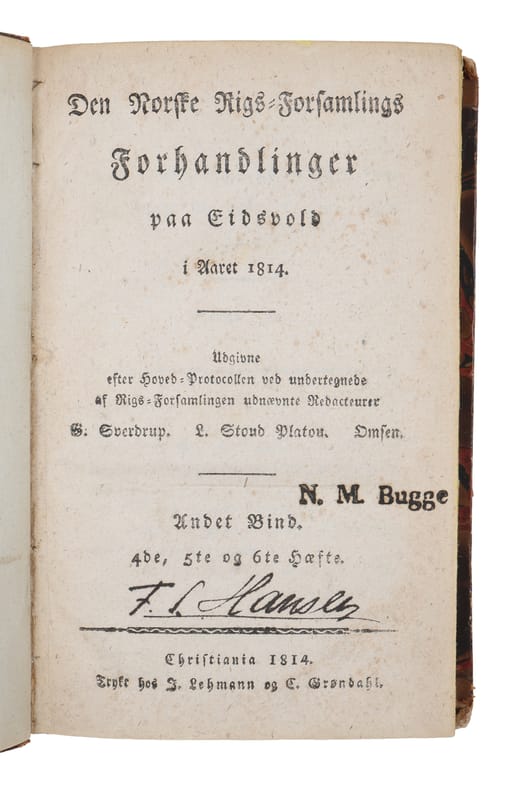
181461660Christiania, Lehmann & Grøndahl, 1814. 8vo. Six parts uniformly bound in two contemporary half calf bindings with red leather title-label and gilt lettering to spines. Previous owner's names to front free end-papers and title-pages. Previous owner's stamp (N. M. Bugge) to title-pages. Wear to extremities, boards with scratches. Leaf A1 in the fifth part with reapir in inner margin, slightly touching text, otherwise internally very nice and clean. Part 1-2: (2), 67, (2), 104, 104 pp. Part 3-6: (2),108, (2), 107, (2), 128 pp.
1855B111216Bruxelles, Gobbaerts (& 3e série: Devroye) 1855-1878 complet en 6 volumes: cxiv,896 + 463 + 462 + 490 + 866 + 1084 pp., 41cm., reliures cart. modernes (dos en toile rouge avec titre doré, plats marbrés) en très bon état, [contient: I: 1ère série (974-1506), 1 tome, 1878 / II-IV: 2ème série (1507-1684), 3 tomes, 1869-1871, V-VI: 3ème série (1684-1794), 2 tomes, 1855-1860], dans la série "Recueil des anciennes ordonnances de la Belgique", texte frais, très bon état, poids: 31kg., B111216
185186794s. l. [Paris] 12 juin (1851) | 11.50 x 17.90 cm | 4 pages sur un bifeuillet
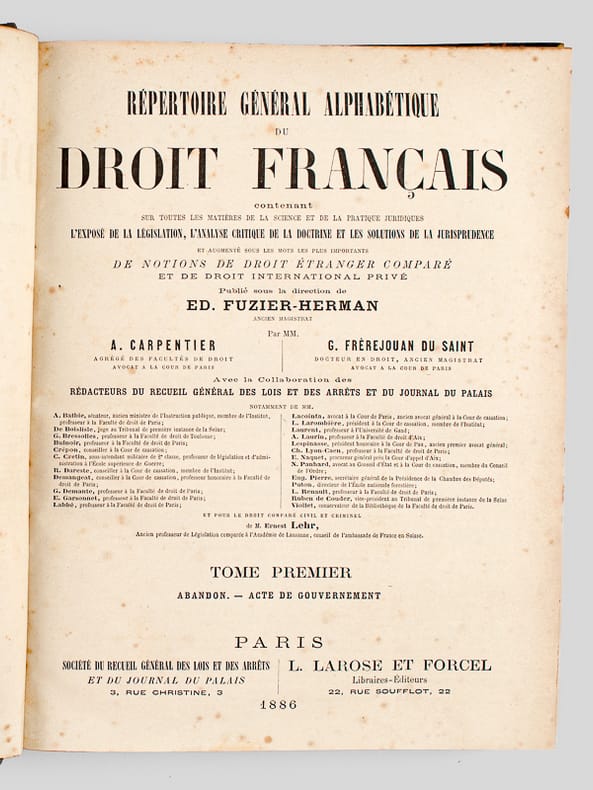
188660659Ensemble de 49 volumes à savoir : Répertoire : 37 vol. in-4 reliure éditeur demi-chagrin noir, dos à 4 nerfs, Société du Recueil général des Lois et des Arrêts et du Journal du Palais, L. Larose et Forcel [ puis : ] Librairie de la Société du Recueil général des Lois et des Arrêts, L. Larose & L. Tenin, 1886-1906 (tome 37 : Table chronologique) ; Supplément au Répertoire : 12 vol. in-4 reliure éditeur demi-chagrin noir, dos à 4 nerfs, Librairie de la Société du Recueil général des Lois et des Arrêts, L. Larose & L. Tenin et Librairie du Recueil Sirey, 1912-1934. Titre complet : Titre complet : Répertoire général alphabétique du Droit Français contenant sur toutes les matières de la science et de la pratique juridiques, l'exposé de la législation, l'analyse critique de la doctrine et les solutions de la jurisprudence et augmenté sous les mots les plus importants de notions de droit étranger comparé et de Droit international privé (37 Tomes - Complet) et Répertoire général alphabétique du Droit Français. Supplément (Tomes 1 à 12).
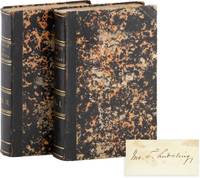
182788857New Orleans: A.T. Penniman & Co 1827-29. First Edition. First printing. Two octavo volumes. Early straight-grained morocco over marbled boards; gilt spine-titles; pp. lxxxiii 364; iii--xv 429pp. Half-titles present. Rubbing to board edges and spine ends with heavier rubbing at crowns and board corners; foxing generally mild more conspicuous but not obtrusive to a few gatherings in each volume. A well-preserved example in an attractive early binding Very Good. With ownership signature to both volumes of John T. Ludeling see note. <br /> <br /> A desirable copy of this early keystone work of Louisiana history. Author François-Xavier Martin 1762-1846 born in France emigrated to North Carolina around 1783 establishing himself first as a printer and then after reading law as a legal scholar and jurist. He entered politics in 1806 and in 1809 was appointed to be the first Attorney General of the newly-acquired Territory of Orleans. As an eye witness to and active protagonist in the legal establishment of the state of Louisiana in 1812 Martin was in a unique position to pen the current history. Though the work was never a popular success - possibly due to Martin's stilted legalistic style which resulted in a work described by his contemporary Charles Gayarré as "lifeless as the minutes and records of proceedings in a court of justice" - subsequent historians have praised the History as for example ".one of the best examinations of the judicial structure from the colonial period to the early nineteenth century. Martin's History of Louisiana has withstood the test of time becoming not only a useful secondary source but also an important primary document." see Mark F. Fernandez From Chaos to Continuity : The Evolution of Louisiana's Judicial System 1712-1862. Baton Rouge: 2001.<br /> <br /> In addition to serving as Louisiana's first Attorney General Martin served for a decade 1836-46 as Chief Justice of the Louisiana Supreme Court a fact that lends special interest to this copy of the History which bears the ownership markings of John Theodore Ludeling 1827-1891. Ludeling a prominent Louisiana-born lawyer and jurist just one generation removed from Martin would serve as the Court's Chief Justice from 1868-1877 - and no doubt would have approached the current work with special interest as both a primer on the State's early legal history as well as the product of a distinguished direct predecessor. A notable and well-preserved copy of an uncommon work. SABIN 44871. HOWES M-332. A.T. Penniman & Co unknown
18992218Paris, Stock ; Ligue Française pour la défense des droits de l’homme et du citoyen ; Société Nouvelle de Librairie et d’édition, 1899-1908. 14 volumes. In-8 - 14 x 22,5cm. Reliures d’époque en demi-chagrin vert, dos à 5 nerfs, tranches mouchetées. L'ensemble comprend :- Tome I : La Révision du procès Dreyfus. Enquête de la Cour de Cassation. Instruction de la Chambre Criminelle. Instruction des Chambres réunies, pièces annexes. Paris, Stock, 1899. 2 Tomes reliés en un volume.- Tome II : La Révision du procès Dreyfus. Débats de la Cour de Cassation. Rapport de M. Ballot-Beaupré, Conclusions de M. le Procureur Général Manau, Mémoire et Plaidoirie de Me Mornard, Arrêt de la Cour.Paris, Stock, 1899. - Tomes III, IV & V : Conseil de Guerre de Rennes. Le Procès Dreyfus devant le Conseil de Guerre de Rennes (7 Août – 9 Septembre 1899). Compte rendu sténographique « in extenso ».Paris, Stock, 1900. 3 Tomes reliés en 3 volumes.- Tome VI : L’Affaire Dreyfus. Révision du Procès de Rennes. Débats de la Cour de Cassation, audiences des 3, 4 et 5 mars 1904. Rapport de M. le Conseiller Boyer, Réquisitoire de M. le Procureur Général Baudouin, Plaidoirie de Me Mornard, Arrêt de la Cour. Documents Annexes : Réquisitoire écrit de M. le Procureur Général, Mémoire de M. Alfred Dreyfus. – Conclusions de Me Mornard, Débats parlementaires, etc. Paris, Société Nouvelle de Librairie et d’édition, 1904.- Tome VII : L’Affaire Dreyfus. Le Procès Dautriche. Compte-rendu sténographique in-extenso. Paris, Société Nouvelle de Librairie et d’édition, 1905.- Tomes VIII & IX : L’Affaire Dreyfus. La Révision du procès de Rennes. Débats de la Cour de Cassation (Chambres réunies). 15 juin 1906 – 12 juillet 1906. Rapport de M. le Conseiller Moras, Réquisitoire de M. le Procureur Général Baudouin, Plaidoirie de Me Henry Mornard, l’Arrêt, Annexes.Paris, Ligue Française pour la défense des droits de l’homme et du citoyen, 1906. 2 Tomes reliés en 2 volumes.- Tome X : L’Affaire Dreyfus. La Révision du Procès de Rennes. 15 juin 1906 - 12 juillet 1906. Réquisitoire écrit de M. le Procureur Général Baudouin. Paris, Ligue Française pour la défense des droits de l’homme et du citoyen, 1907.- Tomes XI, XII & XIII : Affaire Dreyfus. La Révision du Procès de Rennes. Enquête de la Chambre Criminelle, de la Cour de Cassation. Paris, Ligue Française pour la défense des droits de l’homme et du citoyen, 1908. 3 Tomes reliés en 3 volumes. - Tome XIV : L’Affaire Dreyfus. La Révision du Procès de Rennes. 15 juin 1906 – 12 juillet 1906. Mémoire de Me Henry Mornard pour M. Alfred Dreyfus. Paris, Ligue Française pour la défense des droits de l’homme et du citoyen, 1907.
184064741Archives de l'Affaire des Moëres [ Litiges faisant suite à la création des polders près de Dunkerque - Contient : ] (Dimension global de l'ensemble d'environ 30 x30 x 25 cm) : Dossier sous chemise usagée intitulée 2e liasse 3e, contenant nombreux imprimés relatifs à l'affaire dont : "Observations pour les Héritiers Quenedey et les héritiers Tupigny, intimés et incidemment appelants contre M. et MMe Boucher et Consorts, 1845", "Observations pour le général Talon, les héritiers de Pestre, M. et Madame Boucher, contre les héritiers Quenedey, Tupigny et de Puysegur, Imprimerie et Lithographie de Maulde et Renou, Paris, 1846", "Conclusions pour M. et MMe Boucher, le Général Talon et Consorts, contre les héritiers Chastenet et de Puysegur, les Héritiers Quenedey, les Héritiers Tupigny, Imprimerie et Lithographie de Maulde et Renou, Paris, 1845", "Gazette des Tribunaux 1844", etc et documents manuscrits ; Dossier sous chemise intitulé "P. M et Mad. Boucher Contre M. Guillemain" contenant nombreux documents manuscrits ; Dossier sous chemise intitulé "P. M Minard Contre S. Bierge et autres" contenant nombreux documents manuscrits ; Dossier sous chemise intitulé "Affaire Boucher contre Bailly Titres" contenant nombreux documents manuscrits et imprimés (Journal général d'affiches) ; Dossier sous chemise intitulé "P. Bernard contre de Puysegur et Autres" contenant divers documents manuscrits ; Dossier sous chemise intitulé "P. Bernard contre S. et De Bouher" contenant divers documents manuscrits ; Dossier sous chemise intitulé "Moëres Affaire Kervagault" contenant divers documents manuscrits ; Dossier sous chemise intitulé "Affaire des Moëres" contenant de nombreux documents manuscrits ; Dossier sous chemise intitulé "Affaire Desmoëres" contenant divers documents manuscrits et un imrimé ; Fort dossier sous chemise usagée intitulé "Affaire des Moëres 2e liasse P. Boucher contre Bailly Quenedey et Autres" contenant de nombreux documents manuscrits ; Important ensemble non classé de documents manuscrits, imprimés et copies d'actes divers dont Acte daté du 4 septembre 1779 évoquant la copropriété des Seigneuries et Terres des Moëres par les sieurs d'Hérouville et de Galtier, dossier manuscrit de 24 ff. exposant en détail la décision du Conseil de 1842 (avec très clair exposé préliminaire des faits), Manuscrit de 10 ff. daté du 29 janvier 1779 : "Procuration par les co-propriétaires des Moëres, par indivis pour le parts et portions détaillées et énoncées en un Etat annexé à la présente, portant pouvoirs irrévocables de faire la rétrocession au gouvernement des lacs des grandes et petites moëres pour en faire une nouvelle concession à la concession Vendermey"
1824183734Leipzig, Dresden, Gleditsch u. Heinsius, 1724-1824. Fol. (Hauptbde. sowie 1. u. 2. Forts.), 4° (3. Forts.) u. 8°. (Reg.). M. 1 Kpfr.-Taf., 2 gest. Vignetten u. mehr. Textholzschn. In 4 gepr. Schweinslederbdn., 1 Hldrbd. u. 1 Prgtbd. d. Zt. Einbde. teils beschäd. u. m. Rsign., berieben, bestoßen u. fleckig. Bei 1 Einbd. ist der hint. Deckel gelöst. M. mehr. St. Ohne das gest. Portr.
182114057Schleswig, 1821-41. Bound in 20 fine cont. hcalf. Richly gilt backs. Paperlabels pasted on lower part of backs.(titlepage to vol. 1 of Neues...missing). Large fold. map. and Tab. In all ab 18.000 pp.