299 résultats
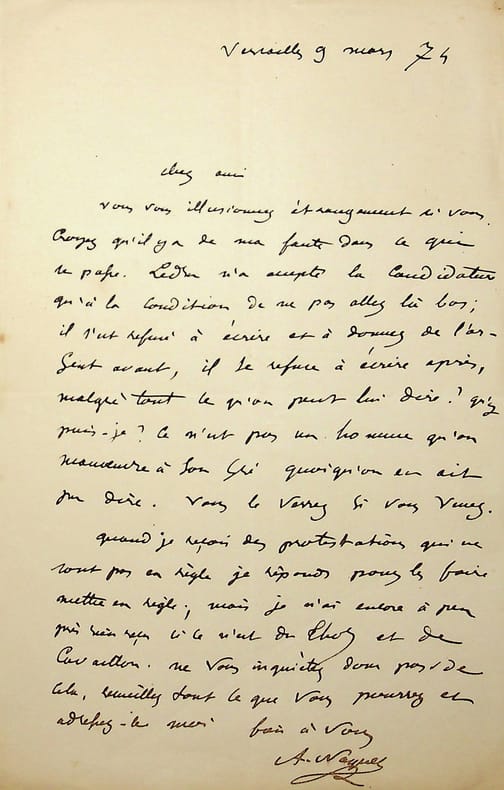
017135Alfred Naquet (1834-1916), chimiste, médecin, homme politique, promoteur du divorce. L.A.S., Versailles, 9 mars 1874, 1p in-8. A Philippe Bordone (1821-1892), médecin, chirurgien militaire dit le général Bordone. « Cher ami, Vous vous illusionnez étrangement si vous croyez qu'il y a de ma faute dans ce qui se passe. Ledru n'a accepté la candidature qu'à la condition de ne pas aller là-bas ; il s'est refusé à écrire et à donner de l'argent avant, il se refuse à écrire après, malgré tout ce qu'on peut lui dire ! Qu'y puis-je ? Ce n'est pas un homme qu'on manoeuvre à son gré quoiqu'on en ait pu dire. Vous le verrez si vous venez. Quand je reçois des protestations qui ne sont pas en règle, je réponds pour les faire mettre en règle ; mais je n'ai encore à peu près rien reçu si ce n'est du Thor et de Cavaillon. Ne vous inquiétez donc pas de cela, recueillez tout ce que vous pourrez et adressez-le moi. Bien à vous. A Naquet ». Il est évidemment question d'Alexandre Ledru-Rollin (1807-1874), alors député du Vaucluse depuis le 1er mars. Cette lettre, même si elle ne le mentionne pas, fait référence à l'affaire Aimé Boussot (1812-1892), maire de Cavaillon révoqué par Mac-Mahon. Peu commun [401]
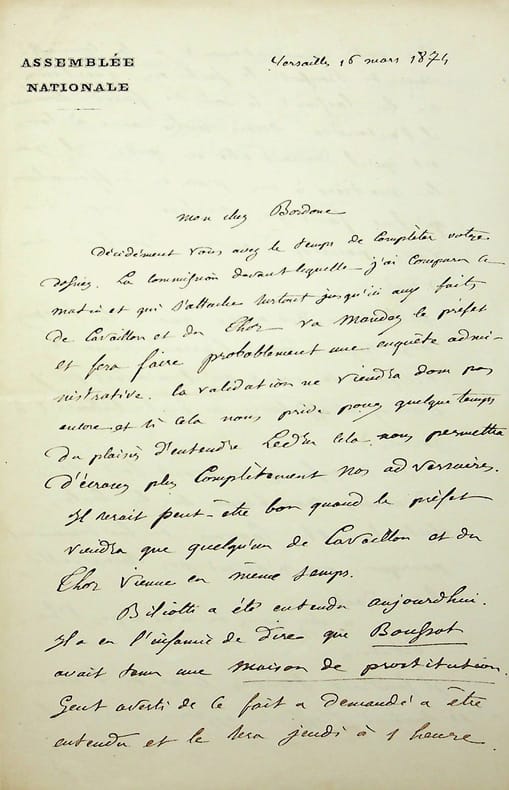
017136Alfred Naquet (1834-1916), chimiste, médecin, homme politique, promoteur du divorce. L.A.S., Versailles, 16 mars 1874, 2pœ in-8. A Philippe Bordone (1821-1892), médecin, chirurgien militaire dit le général Bordone. Très intéressante lettre faisant suite à la révocation du maire de Cavaillon, Aimé Boussot (1812-1892), par Mac-Mahon en février et les magouilles politiques de l'époque (les élections de 1871 dans le Vaucluse avaient déjà été invalidées par exemple). « Mon cher Bordone, Décidément, vous avez le temps de compléter votre dossier. La commission devant laquelle j'ai comparu le matin et qui s'attache surtout jusqu'ici aux faits de Cavaillon et du Thor va mander le préfet et fera faire probablement une enquête administrative. La validation ne viendra donc pas encore et si cela nous prive pour quelques temps du plaisir d'entendre [Alexandre] Ledru[-Rollin], cela nous permettra d'écraser plus complètement nos adversaires. Il serait peut-être bon quand le préfet viendra que quelqu'un de Cavaillon et du Thor vienne en même temps. [Raoul de] Billioti a été entendu aujourd'hui. Il a eu l'infamie de dire que Boussot avait tenue une maison de prostitution. [Alphonse] Gent averti de ce fait a demandé à être entendu et le sera jeudi [19 mars] à 1 heure. Il a porté immédiatement à la connaissance de Boussot le fait en question en lui laissant le soin de faire comme il l'entendra. Mais notre avis à tous est qu'il devrait être ici jeudi. Il y a la matière à un procès en diffamation qu'il ne faut pas négliger. Voyez si vous pouvez décider Boussot à venir. Biliotti a dit encore que la terreur rouge réglait dans l'arrondissement d'Apt à ce point qu'il n'avait pu y trouver d'afficheurs ni distributeurs (à Pertuis). Il a dit enfin qu'on avait fait des radiations nombreuses sur les listes électorales. Et , comme on lui demandait pourquoi on n'avait pas surveillé, il répondait : « Chez nous on n'en a pas l'habitude » Il faudrait trouver le n° de l'union et surtout l'affiche apposée par les légitimistes et qui incitent les citoyens à aller se faire inscrire. Une telle affiche a été apposée sur les murs d'Avignon. Ce sera la réponse. Ecrivez-moi. Tout à vous A Naquet ». Peu commun [401]
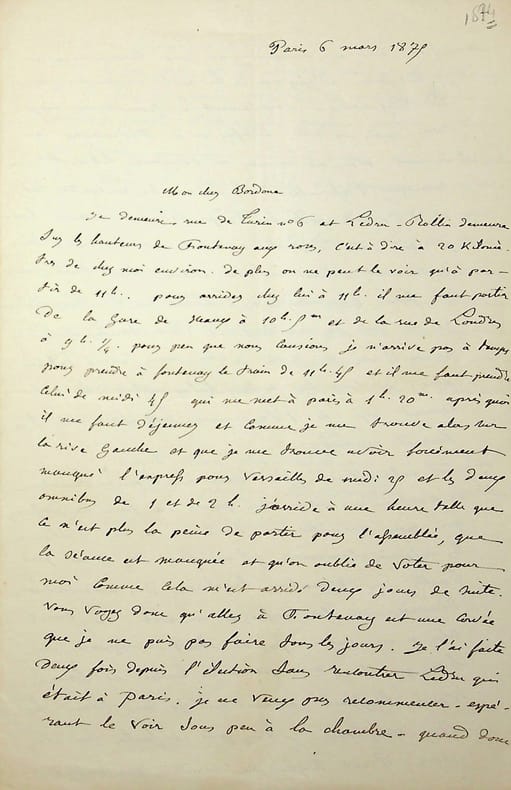
017137Alfred Naquet (1834-1916), chimiste, médecin, homme politique, promoteur du divorce. L.A.S., Paris, 6 mars 1874 [curieusement mal datée 1875], 3p in-8. A Philippe Bordone (1821-1892), médecin, chirurgien militaire dit le général Bordone. Longue et très intéressante lettre autour des tentatives d'invalidation des élections législatives dans le Vaucluse. Il indique comment rencontrer Alexandre Ledru-Rollin (1807-1874), député du Vaucluse depuis le 1er mars, qui vit à Fontenay-aux-Roses, mentionnant Jean-Baptiste Saint-Martin (1840-1926), futur député du Vaucluse, les « infamies commises » par les légitimistes (non nommés ici mais il s'agit bien d'eux) qu'il faut documenter précisément afin que Naquet en parle à la tribune de l'assemblée. Peu commun [401]
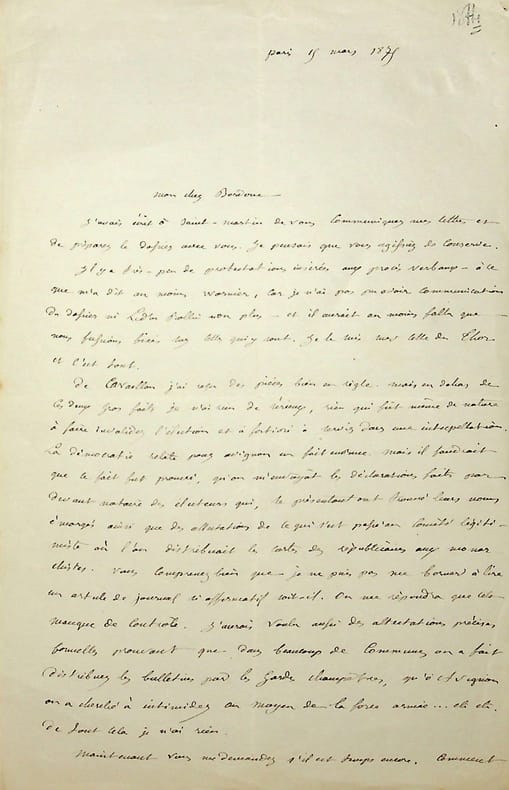
017138Alfred Naquet (1834-1916), chimiste, médecin, homme politique, promoteur du divorce. L.A.S., 15 mars 1874 [curieusement mal datée 1875], 2p in-8. A Philippe Bordone (1821-1892), médecin, chirurgien militaire dit le général Bordone. Longue et très intéressante lettre autour des tentatives d'invalidation des élections législatives dans le Vaucluse, mentionnant Jean-Baptiste Saint-Martin (1840-1926), l'absence de faits pouvant invalider les élections, les manoeuvres des monarchistes qui distribuaient dans leurs réunions les cartes des républicains, l'absence d'intimidation qu'auraient exercé des républicains, l'audition de Raoul de Billioti le lendemain, etc. Billioti est un candidat monarchiste malheureux. On sait, par une autre lettre, que cette audition a bien eu lieu de 16 mars 1874. Peu commun [401]
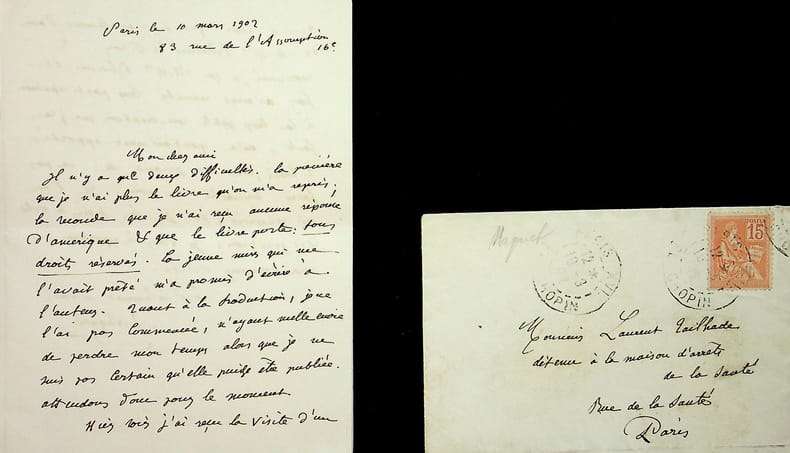
020926Alfred Naquet (1834-1916), chimiste, médecin, homme politique, promoteur du divorce. L.A.S. + enveloppe, Paris, 10 mars 1902, 2p in-12. A Laurent Tailhade (1854-1919), poète, écrivain, pamphlétaire. « Mon cher ami, Il n'y a que deux difficultés. La première que je n'ai plus le livre qu'on m'a repris ; la seconde que je n'ai reçu aucune réponse d'Amérique & que le livre porte : tous droits réservés. La jeune mère qui me l'avait prêté m'a promis d'écrire à l'auteur. Quant à la traduction, je ne l'ai pas commencée, n'ayant nulle envie de perdre mon temps alors que je ne suis pas certain qu'elle puisse être publiée. Attendons donc pour le moment. Hier soir, j'ai reçu la visite d'un ami à moi qui est également l'ami de MMrs Rheims & Fray. Le monsieur, à qui MMrs Rheims et Fray avaient raconté leur participation à la trop petite souscription que j'ai faite, m'a spontanément apporté 2 louis, en me priant de ne pas faire connaître son nom. Je l'en ai remercié, et je les tiens à votre disposition : je vous les apporterai à ma première visite. cordialement à vous. A Naquet ». Rappelons que Tailhade est condamné à un an de prison, suite à un article considéré comme un appel au meurtre du tsar Nicolas II, en visite en France. Il fera six mois à partir d'octobre 1901. Peu commun. [508]
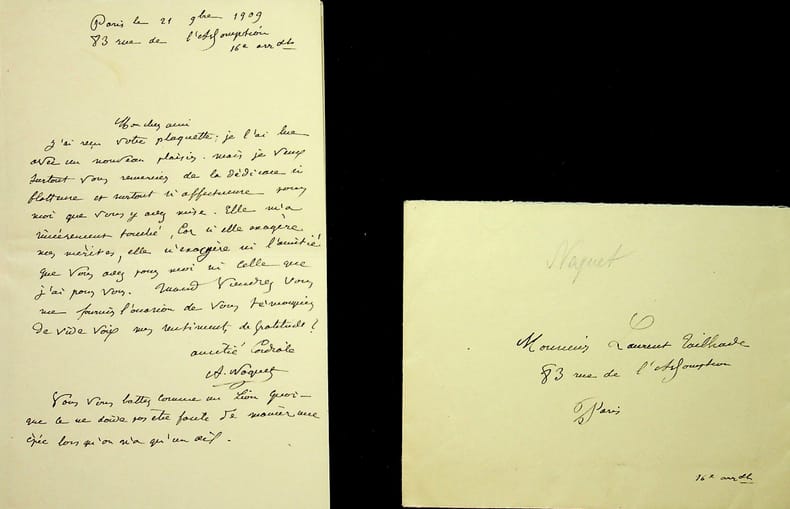
020927Alfred Naquet (1834-1916), chimiste, médecin, homme politique, promoteur du divorce. L.A.S. + enveloppe, Paris, 21 novembre 1909, 1p in-8. A Laurent Tailhade (1854-1919), poète, écrivain, pamphlétaire, probablement au moment de l'envoi de son ouvrage La Feuille à l'envers. « Mon cher ami, j'ai reçu votre plaquette ; je l'ai lue avec un nouveau plaisir. Mais je veux surtout vous remercier de la dédicace si flatteuse et surtout si affectueuse pour moi que vous y avez mise. Elle m'a sincèrement touché, car su elle exagère mes mérites, elle n'exagère ni l'amitié que vous avez pour moi ni celle que j'ai pour vous. Quand viendrez-vous me fournir l'occasion de vous témoigner de vive voix mes sentiments de gratitude ? Amitié cordiale. A.Naquet. Vous vous battez comme un lion quoique ce ne doive pas être facile de manier une épée lorsqu'on n'a qu'un oeil ». [508]
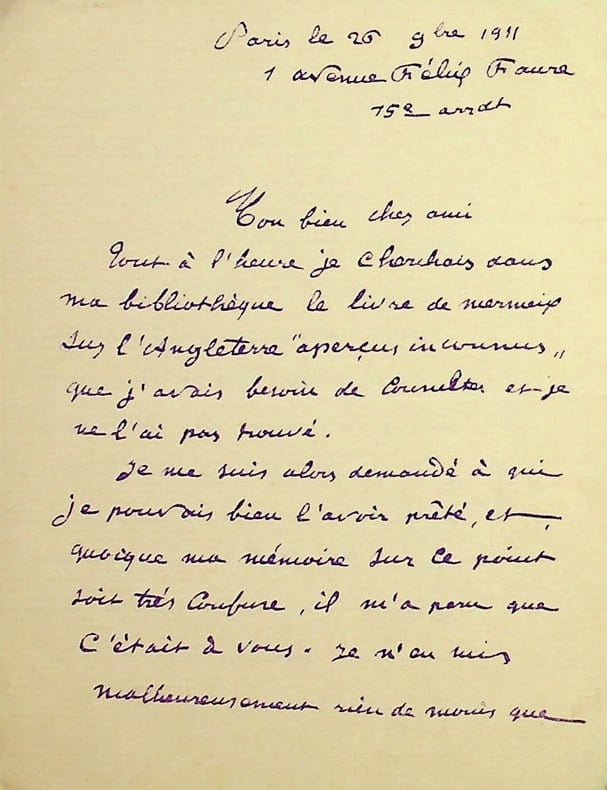
020928Alfred Naquet (1834-1916), chimiste, médecin, homme politique, promoteur du divorce. L.A.S., Paris, 26 novembre 1911, 3p in-12. A Laurent Tailhade (1854-1919), poète, écrivain, pamphlétaire. « Mon bien cher ami, Tout à l'heure, je cherchais dans ma bibliothèque le livre de Mermeix sur l'Angleterre "aperçus inconnus" que j'avais besoin de consulter et je ne l'ai pas trouvé. Je me suis alors demandé à qui je pouvais bien l'avoir prêté, et quoique ma mémoire sur ce point soit très confuse, il m'a paru que c'était vous. Je n'en suis malheureusement rien de moins que certain. Mais si par hasard c'était exacte, vous seriez bien aimable de me le renvoyer, sauf à la reprendre ensuite si vous n'en avez pas achevé la lecture. & si, mieux inspiré encore, vous me le rapportiez vous-même en me prévenant du jour et de l'heure afin que je ne vous manque pas, je serais tout-à-fait heureux car cela me vaudrait le plaisir, dont je suis vraiment trop sevré de tailler une bavette avec vous. Croyez mon cher ami à ma toujours bien vive amitié & veuillez présenter à madame Tailhade, avec les meilleurs souvenirs de ma femme, l'expression de mes sentiments respectueux, sans oublier Laurence qui devient peut-être déjà très grande fille sans doute mais pas encore, allez-vous m'empêcher de lui envoyer un baiser. A. Naquet ». Peu commun. [508]
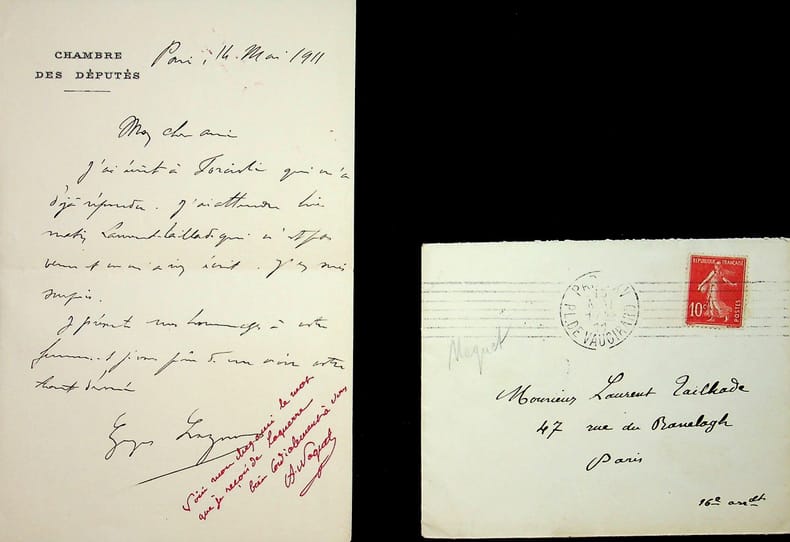
020929Alfred Naquet (1834-1916), chimiste, médecin, homme politique, promoteur du divorce ; Georges Laguerre (1858-1912), avocat, homme politique. L.A.S. + enveloppe, 14 mai 1911, 1p in-8. A Laurent Tailhade (1854-1919), poète, écrivain, pamphlétaire. Note A.S. de Naquet en pied d'une lettre de Laguerre : « Voici mon cher ami le mot que je reçois de Laguerre. Bien cordialement à vous. A. Naquet ». La lettre de Laguerre concerne une visite de Tailhade qu'il a attendu en vain la veille. [508]
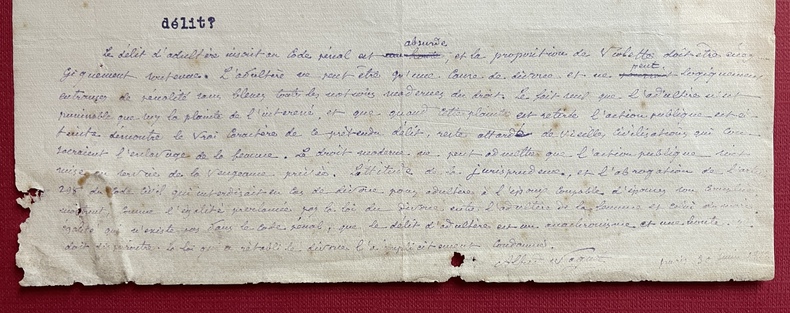
017062Alfred Naquet (1834-1916), chimiste, médecin, homme politique, promoteur du divorce. Manuscrit A.S., 30 juin 1912, 1/2p in-4. A l'écrivain et avocat Jean-Bernard (1857-1936). Intéressante réponse à une enquête sur le délit d'adultère lancée par La Presse Associée dont Jean-Bernard est directeur. « Le délit d'adultère inscrit au Code Pénal est absurde et la proposition de Violette doit être énergiquement soutenue. [.] L'adultère [.] reste attardé de vieilles civilisations qui consacraient l'esclavage de la femme. [.] le délit d'adultère est un anachronisme et une honte ». On joint deux copies tapuscrites de sa réponse. Document un peu sali, encre éclaircie en bordure. Très beau document. [398]
Pages 384-512 plus dozens of pages of nostalgic ads. Features: Racketeers and Organized Labor; Whoe Gets the Children - a wife's reflections on divorce; The New Stage Fright - talking pictures; The Real Value of the League of Nations; Is History a Fraud?; The Wallflower Complex; The Curious Statistics of Suicide; and much more. The following wonderful ads are worthy of mention: Nice Stetson Hats (for men) ad inside front cover; The Hotels Statler; Cadillac Motor Car Company - with illustration of their V-16-powered car; Japan Tourist Burea (color); Hawaii Tourist Bureau (color); and lastly a lovely back cover colour Camel cigarette ad featuring a peaceful and elegant sailing scene. Unmarked with moderate wear to orange covers. Binding intact. A sound vintage copy. Book
19988989New York NY U.S.A.: Aspen Publishers Incorporated. Fine with no dust jacket. 1998. Third Edition. Original Cloth. 1567069223 . 1190 pages.; 6x9 1/2" . Aspen Publishers, Incorporated hardcover
1332344410.Gpaperback. Good. Access codes and supplements are not guaranteed with used items. May be an ex-library book. paperback
1895339518Boston: National Divorce Reform League 1895. First edition. Single sheet folded to make 4 4to page. 4TO. Folded once else a fine copy; uncommon no copy listed on OCLC. First edition. Single sheet folded to make 4 4to page. 4TO. Prints a list of Officers "Its Present Results" including "Improved Marriage and Divorce Laws in many States." "Practical beginning in uniform legislation." etc. Also prints a list of "Its Aims and Methods" "Its Opportunities" "Its Needs" etc. Folded once else a fine copy; uncommon no copy listed on OCLC. <br/><br/> National Divorce Reform League unknown
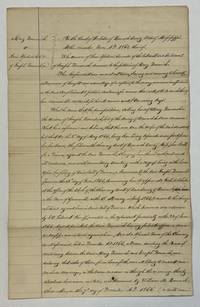
186840969Hancock County MS 1868. 6 pp on lined legal-size paper entirely in ink manuscript. Consisting of the answer of the Executor to the complaint of Mary Tomasich. Light wear a couple of short closed tears without loss. Very Good.<br /> <br /> Mary Tomasich calling herself "the widow of Joseph Tomasich late of the County of Hancock but now deceased" filed a claim against Joseph's estate. But in 1866 while Joseph was still alive she petitioned for a divorce from Joseph "charging him therein with continued ill treatments and with committing adultery with a negress living with him."<br /> The Hancock County Court issued a decree of divorce which the Executor attaches to this Answer. Having dissolved the bonds of holy matrimony Mary thus has no claim to Joseph's estate. unknown
18015554London: J. Wright; Philanthropic Reform 1801. First editions. Two pamphlets bound together in modern quarter calf over marbled boards with morocco label to spine. Measuring 203 x 120mm and both collating complete: 4 136; 27 1 blank. Toning throughout both tracts with closed tears to pages 69-70 and 77-80 with no loss of text; contemporary pencil annotations throughout the first tract documenting one reader's responses to the controversial claims. Numbers 2 and 4 in ink to headers of each title suggest these were part of a larger compilation of legal tracts likely the set of four that were offered for sale in the 1923 Walpole Galleries sale which bear matching marks. Each scarce OCLC reports approximately 20 copies of the first title and ESTC locates 3 copies of the second title; they are the only examples currently in trade. <br /> <br /> Two scarce pamphlets engaging in a longstanding debate about whether how and when divorce should be socially and legally acceptable. These two take up the issue of women's sexual agency and Thoughts on the Propriety specifically espouses the notion that women who have engaged in adultery should not be allowed to divorce an existing spouse in order to marry a man with whom they've been unfaithful. Biblical justifications for this ban are presented throughout; but the hypocrisy woven into the argument makes it clear that its author is manufacturing a problem in order to punish and shame the few women for whom this circumstance even exists. <br /> <br /> Marriages at the time could only be dissolved through divorce in an Act of Parliament; thus divorces were only available to the titled and the wealthy. Additionally at the time of Thoughts on the Propriety's publication in 1800 no woman had ever successfully petitioned Parliament for divorce and been granted one. This landmark would come in 1801 the year of publication for Nuptiae Sacra when Jane Campbell successfully petitioned to divorce Edward Addison on the grounds of abuse. "Of the 314 divorce Acts issued before 1857 all but five were initiated by men. Of the five women who petitioned for divorce Jane Campbell was the first to successfully unbind herself from her husband" History of Parliament. Whether the author of Thoughts anticipated such a ruling or not it is clear that the issue at stake was not so much women gaining divorces as women more openly at the turn of the century engaging in pre and extra marital sexual relationships or even in some cases paid sex work. This was in fact occurring; and it was the subject of numerous satires erotic works and religious diatribes dealing with cuckoldry and whoredom. The desire to shame and control women who expressed sexual subjecthood and the impulse to position them as the sinning parties rather than the men who equally engaged in the behavior with them is telling and predicts how future divorce laws would unfold. J. Wright; Philanthropic Reform unknown
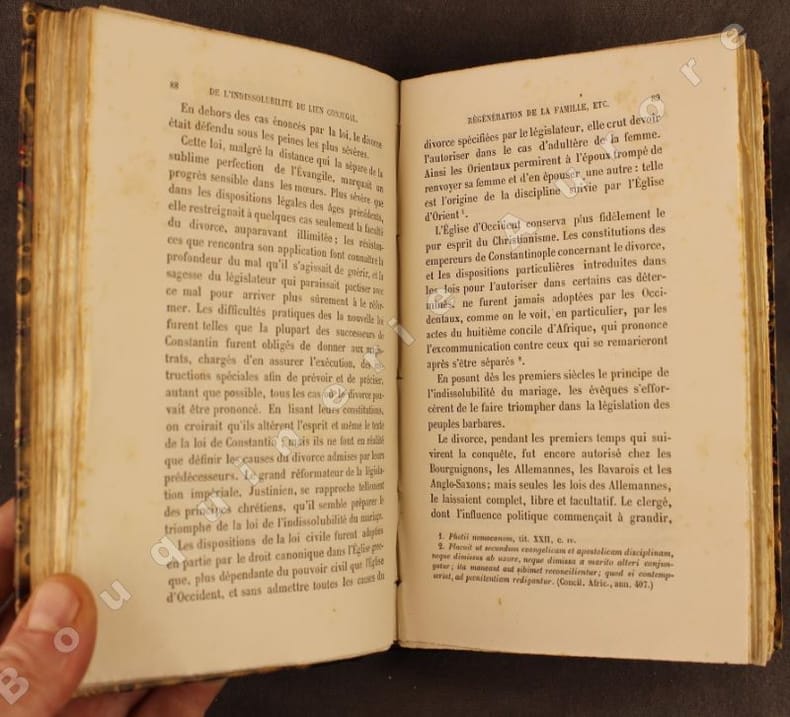
1880141841880 P., E. Dentu, s.d (ca 1880), 1 vol. in-12 (190 x 110 mm) relié 1/2 chagrin marron à la Bradel, auteur, titre et jeu de filets dorés, plats de papier "Oeil de Chat", reliure du temps, de XII - 243 pp.Coiffe légèrement frottée, fines rousseurs et mouillures angulaires claires en fin d'ouvrage, bon exemplaire par ailleurs.
ORD-3188Du 22e jour du 1er mois de l'an second de la République Française une & indivisible. Grasse. Guichard. An II. In-4 (180 x 235mm) de 2 pages imprimées, signé Lauvan à la main. (2).
162206Paris, Delaunay, 1831 in-8, 48 pp., broché.
61143Sans lieu, ni date (vers 1800), 16 pages ; sans couverture.
239173Paris, au comptoir des imprimeurs-unis, 1848 in-8, 47 pp., broché sous couverture factice moderne de papier vert.
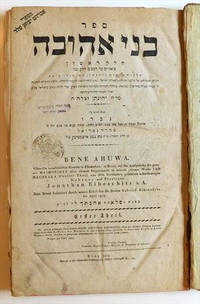
181941334Prag Prague: Gedruckt In D. Schollischen Buchdruckerey 1819. Hardback. 1st edition. 4to period boards 4 82 1 25 leaves aproximately 224 pages. In Hebrew with some German on title page. Vinograd: Prague 1165. StCB: 5867 3; Jewish Museum 179. Contents: helek 1. Hilkhot ishut perek 1-10; helek 2. Hilkhot ishut perek 11-25; helek 3. Hilkhot gerushin. Hilkhot yibum va-halitsah. She'elot u-teshuvot. Maftehot. <br> <br> Novellae to Maimonides of the laws pertaining to women i.e. divorce relationships and marriage by Rabbi Jonathan ben Nathan Nata Eybeschutz 1690/95-1764 the talmudist kabbalist and child prodigy. In his youth after the death of his father he studied in Prossnitz under Rabbi Meir Eisenstadt and Rabbi Eliezer ha-Levi Ettinger his uncle and in Vienna under Rabbi Samson Wertheimer. He married the daughter of Rabbi Isaac Spira the av bet din of Bunzlau. After traveling for some time he settled in Prague in 1715 and in time became head of the yeshivah and a famous preacher. <br> After the death of Rabbi David Oppenheim 1736 he was appointed dayan of Prague. Elected rabbi of Metz in 1741 he subsequently became rabbi of the "Three Communities" Altona Hamburg and Wandsbek in 1750. Both in Metz and in Altona he had many disciples and was considered a great preacher. <br> His position in the Three Communities however was undermined when a dispute broke out concerning his suspected leanings toward Shabbateanism. This controversy accompanied Rabbi Eybeschuetz throughout his life and the quarrel had repercussions in every community from Holland to Poland. His main opponent was Rabbi Jacob Emden also a famous talmudist and a potential rival in the candidature to the rabbinate of the Three Communities.<br> The quarrel developed into a great public dispute which divided the rabbis of the day. While most of the German rabbis opposed Rabbi Eybeschuetz his support came from the rabbis of Poland and Moravia. <br> A fruitless attempt at mediation was made by Rabbi Ezekiel Landau rabbi of Prague. Most of Rabbi Eybeschuetz' own community was loyal to him and confidently accepted his refutation of the charges made by his opponent but dissension reached such a pitch that both sides appealed to the authorities in Hamburg and the government of Denmark for a judicial ruling. The king favored Rabbi Eybeschuetz and ordered new elections which resulted in his reappointment. <br> After his reelection as rabbi of the Three Communities some rabbis of Frankfort Amsterdam and Metz challenged him to appear before them to reply to the suspicions raised against him. Rabbi Eybeschuetz refused and when the matter was brought before the Council of the Four Lands in 1753 the council issued a ruling in his favor. In 1760 the debate was rekindled when some Shabbatean elements were discovered among the students of Rabbi Eybeschuetz' yeshiva. At the same time his youngest son Wolf presented himself as a Shabbatean prophet with the result that the yeshiva was closed. See Bibliography of the Hebrew Book 1470-1960 #000109183; EJ; M. A. Perlmutter R. Yehonatan Eybeschuetz ve-Yahaso la-Shabbeta'ut 1947; Mifal ha-Bibliografyah ha-Ivrit Hoveret le-Dugmah 1964 13-24. <br> <br> SUBJECTS: Marriage Jewish law Divorce Jewish law Husband and wife Jewish law Incest -- Religious aspects -- Judaism. Maimonides Moses 1135-1204. Mishneh Torah -- Commentaries. OCLC: 19167576. <br> Some wear usual light age and damp staining wide margins stamps. Binding starting About Very Good Condition. RAB-66-17-BLRKKQQ-'emn. Prag [Prague]: Gedruckt In D. Schollischen Buchdruckerey unknown
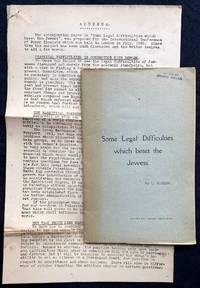
192143436No Place London: No Publisher The Author Printed by Hart & Sons 1921. No Date c. 1920-1921. Original printed paper wrappers Small 8vo 16 pages. 2-leaf stapled mimeograph "Addenda." Addenda appears to be from after February 1921. Includes bibliographical references.<br> "Printed for Private Circulation."<br> <br> Stamped "ex libris ANGELO SULLAM" on cover. <br> <br> Neither the main title nor the Addenda are mentioned in Cecil Roth's Magna Bibliotheca Anglo-Judaica.<br> "Paper prepared for the International Conference on Women Zionists which was held in London in July 1920. Since then the subject has been much discussed and the writer desires to add a few words." from the Addenda which was composed shortly after the February 1921 Rabbinical Conference in Jerusalem.<br> The author Lizzie Hands 1880-1956 here attempts to "briefly to set forth the difficulties which confront the Jewess in the modern world; to indicate the steps which have already been adopted for her relief and to consider the need for further measures. This short survey" she writes "is not exhaustive; it is intended merely to direct attention to the subject and to induce Jewish women all the world over to indicate their wish that the state of affairs may receive the consideration of a Rabbinic Conference in the near future"<br> Hands reviews problems particular to Jewish women as a result of political and religious oppression in Eastern Europe and of customs and traditions within the faith itself. With the possibility of Jewish settlement in Palestine Hands emphasizes the necessity of ensuring that women as well as men have 'the right to develop and utilize their capacities to the full.' <br> The majority of Hands' discussion concerns divorce suggesting that "It seems at least essential that some step should be taken to insure that the wife may have the best independent advice before consenting to a dissolution of marriage. If she cannot attend the divorce proceedings she should be informed that such proceedings are contemplated and furnished with adequate means of safeguarding her interests and those of her children; nor should the man who has instituted divorce proceedings against an innocent wife be allowed to go his way until it has been ascertained that she assents."<br> The work and author are cited by Ralf Balke in his 2020 article on the 1920 Conference "100 Jahre starke Frauen" "100 Years of Strong Women" https://www.hagalil.com/2020/07/wizo-2. The article features a group photo that includes Hands<br> <br> Angelo Sullam 1881-1971 was President of the Jewish Community in Venice 1919-1930 as well as "an Italian jurist and activist and Zionist leader.<br> In 1902 "Sullam.became a contributor to Idea Sionista a magazine.In the articles he published in 1902 as well as in his doctoral thesis the themes dearest to him already emerge: anti-Semitism the oppression of the Jews in Eastern Europe the emancipation of the persecuted Jews through Zionism.<br> In 1903.he founded the Venetian Zionist Group for the movement's propaganda in Venice.In the same year he was part of the Italian delegation to the Sixth World Zionist Congress held in Basel where he distinguished himself as a supporter of Theodor Herzl 's ideals as opposed to more extreme lines of thought. He expressed his support for negotiations with the Ottoman Empire for the colonization of Palestine as a solution to the redemption of the Jews also emphasizing the importance of 'propaganda for a Jewish conscience' among the Jews remaining in Europe.<br> The outbreak of the Libyan war in 1911 was an opportunity to open a new debate on Zionism convinced that colonial policy could open economic prospects for Jews and Italians together. First in Turin in 1912 then in Rome in 1914 he spoke at two Jewish youth conferences denouncing Italians' hostile attitudes toward Libyan Jews despite the fact that they represented the segment of the population most favorable to colonialism. Italy he argued needed to acknowledge the fact that numerous Italian-speaking Jewish communities existed throughout the Mediterranean basin and to disadvantage them would be contrary to its own interests.<br> Between 1917 and 1918 with the end of Turkish rule in Palestine he resumed his Zionist propaganda with greater vigour and also aroused the interest of some government officials when he supported the possibility of a convergence of Jewish and Italian interests in the East.<br> During 1918 when Italy was asked whether or not to adhere to the Balfour Declaration he became a consultant to the Ministry of Foreign Affairs and in particular to Undersecretary Gaetano Manzoni and Consul Carlo Galli. He played a leading role in choosing the delegates to be sent to the Zionist Executive Commission which was established in Jerusalem in January 1918 .<br> After the First World War.he was in close contact with Chaim Weizmann who saw him as an influential figure in guiding the Italian government's decisions regarding the British Mandate of Palestine. In 1920 supported by Mario Lago Director General of Political Affairs at the Ministry of Foreign Affairs he established the Società commerciale italo-mediterranea an economic organization whose purpose was Italian and Italo-Jewish propaganda.<br> From 1919 to 1929 he was president of the General Israelite Fraternity of Venice the future Jewish Community and in 1921 he was appointed vice president of the Consortium of Italian Jewish Communities. In the same year he became president of the Committee for Assistance to Jewish Emigrants dedicating himself to supporting the many Jews who from Eastern Europe were heading for Palestine or the Americas by embarking in Italian ports.<br> He also participated in the reform of the legislation on Jewish Communities and the Union of Jewish Communities.as late as 1937-38 he was still a member of the Committee of Italians of Jewish Religion.<br> The racial laws of 1938 affected him only partially thanks to the status of "discriminated Jew" obtained in February 1939" Wikipedia translated from the Italian. <br> <br> For more on Sullam see L. Brazzo's 2006 article "Angelo Sullam and the Zionism movement in Italy between the Libyan war and the hundred year end crisis" https://www.researchgate.net/publication/293308072_Angelo_Sullam_and_the_Zionism_movement_in_Italy_between_the_Libyan_war_and_the_hundred_year_end_crisis_Part_1<br> <br> OCLC: 55649156.<br> <br> Light toning to covers folds to Addenda as issued. Very Good Condition. Important. B Brit-2-11-GGOLDBCCS. No Place [London]: No Publisher [The Author? Printed by Hart & Sons] unknown
In 16, pp. 15 + (1b). Br. rifatta con carta d'epoca. Descrizione di questa importante legge sul divorzio emanata il 20 settembre 1792 che, dietro l'affermazione della natura contrattuale del matrimonio, implicava ineluttabilmente il riconoscimento del diritto di risolvere il contratto per mutuo consenso. La legge si divide in 5 capitoli: Causes du divorce; Modes du divorce; Effets du divorce par rapport aux epoux; Effets du divorce aux enfans.
189090423Partitions sur l'adultère et le divorce Ondet 1890 approx.
193319605Partitions sur l'adultère et le divorce Labbé Marcel 1933 approx.