33 résultats
18820009183London: Tinsley Brothers 1882. First edition. Hardcover. Fair. 8vos half red polished calf extra-gilt spine joints of vol. 2 repaired. Ex libris F. C. Farwell probably Francis Cooley Farwell Chicago merchant and the son of John V. Farwell and Emma Cooley Farwell. <br/><br/>This is a sequel to Fitzgeralds LIFE OF GEORGE IV. 'Besides gathering together all the published materials laid up from innumerable volumes many scarce and often unknown into a regular form I have here collected a huge amount of unpublished letters diaries and other interesting MS matter - Preface." Tinsley Brothers hardcover
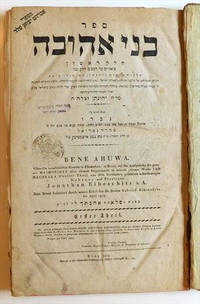
181941334Prag Prague: Gedruckt In D. Schollischen Buchdruckerey 1819. Hardback. 1st edition. 4to period boards 4 82 1 25 leaves aproximately 224 pages. In Hebrew with some German on title page. Vinograd: Prague 1165. StCB: 5867 3; Jewish Museum 179. Contents: helek 1. Hilkhot ishut perek 1-10; helek 2. Hilkhot ishut perek 11-25; helek 3. Hilkhot gerushin. Hilkhot yibum va-halitsah. She'elot u-teshuvot. Maftehot. <br> <br> Novellae to Maimonides of the laws pertaining to women i.e. divorce relationships and marriage by Rabbi Jonathan ben Nathan Nata Eybeschutz 1690/95-1764 the talmudist kabbalist and child prodigy. In his youth after the death of his father he studied in Prossnitz under Rabbi Meir Eisenstadt and Rabbi Eliezer ha-Levi Ettinger his uncle and in Vienna under Rabbi Samson Wertheimer. He married the daughter of Rabbi Isaac Spira the av bet din of Bunzlau. After traveling for some time he settled in Prague in 1715 and in time became head of the yeshivah and a famous preacher. <br> After the death of Rabbi David Oppenheim 1736 he was appointed dayan of Prague. Elected rabbi of Metz in 1741 he subsequently became rabbi of the "Three Communities" Altona Hamburg and Wandsbek in 1750. Both in Metz and in Altona he had many disciples and was considered a great preacher. <br> His position in the Three Communities however was undermined when a dispute broke out concerning his suspected leanings toward Shabbateanism. This controversy accompanied Rabbi Eybeschuetz throughout his life and the quarrel had repercussions in every community from Holland to Poland. His main opponent was Rabbi Jacob Emden also a famous talmudist and a potential rival in the candidature to the rabbinate of the Three Communities.<br> The quarrel developed into a great public dispute which divided the rabbis of the day. While most of the German rabbis opposed Rabbi Eybeschuetz his support came from the rabbis of Poland and Moravia. <br> A fruitless attempt at mediation was made by Rabbi Ezekiel Landau rabbi of Prague. Most of Rabbi Eybeschuetz' own community was loyal to him and confidently accepted his refutation of the charges made by his opponent but dissension reached such a pitch that both sides appealed to the authorities in Hamburg and the government of Denmark for a judicial ruling. The king favored Rabbi Eybeschuetz and ordered new elections which resulted in his reappointment. <br> After his reelection as rabbi of the Three Communities some rabbis of Frankfort Amsterdam and Metz challenged him to appear before them to reply to the suspicions raised against him. Rabbi Eybeschuetz refused and when the matter was brought before the Council of the Four Lands in 1753 the council issued a ruling in his favor. In 1760 the debate was rekindled when some Shabbatean elements were discovered among the students of Rabbi Eybeschuetz' yeshiva. At the same time his youngest son Wolf presented himself as a Shabbatean prophet with the result that the yeshiva was closed. See Bibliography of the Hebrew Book 1470-1960 #000109183; EJ; M. A. Perlmutter R. Yehonatan Eybeschuetz ve-Yahaso la-Shabbeta'ut 1947; Mifal ha-Bibliografyah ha-Ivrit Hoveret le-Dugmah 1964 13-24. <br> <br> SUBJECTS: Marriage Jewish law Divorce Jewish law Husband and wife Jewish law Incest -- Religious aspects -- Judaism. Maimonides Moses 1135-1204. Mishneh Torah -- Commentaries. OCLC: 19167576. <br> Some wear usual light age and damp staining wide margins stamps. Binding starting About Very Good Condition. RAB-66-17-BLRKKQQ-'emn. Prag [Prague]: Gedruckt In D. Schollischen Buchdruckerey unknown
1980KOS01201840Shinshisha 1980. Soft Cover. Fine. KOS01201840 Shinshisha paperback
1980KOS01205643Shinshisha 1980. Soft Cover. Fine. KOS01205643 Shinshisha paperback
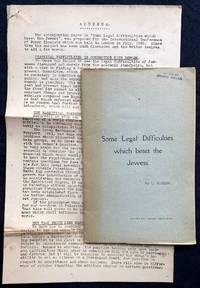
192143436No Place London: No Publisher The Author Printed by Hart & Sons 1921. No Date c. 1920-1921. Original printed paper wrappers Small 8vo 16 pages. 2-leaf stapled mimeograph "Addenda." Addenda appears to be from after February 1921. Includes bibliographical references.<br> "Printed for Private Circulation."<br> <br> Stamped "ex libris ANGELO SULLAM" on cover. <br> <br> Neither the main title nor the Addenda are mentioned in Cecil Roth's Magna Bibliotheca Anglo-Judaica.<br> "Paper prepared for the International Conference on Women Zionists which was held in London in July 1920. Since then the subject has been much discussed and the writer desires to add a few words." from the Addenda which was composed shortly after the February 1921 Rabbinical Conference in Jerusalem.<br> The author Lizzie Hands 1880-1956 here attempts to "briefly to set forth the difficulties which confront the Jewess in the modern world; to indicate the steps which have already been adopted for her relief and to consider the need for further measures. This short survey" she writes "is not exhaustive; it is intended merely to direct attention to the subject and to induce Jewish women all the world over to indicate their wish that the state of affairs may receive the consideration of a Rabbinic Conference in the near future"<br> Hands reviews problems particular to Jewish women as a result of political and religious oppression in Eastern Europe and of customs and traditions within the faith itself. With the possibility of Jewish settlement in Palestine Hands emphasizes the necessity of ensuring that women as well as men have 'the right to develop and utilize their capacities to the full.' <br> The majority of Hands' discussion concerns divorce suggesting that "It seems at least essential that some step should be taken to insure that the wife may have the best independent advice before consenting to a dissolution of marriage. If she cannot attend the divorce proceedings she should be informed that such proceedings are contemplated and furnished with adequate means of safeguarding her interests and those of her children; nor should the man who has instituted divorce proceedings against an innocent wife be allowed to go his way until it has been ascertained that she assents."<br> The work and author are cited by Ralf Balke in his 2020 article on the 1920 Conference "100 Jahre starke Frauen" "100 Years of Strong Women" https://www.hagalil.com/2020/07/wizo-2. The article features a group photo that includes Hands<br> <br> Angelo Sullam 1881-1971 was President of the Jewish Community in Venice 1919-1930 as well as "an Italian jurist and activist and Zionist leader.<br> In 1902 "Sullam.became a contributor to Idea Sionista a magazine.In the articles he published in 1902 as well as in his doctoral thesis the themes dearest to him already emerge: anti-Semitism the oppression of the Jews in Eastern Europe the emancipation of the persecuted Jews through Zionism.<br> In 1903.he founded the Venetian Zionist Group for the movement's propaganda in Venice.In the same year he was part of the Italian delegation to the Sixth World Zionist Congress held in Basel where he distinguished himself as a supporter of Theodor Herzl 's ideals as opposed to more extreme lines of thought. He expressed his support for negotiations with the Ottoman Empire for the colonization of Palestine as a solution to the redemption of the Jews also emphasizing the importance of 'propaganda for a Jewish conscience' among the Jews remaining in Europe.<br> The outbreak of the Libyan war in 1911 was an opportunity to open a new debate on Zionism convinced that colonial policy could open economic prospects for Jews and Italians together. First in Turin in 1912 then in Rome in 1914 he spoke at two Jewish youth conferences denouncing Italians' hostile attitudes toward Libyan Jews despite the fact that they represented the segment of the population most favorable to colonialism. Italy he argued needed to acknowledge the fact that numerous Italian-speaking Jewish communities existed throughout the Mediterranean basin and to disadvantage them would be contrary to its own interests.<br> Between 1917 and 1918 with the end of Turkish rule in Palestine he resumed his Zionist propaganda with greater vigour and also aroused the interest of some government officials when he supported the possibility of a convergence of Jewish and Italian interests in the East.<br> During 1918 when Italy was asked whether or not to adhere to the Balfour Declaration he became a consultant to the Ministry of Foreign Affairs and in particular to Undersecretary Gaetano Manzoni and Consul Carlo Galli. He played a leading role in choosing the delegates to be sent to the Zionist Executive Commission which was established in Jerusalem in January 1918 .<br> After the First World War.he was in close contact with Chaim Weizmann who saw him as an influential figure in guiding the Italian government's decisions regarding the British Mandate of Palestine. In 1920 supported by Mario Lago Director General of Political Affairs at the Ministry of Foreign Affairs he established the Società commerciale italo-mediterranea an economic organization whose purpose was Italian and Italo-Jewish propaganda.<br> From 1919 to 1929 he was president of the General Israelite Fraternity of Venice the future Jewish Community and in 1921 he was appointed vice president of the Consortium of Italian Jewish Communities. In the same year he became president of the Committee for Assistance to Jewish Emigrants dedicating himself to supporting the many Jews who from Eastern Europe were heading for Palestine or the Americas by embarking in Italian ports.<br> He also participated in the reform of the legislation on Jewish Communities and the Union of Jewish Communities.as late as 1937-38 he was still a member of the Committee of Italians of Jewish Religion.<br> The racial laws of 1938 affected him only partially thanks to the status of "discriminated Jew" obtained in February 1939" Wikipedia translated from the Italian. <br> <br> For more on Sullam see L. Brazzo's 2006 article "Angelo Sullam and the Zionism movement in Italy between the Libyan war and the hundred year end crisis" https://www.researchgate.net/publication/293308072_Angelo_Sullam_and_the_Zionism_movement_in_Italy_between_the_Libyan_war_and_the_hundred_year_end_crisis_Part_1<br> <br> OCLC: 55649156.<br> <br> Light toning to covers folds to Addenda as issued. Very Good Condition. Important. B Brit-2-11-GGOLDBCCS. No Place [London]: No Publisher [The Author? Printed by Hart & Sons] unknown
1332344410.Gpaperback. Good. Access codes and supplements are not guaranteed with used items. May be an ex-library book. paperback
1340884593.Ghardcover. Good. Access codes and supplements are not guaranteed with used items. May be an ex-library book. hardcover
036560299X.Gpaperback. Good. Access codes and supplements are not guaranteed with used items. May be an ex-library book. paperback