Livre Rare Book
339 résultats
49122Bruxelles - Berne, Bureau de la Commission Pénitentiaire Internationale 1901, 230x155mm, XLIII 2732pages, reliure demi-basane. Belle reliure. Bon état.
44976aafBern, Stämpfli, 1926 - 1932, in-8vo, 2 Bl. + 264 S. / 3 Bl. + 528 S., Original-Leinenband.
25854Paris, chez Ponthieu, (at end: De l'Imprimerie de P. Dupont, Hotel des Fermes), 1822. 32 pp. 8vo. Sewn, contemporary blind covers, uncut. The Congress of Verona (1822) was the largest and most elaborate assembly of its kind since the Congress of Vienna in 1814-15 (see at length: Historical Dictionary of France from the 1815 Restoration to the Second Empire, volume ii, pp. 1081-3.) It was an assembly of the four major conservative powers in Europe (Russia, Austria, Prussia & France) and its aim was to keep Spain from introducing a liberal constitution. It furthermore stipulated that European countries were to be ruled by absolute monarchs, with considerable influence for the Church and with censorship to combat the spread of liberal ideas. It was in fact a rejection of the principles of the French Revolution and the Enlightenment. The current text is an analysis of the political situation in Europe at the beginning of the Congress: 'quoi qu'il en soit, ni le congrès, ni les matières qu'on y doit traiter, ni les résultats qu'il peut avoir, ne sont la question de l'Europe. Elle n'est pas non plus dans l'alliance fictive de quelque puissance, ni dans la discussion spécieuse de telles doctrines favorables ou contraires au pouvoir. Elle est cette question de l'Europe, immédiatement dans les vices de son organisation sociale, et médiatement dans les vices de son équilibre politique.' Added: A manuscript copy of the same text on 26 pp. in small 4to.
49202Paris, La Documentation Internationale 1927, 250x160mm, 296pages, broché. Petites déchirure sur le haut et le bas du dos.
25288No place, (1701). 8 pp. 4to. Disbound, loose. Knuttel 14577 &14578. Both parts deal with the Spanish War of Succession: the first part contains the articles agreed upon between the English, the United Provinces and France. The second part contains the Memoir presented by Alexander Stanhope, ambassador of the King of Britain. - Stitching holes in the inner margins.
16907Paris, De l'Imprimerie Royale, 1835-1842. 4 volumes. (8), xcix, (1, blank), 552 pp.; (4), 650 pp.; (4), 714 pp.; (4), 712 pp. 8vo. Contemporary half morocco, spines richly gilt with raised bands, marbled boards, corners (Collection de documents inédits sur l'histoire de France). A. Franklin, Les sources de l'histoire de France, pp. 172-175. First edition. Important and rare work covering the years upto 1679 and dealing with the Spanish successions and the claims of the Bourbons to the trone giving correspondance, memoirs and diplomatic papers, etc. etc.
c5814( Paris, 1957) ; grand in-8°, broché, couverture crème imprimée en noir; 208pp., (2)pp.L'aménagement du lac Lanoux en barrage hydro-électrique et ses complications et incidences internationales avec l' Espagne.
16707A Paris, Chez J. Villery, 1623 (Paris, EDHIS, 1976). (12), 226, (16) pp. 8vo. Imitation leather. Goldsmiths' 529. The work is very rare: Van den Dungen counts fewer than a dozen copies known worldwide. Reprint of this extremely rare and important work, published in a limited editon of 150 numbered copies and 30 copies not destined for the trade and since long out-of-print. Le Nouveau Cynée 'is, in essence, an early plea for the settlement of international disputes by means of arbitration. It is also a condemnation of war on rational rather than religious grounds. 'Mit seinem Nouveau Cynée begründete Emeric Crucé den modernen Pazifismus ... So war Crucé der erste, der ein wirklich universelles Friedenssystem verfasste' (almost 100 years before the Abbé de Saint-Pierre's Projet pour rendre la Paix perpetuelle en Europe) writes Ter Meulen in his famous work; his colleague Christian Lange confirms this in his equally well-known study where he calls Crucé 'le prémier internationaliste véritable'. More recently, Hinsley had written that Crucé's book was, 'in the records of modern history, the first proposal for an international organization that was also a proposal for maintaining peace'.'This little work, in short, is of major significance in the history of peace writings, particularly as regards the idea of international organization. There is thus little cause for surprise to find that the two most famous collections of peace literature that exist possess a copy of it. Neither should it cause surprise to learn that a further two copies ... are to be found in two equally famous collections, this time of economic literature (the Seligman Collection at Columbia and the Goldsmiths' Collection at London). For Crucé is not only considered an early advocate of international arbitration, but equally the founder of the free trade doctrine in France ... To facilitate and increase international commerce he proposes the introduction of one currency in Europe, and one system of weights and measures, and the joining together of seas and waterways. Crucé insisted that the economic interests of nations were in peace, rather than war, but this would only become the accepted dogma of political economy one hundred and fifty years later, when Adam Smith published the Wealth of Nations ... One of the reasons commonly suggested of the long obscurity which befell this book is precisely its striking originality. Contemporaries hardly took note of the book, as its thesis appeared too unconventional, and the author's proposal unrealistic and utopian ... His patience bore fruit, (however,) and he is now regarded as the 'véritable précurseur du libéralisme moderne, ... sans doute le premier écrivain qui ait entrevu le rapport intime entre le commerce et la paix'. This estimate indicates that the absence of Crucé's work in the major collections on the history of economic literature might constitute a serious gap' (Peter van den Dungen, The Hidden History of a Peace "Classic": Emeric Crucé's Le Nouveau Cynée, p. 27ff).
16908A Paris, Chez F. Buisson, an IX (1801). 3 volumes. (6), 399, (1) pp.; (4), 404 pp.; (4), 435, (1) pp. 8vo. Contemporary tree calf, spines richly gilt, gilt ornamental fillet on sides, labels with gilt lettering, slightly rubbed and worn, small damage to head of spine of vol. 1. Peloux 224; not in Martin & Walter. Second edition, augmented with a new volume. Roussel was a lawyer who published this material about the secret correspondence of the Comte de Broglie. Interesting because at the time the affairs of Europe were conducted by diplomacy rather than war. The King himself was engaged in a secret correspondence as well. (See: Cobban, A History of Modern France, vol. 1). - An important source for 18th century diplomacy and politics.
18335A Lipsic, chez Georges Weitman, 1696. (2), xix, (1), 113, (1) pp. 12mo. Contemporary brown calf, spine richly gilt with raised bands, slightly rubbed and shaved. Quérard, Superchéries, i, pp. 700-701; not in BMSTC, French Books 1601-1700. First edition. Quérard has a long note on this work and its author. The text formulates in a strong and decisive tone the politics of the House of Austria. The text was published again by the 'Académie des Bibliophiles' in 1866 by Anatole de Montaiglon and with a bibliographic study. A second edition was published in 1760, Ratisbonne. Among other things, the author puts forth a project for perpetual peace. - Paper browned due to the quality of the paper.
RO80083948***. Non daté. In-12. Broché. A restaurer, Livré sans Couverture, Coiffe en pied abîmée, Intérieur acceptable. 1102 pages. Dos et plats absents.. . . . Classification Dewey : 341-Droit international
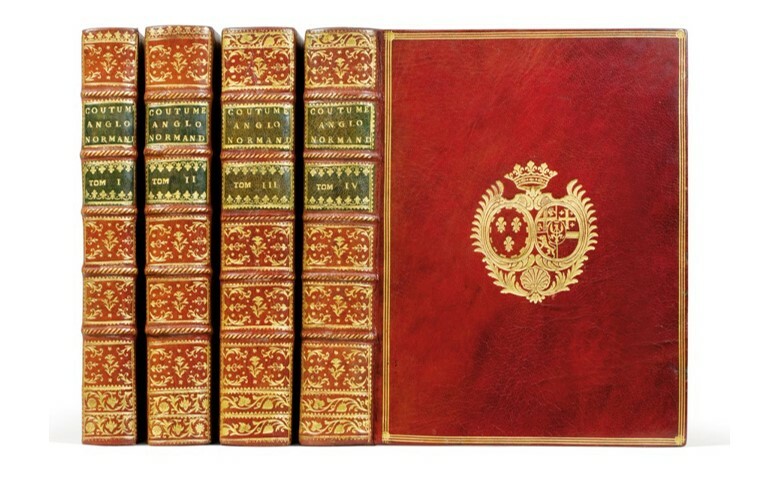
YTB-87Tomes I & II : Paris, Saillant, Nyon & Valade ; & Dieppe, Jean-B-Jos. Dubuc ; tomes III & IV : Rouen, Le Boucher le Jeune ; et Paris, Durand Neveu. 1776. 4 volumes in-4, maroquin rouge, triple filet doré encadrant les plats, armoiries dorées au centre, dos à nefs orné, double filet doré courant sur les coupes, frises dorées sur les chasses, toutes tranches dorées. Reliure de l'époque. 252 x 195 mm. EDITION ORIGINALE TRES RARE. Brunet III, 347 « Ouvrage bien fait et fort curieux ». Né à Dieppe en 1725, le jurisconsulte David Hoüard, avocat au Parlement, célèbre pour ses commentaires sur la coutume de Normandie, ayant par ailleurs reçu le soutien précieux de Bertin dans ses recherches, s’inscrit dans le sillage des recommandations de ce dernier. Hoüard prend en effet part à la quête des érudits qui, tentant de revenir aux racines constitutionnelles de l’Ancien Régime, portent sur l’histoire du droit un regard particulièrement destiné à conforter les étais de la monarchie absolue. David Hoüard prétend en effet dépasser les frontières du duché normand et mettre en exergue les maximes et décisions qui se rapportent « à la jurisprudence universelle du royaume ». Il entreprend donc une modélisation du droit normand qu’il souhaite mettre au service d’une large réflexion sur les mécanismes traditionnels du gouvernement monarchique. La première Normandie peut alors faire office de « champ d’investigations » d’où émergera autant l’exégèse historique du droit provincial que la mise en lumière de l’origine des principes constitutionnels de la monarchie d’Ancien Régime. Son entreprise constitue, dans une certaine mesure, une remise à plat des problématiques touchant au droit primitif. En frontispice, le beau portrait de Louis XVI gravé par N. Le Mire d’après J. Ph. Duplessis, un tableau dépliant hors texte (tome IV). SUPERBE EXEMPLAIRE, A TOUTES MARGES, DE CE TRES RARE OUVRAGE DANS UNE FRAICHE ET SOMPTUEUSE RELIURE DE MAROQUIN AUX ARMES DE LA COMTESSE DE PROVENCE (1753-1810) (Tomes I et II) ET DE LA COMTESSE D’ARTOIS (Tomes III et IV).
1910RO40177536Imprimerie Butty & Cie, Estavayer. 1910. In-8. Broché. Etat d'usage, Plats abîmés, Dos fané, Non coupé. 117 pages. Etiquette de code sur le 1er plat. Tampons et annotation de bibliothèque sur le 1er plat et en page de titre. Dos muet. 1er plat se détachant.. . . . Classification Dewey : 341-Droit international
RO20007242Université de Bordeaux. sans date. In-8. Broché. Bon état, Couv. convenable, Dos satisfaisant, Intérieur frais. 109p. pagination commence à 5.. . . . Classification Dewey : 341-Droit international
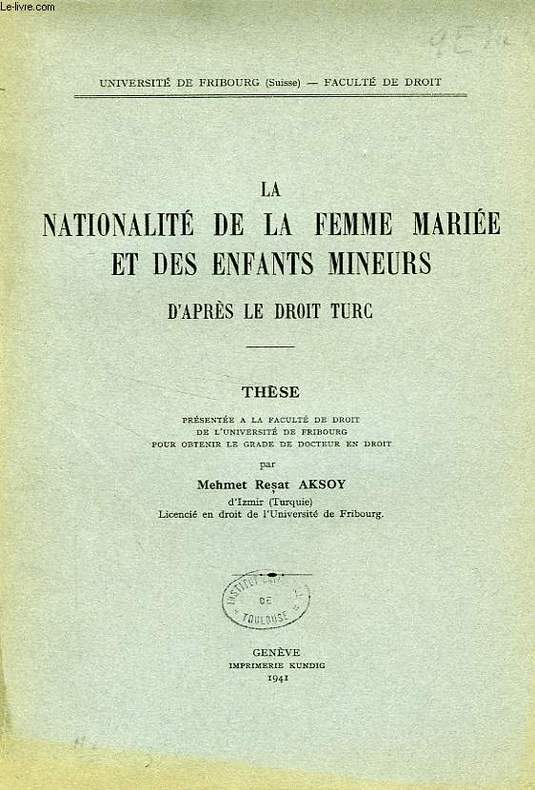
1941RO40169108Imprimerie Kundig, Genève. 1941. In-8. Broché. Bon état, Couv. convenable, Dos satisfaisant, Intérieur frais. 127 pages. Etiquette de code sur le dos. Tampons de bibliothèque sur le 1er plat et en page de titre. Dos muet.. . . . Classification Dewey : 341-Droit international
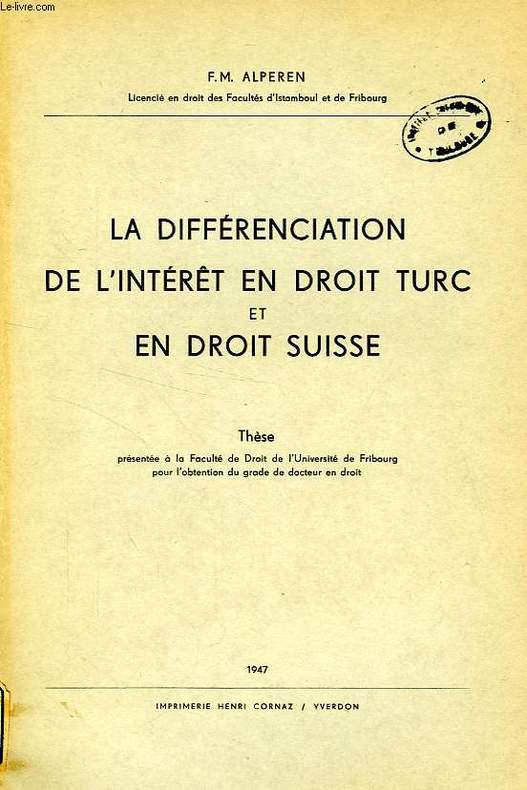
1947RO40166302Imprimerie Henri Cornaz, Yverdon. 1947. In-8. Broché. Bon état, Couv. convenable, Dos satisfaisant, Intérieur frais. 140 pages. Etiquette de code sur le dos. Tampons et annotations de bibliothèque sur le 1er plat et en page de titre.. . . . Classification Dewey : 341-Droit international
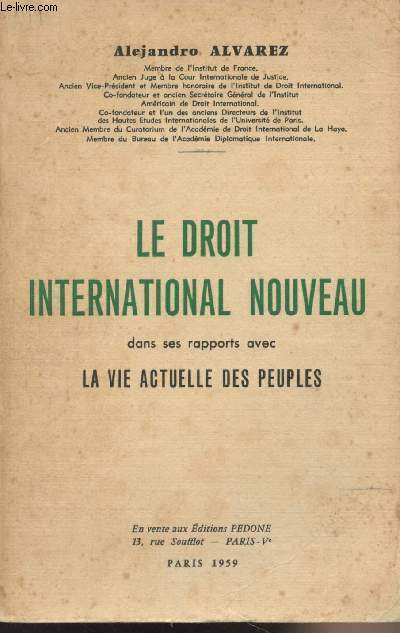
1959R300273354Pedone. 1959. In-8. Broché. Etat d'usage, Couv. légèrement passée, Dos satisfaisant, Intérieur frais. 636 pages. 2e plat légèrement déchiré.. . . . Classification Dewey : 341-Droit international
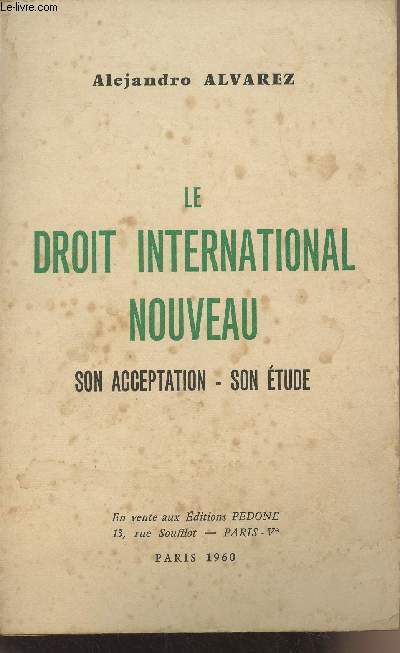
1960R300274603Pédone. 1960. In-8. Broché. Etat d'usage, Tâchée, Dos satisfaisant, Intérieur frais. 127 pages.. . . . Classification Dewey : 341-Droit international
11010Petit in 8 broché, couverture d’attente papier brun. Faux-titre, titre 114 pages, 1 page d’avertissement A la suite Au corps législatif conseil des cinq-cents. 20 pages ; A Paris de l’imprimerie d’Antoine Bailleul An VII de la République ( juillet 1799)
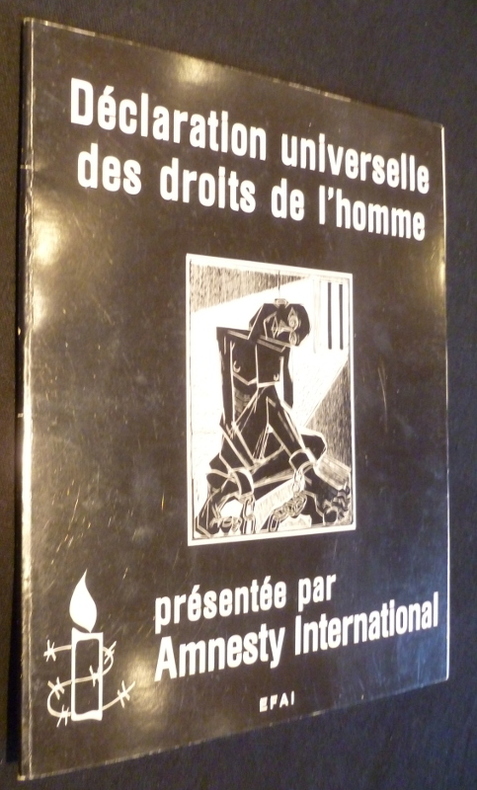
1985za153Editions Francophones d'Amnesty International Album souple 1985 Grand in-8 (21 x 27 cm.), album souple, couverture illustrée à rabats, 63 pages, nombreuses illustrations noir et blanc in-texte (Plantu, Igot, Forcadeu, Bled, etc.) ; plats un peu défraîchis, coiffes légèrement frottées, mors marqués, intérieur frais, bon état. Livraison a domicile (La Poste) ou en Mondial Relay sur simple demande.
74980Strasbourg, Presses Universitaires, 2003. 16 x 24, 623 pp.,broché, très bon état.
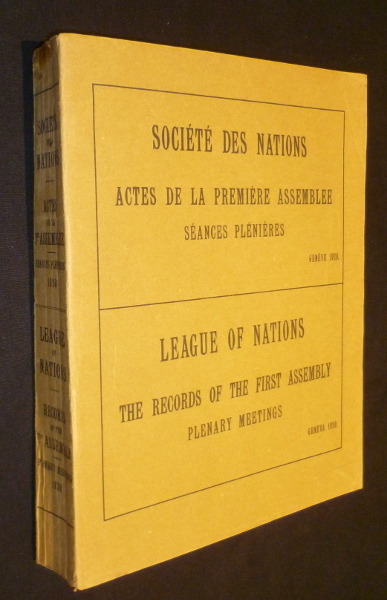
1920gg1138Imprimerie Albert Renaud Broché 1920 Deux massifs volumes in-4 (24 x 29 cm.), brochés, volume 1 : Genève 1920 (771 pages), volume 2 : Genève 1921 (904 pages), texte bilingue français et anglais ; dos plissés et un peu incurvés, coiffes et mors légèrement frottés, menus incidents aux plats, charnières fragilisées, intérieur frais, assez bon état pour cette série de 2 tomes. Livraison a domicile (La Poste) ou en Mondial Relay sur simple demande.
1947RO20202637DALLOZ. 1947. In-8. Broché. Etat d'usage, Couv. convenable, Dos frotté, Intérieur frais. 461 pages - 1 trace de marquer noir sur le 1er plat, page de faux-titre - 1 tampon sur la page de titre et au dos - 2 tampons au dos de la page 461 - 1 etiquette collée au dos.. . . . Classification Dewey : 341-Droit international
1948RO20202670DALLOZ. 1948. In-8. Broché. Etat d'usage, 1er plat abîmé, Dos satisfaisant, Intérieur frais. 620 pages - 1 tampon sur le 1er plat - 1er plat desolidarisé - 1 trace de marquer noir sur la page de faux-titre - 2 tampons sur la page de titre et sur la page 620.. . . . Classification Dewey : 341-Droit international
1929ROD0010470Librairie Dalloz. 1927 et 1929. In-8. Broché. Etat d'usage, Tâchée, Dos plié, Intérieur bon état. 2 tomes. Tome 1 : 303 pp., rousseurs sur couverture, coiffes abîmées ; Les notions fondamentales du Droit internatioanl privé. Tome 2 : 489 pp., forte mouillure sur 1er plat et premiers feuillets, coiffes et mors fendus ; Les personnes, les biens, les actes juridiques et les obligations.. . . . Classification Dewey : 341-Droit international