HAUTEFEUILLE, Laurent - Basile,Livre Rare Book
339 résultats
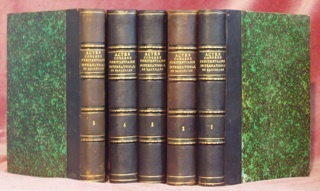
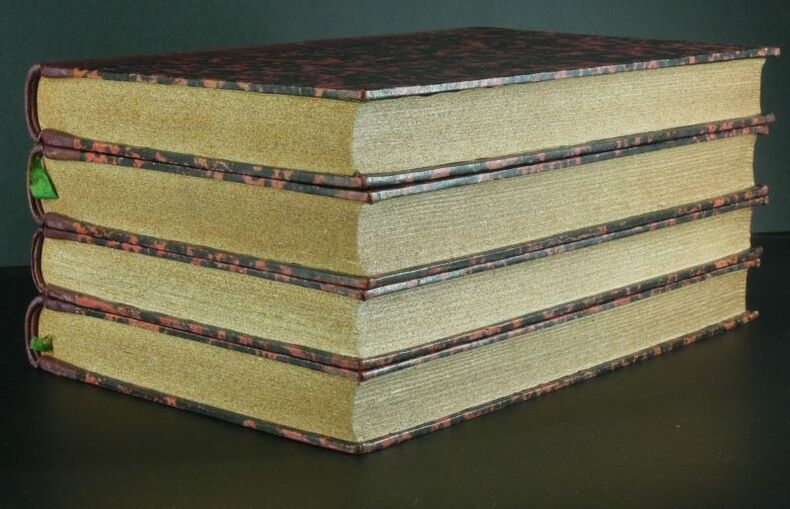
139Paris, Au comptoir des imprimeurs-unis, Comon et Cie, 1848 (tome premier), 1849 (tomes deuxième, troisième et quatrième), 4 vol. in-8° (13,9 x 22 cm). Tome premier : 2 f. de faux-titre et titre, 1-492 p. dont 2 f. de table, cahiers de 8 feuillets signés de 1 à 30, cahier 31 de 6 f.; Tome deuxième : 2 f. de faux-titre et titre, 1-474 p. dont 2 f. de table, cahiers de 8 feuillets signés de 1 à 29, cahier 30 de 5 f ; Tome troisième : 2 f. de faux-titre et titre, 1-528 p. dont 1 f. de table, cahiers de 8 feuillets signés de 1 à 33 ; Tome quatrième : 2 f. de faux-titre et titre, 1-528 p. dont 1 f. de table, cahiers de 8 feuillets signés de 1 à 33. Tomes 1 et 2 : imprimés chez Paul Renouard, rue Garancière, n° 5 ; Tomes 3 et 4 : imprimerie de Crapelet, rue de Vaugirard, n° 9. Edition originale de ce texte fondamental qui a fait l'objet de nombreuses mises à jour (la seconde en 1858, la troisième en 1868 sur un total de 38, la dernière en 2017). Laurent-Basile Hautefeuille (1805-1875), juriste spécialiste du droit maritime international. Ex-libris (ou memo du relieur) sous forme d'un papillon manuscrit inséré entre les pages de faux-titre et de titre, au moment de la couture des feuillets (celui du tome 4 a été déchiré) au nom de Mr P. Devilleneur [?]
17695No place (Bruxelles, Foppens), 1668. (4), 76 pp. 12mo. 19th-century polished calf, spine richly gilt, gilt triple fillet on both sides, all edges gilt. Bourgeois & André 3909; Willems 2040; BMSTC, French Books 1601-1700, L1488. First edition, a very nice copy. The memoirs of Lyonne with annotations by Michel le Tellier, concerning the war of Devolution between France and Spain. The war was ended by the Treaty of Aix-la-Chapelle (or Aachen). At the end a letter of Ernest, landgrave of Hesse, assuring the King of his lasting devotion, and the text of the peace treaty with Portugal (March 1667). - Copy from the library of Jacques Vieillard with bookplate and Bruno Monnier, with bookplate. A very fine copy.
1975R300281389Helbing & Lichtenhahn/Editions S.A. Bâle. 1975. In-8. Relié. Etat d'usage, Couv. convenable, Dos satisfaisant, Quelques rousseurs. XXXVI + 566 + 575 à 1284 + 1285 à 1966 + 1967 à 2531 + 2533 à 2623 pages. Livres en français et en allemand. Texte sur deux colonnes. Jaquettes légèrement passées.. Avec Jaquette. . . Classification Dewey : 341-Droit international
1856RO40238698Cotillon, Libraire du Conseil d'Etat, Paris. 1856. In-4. Broché. Etat d'usage, Couv. légèrement passée, Dos abîmé, Intérieur acceptable. 147 + 244 pages pour le tome I, 647 pages pour le tome II, 586 pages pour le tome III et 619 pages pour le tome IV. Etiquettes de code sur les dos. Tampons de bibliothèque sur les 1ers plats et en pages de titre. Papier muet encollé sur le dos du tome I, le consolidant. Dos du tome II très abîmé, avec plusieurs manques, son 1er plat et ses premiers cahiers se détachant.. . . . Classification Dewey : 341-Droit international
49122Bruxelles - Berne, Bureau de la Commission Pénitentiaire Internationale 1901, 230x155mm, XLIII 2732pages, reliure demi-basane. Belle reliure. Bon état.
16908A Paris, Chez F. Buisson, an IX (1801). 3 volumes. (6), 399, (1) pp.; (4), 404 pp.; (4), 435, (1) pp. 8vo. Contemporary tree calf, spines richly gilt, gilt ornamental fillet on sides, labels with gilt lettering, slightly rubbed and worn, small damage to head of spine of vol. 1. Peloux 224; not in Martin & Walter. Second edition, augmented with a new volume. Roussel was a lawyer who published this material about the secret correspondence of the Comte de Broglie. Interesting because at the time the affairs of Europe were conducted by diplomacy rather than war. The King himself was engaged in a secret correspondence as well. (See: Cobban, A History of Modern France, vol. 1). - An important source for 18th century diplomacy and politics.
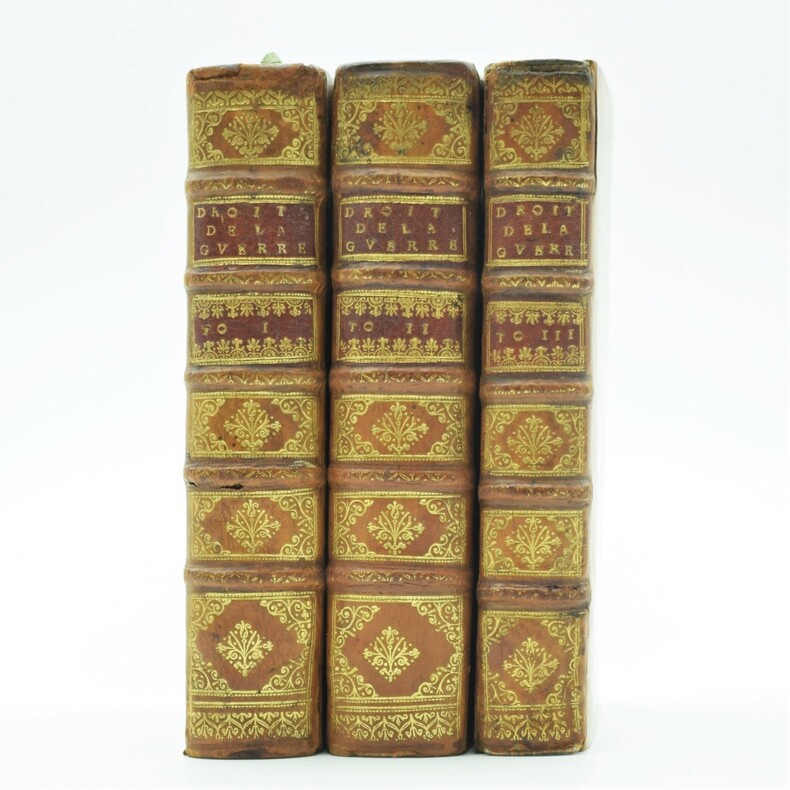
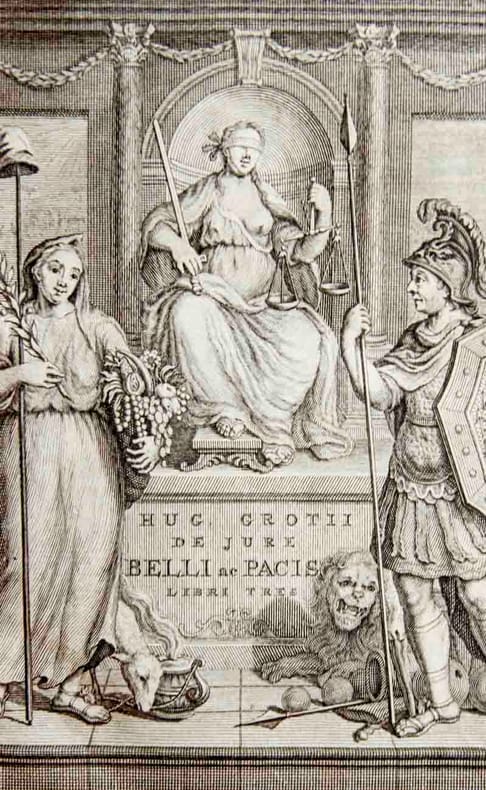
1688UDG-30Amsterdam, Abraham Wolfgang, La Haye, Adrian Moetjens, 1688. 3 volumes in-12. Belle édition en langue française, traduite par De Courtin, de cet ouvrage fondamental pour l'Histoire mondiale des idées. Publié originellement en 1625 et dédié à Louis XIII, ce texte fondamental pose les jalons d'une nouvelle conception du droit naturel et du droit international. Il eut une influence majeure dans la philosophie du droit des siècles suivants, notamment grâce à son principe central et fondateur qui affirme la supériorité d'un droit naturel universel sur toute forme de droit volontaire. L'ouvrage se divise en trois livres, le premier consacré aux définitions de la guerre et de sa licéité ainsi que sur les formes de guerre, le deuxième sur les justes causes de la guerre, traitant de la propriété et des obligations et le troisième visant à former un code de la Guerre. Cette édition parait juste après la première traduction française de 1687. Elle semble être un autre tirage, portant une marque d'imprimeur différente et ne contenant ni portrait ni frontispice, de l'édition que l'on retrouve habituellement en 1688. Reliure plein veau d'époque, dos orné à 5 nerfs, pièces de titre et de tomaison de maroquin rouge. (Reliure frottée, légères taches aux plats, mors légèrement fendus, restauration à une coiffe)
16943A Amsterdam, Chez Meynard Uitwerf, 1748. Titles printed in red and black. With title-vignettes. 2 volumes in 1. (20), 296, (16) pp.; (4), 278, (14), (4, publisher's catalogue) pp. Small 8vo. Contemporary marbled calf, spine gilt with raised bands, gilt letteriing, red edges, slightly worn, corners a bit bumped. Tchémerzine-Scheler, iv, p. 247; Camus 246. This is an unauthorized edition published by the Huguenot Rousset, a stipendiary of the Dutch governement. He added an enormous commentary of his own, highly critical of Mably. Rousset acknowledged the usefulness of the compilation, but constantly castigated its author for his biases against the Dutch and the Austrians. In his eyes Mably was plainly an agent of Versailles, inspired by the raison-d'état principles of Richelieu and Colbert. ' ..... Mably had assembled summaries of the major international treaties and agreements of the past century. This was published, with the explanatory notes, in two volumes in 1746, as Le Droit public de l'Europe, ..... It consists of résumés and citations, together with a considerable explanatory apparatus, of the chief international treaties and agreements among the major European powers, from Westphalia onwards. As such, the first edition of the Droit public is a virtual history of international relations from 1648 to 1740. (......) Mably's handbook was a model of clarity and rational exposition, and it met with instant success, not only in France, but abroad as well' (Johnson Kent Wright, A Classical Republican in Eighteenth-Century France. The Political Thought of Mably, pp. 36-37.) - Margins of first two leaves a bit short.
16926Bound in 1 volume. Folio. Modern boards. Severe condemnation of soldiers for theft and other mischief against civilians. The Carrouge division (suburb of Geneva) belonged to the Army of the Alps. The Army of the Alps was created on 3 October 1793 and was commanded first by Montesquiou and later by Kellerman. It consisted of 20,000 men. The army was united with the Italian forces in 1795.
16907Paris, De l'Imprimerie Royale, 1835-1842. 4 volumes. (8), xcix, (1, blank), 552 pp.; (4), 650 pp.; (4), 714 pp.; (4), 712 pp. 8vo. Contemporary half morocco, spines richly gilt with raised bands, marbled boards, corners (Collection de documents inédits sur l'histoire de France). A. Franklin, Les sources de l'histoire de France, pp. 172-175. First edition. Important and rare work covering the years upto 1679 and dealing with the Spanish successions and the claims of the Bourbons to the trone giving correspondance, memoirs and diplomatic papers, etc. etc.
16840A Paris, Chez Rochette, 1790. With engraved portrait as frontispiece. 155 (misnumbered 157) pp. 8vo. Modern half morroco, spine with raised bands and gilt lettering, top edge gilt, corners. Bougeart, p. 367; Martin & Walter 22850; INED 3053. Second edition, the first being published in 1780 in Neufchâtel at Marat's own expenses. Both Bougeart and Martin & Walter list the edition offered here. According to Cheveremont, in the Index du Bibliophile, the first edition is 'introuvable dans le commerce.' 'Droit criminel. Relation entre la situation économique d'un état et la délinquance. Un chapitre sur les délits contre les moeurs; moyens de prévenir les crimes qui naissent du déréglement social.' (INED). Marat here argues, among other things, that the king is merely the first minister of the law; he speaks only in its name and, should he exceed his legitimate power, may justly be resisted by his people. (See for an analysis: Louis R. Gottschalk, Jean Paul Marat. A Study in Radicalism, pp. 22-24).Jean-Paul Marat (1743-1793), radical, editor, Montagnard deputy to the National Convention. He was one of the foremost radicals of the Revolution, notorious for his denunciations of conspirators, his calls for popular violence, and his advocacy of a dictatorship.Marat's treatise is divided into four parts. The first one, a discussion of the general principles of criminal laws shows him to be a follower of Beccaria, whose treatise Dei delitti e delle Pene (1764) had revolutionized penal law. In the second chapter he classifies crimes and punishments, then considers different forms of proof, and in the fourth and last section presents the rules of judicial procedure. Comparisons with the legal codes of other countries, amongst them Japan and Russia, help to illustrate his enlightened viewpoint. Marat maintains that the rate of delinquency within a society depends on its economic situation. This outline of criminal law was partly incorporated into the penal code adopted by the Emperor Joseph II.
16906A Paris, Chez P.J. Mariette, 1744. 3 volumes. (10), 599, (35) pp.; (10), 656 pp.; (2), 660, (4) pp. 4to. Contemporary speckled calf, spines gilt with raised bands, red labels with gilt lettering, red edges, small damage to top of spine of volume 2. Camus 245; Bourgeois & André 3731. Second or third edition, first published in 1727 and which had one volume only. This is the revised and augmented edition of this rare and important work in international diplomacy and international law. 'Bougeant s'est servi de nombreux documents, en particulier des mémoires du Comte d'Avaux: il cite toujours ses sources en marge, et, pour rendre son ouvrage maniable, il a composé des tables commodes.' (Bourgeois & André). Important work, which, since its publication, formed the basis for many later works on the subject. It was compiled after the memoirs of d'Avaux, who was minister plenipotentiary during the negotiations which led to the Treaty of Münster. - With handwritten ex-libris Bruno Monnier, and his ticket. A very nice copy.
112846aafAmsterdam, Gaspar Fritsch, 1735, gr. in-8vo, Mit gest. Titel u. gest. Portrait-Front. 12 Bl. + XXXIX S. + 2 Bl. + 534 S. + 1 Bl. (Titel zu Teil 2) + S. 539-1040 + 43 S. + 43 Bl. (Index). hs. Besitzverm. a.Vorsatz, 1737 und1844, Prgt. d. Zt. Rotschnitt, schönes Exemplar.
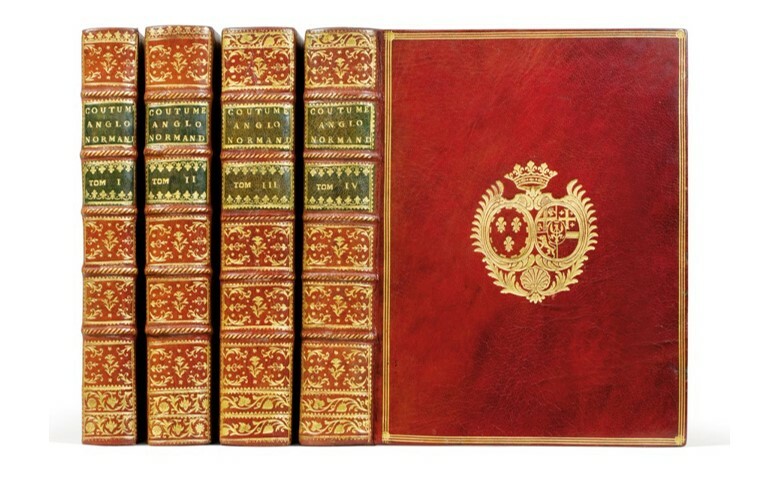
YTB-87Tomes I & II : Paris, Saillant, Nyon & Valade ; & Dieppe, Jean-B-Jos. Dubuc ; tomes III & IV : Rouen, Le Boucher le Jeune ; et Paris, Durand Neveu. 1776. 4 volumes in-4, maroquin rouge, triple filet doré encadrant les plats, armoiries dorées au centre, dos à nefs orné, double filet doré courant sur les coupes, frises dorées sur les chasses, toutes tranches dorées. Reliure de l'époque. 252 x 195 mm. EDITION ORIGINALE TRES RARE. Brunet III, 347 « Ouvrage bien fait et fort curieux ». Né à Dieppe en 1725, le jurisconsulte David Hoüard, avocat au Parlement, célèbre pour ses commentaires sur la coutume de Normandie, ayant par ailleurs reçu le soutien précieux de Bertin dans ses recherches, s’inscrit dans le sillage des recommandations de ce dernier. Hoüard prend en effet part à la quête des érudits qui, tentant de revenir aux racines constitutionnelles de l’Ancien Régime, portent sur l’histoire du droit un regard particulièrement destiné à conforter les étais de la monarchie absolue. David Hoüard prétend en effet dépasser les frontières du duché normand et mettre en exergue les maximes et décisions qui se rapportent « à la jurisprudence universelle du royaume ». Il entreprend donc une modélisation du droit normand qu’il souhaite mettre au service d’une large réflexion sur les mécanismes traditionnels du gouvernement monarchique. La première Normandie peut alors faire office de « champ d’investigations » d’où émergera autant l’exégèse historique du droit provincial que la mise en lumière de l’origine des principes constitutionnels de la monarchie d’Ancien Régime. Son entreprise constitue, dans une certaine mesure, une remise à plat des problématiques touchant au droit primitif. En frontispice, le beau portrait de Louis XVI gravé par N. Le Mire d’après J. Ph. Duplessis, un tableau dépliant hors texte (tome IV). SUPERBE EXEMPLAIRE, A TOUTES MARGES, DE CE TRES RARE OUVRAGE DANS UNE FRAICHE ET SOMPTUEUSE RELIURE DE MAROQUIN AUX ARMES DE LA COMTESSE DE PROVENCE (1753-1810) (Tomes I et II) ET DE LA COMTESSE D’ARTOIS (Tomes III et IV).