267 résultats
1815PHO-2285Москве, году в типографии Селиванова, 1815, (Moscou en 1815 à l'Imprimerie Selivanov), in-8 (22x14cm), portrait-vi-122pp., demi reliure postérieure, manque à la page de titre, écritures sur la page de titre et au dernier feuillet, gribouillage (crayon noir) sur les 2 premières pages de texte. Manques au dos, épidermures, frottements aux plats, coins usés.
1854boz_002274Édouard DROUYN de LHUYS. Lettre autographe signée, 1854 Dimensions : 13,5 x 20,7 cm Nombre de pages : 2 pages
1877boz_002858Édouard Drouyn de Lhuys. Lettre autographe signée, 1877 Lettre autographe signée d'Édouard Drouyn de Lhuys, datée du 30 mars 1877, rédigée à l'encre brune sur un double feuillet de papier vergé. Dimensions : 10,3 x 13,1 cm Nombre de pages : 1 page Édouard Drouyn de Lhuys
18661439(Hamburg, 1866). 14 S. 4to. Interimsumschlag.
187755703[ 1877]. S. [89]-116. Geheftet (Rückenbroschur).
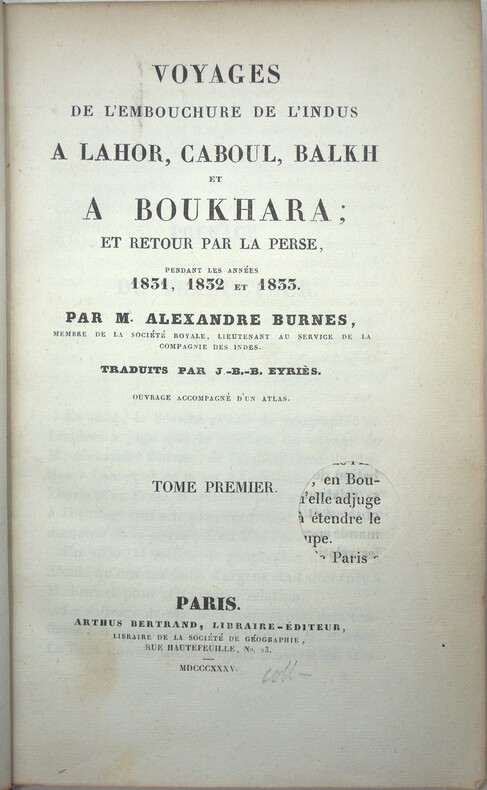
1835PHO-2248Paris, Arthus Bertrand, 1835, 3 volumes de texte in-8 (206 x 130 mm), 2 ff.n.ch., XI, 354 pp.; 2 ff.n.ch., VIII, 375 pp. ; 2 ff.n.ch., 392 pp., sans reliure, cachets retirés aux titres.
1838PHO-1701Paris Ladvocat 1838-1839, 6 volumes, Texte : 5 tomes in-8, 402pp., 396pp., 406pp., 371pp., 384 pp. et l’Atlas in-4 Texte relié, dos lisse avec pièces de titre et tomaison rouge, réf. De biblio. en pied, cachet au titre et étiquettes au faux-titre, frottements, petits manques de papier aux coins. Atlas demi veau, manque au dos, frottements coupes et coins usés comprenant 12 planches et cartes (19), lettre manuscrite au dos du premier plat.
1802PHO-1118Paris, Maradan, 1802. In-8 broché, couv. d'attente (dos et dernier plat manquants).Dernière page salie et volante , une petite déchirure marginale sans manque, coins cornés sinon bon exemplaire en attente de reliure.
189913653Paris Paul Ollendorf 1899 In-8 Fort CI+416 pp, brochage insolé, passé, avec quelques coupures et légers manques ; 1ère de couverture partiellement débrochée.
1858GITj891ENSEMBLES DE 25 LETTRES de divers formats, 6 anglais, 20 en français TOUTES ADRESSEES A L'AMIRAL COMTE LOUIS HENRI DE GUEYDON (1809-1886) alors Commandant de la Station Navale des Antilles et du Mexique, entièrement rédigées et signées par le Commandant et futur Amiral HUGH WALLACE DUNLOP (1806-1887) et le Diplomate et voyageur LEONCE LEVRAUD (1812-v1867) en poste à Caracas. Ces lettres rédigées en marge des dépêches et courriers officiels, ont pour sujet la mise en place d'une stratégie militaire et diplomatique franco-britannique, face aux événements politiques qui secouèrent le Vénézuéla en mars 1858. Alors que le Vénézuéla avait conquis son indépendance en 1831 grâce à une junte militaire conduite par le charismatique Général José Antonio Paëz (1790-1873), des périodes de troubles se succédèrent. Le 23 janvier 1847, le Général José Tadeo Monagas (1784-1868), qui avait combattu aux côtés de Paëz, fut élu Président, malgré une opinion défavorable; Oligarques, Libéraux et Démocrates se disputant le Pouvoir, le gouvernement fut renversé le 15 mars 1858 et Monagas emprisonné. La correspondance que nous proposons retrace les incertitudes engendrées par cet événement, ainsi que les initiatives à prendre par les représentants de la France et de l'Angleterre, en attente des directives de leur gouvernement. D'un côté, le Commandant Dunlop, à bord du HMS Tartar prône une intervention militaire conjointe avec la France (capture des bateaux battants pavillon vénézuélien, blocus, bombardement) pour laver les "insultes faites aux 2 drapeaux" par le nouveau Gouvernement; de l'autre, d'un commun accord, les Chargés d'Affaires Français (Levraud) et britannique (Bingham) se démènent pour obtenir une réparation et la libération de Monagas "homme âgé et malade" sans coup férir ni compromettre la sécurité des résidents étrangers, grâce à la publication d'un Manifeste. BEL ENSEMBLE DE LETTRES DANS UN ETAT DE FRAICHEUR IRREPROCHABLE, bien lisibles, rédigées dans le feu de l'action, révélant bien la personnalité de leurs auteurs: écriture moyenne, rapide, serrée à interlignes étroits, pratiquement sans marges pour le caractère honnête, ferme et déterminé de Dunlop; belle écriture fluide et régulière à marge latérale pour Levraud, homme d'une intelligence affinée par la fréquentation des Salons. BON TEMOIGNAGE rédigé à une époque charnière de l'histoire du Vénézuéla, juste avant que le pays ne bascule dans la terrible Guerre Fédérale, responsable d'au moins 200000 victimes, entre 1859 et 1863.
1860GITh952Paris Dentu 1860. In-8 2 feuillets non chiffrés (faux-titre, titre) 6-32pp. Exemplaire dérelié, solide, frais, complet. Composé par le Duc de Valmy, fils du Maréchal Excelmanns, légitimiste et catholique fervent. Le Duc propose une solution pour régler au mieux le problème de l'indépendance de l'Italie et du Vatican. (4703)
187511937BBBreslau, Joseph Max & Comp., 1875. 54 S. Priv. Broschur.
180143102AB(Wien oder Regensburg?, o. Dr.), 24. März 1801. Mit 1 gef. Tabelle. Kl.-8vo. 24 S. Interims-Broschur der Zeit.
181828411Kopenhagen: Schultz Witwe. 1818. (etwas wellig und knickspurig, minimal braunfleckig) 15 Seiten. Original-Broschur mit papierverstärktem Rücken,
189158711Ohne Ort, ohne Verlag bzw. Drucker, (1891). Fol. 4 Bll., 178 S., HLwd. d. Zt. m. Deckelschild u. dreiseitigem Rotschnitt.
188203423Boston: American Board of Commissioners For Foreign Missions 1882. Hard Cover. Hardcover. Very Good. Book. To Science and Human WellBeing. A hardcover very early edition with lots of black and wie drawings of tribal and groups. An study and account of e US Foreign Missions priort o 1882. Book has some loose pages in center but all present. A very rare 1st edition print. <br/><br/> American Board of Commissioners For Foreign Missions hardcover
186541002LTurin 1865. 8°, 471 S., HPgmt.
186541002LTurin 1865. 8°, 471 S., HPgmt.
1896116203Plon, 1896, in-8°, vii-337 pp, pièces justificatives, broché, qqs rares rousseurs, bon état
188736831887 , Berne, Jent et Reinert, Paris, Lemoigne, 1887, 18,5 x 12 cm, 383 pp., d.-toile brune à coins, BARTH 13860. DHBS IV, 343 : Homme d'état et diplomate éminent.
18954268Paris, Paul Ollendorff, 1895. In-8 (225 x 140 mm.), faux-titre, titre, 336 pp., reliure demi-basane, dos à faux-nerfs, couvertures conservées, fleurons dorés au dos, coins frottés, petit manque à la garde, bel exemplaire.
18841952Calmann-Lévy, 1884, in-8°, 399 pp, reliure demi-chagrin noir, dos à 5 nerfs, titres dorés (rel. de l'époque), ex-libris Bourlon de Rouvre, dos épidermé, sinon bon état
18849996090Calmann Lévy Paris Calmann Lévy 1884/1885, 2 volumes In-8 broché, 399 + 456 pages. Dos du tome II refait au papier collant. Tome I : L'ALLEMAGNE. Tome II : L'ITALIE. Bon état.
1900GITj676Paris Flammarion sans date (1900). In-12 broché XXVIII 338pp. Orné d'un portrait. Rousseurs sur la couverture. Tulard 1408. 1re édition, publiée par Léonce Lex avec des notes. Souvenirs de ce Chambellan de Napoléon 1er, intéressants pour la variété des sujets abordés.
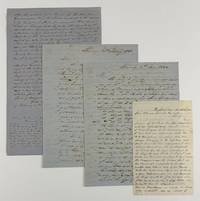
18645296Richmond Va: February 2 1864. Very good. Autograph document signed 1p. folio on blue paper. Old folds minor wear. with: Two autograph letters signed by De Voss Richmond Va. totaling 6pp. and with: Autograph letter signed by William Bradley Assessor Richmond Va. 2pp. Mailing folds minor wear. A collection of manuscript documents and letters pertaining to an interesting diplomatic moment between the Austrian government and the Confederacy in Richmond during the Civil War. Austrian consul Edward William De Voss was based in Richmond during the Civil War. While in Virginia he purchased 612 hogshead of tobacco right at the outbreak of the war in 1861 but was then forbidden to remove it to Austria due to the Union naval blockade. Appeals for relief to Secretary of State William Seward were denied. For a long while the Austrian government in an effort to preserve good relations with the United States accepted Seward's decision without complaint. As a result the Austrian-owned tobacco valued at $252331 sat in storage in Richmond and other locations in Virginia until at least 1864.<br /> <br /> The present manuscript petition dated February 2 1864 is a protest from the Austrian government triggered after the Confederate government apparently forced the Austrian government to pay 8% in taxes on De Voss's tobacco. Here De Voss as an agent for the Austrian government states that they are paying the tax bill "Solemnly protesting against the payment of said tax" and reserve the right to request "repayment or restitution from the said Government of the Confederate States of America of the said tax so paid by us." The sum was not small. At a total value of $252331 the 8% tax totaled $20186.48. The bottom twelve lines of manuscript following De Voss's petition is a statement by a Virginia notary and the bottom of the document is signed by him.<br /> <br /> In addition to the manuscript petition the present group includes two related letters by De Voss and another letter by a tax assessor in Richmond all pertaining to a specific portion of De Voss's tobacco horde. In his first letter dated February 20 1864 De Voss writes to Confederate Treasury Collector William Green about the appraised value of fifty-six hogshead of the aforementioned tobacco "stored near a Rice depot in Prince Edward County." Apparently the Confederate tax assessor had changed the value of this tobacco from just under $10000 to a whopping $24500. De Voss discusses the background of the tobacco's purchase "inspected here in Richmond and purchased by us in the year 1861 during the months of May and August for the account of friends in Europe" the movement of the tobacco to Petersburg for storage and other difficulties and issues relating to the tobacco since then. De Voss informs Green that he also has additional tobacco stored in Richmond Petersburg Dinwiddie County Buckingham County and Nelson County" and expresses surprise at the re-valuation of the tobacco stored in Price Edward County writing that "any dealer or Tobacco shipper will readily testify" in their favor.<br /> <br /> De Voss's second letter was also written to William Green a few weeks later. Here De Voss provides further details about the tobacco stored in Price Edward County stating that it is located "in barns on a plantation near Rice depot under the care of Mr. W.E. Bradshaw." He then provides a detailed breakdown on how much tobacco was stored in each of four warehouses and the value of each portion of each type of "leaf." De Voss then discusses the prospect of moving this tobacco to Richmond commenting that "Tobacco does not improve by keeping and particularly the lower grades which are never judged with the same care as the better descriptions." The letter is followed by a manuscript forwarding note by Green to Confederate tax assessor William Bradley regarding the Austrian tobacco. Green writes that "The Tobacco having been in Price Edward County before the tax act was passed if such was the fact I concur that in applying the Richmond standard of prices allowance should be made for the expense of bringing it again to Richmond."<br /> <br /> The final letter in the present group is Bradley's reply to Green regarding De Voss's tobacco in the "log barns" in Prince Edward County. Bradley confirms some of the information in De Voss's communication regarding the type and quantity of the tobacco and then provides his own "fair evaluation" of the tobacco.<br /> <br /> A fascinating group of manuscripts illustrating the complexity of diplomatic and economic relations during the Civil War with notable information on the value of southern tobacco during the latter period of the conflict. February 2 unknown