VILLEGARDELLE (François).Livre Rare Book
4 561 résultats
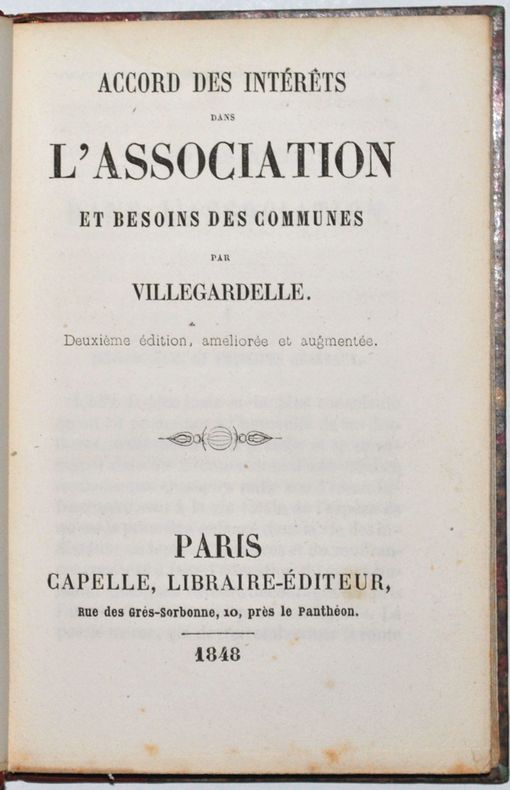
18487455Paris, Capelle, 1848. In-16 de 128-(1) pp., demi-maroquin rouge, dos orné à nerfs (reliure de l'époque).
190043425Société libre d’édition des gens de lettres 1900 In-8, demi-maroquin havane, dos à nerfs, filets bruns, couverture sup. conservée, 305 pp. Illustrations in & hors-texte. Très bel exemplaire.
16985Paris, Pagnerre, 1838. 3 works bound in 1 volume. 114, (2) pp.; 40 pp.; 112, (4) pp. 8vo. Modern half morocco, marbled boards, gilt lettering to spine "Procès Politiques de 1838." 1: Armand Laity was one of Louis-Napoleon Bonaparte's partners in the attempt to raise the garrison at Strasbourg in 1836. In 1838 he published an apologetic account of it and was almost immediately arrested by the government, sentenced to 5 years in prison and one franc fine for every copy printed, in all 10,000 francs.2: Le National was an important revolutionary and republican newspaper of the Restoration, the July Monarchy, and the Second Republic. It was founded by Adolphe Thiers, François-Auguste Mignet and Armand Carrel with the express purpose of overthrowing not merely the Polignac government but the Bourbon dynasty. Le National was among only four newspapers that continued publication despite the July Ordinances.3: Aloysius Huber was a socialist conspirator and member of secret societies during the July Monarchy, and a leader of political clubs during the Second Republic. He was influenced by the theories of the socialist Pierre Leroux and quite active during the 1830 Revolution. Disappointed by the results of the revolution, he joined the Society of the Rights of Man and was sentenced to five years in prison for complicity in the Neuilly plot. Freed by the amnesty of 1837, he left for London but soon returned to Paris and was again put in jail, this time for conspiracy to assassinate the king. - The original covers of the second and third work have been preserved. Nice clean copies.
23200Paris, Edouard Cornély & Cie, éditeurs, 1907. With portrait-frontispiece and 11 plates, 1 facsimile and 2 maps. xl, (2), 688 pp. 8vo. Contemporary half vellum, marbled boards, original covers preserved. Stammhammer, Bibliographie des Sozialismus, iii, p. 272. Original edition. Indispensible source for the study of the Icarian movement. The author made use of the archives of Beluze, today dispersed and even partly lost. The bibliography is the best known and most elaborate. - Wonderful copy: with a handwritten and signed dedication by Prudhommeaux on the half-title and with a coloured portrait of Cabet painted on the spine.
17106Paris, au Comptoir des imprimeurs-unis, 1848. (4), 188 pp. 16mo. Modern half morocco, spine with raised bands and gilt lettering, marbled boards, original covers preserved. DBMOF, iii, pp. 297-298. Second edition, revised and augmented, published in the same year as the first edition. 'Charles Renouvier, Philosophe, né à Montpellier en 1815, mort en 1903. Il s'intéressa de près au développement du saint-simonisme, et le libriarie d'ancien, Michel Bernstein, nous a communiqué les volumes de sa collection du Globe, où se lisaient quelques annotations de sa main' (Maitron). Gaston Richard, in his study La Question sociale et le Mouvement Philosophique au XIXe siècle states however: 'Renouvier avait adhéré dans sa jeunesse à l'école sociétaire de Charles Fourier. Il ne rompit jamais avec elle et tint toujours compte de ses jugements. La Critique philosophique qu'il fonda après 1870 admit des fouriéristes parmi ses collaborateurs, notamment Charles Pellarin'. The first edition of this text, also published in 1848, scandalized people and provoked the resignation of Carnot as minister. Renouvier recommended the abolition of interest on capital by means of credit institutions; to bring commerce and trade under the exclusive control of the government; pleading for progressive taxation aiming at complete equality. On the pages 137-141 of this improved edition, Renouvier explains his tax ideas in mathematical formulae. - A bit spotted and browned, very rare.
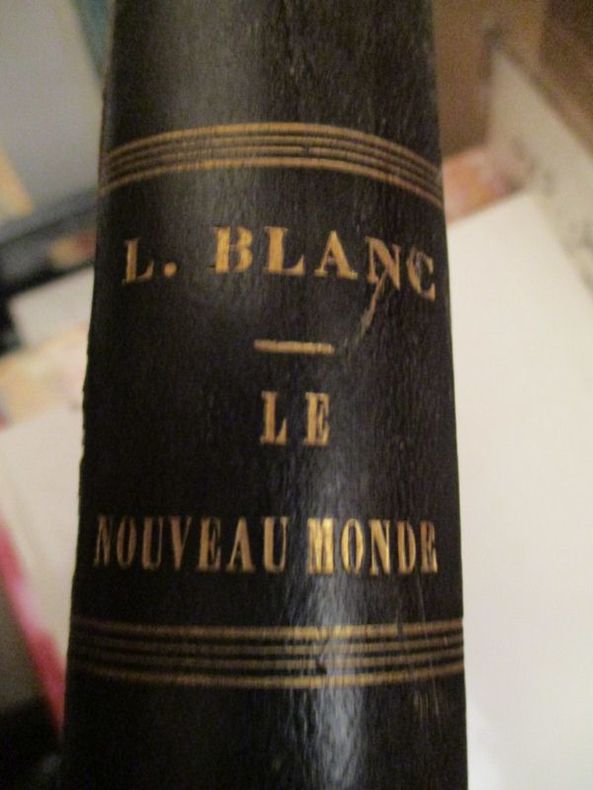
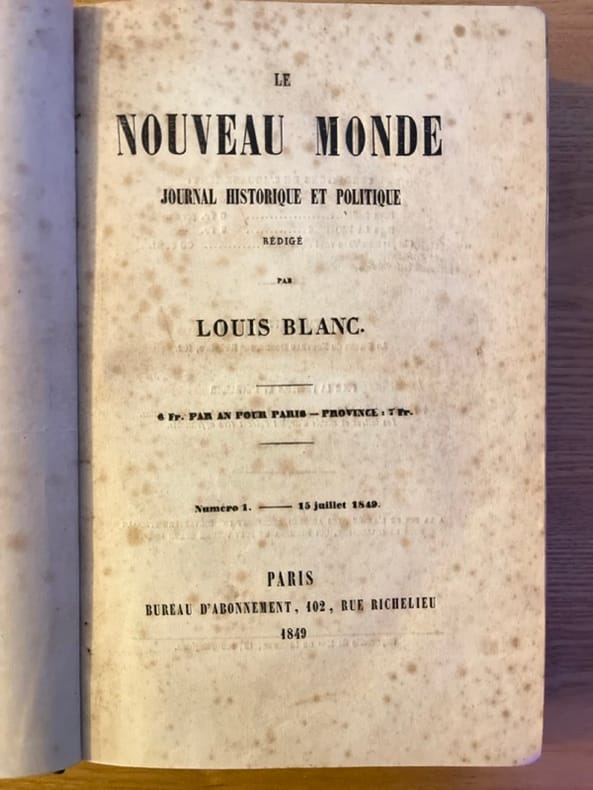
276du numéro 1 ( 15 juillet 1849 ) au numéro 12 ( 15 juin 1850 ) pagination distincte pour les quatre premiers numéros puis suivie petit in 4 relié demi basane 572 pages - quelques mouillures en bas de pages
13039Paris, (Imprimerie de A. Vallée), 8 Mars-11 Mars 1871. 2 numbers of together 48 pp. Small 8vo. Modern cloth, black label with gilt lettering. Del Bo, Comune di Parigi, p. 5; Noël, Dictionnaire de la Commune, p. 199; Le Quillec, 324; Schulkind Commune Collection, p. 28; not in Lemonnyer, Les Journaux de Paris; not in Maillard; not in Drujon. All published. The publication was forbidden after the publication of nr 2 by order of General Vinoy, on March 11, 1871. Grousset founded also the well-known journal L'Affranchi.Paschal Jean François Grousset started as a doctor but became soon involved in politics and journalism opposing the Second Empire. He became director of La Marseillaise in which he launched a campaign against the prince Pierre Bonaparte. He was an active member of the Paris commune, was arrested and deported to Nouvelle-Calédonie from which he managed to escape with Jourde, Rochefort and 4 others: the only succesful escape in the history of the deportations!
13568Jersey, London, 1853-1856 (Paris, EDHIS, 1977). 132 nrs and 2 supplements, in 1 volume. Large folio. Imitation leather. Numbers 1-53 (30 novembre 1853-29 novembre 1854); numbers 1-53 (6 decembre 1854-28 decembre 1855); numbers 107-132 (1 mars 1856-28 aout 1856). The two supplements are to be found after number 45 of the first series and is entitled 'Discours de Victor Hugo prononcé le 27 septembre 1854 sur la tombe du Citoyen Felix Bony, proscrit français, mort a Jersey', the second is to be found after number one of the second series and is entitled 'Discours de Louis Kossuth.' Very well executed reproduction on good paper of the complete text of this famous international journal in a limited edition of 150 copies. The journal was severely prosecuted at the time throughout Europe. The editors were Victor Hugo, Louis Blanc, Felix Pyat, Pierre Leroux, Ledru-Rollin, Victor Schoelcher for the French, Alexander Herzen for the Russians, Dombrowski, Oborski, Zeno Swietoslawski and Worcel for the Polish, Louis Kossuth and Sandor Teleki for the Hungarians, Mazzini, Mazzolini, Aurelio Saffi for the Italians, W.W. Linton and G. Julian Harney for the English, Geurz for the Germans, and other famous collaborators such as Barbès, Jeanne Deroin, Constantin Pecqueur, etc.L'Homme was the first international journal and prosecuted in all European countries, it was created at the moment that almost all democratic and socialist journals had dissappeared in continental Europe. It is an indispensable source for the revolutionary and socialist movements in the 19th century, linking the 1848 revolution to the birth of the Workers' International in 1864, the revolution of September 1870, and the Commune of Paris.
237210Paris, Imprimerie de Mme Lacombe, 1849-1851 18 livraisons en 1 vol. gr. in-8, portrait de Louis Blanc, il manque les pages 41-42 du premier numéro, demi-percaline verte (reliure de l'époque). Plats frottés, coupes et coins très abîmés. Des rousseurs, parfois très fortes. Petites déchirures en marge inférieure de quelques pages, sans atteinte au texte.
18078En France, 1788. 220, (2) pp. 8vo. Modern half red morocco, marbled boards, gilt lettering. INED 4025; Mornet 1363; Le Bucher Bibliographique, 607; Peignot, i, 298; Darnton, The Corpus of Clandestine Literature in France, 1769-1789, 81. One of the two issues of the improved 1788 edition, enlarged with the 'Fragmens politiques', including a.o. 'Réflexions sur les droits des Etats Généraux, relativement à la concession des subsides'; 'De l'autorité des magistrats', etc. The book was first published in 1775 and almost immediately forbidden and suppressed. The work is cited as one of the most radical and serious attempts to maximalize the theory of Rousseau's Contrat Social and stating that nothing supercedes the social contract and the "general will." "Written in response to Chancellor Maupeou's attack on the parlements in 1771, the Catéchisme contained a radical statement of the doctrine of national sovereignty, not simply in the abstract terms of Rousseau's Contrat Social or the more congested historical formulations of the parlementary Maximes du droit public français, upon both of which it drew, but in the more immediate question-and-answer form of a political catechism offering a direct response to a precisely defined act of royal despotism, and culminating in a clear choice between revolution and the destruction of the political order. "Once one has read it, one is not surprised that the partisans of despotism have made such efforts to annihilate it," commented Pidansat de Mairobert in his Mémoires secrets. (...... As a result, copies of the 1775 edition are extremely rare.) Yet the interest of the work remains, not simply because it offered the most radical expression of the principle of national sovereignty, but also because it reappeared in 1787 and went through several editions in 1788 buttressed with additional fragments called forth by the events of the Pre-Revolution" (see: Keith M. Baker, "A classical republican in eighteenth-century Bordeaux: Guillaume-Joseph Saige" in: Inventing the French Revolution, Cambridge, 1990, pp. 128-151). - Slightly stained at blank upper margin throughout.
37103In-8, broché, couverture papier d'origine, pièce de titre imprimée, xij, 158 p. Paris, Louis Colas, Treuttel et Wurtz, 1820.
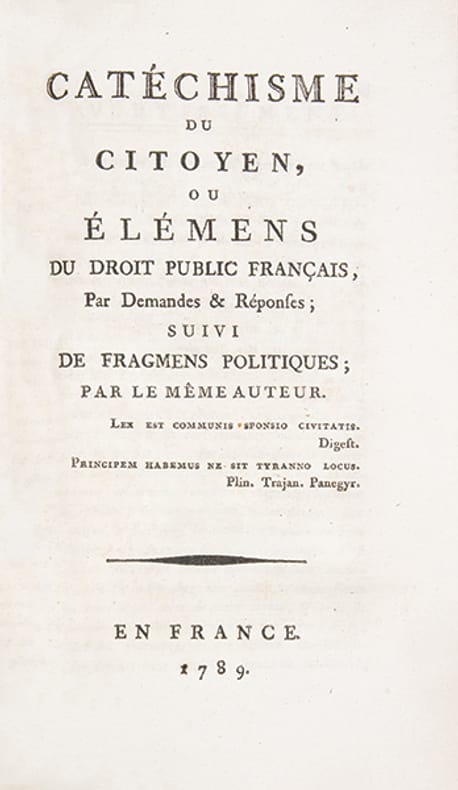
1788391221788 In-8 (193 x 120 mm), plein veau porphyre de l'époque, dos à 5 nerfs guillochés, orné de compartiments fleuronnés et garni d'un fer à l'urne répété, tranches mouchetées bleues, iv, [-5], 159 pages. En France, 1789.
176546404304A Amsterdam, Marc Michel Rey, 1765 ; in-8, basane fauve marbrée, armes dorées sur les plats, dos orné, tranches rouges. (Reliure du XIXe siècle dans un style XVIIIe) VII pp., 312 pp.Ouvrage posthume, publié par le Marquis de Paulmy, le fils de l’auteur. “L’évolution d’Argenson sur la base des principes dont on trouve les prémisses dans cet ouvrage (voir les développements consacrés à Lycurgue) radicalisa sa critique des vices de la propriété individuelle, jusqu’à faire de lui, ainsi que que le conclut Lichtenberger, citant Rathery, “un des grands précurseurs de nos réformes économiques et sociales”. Dans cet ouvrage, d’Argenson cherchait à “établir les principes d’un gouvernement démocratique et municipal. L’édition qui s’introduisait en France était très altérée, le véritable titre étant : Jusqu’où la démocratie peut s’étendre dans un Etat monarchique. On avait dû mettre beaucoup de cartons, et même adouci, le livre était poursuivi” - Belin. Le mouvement philosophique p. 182 - Jammes. Le bûcher bibliographique 481.INED p. 12 “ Sa doctrine économique a de nombreux points communs avec celle des disciples de Quesnay. Si les physiocrates ne reconnurent pas en Argenson un précurseur direct, du moins ils lui adressèrent les mêmes éloges qu’à Gournay”.Barbier 720 se trompe en donnant 1765 comme date de l’originale. Les Considérations ont été publiées pour la première fois en 1764 à Amsterdam chez Marc Michel Rey, le grand éditeur des Lumières. Cette édition de 1765 porte bien son adresse mais il s’agit d’une contrefaçon probablement parisienne. On connaît au moins trois contrefaçons de ce livre célèbre, publiées en 1764 et 1765. Voir Deux siècles de contrefaçon. Dijon, Univ. de Bourgogne et Bibl. municipales, 1987 pp. 26-27Exemplaire relié aux armes et portant l’ex-libris du Comte Balincourt, héritier de la bibliothèque P. Guiraudi (Reinaud et R. de Genas).
230813Paris, chez Langlois et Leclercq, 1847-1862 12 vol. in-8, demi-basane turquoise, dos lisse orné, couv. cons. (reliure de l'époque). Rousseurs. Dos passé.
232662Paris, A. Lacroix et Cie, 1878 15 tomes en 8 vol. in-12, demi-maroquin vert, dos à nerfs, tête dorée (reliure de l'époque). Rousseurs. Dos passé.
168505Paris, Prévot, Rouannet et Chamerot, 1841 in-8, 112 pp., broché. Qqs mouillures et rousseurs.
39519In-12 (178 x 115 mm), cartonnage éditeur polychrome daprès la maquette de Mario Prassinos, 382 p., (1) f. dachevé dimprimer. Paris, Gallimard, 1951.
18443216Paris Librairie de l’École sociétaire 1844 In-8 (22 x 14 cm.), XII-490 pp. demi-reliure chagrin havane, dos à nerfs.
190828102Paris 1908-1912 | 12.50 x 19 cm | 6 volumes reliés
230377Paris, Librairie Phalanstérienne, décembre 1850 in-8, 63 pp., broché. Qqs rousseurs.
238102Paris, Lib. Phalanstérienne, 1848 in-8, VII-264-21 pp. (Doctrine de l'harmonie universelle...), broché. Couverture très abîmée, dos renforcé.
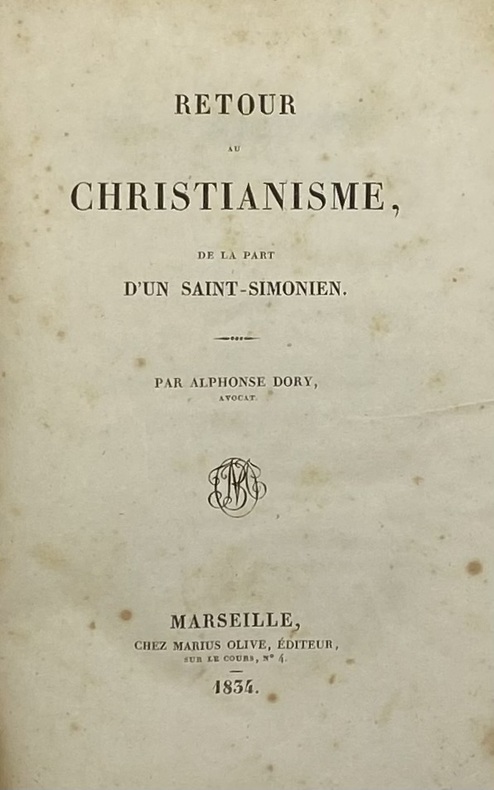
231033Marseille, Marius Olive, Paris, Dentu, Hivert [sur la couverture], 1834 in-8, 382 pp., un f. n. ch. de table, broché sous couverture imprimée. Dos défraîchi. Rousseurs.
1619378781619 Petit in-8, vélin de réemploi, 16 p. S.l. [i.e. Rouen], 1619.
M4500Couverture rigide Edition originale. P, Masson , 1858 , in4° 1/2 basane , XXI -400 pp. Rare édition originale .1 ère partie: Enfantin - A SM Napoléon III , Letrre au DR Guépin, Note A : Cabanis , Note B : Mémoire à l' Académie des Sciences, Note C: Lettre à Duveyrier sur la vie éternelle. - 2 ème partie : St Simon - 1813 - Mémoire sur la science de l' homme. Le travail sur la gravitation , annoncé dans la table des matières n' est pas relié dans le présent ouvrage. Relié avec :ENFANTIN P - LA VIE ETERNELLE . passée - Présente - Future. ,Dentu, 1864 , , 215pp . Quelques épidermurmes sur le dos. Langue: Français
193482880Publication La paix internationale | Paris 1934 | 12 x 19 cm | broché