17 206 résultats
Very Good Turkish Original typewritten proclamation. Folio. (33 x 22,5 cm). In Turkish. 1 p. Stamped by TIP presidency. Declaration on the arrangement against 'Devrim' [i.e. 'Revolution'], the national newspaper of TIP (Turkish Labors Party). Not in OCLC.; Not in IISG (Amsterdam).
Very Good Turkish Original typewritten declaration. Folio. (33 x 25 cm). In Turkish. Folded. 2 p. Sent to Kirklareli branch of TIP. Includes criticism of Mehmet Ali Aybar and his group's separatist movement from party in the rule of Behice Boran, (1910-1987). Boran was a Turkish Marxist politician, author and sociologist. As a dissenting political voice from the left, Boran was repeatedly imprisoned for her work and died in exile after the Turkish military coup of 1980. Boran was born in Bursa to Volga Tatar parents whose families had settled in the Ottoman Empire during the 1890s. She graduated from American College for Girls in Istanbul, Turkey, and studied sociology at the University of Michigan in the United States. She received her PhD on sociology in 1939 from Michigan, and was involved in Marxism. She was nominated to Ankara University, Faculty of Language and History-Geography (AÜ, DTCF) as an associate professor. She also joined the clandestine Communist Party of Turkey (TKP) and began publishing left-wing periodicals, Yurt ve Dünya (English: Motherland and World) and Adimlar (English: Steps), which led to her sacking from the university. In 1950, she led the formation of the Turkish Peacelovers Association, which protested against Turkey's participation the Korean War, which led to her arrest and a sentence of 15 months in prison. Between 1965-69, Boran served as a deputy from the Workers Party of Turkey (TIP) in the Turkish parliament. In 1970, she assumed the leadership of the party. She was arrested after the military coup of 1971 and sentenced to 15 years of imprisonment. After she was released following an amnesty, she re-established the TIP in 1975. After the military coup of 1980, Boran went into exile in Europe, living as a political refugee in Sofia, Brussels and Düsseldorf. In 1987, she announced that TIP and TKP had decided to merge. She died soon after this press conference from heart disease in Brussels, Belgium. She was 77 years old. Her body was brought to Istanbul and her funeral turned into a mass demonstration, the first public show of force of Turkey's left-wing movement after the coup.
Very Good Turkish Original typewritten declaration with autograph signed 'Sait Çiltas'. Folded. Folio. (35 x 23 cm). In Turkish. 1 p. Stamped on verso. [DECLARATION on FACTION ACCUSATION against AYBAR] Türkiye Isçi Partisi Genel Merkezi Sayi: 71/127. Ankara, 12 Subat 1971. Declaration of Anti-Aybar group. A rare faction accusation for Mehmet Ali Aybar and his group. Scarce.
Very Good Turkish Original typewritten declaration. Folio. (33 x 25 cm). In Turkish. Folded. In its original stamped envelope. 2 p. Ismail Nihat Erim, (1912-1980) was a Turkish politician. He was killed in 1980 by DEV-SOL organization. Scarce. Not in IISG.; Not in OCLC.
Very Good Turkish Original wrappers. Cr. 8vo. (20 x 14 cm). In Turkish. 121, [1] p., errata. Rare Turkish edition of selected writings by Mao Zedong in a book form with attractive cover design. His three works collected in one book. This is the first and only translation by Hidayet Onar. "Classes in Chinese society, People's power, and the Chinese Communist Party's working order." A portrait of Mao on the cover.
Very Good Arabic First book of three of the first edition of this early set on Egyptian working class and Arabian labour, printed in Cairo by one of the pioneer intellectual Amin Izz al-Din, (1921-2001). This rare book includes the formative period of the Egyptian working class especially between the years 1882-1919, from the British occupation of Egypt in 1882 which was crystallized many of the economic trends which had been maturing since the era of Muhammad Ali Pasha of Kavala (1769-1849), to Tawra [i.e. The Egyptian Revolution of 1919] which was a countrywide revolution against the British occupation of Egypt and Sudan. It was carried out by Egyptians from different walks of life in the wake of the British-ordered exile of the revolutionary Egyptian Nationalist leader Saad Zaghlul, and other members of the Wafd Party in 1919. Before the Revolution, by 1914 foreign capital represented 70 per cent of the total capital invested in Egypt. According to Izz al-Din, from 1899 to 1903 at least eight workers' associations were formed, mainly under Greek, Italian and Armenian leadership. But the steady expansion of capitalist relations of production in Egypt and the continuing British occupation provided the conditions which soon led to the appearance of native Egyptian working-class organization and leadership. The crash of 1907 produced a sharp rise in the cost of living and provided the economic incentive for another round of working-class struggle. At the same time, the Egyptian national movement was about to assert itself as a significant new political force. The conjuncture of these factors was the basis for sustained struggle and organization of native Egyptian workers. [.] The strike wave led to the formation of new and more soundly organized unions. There were 43 trade unions functioning in 1919-1920: 19 in Cairo, 18 in Alexandria, and 6 in Port Said, Damietta, Damanhour and Mahalla al-Kubra. [.] In the mid-1920s many enterprises fired workers and attempted, with some success, to disregard or revise agreements reached with trade unions in the first years after the 1919 uprising. There were series of strikes in 1927 in response to these actions - the Alexandria Water Company, Alexandria Tram Company, railway porters, silk weavers, Cairo cigarette workers and Suez Canal workers at Port Said. But by 1927 the number of trade unions had dropped to 62 with a total membership of somewhat more than 21,000. (Source: Formation of the Egyptian Working Class / MERIP). Amin Izz al-Din was a thinker and historian of the Egyptian trade union movement and a prominent historian of the Egyptian labour movement. He was one of the most prominent popular and labour leaders, and he has spent his life serving this movement. Izz al-Din held various leadership positions in the interest of workers and social security, as well as political organizations, as he previously worked in the Office of Arab Affairs at the Presidency of the Republic, and contributed to drafting labour legislation in 1970 and laying the foundations on which the Federation of Egyptian Workers was based. Bachelor of Arts from Cairo University, and a Masters degree from Oxford University British Labour Studies: A number of books have been written, foremost of which is "The History of the Egyptian Working Class", in 3 parts. Half leather bound in Egyptian style raised six bands to spine, Arabic lettered gilt in second and fourth. 'Abdelzehar Bnding' stamp on back endpaper. Demy 8vo. (21 x 14 cm). In Arabic. 213, [1] p. OCLC 23517320.
Very Good Turkish Paperback. 12mo. (16 x 12 cm). In Turkish. 54, [2] p., errata. Türkiye Isçi Köylü Partisi. Kurulus bildirisi, tüzük ve program. A rare establishment proclamation, program and regulations. The majority of the founders were people who prosecuted in the case of TIIKP (Türkiye Ihtilâlci Isçi Köylü Partisi -Revolutionary Workers and Peasants Party of Turkey- in the period of March 12 and adopted the views of Mao. Only one copy in OCLC: 255233484 (Universita?ts- und Landesbibliothek Sachsen-Anhalt / Zentrale).
Very Good Turkish Paperback. Cr. 8vo. (20 x 14 cm). In Turkish. 63, [1] p., 3 unnumbered b/w plates. This is one of the early books on May 1 in Turkey printed by the Turkish Revolutionary Workers' Confederation of Trade Unions. Cover art illustrated by Turkish painter Orhan Taylan, (1941-). In the Ottoman Empire, the first celebration of Labour Day was organized in Skopje in 1909. In Istanbul, Labour Day was first celebrated in 1912. No celebrations could be organized between 1928 and 1975. On 1 May 1976 the Confederation of Revolutionary Trade Unions of Turkey (DISK) organized a rally on Taksim Square with mass participation one year ago "Bloody First May" which was an attack on leftist demonstrators on 1 May 1977 (International Workers' Day) in Taksim Square, Istanbul, Turkey. This booklet was printed for the commemoration of this celebration. Orhan Taylan was born in Samsun, to an artist mother in 1941. Graduated from Robert College (1960) and the Fine Arts Academy of Rome (1965). First solo painting exhibition in 1968. Took leading positions in artists' organizations (1975-1978). Organized mural painting symposiums and executed several murals (1976-80). His paintings were exhibited in London, Amsterdam, and Moscow within Turkish Highlights exhibitions between 1988 and 1990. Aside from regular exhibitions in Istanbul and Ankara, his works were also shown in solo gallery exhibitions in Paris, New York, Geneva, and Athens. Orhan Taylan exhibits mainly figurative oil paintings, and occasionally metal sculptures and drawings. Lives and works in Istanbul. During the 1971 Military coup, taken in custody on summer midnight together with his wife and cartoonist Tan Oral. All his archives and hundreds of books destroyed. 1977 Group exhibitions in Paris and Berlin. The May 1 poster wins 1st prize in the International Poster Competition of the World Federation of Trade Unions, Prag. (Source: Turkish Painting - Visual Art Encyclopedia). This is the first appearance of this art before it's winning the prize in 1977. Rare.
Very Good Arabic Half leather bound in Egyptian style raised six bands to spine, Arabic lettered gilt in second and fourth. 'Abdelzehar Binding' stamp on back endpaper. Roy. 8vo. (24 x 17 cm). In Arabic. 179, [1] p. First Arabic edition of Kartun's 'Africa! Africa! A continent rises to its feet' which describes the struggle for freedom in British colonial Africa in the face of horrible pressures. ABOUT THE AUTHOR: Kartun was the improbable combination of a leftist activist, a captain of industry, a Daily Worker journalist and an author of spy thrillers. Kartun was the son of a Russian-French father and a Polish-English mother. He was born into the world of the cultured bourgeoisie, his uncle being the pianist and conductor Léon Kartun. His father had left Paris Conservatoire when he realized that he would not be one of the great violinists of his generation, and went on to become a successful designer and trader of jewelry. He was sent to England for his schooling, first to a prep school in Redhill, where the combination of being bookish, Jewish, and French proved a hindrance to popularity, and then to St Paul's, where he instead flourished and claimed to be the school's first Jewish boy. As what should have been his sixth form years coincided with a temporary reversal of his father's fortunes, and he was set to work in an advertising agency, later on finding himself working a job on writing scripts for B movies for MGM, where he met Claude Cockburn (see separate entry). Becoming a contributor to Cockburn's scurrilous newssheet The Week merely led him into the Communist Party for the next two decades of his life. Bad eyesight confined him to civilian duties during the war but he wrote several books while in the Communist Party, including Tito's plot against Europe: The story of the Raik Conspiracy (1949), This is America (1947), and Africa, Africa! (1954). He became foreign editor of The Daily Worker, writing for the Party on a wide range of allied themes. He contributed a piece on the French political scene in April 1946 for Raji Dutt's Labour Monthly, when he replaced his brother, Clemens Dutt in March 1945 and joined the staff of the Daily Worker for the first time as its European correspondent, based in Paris. He was initially expelled from France by the Ministry of the Interior only a few hours after arriving! Kartun later covered the birth of the state of Israel, being present during the Siege of Jerusalem in April 1948. (Source: Independent - Obituary: Derek Kartun). [FIRST ARABIC EDITION OF 'AFRICA! AFRICA!' BY EDITOR OF THE DAILY WORKER] Ifriqiyah! Ifriqiyah! Qarat taqif ali qidmihâ. [i.e. Africa! Africa! A continent rises to its feet]. Translated by Ahmed Fouad Balbaa; Review by Hassan Lotfi Al-Manfalouti. ???????-??????? ???? ??? ??? ?????? One copy located in OCLC: 949535161 (Fondation du Roi Abdul-Aziz Al Saoud pour les Etudes Islamiques et les Sciences Humaines / King Abdul-Aziz Al Saoud Foundation for Islamic Studies and Human Sciences - Casablanca).
Very Good Turkish Original wrappers. Cr. 8vo. (19 x 13 cm). In Turkish. 305, [1] p., errata. Extremely rare in this condition and in original wrappers. Fading on spine, slight stains on cover. Untrimmed. Otherwise a very good copy. Repaired by tape on the front cover's bottom corner. Yorulmaz's rare first Turkish translation of 'Das Kapital' has been the subject of many 'translation studies'. The most important work in the entrepreneurship of Yorulmaz's left thought repertoire that was published within his cultural series was 'Sermaye [= Das Kapital]'. Published as the 7th book of 'the Capital Culture Series', an abridged translation of Das Kapital by Karl Marx. Yorulmaz wrote about his translation: "I had an experience on these empty days and I am translating and publishing a loyal story of 14 volumes, "Das Kapital", collected by Gabriel Dövil. If this abridged edition is requested, I will finally begin with these 14 volumes, starting in June 1937, and translating four every year." Yorulmaz had translated 'Das Kapital' to Turkish from Gabrielle Deville's French translation which was an abridged edition. According to his comments, the purpose of Yorulmaz was, if this abridged edition is requested or demanded he would translate full text of 'Das Kapital'. However, he couldn't realize this dream. Nevertheless, the effect of the 'Sermaye' in the Turkish leftist thought had been considerable. As "Capital" was the first translation of "Das Kapital" into Turkish, it functioned at that time to fill the gap that existed in terms of socialist thought. He was concerned with knowing Karl Marx's thoughts, and therefore in his preface to 'Sermaye', he described his intellectual approach as "[one] sect which is one of the deepest thoughts and has made the biggest earthquake in the world in social and political life". In his preface, he wrote: "We have nothing but a small realized interference about Karl Marx's study in the law school in Ankara by Cavit Bey and the Turkish attorney Sükrü Kaya Bey, five to ten pages of translations." (Source: Haydar Rifat Yorulmaz'in çevirileri, (1908-1940): Bir sol düsünce 'repertuvari'nin kurulusu, Bilal Çelik). In the preface of the 1888 English Edition of 'Das Kapital', Engels says "I was told that the Armenian translation, which was expected to be published in Istanbul a few months ago, did not see the light of day because the publisher was afraid to release a book bearing the name of Marx, while the translator refused to show it as his own work.". (Das Kapital in Turkey, Savran & Tonak). Haydar Rifat was a Turkish lawyer, intellectual, translator and author. He brought the works of world-famous writers such as Emil Ludwig, Lenin, Gustav, Balzac, Tolstoy, Dostoevsky and Karl Marx into Turkish; he published his translations under the series titled 'Dün ve Yarin Tercüme Külliyati' [i.e. Yesterday and Tomorrow as Translation]. In addition, many articles he wrote in the fields of law and literature appeared in various newspapers and magazines. Not in OCLC.
Very Good Arabic Early Arabic translation and the first Egyptian edition of "Une E?te? africain" novel by Dib, printed in 1959 firstly in French, translated by Egyptian translator Mohammad Bukhârî. An African summer is an early novel about his childhood and youth by Dib and it retains the realistic mode of expression in his description of a people in revolt. Mohammed Dib was an Algerian author, playwriter, and intellectual who was a member of the Generation of '52 - a group of Algerian writers which included Albert Camus and Mouloud Feraoun. In 1959, he was expelled from Algeria by the French authorities for his support for Algerian independence, and also because of the success of his novels (which depicted the reality of life in colonial Algeria for most Algerians). Instead of moving to Cairo as many Algerian nationalists had, he decided to live in France, where he was allowed to stay after various writers (including Camus) lobbied the French government. In contemporary full red imitation leather bdg. Arabic letter gilt on front board. 12mo. (16,5 x 12,5 cm). In Arabic. 172, [4] p., two b/w plates. Chipping on imprint page, overall a very good copy. Copy with no date and press details. First Edition, thus. OCLC 77732316. OCLC shows another Arabic copy printed in "Al-Sûrî" in 196? titled 'Sayf Ifrîqî'.
Very Good Turkish, Ottoman (1500-1928) In modern full leather bdg. Cr. 8vo. (20 x 14 cm). In Ottoman script (Old Turkish with Arabic letters). 49 p. First and only Ottoman Turkish translation from German of this rare book on the description of China by Alfred Forke (1867-1944). Forke was a German sinologist. After studying law at the Universities of Geneva and Berlin, the first state examination in law and a doctorate to become a Dr. jur. in 1889 in Rostock and with a previous linguistic training at the Seminar for Oriental Languages, Forke worked as an interpreter for Chinese in the consulate service in Beijing from 1890 to 1903. In 1903 he succeeded his former teacher Carl Arendt as a professor at the Seminar for Oriental Languages in Berlin. As Otto Franke's successor, he moved to the University of Hamburg in 1923. There he headed the chair dedicated to China until 1935. In 1926 he received an honorary doctorate from the University of Leipzig. Forke's research focus was Chinese philosophy. His three-volume history of Chinese philosophy is considered a "pioneering work". Özege 3356.; TBTK 11000.; Only two institutional copies in OCLC in Turkey: 34010236.
Very Good Turkish Original wrappers. Cr. 8vo. (20 x 14 cm). In Turkish. 185, [4] p. First Turkish translation published in book format of "Guerilla Warfare", written by Mao Zedong and translated with the same subject written by Che Guevara and an American officer. Mao's book contains a summary of knowledge and experience of the guerrilla resistance carried out within the national front established with Chang Kai-shek (1887-1975). Che Guevara's book, on the other hand, explains the technical results of guerrilla resistance, which was the basis of the Cuban War of Independence. The translator of this book, Can Yücel (1926-1999) was a Turkish poet noted for his use of colloquial language. Yücel also translated the works of Shakespeare, Lorca and Brecht into Turkish and his creative rendering of these authors are classics in their own right in Turkey. This book is translated from the original 1961 edition in English by "Cassel and Company Limited", London. Only two institutional copies in OCLC, all of them are in Turkish libraries: 949516672, 1030075606.
Very Good Turkish Original wrappers. Cr. 8vo. (20 x 14 cm). In Turkish. 116, [2] p. First Turkish edition of the book about the intra-party struggle by Mao. Two institutional copies in OCLC 83312365.
194787712S. n. | s.l. (Paris) 1947 | 27.50 x 35 cm | agrafé
Very Good Turkish Original color illustrative label of May 1, 1976 with workers and Turkish Workers' Party emblem. 12,5x10,5 cm. In Turkish.
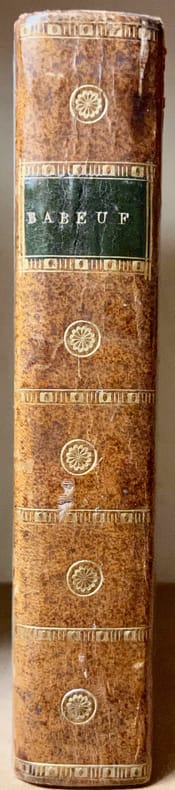
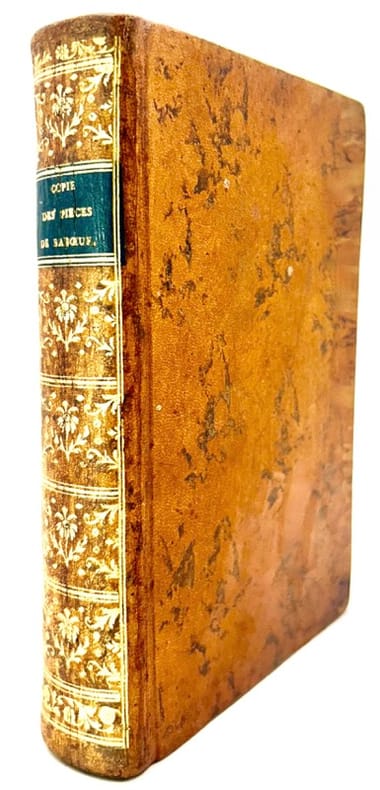
179641857Paris, Imprimerie Nationale, 1796. 2 parties en 1 vol. in-8 de 334-334 pp., basane marbrée, dos lisse orné, pièces de titre en maroquin vert (reliure de l'époque).
179641930Paris, Imprimerie Nationale, 1796. 2 parties en 1 vol. in-8 de 334-334 pp., demi-basane marbrée, dos lisse orné, pièces de titre en maroquin vert (reliure de l'époque).
Very Good Turkish Original wrappers. Newspaper size. In Turkish. The rare issue of the Turkish newspaper "Milliyet", published for Mao's death, one day after his death. The headline reads "Mao is dead: The cause of death of the 82-year-old Chinese leader was not disclosed."
Very Good Turkish Original wrappers. Cr. 8vo. (20 x 14 cm). In Turkish. 71, [1] p. First Turkish translation of selected writings by Mao Zedong about culture, art, and literature. Only one copy in Bogaziçi University Library of Turkey (62711143), no copy except for this one in institutes worldwide.
Very Good Turkish Original periodical. Folio. (42 x 28 cm). In Turkish. 4 p. [MAY 1 COVER] Gida-Is: Türkiye Gida Sanayii Isçileri Sendikasi Yayin Organidir. Year: 2 - No: 8. 21.5.1980. With one of the rare May 1 illustration on cover. Some tears on extremities and folded places. Faded on paper. A fair copy. Extremely rare.
Very Good Turkish Original b/w May 1 poster. Hand-colored. 39x27 cm. In Turkish. 1 p. The poster shows male and female laborers together who hold in their hands May 1 flag, a hammer, and a white dove. It's prepared by Maden-Is Syndicate of Turkey. "Confederation of Progressive Trade UNIONs founded in Istanbul on February 13, 1967. DISK was founded by Kemal Türkler, Riza Kuas, Ibrahim Güzelce, Kemal Nebioglu and Mehmet Alpdündar representing Türkiye Maden-Is, Lastik-Is, Basin-Is, Türkiye Gida-Is, and Türk Maden-Is, respectively. All of these UNIONs were until that time affiliated to Türk-Is, except Gida-Is which was independent.". (Source: DISK: Confederation of Progressive Trade Unions of Turkey).
Very Good Turkish Original b/w May 1 poster and declaration. 28x21 cm. In Turkish. 2 p. [MAY 1 POSTER] "Our power is May 1; our solution is United Labor and Worker Party!". On verso, mentioned IMF, World Bank, TÜSIAD, TISK, TOBB and other elements of imperialism and solutions against them. On behalf the Çalisanlarin Günlügü periodical and United Labor and Worker Party, owner is Ali Firat.
Very Good Turkish Original typewritten declaration. 4to. (30 x 21 cm). With its original stamped envelope. Folded. [NOTIFICATION of TIP on UNIDENTIFIED MURDER of SERAFETTIN ATALAY, (1938-1971)]. Atalay was the president of TIP (TLP) of Amasya city.
Very Good Turkish Original wrappers. Cr. 8vo. (20 x 14 cm). In Turkish. 111 p. First Turkish translation of "On New Democracy" by Mao Zedong, translated from French edition titled "La Democracy nouvelle", examining the way the Chinese revolution should go according to the internal and external conditions of the Chinese society. Mao wrote that the historical course of the Chinese revolution included two phases: the first phase being the democratic revolution and the second one being the socialist revolution, and these phases should follow each other. This theory has been accepted among the Turkish Maoists and constantly expressed and emphasized. Four paper copies in OCLC 943650048, 27993188 (Two are in Turkish institutes, one in International Institute of Social History (IISG) of Netherlands, one in UC Berkeley Libraries of USA).