96 résultats
198081760Moscow: Tushino Machine Building Plant 1980's. Pasteboard box 44cm x 23cm. Name printed in stark black and white onto a stereotypically minimalist Soviet box all the more susrprising considering this is a toy for children. Light inoffensive wear to the extremities a little rubbing and scuffing to the corners clean and complete. The verso of the box lid contains a plan of the contents with item numbers and small illustrations. Inside the box liner is moulded polystyrene with spaces for the individual components ranging from pressed steel baseboards and wall/hull sections to a set of rubber tyres woven string to simulate hawsers and cables pulleys connecting rods all the necessary tools a bag of nuts bolts and other connector pieces; all mass produced in a fashion that would have even a cursory modern day child safety inspection shutting down the whole plant and issuing a warning that if your children get this for Christmas you might need to count their fingers on Boxing Day. Miraculously complete as far as can be ascertained and with very little sign of use including the plans and construction book which is complex enough to count as aggressively educational and has the original warranty sheet with inspection stamps hand stamped and dated 1992 although the slip dates the set to the 1980's laid in. The introduction to the set in the 62 page instruction book states: "The 'Yunost' contruction set is a game designed in 1944 to introduce children aged 10-15 years to the principles of technical design and construction engineering. Each set of the 'Yunost' construction set contains the most intricate parts intnded for assembling models of various mechanisms machines and industrial structures."<br /> <br /> Clearly designed as a controlled Soviet alternative to Western toys like Erector Sets Meccano and the like the principles are identical whilst the delivery is rather more tailored to a deliberately educational USSR approach to entertaining children. "Nothing without purpose" seems to have been the guiding tenet of USSR toy production approaches which became notorious for taking an existing Western temptation like Meccano or Lego or GI-Joe and adapting them to the requirements of collective adherence to the improvement of the USSR. To Western eyes a lot of this material looks like the physical representation of the "We have McDonalds at home." meme but whilst Western toy design was aimed as much at keeping kids quiet and out of the way with a side of education the Soviet philosophy seems to have been 'if a child is building a toy crane then he should be learning the principles of load bearing members understanding pulleys and getting an idea of where crane operators fit into the process of industrial engineering' whilst this approach seems to take some of the joy out of play time it also contributed to the Western paranoia that the USSR was basically a cradle to grave enemy factory. Tushino Machine Building Plant unknown
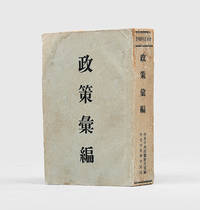
1949183227No stated place: Zhonggong zhongyang huajong ju "Middle China Bureau of the Chinese Communist Party" c.1949. First edition thus number 126 of an unknown internal distribution gathering together documents and speech transcripts issued by central party authorities in the decisive two years of the Chinese civil war. As the communist victory became inevitable the party's focus switched to preparing its burgeoning ranks of cadres for the many challenges of government. This anthology was printed for cadres in the Middle China Bureau which had been founded in 1941 under the leadership of Liu Shaoqi to oversee New Fourth Army operations. In May 1949 the leadership was transferred to Lin Biao Mao's superstar general and future heir apparent. Octavo. Text in Chinese. Original grey wrappers spine and front cover lettered in black. A few reader marks internally. Tidemarks spine worn in places front cover with simple old paper repair on verso foxing and staining internally: very good. unknown
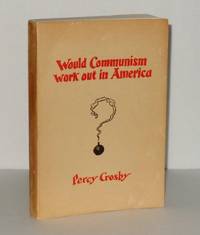
193807785McLean Virginia: Freedom Press 1938. Book. Good. Soft cover. First Edition. Scuffing to covers and creasing to the spine. Binding tight. 316 pages with Appendixes. Crosby was best known for his long-running comic strip Skippy. By the late 1930s the cartoonist/author's political and philosophical leanings had worked their way into the Skippy comics and he wrote scathing editorials against Roosevelt policies though he had earlier voted for him. Alcoholism and tax problems began to destroy his personal life and he spent his last 16 years institutionalized. Crosby has much to say about Roosevelt. Freedom Press Paperback
191917439Chicago: Deutschen Sprachgruppe der Socialist Party of the United States 1919. First American Edition. 12mo 18cm. Printed card wrappers; 127pp. Very mild external wear; faint spotting to a few pages of text; Near Fine in the original wrappers. Probable first printing in America of Trotsky's account of the October revolution. English editions appeared the same year in London and Brooklyn but it is likely that this German-language version translated from the Russian by German-American scholar Jacob Wittmer Hartmann precedes any English edition. Interestingly a German translation had already appeared in Berlin in 1918 but the German-language group of the Socialist Party commissioned this new translation from Hartmann for the American edition. Deutschen Sprachgruppe der Socialist Party of the United States unknown
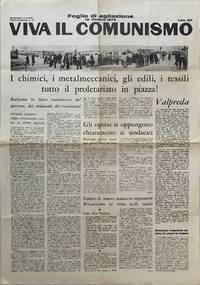
1972238152Roma: Viva il Comunismo 1972. Foglio singolo loose page. Molto buono Very Good. <em><strong>Supplemento al mensile Viva il Comunismo n. 13</strong></em>. Articoli: "I chimici i metalmeccanci gli edili i tessili tutto il proletariato in piazza!"";" Glioperai si oppongono chiaramente ai sindacati"";" "Valpreda"";" "Nelle assemblee chimiche: respingiamo l'accordo"";" etc. In apertura una foto di <strong>Tano D'Amico</strong>. Cm 50x35. pp. 2. Molto buono Very Good. . <em>Il sottotitolo diceva: "Per la costruizione del partito marxista-leninista. Direttore responsabile: Marco Pannella. Il giornale esce nel 1971 per volontà"; del Comitato Comunisti Romani m-l sorto dopo la scissione da Unità Operaia avendo come leaders Augusto Illumintai e Claudio De Tovo. Nonostante le origini trotzkiste Viva il comunismo - con il quale sarà" qausi sempre identificabile anche il gruppo politico - esprime un evidente consenso verso il maoismo utilizzando la fraseologia m-l" da Managno Attilio Le riviste degli anni Settanta.</em> Viva il Comunismo, unknown
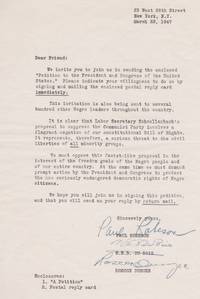
19471474<p>Robeson Paul W.E.B. Du Bois and Roscoe Dungee.</p><p>To the President and Congress of the United States of America Petition and Typed Letter Bearing Signatures of Robeson Du Bois and Dungee. New York: Communist Party USA 1947.</p><p><br />Single-page typed letter and two-page petition printed on rectos only. Each page 8 1/2 x 11 inches 215 x 280 mm.</p><p>A rare typed letter bearing signatures of Paul Robeson W.E.B. Du Bois and Roscoe Dungee asking recipients to sign a petition against banning the Communist Party USA. <strong>We believe the signatures were printed as does an autograph expert we consulted.</strong></p><p>In any case the three African-American leaders sprang into action after President Truman's Labor Secretary Lewis B. Schwellenbach told Congress that the Communist Party should be outlawed. Schwellenbach was concerned about Communist control and infiltration of labor unions and thought no Communist should be allowed to lead a union.</p><p>The letter is dated March 22 1947 and carries the address of 23 West 26th Street New York the Communist Party's headquarters at the time. The letter is aimed at African-American recipients: "This invitation to sign the petition is also being sent to several hundred other Negro leaders throughout the country."</p><p>According to the letter "It is clear that Labor Secretary Schwellenbach's proposal to suppress the Communist Party involves a flagrant negation of our constitutional Bill of Rights. It represents therefore a serious threat to the civil liberties of all minority groups." The authors urge recipients to mail back a postal reply card confirming they would sign the petition. The card is not present probably because it was mailed back to the Communist Party.</p><p>The petition which is also rare is addressed to the President and Congress urging them to reject Schwellenbach's "fascist-like proposal" to ban the Communist Party. The Party was not banned but the government regularly harassed and imprisoned its leaders in the 1940s and '50s.</p><p>Even though we believe the signatures on the letter were printed these materials are nonetheless rare. We have not found any institutional holdings of the letter or petition. None in commerce.</p><p>CONDITION: Pages lightly creased for mailing staple on petition badly rusted. A Very Good set. <strong>RARE</strong>.</p> [Communist Party USA]
19522001West Haven Connecticut: Foundation for Promoting Enduring Peace 1952. No Edition Stated.<br /><br />Single sheet folded to create 4 pages each measuring 11 x 8 1/2 inches 279 x 216 mm. <br /><br />Rare leaflet on U.S.-Soviet relations from a Christian Left perspective. The author pleads for better understanding of Russian history arguing that the country has made great strides since the October Revolution. He also says the Soviets feel encircled by hostile forces pointing to Western military bases along the country's perimeters. <br /><br />The format of this leaflet is a bit odd: the first three pages are professionally printed while the last page appears to be mimeographed. The publisher the Foundation for Promoting Enduring Peace was established in 1952 to promote world peace and oppose military conflict. <br /><br />OCLC shows no institutional holdings although a separate search turns up a copy in the Kringlock Pamphlet Collection of the University of Iowa. Nor were there any copies in commerce as of January 2021. <b>RARE</b>. <br /><br />CONDITION: Some toning along edges general handling wear two horizontal folds perhaps for mailing. A Very Good copy. Foundation for Promoting Enduring Peace
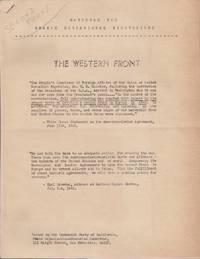
19421279San Francisco: Communist Party of California 1942. No Edition Stated. <br /><br />Seven-page mimeographed document 8 1/2 x 11 inches 217 x 280 mm stapled in top left-hand corner.<p>A "Dear Comrades" letter addressed to all branches of the Communist Party in California Arizona and Nevada urging them to meet and discuss an editorial in the August 1942 issue of the Communist "No Delay in Opening the Western Front." The letter provides reading suggestions from Communist Party publications and suggests that party members bring articles from the non-Communist press that favor a second front against Germany. It further warns that "appeasers" are trying to prevent the opening of a second front and provides counter-arguments to those opposing the second front.<br /></p><p>No institutional copies found in OCLC. None in commerce. <b>RARE.</b><br /></p><p>An interesting look at how the Communist Party sought to mobilize popular support for a second front in Europe.<br /></p><p>CONDITION: Moderate toning to cover page less toning to subsequent pages pencil notation at upper left corner of cover page. Horizontal fold probably for mailing. Light dampstaining. A Very Good copy.<br /></p> Communist Party of California paperback
39London: Victor Gollancz 1935. Hard bound first edition. Very good with some spotting and chips to head of dust jacket spine. Scarce in dust jacket. 355 grams. All books in stock and available for immediate shipment from Winnipeg Manitoba. London: Victor Gollancz, 1935 unknown
199984402New Haven CT: Yale University Press 1999. First American Edition. Octavo. 24cm. Publisher's red cloth spine over black paper covered boards titled and ruled in gilt to spine. Dustjacket. xxvii; 635pp. Very light wear to spine ends; internally clean illustrated throughout; in a clean bright dustjacket. A near fine copy. <br /> <br /> An academic analysis of the depradations of Stalin's ruling party during the pogroms and cleansings in the few years immediately prior to WW2 compiled from previously secret of inaccessible documents and testimonies. Yale University Press unknown
036559427X.Gpaperback. Good. Access codes and supplements are not guaranteed with used items. May be an ex-library book. paperback
1957865<p>New York: Frederick A. Praeger Inc. 1957. First Edition.</p><p>Howard Fast explains his disillusionment and break with the Communist Party.</p><p>Octavo 197 pages hard cover. Near Fine in an unclipped Very Good dust jacket that has a couple of small creases tears and sunning. Overall a beautiful copy. <br /><br /></p> Frederick A. Praeger, Inc. hardcover
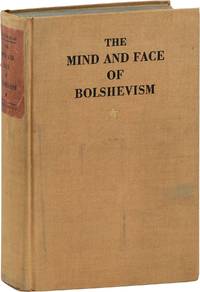
192984083New York: Alfred A. Knopf 1929. Large Paper Edition. Large Octavo. 26.5cm. Publisher's pale orange cloth titled in black and gilt to front board with red paper title label to spine. xvi; 308pp. Scuffing and bumping to extremities the cloth uniformly faded to a pale diluted pinkish orange with some scuffing and soiling darkening to the spine label and some very light marginal chipping; internally clean black topstain fore-edge untrimmed lavishly illustrated throughout in color and black and white. A strong and handsome copy about very good due to solidity and completeness but with cosmetic external wear. <br /> <br /> Significantly taller and more bulky than the trade edition likely a deluxe or large paper edition produced from British sheets the pagination differs considerably from the earlier trade edition with several additional color illustrations for example the "Red Angel of Revolution" color plate is here the recto of the photographic frontis and a rather unusual contemporary small format photograph of Leningrad tipped onto one of the plate pages. The paper title label suggests a slipcase although none is present. Unusual rather than scarce with a pretty solid showing in institutions if none in trade. Alfred A. Knopf unknown
19762090502113718213Not Available 1976. Soft Cover. Fine. The book is in fine condition. Not Available paperback
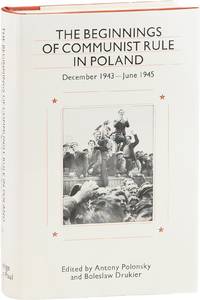
198084959London Boston Henley: Routledge & Kegan Paul 1980. First U.K. Edition. Octavo. 22cm. Publisher's deep red cloth titled in gilt to spine. Dustjacket. 464pp. Clean and bright cloth strong and tight; internally clean and fresh. A near fine copy in dustjacket. <br /> <br /> An examination of the process by which the Soviets laid the groundwork for post war occupation of Poland providing a step by step analysis. The research is assisted by the data found in a number of contemporary Soviet documents which were smuggled into the West in the early-1970's. Routledge & Kegan Paul unknown
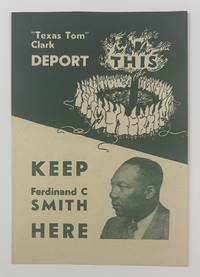
19482875New York: Council of Negro Trade Unionists 1948. Near fine. 4pp. on a single folded sheet. Minimal wear. A rare leaflet issued by the Provisional Harlem Committee to Free Ferdinand C. Smith and the Council of Negro Trade Unionists. Ferdinand C. Smith secretary of the National Maritime Union was instrumental in promoting Black membership in the Negro Trade Unionists. Attorney General Tom C. Clark originally from Texas sought to deport Smith back to Jamaica because of his Communist affiliations and work for civil rights. OCLC reports just a single copy of this work at the University of Kansas. Council of Negro Trade Unionists unknown
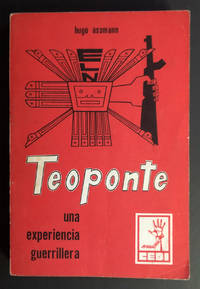
19713912<p>Oruro Bolivia: CEDI 1971. 1st edition. Soft cover. Very Good/No Jacket as issued. VG. 8vo 282pp printed wrappers. Rare original edition of this revolutionary memoir published in Bolivia. In Spanish. Unmarked copy a bit of reading wear.</p> Oruro, Bolivia: CEDI paperback
193535877Wichita Kan.: Defender Publishers. Good with no dust jacket. 1935. Third Edition. Paperback. Photo ; Interesting overview of Stalin. "Stalin's father Vissarion Djugashvili was the only cobbler in Gori. In his youth the father shared the brigand life of the Ossetes who live north of Georgia. He abducted his wife from the Ossetes then left the mountains to settle down in town and resume the trade of his ancestors. " original wraps sometime in the 1930's. Dust stains wear to soine fold toning. Only 3 copies located wolrdwide scarce. Anti-communist. . Defender Publishers paperback
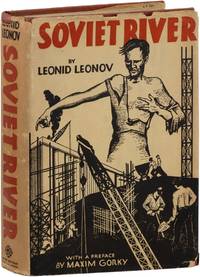
193284363New York: Dial Press; Lincoln Mac Veagh 1932. First American Edition. Octavo. 19.5cm. Original deep red cloth titled in black to spine with embossed publisher's imprint to front board. Dustjacket. 383pp. Bumped to spine ends with some minor wear to corners some minor darkening to the cloth in places; internally clean fore-edge untrimmed top edge a trifle dusty; in the John Gram dustjacket with some toning to the spine panel shallow chipping and loss to the spine ends intruding upon the author's first name and a short closed tear to the front upper front spine hinge. A good strong copy with some wear.<br /> <br /> Leonov's novel of Soviet labor centred around the building of an enormous factory; Sotstroy. Gorky provides the preface; the novel was notable at the time as an antidote to the image of the USSR as an enormous generator of plans progress noble artistic and industrial endeavor and a shining beacon of energy. Leonov tends towards a more on the ground depiction of enthusiastic ineptitude paranoia and fanaticism. Bookplate of Alvin Kapusta to front pastedown a Special Assistant for Soviet Nationalities at the US State Department and a notable scholar of the Soviet Bloc whose collections are housed at the Hoover Institution. Dial Press; Lincoln Mac Veagh unknown
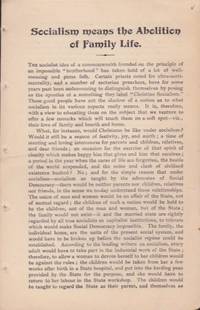
19011202<p>London: Liberty and Property Defence League ca. 1901-05. First Edition. <br /><br />A wonderfully lurid warning against socialism by an organization devoted to laissez-faire economics.</p><p>The anonymous author suggests that socialism would lead to the breakup of families: "There would be no such place as home under socialism. Everyone would live in the State barracks. There would be no breakfasts dinners or teas with one's family at one's own table as in the first place meals in private would not be permitted as it would be against the socialist idea of equality.In other words everybody when hungry would be reduced to the necessity of repairing to the common swine-trough and eating the hogwash the State had placed therein. No roast beef turkey and plum pudding no smiling faces of children and friends around the table on Christmas Day. Indeed there would not be any Christmas Day under socialism."</p><p>This pamphlet carries no publication date but it appears to have been issued sometime between 1901 and 1905. It refers to "the late Mr. Oscar Wilde" who died in late 1900. In 1906 the Liberty and Property Defence League issued a book Socialism: Its Fallacies and Dangers which included the text of this pamphlet.</p><p>OCLC lists 8 institutional holdings under two different accession numbers: Syracuse Stanford Amherst Harvard Texas Wisconsin Historical Society Michigan and the London School of Economics. No other copies in commerce.</p><p>PHYSICAL DETAILS: Single sheet measuring 8 x 5 1/4 inches 205 x 132 mm when folded creating a 4-page unbound pamphlet.</p><p>CONDITION: Paper lightly toned old stab holes along the gutter tiny check mark to front wrapper a couple small closed tears small ink stamp at the end of the text general handling wear. A Very Good copy of an uncommon publication.</p> Liberty and Property Defence League paperback
19091228<p>London: The Fabian Society 1909. First Edition First Printing. <br /><br />Octavo 8 1/2 inches / 21 1/2 cm 23 1 pages in stapled red wrappers. Photographic portrait of Shaw by Marie Leon.</p><p>Pamphlet criticizing the conservative anti-socialist writer and economist W.H. Mallock. According to Shaw Mallock believes that inventors and other people of exceptional ability have no reason to share their earnings with others. Mallock in letters to newspapers reprinted here says he doesn't make any such contention in his writings giving Shaw the opportunity to attack him further. Fabian Tract No. 146. Although this pamphlet has been reprinted several times and in different formats copies of this first edition are uncommon to the market. SCARCE.</p><p>CONDITION: Wrappers are rather brittle and age-toned <strong>front cover detached</strong>. Small split at the head of the spine and several nicks and tears to the covers especially the rear cover. Vertical crease throughout. A Fair copy only. </p> The Fabian Society paperback
1970002392Frankfurt Germany: Posev 1970. Soft cover. Good/No Jacket as Issued. 8vo - over 7¾" - 9¾" tall. Covers lt edgeworn scuffed & lt soiled reading crease on spine. Owner stamp inside front cover. Contents clean in tight binding. Last volume in the 6-vol Collected Works containing letters appeals essays media reports meeting minutes and relevant documents pertaining to Solzhenitsyn's struggle to have his work published in the Soviet Union following his exile. Also some literary criticism. All Russian text. 609 for Posev paperback
194135913Breslau: Gauverlag-Ns-Schlesien. Very Good with no dust jacket. 1941. Presumed 1st. Paperback. Photos; 4124 1 pages; So sa ich moskau so sa ich moskau so sa ich moskau . A notable action in Breslau was Battle of Breslau also known as the Siege of Breslau was a three-month-long siege of the city of Breslau in Lower Silesia Germany now Wroclaw Poland .German language. Includes Ukraine Mongolia Georgia Odessa Kiew etc. . Gauverlag-Ns-Schlesien paperback
191943051New York: Libreria Rossa N.d. ca 1919. First Edition. 12mo 18cm. Staple-bound pamphlet; printed thick paper wrappers; 24pp. Slight aging; mild creasing to spine; Very Good. Text entirely in Italian. Communist tract issued shortly after the Russian revolution calling for an immediate proletarian revolution in Italy with socialization of industry and agriculture; closure of borders to prevent the flight of the bourgeoisie; and the "management of the new society through a free arrangement of persons and competent groups" ".persone e di gruppi competenti interessati all soluzione di ogni singolo problema tecnico e sociale". The pseudonym "Emme" is unknown to us; nor is it certain from which "Libreria Rossa" this pamphlet originated - "libreria rossa" "red bookshop" being a common enough appelation among Italian-American radical booksellers of all political stripes during this period. One copy only in OCLC; not seen in commerce; not in Periconi. Libreria Rossa unknown
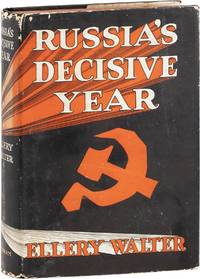
193284963New York: G.P. Putnam's Sons 1932. First American Edition. Octavo. 21cm. Publisher's black cloth titled and decorated in red to spine and front board. Dustjacket. 282pp. A little light wear to extremities minor bumping to spine ends bright and strong; internally clean topstain red fore-edge untrimmed; in a strong example of the dustjacket priceclipped with some soiling to the white portions and some shallow marginal chipping. A very good copy. Signed by the author to the title page. <br /> <br /> Walter's assessment of the Russian experiment as it stood in the early 1930's after he had just been granted unprecedented access to administration and infrastructure during a six month tour of the country. G.P. Putnam's Sons unknown