[Trotzki, Leo]Antiquariat.de

1 184 résultats
19063660St. Petersburg, Tipografija Spb. aki. obschch. "Slovo". Ul. Zukovskago, 21, 1906. (2), 98 SS. Halbleinenband der Zeit, die bedruckte Originalbroschur mitgebunden. 8vo.
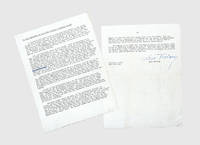
1938167061Coyoacán Mexico: 24 July 1938. A revolutionary party must of necessity base itself on the youth Trotsky writes in English from exile in Mexico to the socialist youth of America stating the importance of young people to a revolutionary party condemning Stalinism and urging them to increase their political experience. From 1937 until his assassination by Stalin's agents in 1940 Trotsky lived in Coyoacán a suburb of Mexico City. He continued a worldwide campaign for his form of Communism remained closely linked to favourable socialist organizations and wrote prolifically. The Young People's Socialist League was the official youth arm of the Socialist Party of America. Unlike the pro-Stalinist Communist Party of America the Socialist Party took a more pro-Trotsky line and the then-leader of the league Ray Sparrow was linked to the American Committee for the defence of Leon Trotsky. Trotsky writes: "the revolutionary character of a party can be judged in the first instance by its capacity to attract to its banner the working class youth. The basic attribute of socialist youth - and I have in mind the genuine youth and not old men at twenty - lies in its readiness to give itself fully and completely to the cause of socialism". While they must give themselves fully to the cause he urges them to avoid doctrinaire stubbornness and the repetition of formulas. This leads to "sectarianism and pedantic phrase-mongering" which impedes fighting the main enemy within the movement: "opportunism especially its most viscous and malignant form - Stalinism that syphilis of the working class movement". He hopes the league's conference "will become an important stage on the road of acquiring political experience on the granite basis of Marxist program". The article was published in Trotsky's Collected Writings 1937-38 in 1970. Trotsky makes an emendation on the typescript removing two words which was not made in the published writings. Two leaves 281 x 215 mm 582 words typed one side only signed in blue ink. Old fold lines a little toned and creased a few nicks at extremities. In very good condition. unknown
1937015339Doubleday Doran & Co. Signed by Author. Stated First Edition. Signed by the author on the third free end page dated 1937 & he gives his location given in blue ink in Coyoacan Mexico where he lived with Diego Rivera and Frida Kahlo and where he was assassinated by the KGB. This book has been rebound in black buckram. There is a very slight dampstaining on the second free end page which does not impact or harm the signature at all. A very scarce autograph. No DJ. In archival cover. . Near Fine. Hardcover. 1st Edition. 1937. Doubleday, Doran, & Co. hardcover
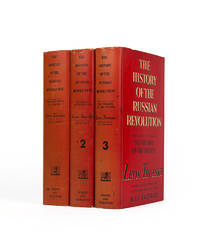
122766New York Simon and Schuster 1932. . First edition in English first impressions; 3 vols; 8vo 24 x 16.5 cm; black & white photographic plates advertisement slip for vol. II loose to vol. I old bookseller's ticket for 'Zeitlin Books' to rear pastedown of each vol. slight offsetting to endpapers a little spotting to pastedowns of vols II & III otherwise internally clean; publisher's oatmeal cloth lettered in red to upper covers and spines in the rare unclipped typographic dustjackets lettered in oatmeal and black on a red ground spines very slightly sunned and a little chipped and frayed at head old foldline diagonal across upper cover of vol. I top-edges stained red overall a bright and vibrant set; xxii 522; xv 1 271 1; 6 474pp.<br /> The first edition in English of Leon Trotsky's History of the Russian Revolution. Very rare in the original bright red dustjackets.<br /> New York, Simon and Schuster, 1932. hardcover
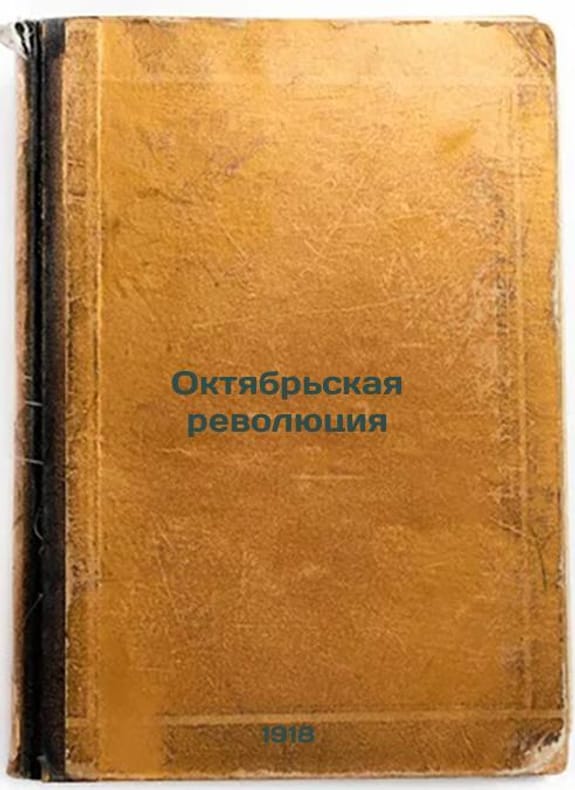
9175495"Short description: In Russian. Trotsky, Lev Davidovich. October Revolution. Moscow; Petrograd: Communist, 1918. You are welcome to reach out to us for a detailed description of the copies currently available. Delivery of this book may take longer than usual including extended processing and pre-shipping time, no expedited shipping is available. Please advise us if you have a set date or a deadline to receive your order.SKU9175495"
9175495Short description: In Russian. Trotsky Lev Davidovich. October Revolution. Moscow; Petrograd: Communist 1918. The image is provided for reference only. It may reflect condition of one of the available copies or only help in identifying the edition. Please feel free to contact us for a detailed description of the copies available. SKU9175495 unknown
1965mon0000121044University of Michigan Press 1965-01-01. Paperback. Acceptable. 0.5512 in x 8.5433 in x 5.5906 in. Pages clean binding sound. Good reading or working copy. Bent corner to back few pages. Mild shelf wear and aging to cover. Former owner's name on first page. University of Michigan Press paperback
193697388New York: Pioneer Publishers 1936. First edition of this collection of writings and speeches by Trotsky. Octavo original cloth. Presentation copy inscribed by the author on the front free endpaper in the year of publication "To Comrade Max Sterling fraternally Leon Trotsky 8/7 1936 Weksel Norway." After being exiled from the Soviet Union Trotsky lived in a number of places Norway among them. The Norwegian Labor Party which rose to power in 1935 had had previous affiliations with the Communist International and the Second International prompting Trotsky to seek and obtain a visa from Oslo. Bookplate to the front pastedown very good in a very good dust jacket. Translated by John G. Wright. With an introduction and explanatory notes by Max Shachtman. Uncommon signed and inscribed. Written in 1928 this is Trotsky's alternative to Stalin's course toward gutting the revolutionary program of the Communist International. "An international communist program is in no case the sum total of national programs or an amalgam of their common features" Trotsky wrote. "In the present epoch to a much larger extent than in the past the national orientation of the proletariat must and can flow only from a world orientation and not vice versa." Suppressed by Stalin in the Soviet Union its publication elsewhere in the world helped gather the forces that continued the fight to build a revolutionary international movement of the working class. Pioneer Publishers hardcover books
193697388New York: Pioneer Publishers 1936. First edition of this collection of writings and speeches by Trotsky. Octavo original cloth. Presentation copy inscribed by the author on the front free endpaper in the year of publication "To Comrade Max Sterling fraternally Leon Trotsky 8/7 1936 Weksel Norway." After being exiled from the Soviet Union Trotsky lived in a number of places Norway among them. The Norwegian Labor Party which rose to power in 1935 had had previous affiliations with the Communist International and the Second International prompting Trotsky to seek and obtain a visa from Oslo. Bookplate to the front pastedown very good in a very good dust jacket. Translated by John G. Wright. With an introduction and explanatory notes by Max Shachtman. Uncommon signed and inscribed. Written in 1928 this is Trotsky's alternative to Stalin's course toward gutting the revolutionary program of the Communist International. "An international communist program is in no case the sum total of national programs or an amalgam of their common features" Trotsky wrote. "In the present epoch to a much larger extent than in the past the national orientation of the proletariat must and can flow only from a world orientation and not vice versa." Suppressed by Stalin in the Soviet Union its publication elsewhere in the world helped gather the forces that continued the fight to build a revolutionary international movement of the working class. Pioneer Publishers hardcover
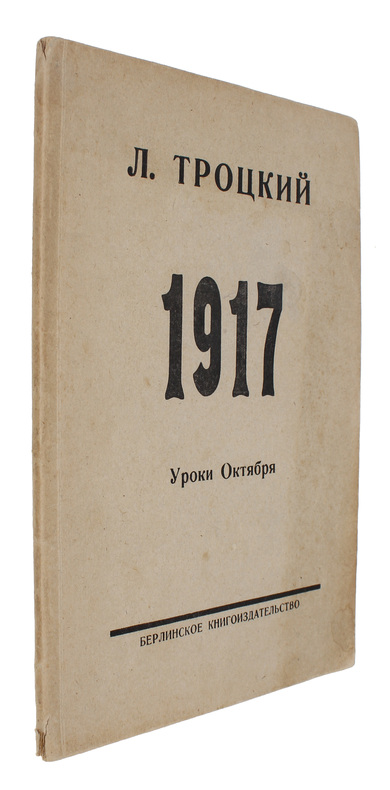
192458185(Berlin, 1924). Original printed wrappers. A bit of browning to wrappers and a bit loose at the inner hinges. But overall in very nice condition. 59pp.
192458185Berlin 1924. Original printed wrappers. A bit of browning to wrappers and a bit loose at the inner hinges. But overall in very nice condition. 59pp. <br/><br/><em>First edition in the extremely scarce separate off-print of this seminal essay which appeared in October 1924 as the preface to the third volume of Trotsky's collected works. The essay now counts as a work in its own and was subsequently reprinted numerous times on its own by the Trotskyist movement. This seminal essay came to play a defining role in the development of post-Lenin politics in Russia. It was extremely critical of the purported revolutionary failings of two key members of the collective leadership that ruled Soviet Russia in the months after Lenin's death Grigory Zinoviev and Lev Kamenev and Trotsky was seen as main threat to the accession of power. The publication of his foundational essay on the October Revolution was used as a pretext for the Soviet leadership to isolate and attack Trotsky. It now constitutes a cornerstone of post-Revolutionaly Russian politics. "When Lenin was stricken with his first cerebral hemorrhage in May 1922 the question of eventual succession to the leadership of Russia became urgent. Trotsky owing to his record and his charismatic qualities was the obvious candidate in the eyes of the party rank and file but jealousy among his colleagues on the Politburo prompted them to combine against him. As an alternative the Politburo supported the informal leadership of the troika composed of Grigory Zinovyev Lev Kamenev and Stalin.In the winter of 1922-23 Lenin recovered partially and turned to Trotsky for assistance in correcting the errors of the troika particularly in foreign trade policy the handling of the national minorities and reform of the bureaucracy. In December 1922 warning in his then secret "Testament" of the danger of a split between Trotsky and Stalin Lenin characterized Trotsky as a man of "exceptional abilities" but "too far-reaching self-confidence and a disposition to be too much attracted by the purely administrative side of affairs." Just before he was silenced by a final stroke in March 1923 Lenin invited Trotsky to open an attack on Stalin but Trotsky chose to bide his time possibly contemplating an alliance against Zinovyev. Stalin moved rapidly to consolidate his hold on the Central Committee at the 12th Party Congress in April 1923.By fall alarmed by inroads of the secret police among party members and efforts to weaken his control of the war commissariat Trotsky decided to strike out against the party leadership. In October he addressed a wide-ranging critique to the Central Committee stressing especially the violation of democracy in the party and the failure to develop adequate economic planning. Reforms were promised and Trotsky responded with an open letter detailing the direction they should take. This however served only as the signal for a massive propaganda counterattack against Trotsky and his supporters on grounds of factionalism and opportunism. At this critical moment Trotsky fell ill of an undiagnosed fever and could take no personal part in the struggle. Because of Stalin's organizational controls the party leadership easily won and the "New Course" controversy was terminated at the 13th Party Conference in January 1924 the first substantially stage-managed party assembly with the condemnation of the Trotskyist opposition as a Menshevik-like illegal factional deviation. Lenin's death a week later only confirmed Trotsky's isolation. Convalescing on the Black Sea coast Trotsky was deceived about the date of the funeral failed to return to Moscow and left the scene to Stalin. His eulogy for the late party leader was in effect delivered in a biography of Lenin that Trotsky wrote for the 13th edition 1926 of the Encyclopædia Britannica.Attacks on Trotsky did not cease. When the 13th Party Congress in May 1924 repeated the denunciations of his violations of party discipline Trotsky vainly professed his belief in the omnipotence of the party. The following fall he took a different tack in his essay "The Lessons of October 1917" linking the opposition of Zinovyev and Kamenev to the October Revolution with the failure of the Soviet-inspired German communist uprising in 1923. The party leadership replied with a wave of denunciation counterposing Trotskyism to Leninism denigrating Trotsky's role in the Revolution and denouncing the theory of permanent revolution as a Menshevik heresy. In January 1925 Trotsky was removed from the war commissariat." Encycl. Britt. </em> unknown
193678255Paris: Grasset 1936. Fine. Grasset Paris 1936 11.50 x 18.50 cm relié First edition of the French translation by Victor Serge one of 26 numbered copies on deluxe paper the only large-paper issue. Half red morocco binding spine with five raised bands grey paper endpapers and boards original wrappers and spine preserved top edge gilt signed binding by Goy & Vilaine. Born in Belgium to anti-tsarist émigré parents Victor Serge became politically engaged from the age of fifteen militating within the ranks of the Young Socialist Guard. An antimilitarist and libertarian he took part in numerous anarchist demonstrations and was sentenced for having sheltered members of the Bonnot Gang. In 1919 he placed himself at the service of the revolution and became a member of the Russian Communist Party before strongly condemning the Stalinist degeneration of the Soviet state. Expelled from the Party and stripped of his Soviet nationality he was ultimately banished from the U.S.S.R. in 1936 a few months before the first Moscow Trial. Close to Leon Trotsky he translated several of his works before distancing himself from him judging his ideology to be overly sectarian. A rare and very fine copy of this essay written by Trotsky during his exile in Norway which would not be published in the U.S.S.R. until 1991. Grasset hardcover
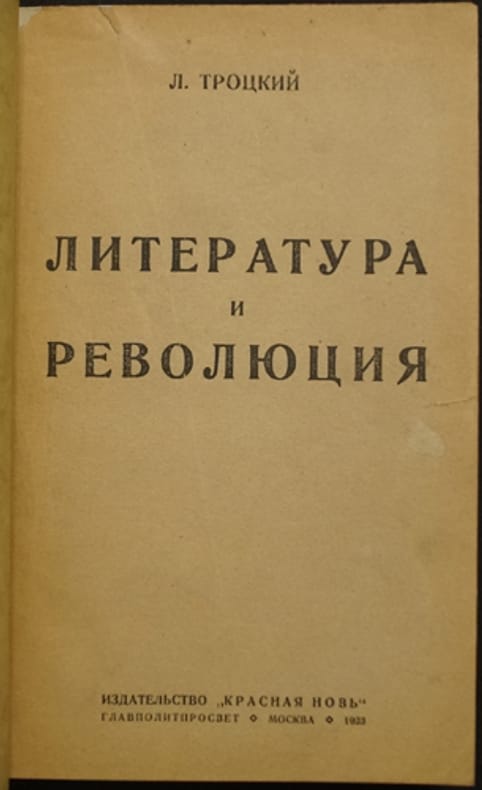
9175467Short description: In Russian. Trotsky, Lev Davidovich. Literature and Revolution. Moscow: Red Again: Glavpolitik, 1923. You are welcome to reach out to us for a detailed description of the copies currently available. Delivery of this book may take longer than usual including extended processing and pre-shipping time, no expedited shipping is available. Please advise us if you have a set date or a deadline to receive your order.SKU9175467
9175467Short description: In Russian. Trotsky Lev Davidovich. Literature and Revolution. Moscow: Red Again: Glavpolitik 1923. The image is provided for reference only. It may reflect condition of one of the available copies or only help in identifying the edition. Please feel free to contact us for a detailed description of the copies available. SKU9175467 unknown
1930469117Berlin: Granit 1930. Hardcover. Very Good. First edition. Text in Russian. Two volumes. 12mos. Bound in red cloth over boards without the wrappers gilt spines. The text pages are modestly toned vol. 1 has a few light marginal check marks in pencil vol. 2 has one small quarter-inch line of worming at the back upper right corner and is slightly cocked very good overall. The rare first edition of Trotsky’s now classic autobiography My Life: An Attempt at an Autobiography. Written and published in the first year of Trotsky’s exile it covers both revolutions of 1905 and 1917 the Russian Civil War and the beginning of his epic conflict with Stalin. A plain attractive set appropriately bound in red cloth boards. Granit] hardcover
19231<p>The unfindable first edition of one of the most important books of Leon Trotsky Lev Davydovich Bronstein 1879-1940 in which one of the main architects of the Russian revolution and Stalin´s principal opposite desploys his literary theories and performs a crytical analysis of the cultural panorama of the early USSR. The entire run of the book has been destroyed during the anti-Trotskyist campaign. The possession was punishable during the Soviet period. This is one of the scarce surviving copies in a near flawless condition. Conserves the original editor´s full-cloth binding.</p><p>392 pages.</p> Krasnaya Nov hardcover
1937015351Doubleday Doran & Co. Stated First Edition. Unclipped DJ in archival cover edge wear small chips. . Fine. Hardcover. 1st Edition. 1937. Doubleday, Doran, & Co. hardcover
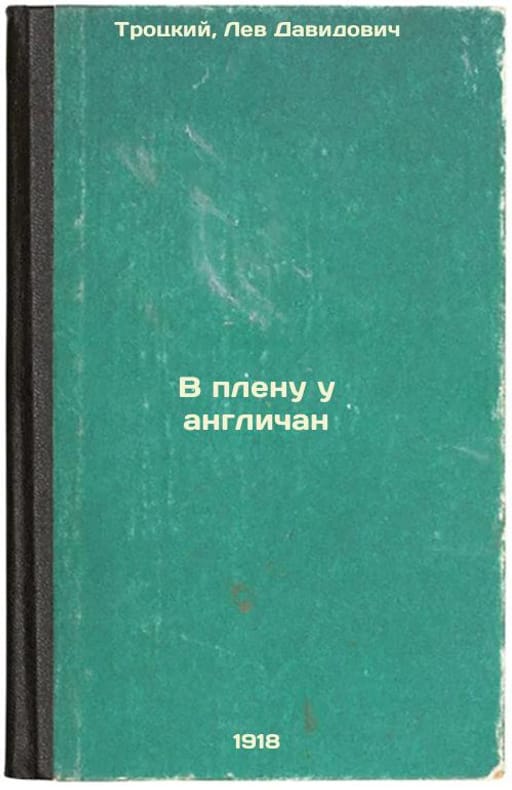
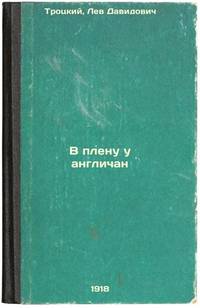
9175417Short description: In Russian. Trotsky, Lev Davidovich. In captivity with the British. Moscow: All-Central Executive Committee, 1918. You are welcome to reach out to us for a detailed description of the copies currently available. Delivery of this book may take longer than usual including extended processing and pre-shipping time, no expedited shipping is available. Please advise us if you have a set date or a deadline to receive your order.SKU9175417
9175417Short description: In Russian. Trotsky Lev Davidovich. In captivity with the British. Moscow: All-Central Executive Committee 1918. The image is provided for reference only. It may reflect condition of one of the available copies or only help in identifying the edition. Please feel free to contact us for a detailed description of the copies available. SKU9175417 unknown
196751312160006Sphere Books 1967. Paperback. Very Good. Very good SET OF 3 paperbacks. in slipcase. Pages are clean and unmarked. Covers show minor shelf wear. 2 books have minor corner bump/bend. Slipcase shows light edge wear with rubbing.; 100% Satisfaction Guaranteed! Ships same or next business day! Sphere Books paperback
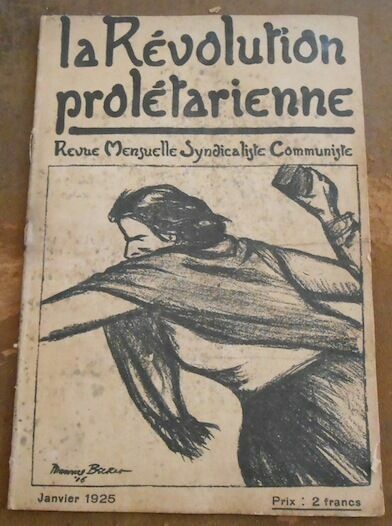
1925124121925. Paris La Révolution Prolétarienne du n°1 (janvier 1925) au n°112 (5 décembre 1930) ; D'abord mensuelle la revue est bimensuelle à partir de 1927 - Brochés 18 cm x 26 5 cm puis 20 5 cm x 26 5 cm à partir du n°49 (1 janvier 1928) 32 pages par numéro puis 16 puis 32 ; seule la couverture du premier numéro est illustrée ; de blanche elle deviendra orange au n°49 - Textes de Pierre Monatte Alfred Rosmer Maurice Chambelland Robert Louzon Léon Trotsky J. Péra R. Mouzeau V. Godonnèche G. Lacoste V. Delagarde Marthe Bigot C. Talès Marcel Martinet Boris Souvarine E. Berth Romain Rolland B. Giauffret Frans Liebaers Fernand Loriot Upton Sinclair Max Eastman etc.. - Etat moyen tous ces numéros ayant été mal reliés avec une toile collée ! mais ils sont complets - Très rare tête de collection
1930015345Thornton Butterworth. Publisher's red cloth with gilt topstain spine sunned corners bumped. Light toning and foxing on end pages but not body of the book. Frontis bright. 1/4" tear in title page. . Very Good. Hardcover. 1st Edition. 1930. Thornton Butterworth hardcover
1930463h5704London: Thornton Butterworth Limited. Fair. 1930. First English Edition. Hardcover. 6-512 pp. Index. Black and white photo frontispiece photo of Trotsky 1879-1940. A sound working copy of this tumultuous and impactful life story published in the year following Trotsky's exile from the Soviet Union and ten years before his murder in Mexico. No dust jacket. Faint prior owner's name upon front free endpaper otherwise unmarked. Moderate scattered foxing. Somewhat above-average wear to publisher's red cloth which is sunned on spine and lettered in gilt. Binding intact with moderate lean. Chip from top corner of pages 7-16. Smele 273.; 8vo - over 7¾ - 9¾" tall; Leon Trotsky - biography Leon Trotsky - autobiography Russian Revolution Soviet Union - history Communism Trotskyism Lev Bronstein Marxists Marxism Marxist Revolutionaries October Revolution . Thornton Butterworth, Limited hardcover
1930013524New York: Charles Scribner's Sons 1930. Small faint stain on rear cover; browning on endpapers from old newspaper clippings. Has the letter "A" on the verso of the title page. First Edition In English. Original Red Cloth. Very Good/No Jacket. Charles Scribner's Sons Hardcover
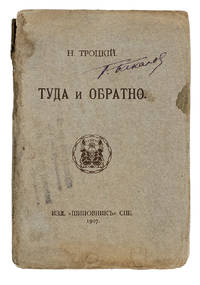
1907ABC_45588St. Petersburg: Shipovnik 1907. Original publisher's printed wrappers. With a lithographed device on the front cover. Rare first edition of Leon Trotsky's seventh publication in the original Russian set in Cyrillic type. In this pre-revolutionary work he describes his second exile to Siberia in 1906 and his return in 1907.Owner's inscription in ink on front cover and title-page. Covers slightly dirty and frayed head of spine worn. Faint stain in the foot margin of the first 15 pages. Otherwise in good condition.l Robert Service Trotsky: a bibliography p. 567; WorldCat 83038814 1 copy; not in Kerssemakers Social liberation. Shipovnik, unknown