2 863 résultats
193025262ELondon: Heinemann 1930. First Edition. First Issue. Signed presentation copy from Maugham to Harpo Marx. Inscribed by the author: “For Harpo Marx W. Somerset Maugham this book which I like myselfâ€. From the library of Harpo Marx the great clown of the Marx Brothers comedy team and his wife actress Susan Fleming Marx former member of the Ziegfeld Follies and star of early talking films like Million Dollar Legs with W.C. Fields. Near fine copy with a hint of edge wear in a near fine dust jacket with some minor repair to the top edge by an expert paper conservationist. With a charming bookplate illustrated by Susan Marx with a drawing of Harpo in his comic character which reads: “FROM THE LIBRARY OF HARPO & SUSAN MARX.†Harpo Marx first became friends with Maugham in the late 1920s when Alexander Woollcott took Harpo to Maugham’s home the Villa Mauresque on the French Riviera. Heinemann unknown
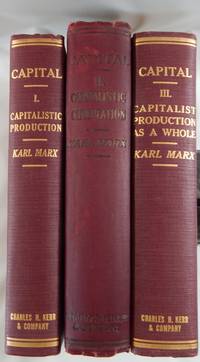
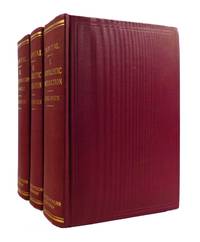
190688451Chicago Ill: Charles H. Kerr & Co. London: Swan Sonnenschein & Co. 1906 1907 1909. First Editions First Printings. Three Volumes. Octavo. 22.5cm. Publisher's deep maroon ribbed cloth titled in gilt to spines and ruled in blind to boards. 869pp.; 618pp.; 1048pp. Generally strong and tight; mild scuffing and to spine ends and corners and a few minor exterior stains. Spine gilt is significantly oxidized to Vol II as is usually seen on the first printing; internally clean and fresh some very light spotting in places mainly confined to the page edges. A very good handsome set of first printings. <br /> <br /> A full set of first printings of this bibliographically complex edition issued over the course of three years. Marx published the first volume of his epic analysis of capitalism in German in 1867. The first translation into English was of Volume 1 only and was accomplished by Edward Aveling and Samuel Moore in 1887 based on the revised 4th German edition as edited by Engels. The 1906 first American printing under the Charles Kerr impint as here largely follows this translation with the subsequent translation work for Volumes II and III being performed by Ernest Untermann. Thus the earliest printings of the Kerr edition comprise the first complete edition of Capital in the English language. The printing was done in Chicago by James Higgins Kerr's printer of choice making this also the first complete edition of Capital to be printed entirely by a union-run print shop. Untermann did most of his translation work from remote Florida beginning the effort in 1905 discovering in the process a number of indices footnotes and at least ten pages of text that Aveling and Moore had not included in their London edition - making the Kerr edition the most complete up to its time. <br /> <br /> Kerr burned through the first two-thousand copy print run of Volume I almost immediately and rushed to get Volume II out by July 1907. It's very possible that financial constraints were already making themselves known by Volume II as Kerr was selling the books at a loss to encourage sales; the almost ubiquitous oxidation of the gilt on Vol II is likely a result of experimental economy that swiftly failed. Vol III returns to the higher standards of the first volume. The bindings on the first printings also feature a triple blind rule to the ribbed cloth boards with subsequent printings having double rules. Kerr's reprint system seems to have incorporated dates on the title pages for some length of time with the dates on the copyright pages remaining unchanged; after a certain point around the early 1920's reprints were issued without dates to the title pages and any volume without a date can safely be deemed a post-1920s reprint. Issues of Kerr's International Socialist Review from the period of printing recount in detail some of his problems and concerns publishing and selling the work with detailed data on dates numbers of copies and the firm's hopes for the completed book. <br /> <br /> Genuine first printing sets of this important edition are tremendously scarce in commerce. The lack of any real bibliographical authority for the American edition combined with Kerr's generally lax approach to differentiating printings has over the years led to frequent errors and misjudgments on the part of cataloguers including in full disclosure ourselves. After a good deal of research most in the advertising pages of the International Socialist Review we're confident we've finally got it right. Charles H. Kerr & Co. [London: Swan Sonnenschein & Co.] unknown
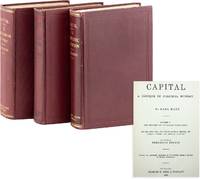
190918341Chicago: Charles H. Kerr & Company 1909. First US editions. Hardcover. Very good. Three volumes 8vo. Red cloth blocked in gilt on the spines. Volume I is the 1906 US firs tprinting; Volume II is the 1907 US first printing; and Volume II is the 1909 US first printing. Volume II spine gilt dulled a comon issue with this volume some rubbing to the spine and inner hinges neatly repaired. Volumes I and II are in very good condition. Inner hinges of volume I neatly repaired; spine of Volume III is rubbed in places else this is a very good set.<br /> <p><br /> The Kerr edition is the first US edition of Marx's complete three volume work usually known by its German title Das Kapital. Only the first volume was published in Marx's lifetime; it appeared in the US in 1890. Engels completed the work using Marx's notes and published them in Germany in 1885 and 1894 respectively. This American issue was translated from the third German edition by Samuel Moore and Edward Aveling and revised and amplified from the fourth German edition by Ernest Untermann.Vol. I from the second German edition by Ernest Untermann Vol II and from the first German edition by Untermann Vol III. <br /> <p><br /> A PMM selection.<br /> <p>. Charles H. Kerr & Company hardcover
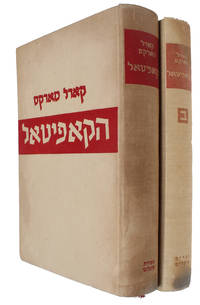
1933188698Chicago: Charles H. Kerr & Company 1933. Hardcover. All 3 Volumes Near Fine in red cloth. Vol. I printed 1906. Vol. II printed 1933. Vol. III printed 1909. Charles H. Kerr & Company hardcover
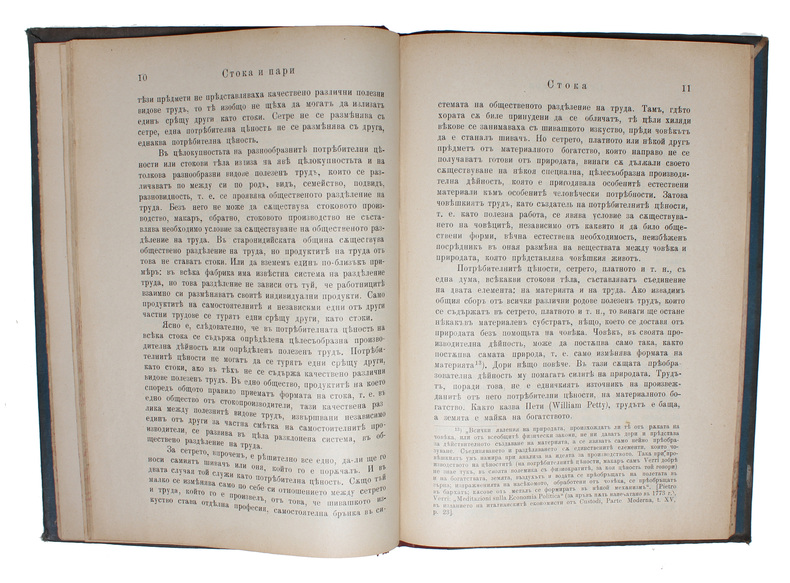
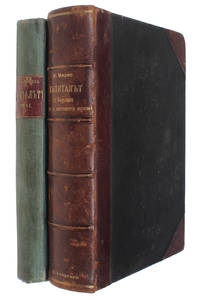
191057297[Blagoev-translation:] Sofia, [presumably 1910 but august 1909 stated on last leaf of preface] & [Ba [Blagoev-translation:] 8vo. In a contemporary full cloth binding with red leather title-label with gilt lettering to spine. Spine with wear and light soiling to extremities. Hindges a bit weak First 10 leaves with stain in margin, otherwise a good copy. (6), XXXI, (1), 675, (1) pp.{Bakalov-translation:] 8vo. In contemporary half calf with five raised bands and gilt lettering to spine. Wear to extremities and hindges a bit weak Repair to inner margin of title-page. Internally fine and clean. XXX, (2), 598, (2) pp. + frontiespiece of Marx. Withbound is ""Karl Marx and His Time"": (1)-180 pp.
190558543[Kapitalut:] Balchik, Izdanie na Krist'o Ivanov, 1905. [Speech On the Question of Free Trade:] Sofia 8vo. In contemporary red half calf. Extremities with wear. Previous owner's name in contemporary hand to upper part of both title-pages. Light browning throughout and a few occassional underlignings in text, mainly in ""A speech on free trade"". [Kapitalut:] XXXVIII, 122 pp. [Rech za...:] 27, (1).
191057297Blagoev-translation: Sofia presumably 1910 but august 1909 stated on last leaf of preface & Ba Blagoev-translation: 8vo. In a contemporary full cloth binding with red leather title-label with gilt lettering to spine. Spine with wear and light soiling to extremities. Hindges a bit weak First 10 leaves with stain in margin otherwise a good copy. 6 XXXI 1 675 1 pp.Bakalov-translation: 8vo. In contemporary half calf with five raised bands and gilt lettering to spine. Wear to extremities and hindges a bit weak Repair to inner margin of title-page. Internally fine and clean. XXX 2 598 2 pp. frontiespiece of Marx. Withbound is "Karl Marx and His Time": 1-180 pp. <br/><br/><em>A most interesting set consisting of the two first Bulgarian translations of Marx' 'Das Kapital'. Quite extraordinary in the history of translations of 'Das Kapital' two Bulgarian translation appeared presumably simultaneously and both translations seems to have been actively used though the 20ies and 30ies and they were reprinted simultaneously in 1930-31 both edited by Todor Pavlov. To our best knowledge Bulgarian is the only language which have had two complete translation published at the same time.The Bakalov-translation is certainly published in 1910. The Blagoew-translation printed in Sofia has often been referred to as being printed in 1909 and has occasionally been referred to as the first translation of the two solely because his foreword was proceeded by "August 1909". That the book was actually printed in 1909 has however recently been disputed. Both translators were well aware of each other and perhaps Blagoew simply wrote "August 1909" to gain primacy in being the first to have a complete translation published: "I was not able to prove this but this is either a typo unlikely or was Blagoev's way to acquire primacy over the other translation from 1910 that of Georgi Bakalov" Panayotov Capital without Value: The Soviet-Bulgarian Synthesis. Translator Dimitar Blagoev the founder and leader of the Bulgarian Worker's Social Democratic Party became or Narrow Socialists or Tesniaki became the the first Marxist propangandist in Bulgaria. About the present translation Blagoev said: "The translation was made from Russian but we can rightly say that it came from Russian as well as from Russian German and French. We all had four Russian issuesbut the basis for this was the last Russian translation which was edited by G. P. Struwe as it came closest to the original. In all this however we had to compare almost line by line with the original of the last fourth German edition of Friedrich Engels and the French translation which was specially reviewed by Marx himself."Blagoev was also a prominent proponent of ideas for the establishment of a Balkan Federation leading the Narrow Socialists into the Communist International in 1919 where the party changed its name to the Bulgarian Communist Party. However during this period Blagoev and the party as a whole did not completely adopt Bolshevik's positions on the basic questions. This determined the party's policies during the Vladaya Soldiers' Rebellion of 1918 and the military coup of 9 June 1923 when the party adopted a position of neutrality. He was also an opponent of the failed September Uprising and thought that there were no ripe conditions for a revolution in Bulgaria yet.A partial translation by Blagoev only 122 pp was published in 1905 and is of the utmost scarcity. Georgi Bakalov published his translation from the German in his hometown Stara Zagora. The publisher was The Liberal Club which was a printshop rather than a proper publisher. He was also a member of Bulgarian Social Democratic Party as of 1891 and likely much similar to many of the early Bulgarian socialists was active in education and socalled 'uchitelsko delo' teachers' affairs. In 1891-93 he studied in Geneva and quickly befriended Plekhanov whom he translated in the 1890s.OCLC only list no copies of either translation. We know however that a copy of both translations are held in the SS. Cyril and Methodius National Library Bulgaria. </em> hardcover
190558543Kapitalut: Balchik Izdanie na Krist'o Ivanov 1905. Speech On the Question of Free Trade: Sofia 8vo. In contemporary red half calf. Extremities with wear. Previous owner's name in contemporary hand to upper part of both title-pages. Light browning throughout and a few occassional underlignings in text mainly in "A speech on free trade". Kapitalut: XXXVIII 122 pp. Rech za.: 27 1. <br/><br/><em>The exceedingly rare first partial Bulgarian translation of Marx's 'Das Kapital' heft. 1. Translator Dimitar Glagoev who eventually in 1909-10 made the first complete translation was the founder and leader of the Bulgarian Worker's Social Democratic Party became or Narrow Socialists or Tesniaki became the the first Marxist propangandist in Bulgaria. The present publication is presumably printed in very low number and are of the utmost scarcity; OCLC locate no institutional holdings We know of one copy in the SS. Cyril and Methodius National Library Bulgaria and no copy has been up for auction the past 50 years.Extradited in 1885 by the Russian government Blagoev returned to Bulgaria settled in Sofia and began to propagate socialist ideas. In July 1891 on the initiative of Blagoev the social democratic circles of Tarnovo Gabrovo Sliven Stara Zagora Kazanluk and other cities united to form the Bulgarian Social Democratic Party BSDP. The Marxist nucleus of the BSDP was opposed by a group who were essentially opposed to making the social democratic movement into a party. In 1893 this group led by Yanko Sakazov founded a reformist organization the Bulgarian Social Democratic Union. In 1894 Blagoev's supporters agreed to unite with the Unionists in the interests of working class unity and took the name Bulgarian Social Democratic Workers Party. Blagoev founder and became the leader of its left wing which split from the BSDWP in 1903 to found the Bulgarian Social Democratic Workers' Party Narrow Socialists. Under his guidance the foundations of the class trade-union movement was laid in 1904. Blagoev was also a prominent proponent of ideas for the establishment of a Balkan Federation leading the Narrow Socialists into the Communist International in 1919 where the party changed its name to the Bulgarian Communist Party. However during this period Blagoev and the party as a whole did not completely adopt Bolshevik's positions on the basic questions. This determined the party's policies during the Vladaya Soldiers' Rebellion of 1918 and the military coup of 9 June 1923 when the party adopted a position of neutrality. He was also an opponent of the failed September Uprising and thought that there were no ripe conditions for a revolution in Bulgaria yet.From 1897 to 1923 Blagoev directed the publication of the party's theoretical organ the journal "Novo Vreme" which published more than 500 of his articles. The first complete Bulgarian translation were published in 1909/1910. </em> unknown
19044178Paris: Les Cent Bibliophiles 1904. 4to cream wrappers with embossed design covering both covers in pink green and gilt. Professionally rebacked in compatible paper. Included is the contemporary marbled board portfolio into which the book had been bound presumably for the original owner Maurice Quarré a member of the French bibliophile with his bookplate laid in. With announcement from L'Estampe Originale listing this work as appearing next. Scattered minor foxing; a very pretty copy. Seventeen embossed designs in color "estampes modelées" by Pierre Roche. These are sculptural relief engravings apparently from plaster models according to Gordon Ray printed with touches of color in a process called gypsography. Roche a pupil of Rodin was a noted sculptor medallist and ceramist. This is the first use of relief illustrations in a book and the first use of Auriol Italique type which combine for a beautiful mise-en-page. This exquisite Art Nouveau book captures the celebrated American artiste whirling in here diaphanous veils lit by colored spotlights. Loïe opened her own special theater at the 1900 Paris World's Fair and called her performance "la danse serpentine." A vibrant homage to the dancer who fascinated the world and a bibliographic and technical tour de force. Ray The Art of the French Illustrated book p. 480. Illustrations can be found on my website by clicking on Catalogue 31 item 51. . Embossed Wrappers. Fine. Illus. by Pierre Roche. 4to. Les Cent Bibliophiles Paperback books
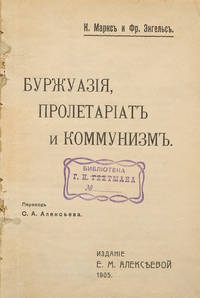
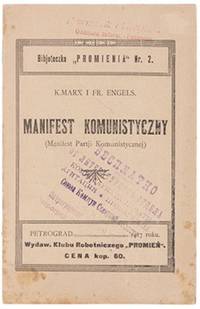
19055608<p><strong>First legal Russian edition of '<em>The Communist Manifesto'</em> by Karl Marx and Friedrich Engels. </strong>Published on May 1905. One of 10 000 copies published.</p><p>About fifteen editions of the Manifesto were published in Russia within several months following the Revolution of 1905.<br />This is a rare edition of the Manifesto. Bert Andréas never saw it nor the original edition nor its photocopy. He did not find any copies outside the USSR in 1963.</p><p>We also couldn't trace any copy in OCLC.</p><p>>Andréas No 428.</p> E.M. Alekseev hardcover
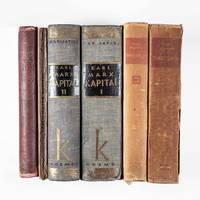
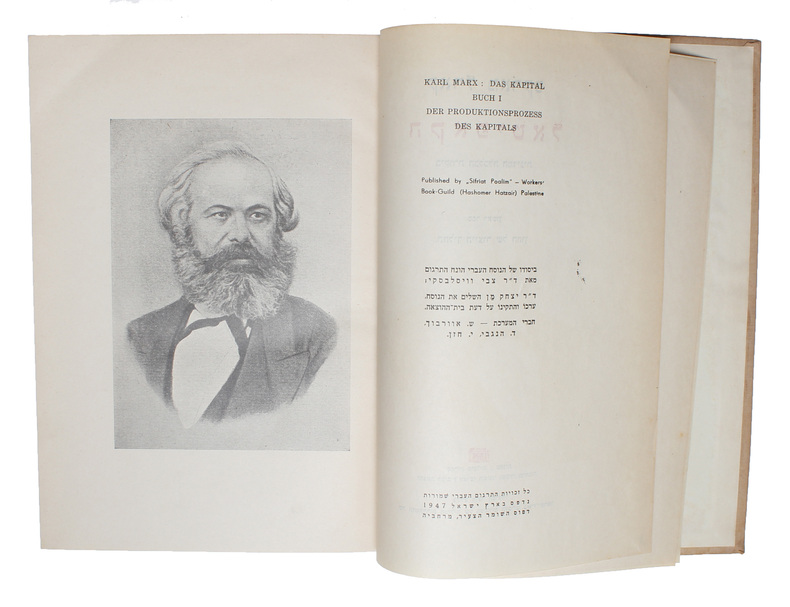
1954503831954. First & Second editions. 1 Dimitar Blagoev trans. Капиталътъ: Критика на ПолитичеÑката ЕкономиÑ. Томъ Първи/ KapitalÅt: Kritika na Politicheskata Ekonomiya. TomÅ PÅrvi Capital: A Critique of Political Economy. Vol.1 FIRST BULGARIAN EDITION. Ð¡Ð¾Ñ„Ð¸Ñ Sofia. Партийната СоциалиÑтичеÑка Книжарница и Печатница The Party Socialist Bookstore and Printing House. ca. 1909. First Bulgarian edition. Small quarto. 675pp. 1. Period red buckram boards with gilt lettering ruling and tooling on the front cover and spine. Decorative endpapers. The extremely scarce first Bulgarian edition of the first part of Karl Marx's seminal work Capital Das Kapital originally published in German in 1867. Eventually the work comprised three volumes with the second and third parts published after Marx's death by his colleague Friedrich Engels.<br /> <br /> This edition was published by the bookstore of the Bulgarian Social Democratic Workers' Party later the Bulgarian Communist Party who's founder leading Balkan Marxist Dimitar Blagoev 1856-1924 translated this edition. In 1905 Blagoev published a scarce partial translation of the work but it wasn't until 4 year later that this full translation was released to the Bulgarian public. The date of August 1909 is given at the end of Blagoev's introduction although the title page does not list a publication date. There is some debate as to weather this or another edition translated by Bulgarian writer historian and socialist Georgi Bakalov 1873-1939 with a title page listing the publication date as 1910 should be considered the first Bulgarian edition. However given the earlier 1909 date in this introduction and the fact that Blagoev was already translating the work four years earlier suggests that this translation probably supersedes the other. As stated in this edition this edition was based on the 1906 Russian edition. The text throughout contains copious scholarly footnotes. The front of the book contains a detailed table of contents and a page containing a small b/w photographic reproduction after a portrait of Karl Marx immediately following the title page. It is believed that ultimately only the first volume of Das Kapital was translated by Blagoev and not the others.<br /> <br /> Text in Bulgarian in Cyrillic script.<br /> <br /> Binding with some rubbing and bumping to extremities including the head and tail of the spine. Some light smudges scratches and stains to the covers and spine with gilt a bit rubbed. Interior with some sporadic light marginal notes and/or underlining in regular and red colored pencil to few pages throughout the text as well as some sporadic minor smudges. Book block quite tight overall. Binding in good interior in very good- condition overall. Extremely scarce. g to vg-. <br /> Hardcover.<br /> <br /> Only one confirmed copy of this full translation in OCLC.<br /> <br /> <br /> <br /> 2 Porobić M. MoÅ¡a Pijade and R. Bosanac Rodoljub ÄŒolaković translators; Svetomir Lazarevic ed. Kapital. Kritika PolitiÄke Ekonomije. Proces Proizvodnje Kapitala WITH Prometni Proces Kapitala SCARCE FIRST COMPLETE SERBO-CROATIAN TRANSLATION BOTH THE FIRST AND SECOND VOLUMES. Belgrade. Kosmos. 1933-1934. First Serbo-Croatian edition. Quarto. Vol.1: 837pp. 2. Vol.2: 549pp. 2. Blue-grey cloth boards with gilt and black lettering on the front covers and spines. A complete set of both the first and second volumes of Karl Marx's magnum opus "Kapital" here fully translated into Serbo-Croatian for the first time. Among the notable aspects of the these volumes is that the translation was done in collaboration between two major Communist political and cultural figures in Yugoslavian history Marxist theorist MoÅ¡a Pijade 1890-1957 and writer and political activist Rodoljub ÄŒolaković 1900-1983 while serving in prison together as political dissidents. The second volume was translated by Pijade alone. Both men were seen as influential Yugoslavian Marxist figures and both played prominent roles in the Yugoslav Partisan resistance to the Axis-powers' occupation during WWII. After the war and the reestablishment of Yugoslav governance Pijade became a significant figure in politics and government and a close confidant of Yugoslav leader Josip Broz Tito while ÄŒolaković became a prolific writer. These volumes were published by Kosmos as the third and six parts respectively of their series of philosophical publications and were the sole volumes to been printed with text in Roman script until 1940. At the time of publication both MoÅ¡a Pijade and Rodoljub ÄŒolaković were still imprisoned and so were credited under the pseudonyms of M. Porobić and R. Bosanac respectively. The final pages of each volume contain an index a table of contents and publisher's advertisements.<br /> <br /> Text throughout in Serbo-Croatian in Roman script.<br /> <br /> Bindings with some bumping to corners and some minor to moderate rubbing to extremities as well as some minor to light rubbing to the gilt. Vol.1 with some rubbing and tearing at the tail of the spine along the front hinge as well as a few small abrasions to the back cover. Vol.1 with starting at the interior covers. Vol. 2 with starting at the interior front cover and p.550 and a signed inscription to the previous owner on the front free endpaper. Pages throughout both volumes with some minor to light age toning along the edges as well as some very sporadic minor to light water stains smudges and/or underlining in pencil. Bindings in good to very good- condition. Interior in good to very good- condition overall. Quite scarce. g to vg-. Hardcover. <br /> <br /> The previously issued 1924 Serbian edition of Kapital was issued in Belgrade and was a translation of the widely and internationally circulated digest of the work done by Julian Borchardt 1868-1932. This 1933-1934 edition contains the first complete translation done by MoÅ¡a Pijade and was seen as among a number of reasons for his arrest in the first place. These two volumes are considered the first full translation of the work into Serbo-Croatian.<br /> <br /> <br /> <br /> 3 Julian Borchardt ed.; MoÅ¡a Pijade trans. Kapital. Kritika PolitiÄke Ekonomije. Popularno Izdanje Popular Edition FIRST SERBIAN EDITION. Belgrade. Izdavac̆ka Knjiz̆arnica Gece Kona. 1924. First Serbian edition. Quarto. 198pp. 3. Purple printed wrappers with black lettering on the front cover. This "popular edition" is considered the very first edition of Karl Marx's seminal work "Kapital" to be translated into the Serbian language. It is based on the internationally popular digest version of all three volumes of the work first published in Germany in 1919 prepared and edited by German socialist journalist and politician Julian Borchardt 1868–1932 here credited as "Julian Borhart". This translation was done by prominent Yugoslav Marxist theorist partisan and politician MoÅ¡a Pijade 1890-1957. His work on this translation and other political activities and agitations were the reasons for which Pijade was imprisoned by the Yugoslav government in 1925. He became a prominent member of the Yugoslav partisan resistance during WWII becoming a close confidant and ally to future Yugoslav leader Josip Broz Tito and later serving in prominent roles in the post-war government.<br /> <br /> Other international editions of Borchardt's abridged version of the work were published including German English and Russian. It would be another 9 years before the work was fully translated in Yugoslavia.<br /> <br /> Text throughout in Serbian printed in Roman script.<br /> <br /> Wrappers with some rubbing sunning and light chipping to extremities. Spine cocked and creased. Covers lightly stained and smudged with the name of a previous owner in ink at the top of the front cover. Interior with age toning to pages as well as some sporadic minor to light water stains and/or creasing throughout. Wrappers in good- interior in good condition overall. g- to g. Softcover.<br /> <br /> A complete 2-volume edition of both the first and second parts of Kapital was translated in Serbo-Croatian by Pijade along with prominent Yugoslav Marxist Rodoljub ÄŒolaković 1900-1983 while the two men were political prisoners which would be released 1933-1934.<br /> <br /> <br /> <br /> 4 Zevi Woyslawski; Yitzhak Man translators. Ha-Kapital Das Kapital FIRST COMPLETE HEBREW EDITION 2 vols. complete. Merhavia. Sifriat Poalim/ Ma'anit/ Ha-Shomer Hatzair. 1947-1954. First Hebrew edition. Quartos. Vol.1: 763pp. 1. Vol. 2: 516pp. Tan and red cloth boards with red lettering on the front cover and spine. Ribbon markers. First volume with b/w frontispiece portrait of Marx. The first full Hebrew translation of Karl Marx's magnum opus "Das Kapital" complete in two parts by Zevi Woyslawski 1889-1957 and Yitzhak Man 1890-1956. This edition was published at Kibbutz Merhavia in Israel the headquarters of the leftist Zionist movement Ha-Shomer Hatzair and released by their publishing house Sifriat Poalim. The set includes both the complete first part of Das Kapital Der Produktionprocess des Kapitals and the second part Der Zirkulationsprozess des Kapitals. Their had been previous attempts to published Das Kapital in Hebrew but this was the first successfully produced full translation.<br /> <br /> Text in Hebrew.<br /> <br /> Bindings with sunning to spines and water stains to the top edges of the book blocks. Water stains and smudges to the covers of the first volume. Hinges of the spine lightly rubbed. Light chipping to the tail of the spine of the second volume. Interior gutters of volumes reinforced with Japan tissue. Bindings in good to very good- interiors in very good to very good condition overall. Bindings protected in modern mylar. Scarce. g to vg. Hardcover.<br /> <br /> Hebrew title: ×”×§×פיט×ל: ביקורת הכלכלה ×”×ž×“×™× ×™×ª<br /> Author: ×§×רל מ×רקס<br /> Publication: מרחביה : ספרית ×¤×•×¢×œ×™× / ×ž×¢× ×™×ª הוצ×ת הקיבוץ ×”×רצי השומר הצעיר<br /> <br /> <br /> WITH<br /> <br /> 5 Henryk Gustaw Lauer; Jerzy Heryng; MieczysÅ‚aw Kwiatkowski; Ludwik Selen translators and editors; David Riazanov catalog. Kapital: Krytyka Ekonomji Politycznej. Tom 1. Przebieg Wytwarzania KapitaÅ‚u "Kapital Volume 1": Bound in 2 volumes COMPLETE SECOND POLISH EDITION MISSING TITLE PAGES. Warsaw. Spółdzielnia KsiÄ™garska "Książka"/ KsiÄ™garnia i Wydawnictwo "Tom". 1926-1933. Second Polish edition. Small quartos. Vol.1: xxxi 2 5-154pp. 1 157- 555pp. 2. Vol.2: xxxiii-xxxvii 1 557- 905pp. 3. Bound in black buckram boards with gilt lettering on the spines. This 2-volume set collects the second Polish translation of Volume 1 of Karl Marx's groundbreaking seminal work of political economy "Kapital". The set brings together the entirety of the contents of the first volume of Kapital originally issued in 3 separate parts in 1926 1929 and 1933. The Polish translations of the prefaces of the earlier editions from Marx and Engels 1867-1886 are included in addition to the more contemporary preface from the translators xxxiii-xxxviii. The translation and editing of the text for this edition was done by group of prominent figures in the Polish Communist Party including Henryk Gustaw Lauer 1890-1937 Ludwik Selen Jerzy Heryng 1886-1937 and MieczysÅ‚aw Kwiatkowski. The final extensive reference section "Katalog" at the end of vol.2 includes an extensive glossary of published works historical figures and other terms referenced by Marx in the original text compiled by pioneering Marx scholar David Riazanov 1870-1938 as well as a full detailed table of contents and errata. The text throughout these volumes is accompanied by extensive scholarly footnotes as well as occasional statistical tables an/ or charts. A planned planned follow-up to this work translating the second volume of Kapital during this period was never completed.<br /> <br /> Text in Polish.<br /> <br /> Binding with some light to moderate bumping and rubbing to corners. Heads and tails of spines lightly chipped. Edges of book blocks with some water spots and/or stains. Interiors with all title pages from the original issues missing. Edges of the pages in some sections lightly age toned. Book blocks tight overall. Binding in good to good interiors in good to very good- condition overall. Scarce. g to vg-. Hardcover. unknown
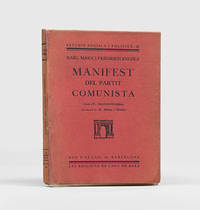
1930163928Barcelona: Les Edicions de l'arc de Bara 1930. Marxism in Catalonia in the years before the Civil War First edition in Catalan of the Communist Manifesto limited issue number 6 of 17 numbered copies on Guarro paper three further copies were issued on Japanese paper and three others were for presentation; the size of the rest of the edition is unstated. Emili Granier Barrera 1908-1997 was a Catalan nationalist jailed for his role in the 1928 "Garraf plot" to assassinate Alfonso XIII. After his release he became general secretary of the Unió Socialista de Catalunya was elected councillor in Barcelona and fled Spain after the Civil War. He returned in 1978 following the re-establishment of Spanish democracy. His translation was based on the 1872 French translation of Laura Marx; the first direct translation from the German was published in 1936 by Pau Cirera i Feliu. Octavo. Original red stiff paper wrappers spine and front panel lettered in black. Neat repair to front joint repaired short closed tear to half-title short closed tear at foot of pp. 115/6 contents otherwise fresh. A very good copy. unknown
192756714Tokyo, Kaizosha, 1927-1928. Small4to. 5 volumes all in publisher's original full red cloth with gilt lettering to spine, all five volumes house the original slipcases. Free end-papers browned and only very light sporadic brownspots throughout. A very fine and clean copy.
192756714Tokyo Kaizosha 1927-1928. Small4to. 5 volumes all in publisher's original full red cloth with gilt lettering to spine all five volumes house the original slipcases. Free end-papers browned and only very light sporadic brownspots throughout. A very fine and clean copy. <br/><br/><em>Rare first complete Japanese translation of Marx's 'Das Kapital'. In response to the Russian October Revolution young Marxists produced in rapid succession partial translations of Marx's works and secondary accounts of the same. Japanese translations of Marx's works were comparatively late compared to those in Europe. Japanse translations however did exercise a great influence in Asia and especially in China where several of the early translations were made from the Japanese. "Similarly Takabatake Motoyuki the first to produce a complete Japanese translation of the three volumes of 'Capital' created a system of Marxist national socialism. Asserting the "Marxism was originally statism" Takabatake cited Thomas Hobbes and other western state theorists to support the notion that the state preceded class society and would not wither away after a proletarian revolution. To guard against external threats and to organize economic activity at home - against the possibility of proletarian imperialism on the part of Soviet Russia for eksample - a socialist Japan would require a powerful state" Hoston Marxism and the Crisis of Development in Prewar Japan. </em> hardcover
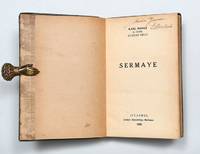
1933143060Istanbul: Sirketi Mürettibiye Matbaasi 1933. First edition in Turkish of Das Kapital First appearance in book form of Marx's Das Kapital in Turkish being the first edition of Haydar Rifat's translation and the first book-length translation preceded only by Bohor Israel's summary translation in a 1912 journal. The translation is of Gabriel Deville's abridgement of the first volume of Das Kapital originally published in Paris in 1883. Internationally acclaimed Deville's abridgement "did more to disseminate the arguments of Marx's revered but unread magnum opus than did any other publication before or since" Stuart Marxism at Work p. 25. The translation was undertaken by Haydar Rifat 1877-1942 later known as Yorulmaz one of the most prominent translators of the late Ottoman and early Republican periods. Particularly associated with the formation of the leftist discourse in Turkey his 1910 translation of George Tournaire's Le Socialisme is held to be the first socialist book published in Turkish see Konca p. 81 86ff. The translation was preceded only be a short summary of Das Kapital in Turkish by the socialist Bohor Israel in 1912 which was published as an article in the first and only issue of his journal Ceride-i Felsefiye Philosophical Newspaper under the title "Iktisad-i Içtimaiye" Social Economics. However this was described by Israel himself as less a translation than a "summary of the summary" Savran & Tonak p. 2; this is therefore the first sustained translation as opposed to a summary and the first appearance of Das Kapital in Turkish in book form. Rifat's translation came suprisingly late long after the founding of the Turkish Communist Party in 1920. It immediately provoked controversy among Turkish socialist intellectuals sparking a series of critiques regarding accuracy of translation and conformity to Marxist orthodoxy. It prompted two rival translations in 1936 by Turkish Communists: a 32 page summary by Nevzat Cerrahlar under the pseudonym Kerim Sadi drawn from Paul Lafargue's 1893 French abridgement and a more substantial attempt by Suphi Nuri Ileri based on Carlo Cafiero's 1879 Italian abridgement. Another Turkish abridgement by Hikmet Kivilcimli was serialized in 1937. "The rather feverish activity of translating Kapital into Turkish albeit in abridged form. ended abruptly in 1938. Turkey had been moving for some time away from the Soviet Union and towards Nazi Germany a trend that would last until the final years of World War II. This culminated in a series of attacks on the Turkish Communist movement. In 1938 the one-party regime proceeded to ban certain Marxist works that had been published in preceding years. Kapital was among the list of prohibited works" Savran & Tonak p. 4. No doubt due to the suppression of socialist literature in Turkey from 1938 the translation is rare - no institutional copies are located by WorldCat. Small octavo. Original wrappers printed in red and black. Housed in a red cloth flat-back box by the Chelsea Bindery. Spine backing and foot of rear joint reglued with minor loss to lettering a couple of gatherings neatly reinserted soiling and light wear to wrappers with chip at head of front cover and foot of rear cover contents unopened from second gathering onwards. A good copy. See Konca "The Turkish Retranslations of Marx's Das Kapital as a Site of Intellectual and Ideological Struggle" in Studies from a Retranslation Culture ehnaz and Gürça lar 2019; Savran & Tonak "Marx's Capital in Turkey" Routledge Handbook of Marx's Capital: A Global History of Translation Dissemination and Reception forthcoming. Not in Draper The Marx-Engels Register. hardcover
1903140947745Hamburg: Otto Meissners Verlag 1903. Very Good. Complete in three volumes. A mixed set: fifth edition of Volume I third edition of Volume II and first edition of Volume III. xxxii 739; xxvii 500; xxviii 422 pp. Bound in half navy morocco over blue paper-covered boards morocco title labels and gilt stamping to spines all edges speckled and stained blue. Very Good with moderate rubbing and soiling to covers; leather leaves residue. Contents lightly toned and overall clean with very occasional penciled underlining binding firm. <p>Early editions of the book that altered the course of human history. Only the first volume of Das Kapital was published in Karl Marx's lifetime in 1867; the second and third volumes were prepared from Marx's notes by his longtime friend and collaborator Friedrich Engels. This set bound to order for a previous owner combines the first edition of the third volume with the fifth and third editions of the first and second volumes respectively. Otto Meissners Verlag unknown
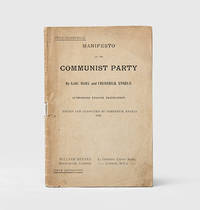
1927170285London: William Reeves 1927. A spectre is haunting Europe - the first authorized English translation of the Communist Manifesto - "undoubtedly the most important one of all" Draper First edition stated sixth impression of the first authorized English translation of the Communist Manifesto. Engel's role in the translation was extensive; he personally chose the translator Samuel Moore who had earlier translated Marx's Das Kapital and also negotiated with the publisher. The preface is the longest and the most important of any that Engels wrote for the Manifesto and this is the only translation edited by him with additional notes. The translation was edited by Engels with a four-page preface specially written by him for this translation as well as eight footnotes. It includes a large number of modifications of expression omissions and minor additions. First published by Reeves in March 1888 based on the German edition of either 1872 or 1883 it is the second edition of the Communist Manifesto to be distributed in bookshops preceded only by the Swedish translation of 1848 all earlier publications being either in periodicals or distributed by socialist organisations. According to an exchange between Andréas and William Arnold Reeves the stereotype plates made in 1888 were used for pages 3-31 of all the English editions of the Manifesto published by Reeves this "sixth impression" being published in 1927 Andréas notes further impressions - his description in his entry for 495 places this as the ninth. "Of exceptional importance was the authorized English translation of 1888 by Samuel Moore translator of Marx's Das Kapital the only translation personally edited and annotated by Engels although he edited and prefaced a German text published in London in 1890" PMM. Octavo 32 pages. Wire-stitched as issued in self-wrappers preserved in a cloth slip case. Small tear around staple to first and last leaves; a very good copy. Andréas 237. See Printing and the Mind of Man 326. Hal Draper The Adventures of the Communist Manifesto 2004. hardcover
1933143061Istanbul: Sirketi Mürettibiye Matbaasi 1933. First edition in Turkish of Das Kapital First appearance in book form of Marx's Das Kapital in Turkish being the first edition of Haydar Rifat's translation and the first book-length translation preceded only by Bohor Israel's summary translation in a 1912 journal. The translation is of Gabriel Deville's abridgement of the first volume of Das Kapital originally published in Paris in 1883. Internationally acclaimed Deville's abridgement "did more to disseminate the arguments of Marx's revered but unread magnum opus than did any other publication before or since" Stuart Marxism at Work p. 25. The translation was undertaken by Haydar Rifat 1877-1942 later known as Yorulmaz one of the most prominent translators of the late Ottoman and early Republican periods. Particularly associated with the formation of the leftist discourse in Turkey his 1910 translation of George Tournaire's Le Socialisme is held to be the first socialist book published in Turkish see Konca p. 81 86ff. The translation was preceded only be a short summary of Das Kapital in Turkish by the socialist Bohor Israel in 1912 which was published as an article in the first and only issue of his journal Ceride-i Felsefiye Philosophical Newspaper under the title "Iktisad-i Içtimaiye" Social Economics. However this was described by Israel himself as less a translation than a "summary of the summary" Savran & Tonak p. 2; this is therefore the first sustained translation as opposed to a summary and the first appearance of Das Kapital in Turkish in book form. Rifat's translation came suprizingly late long after the founding of the Turkish Communist Party in 1920. It immediately provoked controversy among Turkish socialist intellectuals sparking a series of critiques regarding accuracy of translation and conformity to Marxist orthodoxy. It prompted two rival translations in 1936 by Turkish Communists: a 32 page summary by Nevzat Cerrahlar under the pseudonym Kerim Sadi drawn from Paul Lafargue's 1893 French abridgement and a more substantial attempt by Suphi Nuri Ileri based on Carlo Cafiero's 1879 Italian abridgement. Another Rukish abridgement by Hikmet Kivilcimli was serialized in 1937. "The rather feverish activity of translating Kapital into Turkish albeit in abridged form. ended abruptly in 1938. Turkey had been moving for some time away from the Soviet Union and towards Nazi Germany a trend that would last until the final years of World War II. This culminated in a series of attacks on the Turkish Communist movement. In 1938 the one-party regime proceeded to ban certain Marxist works that had been published in preceding years. Kapital was among the list of prohibited works" Savran & Tonak p. 4. No doubt due to the suppression of socialist literature in Turkey from 1938 the translation is rare - no institutional copies are located by WorldCat. Small octavo 177 x 117 mm. Contemporary green cloth. Contemporary ownership signatures to title and half-title. Complete with errata leaf. Spine lightly sunned slight wear at extremities recoloured at tips slight soiling contents toned. A good copy. See Konca "The Turkish Retranslations of Marx's Das Kapital as a Site of Intellectual and Ideological Struggle" in Studies from a Retranslation Culture ehnaz and Gürça lar 2019; Savran & Tonak "Marx's Capital in Turkey" Routledge Handbook of Marx's Capital: A Global History of Translation Dissemination and Reception to be published in 2021. Not in Draper The Marx-Engels Register. hardcover
194858682Los Angeles:: Cal Interests May 7 1948. Single sheet printed on both sides. Hole-punched at top edge and with an old staple at one corner; signatures fine. 11 x 8-1/2 inches. Cal Interests, unknown
194756712Yerûsalayim [Jerusalem], Sifriyyat Pôalîm, 1947 & 1954. Large8vo. Two volumes both in publisher's original printed cloth with the original dust-jackets. 763 pp."" 516 pp.Vol. 1: A bit of misolocured to spine and front board. Front dust-jacket detached from the spine and back-part. Spine lacking a third of the paper. Very fragile.Vol. 2: Upper and lower part of spine miscoloured. Dust-jacket missing upper and lower part of spine. Both volumes internally very fine and clean.
191263248Lisboa, De Francisco Luiz Goncalves, 1912. 8vo. Uncut in the original printed wrappers. Wrappers brownpostted and with a few minor nicks and tear. Upper part of spine with loss of paper. Internally fine and clean. A fine and well preserved copy of an otherwise fragile book. 240 pp.
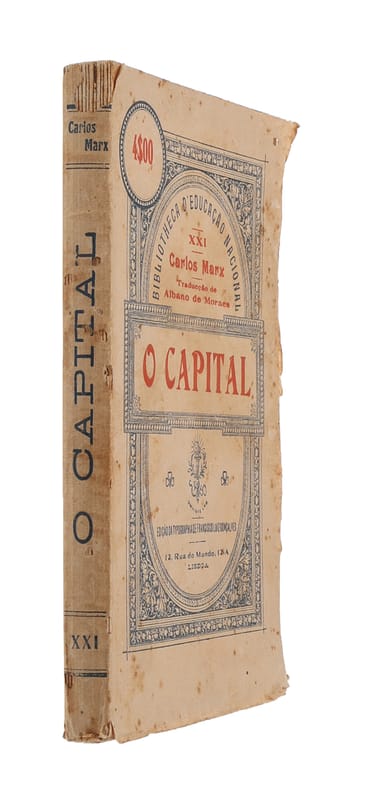
191263248Lisboa De Francisco Luiz Goncalves 1912. 8vo. Uncut in the original printed wrappers. Wrappers brownpostted and with a few minor nicks and tear. Upper part of spine with loss of paper. Internally fine and clean. A fine and well preserved copy of an otherwise fragile book. 240 pp. <br/><br/><em>The scarce first Portuguese edition of the most important abridged version of Marx's Capital ever to have appeared published fifty-six years before the first full Portuguese but published in Brazil translation and whole sixy-two years before the first full translation published in Portugal. Curiously two translations of the present work were made 1912 but the present translation seems to have priority see Bastien "Readings and Translations of Karl Marx in Portugal". After the 1933 rise of Salazar's dictatorial Estado Novo regime suppression of the relatively newly founded Communist party grew. Members were arrested tortured and executed and many were sent to the Tarrafal concentration camp in the Cape Verde Islands. Communist literature suffered an equally repressive fate hence the rarity of the present work. Marxism and especially Marxist writing caught on comparatively late in Portugal: "As for the Socialist Party - supposed to be the main expression of Marxism - it revealed itself unable to stimulate effective theoretical and doctrinal efforts. Its existence was an example of ambiguity and inconsequence. Its political programme went on mixing Marxian elements associationist tradition and positivist thinking. Its strategy balanced continuously between an alliance with republican politicians and the maintenance of political autonomy. Its tatics balanced between electoral abstencionism and an involvement in election processes that never led it to a relevant position in parliament. Even its international relations showed a lasting ambiguity: it had been created according to the instructions of the Marxist majority at the Hague Congress when most of its members tended to support political abstencionism. When the formation of the Second lnternacional was taking place in Paris in 1889 Portuguese socialists tried to join the Marxist congress after being present at the possibilist congress. In 1920 they decided to join the Third lnternacional what was not accomplished at the same time that an internal reformist turn was taking place." Bastien "Readings and Translations of Karl Marx in Portugal". "The epitome here translated was published in Paris in 1883 by Gabriel Deville possibly the most brilliant writer among the French Marxians. It is the most successful attempt yet made to popularize Marx's scientific economics. It is by no means free from difficulties for the subject is essentially a complex and difficult subject but there are no difficulties that reasonable attention and patience will not enable the average reader to overcome. There is no attempt at originality. The very words in most cases are Marx's own words and Capital is followed so closely that the first twenty-five chapters correspond in subject and treatment with the first twenty-five chapters of Capital. Chapter XXVI corresponds in the main with Chapter XXVI of Capital but also contains portions of chapter XXX. The last three chapters-XXVII XXVIII and XXIX-correspond to the last three chapters-XXXI XXXII and XXXIII-of Capital." ROBERT RIVES LA MONTE Intruductory Note to the 1899 English translation. Capital de Marx also had a Portuguese edition at this time or better two different editions both in 1912 but only in translation of the survey of Book I published in France by Gabriel Deville in 1883 Marx 1912a and Marx 1912b. This version omitted material dealt with in at least four chapters of the original text and was not particularly appreciated by Engels. It was a simplified text aimed at supporting the training of socialist militants and that made it possible for them to have access indirect to the work of Marx. The other summaries and anthologies of Capital which with a purpose similar to that of Deville circulated in Europe during this period or ignored in Portugal as was the case with Carlo Cafiero or were only occasionally mentioned as was the case with Paul Lafargue and Karl Kautsky in its French versions. OCLC list two copies both in the US. </em> unknown
194756712Yerûsalayim Jerusalem Sifriyyat Pôalîm 1947 & 1954. Large8vo. Two volumes both in publisher's original printed cloth with the original dust-jackets. 763 pp.; 516 pp.Vol. 1: A bit of misolocured to spine and front board. Front dust-jacket detached from the spine and back-part. Spine lacking a third of the paper. Very fragile.Vol. 2: Upper and lower part of spine miscoloured. Dust-jacket missing upper and lower part of spine. Both volumes internally very fine and clean. <br/><br/><em>The very rare first complete Hebrew translation of Marx's Das Kapital. In the 1890ies numerous attempts at a Hebrew translation were made but not until Zevi Wislavsky's 1947-translation the Hebrew speaking world were able to read the full volume 1 of 'Das Kapital'.Marx himself being of Jewish descent was a proponent of antisemic idea and he argued that the modern commercialized world is the triumph of Judaism a pseudo-religion whose god is money. Even in Das Kapital he lets his anti-Semitism flourish: "The capitalist knows that all merchandise no matter how ruinous it may seem or how bad it might smell is by faith and in truth money internally circumcised Jews". "He denigrated the Polish Jewish refugees in Germany as "the filthiest of all races" and in the Neue Rheinische Zeitung edited by himself he accused the Jews of Poland of setting churches ablaze burning villages and beating down defenseless Poles when these were in fact the very things Polish Jews suffered at the hands of Christians." Schvindlerman Karl Marx the Jews and capitalismOCLC only locates two copies. </em> hardcover
191797<p><b>Very rare Polish edition of the Manifest of the communist party published the year before the Russian revolution. </b></p><p>"<i>One of the outstanding political documents of all times."</i>PMM</p><p><i>Bibliographie deutscher Literatur polnischer Ubersetzung</i> J. St Buras p.422.</p><p><i>"The Manifest gained wordly recognition with the Russian revolution of October 1917</i>." J. Elleinstein <i>Histoire mondiale des socialismes</i></p><p>On January 24th 1917 president Wilson in his address to the Senate speaks of an independent autonomous unified Poland and the new Russian government promises an "independent Polish state" on March 29th 1917.</p><p>The Polish conservatives who may have had Russian feelings ignore them since the Revolution and turn to Vienna for their interests. </p><p><i>"The fact that a new Polish edition of the Communist Manifesto has become necessary gives rise to various thoughts.</i></p><p><i>First of all it is noteworthy that of late the Manifesto has become an index as it were of the development of large-scale industry on the European continent. In proportion as large-scale industry expands in a given country the demand grows among the workers of that country for enlightenment regarding their position as the working class in relation to the possessing classes the socialist movement spreads among them and the demand for the Manifesto increases. Thus not only the state of the labor movement but also the degree of development of large-scale industry can be measured with fair accuracy in every country by the number of copies of the Manifesto circulated in the language of that country.</i></p><p><i>Accordingly the new Polish edition indicates a decided progress of Polish industry. And there can be no doubt whatever that this progress since the previous edition published ten years ago has actually taken place. Russian Poland has become the big industrial region of the Russian Empire. The disadvantages — for the Polish manufacturers and the Russian government — are manifest in the rapid spread of socialist ideas among the Polish workers and in the growing demand for the Manifesto.</i></p><p><i>But the rapid development of Polish industry outstripping that of Russia is in its turn a new proof of the inexhaustible vitality of the Polish people and a new guarantee of its impending national restoration. And the restoration of an independent and strong Poland is a matter which concerns not only the Poles but all of us. A sincere international collaboration of the European nations is possible only if each of these nations is fully autonomous in its own house. It can be gained only by the young Polish proletariat and in its hands it is secure. For the workers of all the rest of Europe need the independence of Poland just as much as the Polish workers themselves." </i>F. Engels<i> London February 10th 1892</i></p><p><b>A partly uncut copy preserved in its contemporary wrappers as issued. </b></p><p><b>A very rare edition.</b></p><p>Our searches in the international public institutions have allowed us to locate only one copy: <i>Hoover Institute of War California</i> USA.</p><p>Provenance : Library of <i>Marcel Bekus</i> with library stamp ; presence of two library stamps on the cover.</p><p>"The personality and history of<i> Marcel Bekus deserve attention. Present in Russia in 1905 close to the Anarchists he goes to Spain during the civil war and dies there in 1938. Some fifty years later his grandson opens his cellar and finds numerous brochures and posters perfectly preserved." </i><i>Matériaux pour l'histoire de notre temps</i>Année 1991 XXIV N°24 pp.29-30</p><p><i>Marcel Bekus</i> 1888-1939 rallies the Revolution in 1905 in Russia and is then deported to Siberia. Once freed he develops an interest in the French Revolution and in the Russian one of 1917. </p><p>In 1919 he arrives in Paris and continues to frequent revolutionary circles.</p> paperback
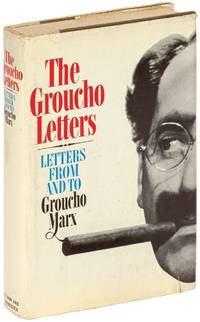
1967540788New York: Simon and Schuster 1967. Hardcover. Fine/Near Fine. First edition. Fine in near fine dust jacket with a couple of tiny tears. Cheekily Inscribed by the legendary comedian to fellow legend Elizabeth Taylor: "To Liz - Maybe some day you'll have Burton - My best Groucho." A significant association. Simon and Schuster hardcover