130 résultats
18489305AB1848. Göttingen Dieterich 1848. 4°. 99 S. Neuer Halblederband. Titel leicht fleckig und wasserrandig. Stellenweise geringfügig fleckig. Durchgehend dezent gebräunt sonst in sehr schöner Erhaltung. Aus dem vierten Bande der Abhandlungen der Königlichen Gesellschaft der Wissenschaften zu Göttingen. Karl Friedrich Heinrich Marx 1796-1877 las in Göttingen allgemeine und spezielle Pathologie sowie Arzneimittellehre. Sein 'hauptsächlichstes Verdienst liegt auf dem Gebiete der historischen Medicin seine in den Abhandlungen der Göttinger Societät erschienenen Aufsätze zeigen einen großen Schatz von Gelehrsamkeit' Hirsch/H. IV 105. unknown
1842003931Gottingen: Dieterich 1842. Bookplate of Charles Darember 19th-century French historian of medicine. Spine and corners worn. First Edition. Contemporary Marbled Wrappers. Good. Dieterich Paperback
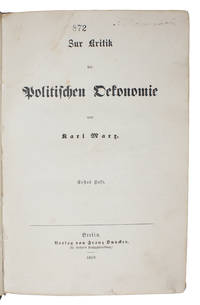
185958578Berlin Franz Duncker 1859. 8vo. Nice contemporary hafl calf with gilt lettering to spine. A bit of wear to extremities markings after old label to front board and signs of vague damp staining to front board. A mostly faint damp stain to outer inner corner throrughout but otherwise very nice. Title-page a bit dusty. Old library number 872 to front free end-paper and top of title-page and marginal pencil-annotations to a number of leaves. VIII 2 170 pp. Title-page with the ownership-signature of Alexander Appolonovich Manuilov to top of title-page and binding with his initials "A. M." in gold to the fot of spine. <br/><br/><em>Scarce first edition in a magnificent association-copy of the groundbreaking work in which Marx first presents his revolutionizing theories of capitalism forming the foundation for his main work "The Capital" which appeared eight year later. It is also in this milestone of political and economic thought that Marx presents his economic interpretation of history for the first time.Alexander Appolonovich Manuilov 1861-1929 was a Russian economist and politician famous not only as one of the founding members of the Constitutional Democratic party known as the Kadets but also as the Russian translator of Marx' "Zur Kritik." i.e. the present work. "Manuilov graduated from the law department of the University of Novorossiia Odessa 1883. He began scholarly and pedagogical work in political economy in 1888. In 1901 he became head of a subdepartment at Moscow University becoming assistant rector in 1905 and serving as rector from 1908 to 1911. He was dismissed by the tsarist government for attacking the "extremes" of Stolypin’s agrarian legislation. In the 1890’s he was a liberal Narodnik Populist later becoming a Constitutional Democrat Cadet and a member of the Central Committee of the Cadet Party. Manuilov’s draft on agrarian reform 1905 was the basis for the Cadets’ agrarian program. V. I. Lenin sharply criticized Manuilov calling him one of "the bourgeois liberal friends of the muzhik who desire the ‘extension of peasant land ownership’ but do not wish to offend the landlords" Poln. sobr. soch. 5th ed. vol. 11 p. 126 note.At the beginning of his scholarly career Manuilov accepted the labor theory of value. In 1896 he translated K. Marx’ work A Contribution to the Criticism of Political Economy Zur Kritik der Politischen Oekonomie. During the years of reaction he espoused subjectivist and psychological views in political economy. In 1917 he was minister of education of the Provisional Government. After the October Revolution in 1917 he emigrated but soon returned and cooperated with Soviet power. He participated in the orthographic reform 1918. In 1924 he became a member of the board of Gosbank State Bank. He taught in higher educational institutions. Changing to Marxist positions and relying on Lenin’s works he criticized the revisionists and neo-Narodniks on the agrarian question." Encycl. Britt.For many years the exclusive focus on "Das Kapital" meant that the "Kritik" was overlooked. Since the beginning of the 1960's however scholars have become increasingly aware of its importance as the blueprint for the social and economic theory Marx shall go on to develop see for example Raymond Aron "Le Marxisme de Marx" 1962. It is here that Marx outlines the research programme to which he shall devote the rest of his working life. He himself described "Das Kapital" as a continuation of his "Zur Kritik der politischen Oekonomie" see e.g. PMM 359 in which his primary concern is an examination of capital and in which he provides the theoretical foundation for his political conclusions later presented in "Das Kapital". "I examine the system of bourgeois economy in the following order: capital landed property wage-labour; the State foreign trade world market.The economic conditions of existence of the three great classes into which modern bourgeois society is divided are analysed under the first three headings; the interconnection of the other three headings is self-evident. The first part of the first book dealing with Capital comprises the following chapters: 1. The commodity 2. Money or simple circulation; 3. Capital in general. The present part consists of the first two chapters." Preface to the present work in the translation by S.W. Ryazanskaya of the Progress Publishers-edition Moscow 1977.Apart from the obvious importance of the work as the foundational precursor to what is probably the greatest revolutionary work of the nineteenth century the "Kritik" is of the utmost importance in the history of political and economic thought as it is here in the preface that Marx outlines his classic formulation of historical materialism. This preface contains the first connected account of what constitutes one of Marx's most important and influential theories namely the economic interpretation of history - the idea that economic factors condition the politics and ideologies that are possible in a society."The first work which I undertook to dispel the doubts assailing me was a critical re-examination of the Hegelian philosophy of law; the introduction to this work being published in the Deutsch-Franzosische Jahrbucher issued in Paris in 1844. My inquiry led me to the conclusion that neither legal relations nor political forms could be comprehended whether by themselves or on the basis of a so-called general development of the human mind but that on the contrary they originate in the material conditions of life the totality of which Hegel following the example of English and French thinkers of the eighteenth century embraces within the term "civil society"; that the anatomy of this civil society however has to be sought in political economy. The study of this which I began in Paris I continued in Brussels where I moved owing to an expulsion order issued by M. Guizot. The general conclusion at which I arrived and which once reached became the guiding principle of my studies can be summarised as follows. In the social production of their existence men inevitably enter into definite relations which are independent of their will namely relations of production appropriate to a given stage in the development of their material forces of production. The totality of these relations of production constitutes the economic structure of society the real foundation on which arises a legal and political superstructure and to which correspond definite forms of social consciousness. The mode of production of material life conditions the general process of social political and intellectual life. It is not the consciousness of men that determines their existence but their social existence that determines their consciousness. At a certain stage of development the material productive forces of society come into conflict with the existing relations of production or - this merely expresses the same thing in legal terms - with the property relations within the framework of which they have operated hitherto. From forms of development of the productive forces these relations turn into their fetters. Then begins an era of social revolution. The changes in the economic foundation lead sooner or later to the transformation of the whole immense superstructure." Preface to the present work in the translation by S.W. Ryazanskaya of the Progress Publishers-edition Moscow 1977.The work is a summation of Marx' many years of economic studies mainly undertaken at the Reading Room of the British Museum and it constitutes the first attempt at a general outline of his theories. Like his "Capital" the "Critique" was originally planned as a work in several volumes but only this first volume appeared. The work which was printed in a mere 1000 copies is scarce and rarely seen on the market. </em> unknown
1898527481898. Leipzig Joahnn Ambrosius Barth 1898 8° 56 2 pp. 2 gefalt. Tab. orig. Broschur; mit eigenhändiger Widmung "s.l. Ernst Harald Schütz z. frdl. Erinnerung Erich Marx 1898.". Erich Anselm Marx 1874-1956 Physiker Hrsg. Handbuch der Radiologie. unknown
1827533421827. Hecker's Annalen 7. - Berlin im Verlagee von Theod. Christ. Friedr. Enslin 1827 8° VIII 512 pp. 1 Taf. Halbledereinband d.Zt.; feines Expl. Erstdruck! Auf Karl Friedrich Heinrich Marx 1796-1877 geht - mit Berufung auf Bacon als philosophischem Vordenker - die Begriffsfindung "Euthanasie" im unverfälschten Sinne eines Linderns des Sterbens zurück. Marx zufolge hat der Arzt die moralische Aufgabe dem Sterbenden durch Zuspruch Beistand und durch medikamentöse Milderung seiner Leiden das Sterben zu erleichtern. Eine solche "Todeslinderung" entsprach dem damaligen Zeitgeist doch wurde sie von Marx erstmals in den ärztlichen Pflichtenkanon aufgenommen. Marx betonte ebenso die Trennung der theologischen Seelsorge am Kranken von der psychischen Hinwendung und medikamentösen Betreuung durch den Arzt. "Wenn es so unabwendbar beschossen ist daß der Mensch wie jedes andere erschaffende Gebilde untergehe so fragt es sich was er thun kann um den letzten Ausgang wenn dieser nicht durch einen Schlag sondern allmählig heranrückt so erträglich und so leicht als möglich zu machen. Da er in so vielem Meister ist und so unzählige Künste erfunden hat so wird er ja wohl auch eine Kunst zu sterben besitzen und auch hierin eine Meisterschaft vor allen übrigen Geschöpfen behaupten. Der Philosoph und der Geistliche wissen für die Stunde wo der Wille nichts mehr vermag wo es im Geiste dunkelt und wo die Frage über die persönliche Fortdauer keinesweges gelöst wird vielen aufrichtenden Trost; um wie viel mehr mufs der Arzt der beständige Zuschauer des schmerzvollen Zustandes in der höchsten Zeit der Noth wo seine eigene Hoffnung gesunken ist und wo dennoch der Leidende von seiner Kunst um Hülfe fleht eine beruhigende und besänftigende Methode besitzen. Das ist denn die Euthanasie oder diejenige Kunst welche alle drängenden Symptome der Krankheit unterdrückt jeden schmerzlichen Zufall mäßigt und die Todesstunde die nicht abgewehrt werden kann so leicht als möglich vorbereitet." C.F.H. Marx unknown
1854322698Boston: Gould and Lincoln 1854. hardcover. very good. Small thick 8vo pebbled brown cloth spine faded. Boston: Gould and Lincoln 1854. Very good.<br/> <br/> Gift inscription in silver on flyleaf.<br/> <br/> Gould and Lincoln unknown
1856019246New York: Mason Brothers 1856. Hardcover. Good. 8vo - over 7¾" - 9¾" tall. 165 pages. The book has been rebound and has new paste downs and end papers. The boards are unevenly faded and chipped at the edges there is very intermittent foxing throughout the book; from page 275 to page 237 the pages jut out at the tail and the the outer edge and neatly handwritten at the head of the Publishers' advertisement Germany Home of Music Italy land of song. Land and onsg neatly underlined as is the line in the advert. also stating that Germany is the home of music. Overall the book is clean ans unmarked and thanks to the rebinding a solid copy which will easily last another 160 year plus. Not quite a very good copy but close enough. From the title page: "Translated from the third German edition and edited by Herrman S. Saroni. Fifth American edition with appendix and notes by Emilius Girac" "Adolph Bernhard Marx German was musical writer; born at Halle May 15 1799; died at Berlin May 17 1866.With Kullak and Stern Marx founded in 1850 the Berliner Musikschule now the Stern Musik Conservatorium one of the most prominent musical institutes of Berlin. Here he taught until 1856 when he resigned in order to devote himself entirely to literary and university work and to the teaching of composition. His long and intimate friendship with Mendelssohn was ultimately severed because of the latter's strictures upon Marx's compositions which indeed have not withstood the test of time. His musical writings however are far more valuable and include: "Ueber Malerei in der Tonkunst" 1828; "Die Lehre von der Musikalischen Komposition" Berlin 1837-1847 4 vols. ; several times reprinted;"Allgemeine Musiklehre" 1839; 9th ed. 1875; translated into English; "Die Musik des 19ten Jahrhunderts und Ihre Pflege" 1855; "Ludwig van Beethoven's Leben und Schaffen" 1858; 3d ed. 1875; "Gluck und die Oper" 1863 2 vols.; "Erinnerungen aus Meinem Leben" 1865 2 vols.; and several other writings of an analytical nature." Isidore Singer Joseph Sohn Jewish Encyclopedia <br/> <br/> Mason Brothers hardcover
18602010204NY.: Mason Brothers 1860. Blind stamped brown cloth. Front cover & cover edges heavily rubbed in several places to boards spine ends rubbed and chipping: VG-. 8vo. Musical notation. Translated from the third German edition & edited by Herman S. Saroni. Sixth American Edition with appendix & notes by Emilius Girac. Mason Brothers hardcover
185311London: Robert Cocks and Co 1853. First English language edition. Hardcover. Very Good. Some foxing to endpapers and inscription on front endpaper. Rebound in fawn cloth. Contents very good. Translated from the fifth edition of the original german Robert Cocks and Co hardcover
18522007160020Robert Cocles and Company 1852. Hardcover. Good with shelf wear/no dust jacket. Vol. 1 only/ 1st English edition translated from the 4th German edition Robert Cocles and Company hardcover
1900C33712London 1900. First Edition. Hardback. No Dust Jacket. Somewhat used copy: rubbing marks discolouration and staining to covers with slight foxing to title page - otherwise sound with complete text; good only. . 8vo. pp xix 195. Original publisher's red cloth lettered gilt on spine and black on the front cover. Title page printed in red and black. A reply to 'La Philosophie de la Misere' of M. Proudhon. Portrait frontispiece. hardcover
1846450418Published by the Brook Farm Phalanx. New York: Burgess Stringer and Company. Boston: Redding and Company 1846. Hardcover. Very Good. Two volumes. Quartos 8¼" x 11¼". Both volumes are complete with 26 weekly issues. Vol. II: pp. iv 412 December 13 1845 – June 6 1846; Vol. III: pp. iv 412 June 13 1846 – December 5 1846. Bound in contemporary half morocco and marbled paper over boards gilt spines edges lightly sprinkled. Contemporary ownership signature of “W.B. Brown†on the front free endpaper of each volume. <br /> <br /> Both volumes are in very good condition with overall rubbing and some scuffing on the spine of vol. II scattered foxing and two early stitched repairs: on the lower corner of one leaf in vol. II pp. 201-202 and diagonally across one leaf in vol. III pp. 399-400.<br /> <br /> Two well-preserved volumes of George Ripley’s pioneering and important radical magazine. Published and printed at the utopian Brook Farm community in West Roxbury Massachusetts the magazine was well ahead of its time particularly in its advocacy of women's rights and featured in its pages many of the country's best critical and literary figures.<br /> <br /> As noted in a recent exhibition at Yale University America and the Utopian Dream the Brook Farm community was founded by George and Sophia Ripley in 1841 and “began as a product of the transcendentalist movement and a showplace for Christian socialism. The commune had more than 120 members at its highest point†including a young Nathaniel Hawthorne “and was widely regarded as an intellectual center. After four years of existence however the members changed its purpose to that of a Fourierist phalanx. When the headquarters of Fourierism moved from New York City to Brook Farm in 1845 the Fourierist Magazine the Phalanx was renamed the Harbinger to be published on the Brook Farm printing press.â€<br /> <br /> The Harbinger received the full-time attention of Ripley and his associates Charles A. Dana and John S. Dwight. Dana later achieved celebrity as editor of the New York Sun and Dwight went on to become one of the earliest and foremost music critics in the United States. The magazine offered an alternative to transcendentalists who admired Emerson’s romantic perfectionism but rejected his belief in renovation through individualism and self-culture. The contributors to the Harbinger instead emphasized social reform and cooperation which would elevate the individual while benefiting the entire community; the magazine quickly became the most important "Associationist" journal in America.<br /> <br /> Also included among the many notable contributors in addition to Ripley Dana and Dwight are Albert Brisbane who first introduced the theories of Charles Fourier in the United States; William H. Channing a key figure in the early years of the woman's rights movement; and M.E. Lazarus an important American individualist anarchist who advocated for free love.<br /> <br /> The original owner of both volumes “W.B. Brown" was related to John Stillman Brown a Unitarian minister and member of Brook Farm who acted as instructor in Theosophical and Practical Agriculture. J.S. Brown was the husband of Mary Ripley George Ripley's cousin. Volume three has two additional small owner's signatures written in light pencil on the outer margin of p. 70: "Mary G. Brown"; and p. 68: "E.H. Brown".<br /> <br /> An attractive scarce set of two consecutive volumes in the original bindings. Published by the Brook Farm Phalanx. New York: Burgess, Stringer, and Company. Boston: Redding and Company hardcover
1897787J4London: Swan Sonneschein & Co. 1897. First edition. Cloth. Very Good. 9" by 6". Not Stated. A first edition copy of this important work on the Crimean War by Karl Marx. An uncommon work. A collection of letters articles written from 1853 to 1856 by Karl Marx during the Crimean War concerning the disintegration of the Ottoman Empire and Russian imperialism towards Turkey. The Crimean War was a military conflict fought from October 1853 to February 1856 in which Russia lost to an alliance of France the Ottoman Empire the United Kingdom and Sardinia. The immediate cause of the war involved the rights of Christian minorities in Palestine which was part of the Ottoman Empire. According to Karl Marx's writings around the Crimean War the main factor of the Eastern Question was Russian imperialism towards Turkey - with Turkey being a barrier that would protect the rest of Europe and thus England's interests laid with the Ottoman Empire during the Crimean War. Including an introduction by Eleanor Marx Aveling and Edward Aveling. Also including two folding maps one to the front and one to the rear. Bound in the publisher's original cloth binding. Externally smart with a few marks to the front board and slight bumping to head and tail of spine. Prize bookplate to the front pastedown. A small tear in the binding on the spine. Internally binding slightly strained but remaining firm throughout. Internally slight discolouration to the front and rear pastedown and front and rear free-endpapers. Pages bright and clean. Very Good Swan Sonneschein & Co. hardcover
1897021518Swan Sonnenschein & Co 1897. Hardcover. Fair. Hardcover book in fair condition wear at edges slight scuffing on covers bumps on corners and tanning on spine. Pages yellowing foxing on first several pages and at edges throughout foxing also on last several pages and fold-out maps at back cracked spine. Otherwise a lovely copy. Questions welcome. We ship internationally from the United States and Canada every week. If buying internationally please be aware that additional charges may apply for heavier books. We guarantee a safe quick and secure transaction. 10 years in online bookselling experience. <br/> <br/> Swan Sonnenschein & Co hardcover
187158474High Holborn for the Council by Edward Truelove 1871. Small 8vo. Near contemporary quarter cloth with silver lettering to front board. Binding with signs of use but overall good. One closed marginal tear and title-page with a few brownspots otherwise very nice and clean. 35 pp. <br/><br/><em>Exceedingly rare first edition with the names of Lucraft and Odger still present under "The General Council" of one of Marx' most important works his seminal defense of the Paris Commune and exposition of the struggle of the Communards written for all proletarians of the world. While living in London Marx had joined the International Working Men's Association in 1864 - "a society founded largely by members of Britain's growing trade unions and designed to foster international working class solidarity and mutual assistance. Marx accepted the International's invitation to represent Germany and became the most active member of its governing General Council which met every Tuesday evening first at 18 Greek Street in Soho and later in Holborn. In this role Marx had his first sustained contact with the British working class and wrote some of his most memorable works notably "The Civil War in France". A polemical response to the destruction of the Paris Commune by the French government in 1871 it brought Marx notoriety in London as 'the red terror doctor' a reputation that helped ensure the rejection of his application for British citizenship several years later. Despite his considerable influence within the International it was never ideologically homogenous. homas C. Jones: "Karl Marx' London".The work was highly controversial but extremely influential. Even though most of the Council members of the International sanctioned the Address it caused a rift internally and some of the English members of the General Council were enraged to be seen to endorse it. Thus for the second printing of the work the names of Lucraft and Odger who had now withdrawn from the Council were removed from the list of members of "The General Council" at the end of the pamphlet. "Marx defended the Commune in a bitterly eloquent pamphlet "The Civil War in France" whose immediate effect was further to identify the International with the Commune by then in such wide disrepute that some of the English members of the General Council refused to endorse it." Saul K. Padover preface to Vol. II of the Karl Marx Library pp. XLVII-XLVIII."Written by Karl Marx as an address to the General Council of the International with the aim of distributing to workers of all countries a clear understanding of the character and world-wide significance of the heroic struggle of the Communards and their historical experience to learn from. The book was widely circulated by 1872 it was translated into several languages and published throughout Europe and the United States." The Karl Marx ArchiveMarx concluded "The Civil War in France" with these impassioned words which were to resound with workers all over the world: "Working men's Paris with its Commune will be forever celebrated as the glorious harbinger of a new society. Its martyrs are enshrined in the great heart of the working class. Its exterminators history has already nailed to that eternal pillory from which all the prayers of their priests will not avail to redeem them."The address which was delivered on May 30 1871 two days after the defeat of the Paris Commune was to have an astounding effect on working men all over the world and on the organization of power of the proletarians. It appeared in three editions in 1871 was almost immediately translated into numerous languages and is now considered one of the most important works that Marx ever wrote. " "The Civil War in France" one of Marx's most important works was written as an address by the General Council of the International to all Association members in Europe and the United States.From the earliest days of the Paris Commune Marx made a point of collecting and studying all available information about its activities. He made clippings from all available French English and German newspapers of the time. Newspapers from Paris reached London with great difficulty. Marx had at his disposal only individual issues of Paris newspapers that supported the Commune. He had to use English and French bourgeois newspapers published in London including ones of Bonapartist leanings but succeeded in giving an objective picture of the developments in Paris. .Marx also drew valuable information from the letters of active participants and prominent figures of the Paris Commune such as Leo Frankel Eugene Varlin Auguste Serraillier Yelisaveta Tornanovskaya as well as from the letters of Paul Lafargue Pyotr Lavrov and others.Originally he intended to write an address to the workers of Paris as he declared at the meeting of the General Council on March 28 1871. His motion was unanimously approved. The further developments in Paris led him however to the conclusion that an appeal should be addressed to proletarians of the world. At the General Council meeting on April 18 Marx suggested to issue "an address to the International generally about the general tendency of the struggle." Marx was entrusted with drafting the address. He started his work after April 18 and continued throughout May. Originally he wrote the First and Second drafts of "The Civil War in France" as preparatory variants for the work and then set about making up the final text of the address.He did most of the work on the First and Second drafts and the final version roughly between May 6 and 30. On May 30 1871 two days after the last barricade had fallen in Paris the General Council unanimously approved the text of "The Civil War in France" which Marx had read out."The Civil War in France" was first published in London on about June 13 1871 in English as a pamphlet of 35 pages in 1000 copies. Since the first edition quickly sold out the second English edition of 2000 copies was published at a lower price for sale to workers. In this edition i.e. MECW Marx corrected some of the misprints occurring in the first edition and the section "Notes" was supplemented with another document. Changes were made in the list of General Council members who signed the Address: the names of Lucraft and Odger were deleted as they had expressed disagreement with the Address in the bourgeois press and had withdrawn from the General Council and the names of the new members of the General Council were added. In August 1871 the third English edition of "The Civil War in France" came out in which Marx eliminated the inaccuracies of the previous editions.In 1871-72 "The Civil War" in France was translated into French German Russian Italian Spanish Dutch Flemish Serbo-Croat Danish and Polish and published in the periodical press and as separate pamphlets in various European countries and the USA. It was repeatedly published in subsequent years.In 1891 when preparing a jubilee German edition of "The Civil War in France" to mark the 20th anniversary of the Paris Commune Engels once again edited the text of his translation. He also wrote an introduction to this edition emphasising the historical significance of the experience of the Paris Commune and its theoretical generalisation by Marx in "The Civil War in France" and also giving additional information on the activities of the Communards from among the Blanquists and Proudhonists. Engels included in this edition the First and Second addresses of the General Council of the International Working Men's Association on the Franco-Prussian war which were published in subsequent editions in different languages also together with "The Civil War France". Notes on the Publication of "The Civil War in France" from MECW Volume 22. Only very few copies of the book from 1871 on OCLC are not explicitly stated to be 2nd or 3rd editions and we have not been able to find a single copy for sale at auctions within the last 50 years. </em> hardcover
18105338Strasbourg Levrault 1810. 1st Edition . Hardcover. . ~ ~ NOTE: THE PRICE OF THIS BOOK IS CURRENTLY REDUCED! ~ ~ . Octavo. Pp. iii 156 consisting of 78 double-page tables vi. Handsome vignette of a mounted knight to title-page. HARDCOVER bound in contemporary quarter morocco and matching paper-covered boards vellum French corners spine gilt black morocco lettering-pieces gilt old expert mend to joint pink ribbon marker; spine-ends bit worn minor spot or two. In a very good condition. A clean tight copy well preserved. ~ FIRST EDITION. Extremely rare. I-4 OUT <br/> <br/> Strasbourg, Levrault hardcover
18897705Paris: E. Dentu 1889. Fine. E. Dentu Paris 1889 12 x 19 cm broché First edition of which no deluxe copies were issued. About A. Thiers J. Richepin Sacher-Masoch A. Dumas C. Bernard L. Pasteur among others. Spine cracked with slight lacks at foot. E. Dentu unknown
184519731Nürnberg 1845-50. Other. In excellent condition. 178 by 240mm 7 by 9 inches. 178 by 240mm 7 by 9 inches. Hand-Colored Original Steel Engraving by A. Marx depicting Schleusse am Malckerspund in Bamberg. Published Nürnberg 1845. Sheet: 178 by 240mm 7 by 9 inches. A fine and original hand-colored example of Marx's celebrated cartographic work documenting this region of Germany with the precision and decorative artistry characteristic of the 18400s. A. Marx was a cartographer active in the 1800s working in the tradition of European copper-engraved cartography. Their maps are valued by collectors for their historical accuracy and decorative quality.This original steel engraving with original hand coloring depicts the region of Schleusse am Malckerspund in Bamberg. published in Nürnberg 1845-50. The map records the political and geographic boundaries of the region as understood in 1845-50 offering a fascinating window into the history of German territorial organization. Sheet measures 178 by 240mm 7 by 9 inches. In good condition showing expected signs of age. Ready to frame. unknown
1896187367London: Swan Sonnenschein & Co. 1896. The exploitation of Engels's labour First edition in book form of 19 articles first published in the New York Tribune in 1851-2 on Prussia's response to the revolution of 1848. Marx had been in Prussia in 1848 where he established a revolutionary newspaper and attempted to arrange armed resistance to the monarchy. He was banished in 1849 whereafter he made his way to London. The New York Tribune was among the more sympathetic mainstream outlets with a particular interest in the Utopian Socialist systems of Charles Fourier. Although published exclusively under Marx's byline many of these articles were written by Engels whose grasp of English far exceeded Marx's at this point. This edition was edited by Marx's daughter Eleanor 1855-1898. Octavo. Original red cloth spine ruled lettered and with publisher's device in gilt front board ruled lettered and decorated in black light yellow coated endpapers. Contemporary lithographic bookplate. Light wear minor toning to spine and loss to spine ends inner hinges split but holding firm: a very good copy. hardcover
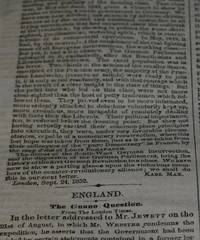
18521630New York: Greeley & McElrath 1852. First edition. With the article Revolution and Counter-Revolution in Germany on pp. 7–8. First edition. With the article Revolution and Counter-Revolution in Germany on pp. 7–8. Folded once. First sheet torn at spine. A few leaves with small tears at foldings. A tiny loss to a few letters with no effect on legibility on p. 7. Paper discolored. Chipped at edges. First edition. With the article Revolution and Counter-Revolution in Germany on pp. 7–8. 12 p. <p><br /> The ultimate article of the series of Revolution and Counter-Revolution in Germany written by Engels and published under the byline of Marx.<br /> <p><p><br /> Revolution and Counter-Revolution in Germany was written after Charles Dana the managing editor of the powerful progressive Republican newspaper the New-York Daily Tribune approached Karl Marx early in 1851 with the idea that he should contribute topical and historical writings to the newspaper. Dana and Marx met first in Germany some three years before when Dana reported the American press about the revolutionary movements in Europe. <br /> <p><p><br /> Marx being engaged in economic research was unable to fulfill the commission thus he asked his friend and co-thinker Friedrich Engels on August 14 1851 to write "a series of articles about Germany from 1848 onwardsâ€. MECW p. 629 “Engels agreed and in the course of thirteen months he wrote 19 articles about the German revolution of 1848–49. … Engels used as the main source of reference a file of the Neue Rheinische Zeitung apart from some additional material given him by Marx whom he constantly consulted and who read every article before mailing it.†MECW p. 629 <br /> <p><p><br /> In these articles Engels examines the economic basis and social development of Germany at the time of the Revolution shows that the uprising was defeated because of the liberal bourgeoisie and concludes that bold and resolute action is essential for the victory of a revolution. MECW pp. xiv–xv His “work lays down basic principles of Marxist teaching on armed insurrection. Engels formulates for the first time the idea that »insurrection is an art quite as much as war«â€. MECW p. xv<br /> <p><p><br /> The series was printed in the Tribune between October 25 1851 and October 23 1852 over the signature of Karl Marx the paper's official London-based correspondent. <br /> <p><p><br /> Until the correspondence between Marx and Engels was published in 1913 Revolution and Counter-Revolution in Germany was regarded as Marx’s text. Its first separate edition was prepared by Eleanor Marx-Aveling Marx’s daughter in 1896 and in the same year a German translation was also published. While in the Tribune the articles were printed under a general title and numbered in Roman figures in the book the articles are titled the present nineteenth piece bears the title The Close of the Insurrection.<br /> <p><p><br /> Bibl.: Marx/Engels Collected Works Vol 11. The Collected Works of Karl Marx and Friedrich Engels. The Collected Works of Karl Marx and Frederick Engels. Volume 11. Marx and Engels 1851–1853. <br /> <p>. [Greeley & McElrath] unknown
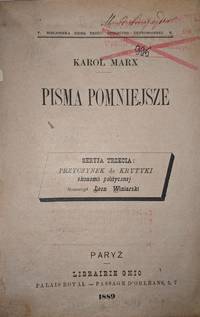
18891872Paryż Paris: Librairie Ghio 1889. First Polish edition. In contemporary half leather. Binding rubbed at extremities. Spine damaged at tail and head. With old private and institutional collection inscriptions and stamps. Paper yellowed due to aging. Rear panel restored by tape. First Polish edition. In contemporary half leather. 111 1 p. <p><br /> Pisma Pomniejsze the first Polish translation of the essay The Contribution to the Critique of Political Economy appeared in the series of “Biblioteka dzieł treści społeczno-ekonomicznej†an early series of social economical works initiated and organized by Maria Jankowska-Mendelson 1850–1909 a Polish emigré publicist and socialist activist in Paris correspondent and friend of Friedrich Engels.<br /> <p><p><br /> The book includes explanations by Léon Winiarski 1865–1915 a pioneer Marxist social economist.<br /> <p>. Librairie Ghio unknown
1827224671827/26. Caroliruhe & Badae Apud D.R. Marx 1827 8° XX 153 pp.; 1826 XII 51 pp. orig. Broschur; unaufgeschnittenes feines Expl. Wichtige Geschichte der Infektionskrankheiten! Karl Friedrich Heinrich Marx 1796-1877 "Verdienst liegt hauptsächlich auf dem Gebiete der historischen Medizin . und zeigen ausserdem wie einzelne pathologisch-historische Untersuchungen insbesondere der 'Origines contagii' einen grossen Schatz der Belesenheit und Gelehrsamkeit in welchem Marx unbezweifelt die meisten seiner Zeitgenossen überragte." Hirsch IV p.155f. "has dealt with this subject exhaustively and considers that the most ancient traces of the opinion that disease may be communicated by touch is found among the customs of Egyptians and Jaws." Bulloch p. 4 Karl Friedrich Heinrich Marx 1796-1877 "geboren am 10. März 1796 zu Karlsruhe studirte von 1813 in Heidelberg wo 1817 seine akademische Preisschrift: "Diatribe anatomico-physiologica de structura atque vita venarum" Karlsruhe 1819 gekrönt wurde. In Wien wohin er zu ferneren Studien gezogen war wurde er auf Requisition der preuss. Regierung wegen seiner Betheiligung an burschenschaftlichen Bestrebungen verhaftet und 9 Monate im Kerker gehalten. Nachdem er 1820 in Jena Dr. med. geworden ging er nach Göttingen wo er zunächst Accessist an der Universitätsbibliothek wurde und 1822 pro venia legendi disputirte. In Göttingen hat er als Arzt akademischer Lehrer und Schriftsteller bis zu seinem am 2. October 1877 erfolgten Tode gewirkt. Er wurde 1826 a. o. 1831 ord. Prof. 1840 Hofrath. In der ersten Periode seiner Lehrthätigkeit trug er besonders Geschichte der Medicin und allgem. und spec. Pathologie vor in den letzten Jahrzehnten fast ausschliesslich Arzneimittellehre ohne jedoch in letzterem Fache von historischen Forschungen abgesehen jemals eine eigene Untersuchung ausgeführt zu haben und ohne jemals ein Verständniss der physiolog. und ehem. Pharmakodynamik der Neuzeit zu erlangen. Seine "Grundzüge der Arzneimittellehre" Stuttgart 1876 sind ohne Bedeutung; dagegen ist sein Werk: "Die Lehre von den Giften in medic. gerichtl. und polizeil. Hinsicht" Göttingen 1827 wenn es auch keine eigenen Beobachtungen enthält von nicht zu unterschätzendem Werthe indem es sine auf ausgedehntes Studium der reichen Schätze der Göttinger Bibliothek gegründete allgemeine Geschichte der Giftlehre bildet wie sie die Literatur keines anderen Landes besitzt und es ist sehr zu bedauern dass der von Marx vorbereitete specielle Theil dieses Buches wegen des nicht ausreichenden buchhändlerischen Erfolges des allgemeinen den Flammen überliefert wurde. Ueberhaupt liegt Marx's hauptsächlichstes Verdienst auf dem Gebiete der historischen Medicin und seine in den Abhandlungen der Göttinger Societät erschienenen und auch separat herausgegebenen zahlreichen Aufsätze über alte Aerzte oder der Medicin nahestehende Personen Herophilus Theophbast Conring Caspar Hofmann Daniel Ludwig Georg Heinisch Haller Leibniz Antonio della Torre Leonardo da Vinci u. A. m. sind ebenso wie seine Nekrologe von Blumenbach und Stieglitz mit denen ihn enge Freundschaft verband lesenswerth und zeigen ausserdem wie einzelne pathologisch-historische Untersuchungen insbesondere der "Origines contagii" Karlsruhe 1824 und die "Additamenta ad Origines contagii" Ebenda 1826 einen grossen Schatz von Belesenheit und Gelehrsamkeit in welchen Marx unbezweifelt die meisten seiner Zeitgenossen überragte. Auch seine nicht rein historischen Schriften geben davon durchgängig Kunde. Daneben macht sich in denselben namentlich aber in den Arbeiten der früheren Lebensperiode originelle Auffassung und selbständiges oft vom Hergebrachten abweichendes Urtheil geltend. Die Originalität des Urtheils documentirt sich abgesehen von den bereits erwähnten historischen Abhandlungen über Herophilus und Pabacelsus auch in seinen ausserordentlich zahlreichen Recensionen von denen die Mehrzahl nicht weniger als 485 in den Göttinger gelehrten Anzeigen erschienen ist; vergl. darüber seine Schrift: "Ueber die Wirksamkeit der Göttinqischen gelehrten Anzeigen und meine Theilnahne an denselben" Göttingen 1863; ferner im Vereine mit scharfer Beobachtung in seinen "Erinnerungen an England" Braunschweig 1842. Auf eigener Beobachtnng beruht zum Theil auch seine Monographie der Cholera asiatica: "Die Erkenntniss Verhütung und Heilung der ansteckenden Cholera- Karlsruhe 1831 indem Marx sich zum Studium der Krankbeit zu FRICKE in Hamburg begeben hatte wo er die in seiner Schrift niedergelegte Ueberzeugung von der Contagiosität der Affectionen gewann. Seine übrigen auf die spec. Pathologie bezüglichen Schriften. "Zur Lehre der Lähmungen der unteren Gliedmassen" Ebenda 1838 - "Ueber die Anfälle mit dem. Gefühle des Verscheidens Angina pectoris" Göttingen 1872 sind von geringerer Bedeutung. Eine medicinische Topographie Göttingens 1824 hat vorwaltend localen Werth. Der Standpunkt welchen Marx in der allgemeinen Pathologie einnimmt ist ein durchaus selbständiger indem er in seiner "Allgemeinen Krankheitslehre" Göttingen 1833 wie auch später in seinen "Grundzügen der Lehre von der Krankheit und Heilung" Karlsruhe 1838 sich von einseitigem Dynamismus und Materialismus sowohl als von einseitiger Solidar- und Humoralpathnlogie freihielt. Wenn diese Bücher schon den originellen Denker charakterisiren so ist dies noch mehr der Fall mit der Fülle allgemeinmedicinischer Abhandlungen die Marx im Laufe seiner Thätigkeit veröffentlichte und welche die Beziehungen des Arztes zum Collegen zum Publicum im Allgemeinen zu diversen Künsten und Wissenschaften zum Staate u.s.w. zum Vorwurfe haben. Echte Humanität trieb schon früh Max zu dem Interesse für die "Euthanasie" über welche 1826 im Programm zum Antritt der Professur schrieb; sie bildet die Basis seiner Abhandlung "Ueber die Abnahme der Krankheiten durch die Zunahme der Civilisation" Göttingen 1844 und "Ueber das Verdienst der Aerzte um das Verschwinden der dämonischen Krankheiten" Ebenda 1859 von denen die letztere nach Form und Inhalt seine vollendetste Arbeit ist. Die von Marx in seiner eigenen in seinem Jünglings- und Mannesalter sehr ausgedehnten ärztlichen Praxis gewonnene Erkenntniss dass der Arzt nicht bloss als Heilkünstler sondern auch als Mensch am Krankenbette eine segensreiche Wirkung habe die er nur ausüben könne. wenn er die nöthigen sittlichen Eigenschaften dazu besitze ist zuerst im "Akesios. Blicke in die ethischen Beziehungen der Medicin" Ebenda 1848; engl. Uebers. von John Mackness 2 Aufl. ausgesprochen. Dieser Satz ist auch die Grundidee von "Beiträge zur Beurteilung von Personen Ansichten und Thatsachen" 1868 "Mittheilunqen über Zwecke Leiden und Freuden und Gedachtes. Ein Lesebuch für Kranke und Gesunde" 1868. Obwohl die wohlwollende und edle Tendenz dieser Bestrebungen nicht verkannt werden darf so sind dieselben doch nicht im Stande "Marx dem Einzigen" wie sein Schüler H. ROHLFS in seinem rosig gefärbten Panegyricus auf seinen Lehrer Geschichte der deutschen Medicin I 1875 pag. 323 genannt hat die ihm von seinem Biographen vindicirten Ansprüche auf den Titel eines "Gründers der ethischen Medicin" zuzugestehen. Nachweislich hat das literarische "ethische Streben von Marx einen irgendwie wesentlichen und dauernden praktischen Erfolg nicht gehabt. Seine literarische Bizarrerie steht übrigens im Einklänge mit allerlei Sonderbarkeiten in Bezug auf Umgangsformen Leben und Lebensgewohnheiten welche Marx in den letzten 25 Jahren zur Schau trug und die verbunden mit den von ihm häufig verfochtenen antiquirten Anschauungen in Bezug auf alle möglichen Gegenstände den "alten Marx" in seinem Wirkungsbezirke als Sonderling qualificirten. Selbst in den Kreisen der Göttinger Universität und der med. Facultät in welchen Marx abgesehen von persönlichen Beweggründen wegen seiner prononcirten Abneigung gegen jede Neuerung gegen pathologische Anatomie und physiologische Chemie gegen Institute welche nach seiner Ansicht die Freiheit des akademischen Lehrers beschränkten nicht beliebt war ist daher der Kern der Wahrheit in ROHLF'S allerdings übertriebener und daher der Satire alsbald anheimgefallener vergl. K. GOEDEKE in Allg. Zeitg. 1875 10. Beil. Würdigung von Marx's Verdiensten kaum anerkannt worden. Marx starb unverheirathet an den Folgen eines Darmkrebses und hinterliess sein beträchtliches Vermögen seinem Biographen." Th. Husemann Hirsch-H. IV pp.105-107 siehe - Schriftenverzeichniss Bei Bohlfs. - H. Hirsch ADB XX p. 540 Garrison & Morton No.2531 unknown
1899123720Rome: Luigi Mongini 1899-1902. Marx in Italian First edition a bound volume of 12 Italian translations of works by Marx issued by Luigi Mongini in parts each work separately paginated but continuously signed. "1899 would mark a further qualitative leap in the publication of Marx and Engels's texts in Italy reaching a particular peak in the years between 1899 and 1902. This was the most important attempt thus far to provide socialism and Italian culture with the greater part of the works by Marx and Engels that were then available. The publication in instalments of Marx Engels and Lassalle's Works later appearing as a collection thanks to the collaboration of important ancient historian Ettore Ciccotti and socialist publisher Luigi Mongini would doubtless represent 'Italian culture's only true and substantial approach to Marx. until after the Second World War'" Favilli pp. 213-4. Of the 12 translations present bound as listed below all but two are listed in Sraffa: those not are Rivelazioni sul processo dei Comunisti in Colonia 1900 and La guerra civile in Francia 1902. a MARX Carlo. Le Discussioni del sesto Landtag delle provincie Renane 1842. 1899. b -. Un Carteggio del 1843. Per la Critica della filosofia del diritto di Hegel. Per la questione degli Ebrei 1844. 1899. c -. Per la Critica dell'economia politica 1859. 1899. d -. Rivelazioni sul processo dei Comunisti in Colonia 1852. 1900. e -. L'Alleanza della democrazia socialista e l'associazione internazionale dei lavoratori 1873. 1901. f -. Innanzi ai giurati di Colonia. Processo contro il presidio della democrazia Renana. 1901. g -. Indirizzo inaugurale dell'associazione internazionale dei lavoratori 1864. 1901. h -. Per la critica del programma della democrazia socialista 1875. 1901. i -. Miseria della filosofia 1847. 1901. j -. La guerra civile in Francia 1870-1. 1902. k -. Il diciotto Brumaio di Luigi Bonaparte 1852. 1902. l -. Le lotte di classe in Francia dal 1848 al 1850 1850. 1902. Octavo 240 x 164 mm. Contemporary quarter roan and pebbled cloth boards vellum corners spine ruled and direct lettered gilt. Spine lettered "Marx: Opere vol. I" with the ownership of M. Giua stamped at foot occasional pencil annotation. Joints cracked but firm neat repair to foot of spine and to inner hinges contents foxed the leaf edges slightly brittle with a few closed tears overall a very good copy. See Paolo Favilli The History of Italian Marxism: From its Origins to the Great War 2016. hardcover
190073265Nantes: Emile Grimaud et fils 1900. Fine. Emile Grimaud et fils Nantes 30 juillet 1900 19.50 x 27.50 cm relié First edition illustrated with fifty-nine engravings on copper and wood by Auguste Lepère one of 220 numbered copies on pure Arches laid paper with the Nantes watermark the only issue this one printed specially for M. Join-Lambert. Full tawny calf binding spine with five raised bands date at foot boards richly decorated with a broad design of compartments interlacing and shells inlaid with green mahogany and black calf in the Renaissance taste silk moiré doublures framed with seven gilt fillets endpapers of matching silk covers and spine preserved top edge gilt slipcase with rubbed and peeling headcaps Art Nouveau binding signed with the monogram DLR at foot of first board. Our copy is enhanced with one of the destroyed wood-engraved plates from the first series ""Rue des Barres - Rue Grenier sur l'eau - Sortie de l'exposition"" given to the Nantes museum. Rare and very handsome copy perfectly executed in an elegant binding with Art Nouveau decoration. Emile Grimaud et fils hardcover
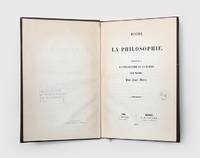
1847170758Paris: A. Frank & C. G. Vogler Brussels 1847. A comprehensive exposition of the materialistic conception of history First edition of Marx's caustic attack on Proudhon "the bitterest attack delivered by one thinker upon another since the celebrated polemics of the Renaissance" Isaiah Berlin one of 800 copies printed. In 1846 Proudhon had published his celebrated book La Philosophie de la Misère inviting Marx's response to it in a letter: "j'attends votre férule critique" I await your critical rod. Marx wasted no time in reading it and in writing a scathing reply to it in French thereby creating a permanent rift in their relationship. "The book is a masterpiece of polemical writing. It has also another and greater merit. In it we get the first approach to a comprehensive exposition of the materialistic conception of history. Here we find elaborated the theory that history must be interpreted in the light of economic development. The Misère de la Philosophie created a sensation in radical circles as might have been expected and added considerably to the fame of the author" Spargo. Octavo 225 x 144 mm pp. viii 178. Without the leaf of errata sometimes found. Contemporary maroon pebble-grain cloth spine ruled and direct lettered in gilt sides with double rule blind-stamped border marbled edges silk ribbon marker. Ownership stamp "O.G." to title page pencil ownership inscription E.S. dated 1966 with cost code and note signed E.E.S. dated 2005 to front free endpaper and half-title verso. Spine faded short split to head of front joint corners a little bruised. Endpapers a little browned and fragile short tear to lower margin of front free endpaper and half-title without loss; contents with very occasional light spotting; a very good copy. Die Erstdrucke der Werke von Marx und Engels p. 10; Draper M681; Rubel 55; Sraffa 3837. John Spargo Karl Marx: His Life and Work 1910. hardcover