212 résultats
1881RO40239198Stephan Geibel & Co., Altenburg. 1881. In-8. Broché. Etat d'usage, Livré sans Couverture, Dos abîmé, Intérieur acceptable. Plaquette de 26 pages. Etiquette de code et tampons de bibliothèque en page de titre. Petits manques sur les bords de la page de titre et de la dernière page.. . . . Classification Dewey : 430-Langues germaniques. Allemand
18489305AB1848. Göttingen Dieterich 1848. 4°. 99 S. Neuer Halblederband. Titel leicht fleckig und wasserrandig. Stellenweise geringfügig fleckig. Durchgehend dezent gebräunt sonst in sehr schöner Erhaltung. Aus dem vierten Bande der Abhandlungen der Königlichen Gesellschaft der Wissenschaften zu Göttingen. Karl Friedrich Heinrich Marx 1796-1877 las in Göttingen allgemeine und spezielle Pathologie sowie Arzneimittellehre. Sein 'hauptsächlichstes Verdienst liegt auf dem Gebiete der historischen Medicin seine in den Abhandlungen der Göttinger Societät erschienenen Aufsätze zeigen einen großen Schatz von Gelehrsamkeit' Hirsch/H. IV 105. unknown
1842003931Gottingen: Dieterich 1842. Bookplate of Charles Darember 19th-century French historian of medicine. Spine and corners worn. First Edition. Contemporary Marbled Wrappers. Good. Dieterich Paperback
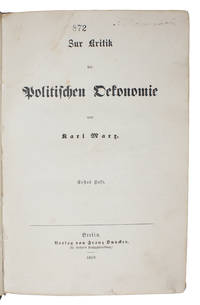
185958578Berlin, Franz Duncker, 1859. 8vo. Nice contemporary hafl calf with gilt lettering to spine. A bit of wear to extremities, markings after old label to front board and signs of vague damp staining to front board. A mostly faint damp stain to outer inner corner throrughout, but otherwise very nice. Title-page a bit dusty. Old library number (872) to front free end-paper and top of title-page and marginal pencil-annotations to a number of leaves. VIII, (2), 170 pp. Title-page with the ownership-signature of Alexander Appolonovich Manuilov to top of title-page and binding with his initials ""A. M."" in gold to the fot of spine.

185958578Berlin Franz Duncker 1859. 8vo. Nice contemporary hafl calf with gilt lettering to spine. A bit of wear to extremities markings after old label to front board and signs of vague damp staining to front board. A mostly faint damp stain to outer inner corner throrughout but otherwise very nice. Title-page a bit dusty. Old library number 872 to front free end-paper and top of title-page and marginal pencil-annotations to a number of leaves. VIII 2 170 pp. Title-page with the ownership-signature of Alexander Appolonovich Manuilov to top of title-page and binding with his initials "A. M." in gold to the fot of spine. <br/><br/><em>Scarce first edition in a magnificent association-copy of the groundbreaking work in which Marx first presents his revolutionizing theories of capitalism forming the foundation for his main work "The Capital" which appeared eight year later. It is also in this milestone of political and economic thought that Marx presents his economic interpretation of history for the first time.Alexander Appolonovich Manuilov 1861-1929 was a Russian economist and politician famous not only as one of the founding members of the Constitutional Democratic party known as the Kadets but also as the Russian translator of Marx' "Zur Kritik." i.e. the present work. "Manuilov graduated from the law department of the University of Novorossiia Odessa 1883. He began scholarly and pedagogical work in political economy in 1888. In 1901 he became head of a subdepartment at Moscow University becoming assistant rector in 1905 and serving as rector from 1908 to 1911. He was dismissed by the tsarist government for attacking the "extremes" of Stolypin’s agrarian legislation. In the 1890’s he was a liberal Narodnik Populist later becoming a Constitutional Democrat Cadet and a member of the Central Committee of the Cadet Party. Manuilov’s draft on agrarian reform 1905 was the basis for the Cadets’ agrarian program. V. I. Lenin sharply criticized Manuilov calling him one of "the bourgeois liberal friends of the muzhik who desire the ‘extension of peasant land ownership’ but do not wish to offend the landlords" Poln. sobr. soch. 5th ed. vol. 11 p. 126 note.At the beginning of his scholarly career Manuilov accepted the labor theory of value. In 1896 he translated K. Marx’ work A Contribution to the Criticism of Political Economy Zur Kritik der Politischen Oekonomie. During the years of reaction he espoused subjectivist and psychological views in political economy. In 1917 he was minister of education of the Provisional Government. After the October Revolution in 1917 he emigrated but soon returned and cooperated with Soviet power. He participated in the orthographic reform 1918. In 1924 he became a member of the board of Gosbank State Bank. He taught in higher educational institutions. Changing to Marxist positions and relying on Lenin’s works he criticized the revisionists and neo-Narodniks on the agrarian question." Encycl. Britt.For many years the exclusive focus on "Das Kapital" meant that the "Kritik" was overlooked. Since the beginning of the 1960's however scholars have become increasingly aware of its importance as the blueprint for the social and economic theory Marx shall go on to develop see for example Raymond Aron "Le Marxisme de Marx" 1962. It is here that Marx outlines the research programme to which he shall devote the rest of his working life. He himself described "Das Kapital" as a continuation of his "Zur Kritik der politischen Oekonomie" see e.g. PMM 359 in which his primary concern is an examination of capital and in which he provides the theoretical foundation for his political conclusions later presented in "Das Kapital". "I examine the system of bourgeois economy in the following order: capital landed property wage-labour; the State foreign trade world market.The economic conditions of existence of the three great classes into which modern bourgeois society is divided are analysed under the first three headings; the interconnection of the other three headings is self-evident. The first part of the first book dealing with Capital comprises the following chapters: 1. The commodity 2. Money or simple circulation; 3. Capital in general. The present part consists of the first two chapters." Preface to the present work in the translation by S.W. Ryazanskaya of the Progress Publishers-edition Moscow 1977.Apart from the obvious importance of the work as the foundational precursor to what is probably the greatest revolutionary work of the nineteenth century the "Kritik" is of the utmost importance in the history of political and economic thought as it is here in the preface that Marx outlines his classic formulation of historical materialism. This preface contains the first connected account of what constitutes one of Marx's most important and influential theories namely the economic interpretation of history - the idea that economic factors condition the politics and ideologies that are possible in a society."The first work which I undertook to dispel the doubts assailing me was a critical re-examination of the Hegelian philosophy of law; the introduction to this work being published in the Deutsch-Franzosische Jahrbucher issued in Paris in 1844. My inquiry led me to the conclusion that neither legal relations nor political forms could be comprehended whether by themselves or on the basis of a so-called general development of the human mind but that on the contrary they originate in the material conditions of life the totality of which Hegel following the example of English and French thinkers of the eighteenth century embraces within the term "civil society"; that the anatomy of this civil society however has to be sought in political economy. The study of this which I began in Paris I continued in Brussels where I moved owing to an expulsion order issued by M. Guizot. The general conclusion at which I arrived and which once reached became the guiding principle of my studies can be summarised as follows. In the social production of their existence men inevitably enter into definite relations which are independent of their will namely relations of production appropriate to a given stage in the development of their material forces of production. The totality of these relations of production constitutes the economic structure of society the real foundation on which arises a legal and political superstructure and to which correspond definite forms of social consciousness. The mode of production of material life conditions the general process of social political and intellectual life. It is not the consciousness of men that determines their existence but their social existence that determines their consciousness. At a certain stage of development the material productive forces of society come into conflict with the existing relations of production or - this merely expresses the same thing in legal terms - with the property relations within the framework of which they have operated hitherto. From forms of development of the productive forces these relations turn into their fetters. Then begins an era of social revolution. The changes in the economic foundation lead sooner or later to the transformation of the whole immense superstructure." Preface to the present work in the translation by S.W. Ryazanskaya of the Progress Publishers-edition Moscow 1977.The work is a summation of Marx' many years of economic studies mainly undertaken at the Reading Room of the British Museum and it constitutes the first attempt at a general outline of his theories. Like his "Capital" the "Critique" was originally planned as a work in several volumes but only this first volume appeared. The work which was printed in a mere 1000 copies is scarce and rarely seen on the market. </em> unknown
1898527481898. Leipzig Joahnn Ambrosius Barth 1898 8° 56 2 pp. 2 gefalt. Tab. orig. Broschur; mit eigenhändiger Widmung "s.l. Ernst Harald Schütz z. frdl. Erinnerung Erich Marx 1898.". Erich Anselm Marx 1874-1956 Physiker Hrsg. Handbuch der Radiologie. unknown
1827533421827. Hecker's Annalen 7. - Berlin im Verlagee von Theod. Christ. Friedr. Enslin 1827 8° VIII 512 pp. 1 Taf. Halbledereinband d.Zt.; feines Expl. Erstdruck! Auf Karl Friedrich Heinrich Marx 1796-1877 geht - mit Berufung auf Bacon als philosophischem Vordenker - die Begriffsfindung "Euthanasie" im unverfälschten Sinne eines Linderns des Sterbens zurück. Marx zufolge hat der Arzt die moralische Aufgabe dem Sterbenden durch Zuspruch Beistand und durch medikamentöse Milderung seiner Leiden das Sterben zu erleichtern. Eine solche "Todeslinderung" entsprach dem damaligen Zeitgeist doch wurde sie von Marx erstmals in den ärztlichen Pflichtenkanon aufgenommen. Marx betonte ebenso die Trennung der theologischen Seelsorge am Kranken von der psychischen Hinwendung und medikamentösen Betreuung durch den Arzt. "Wenn es so unabwendbar beschossen ist daß der Mensch wie jedes andere erschaffende Gebilde untergehe so fragt es sich was er thun kann um den letzten Ausgang wenn dieser nicht durch einen Schlag sondern allmählig heranrückt so erträglich und so leicht als möglich zu machen. Da er in so vielem Meister ist und so unzählige Künste erfunden hat so wird er ja wohl auch eine Kunst zu sterben besitzen und auch hierin eine Meisterschaft vor allen übrigen Geschöpfen behaupten. Der Philosoph und der Geistliche wissen für die Stunde wo der Wille nichts mehr vermag wo es im Geiste dunkelt und wo die Frage über die persönliche Fortdauer keinesweges gelöst wird vielen aufrichtenden Trost; um wie viel mehr mufs der Arzt der beständige Zuschauer des schmerzvollen Zustandes in der höchsten Zeit der Noth wo seine eigene Hoffnung gesunken ist und wo dennoch der Leidende von seiner Kunst um Hülfe fleht eine beruhigende und besänftigende Methode besitzen. Das ist denn die Euthanasie oder diejenige Kunst welche alle drängenden Symptome der Krankheit unterdrückt jeden schmerzlichen Zufall mäßigt und die Todesstunde die nicht abgewehrt werden kann so leicht als möglich vorbereitet." C.F.H. Marx unknown
1854322698Boston: Gould and Lincoln 1854. hardcover. very good. Small thick 8vo pebbled brown cloth spine faded. Boston: Gould and Lincoln 1854. Very good.<br/> <br/> Gift inscription in silver on flyleaf.<br/> <br/> Gould and Lincoln unknown
1856212495New York: Mason Brothers 1856. hardcover. poor. Musical notations throughout. 165pp. 8vo embossed cloth; top & bottom of spine chipped with pieces missing corners bumped & fraying front & back hinge cracking & some water damage to several pages not affecting text. New York: Mason Brothers 1856.<br/><br/> Mason Brothers unknown books
1856019246New York: Mason Brothers 1856. Hardcover. Good. 8vo - over 7¾" - 9¾" tall. 165 pages. The book has been rebound and has new paste downs and end papers. The boards are unevenly faded and chipped at the edges there is very intermittent foxing throughout the book; from page 275 to page 237 the pages jut out at the tail and the the outer edge and neatly handwritten at the head of the Publishers' advertisement Germany Home of Music Italy land of song. Land and onsg neatly underlined as is the line in the advert. also stating that Germany is the home of music. Overall the book is clean ans unmarked and thanks to the rebinding a solid copy which will easily last another 160 year plus. Not quite a very good copy but close enough. From the title page: "Translated from the third German edition and edited by Herrman S. Saroni. Fifth American edition with appendix and notes by Emilius Girac" "Adolph Bernhard Marx German was musical writer; born at Halle May 15 1799; died at Berlin May 17 1866.With Kullak and Stern Marx founded in 1850 the Berliner Musikschule now the Stern Musik Conservatorium one of the most prominent musical institutes of Berlin. Here he taught until 1856 when he resigned in order to devote himself entirely to literary and university work and to the teaching of composition. His long and intimate friendship with Mendelssohn was ultimately severed because of the latter's strictures upon Marx's compositions which indeed have not withstood the test of time. His musical writings however are far more valuable and include: "Ueber Malerei in der Tonkunst" 1828; "Die Lehre von der Musikalischen Komposition" Berlin 1837-1847 4 vols. ; several times reprinted;"Allgemeine Musiklehre" 1839; 9th ed. 1875; translated into English; "Die Musik des 19ten Jahrhunderts und Ihre Pflege" 1855; "Ludwig van Beethoven's Leben und Schaffen" 1858; 3d ed. 1875; "Gluck und die Oper" 1863 2 vols.; "Erinnerungen aus Meinem Leben" 1865 2 vols.; and several other writings of an analytical nature." Isidore Singer Joseph Sohn Jewish Encyclopedia <br/> <br/> Mason Brothers hardcover
18602010204NY.: Mason Brothers 1860. Blind stamped brown cloth. Front cover & cover edges heavily rubbed in several places to boards spine ends rubbed and chipping: VG-. 8vo. Musical notation. Translated from the third German edition & edited by Herman S. Saroni. Sixth American Edition with appendix & notes by Emilius Girac. Mason Brothers hardcover
185311London: Robert Cocks and Co 1853. First English language edition. Hardcover. Very Good. Some foxing to endpapers and inscription on front endpaper. Rebound in fawn cloth. Contents very good. Translated from the fifth edition of the original german Robert Cocks and Co hardcover
18522007160020Robert Cocles and Company 1852. Hardcover. Good with shelf wear/no dust jacket. Vol. 1 only/ 1st English edition translated from the 4th German edition Robert Cocles and Company hardcover
1900C33712London 1900. First Edition. Hardback. No Dust Jacket. Somewhat used copy: rubbing marks discolouration and staining to covers with slight foxing to title page - otherwise sound with complete text; good only. . 8vo. pp xix 195. Original publisher's red cloth lettered gilt on spine and black on the front cover. Title page printed in red and black. A reply to 'La Philosophie de la Misere' of M. Proudhon. Portrait frontispiece. hardcover
186154302London: Hardwicke 1861. Paperback. Good. 28p. Original wrapper. 21cm. Cover almost detached. Small library stamp on front. Browned at edges and rather brittle throughout. Consists of two articles from Fraser's Magazine for August 1856 and March 1861 under the titles "The Last Naval Campaign in the Pacific" and "Another Chapter on the Amoor." <br/><br/> Hardwicke paperback books
18881291947Ithaca N.Y.: Cornell University 1888. First Edition. Softcover. 8vo. 26 pages; VG; gold cover with grey print tear at lower spine edge mild spotting on front back cover and adjoining pages have slight fold in upper left corner cover beginning to separate from lower spine edge; clean inside; cover title: The Sigma XI Society 1888" 1291947. Rockville Non-Retail Listings. Cornell University unknown books
189923048ELondon: Leonard Smithers & Co 1899. First Edition. Number 298 of an edition limited to 1000 copies. Square quarto. Bound in original lavender cloth with gilt lettering at the spine and gilt decorative designs by Charles Shannon at the outer edges of the boards and the spine. A lovely copy with a trace of foxing a minor bump to the top corner of the front board some slight browning to the endpapers and very minor edgewear. From the library of Harpo Marx the great clown of the Marx Brothers comedy team and his wife actress Susan Fleming Marx former member of the Ziegfeld Follies and star of early talking films like Million Dollar Legs with W.C. Fields. With a charming bookplate illustrated by Susan Marx with a drawing of Harpo in his comic character which reads: “FROM THE LIBRARY OF HARPO & SUSAN MARX.†Leonard Smithers & Co hardcover books
1846450418Published by the Brook Farm Phalanx. New York: Burgess Stringer and Company. Boston: Redding and Company 1846. Hardcover. Very Good. Two volumes. Quartos 8¼" x 11¼". Both volumes are complete with 26 weekly issues. Vol. II: pp. iv 412 December 13 1845 – June 6 1846; Vol. III: pp. iv 412 June 13 1846 – December 5 1846. Bound in contemporary half morocco and marbled paper over boards gilt spines edges lightly sprinkled. Contemporary ownership signature of “W.B. Brown†on the front free endpaper of each volume. <br /> <br /> Both volumes are in very good condition with overall rubbing and some scuffing on the spine of vol. II scattered foxing and two early stitched repairs: on the lower corner of one leaf in vol. II pp. 201-202 and diagonally across one leaf in vol. III pp. 399-400.<br /> <br /> Two well-preserved volumes of George Ripley’s pioneering and important radical magazine. Published and printed at the utopian Brook Farm community in West Roxbury Massachusetts the magazine was well ahead of its time particularly in its advocacy of women's rights and featured in its pages many of the country's best critical and literary figures.<br /> <br /> As noted in a recent exhibition at Yale University America and the Utopian Dream the Brook Farm community was founded by George and Sophia Ripley in 1841 and “began as a product of the transcendentalist movement and a showplace for Christian socialism. The commune had more than 120 members at its highest point†including a young Nathaniel Hawthorne “and was widely regarded as an intellectual center. After four years of existence however the members changed its purpose to that of a Fourierist phalanx. When the headquarters of Fourierism moved from New York City to Brook Farm in 1845 the Fourierist Magazine the Phalanx was renamed the Harbinger to be published on the Brook Farm printing press.â€<br /> <br /> The Harbinger received the full-time attention of Ripley and his associates Charles A. Dana and John S. Dwight. Dana later achieved celebrity as editor of the New York Sun and Dwight went on to become one of the earliest and foremost music critics in the United States. The magazine offered an alternative to transcendentalists who admired Emerson’s romantic perfectionism but rejected his belief in renovation through individualism and self-culture. The contributors to the Harbinger instead emphasized social reform and cooperation which would elevate the individual while benefiting the entire community; the magazine quickly became the most important "Associationist" journal in America.<br /> <br /> Also included among the many notable contributors in addition to Ripley Dana and Dwight are Albert Brisbane who first introduced the theories of Charles Fourier in the United States; William H. Channing a key figure in the early years of the woman's rights movement; and M.E. Lazarus an important American individualist anarchist who advocated for free love.<br /> <br /> The original owner of both volumes “W.B. Brown" was related to John Stillman Brown a Unitarian minister and member of Brook Farm who acted as instructor in Theosophical and Practical Agriculture. J.S. Brown was the husband of Mary Ripley George Ripley's cousin. Volume three has two additional small owner's signatures written in light pencil on the outer margin of p. 70: "Mary G. Brown"; and p. 68: "E.H. Brown".<br /> <br /> An attractive scarce set of two consecutive volumes in the original bindings. Published by the Brook Farm Phalanx. New York: Burgess, Stringer, and Company. Boston: Redding and Company hardcover
1897105014London: Swan Sonnenschein & Co 1897. First edition in English of this collection of letters and articles by Karl Marx dealing with the events of the Crimean War. Octavo original cloth with gilt titles to the spine folding map in color at rear. Edited by Eleanor Marx Aveling and Edward Aveling. In very good condition with light rubbing. A very sharp example. Marx's theories about society economics and politics--collectively understood as Marxism--hold that human societies develop through class struggle. In capitalism this manifests itself in the conflict between the ruling classes known as the bourgeoisie that control the means of production and working classes known as the proletariat that enable these means by selling their labor power in return for wages. Employing a critical approach known as historical materialism Marx predicted that like previous socioeconomic systems capitalism produced internal tensions which would lead to its self-destruction and replacement by a new system: socialism. For Marx class antagonisms under capitalism owing in part to its instability and crisis-prone nature would eventuate the working class' development of class consciousness leading to their conquest of political power and eventually the establishment of a classless communist society constituted by a free association of producers. Marx actively fought for its implementation arguing that the working class should carry out organised revolutionary action to topple capitalism and bring about socio-economic emancipation. Swan Sonnenschein & Co hardcover books
1897787J4London: Swan Sonneschein & Co. 1897. First edition. Cloth. Very Good. 9" by 6". Not Stated. A first edition copy of this important work on the Crimean War by Karl Marx. An uncommon work. A collection of letters articles written from 1853 to 1856 by Karl Marx during the Crimean War concerning the disintegration of the Ottoman Empire and Russian imperialism towards Turkey. The Crimean War was a military conflict fought from October 1853 to February 1856 in which Russia lost to an alliance of France the Ottoman Empire the United Kingdom and Sardinia. The immediate cause of the war involved the rights of Christian minorities in Palestine which was part of the Ottoman Empire. According to Karl Marx's writings around the Crimean War the main factor of the Eastern Question was Russian imperialism towards Turkey - with Turkey being a barrier that would protect the rest of Europe and thus England's interests laid with the Ottoman Empire during the Crimean War. Including an introduction by Eleanor Marx Aveling and Edward Aveling. Also including two folding maps one to the front and one to the rear. Bound in the publisher's original cloth binding. Externally smart with a few marks to the front board and slight bumping to head and tail of spine. Prize bookplate to the front pastedown. A small tear in the binding on the spine. Internally binding slightly strained but remaining firm throughout. Internally slight discolouration to the front and rear pastedown and front and rear free-endpapers. Pages bright and clean. Very Good Swan Sonneschein & Co. hardcover
1897021518Swan Sonnenschein & Co 1897. Hardcover. Fair. Hardcover book in fair condition wear at edges slight scuffing on covers bumps on corners and tanning on spine. Pages yellowing foxing on first several pages and at edges throughout foxing also on last several pages and fold-out maps at back cracked spine. Otherwise a lovely copy. Questions welcome. We ship internationally from the United States and Canada every week. If buying internationally please be aware that additional charges may apply for heavier books. We guarantee a safe quick and secure transaction. 10 years in online bookselling experience. <br/> <br/> Swan Sonnenschein & Co hardcover
187158474High Holborn, for the Council by Edward Truelove, 1871. Small 8vo. Near contemporary quarter cloth with silver lettering to front board. Binding with signs of use, but overall good. One closed marginal tear and title-page with a few brownspots, otherwise very nice and clean. 35 pp.
187158474High Holborn for the Council by Edward Truelove 1871. Small 8vo. Near contemporary quarter cloth with silver lettering to front board. Binding with signs of use but overall good. One closed marginal tear and title-page with a few brownspots otherwise very nice and clean. 35 pp. <br/><br/><em>Exceedingly rare first edition with the names of Lucraft and Odger still present under "The General Council" of one of Marx' most important works his seminal defense of the Paris Commune and exposition of the struggle of the Communards written for all proletarians of the world. While living in London Marx had joined the International Working Men's Association in 1864 - "a society founded largely by members of Britain's growing trade unions and designed to foster international working class solidarity and mutual assistance. Marx accepted the International's invitation to represent Germany and became the most active member of its governing General Council which met every Tuesday evening first at 18 Greek Street in Soho and later in Holborn. In this role Marx had his first sustained contact with the British working class and wrote some of his most memorable works notably "The Civil War in France". A polemical response to the destruction of the Paris Commune by the French government in 1871 it brought Marx notoriety in London as 'the red terror doctor' a reputation that helped ensure the rejection of his application for British citizenship several years later. Despite his considerable influence within the International it was never ideologically homogenous. homas C. Jones: "Karl Marx' London".The work was highly controversial but extremely influential. Even though most of the Council members of the International sanctioned the Address it caused a rift internally and some of the English members of the General Council were enraged to be seen to endorse it. Thus for the second printing of the work the names of Lucraft and Odger who had now withdrawn from the Council were removed from the list of members of "The General Council" at the end of the pamphlet. "Marx defended the Commune in a bitterly eloquent pamphlet "The Civil War in France" whose immediate effect was further to identify the International with the Commune by then in such wide disrepute that some of the English members of the General Council refused to endorse it." Saul K. Padover preface to Vol. II of the Karl Marx Library pp. XLVII-XLVIII."Written by Karl Marx as an address to the General Council of the International with the aim of distributing to workers of all countries a clear understanding of the character and world-wide significance of the heroic struggle of the Communards and their historical experience to learn from. The book was widely circulated by 1872 it was translated into several languages and published throughout Europe and the United States." The Karl Marx ArchiveMarx concluded "The Civil War in France" with these impassioned words which were to resound with workers all over the world: "Working men's Paris with its Commune will be forever celebrated as the glorious harbinger of a new society. Its martyrs are enshrined in the great heart of the working class. Its exterminators history has already nailed to that eternal pillory from which all the prayers of their priests will not avail to redeem them."The address which was delivered on May 30 1871 two days after the defeat of the Paris Commune was to have an astounding effect on working men all over the world and on the organization of power of the proletarians. It appeared in three editions in 1871 was almost immediately translated into numerous languages and is now considered one of the most important works that Marx ever wrote. " "The Civil War in France" one of Marx's most important works was written as an address by the General Council of the International to all Association members in Europe and the United States.From the earliest days of the Paris Commune Marx made a point of collecting and studying all available information about its activities. He made clippings from all available French English and German newspapers of the time. Newspapers from Paris reached London with great difficulty. Marx had at his disposal only individual issues of Paris newspapers that supported the Commune. He had to use English and French bourgeois newspapers published in London including ones of Bonapartist leanings but succeeded in giving an objective picture of the developments in Paris. .Marx also drew valuable information from the letters of active participants and prominent figures of the Paris Commune such as Leo Frankel Eugene Varlin Auguste Serraillier Yelisaveta Tornanovskaya as well as from the letters of Paul Lafargue Pyotr Lavrov and others.Originally he intended to write an address to the workers of Paris as he declared at the meeting of the General Council on March 28 1871. His motion was unanimously approved. The further developments in Paris led him however to the conclusion that an appeal should be addressed to proletarians of the world. At the General Council meeting on April 18 Marx suggested to issue "an address to the International generally about the general tendency of the struggle." Marx was entrusted with drafting the address. He started his work after April 18 and continued throughout May. Originally he wrote the First and Second drafts of "The Civil War in France" as preparatory variants for the work and then set about making up the final text of the address.He did most of the work on the First and Second drafts and the final version roughly between May 6 and 30. On May 30 1871 two days after the last barricade had fallen in Paris the General Council unanimously approved the text of "The Civil War in France" which Marx had read out."The Civil War in France" was first published in London on about June 13 1871 in English as a pamphlet of 35 pages in 1000 copies. Since the first edition quickly sold out the second English edition of 2000 copies was published at a lower price for sale to workers. In this edition i.e. MECW Marx corrected some of the misprints occurring in the first edition and the section "Notes" was supplemented with another document. Changes were made in the list of General Council members who signed the Address: the names of Lucraft and Odger were deleted as they had expressed disagreement with the Address in the bourgeois press and had withdrawn from the General Council and the names of the new members of the General Council were added. In August 1871 the third English edition of "The Civil War in France" came out in which Marx eliminated the inaccuracies of the previous editions.In 1871-72 "The Civil War" in France was translated into French German Russian Italian Spanish Dutch Flemish Serbo-Croat Danish and Polish and published in the periodical press and as separate pamphlets in various European countries and the USA. It was repeatedly published in subsequent years.In 1891 when preparing a jubilee German edition of "The Civil War in France" to mark the 20th anniversary of the Paris Commune Engels once again edited the text of his translation. He also wrote an introduction to this edition emphasising the historical significance of the experience of the Paris Commune and its theoretical generalisation by Marx in "The Civil War in France" and also giving additional information on the activities of the Communards from among the Blanquists and Proudhonists. Engels included in this edition the First and Second addresses of the General Council of the International Working Men's Association on the Franco-Prussian war which were published in subsequent editions in different languages also together with "The Civil War France". Notes on the Publication of "The Civil War in France" from MECW Volume 22. Only very few copies of the book from 1871 on OCLC are not explicitly stated to be 2nd or 3rd editions and we have not been able to find a single copy for sale at auctions within the last 50 years. </em> hardcover
1865PW1079London:: Longman Green Longman Roberts & Green 1865. 1865. Five parts in one volume. 8vo. xiv 2 406 22 10 pp. 4 plates 2 folding; a few pages roughly opened first few leaves nicked on outer margin archival repairs. Original half dark purple morocco marbled boards gilt-lined raised bands gilt spine title top edge gilt; upper corner dented. Occasional pencil marginalia. Library sticker/label removed from ffep. Very good. First editions in English. Johann Friedrich Blumenbach was a German naturalist and anthropologist whose work on comparative anatomy greatly impacted the development of anthropology as a science in the 19th century. He was invited to examine Egyptian mummies at the British Museum. He did six dissections. "Blumenbach. . believed he could deduce all manner of details – race sex and beauty – from the smooth calciferous plates of the human skull. What he bel`ieved he found in terms of racial types was decidedly intermediate. The maxillae bones of the upper jaw were 'prominent but by no means so much as a true Guinea face; and not more so than is often seen on handsome negroes and not seldom on European countenances.'" - Michael F. Robinson The Lost White Tribe: Explorers Scientists and the Theory that Changed a Continent. Oxford University Press 2016. Contents: Memoir of the author; On the Natural Variety of Mankind; Contributions to Natural history; Remarks on an Hippocratic Macrocephalus; An account of the Blumenbachan Museum;. . On the varieties of man 1775 by Hunter. The physician and lecturer Karl Friedrich Heinrich Marx here contributes a biography of Blumenbach. Professor Wagner gives an account of the Blumenbachan Museum. Longman, Green, Longman, Roberts & Green, 1865. hardcover books
18105338Strasbourg Levrault 1810. 1st Edition . Hardcover. . ~ ~ NOTE: THE PRICE OF THIS BOOK IS CURRENTLY REDUCED! ~ ~ . Octavo. Pp. iii 156 consisting of 78 double-page tables vi. Handsome vignette of a mounted knight to title-page. HARDCOVER bound in contemporary quarter morocco and matching paper-covered boards vellum French corners spine gilt black morocco lettering-pieces gilt old expert mend to joint pink ribbon marker; spine-ends bit worn minor spot or two. In a very good condition. A clean tight copy well preserved. ~ FIRST EDITION. Extremely rare. I-4 OUT <br/> <br/> Strasbourg, Levrault hardcover