MARX, Karl, & Friedrich EngelsBiblio.com
130 résultats
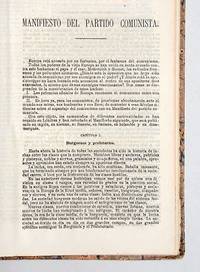
1872135988Madrid: de la viuda é hijos de Alvarez November-December 1872. The first appearance in Spanish of the Communist Manifesto First appearance of the Communist Manifesto in Spanish published within six issues of La Emancipación the official organ of the New Madrid Federation of the International. Issued every Saturday as a four-page folio news sheet the text of the Manifesto was printed in two columns across the lower half of each page of numbers 72-77 with separate pagination effectively printed as two pages on the lower portion of each page designed to be cut out and kept as a booklet with other texts following in later numbers. The Manifesto itself fills 22 pages with two additional texts "La Propriedad" 16 pages and "Manifesto inaugural de la Asociación internacional de los trabajadores" 7 pages continuing in later issues our copy of the journal ends with number 80 page 14 of "La Propriedad". The paper ceased publication with number 91 The translator José Mesa co-founder of the Internationale in Spain based his translation of sections I and II on a French text revised by Engels that had appeared in Le Socialiste in New York in 1872. Sections III and IV were translated from the German edition of 1872 Andréas 72 as well as the authors' preface of 24 June 1872. Andréas notes that there are a small number of changes omissions and free translations concluding that this first Spanish translation of the Manifesto is not absolutely complete. WorldCat and Andréas together locate just 5 copies at the National Library of Spain the Feltrinelli Foundation in Milan the Marx-Lenin Institute in Moscow the International Institute of Social History in Amsterdam and the Karl Marx Haus Friedrich Ebert Stiftung in Trier. 6 numbers bound in a vol. of the first 80 numbers of La Emancipación beginning with number 1 19 June 1871. Folio 410 x 475 mm. Contemporary brown cloth-backed marbled paper boards spine unlettered edges sprinkled red. Head of front joint split rear joint slightly rubbed with some wear. Tax stamp to final few numbers occasional marking repair to first leaf obscuring text bound without number 67; in very good condition. Andréas Le Manifeste Communiste de Marx et Engels 74. hardcover
1884248178Berlin : Otto Janke 1884. Fourth Edition. Hardcover. Good copy in the original publisher's gilt-blocked and blind-bordered cloth edges very slightly toned. Some wear and tear as with age. Corners sharp with an overall tight bright and clean impression. Physical description; 2 v. : ill. music facsims. part fold. ; 24 cm. Notes; ""Verzeichniss der werke Beethovens"": Vol. 2 p. 417-445. Subject; Beethoven Ludwig van 1770-1827. Genres; Bibliography. Biography. Illustrated. Berlin : Otto Janke hardcover
19003733039Henri Laurens 1900. This is an ex-library book and may have the usual library/used-book markings inside.This book has hardback covers. In good all round condition. No dust jacket. Please note the Image in this listing is a stock photo and may not match the covers of the actual item1300grams ISBN: Henri Laurens hardcover
1897104981Paris: Societe de Propagation des Livres d'Art. 1897. Tall quarto half-leather binding with marbled sides title in gilt to spine within raised bands eleven heliogravure plates with tissue guards and many similigravure illustrations in text pp.62. i Index decorated endpapers. Scraping to boards. Ex-library with stamps in text and to reverse side of plates but none to the plate side. Good condition. Rare first edition. An illustrated study of medals awarded in nineteenth-century post-revolutionary plates following the Storming of the Bastille 14 July 1789 with striking photogravure plates. Includes medals by Augustin Dupre Pierre-Simon-Benjamin Duvivier Nicolas Marie Gatteaux Jean Jacues Barre et al. Uncommon. 1st Edition. Half leather. Societe de Propagation des Livres d'Art hardcover
18973733541Societe de Propagation des Livres d'Art 1897. This is an ex-library book and may have the usual library/used-book markings inside.This book has hardback covers. In good all round condition. No dust jacket. 4to. Red library cloth with gilt titles to spine. Spine sunned and exterior moderately soiled. Secure binding. Pages clean. Illustrated. Please note the Image in this listing is a stock photo and may not match the covers of the actual item750grams ISBN: Societe de Propagation des Livres d'Art hardcover
1897222685Paris: Societe de Propagation des Livres d'Art 1897. First. hardcover. very good. 11 heliographs and many text illustrations. Slim 4to 63 pages green cloth backed marbled boards with the original printed wrappers bound in gilt spine withtan leather spine label. Paris: Societe de Propagation des Livres d'Art 1897. First Edition. Very good .<br/> <br/> Societe de Propagation des Livres d'Art unknown
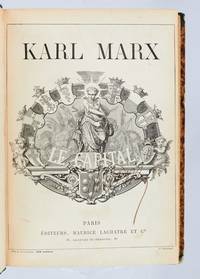
187247305Paris: Maurice Lachatre et Cie 1872-1875. First French Edition. Large octavo 28.5cm.; original parts bound in early 20th century blue cloth gilt-lettered spine; 351pp.; pictorial half title and title pages full-paged steel-engraved portrait and facsimile additional vignettes throughout; text printed in double column. Boards a bit rubbed and corners bumped foxing and toning to preliminaries as well as minor dampstaining to last few leaves of text light foxing to rear cover; overall Very Good and sound. First appearance in French of Marx's "Das Kapital" the translation the only such to have been executed with the collaboration of the author whose letter to Lachatre appears in facsimile on p. 7: "J'applaudis à votre idée de publier la traduction de 'Das Kapital' en livraisons périodiques. Sous cette forme l'ouvrage sera plus accessible à la classe ouvrière et pour moi cette considération l'emporte sur toute autre" "I congratulate you on your idea to publish the translation of 'Das Kapital' as a periodical. In this format the work should be more accessible to the working class and to me this is more important than all else" our translation. Maurice Lachatre 1814-1900 was a Parisian radical bookseller publisher and collaborator of Félix Pyat's with whom Marx butted heads over the growth of the International Working Men's Association in France. Lachatre's projected publication of the anarchist newspaper "La Commune" nearly cost him his life after the fall of the Paris Commune when his bookshop was attacked with murderous intent by the Versaillaise army see "The Publisher's Weekly" Vol. 19 1881 pp. 50-1. It was while exiled first in Belgium and then Switzerland that Lachatre began work on publishing the present edition though he was not free to return to Paris until 1879. Maurice Lachatre et Cie unknown
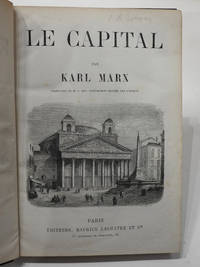
1872017495Paris: Lachatre 1872-75. Un volume 185x29 cm di 351-1 pagine. Senza la seconda delle due pagine di titolo; il volume si presenta dunque così: pagina di titolo con illustrazione raffigurante la Repubblica francese con nome e indirizzo dell'editore e le indicazioni 1ere livraison e Prix de la livraison: dix centimes; ritratto di Marx; facsimile della lettera di M. a Lachatre; risposta di Lachatre a Marx. A pag. 9 comincia la prefazione e a pag. 13 il testo del Capitale. Poche fioriture o ingialliture sparse. Legatura in mezza pelle coeva con usure; qualche usura anche ai piatti con carta marmorizzata angoli acciaccati. Sorprendente la provenienza del volume: sulla pagina di titolo infatti timbretto della Biblioteca del Grand Seminaire de Perigueux !. Prima tiratura della prima edizione della traduzione francese del Capitale apparsa in fascicoli tra l'agosto del 1872 e il novembre 1875. Famosa traduzione curata dallo stesso Marx che ne sottolineava il valore scientifico indipendente dall'originale consigliandola anche ai lettori familiari della lingua tedesca. Opera diventata rara a causa anche della pubblicazione in fascicoli in un arco di tempo assai lungo tre anni e degli ostacoli frapposti dall'autorità alla sua diffusione. Una seconda edizione che riprese la stessa traduzione e in gran parte gli stessi piombi venne pubblicata poi nel 1885 sotto l'indicazione "Librairie du Progres". La mancanza della seconda pagina di titolo con la raffigurazione del Pantheon di Roma si riscontra anche in altri esemplari e ciò ha fatto supporre che possa essere una caratteristica delle copie costituite dalla raccolta dei singoli fascicoli che si presentavano appunto con una copertina cartacea che i legatori poi eliminavano come quelle delle altre livraisons. Vicende dell'edizione: Dopo varie ricerche e contatti venne contattato Joseph Roy a Bordeaux traduttore di libri di Feuerbach. Ci lavorò dal febbraio 72 alla fine del 73. Marx si tenne in contatto ma non era molto contento la traduzione era troppo letterale si incontrarono una sola volta e Roy non piacque a Marx. Come editore fu contattato Maurice Lachatre 1814-1900 rifugiato in Spagna dopo la Comune che accettò stimando la spesa in 4000 franchi di cui metà dovevano venire da Marx li pagò Paul Lafargue e il 15 febbraio 1872 venne firmato il contratto. Frequenti contatti dell'editore con Marx al quale chiese di poter pubbicare uno scambio di lettere in facsimile e il ritratto. Nessuna pubblicità al libro per evitare la censura. La prima serie di 5 fascicoli 40pp uscì il 17 settembre 1873 e vendette in un mese 576 copie. Le serie 2 3 4 5 e 6 fascicoli da 6 a 30 uscirono nel 1873. Altre due serie 7 e 8 solo nel 1875. L'ultima serie la 9 era in preparazione quando Lachatre perse i diritti legali sulla sua casa editrice che furono passati a un certo Quest un reazionario che accettò di stamparla solo per evitare problemi legali coll'autore. Uscì alla fine di novembre del 1875. Quest aveva ridotto la tiratura degli ultimi fascicoli. Di quanto Non si sa. Poi Oriol che aveva preso di fatto il posto di Lachatre decise di ristampare il Capitale avendo a disposizione le copie invendute dei primi fascicoli: ne ristampò gli ultimi venne modificata la sequenza di inizio abolite le lettere e sostituito il nome dell'Editore con Librairie du Progrés. La ristampa ebbe circa 5000 copie di tiratura e fu messa in circolazione nel 1885. La struttura e il testo dell'edizione francese sono diversi da quelli delle edizioni tedesche ma Marx considerò avere quella francese un valore a se stante e la consigliò per i traduttori in altre lingue. Anna Uroeva La fortuna del Capitale. Lachatre unknown
187585992Paris: Librairie du Progrès - Directeur Maurice Lachatre & Cie 1875. Fine. Librairie du Progrès - Directeur Maurice Lachatre & Cie Paris s. d. 1875 19.50 x 28 cm relié First edition in French translated by Joseph Roy partly previously unpublished with corrections and additions by Karl Marx. Complete with the two title pages addressed to Lachatre a frontispiece portrait of Karl Marx the facsimile of his letter to the publisher and his reply on the verso removed from later editions. Simple contemporary bronze half-cloth binding smooth spine framed in gilt gilt title bookbinder's ticket at foot of the pastedown ""Buchbinderei Schey & Co Zürich"". This first French edition of 'Das Kapital' was published in parts between 1872 and 1875 but met with no success as the publisher writes in a letter to Marx dated 24 December 1873: ""Sales are nil on your book . The print run is 1100 copies almost all still in store"". Unsold quires were partly reassembled and offered in bound paperback volumes in early 1876. As the book was barely finished booksellers were already sabotaging distribution. In June 1879 La Châtre wrote to Marx: ""There are still three hundred copies left of the last parts printed at a thousand copies. We would therefore have sold only 600 or 700 copies in a span of six years. It is a very sad result."" This was a major disappointment for Karl Marx who had put a great deal of effort into this French edition the only translation he personally edited and last one published in his lifetime. Marx ""wished to leave a mark with Le Capital in French theoretical and political debates strongly influenced by the legacy of Proudhon in a country where the International was more effectively organized than anywhere else and whose capital had 'set itself up as a Commune'. In France Le Capital was in a way the epilogue to a long theoretical and political debate begun in French twenty years earlier with the first polemic against Proudhon. . In 1872 Marx simultaneously corrected and revised Joseph Roy's translation and reworked the first German edition in preparation for the second edition published by Meissner. This twofold work constantly intersecting with each other is partly responsible for the many differences that remain between German texts of the 2nd and even later editions and the French version which Marx was correcting separately and simultaneously. At each stage of the process preparation of the original text for Roy correction of the proofs for Meissner correction of the translation sent by Roy correction of the proofs sent by the printer Marx made changes much to the despair of the printers. For many authors this division of labor into different phases would result in a large number of small variants. For Marx it encouraged a tendency that didn't need encouraging the tendency to perpetual rewriting to palimpsest."" Jean-Pierre Lefebvre introduction to the 1983 reprint of Le Capital published by Editions Sociales. On 28 April 1875 Karl Marx makes additions to a notice to the reader that would appear in the last issue on p. 348 stating his involvement in this French version and its importance within his work: ""M. J. Roy's scrupulous translation has forced me to modify the wording with the aim of making it more accessible to the reader. Since the book was published in separate parts these changes were made one after the other and were carried out with uneven attention to detail resulting in stylistic discrepancies. Having once undertaken this revision work I was led to apply it also to the substance of the original text the second German edition to simplify some developments to complete others to give additional historical or statistical material to add critical insights and so on. Whatever the literary imperfections of this French edition it has a scientific value independent of the first edition and should be read even by readers familiar with the German language"". Our copy was undoubtedly acquired by a fellow countryman Librairie du Progrès - Directeur Maurice Lachatre & Cie paperback
1872#10<p></p><p><strong>Karl Marx. </strong></p><p><strong>Le Capital.</strong> Traduction de M. J. Roy entièrement révisée par l'auteur.</p><p><em>Paris Librairie du Progrès 1872-1875.</em></p><p>English binding by Thompson Bros. Black half sheepskin with corners.</p><p>First edition of the French translation.</p><p>Presentation copy signed by Karl Marx in black ink on the title : <em>" To his friend Dakyns / Lond. 8 Oct. </em><em>Karl Marx ".</em></p><p>With 13 autograph corrections by the hand of Marx in black ink.</p><p><strong>Very precious copy inscribed to John Daykins a "born-communist".</strong></p><p>John Roche Daykins 1836-1910 was an English geologist who was in relations with Friedrich Engels.</p><p>Marx met him in 1869 and spoke of him as a <em>"marvelous compagnon".</em></p><p>Inscribed copies of the French edition of <em>Das Kapital</em> are scarce and the personality of the dedicatee makes this copy most precious.</p> Librairie du Progrès
1893131793Paris: Guillaumiin & Cie. 1893. First edition of this selection from Marx's Capital published in the series Petite bibliothèque économique française et étrangère the product of a surprising collaboration. Lafargue a founder of the French socialist party and later Marx's son-in-law of all the French Marxist writers closest to German orthodoxy made the selection of the extracts. Pareto whose economic and sociological views by no means coincided with those of Marx provided the lengthy introduction. Small octavo. Frontispiece portrait of Marx with tissue guard. Original brown cloth spine and front board lettered in black. Spine ends and corners bumped and lightly rubbed cloth bright and clean front inner hinge expertly repaired contents evenly browned as typical for the paper stock upper tip of rear free endpaper strengthened with Japanese tissue. A very good copy in its original binding. Einaudi 3771; Mattioli 2285; Sraffa 3881. hardcover
1899135235Pisa: Enrico Spoerri 1899. First edition of Gentile's study of Marx's philosophy from the library of Léon Brunschwicg. Octavo 233 x 155 mm. Contemporary calf-backed marbled paper boards spine ruled and lettered gilt. Bookplate of French philosopher Léon Brunschvicg to front pastedown with his occasional pencil and crayon markings. Leaf edges a little browned; a very good copy. hardcover
1896106260Paris: Floury 1896-01-01. Leather Bound. Very Good. 0x0x0. 12 issues bound in quarter leather text is in French. December 1896 December 1897 images throughout. Original wrappers bound in rear. oversized and overweight. D47 Please email for photos. Paris: Floury hardcover
189738951Paris: Floury 1897. A COMPLETE PROOF SET ON CHINESE PAPER before all letters of all of the relief prints executed for the July issue--the ninth of twelve published--of L'Image a groundbreaking artistic and literary journal. Numerous wood-engravings and woodcuts including A FINE PROOF ON CHINE OF LABOUREUR'S "AU LUXEMBOURG" Laboureur I 572 his first important print. Laboureur was 19 when this issue came out and its publication marked his being recognized as a consequential artist. This copy exceptionally includes A "FUME" early proof OF THE WOOD-ENGRAVING AFTER THOMAS LAWRENCE SIGNED IN PENCIL BY BELTRAND AND JUSTIFIED "Fumé nº 1". Folio. Printed wraps illustrated iwth art nouveau wood engravings after Berthon and De Feure. Stitching loose else FINE AND BRIGHT. Ray 321 and 321A. <br/><br/> Floury paperback
18731526Londres London; Hambourg Hamburg: A. Darson; Otto Meissner 1873. First edition. The original printed wrappers bound into later half cloth. Old faint collection stamps on wrappers and title page. The front wrapper and first leaf with traces of creasing. Wrappers and first and last two leaves dusted. A stain at the upper corner of the first four leaves one leaf with a whole due to the stain which only affects the margin. Overall in very good condition. First edition. The original printed wrappers bound into later half cloth. 4 137 1 p. <p><br /> A scarce copy of the renowned Alliance Pamphlet whose conclusion was written by Karl Marx.<br /> <p><br /> <p><br /> This report the so-called Alliance Pamphlet is a collection of documents and writings related to the International Alliance of Socialist Democracy written compiled and edited by Friedrich Engels Paul Lafargue and Karl Marx. <br /> <p><br /> <p><br /> The Alliance was a semi-secret subgroup of the International Workingmen's Association IWA; First International founded and led by Mikhail Bakunin the Russian revolutionary anarchist. The International sought to extrude the sectarian Alliance from the organization since its establishment in late 1868. Eventually at the Hague Congress 1872 the leaders of the International exposed the public and clandestine activities of the group and expelled its chief leaders Bakunin and James Guillaume from the IWA. The Congress appointed a committee which included Marx Engles and Lafargue to edit and publish the documents related to the Alliance. “The bulk of the work involved in the collection of additional material its comparison and analysis was carried out by Engels and Paul Lafargue. The concluding part of the pamphlet was written by Marx†see Collected Works 44. p. 665 note 623. In his letter dated on 26 July 1873 to Adolph Sorge Engels wrote: “Lafargue and I wrote it i.e. the Pamphlet together; only the conclusion is by Marx and myselfâ€. Collected Works 44. p. 521. The book appeared in French in the fall of 1873 and soon it was translated into German under a somewhat more tendentious title “Ein Complot gegen die Internationale Arbeiter-Associationâ€. <br /> <p><br /> <p><br /> Bibl.: The Collected Works of Karl Marx and Friedrich Engels. The Collected Works of Karl Marx and Frederick Engels. Letters 1844–1895. Volume 44. Charlottesville Va.: InteLex Corporation 2001. <br /> Rubel 726.; Stammhammer I 3.<br /> <p>. A. Darson; Otto Meissner unknown
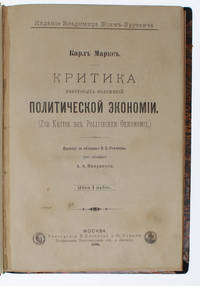
189659587Moscow Izdanie Vladimira Bonch-Bruevicha 1896. 8vo. In a later modest black half calf binding with marbled boards. Traces of stamp to verso of front and back board. Title-page slightly rubbed. Occassional underlignings in text and margins. Pp. 145-146 reinforced in margin. Otherwise a fine copy. XII 4 1-160 pp. <br/><br/><em>Exceedingly rare first Russian translation of this groundbreaking work in which Marx first presents his revolutionizing theories of capitalism. For years the present work was largely overshadowed by ‘Das Kapital’ and despite being published 8 years earlier The original being published in 1859 ‘Das Kapital’ in 1867 the present work was not translated until ‘Das Kapital’ had made Marx a household name in socialist and revolutionary circles making the present translation comparatively early the first English translation being from 1904.The Russian censorship cut Marx’ preface in this first translation - the full text did not appear until the revolutionary decade of 1905-1917. This Manuilov/Rumiantsev-translation remained the canonic-translation throughout the Soviet rule. The translation was made by Bolshevik revolutionary Petr Rumiantsev 1870-1924 who left the party in 1907 and emigrated in 1918 but the success of the present translation is primarily due to editor Manuilov. Editor Alexander Appolonovich Manuilov 1861-1929 was a Russian economist and politician famous not only as one of the founding members of the Constitutional Democratic party known as the Kadets but also as the Russian translator of the present work. "Manuilov graduated from the law department of the University of Novorossiia Odessa 1883. He began scholarly and pedagogical work in political economy in 1888. In 1901 he became head of a subdepartment at Moscow University becoming assistant rector in 1905 and serving as rector from 1908 to 1911. He was dismissed by the tsarist government for attacking the "extremes" of Stolypin's agrarian legislation. In the 1890's he was a liberal Narodnik Populist later becoming a Constitutional Democrat Cadet and a member of the Central Committee of the Cadet Party. Manuilov's draft on agrarian reform 1905 was the basis for the Cadets' agrarian program. V. I. Lenin sharply criticized Manuilov calling him one of "the bourgeois liberal friends of the muzhik who desire the 'extension of peasant land ownership' but do not wish to offend the landlords" Poln. sobr. soch. 5th ed. vol. 11 p. 126 note."At the beginning of his scholarly career Manuilov accepted the labor theory of value. In 1896 he translated K. Marx' work A Contribution to the Criticism of Political Economy Zur Kritik der Politischen Oekonomie. During the years of reaction he espoused subjectivist and psychological views in political economy. In 1917 he was minister of education of the Provisional Government. After the October Revolution in 1917 he emigrated but soon returned and cooperated with Soviet power. He participated in the orthographic reform 1918. In 1924 he became a member of the board of Gosbank State Bank. He taught in higher educational institutions. Changing to Marxist positions and relying on Lenin's works he criticized the revisionists and neo-Narodniks on the agrarian question." Encycl. Britt. For many years the exclusive focus on "Das Kapital" meant that the "Kritik" was overlooked. Since the beginning of the 1960's however scholars have become increasingly aware of its importance as the blueprint for the social and economic theory Marx shall go on to develop see for example Raymond Aron "Le Marxisme de Marx" 1962. It is here that Marx outlines the research programme to which he shall devote the rest of his working life. He himself described "Das Kapital" as a continuation of his "Zur Kritik der politischen Oekonomie" see e.g. PMM 359 in which his primary concern is an examination of capital and in which he provides the theoretical foundation for his political conclusions later presented in "Das Kapital". "I examine the system of bourgeois economy in the following order: capital landed property wage-labour; the State foreign trade world market. The economic conditions of existence of the three great classes into which modern bourgeois society is divided are analysed under the first three headings; the interconnection of the other three headings is self-evident. The first part of the first book dealing with Capital comprises the following chapters: 1. The commodity 2. Money or simple circulation; 3. Capital in general. The present part consists of the first two chapters." Preface to the present work in the translation by S.W. Ryazanskaya of the Progress Publishers-edition Moscow 1977. Apart from the obvious importance of the work as the foundational precursor to what is probably the greatest revolutionary work of the nineteenth century the "Kritik" is of the utmost importance in the history of political and economic thought as it is here in the preface that Marx outlines his classic formulation of historical materialism. This preface contains the first connected account of what constitutes one of Marx's most important and influential theories namely the economic interpretation of history - the idea that economic factors condition the politics and ideologies that are possible in a society. "The first work which I undertook to dispel the doubts assailing me was a critical re-examination of the Hegelian philosophy of law; the introduction to this work being published in the Deutsch-Franzosische Jahrbucher issued in Paris in 1844. My inquiry led me to the conclusion that neither legal relations nor political forms could be comprehended whether by themselves or on the basis of a so-called general development of the human mind but that on the contrary they originate in the material conditions of life the totality of which Hegel following the example of English and French thinkers of the eighteenth century embraces within the term "civil society"; that the anatomy of this civil society however has to be sought in political economy. The study of this which I began in Paris I continued in Brussels where I moved owing to an expulsion order issued by M. Guizot. The general conclusion at which I arrived and which once reached became the guiding principle of my studies can be summarised as follows. In the social production of their existence men inevitably enter into definite relations which are independent of their will namely relations of production appropriate to a given stage in the development of their material forces of production. The totality of these relations of production constitutes the economic structure of society the real foundation on which arises a legal and political superstructure and to which correspond definite forms of social consciousness. The mode of production of material life conditions the general process of social political and intellectual life. It is not the consciousness of men that determines their existence but their social existence that determines their consciousness. At a certain stage of development the material productive forces of society come into conflict with the existing relations of production or - this merely expresses the same thing in legal terms - with the property relations within the framework of which they have operated hitherto. From forms of development of the productive forces these relations turn into their fetters. Then begins an era of social revolution. The changes in the economic foundation lead sooner or later to the transformation of the whole immense superstructure." Preface to the present work in the translation by S.W. Ryazanskaya of the Progress Publishers-edition Moscow 1977. OCLC lists merely three copies all in the US Havard Wisconsin and Hoover Institute on War. </em> hardcover
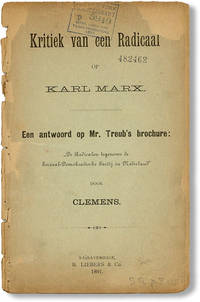
189143347's-Gravenhage: B. Liebers & Co 1891. First Edition. Octavo 20cm.; publisher's green wrappers; 53pp. Ex-NYPL with their usual markings wrappers and textblock exceedingly brittle and toned due to poor paper stock lacking rear cover. Good only. The Dutch syndicalist author's study of Marx published a year before his translation of The Communist Manifesto the first to appear in Dutch. Though this title is not institutionally uncommon in Europe OCLC locates no copies in North America as of January 2019. B. Liebers & Co unknown
1839MASTER243835IANTWERP: DEWEVER BROTHERS. G IN MARBLED BOARDS W/BLACK LEATHER SPINE. TEXT IN DUTCH. Pages: 339. . 1839. HARDCOVER. MARBLED EPS. HEAVILY EDGEWORN. LIGHTLY SCUFFED & SOILED. PREV. OWNER NOTATIONS ON 1ST BLANK. TEXT CLEAN BINDING INTACT. . DEWEVER BROTHERS hardcover
187322869AB1873. Göttingen Dieterich 1873. 4°. 48 S. OPp. etwas fingerfl. bzw. bestoßen Rücken unauffällig überklebt. unknown
190031504Reading PA: Communist Co-operative Association. c 1900. First Printing. Ephemera. Wooden Karl Marx Cigar Box c. 1944 with a full color cameo portrait of Karl Marx with Economist at the foot of the cameo. At the upper left corner is 6¢ imposed on a shield. A green wreath surrounds the sides and bottom of the portrait and to the wreath are appended a rolled manuscript and book on each side of the portrait. The decorations of the entire panel are embossed in gilt. Beneath the portrait in large type is Strictly Hand Made.The entire label extends below the box lid into the inner rear panel of the box itself. Here are printed Karl Marx Economist beneath which is The Commonwealth Co-Operative Assn Reading PA. ¶¶ A thin ribbon with Karl Marx repeating covers every edge of the cigar box and each end carries Karl Marx in large type. The top of the box is stamped Karl Marx in black as is the front of the box. A tax stamp is visible at the lower left edge of the top and left edge of the front panel. It is this stamp that suggests the date of 1944 but the fact that the Cigarworkers International Local 236 absorbed the Communist Co-operative Association in 1905 suggests a date prior to 1905 rather than the 1944 suggested by the tax stamp.Historical Note: The Communist Co-operative Association was a Socialist collective and their Karl Marx 5¢ cigars were made on the second floor of the Labor Lyceum Hall in ReadingPA. In 1905 they were absorbed by the Cigarworkers International Local 236 also in Reading PA . A good example but with darkened wood at top and miscellaneous stains on the outside of the lid and the front panel. ; 8¼ x 5 5/8 x2 3/8" . Communist Co-operative Association unknown
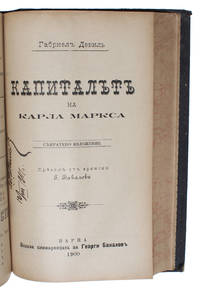
190057116Varna 1900. 8vo. In contemporary half calf with four raised bands to spine. Extremities with wear. Frontboard missing parts of cloth. Two bands on spine missing some of the leather. Verso of front free end paper with notes in contemporary hand and previous owner's name to title-page of all three works. A few occassional marginal lignings in pencil otherwise internally good and clean. Predpostavkit na sotsializma i zadachitu.: XII 257 1 XIV pp. Marksovata Istoricheska Teoria: 86 2 pp. Kapitalutu: IV 5-284 pp. <br/><br/><em>The exceedingly scarce first Bulgarian edition of the most important abridged version of Marx's Capital ever to have appeared published five years before the first partial translation and whole 9 years before the first full Bulgarian translation. Translator Christian Rakovsky later became head of Soviet Ukraine and leader of the left opposition in the Soviet Union after 1928 was one of Trotsky's few intimate friends."The epitome here translated was published in Paris in 1883 by Gabriel Deville possibly the most brilliant writer among the French Marxians. It is the most successful attempt yet made to popularize Marx's scientific economics. It is by no means free from difficulties for the subject is essentially a complex and difficult subject but there are no difficulties that reasonable attention and patience will not enable the average reader to overcome. There is no attempt at originality. The very words in most cases are Marx's own words and Capital is followed so closely that the first twenty-five chapters correspond in subject and treatment with the first twenty-five chapters of Capital. Chapter XXVI corresponds in the main with Chapter XXVI of Capital but also contains portions of chapter XXX. The last three chapters-XXVII XXVIII and XXIX-correspond to the last three chapters-XXXI XXXII and XXXIII-of Capital." ROBERT RIVES LA MONTE Intruductory Note to the 1899 English translation.Translator Christian Rakovsky dominated the socialist movement in the Balkans during the two decades before the first world war and was probably the most influential character in spread of socialism in Europe. Trotsky wrote of him: " Ch.G. Rakovsky is internationally one of the best known figures in the European Socialist movement" and G.D.H. Cole wrote in The Second International "No other Socialist spans the Balkans in the same way as Rakovsky nor is there any of comparable importance."In 1913 Rakovsky was an organizer and leader of the Rumanian Socialist Party which later joined the Communist International. The party was showing considerable growth. Rakovsky edited a daily paper which he financed as well."He received his initial education at Kotel. At the age of fourteen in a period when as he says in his Autobiography in this volume "even the youngest students were passionately interested in politics" he was excluded from all Bulgarian schools after organizing a school riot which it took a company of soldiers to suppress. After a year in his father's house "reading indiscriminately everything that came to hand" he was readmitted to school only to be expelled again after a year this time for good. The occasion this time was his collaboration with his friend and mentor E. Dabev one of the veterans of the Bulgarian revolutionary movement. Dabev 1864-1946 edited the first marxist weekly in Bulgaria in 1886. He published in it Marx's Wage Labour and Capital. In 1890 already a marxist Rakovsky aided Dabev in preparing the publication of Engels's Development of Scientific Socialism in particular in adapting Vera Zasulich's introduction to Bulgarian conditions. In this final year in school Rakovsky also produced with a friend a clandestine newspaper called Zerkalo "Mirror" which his Autobiography describes as having "something of everything: Rousseau's educational ideas the struggle between rich and poor the misdeeds of teachers etc. ." He was now seventeen years old. That same year he left Bulgaria to study medicine in Geneva."In Geneva in 1892 Rakovsky began to edit and publish the Bulgarian journal Social Democrat which not only in its title but also in its contents resembled the Russian journal. Jointly with his companion Savva Balabanov and with the active collaboration of Plekhanov Rakovsky continued the journal for two years. Social Democrat grouped around itself in Bulgaria the supporters of the Bulgarian Social Democratic Union. This group opposed itself to the Bulgarian Social Democratic Party founded in 1891 by Dimitar Blagoev who led the left wing of the movement and later in 1919 the Bulgarian Communist Party and made the full translation of Das Kapital in 1909. Fagan Biographical Introduction to Christian Rakovsky.OCLC list no copies. </em> hardcover
188555207København Copenhagen 1885-87. 4to. In contemporary half cloth with gilt lettering to spine. Even browning as usual due to the paper quality. An envelope pasted on to front free end-paper containing Danish articles on Marx. Previous owner's name to title-pages. A fine and clean copy with both half-titles present "Socialistisk Bibliotek" Vol. IV-V. Vol 1: 2 473 1; Vol 2: VII; 1; 4 363 1 pp. <br/><br/><em>First edition of the first Danish translation of "Das Kapital". The translation is remarkable in several respects - the Danish Social-democratic party was one of the first labour organizations in the world to publish the two volumes of "The Capital" the translation of the first volume preceded both the English and the Italian and the translation of the second volume is the second in the world to appear only preceded by the Russian from 1885 - furthermore these two translations were the only two to appear of volume two until after Engels' death in 1895. After having been in a serious crisis at the end of the 1870'ies the labour movement in Denmark turned things around in the 1880'ies primarily with the aid of Marx. Marx' theories and his connection between theoretical and practical politics became the foundation for the Social Democrats. In 1884 the Danish Social Democratic Party got its two first members of parliament elected and many workers wished to become politically active. Also in Denmark the class struggle had properly begun.As Marx was the foundation for the beginning success of the Social Democrats the Party decided that it would translate and publish all the most important works by Marx - of course most importantly "The Capital". This translation was to become "a new and powerful weapon for the Danish Labour Party in the agitation for the socialist principles". The translation of "The Capital" was made by the linguist and journalist Hans Vilhelm Lund 1840-1893 who worked at the paper Social-Demokraten in the 1880'ies and 90'ies. The translation is famed for being extremely true to the original and virtually flawless. In order to reach as wide a relevant audience as possible the price was kept as low as it could be. It still constituted a full day's wages for a skilled worker namely 2 kroner - still about 1/7 of the German edition. In spite of all the efforts to distribute the translation it did not become a bestseller and in 1911 the remainders were issued with a new title-page in 1911. PMM 359 - first edition. </em> hardcover
1885122813Copenhagen: N. Cohens Bogtrykkeri 1885 & 1887. Capital in Danish First edition in Danish of Das Kapital. Marx's seminal work first appeared in German in 1867 and the first translation of the work was that into Russian 1872. The first English translation appeared after the Danish in 1887. "The history of the twentieth century is Marx's legacy. Stalin Mao Che Castro - the icons and monsters of the modern age have all presented themselves as his heirs. Whether he would recognise them as such is quite another matter. Nevertheless within one hundred years of his death half the world's population was ruled by governments that professed Marxism to be their guiding faith. His ideas have transformed the study of economics history geography sociology and literature. Not since Jesus Christ has an obscure pauper inspired such global devotion - or been so calamitously misinterpreted" Francis Wheen in his introduction to Karl Marx 1999. 2 vols in 1 quarto. Modern red buckram spine lettered in gilt top edge sprinkled black. Without the half-titles "Socialistisk Bibliotek Vol. IV-V". Previous ownership inscription in blue ink to front free endpaper with the quotation "The expropriators are expropriated. p. 462 I" inscribed underneath in red ink; library stamp to vol. 2 p. 1. Spine slightly faded ends a little bruised and rubbed contents evenly browned with some chipping to page edges as usual due to paper quality front and rear gutters and several page edges neatly reinforced using Japanese tissue overall a very good clean copy of a fragile publication. See Printing and the Mind of Man 359 first edition. hardcover
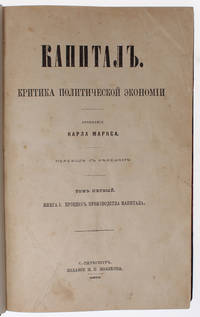
187260281S.-Peterburg N.I. Poliakov 1872. Large 8vo. In a nice recent half calf binding with gilt lettering to spine and five raised bands. First few leaves with light soling and a closed tear and a few marginal repairs to title-page. pp. 11-18 with repairs to upper outer corner. Closed tears to last leaf otherwise a fine copy. XIII 3 678 pp. wanting the half-title. <br/><br/><em>First Russian edition first issue with the issue-pointers being the first translation into any language of Marx' immensely influential main work probably the greatest revolutionary work of the nineteenth century.Marx' groundbreaking "Das Kapital" originally appeared in German in 1867 and only the first part of the work appeared in Marx' lifetime. The very first foreign translation of the work was that into Russian which considering Russian censorship at the time would seem a very unlikely event. But as it happened "Das Kapital" actually came to enjoy greater renown in Russia than in any other country; for many varying reasons it won a warm reception in many political quarters in Russia and it enjoyed a totally unexpected rapid and widespread success. The first Russian translation of "Das Kapital" came to have a profound influence the economic development of of Russia. It was frequently quoted in the most important economic and political discussions on how to industrialize Russia and the essential points of the work were seen by many as the essential questions for an industrializing Russia. " "Das Kapital" arrived in Russia just at the moment that the Russian economy was recovering from the slump that followed Emancipation and was beginning to assume capitalist characteristics. Industrialization raised in the minds of the intelligentsia the question of their country's economic destiny. And it was precisely this concern that drew Mikhailovsky and many of the "intelligenty" to "Das Kapital"." Resis p. 232.The story of how the first printing of the first translation of "Das Kapital" came about is quite unexpected. As the "triumph of Marxism in backward Russia is commonly regarded as a historical anomaly" Resis p. 221 so is the triumph of the first Russian edition of "Das Kapital". The main credit for the coming to be of the translation of "Das Kapital" must be given to Nicolai Danielson later a highly important economist in his own right. The idea came from a circle of revolutionary youths in St. Petersburg including N.F. Danielson G.A. Lopatin M.F. Negreskul and N.N. Liubavin all four of whom participated in the project. Danielson had read the work shortly after its publication and it had made such an impact on him that he decided to make it available to the Russian reading public. He persuaded N.I. Poliakov to run the risk of publishing it. "Poliakov the publisher specialized in publishing authors Russian and foreign considered dangerous by the authorities. Poliakov also frequently subsidized revolutionaries by commissioning them to do translations for his publishing house. Diffusion of advanced ideas rather than profit was no doubt his primary motive in publishing the book." Resis p. 222. Owing to Danielson's initiative Poliakov engaged first Bakunin and then Lopatin to do the translation. Danielson himself finished the translation and saw the work through press. It was undeniably his leadership that brought Marx to the Russian reading public. In fact with the first Russian edition of "Das Kapital" Danielson was responsible for the first public success of the revolutionizing work. "Few scholars today would deny that "Das Kapital" has had an enormous effect on history in the past hundred years. Nonetheless when the book was published in Hamburg on September 5 1867 it made scarcely a stir except among German revolutionaries. Marx complained that his work was greeted by "a conspiracy of silence" on the part of "a pack of liberals and vulgar economists." However desperately he contrived to provoke established economists to take up "Das Kapital"'s challenge to their work his efforts came to nought. But in October 1868 Marx received good news from an unexpected source. From Nikolai Frantsevich Danielson a young economist employed by the St. Petersburg Mutual Credit Society came a letter informing Marx that N. P. Poliakov a publisher of that city desired to publish a Russian translation of the first volume of "Das Kapital"; moreover he also wanted to publish the forthcoming second volume. Danielson the publisher's representative requested that Marx send him the proofs of volume 2 as they came off the press so that Poliakov could publish both volumes simultaneously. Marx replied immediately. The publication of a Russian edition of volume 1 he wrote should not be held up because the completion of volume 2 might be delayed by some six months in fact it did not appear in Marx' life-time and was only published ab. 17 years later in 1885; and in any case volume 1 represented an independent whole. Danielson proceeded at once to set the project in motion. Nearly four years passed however before a Russian translation appeared. Indeed a year passed before the translation was even begun and four translators tried their hand at it before Danielson was able to send the manuscript to the printers in late December 1871." Resis pp. 221-22. This explains how the book came to be translated but how did this main work of revolutionary thought escape the rigid Russian censors "By an odd quirk of history the first foreign translation of "Das Kapital" to appear was the Russian which Petersburgers found in their bookshops early in April 1872. Giving his imprimatur the censor one Skuratov had written "few people in Russia will read it and still fewer will understand it." He was wrong: the edition of three thousand sold out quickly; and in 1880 Marx was writing to his friend F.A. Sorge that "our success is still greater in Russia where "Kapital" is read and appreciated more than anywhere else." PMM 359 p.218. Astonishingly Within six weeks of the publication date nine hundred copies of the edition of three thousand had already been sold."Under the new laws on the press "Das Kapital" could have been proscribed on any number of grounds. The Temporary Rules held for example that censorship must not permit publication of works that "expound the harmful doctrines of socialism or communism" or works that "rouse enmity and hatred of one class for another." The Board of Censors of Foreign Publications was specifically instructed to prohibit importation of works contrary to the tenets of the Orthodox Church or works that led to atheism materialism or disrespect for Scriptures. Nor did the recent fate of the works of Marx and Engels at the hands of the censors offer much hope that "Das Kapital" would pass censorship. As recently as August 11 the censors of foreign works had decided to ban importation of Engels' "Die Lage der arbeitenden Klassen in England" and according to Lopatin the censors reprimanded Poliakov for daring to run announcements on book jackets of the forthcoming publication of "Das Kapital". By 1872 the censors had prohibited the importation and circulation of all works by Marx and Engels except one - "Das Kapital". The book as we shall see had already won some recognition in Russia shortly after its publication in Germany. Not until 1871 however did the censors render a judgment on the book when the Central Committee of Censors of Foreign Publications on the recommendation of its reader permitted importation and circulation of the book both in the original language and in translation. The official reader had described the book as "a difficult inaccessible strictly scientific work" implying that it could scarcely pose a danger to the state. . The length and complexity of the book prompted the office to divide the task of scrutinizing it between two readers D. Skuratov who read the first half of the book and A. De-Roberti who read the last half. Skuratov dutifully listed objectionable socialist and antireligious passages taking special note of Marx's harsh attack on the land reforms General Kiselev had instituted in the Danubian Principalities. But in his report Skuratov dismissed these attacks as harmless since they were imbedded in a "colossal mass of abstruse somewhat obscure politico-economic argumentation." Indeed he regarded the work as its own best antidote to sedition. "It can be confidently stated" he wrote "that in Russia few will read it and even fewer will understand it." Second he said the book could do little harm. Since the book attacked a system rather than individual persons Skuratov implied that the book would not incite acts threatening the safety of the royal family and government officials. Third he believed that the argument of the book did not apply to Russia. Marx attacked the unbridled competition practiced in the British factory system and such attacks Skuratov asserted could find no target in Russia because the tsarist regime did not pursue a policy of laissez faire. Indeed at that very moment Skuratov stated a special commission had drafted a plan that "as zealously protects the workers' well-being from abuses on the part of the employers as it protects the employers' interests against lack of discipline and nonfulfillment of obligations on the part of the workers." Repeating most of Skuratov's views De-Roberti also noted that the book contained a good account of the impact of the factory system and the system of unpaid labor time that prevailed in the West. In spite of the obvious socialist tendency of the book he concluded a court case could scarcely be made against it because the censors of foreign works had already agreed to permit importation and circulation of the German edition. With the last barrier removed on March 27 1872 the Russian translation of "Das Kapital" went on sale in the Russian Empire. The publisher translators and advocates of the book had persevered in the project for nearly four years until they were finally able to bring the book to the Russian reading public." Resis pp. 220-22. The Russian authorities quickly realized however that Skuratov's statement could not have been more wrong and the planned second edition of the Russian translation was forbidden; thus it came to be published in New York in 1890. That second edition is nearly identical to the first which can be distinguished by the misplaced comma opposite "p. 73" in the table of contents replaced by a full stop in the 2nd ed. and the "e" at the end of l. 40 on p. 65 replaced by a "c" in the 2nd ed. A third edition translated from the fourth German edition appeared in 1898. Volumes 2 and 3 of "Das Kapital" appeared in Russian translation also by Danielson in 1885 and 1896.See: Albert Resis Das Kapital Comes to Russia in: Slavic Review Vol. 29 No. 2 Jun. 1970 pp. 219-237. </em> hardcover
188460267Weimar Gustaf Uszman for E.L. Kasprowicz Lipsk Leipzig 1884-89. Large 4to. Bound in a very nice recent red half calf with five raised bands and gilt title to spine. Title-page with repair to inner margin and with a few closed tears. Outer margin discreetly reinforced. Verso of title-page with "1942 D. 1513" in pencil. Last leaf also with a couple of closed/repaired tears with minor loss of text and reinforced in margin. Apart from the nicely restored flaws to the first and last leaf this is an excellent very nice and clean copy. VII 325 1 pp. <br/><br/><em>Very rare first edition of the first Polish translation of Marx' revolutionizing main work "The Capital" which was clandestinely printed in Germany and then smuggled into Poland. The Polish translation which is much rarer than the first Russian edition and thus of the utmost scarcity was illegally printed in Germany with the mediation of the translator Kasprowicz who worked for Brockhaus by G. Uszman in Weimar far enough from Prussia for the government not to be too concerned with the socialist activities of Polish students and was then smuggled mostly via Leipzig and Torún into Russian Poland. It appeared in three parts from 1884 to 1889. The translation which was mainly done from the French was the work of the hugely influential Polish socialist group the Krusinsk-ites which counted Stanislaw Krusinski Ludwik Krzywicki who corresponded directly with Marx himself Mieczyslaw Brzezinski Kazimierz Plawinski and Jozef Siemaszko. Ludwik Krzywicki 1859-1941 was the editor-in-chief of this great collaborative work. He is credited with being the leading Marxist of the period and one of the greatest Marxist thinkers of Poland. In 1883 he was expelled from Warsaw University after which he went to Germany Switzerland and France before returning to Poland in 1893 where he continued his political activities and took part in the 1905 revolution. While in Leipzig from 1883 working on the translation of the Capital into Polish he began corresponding with Marx and after Marx died March 1883 he continued corresponding with Engels who provided direct suggestions of improvements and corrections.The publication of the first Polish translation of Marx' Capital not only came to influence Polish politics and economics it also marked an important divide in Polish socialism and constitutes one of the earliest printings within organized Polish Marxism. "In 1882 Ludwig Warýnsk 1856-89 organized in the former Congress Kingdom the first Polish workers' party under the name Social-Revolutionary Party "Proletariat". At the same time in the Russianized Imperial University of Warsaw a circle of young Polish socialists established itself. Its main theoretician was Stanislaw Krusinski 1857-86 after whom the group were called "Krusinski-ites". The most important among them was later to become one of the greatest scholars in the field of the social sciences. In 1884 the Krusinski-ites published in Leipzig the Polish translation of volume one of "Capital".In the ideology of the first Polish Marxists two different tendencies are to be distinguished; a social-revolutionary and a social-democratic one. The first was prevalent in Warzynski's "Proletariat"; after the secession of a social-democratic group named "Solidarity" and led by Kazimierz Puchewicz it was unanimously accepted by this party. The second tendency was dominant in Krusinski's circle. The differences dividing them were profoundly theoretical and not merely tactical. Generally speaking the social revolutionaries emphasized the important role of the "subjective factor" in history while the social democrats insisted on the necessity of a gradual "ripening" of the economic conditions of the socialist revolution. The social revolutionaries closely collaborated with the Russian populist party The People's Will and under its influence endorsed political terrorism; the social democrats were resolutely opposed to this. Even more important was the controversy concerning the basic theoretical assumptions of Marxism and their applicability to an economically backward country. The social democrats were convinced that the objective conditions for a socialist revolution would not be ripe until the given country had passed through all phases of capitalist development." Walicki Stanislaw Brzozowski and the Polish Beginnings of "Western Marxism" pp. 41-42. </em> hardcover