93 résultats
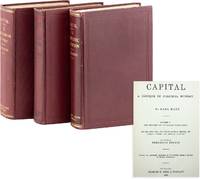
190688451Chicago Ill: Charles H. Kerr & Co. London: Swan Sonnenschein & Co. 1906 1907 1909. First Editions First Printings. Three Volumes. Octavo. 22.5cm. Publisher's deep maroon ribbed cloth titled in gilt to spines and ruled in blind to boards. 869pp.; 618pp.; 1048pp. Generally strong and tight; mild scuffing and to spine ends and corners and a few minor exterior stains. Spine gilt is significantly oxidized to Vol II as is usually seen on the first printing; internally clean and fresh some very light spotting in places mainly confined to the page edges. A very good handsome set of first printings. <br /> <br /> A full set of first printings of this bibliographically complex edition issued over the course of three years. Marx published the first volume of his epic analysis of capitalism in German in 1867. The first translation into English was of Volume 1 only and was accomplished by Edward Aveling and Samuel Moore in 1887 based on the revised 4th German edition as edited by Engels. The 1906 first American printing under the Charles Kerr impint as here largely follows this translation with the subsequent translation work for Volumes II and III being performed by Ernest Untermann. Thus the earliest printings of the Kerr edition comprise the first complete edition of Capital in the English language. The printing was done in Chicago by James Higgins Kerr's printer of choice making this also the first complete edition of Capital to be printed entirely by a union-run print shop. Untermann did most of his translation work from remote Florida beginning the effort in 1905 discovering in the process a number of indices footnotes and at least ten pages of text that Aveling and Moore had not included in their London edition - making the Kerr edition the most complete up to its time. <br /> <br /> Kerr burned through the first two-thousand copy print run of Volume I almost immediately and rushed to get Volume II out by July 1907. It's very possible that financial constraints were already making themselves known by Volume II as Kerr was selling the books at a loss to encourage sales; the almost ubiquitous oxidation of the gilt on Vol II is likely a result of experimental economy that swiftly failed. Vol III returns to the higher standards of the first volume. The bindings on the first printings also feature a triple blind rule to the ribbed cloth boards with subsequent printings having double rules. Kerr's reprint system seems to have incorporated dates on the title pages for some length of time with the dates on the copyright pages remaining unchanged; after a certain point around the early 1920's reprints were issued without dates to the title pages and any volume without a date can safely be deemed a post-1920s reprint. Issues of Kerr's International Socialist Review from the period of printing recount in detail some of his problems and concerns publishing and selling the work with detailed data on dates numbers of copies and the firm's hopes for the completed book. <br /> <br /> Genuine first printing sets of this important edition are tremendously scarce in commerce. The lack of any real bibliographical authority for the American edition combined with Kerr's generally lax approach to differentiating printings has over the years led to frequent errors and misjudgments on the part of cataloguers including in full disclosure ourselves. After a good deal of research most in the advertising pages of the International Socialist Review we're confident we've finally got it right. Charles H. Kerr & Co. [London: Swan Sonnenschein & Co.] unknown
187247305Paris: Maurice Lachatre et Cie 1872-1875. First French Edition. Large octavo 28.5cm.; original parts bound in early 20th century blue cloth gilt-lettered spine; 351pp.; pictorial half title and title pages full-paged steel-engraved portrait and facsimile additional vignettes throughout; text printed in double column. Boards a bit rubbed and corners bumped foxing and toning to preliminaries as well as minor dampstaining to last few leaves of text light foxing to rear cover; overall Very Good and sound. First appearance in French of Marx's "Das Kapital" the translation the only such to have been executed with the collaboration of the author whose letter to Lachatre appears in facsimile on p. 7: "J'applaudis à votre idée de publier la traduction de 'Das Kapital' en livraisons périodiques. Sous cette forme l'ouvrage sera plus accessible à la classe ouvrière et pour moi cette considération l'emporte sur toute autre" "I congratulate you on your idea to publish the translation of 'Das Kapital' as a periodical. In this format the work should be more accessible to the working class and to me this is more important than all else" our translation. Maurice Lachatre 1814-1900 was a Parisian radical bookseller publisher and collaborator of Félix Pyat's with whom Marx butted heads over the growth of the International Working Men's Association in France. Lachatre's projected publication of the anarchist newspaper "La Commune" nearly cost him his life after the fall of the Paris Commune when his bookshop was attacked with murderous intent by the Versaillaise army see "The Publisher's Weekly" Vol. 19 1881 pp. 50-1. It was while exiled first in Belgium and then Switzerland that Lachatre began work on publishing the present edition though he was not free to return to Paris until 1879. Maurice Lachatre et Cie unknown
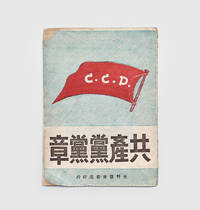
1947182588Shexian: Taihang qunzhing shudian "Taihang People's Bookstore" 1947. Maoism made official First edition thus. Passed at the party's seventh congress in 1945 the constitution for the first time formalized "Mao Zedong Thought" as the guiding ideology of Chinese communism. Following the historic congress the new constitution was disseminated by local printers in the rural base areas under party control. This example was issued in the foothills of the Taihang Mountains near the capital of the strategically important Shanxi-Hobei-Shandong-Henan "liberated zone." In 1948 Mao took up residence in nearby Xibaipo where he lived until his triumphant entry into Beijing in March 1949. This first printing dates to September 1947. Subsequent printings appeared in December 1947 and several times in 1948 but they did not have a frontispiece. Rural printers had access to only the most rudimentary facilities and the vast majority of base-area publications have now perished. Octavo pp. ii 27 1. Half-tone frontispiece portrait of Mao decoration above table of contents. Text in Chinese. Original illustrated wrappers front cover lettered in black. Tidemark at head of volume spine worn split at head of front joint chip to front cover several gatherings uncut: a very good copy typical of publications printed in the Chinese Communist Party's rural base areas. unknown
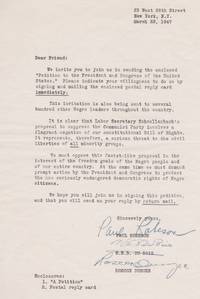
19471474<p>Robeson Paul W.E.B. Du Bois and Roscoe Dungee.</p><p>To the President and Congress of the United States of America Petition and Typed Letter Bearing Signatures of Robeson Du Bois and Dungee. New York: Communist Party USA 1947.</p><p><br />Single-page typed letter and two-page petition printed on rectos only. Each page 8 1/2 x 11 inches 215 x 280 mm.</p><p>A rare typed letter bearing signatures of Paul Robeson W.E.B. Du Bois and Roscoe Dungee asking recipients to sign a petition against banning the Communist Party USA. <strong>We believe the signatures were printed as does an autograph expert we consulted.</strong></p><p>In any case the three African-American leaders sprang into action after President Truman's Labor Secretary Lewis B. Schwellenbach told Congress that the Communist Party should be outlawed. Schwellenbach was concerned about Communist control and infiltration of labor unions and thought no Communist should be allowed to lead a union.</p><p>The letter is dated March 22 1947 and carries the address of 23 West 26th Street New York the Communist Party's headquarters at the time. The letter is aimed at African-American recipients: "This invitation to sign the petition is also being sent to several hundred other Negro leaders throughout the country."</p><p>According to the letter "It is clear that Labor Secretary Schwellenbach's proposal to suppress the Communist Party involves a flagrant negation of our constitutional Bill of Rights. It represents therefore a serious threat to the civil liberties of all minority groups." The authors urge recipients to mail back a postal reply card confirming they would sign the petition. The card is not present probably because it was mailed back to the Communist Party.</p><p>The petition which is also rare is addressed to the President and Congress urging them to reject Schwellenbach's "fascist-like proposal" to ban the Communist Party. The Party was not banned but the government regularly harassed and imprisoned its leaders in the 1940s and '50s.</p><p>Even though we believe the signatures on the letter were printed these materials are nonetheless rare. We have not found any institutional holdings of the letter or petition. None in commerce.</p><p>CONDITION: Pages lightly creased for mailing staple on petition badly rusted. A Very Good set. <strong>RARE</strong>.</p> [Communist Party USA]
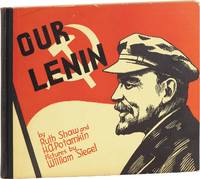
193481518New York: International Publishers 1934. First Edition. Oblong quarto 23cm x 27cm. Original cloth-backed pictorial boards; 62pp; illus. A remarkably bright unworn copy with minimal rubbing to board corners with the pictorial elements bright and unfaded. Internally clean and unmarked with joints and hinges tight; Near Fine. Lacking the scarce dustwrapper. There was also an issue in plain black bookcloth priority uncertain. <br /> <br /> A biographical encomium to Lenin for juvenile readers with illustrations by the New Masses cartoonist William Siegel. A great example of "party-approved" literature for children during the heyday of communism in America an unusually well-preserved copy. International Publishers unknown
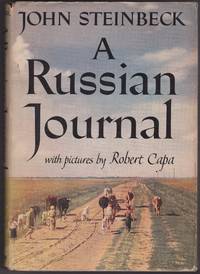
19482521New York: The Viking Press 1948. First Edition First Printing. <br /><br />Small Quarto 9 3/4 x 6 3/4 inches; 247 x 167 mm 220 pages in green and tan cloth in an unclipped illustrated dust jacket hard cover accompanied by four photographic prints. <br /><br />An account of a trip to the Soviet Union in 1947 by author John Steinbeck and photographer Robert Capa who visited while the country was attempting to recover from the devastation of World War II. They traveled to Moscow Stalingrad and other cities as well as to Ukraine and Georgia meeting numerous ordinary people while accompanied by a minder from the government. <br /><br />The New York Herald Tribune financed the trip and along with some other newspapers published articles by Steinbeck and photos by Capa. Indeed included here are three photographs that were used by one of the newspapers as indicated by layout instructions on the versos of the photos. There's also a later publicity photo of Steinbeck. One of the photos from the trip showing a Georgian restaurant in Moscow appears on page 47 of the book. Two of the trip photos are stamped on the versos with the notice that their reproduction could be used only with the "1948 Steinbeck-Capa articles on Russia" along with "Copyright 1948 by John Steinbeck." <br /><br />Our copy is a first printing of the first edition with "Printed by the Viking Press in April 1948" on the copyright page. The dust jacket carries a price of $3.75. <br /><br />A fascinating look at ordinary people in the Soviet Union as the country tried to rebuild following World War II accompanied by three photographs of scenes from the country and a publicity photo of Steinbeck. <br /><br />CONDITION: Book slightly cocked rear hinge loose corners rubbed spine ends bumped end papers slightly toned a couple of pages with vertical creases possibly a production error. Nearly Very Good in a Good dust jacket that has some loss to both spine ends as well as a few tears nicks toning foxing and stains. The four photographs have some nicks creases and soiling to the edges. The versos contain notes stamped instructions and captions pasted on the photo of Steinbeck has an article pasted to the verso. Some discoloration to two photos resulting from pasting of newspaper captions to the versos. The Viking Press hardcover
19990008049Boulder CO: Westview Press 1999. First English language edition. Hardcover. As New/issued without. 8vos; xxxiv 562; ix 389 pages maroon cloth in original shrinkwrap. Not x-library. Scarce. O.P. <br/><br/>This English translation contains an autobiography by Mironov which was not in the Russian edition. It details his anti-Marxism philosophy while a student in Leningrad. "The author has assimilated a large body of foreign scholarship primarily "new social history" produced by Anglo-American authors along with a sprinkling of more broadly European economic and demographic history from the 1970s and 1980s which is effectively incorporated into his own very deep empirical knowledge. . The reader does not find in this extensively researched account the standard Soviet answers to specific historical questions. Mironov has abandoned most Soviet cliches though he still assumes that laws of Russian history can be identified based on social science theory and quantitative analysis Elise Kimerling Wirtschafter." "This is a massterful work that provides other scholars with a wealth of useful information while confrontimg them with an argument that compels a response - William G. Wagner." Maps. Westview Press hardcover
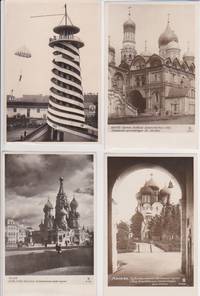
19302279Moscow: Various Publishers 1930s. <br /><br />Thirty black-and-white postcards each measuring 5 3/4 x 3 7/8 inches 147 x 98 mm all unused and unmounted. <br /><br />A collection of postcards depicting scenes in Moscow during the tumultuous 1930s when Stalin was expanding his power and killing off his opponents. The scenes include workers' houses hotels department stores and cathedrals that the Bolsheviks closed and turned into museums. Other scenes show Arbat Square Pushkin's monument the race course Dynamo stadium the Izvestia building Moscow University and more. <br /><br />Seventeen of the cards have brief captions in English and sometimes in French and German in addition to Russian. <br /><br />A wonderful series of vibrant images of Moscow in one of the most significant decades in Soviet history. <br /><br />CONDITION: One card lightly trimmed at the edges a few minor stains to the versos of some cards. Overall Very Good or better. Various Publishers
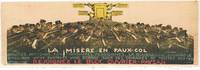
192982982Impression illegible: Bloc Ouvrier-Paysan 1929. Original lithographed poster 40cm x 120cm ca 16" x 47". Minuscule losses at margins not approaching image; closed tears; impression slightly weak; Very Good professionally backed on linen B/B.<br /> <br /> An ephemeral work produced for the short-lived Bloc Ouvrier-Paysan Workers & Peasants Party a Communist splinter group which existed in France only from 1929-30. The poster invites white-collar workers including artisans civil servants and pensioners to join the Bloc to save themselves from being crushed under the weight of bourgeois capitalism. The image depicts the bourgeoisie personified in the form of high rents food goods taxes and transportation costs being pulled forward by a horde of civil servants under harness. Copies located at Hoover Institution and the archives of the Department of Correze France; none others in institutional collections or commerce. Bloc Ouvrier-Paysan unknown
193426222New York: Workers Library Publishers n.d. but ca.1934. Original poster offset printed in black on white stock measuring 67.5cm x 80.5cm. Light wear to extremities old horizontal and vertical folds with attendant creasing; Very Good.<br /> <br /> Propaganda poster advertising eight penny pamphlets published by the Workers Library; pricing ensured that even the lowliest worker would be able to afford something to read. The poster pictures titles by Israel Amter Elizabeth Lawson Herbert Benjamin and Sadie Van Veen. Issued by the National Committee Unemployed Councils proceeds presumably went to aid the unemployed and anti-hunger organizations. Not found in OCLC. Workers Library Publishers unknown
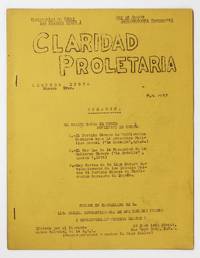
19376146New York: Revolutionary Workers League 1937. About very good. Two issues each 13pp. Folio. Mimeographed front wrapper stapled. One cover loosening. Moderate toning and dust soiling. Two issues of the scarce New York Spanish-language periodical Claridad Proletaria "El Organo en Castellano de la Liga Obrera Revolucionaria de los Estados Unidos." The Revolutionary Workers League was formed by American Trotskyist and Communist Party leader Hugo Oehler in 1935. The first issue present here dated September 1936 contains articles describing the revolutions in Spain and Latin America as well as pieces on the various internecine fights between the Trotskyist Stalinsist and other Communist factions during the 1930s. The second dated February 1937 is dedicated entirely to events in Spain and the role of Partido Obrero de Marxista Unificacion Workers' Party of Marxist Unification. OCLC locates a small smattering of individual issues. Revolutionary Workers League unknown
13603Heraklion Crete Greece. 12 January 1947. 4pp. 8vo. 96 lines of text. On paper ruled for accounts. On lightly-aged paper with loss to corners and at central edge affecting a few lines of text. Accompanying the letter is a translation 2pp. 8vo by Colin Jordan with the assistance of Dr Loukas Christodloulos. The letter is of great interest casting light on Leigh Fermor's activities in Crete in the period following the Second World War. The identity of 'Haris' is not immediately apparent: he does not appear to feature in George Psychoundakis's account of the Cretan resistance 'The Cretan Runner' 1955 which was translated by Leigh Fermor. Addressing 'Mr. Leigh Fermor' the author of the letter begins in reproachful terms: 'After my third letter you remain silent. I write now with a big question mark: why this is happening and why you are ignoring my thoughts and my offer in general' He asks Fermor 'for the sake of our friendship and co-operation and for our land of Crete' to guide him in his thoughts and to advise him in his actions 'and to help me in my efforts against the slanderers and the malevolent enemies of our union'. He desires Leigh Fermor's 'co-operation against the transformation of Crete and Greece my country into a Soviet protectorate.' He proceeds to report on 'the situation that exists': 'The Communist newspaper "Free Crete" has begun again a serious campaign against the English generally and in particular against us Major Fielding Major Alexander Wallace 'Xan' Fielding who like Leigh Fermor was in the SOE in Crete during the war and Kyrios Giorgos. They claim that the crimes of killing a villager from Potamiko Nikos Komi of another from Heraklion prior to the referendum others from Apokoronou and from Hania family murders for revenge and political party murders were done by you that you organized them that is and ordered their execution by your people.' A further claim is that 'from the time of the occupation' Leigh Fermor has been 'organizing here the ground for the occupation of Crete by the English and the creation of military bases since Alexandria is hostile towards Egypt and you are using that against her'. In his view it is easy to refute the Apokorona and Hania murder charges 'since it's commonly known that they were done by locals for revenge and due to political hatred and had nothing whatsoever to do with our work. The murder of the police officer from Heraklion happened before your arrival here in September. As for the killing of Komi at Potamiko the same man wrote a letter that he did it because of personal motives and not following orders from yourself.' He proposes to write 'to the newspapers of the Right-wing here that your visit to Crete was entirely a holiday trip to see your friends and that the villager's murder was done before you came. Also that the Hana murder had other purposes and that you and the English generally have never thought of occupying Crete and that you have always acted from friendship. I will also go to the prison and I will oblige Nikos Komis to sign a letter of protest against the writings of the "Free Crete" newspaper.' He will take responsibility for the publication 'as I did a few days ago when I published articles about English/Greek friendship in the <.>IDI and PATRIDA newspapers. Regarding 'the Communist nightmare that threatens all of us with destruction': 'Once again I give my life and for that thought I would gladly sacrifice. The communists know this and consider me their enemy like nobody else.' He ends with an enquiry regarding 'the Anglo-Greek Society at Heraklion that you had promised back in September'. Heraklion [Crete, Greece]. 12 January 1947. unknown
18771Heraklion Crete Greece. 12 January 1947. 4pp. 8vo. 96 lines of text. On paper ruled for accounts. On lightly-aged paper with loss to corners and at central edge affecting a few lines of text. Accompanying the letter is a translation 2pp. 8vo by Colin Jordan with the assistance of Dr Loukas Christodloulos. The letter is of great interest casting light on Leigh Fermor's activities in Crete in the period following the Second World War. The identity of 'Haris' is not immediately apparent: he does not appear to feature in George Psychoundakis's account of the Cretan resistance 'The Cretan Runner' 1955 which was translated by Leigh Fermor. Addressing 'Mr. Leigh Fermor' the author of the letter begins in reproachful terms: 'After my third letter you remain silent. I write now with a big question mark: why this is happening and why you are ignoring my thoughts and my offer in general' He asks Fermor 'for the sake of our friendship and co-operation and for our land of Crete' to guide him in his thoughts and to advise him in his actions 'and to help me in my efforts against the slanderers and the malevolent enemies of our union'. He desires Leigh Fermor's 'co-operation against the transformation of Crete and Greece my country into a Soviet protectorate.' He proceeds to report on 'the situation that exists': 'The Communist newspaper "Free Crete" has begun again a serious campaign against the English generally and in particular against us Major Fielding Major Alexander Wallace 'Xan' Fielding who like Leigh Fermor was in the SOE in Crete during the war and Kyrios Giorgos. They claim that the crimes of killing a villager from Potamiko Nikos Komi of another from Heraklion prior to the referendum others from Apokoronou and from Hania family murders for revenge and political party murders were done by you that you organized them that is and ordered their execution by your people.' A further claim is that 'from the time of the occupation' Leigh Fermor has been 'organizing here the ground for the occupation of Crete by the English and the creation of military bases since Alexandria is hostile towards Egypt and you are using that against her'. In his view it is easy to refute the Apokorona and Hania murder charges 'since it's commonly known that they were done by locals for revenge and due to political hatred and had nothing whatsoever to do with our work. The murder of the police officer from Heraklion happened before your arrival here in September. As for the killing of Komi at Potamiko the same man wrote a letter that he did it because of personal motives and not following orders from yourself.' He proposes to write 'to the newspapers of the Right-wing here that your visit to Crete was entirely a holiday trip to see your friends and that the villager's murder was done before you came. Also that the Hana murder had other purposes and that you and the English generally have never thought of occupying Crete and that you have always acted from friendship. I will also go to the prison and I will oblige Nikos Komis to sign a letter of protest against the writings of the "Free Crete" newspaper.' He will take responsibility for the publication 'as I did a few days ago when I published articles about English/Greek friendship in the <.>IDI and PATRIDA newspapers. Regarding 'the Communist nightmare that threatens all of us with destruction': 'Once again I give my life and for that thought I would gladly sacrifice. The communists know this and consider me their enemy like nobody else.' He ends with an enquiry regarding 'the Anglo-Greek Society at Heraklion that you had promised back in September'. Heraklion [Crete, Greece]. 12 January 1947. unknown
191917439Chicago: Deutschen Sprachgruppe der Socialist Party of the United States 1919. First American Edition. 12mo 18cm. Printed card wrappers; 127pp. Very mild external wear; faint spotting to a few pages of text; Near Fine in the original wrappers. Probable first printing in America of Trotsky's account of the October revolution. English editions appeared the same year in London and Brooklyn but it is likely that this German-language version translated from the Russian by German-American scholar Jacob Wittmer Hartmann precedes any English edition. Interestingly a German translation had already appeared in Berlin in 1918 but the German-language group of the Socialist Party commissioned this new translation from Hartmann for the American edition. Deutschen Sprachgruppe der Socialist Party of the United States unknown
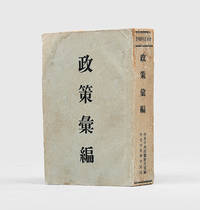
1949183227No stated place: Zhonggong zhongyang huajong ju "Middle China Bureau of the Chinese Communist Party" c.1949. First edition thus number 126 of an unknown internal distribution gathering together documents and speech transcripts issued by central party authorities in the decisive two years of the Chinese civil war. As the communist victory became inevitable the party's focus switched to preparing its burgeoning ranks of cadres for the many challenges of government. This anthology was printed for cadres in the Middle China Bureau which had been founded in 1941 under the leadership of Liu Shaoqi to oversee New Fourth Army operations. In May 1949 the leadership was transferred to Lin Biao Mao's superstar general and future heir apparent. Octavo. Text in Chinese. Original grey wrappers spine and front cover lettered in black. A few reader marks internally. Tidemarks spine worn in places front cover with simple old paper repair on verso foxing and staining internally: very good. unknown
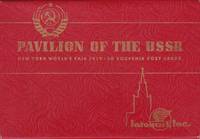
19392412n.p.: Intourist Inc. 1939. <br /><br />Red folder measuring 4 x 5 3/4 inches 150 x 113 mm containing 10 post cards. <br /><br />Souvenir folder issued to commemorate the 1939 World's Fair in New York. The folder consists of 10 post cards in black-and-white with descriptions in English French and Russian on the verso of each card. Perhaps not surprisingly two of the cards depict Lenin and Stalin while others show a model of the Soviet Union's pavilion a sailboat Red Square a Caucasian dance festival Theatre Square the fountains at Peterhof holiday makers on the Black Sea and a map showing Intourist offices around the Soviet Union. <br /><br />We find no institutional holdings in OCLC. No others in commerce July 2021. A complete set of this rare portfolio. <br /><br />CONDITION: Fading to lettering of folder along with some creases and edge wear. Toning to the verso of the cards. Overall Very Good or better. Intourist, Inc.
a75830Washington 1952-1964. The first 13 years of this noteworthy journal uniformly bound in 12 volumes. Six issues per year except for 1952 Volume I which has 4 issues. 4tos. most original covers bound in light tan institution buckram. Very light depository library marks - name stamp on each issue cover stamps on top and bottom fore-edges no other markings no spine numbers no bookplates no pockets. Several years are reprint editions. Near Fine. 13 years in 12 volumes. . hardcover
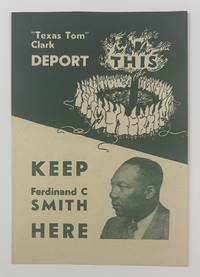
19482875New York: Council of Negro Trade Unionists 1948. Near fine. 4pp. on a single folded sheet. Minimal wear. A rare leaflet issued by the Provisional Harlem Committee to Free Ferdinand C. Smith and the Council of Negro Trade Unionists. Ferdinand C. Smith secretary of the National Maritime Union was instrumental in promoting Black membership in the Negro Trade Unionists. Attorney General Tom C. Clark originally from Texas sought to deport Smith back to Jamaica because of his Communist affiliations and work for civil rights. OCLC reports just a single copy of this work at the University of Kansas. Council of Negro Trade Unionists unknown
198081760Moscow: Tushino Machine Building Plant 1980's. Pasteboard box 44cm x 23cm. Name printed in stark black and white onto a stereotypically minimalist Soviet box all the more susrprising considering this is a toy for children. Light inoffensive wear to the extremities a little rubbing and scuffing to the corners clean and complete. The verso of the box lid contains a plan of the contents with item numbers and small illustrations. Inside the box liner is moulded polystyrene with spaces for the individual components ranging from pressed steel baseboards and wall/hull sections to a set of rubber tyres woven string to simulate hawsers and cables pulleys connecting rods all the necessary tools a bag of nuts bolts and other connector pieces; all mass produced in a fashion that would have even a cursory modern day child safety inspection shutting down the whole plant and issuing a warning that if your children get this for Christmas you might need to count their fingers on Boxing Day. Miraculously complete as far as can be ascertained and with very little sign of use including the plans and construction book which is complex enough to count as aggressively educational and has the original warranty sheet with inspection stamps hand stamped and dated 1992 although the slip dates the set to the 1980's laid in. The introduction to the set in the 62 page instruction book states: "The 'Yunost' contruction set is a game designed in 1944 to introduce children aged 10-15 years to the principles of technical design and construction engineering. Each set of the 'Yunost' construction set contains the most intricate parts intnded for assembling models of various mechanisms machines and industrial structures."<br /> <br /> Clearly designed as a controlled Soviet alternative to Western toys like Erector Sets Meccano and the like the principles are identical whilst the delivery is rather more tailored to a deliberately educational USSR approach to entertaining children. "Nothing without purpose" seems to have been the guiding tenet of USSR toy production approaches which became notorious for taking an existing Western temptation like Meccano or Lego or GI-Joe and adapting them to the requirements of collective adherence to the improvement of the USSR. To Western eyes a lot of this material looks like the physical representation of the "We have McDonalds at home." meme but whilst Western toy design was aimed as much at keeping kids quiet and out of the way with a side of education the Soviet philosophy seems to have been 'if a child is building a toy crane then he should be learning the principles of load bearing members understanding pulleys and getting an idea of where crane operators fit into the process of industrial engineering' whilst this approach seems to take some of the joy out of play time it also contributed to the Western paranoia that the USSR was basically a cradle to grave enemy factory. Tushino Machine Building Plant unknown
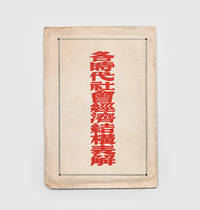
1949182587Shanghai: Taipingyang chubanshe 1949. First edition of this large political visualization significant for its publication date only a few weeks before the founding of the People's Republic of China. It reflects an increased demand for material explaining the ideology of the Chinese Communist Party caused by the party's victory in the civil war and the complete collapse of the Kuomintang on the mainland. The table presents some of the core ideas of Marxism tracking economic and cultural evolution from primitive through to capitalist and then socialist societies. The columns address such criteria as modes and means of production vanguard revolutionary forces and class relations. Although the table accommodates a transitional period from capitalism and socialism this differs from the "new democracy" approach favoured by Mao in the PRC's early years. Printed table 530 x 680 mm folding away into 157 x 107 mm card wrappers front cover lettered in red within black frame. Table in Chinese text printed in red and black. Table with 140 mm closed tear sometime repaired on recto with adhesive tape small split at one intersection unknown
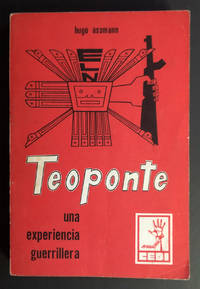
19713912<p>Oruro Bolivia: CEDI 1971. 1st edition. Soft cover. Very Good/No Jacket as issued. VG. 8vo 282pp printed wrappers. Rare original edition of this revolutionary memoir published in Bolivia. In Spanish. Unmarked copy a bit of reading wear.</p> Oruro, Bolivia: CEDI paperback
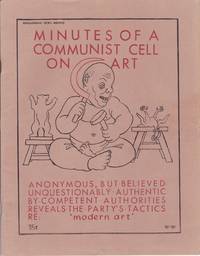
19602275Fullerton California: Education Information Inc. 1960. First Edition. <br /><br />Small Quarto 10 5/8 x 8 1/4 inches; 271 x 212 mm 21 pages in stapled illustrated wrappers <br /><br />A "second report on modern art" issued by Education Information Inc. an Orange County California anti-communist outfit. The main highlight: the purported minutes of a Communist cell comprising artists and writers: "PROGRAM: Remove all inspiring and beautiful art from all exhibits and substitute degenerate art in its place.Keep rational art out of all public exhibits -- allow only empty or distorted art to be shown in museums dealers' exhibits.Tie junk together and set it up as sculpture." <br /><br />There's plenty more in this vein. The woman who took these notes -- "a friend of truth and decency" -- supposedly mailed them to the right-wing sculptor Wheeler Williams who was active in anticommunist politics. Williams provides a Foreword to the notes saying he believes they're authentic. He says he shared the notes with colleagues and some former FBI undercover agents all of whom apparently believe the notes are genuine. <br /><br />Also in this pamphlet are articles on "subversion in art" lengthy excerpts from Williams's testimony to Congress on the Soviet uses of art and a piece by E. Merrill Root on conservative philosophy. <br /><br />This pamphlet is scarce. OCLC records around a dozen institutional holdings. <b>SCARCE</b>. <br /><br />CONDITION: Vertical fold throughout original mailing label and partially removed tape to lower wrapper extremities worn from handling staples a bit rusted. Otherwise Very Good. Education Information, Inc.
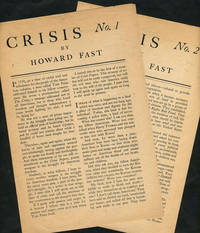
195123521New York: Civil Rights Congress 1951. Very good condition. Two pamphlets part of a series of articles by the American author and noted Communist. Fast modeled his pamphlets on Thomas Paine's "Crisis Papers" noting "I intend this to be the first of a number of Crisis Papers. This tyranny of today will not be easily conquered nor will the evil men who rule America easily bow to the will of the people. I state that I will speak up again and again so long as the need be present". <br /> <br /> Crisis No. 1 protests the American war in Korea the activities of the House Committee on Un-American Activities and attacks and threats on American Communists. Fast decries the threats against the leader of the Civil Rights Congress William L. Patterson to turn over all of his organization's records or be jailed. The Congress's goal was to fight racism & racial injustice in the US.<br /> <br /> Crisis No. 2 concerns the government's attacks on the Civil Rights Congress Bail Fund. 8vo 4pp each. Paper evenly toned. These are the first and second of three pamphlets titled Crisis. Fast wrote extensively on the Paul Robeson riots in Peekskill NY. OCLC: 30448136 Crisis No. 1 and OCLC: 71682230. Civil Rights Congress unknown
193243659Santiago de Chile: Union Social de Chile 1932. First Edition. 12mo 17.5cm.; publisher's blue-grey printed staplebound wrappers; 8pp. Textblock slightly toned else a Fine copy. Issued as "Folleto No. 21. [Union Social de Chile] unknown
193416160Hamtramck MI 1934. Hand-painted banner 8.5cm x 65cm ca 3-1/4" x 26". In red and black on a white background. Old stains and tape adhesions; complete and Good. Scarce relic from the 1934 Hamtramck Michigan mayoral campaign in which George Kristalsky and a slate of seven communist candidates for City Council were defeated. Hamtramck a working-class suburb of Detroit was a center of radical labor activity during the Great Depression. unknown