John OniansLivre Rare Book
Leigh AshtonLivre Rare Book
LETTERS AND MEMOIRS OF THE PRINCE DE LIGNE.
HIS926M1927 / 194 pages. Relié. Editions George Routledge & Sons.

Librairie du Levant · Bayonne, France20,00 €
48 résultats
HIS259C10GAR1990 / 351 pages. Broché. Editions Press
HIS926M1927 / 194 pages. Relié. Editions George Routledge & Sons.
194628361Partitions sur l'Amérique du Nord,Partitions sur les États-Unis,Partitions sur la Politique et gouvernement Chappell 1946
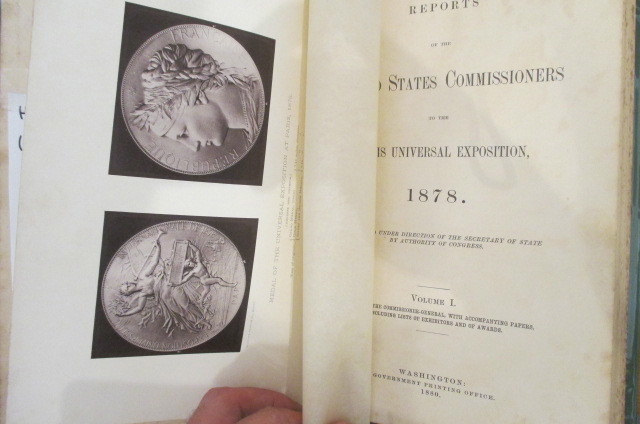
HIS131C27GAR1880 / 702 pages. Relié Editions Washington : Government printing office.
HIS132C27GAR1880 / 595 pages. Relié Editions Washington Government Printing Office.
LAN057C20GAR2002 / 150 pages. Relié avec jaquette. Editions Arizona Center for Medieval and Renaissance Studies.
HIS930M1928 / 253 pages. Relié. Editions George Routledge.
HIS261C10GAR1989 / 158 pages. Relié avec jaquette.
HIS267C10GAR1962 / 80 pages. Relié avec jaquette. Editions Thames an Hudson.
HIS933M1966 / 366 pages. Broché. Editions Norton & Companie.
HIS130M1880 / 464 pages. Relié Editions Washington : Government Printing Office.
1970203826Couverture souple. Broché. 155 pages. Légères rousseurs. Passages soulignés.
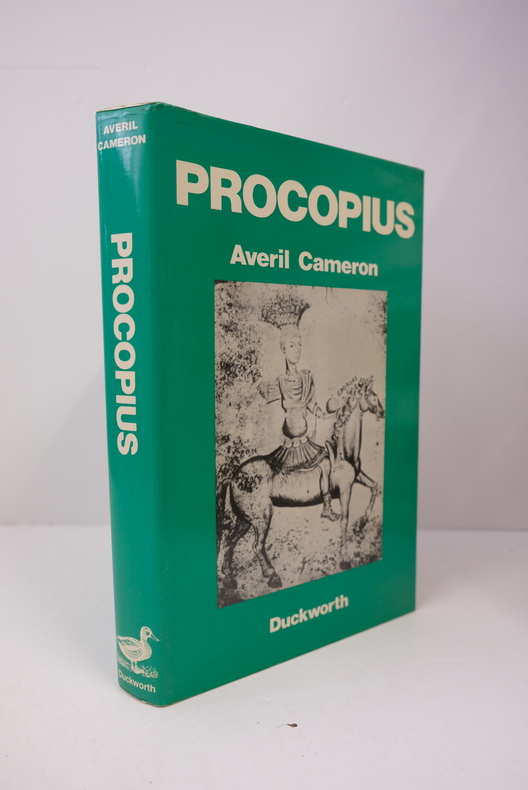
1985HIS4211MA1Duckworth, 1985. In-4, hardcover with illustrated dustjacket, 297 pp.
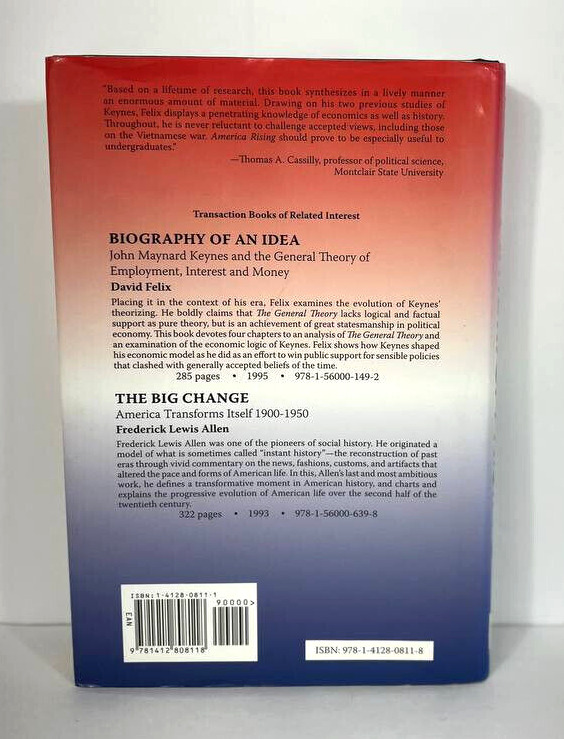
20090271New Brunswick (NJ), Transaction Publishers, 2009. First edition. Octavo, 235 x 160 mm, (xiii) 265 pp. Hardcover with dust jacket. "The United States became a great power in the last quarter of the nineteenth century and a superpower during World War II without quite knowing it. Few Americans fully appreciate the fact today. How many people know that in recent years we have had 250,000 troops in 700 bases around the world? Consider our recent history of military operations in the Caribbean, East Asia, the Far East, Middle East, Southeast Asia, Africa, and the Balkans. In America Rising, David Felix attempts to explain how and why America became a superpower by examining the political and economic factors that have driven its ascendance and their relationship throughout history. Felix begins with the dawn of America, showing how America amassed wealth and political power from the start through wars, assertions of economic might, and the creation of a cultural and philosophical base. The nation began with a political order, derived from our British origins, which enabled our pragmatic culture to take advantage of the vast wealth of a near-virgin continent. Political and economic freedom were paired, authority yielding to both freedoms. Our farmers and businessmen were dreamers, manufacturing realities out of those dreams. Felix's account then makes a point of neoclassical economics as an anvil on which to hammer out a sharper sense of the content of our existence. This book, which demonstrates the author's zest for historical analysis and great story-telling ability, points to the central fact of a rising America--the intensely energizing interaction between polity and economy. The United States is the greatest power in world history, but the rise of another great power, China, is beginning to be increasingly apparent. One trusts that, drawing upon its deep resources, America will remember its history and traditions and continue as a superpower." (Front and back flap)
1884POL002C19New York: Charles Scribner's Sons, 1884 New York: Charles Scribner's Sons, 1884. First American edition. Hardcover. vg. Octavo. XIII, [1], 483pp. Original green cloth with gold lettering and borders on spine. The first of three major books by the then assistant editor of the Contemporary Review: it was followed in 1894 by "Eight Hours for Work" and in 1895 by his admirable "Life of Adam Smith". Rae's description of contemporary socialism includes studies of Ferdinand Lassalle, Karl Marx, The Federalism of Carl Marlo, the Christian Socialists, Henry George, the Federalism of Carl Marlo and Russian Nihilism. Binding in overall good-, interior in very good to near fine condition.
1982486New York, Norton, 1982 [1950]. Abridged edition of Adorno et al.'s landmark study. A duodecimo softcover book of 130 x 195 mm; (xxv) 493 pp. + 3 pp. of catalog. With a foreword for the Abridged Edition, a foreword by editor Max Horkheimer, numerous tables and figures throughout. Index at the end of the book. "Since its first publication in 1951, when it was hailed as a monumental study which blazes new trails in the investigation of prejudice, this book has remained an essential document for the modern world. Written after the single most evil and deliberate act of the century, it undertook the challenging task of determining scientifically what personality traits characterized the phenomenom of authoritarianism and what internal and external forces allowed for its development." Front cover gapes a little, some rubbing on the front cover and tail, a blue pencil mention at the bottom of the half-title page, paper slightly yellowed.
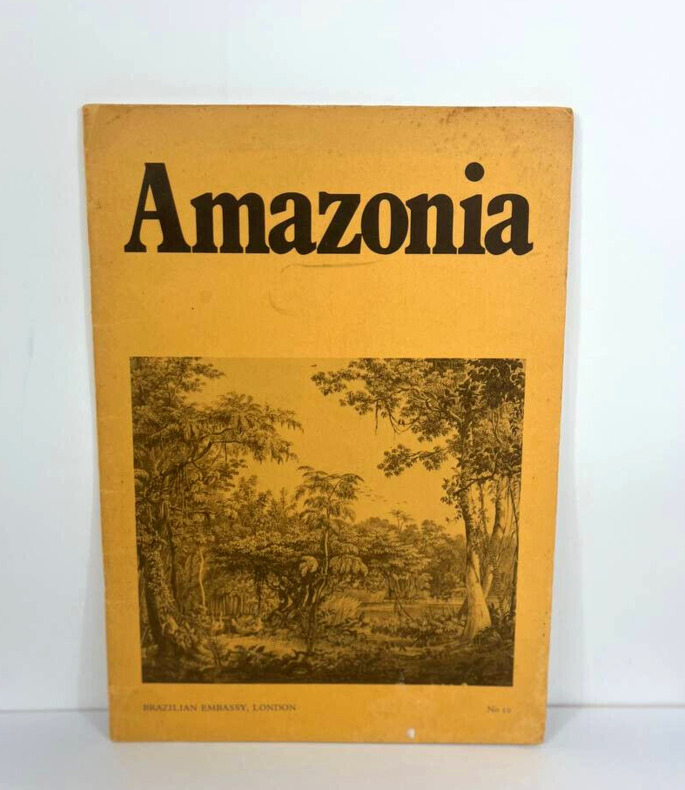
19760185London, Dialogue Publications Ltd, 1976. in English. Rare 70s publication about the Amazon rainforest, few copies printed. "This is the tenth of a series of papers prepared by the Brazilian Embassy" after a few on the Brazilian development model, inflation control and economic growth, foreign policy, etc. A tall in-4 softcover booklet of 297 x 212 mm. 35 pp. Twelve chapters, many black-and-white pictures, colored maps of Brazil and the Amazon region. List of chapters: The World of the Amazon, the People of the Amazon, the Traditional Economy of Amazonia, the First seven years of the SUDAM project, the New Development Strategy of Polamazonia, the Free Zone of Manaus, the Amazonian Bank of BASA, Agriculture in Amazonia, New Roads in Amazonia, Modern Man in Amazonia, The Traveller in Amazonia and Science and the Amazon. "When the Brazilian Government launched 'Operation Amazonia' in 1966, it rekindled the country's concern for this vast region of forest and river. For most Brazilians, interest in Amazonia had faded since th collapse of the rubber boom and extravagant life that went with it in the early years of this century. But in the past ten years there has been a radical and continuing change in Amazonia's fortunes, the impact of which is already being felt. Today it is not only Brazilians who are interested in Amazonia. The Brazilian Embassy in London receives more requests for information about the region than about any other in the country. The booklet contains as much basic and up to date information on Amazonia as possible: it is intended to serve as a guide for those who are already acquainted with the region's resources and potentialities." This booklet is now almost impossible to find aside from a few higher learning libraries. Issued by a sovereign, developing country, while the rainforest was garnering interest yet had no political stakes as it does today.
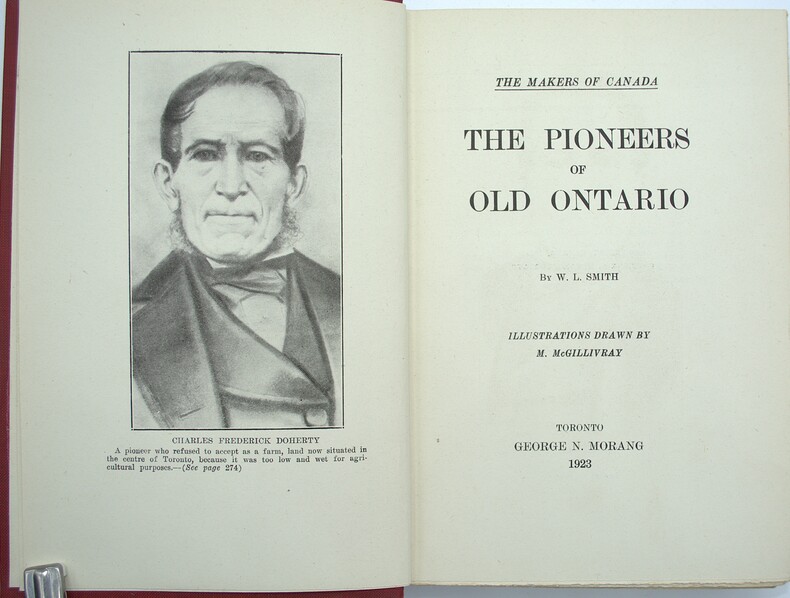
1923PHO-2313Toronto, George N. Morang,1923. In-8 (22,5x15cm), XIX-343pp., percale, dos lisse avec auteur, titre et éditeur en pied. Illustré de dessins par M. McGillivray
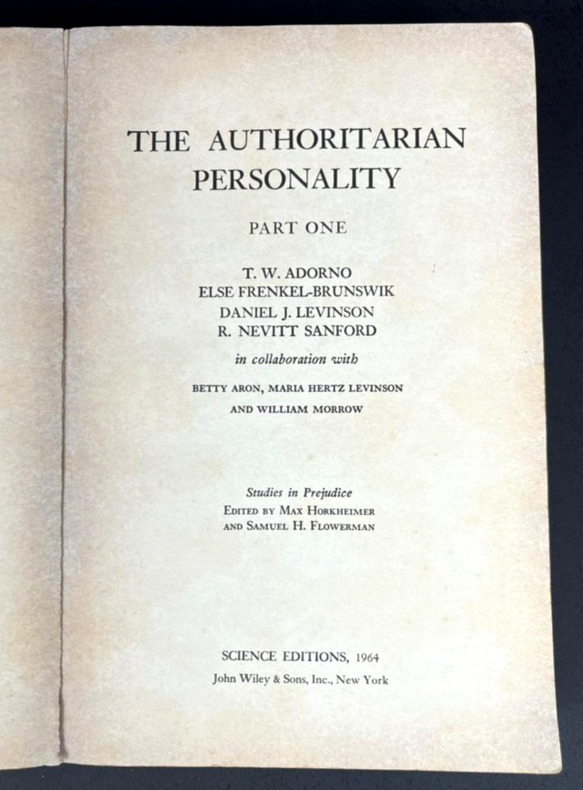
1964487New York, Wiley / Science Editions, 1964 [1950]. Complete two-volumes edition. Two softcover volumes of 142 x 214 mm, (xxxi) 990 pp. With a foreword by editor Max Horkheimer, numerous tables and figures throughout. Index at the end of the book. "Since its first publication in 1951, when it was hailed as a monumental study which blazes new trails in the investigation of prejudice, this book has remained an essential document for the modern world. Written after the single most evil and deliberate act of the century, it undertook the challenging task of determining scientifically what personality traits characterized the phenomenom of authoritarianism and what internal and external forces allowed for its development." First pages of vol. 1 disbound, yellowed paper. Complete text.
1865boz_002372Edward Henry STANLEY, homme d'Etat Britannique. Lettre autographe signée, adressée à Jacques-Henri WUSTENBERG, jointe de son enveloppe, 19 Novembre 1865. État: Voir photos pour plus de détails. Dimensions : Lettre : 18,1 x 11,5 cm. 3 pages.
REL568M1919 / 534 pages. Relié. Editions Longmans, Green and Co.
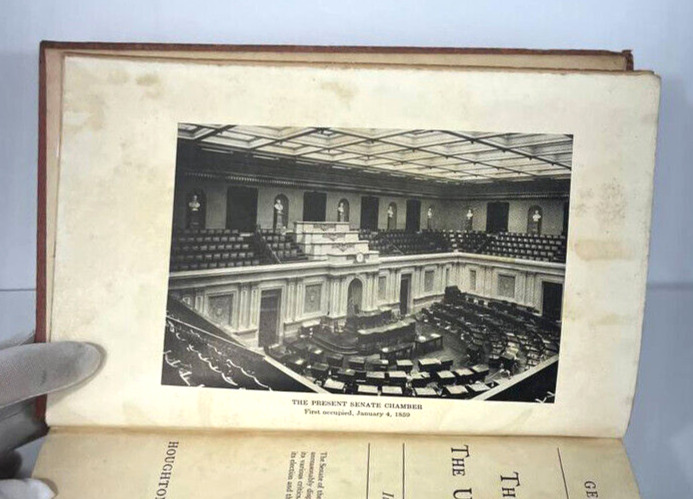
19380058Cambridge (MA), Houghton Mifflin Co. / Riverside Press, 1938. First edition of Georges Haynes' classic. Two octavo volumes, 220 x 150 mm each. Both volumes share the same pagination, the first having 567 pp. and second starting p. 568 to end at p. 1118. Hardcover, original editor's red cloth, with author's name in gold and title within a black lozenge on spine. Small paper of the "Livraria Agir Editôra", a Rio de Janeiro bookstore, tipped in at the beginning of the first volume. Each vol. has a black-and-white picture as frontispiece. Both volumes show several black-and-white illustrations. Some yellowing and foxing throughout with most pages being toned. All legible, sturdy binding, no bad smell, not ex-library. PP. 340 to 363 (first volume) have slightly folded corners with no damage to the text. "The 1938 publication of George Haynes’ two-volume The Senate of the United States: Its History and Practice instantly made Haynes the nation’s leading academic authority on that institution. Reviewers routinely ranked Haynes’ work with Charles Warren’s monumental three-volume The Supreme Court in United States History, published 15 years earlier. While others had produced major studies examining individual areas of Senate activity, and while Lindsay Rogers had created an extended essay on the institution in defense of unlimited debate, Haynes was the first to attempt a comprehensive history." (Excerpt from the summary on the U.S. Senate's website)
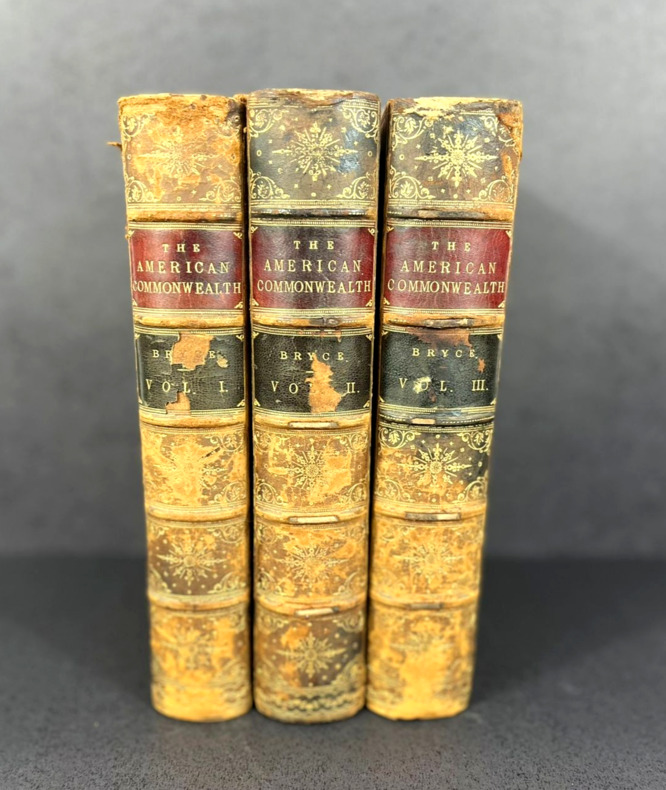
1888480London and New York, MacMillan, 1888. Three volumes bound in full vellum leather. First edition. Three delicately bound 155 x 220 mm (6" x 8.5") volumes of (xxxii) 592, 683 and 699 pp. Full caramel vellum leather, intricately ornated spines with 5 nerves, gilded frames and boxes containing lush greenery-inspired patterns and fleurons, all gilded, double titlepiece with the book title, author's name and volume Roman number on dark red and anthracite backgrounds, gilded floral frieze on the tails. Covers with double gilded frames and tiny corner flowers. All fore-edges colored in a mostly blue polychromia with marbled red veins. Gilded roulette work on the edges of the covers and pastedowns, colored endpapers. Unidentified ex-libris on the first pastedown bearing the motto "Ab Multis Ad Unum." With an unfolding map of "The Growth of the United States" at the beginning of the first volume. Table of contents at the beginning and index at the end of each volume. First volume: The National Government. Preface. Second volume: The State Government and the Party System. Third volume: Public Opinion, Illustrations and Reflections, Social Institutions. This book is not an encyclopaedia of the institutions of the American Republic, even though it may look like it is. Actually, James Bryce talks about the real workings of the institutions: parties, bosses, the spoil system and the public opinion. It shows an America already different from what the mere Constitution says. He compares the British monarchy with the American federal republic, the democratic versus lord elites and the centralization vs local power dynamics. By doing so, James Bryce predates the sociology of Robert Mitchels and Max Weber while maintaining the magnitude and depth of a true treatise. An analytical tour de force, worthy of a serious Americana collection.