MALTHUS, T RBiblio.com

7 résultats
17011508040041John Murray 1817-01-01. 5th. Hardcover. Acceptable. 2 volumes of 3. Vol. 1 and 3 only. 1/4 contemporary leather over marbled boards. Boards detached. 22 cm. 5th edition with important additions. John Murray hardcover
17163115621716. 4 pp. Small splits at old folds old reinforcement to center fold very good. 4 pp. 18th century apothecary's bill; great-grandfather of Malthus. The bill of one John Boundy as issued by Daniel Malthus 1651-1717 apothecary to Queen Anne and George I and great-grandfather of the economist Thomas Robert Malthus. Items charged include various juleps cordials and draughts linseed oil chamomile flowers marshmallow leaves purging potions King's drops quieting powders etc. Attested paid to estate of Mr. Malthus at end by Tho. Graham and docketed paid £58 July 10 1718. With 4 small circular stamps with the motto of the Earl of Fortescue "Forte Scutum Salus Ducum" "A Strong Shield is the Salvation of Leaders" unknown books
17163115621716. 4 pp. Small splits at old folds old reinforcement to center fold very good. 4 pp. The bill of one John Boundy as issued by Daniel Malthus 1651-1717 apothecary to Queen Anne and George I and great-grandfather of the economist Thomas Robert Malthus. Items charged include various juleps cordials and draughts linseed oil chamomile flowers marshmallow leaves purging potions King's drops quieting powders etc. Attested paid to estate of Mr. Malthus at end by Tho. Graham and docketed paid £58 July 10 1718. With 4 small circular stamps with the motto of the Earl of Fortescue "Forte Scutum Salus Ducum" "A Strong Shield is the Salvation of Leaders" unknown
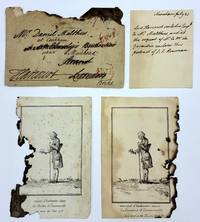
17791748Original manuscript / ink drawing. c.1779-1788. Pen and ink portrait of Jean Jacques Rousseau in the garden at Ermenonville titled beneath "venant d'herboriser dans les Jardins d'Ermenonville au mois de Juin 1778" along with a printed version of the image signed Mayer Georg Friedrich Meyer engraved by J. M. Moreau in 1779. Each 15 x 10cm. Accompanied by an ink manuscript letter 10.5 x 8cm headed "Nuneham July 21" presenting the images: "Lord Harcourt sends his compts. to Mr. Malthus and at the request of Mr. le Mqs. de Girardin encloses this portrait of J: J: Rousseau". Contained within the original postal cover addressed to Mr. Daniel Malthus redirected from his London address to Cookham signed at the foot by Harcourt under the parliamentary privilege franking system with additional "free" handstamps to the front panel and further postal markings to the reverse the specific types of postal markings on the cover indicate a date range of 1779-1788. The ink portrait engraved portrait and postal cover all have historical burn marks and associated loss as well as toning and light foxing; the letter remains in good order. A fascinating and intimate gift linking several late eighteenth-century intellectuals all connected to the French philosopher Jean Jacques Rousseau in the form of two portraits of the philosopher one ink one engraved sent from Rousseau's last pupil René de Girardin Marquis of Vauvray 1735-1808 via the radically-inclined politician and gardener George Harcourt 2nd Earl Harcourt 1736-1809 to the father of the famous economist Thomas Malthus Daniel Malthus 1730-1800 himself a friend of Rousseau.</p><p>The present portrait depicts Rousseau in the final weeks of his life 'botanizing' in the garden at Ermenonville the first French landscape garden created by his pupil René de Girardin who here sends the portrait. Ermenonville was itself inspired by Rousseau's ideas created by Girardin as an illustration of his philosophical and social beliefs regarding the place of man in nature. Within the garden Girardin began construction of a house for Rousseau modelled after the "Élysée" of Julie in Rousseau's novel <em>La Nouvelle Héloïse</em>. Rousseau himself visited the garden in May 1778 staying in a small thatched cottage where he remained until his death in July that year. Girardin subsequently made a tomb for Rousseau at Ermenonville which became a destination of pilgrimage for his admirers until his body was re-interred at the Pantheon in Paris in October 1794. Following Rousseau's death Girardin and two other of his friends of prepared a complete edition of his works using the manuscripts of some of his most important writings including <em>Les Confessions </em>and <em>Les Rêveries du promeneur solitaire</em> which he had left behind at Ermenonville. This new edition was published in Geneva between 1780 and 1782 and contributed greatly to the spread of Rousseau's ideas throughout France and beyond in the years leading up to the French Revolution.</p><p>The original drawing of Rousseau at Ermenonville was executed by the German artist Georg Friedrich Meyer 1733-1779 who also resided with Girardin at Eremenonville during his final years and where he became well acquainted with Rousseau. Other similar versions of this drawing by Meyer exist one being in the collection of the Fine Art Museum of San Francisco and it is unclear as to whether the present pen and ink drawing is an original work by Meyer or a contemporary copy of the engraving - either way its origin from the hands of Girardin himself provide it with sufficient interest. </p><p>The present two portraits subsequently made their way to the politician George Harcourt 2nd Earl Harcourt previously Viscount Nuneham a supporter of John Wilkes friend of Catherine Macaulay opponent of the war against the American colonies and pioneering garden designer. Here he apparently acted as an intermediary in this distinguished friendship circle sending the pictures on to Daniel Malthus - enlightened gentlemen friend of David Hume and Rousseau and father to Thomas Malthus.</p><p>Daniel Malthus had first become acquainted with Rousseau when he visited him at Môtiers in May 1764. He later invited Rousseau and his wife Thérèse to stay at his estate "The Rookery" near Dorking Surrey during the couple's visit to England in 1766 with Malthus hoping to find them a place to settle nearby. They visited the Malthus home for a day with Hume about three weeks after Thomas's birth but ultimately settled in Derbyshire for the remainder of their visit. Daniel and several family members subsequently went north to visit Rousseau joining him on botanical expeditions - a shared passion. Rousseau and Malthus maintained a lifelong correspondence and botanical exchange with the pair enthusiastically swapping English and French literature botanical specimens and philosophical musings. Later in life Rousseau would divide his personal herbarium among his friends sending parts of it to Daniel who also ultimately purchased his botanical library.</p><p>Daniel Malthus was - like Girardin - a dedicated Rousseauist using like many enlightened families of the period Rousseau's <em>Émile</em> as a guide to the education of his children; as he described in a letter to Rousseau of 1768 his children botanized in their local area went on nature walks carried out farm work and conducted their own little experiments. Indeed in his last known letter to Rousseau he declared "if I am ever known it will be as the friend of Rousseau". He would however ultimately be best known by his progeny Thomas who would go on to famously argue against the writings of the thinkers who proclaimed humanity's perfectibility preferred by his father including Rousseau William Godwin and the Marquis de Condorcet. Regardless of this Daniel keenly supported his adult son's endeavours with Thomas's earlier unorthodox education itself also having played a key role in shaping his knowledge of natural law and mathematics. MacDonald J. Marc "Malthus and the Philanthropists 1764–1859: The Cultural Circulation of Political Economy Botany and Natural Knowledge" Social Sciences 2017 61 4. [Original manuscript / ink drawing]. unknown
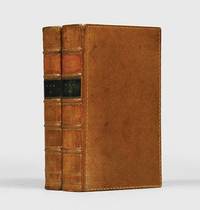
1718149970London: John Murray Eden: London J. Wright 1817 Eden: 1800. An excellent copy in contemporary calf Fourth edition of Malthus's Essay first published in 1798 one of the most important and influential works in the history of economic thought and the foundation text of modern demography. The second volume is appended with the first edition of Frederick Morton Eden's An Estimate of the Number of Inhabitants in Great Britain an appropriate pairing by the contemporary owner - Eden's population census preceded the first national decennial population census by a year but undershot the official figure by five million. It nonetheless marks like Malthus's Essay an important milestone in the study of population. Two works bound in 2 vols octavo 210 x 128 mm. Bound without half-titles. Contemporary sprinkled calf orange and dark green morocco labels gilt in compartments gilt roll border to covers blind serrated turn-ins marbled endpapers brown speckled edges. Contemporary ownership signature of Thomas Entwisle to title pages later small ink notation to front free endpapers versos. Minor patch of abrasion to rear cover of vol. I joints just beginning to split but holding firm light browning to Eden else contents fresh. An excellent copy. unknown
1798116955London: J. Johnson 1798. First edition of this cornerstone text of modern economics. Octavo bound in three quarters calf. Laid in is a clipping from an original manuscript signed by Malthus and entirely in his hand which reads in part "If at one time such a given product would make an effectual demand for certain commodities the conditions of the supply of which are supposed to remain the same it would immediately cease to make such effectual." Signed by Malthus in the lower right corner "Malthus." The verso features two further partial lines of text relating to supply and demand. In near fine condition. First editions of Malthus' magnum opus are exceptionally scarce. Malthus was one of the founders of modern economics. His Essay was originally the product of a discussion on the perfectibility of society with his father who urged him to publish. Thus the first edition published anonymously was essentially a fighting tract but later editions were considerably altered and grew bulkier as Malthus defended his views against a host of critics. The Essay was highly influential in the progress of thought in early 19th-century Europe and his influence on social policy was considerable. Both Darwin and Wallace clearly acknowledged Malthus as a source of the idea of 'the struggle for existence" PMM 251. J. Johnson unknown books
1798116955London: J. Johnson 1798. First edition of this cornerstone text of modern economics. Octavo bound in three quarters calf. Laid in is a clipping from an original manuscript signed by Malthus and entirely in his hand which reads in part "If at one time such a given product would make an effectual demand for certain commodities the conditions of the supply of which are supposed to remain the same it would immediately cease to make such effectual." Signed by Malthus in the lower right corner "Malthus." The verso features two further partial lines of text relating to supply and demand. In near fine condition. First editions of Malthus' magnum opus are exceptionally scarce. “Malthus was one of the founders of modern economics. His Essay was originally the product of a discussion on the perfectibility of society with his father who urged him to publish. Thus the first edition published anonymously was essentially a fighting tract but later editions were considerably altered and grew bulkier as Malthus defended his views against a host of critics… The Essay was highly influential in the progress of thought in early 19th-century Europe and his influence on social policy was considerable… Both Darwin and Wallace clearly acknowledged Malthus as a source of the idea of ‘the struggle for existence†PMM 251. J. Johnson unknown