443 résultats
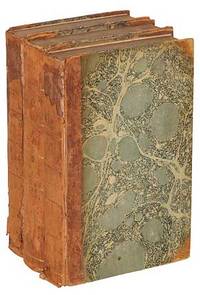
1808385225London: Sold by T. Becket 1808. Hardcover. Fair. First edition. Volume 56 May to August 1808. Octavo. Contemporary half calf and marbled paper over boards red morocco spine label. The leather is dry and worn front joint is split else a good sound copy. Armorial bookplate of Margaret Smith Burges on the front pastedown. Contains reviews of George Crabbe's "Poems" Jarrold's "Answer" to Malthus's "Essay on the Principle of Population" Malthus's "A Reply to the Essay on Population" and much more. Sold by T. Becket hardcover
189311039Torino: Ermanno Loescher 1893. 1893. Good. - Small quarto 9-5/8 inches high by 6-3/4 inches wide rebound without original wraps in dark green cloth titled in gilt with decorations in gilt on the spine. The covers are slightly warped & the binding is bumped & rubbed affecting the titling. The head of the spine is chipped & frayed. 167 pages plus errata/corrigenda page. The pastedowns & endpapers are darkened & there is scattered foxing & light staining. Good. <p>First edition. The text is in Italian.<p>The book is inscribed by the author but the inscription & signature have been partially cut off in rebinding.<p>"This interesting work proposes to examine by the light of scientific criticism the theory of Malthus and the principal objections that have been brought against it. The author turns his attention first to pointing out the irrefutability of the biological tendency as Malthus has shown it and the necessity which devolves upon political economy to recognize it as a fundamental law. Lebrecht does not ignore the objections raised by various writers against this tendency; on the contrary he estimates them with praiseworthy impartiality; yet after careful examination he believes that they are not destructive of the theory.He does not deny that the coefficient of procreation is essentially economic and that poverty is one of its potent factors; yet he affirms that the prolific action of poverty can be remedied by moral influences. From a review of the book by Achille Loria and Cornelia H. B. Rogers in "Annals of the American Academy of Political and Social Science Vol. 4 May 1894 p. 134.<p>Rare. Torino: Ermanno Loescher, 1893. paperback
1821267479London: J. Porter 1821. Hardcover. Fair. First edition. Volumes 94-96 Complete three volume set for 1821. Octavos. Contemporary half calf and marbled paper boards. Overall scuffing to the spine and boards chipping to the spine backs else a good sound set. Contains reviews of Shelley's "The Cenci A Tragedy" and "Prometheus Unbound" William Edward Parry's two "Journals" of a Voyage for the Discovery of a North-West Passage and a Voyage of Discovery to the Arctic Regions the "Principles of Political Economy" by Malthus "The History of British India" by James Mill and much more. J. Porter hardcover
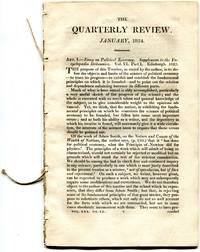
1824000011084London: John Murray 1824. Disbound. Good. 8vo. 24 cm x 13.5 cm. 1 298-334 pp. Pamphlet. The Quarterly Review was a British periodical that began in 1809. This is a review of Thomas Malthus' Principles of Political Economy and the writers of this review frequently compare Malthus' work to Adam Smith's The Wealth of Nations. A fascinating look at what Malthus' contemporaries thought of his work a work which would later be praised by J.M. Keynes the twentieth-century economist. This article was once bound in a compendium of the Quarterly review but now lacks boards and wraps. The stitching is present on the side and the final leaf is starting from the stitching. John Murray unknown
122711London Routledge & Kegan Paul 1951. x350pp. 8vo. Original boards in lightly foxed dustwrapper slight chipping at head of backstrip. Foxed edges and endpapers otherwise a very good crisp copy. First edition. London, Routledge & Kegan Paul 1951. hardcover
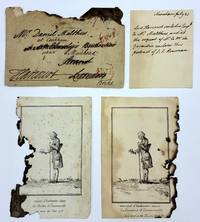
17791748Original manuscript / ink drawing. c.1779-1788. Pen and ink portrait of Jean Jacques Rousseau in the garden at Ermenonville titled beneath "venant d'herboriser dans les Jardins d'Ermenonville au mois de Juin 1778" along with a printed version of the image signed Mayer Georg Friedrich Meyer engraved by J. M. Moreau in 1779. Each 15 x 10cm. Accompanied by an ink manuscript letter 10.5 x 8cm headed "Nuneham July 21" presenting the images: "Lord Harcourt sends his compts. to Mr. Malthus and at the request of Mr. le Mqs. de Girardin encloses this portrait of J: J: Rousseau". Contained within the original postal cover addressed to Mr. Daniel Malthus redirected from his London address to Cookham signed at the foot by Harcourt under the parliamentary privilege franking system with additional "free" handstamps to the front panel and further postal markings to the reverse the specific types of postal markings on the cover indicate a date range of 1779-1788. The ink portrait engraved portrait and postal cover all have historical burn marks and associated loss as well as toning and light foxing; the letter remains in good order. A fascinating and intimate gift linking several late eighteenth-century intellectuals all connected to the French philosopher Jean Jacques Rousseau in the form of two portraits of the philosopher one ink one engraved sent from Rousseau's last pupil René de Girardin Marquis of Vauvray 1735-1808 via the radically-inclined politician and gardener George Harcourt 2nd Earl Harcourt 1736-1809 to the father of the famous economist Thomas Malthus Daniel Malthus 1730-1800 himself a friend of Rousseau.</p><p>The present portrait depicts Rousseau in the final weeks of his life 'botanizing' in the garden at Ermenonville the first French landscape garden created by his pupil René de Girardin who here sends the portrait. Ermenonville was itself inspired by Rousseau's ideas created by Girardin as an illustration of his philosophical and social beliefs regarding the place of man in nature. Within the garden Girardin began construction of a house for Rousseau modelled after the "Élysée" of Julie in Rousseau's novel <em>La Nouvelle Héloïse</em>. Rousseau himself visited the garden in May 1778 staying in a small thatched cottage where he remained until his death in July that year. Girardin subsequently made a tomb for Rousseau at Ermenonville which became a destination of pilgrimage for his admirers until his body was re-interred at the Pantheon in Paris in October 1794. Following Rousseau's death Girardin and two other of his friends of prepared a complete edition of his works using the manuscripts of some of his most important writings including <em>Les Confessions </em>and <em>Les Rêveries du promeneur solitaire</em> which he had left behind at Ermenonville. This new edition was published in Geneva between 1780 and 1782 and contributed greatly to the spread of Rousseau's ideas throughout France and beyond in the years leading up to the French Revolution.</p><p>The original drawing of Rousseau at Ermenonville was executed by the German artist Georg Friedrich Meyer 1733-1779 who also resided with Girardin at Eremenonville during his final years and where he became well acquainted with Rousseau. Other similar versions of this drawing by Meyer exist one being in the collection of the Fine Art Museum of San Francisco and it is unclear as to whether the present pen and ink drawing is an original work by Meyer or a contemporary copy of the engraving - either way its origin from the hands of Girardin himself provide it with sufficient interest. </p><p>The present two portraits subsequently made their way to the politician George Harcourt 2nd Earl Harcourt previously Viscount Nuneham a supporter of John Wilkes friend of Catherine Macaulay opponent of the war against the American colonies and pioneering garden designer. Here he apparently acted as an intermediary in this distinguished friendship circle sending the pictures on to Daniel Malthus - enlightened gentlemen friend of David Hume and Rousseau and father to Thomas Malthus.</p><p>Daniel Malthus had first become acquainted with Rousseau when he visited him at Môtiers in May 1764. He later invited Rousseau and his wife Thérèse to stay at his estate "The Rookery" near Dorking Surrey during the couple's visit to England in 1766 with Malthus hoping to find them a place to settle nearby. They visited the Malthus home for a day with Hume about three weeks after Thomas's birth but ultimately settled in Derbyshire for the remainder of their visit. Daniel and several family members subsequently went north to visit Rousseau joining him on botanical expeditions - a shared passion. Rousseau and Malthus maintained a lifelong correspondence and botanical exchange with the pair enthusiastically swapping English and French literature botanical specimens and philosophical musings. Later in life Rousseau would divide his personal herbarium among his friends sending parts of it to Daniel who also ultimately purchased his botanical library.</p><p>Daniel Malthus was - like Girardin - a dedicated Rousseauist using like many enlightened families of the period Rousseau's <em>Émile</em> as a guide to the education of his children; as he described in a letter to Rousseau of 1768 his children botanized in their local area went on nature walks carried out farm work and conducted their own little experiments. Indeed in his last known letter to Rousseau he declared "if I am ever known it will be as the friend of Rousseau". He would however ultimately be best known by his progeny Thomas who would go on to famously argue against the writings of the thinkers who proclaimed humanity's perfectibility preferred by his father including Rousseau William Godwin and the Marquis de Condorcet. Regardless of this Daniel keenly supported his adult son's endeavours with Thomas's earlier unorthodox education itself also having played a key role in shaping his knowledge of natural law and mathematics. MacDonald J. Marc "Malthus and the Philanthropists 1764–1859: The Cultural Circulation of Political Economy Botany and Natural Knowledge" Social Sciences 2017 61 4. [Original manuscript / ink drawing]. unknown
0243428723.Gpaperback. Good. Access codes and supplements are not guaranteed with used items. May be an ex-library book. paperback
1997x-0714647500Frank Cass & Co 1997. Hardcover. New. 1st edition. 151 pages. 9.75x6.50x0.75 inches. Frank Cass & Co hardcover
1997x-0714644048Frank Cass & Co 1997. Paperback. New. 1st edition. 168 pages. 9.50x6.25x0.75 inches. Frank Cass & Co paperback
19552111902161001716Kawaideshobo 1955. Soft Cover. Fine. The book is in fine condition. Kawaideshobo paperback
2080202103702895Kobunsha N.A. Soft Cover. Fine. Page size: 307p Size: 16cm Bunko size Kobunsha paperback
19070His Majesty's Receipt of Exchequer London. 9 February no year . 1p. 8vo. In poor condition aged and worn with loss to edges and holing around the signature. Begins with manuscript text in square brackets: 'The -9 Day of ffebry <.> Received by me Daniel Malthus Execd as P Margin Of the Right Honourable Robert Earl of Northampton One of the Four Tellers of His Majesty's Receipt of Exchequer the Sum of Fifty Pounds .'. The annuity has been raised on 'Rates and Duties upon all Wines imported into Great Britain and for raising a certain Sum of Money for the Service of the year 1745'. According to T. R. Malthus's entry in the Oxford DNB his father 'being an only son of seven children appears to have inherited considerable wealth and property and these independent means enabled him to travel and to cultivate his literary artistic theatrical and scientific interests. He entered Queen's College Oxford in 1747 but did not graduate. He was an admirer of Rousseau who once visited The Rookery when Malthus was an infant. He was said to have published some literary pieces anonymously but the statement by an obituarist that he had translated works from French and German was firmly contradicted by Malthus. He supported the views of the marquis de Condorcet and William Godwin on the perfectibility of mankind but also encouraged his son's publication of opposing views. Aspects of his behaviour—for example the unconventional education he chose for Malthus and his refusal to allow his wife to wear her wedding ring—were regarded as eccentric and perhaps show the influence of Rousseau. He married on 6 May 1752 Henrietta Catherine Graham 1733–1800 his second cousin the daughter of Daniel Graham 1695–1778 apothecary to George II and George III. She can be seen as a young girl with her brother and two sisters in Hogarth's painting The Graham Children 1742 now in the National Gallery London. Malthus was the sixth of their seven children two boys and five girls. His Majesty's Receipt of Exchequer, London. 9 February [ no year ]. unknown
1390024601.Ghardcover. Good. Access codes and supplements are not guaranteed with used items. May be an ex-library book. hardcover
1390024547.Gpaperback. Good. Access codes and supplements are not guaranteed with used items. May be an ex-library book. paperback
126979 May 1827. 'L. I. Fields' i.e. Lincolns Inn Fields London. 2pp. 12mo. 40 lines. Bifolium. Good on aged paper. The reverse of the second leaf carries half of a red wax seal as well as the address to 'James Loch Esqr Bloomsbury Square'. The letter begins: 'My dear Loch Some friends of mine from the Country are desirous of seeing Lord Stafford's & Lord Grosvenor's pictures some time next week; & they understand that the obtaining of Tickets is not a matter of course but that some little interest is necessary.' He asks for assistance 'with regard to Cleveland House . for Mrs Johnston & party about 5 or 6 persons'. He is going 'to the Cambridge Election' on the following day and thinks that it will be 'very keenly contested'. On his return he hopes 'to attend the Council of the London University' when he hopes 'that Horner's business will be finally & satisfactorily settled'. He has heard 'nothing more about Silk Gowns' but 'Willy Brougham . persists in retaining his appointment and will not be scared into resignation like Plunkett by the Chancery Lawyers.' In the last paragraph he deprecates the news that 'Lord Exeter is to have one of the blue Ribbands though he is no friend of Canning's & indeed closely connected with the high Tory opposition'. This is in his view 'one among many instances of C's weakness & entire dependence upon the higher power.' There is no mention of Loch in Lady Seymour's 'The "Pope" of Holland House Selections from the Correspondence of John Whishaw and his Friends 1813-1840' 1906 and the year 1827 is skirted over. 9 May [1827]. 'L. I. Fields' [i.e. Lincolns Inn Fields, London]. unknown
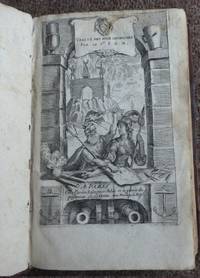
53104<p>Paris Cardin Besogne 1640. TITLE CONTINUED: De nouveau reveu corrige & augmente par l'autheur. 1640 first published in 1629 8vo approximately 170 x 100mm 6¾ x 4 inches French text added engraved pictorial title page of Neptune and Mars fireworks in the background dated 1629 6 full page illustrations 38 text engravings both illustrations and diagrams some decorated initials and headpieces pages: 10 1-277 5 pages 136 and 139 misnumbered 116 and 137 collation: A-S8 T4 T4 a blank bound in contemporary speckled calf raised bands to spine gilt decoration to spine pale red speckling to edges. Binding slightly worn small neat repair to top of spine gilt slightly worn pitting to sides small water stain to top of engraved title a larger one to top of letterpress title see image a very faint small intermittent stain to upper margin throughout very faint half page water stain on S8 - T3 small closed tear to margin of 2 pages neatly repaired very small blank corner missing on S2 verso T3 lightly browned. A very good sturdy copy. Francis Malthus d.1658 of English origin was an engineer in the royal French army and a captain general of mines and sapping. He was responsible for the French use of the mortar beginning in 1634. See: Chris Philip A Bibliography of Firework Books page 91 M 040.5; Spaulding and Karpinski Early Military Books in the University of Michigan Libraries page 19; John Eliot Hodgkin Rariora Volume 3 Books on Fireworks section page 15; Maurice Cockle A Bibliography of Military Books to 1642 page 93 No.118 referring to the English edition of 1629: "This work though in advance of anything so far written on the subject in English does not attain to the standard of Thibourel and Appier. Yet it is with foreign treatises it must be weighed for Malthus received his training in pyrotechnics abroad. It was Malthus who about the year 1634 introduced the mortar into the French service." 4 copies of our 1640 edition listed in Library Hub Discover. MORE IMAGES ATTACHED TO THIS LISTING ALL ZOOMABLE FURTHER IMAGES ON REQUEST. POSTAGE AT COST AND ALL PARCELS SENT FULLY TRACKED AND FULLY INSURED.</p> Paris, Cardin Besogne, 1640. hardcover
30964Paris & Genève J. J. Paschoud 1809. 3 vol. 120 x 195 mm de 424 395 et 392 p. Demi-veau brun dos ornés de fleurons à froid et roulettes dorées pièces de titre et de tomaison tranches jaunes mouchetées reliure légèrement postérieure. . Édition originale de la traduction française. . Au début des années 1790 le philosophe anglais William Godwin expose un « principe de population ». Réagissant principalement à la thèse alors développée par Godwin Malthus fait alors paraître la première édition de son Essai sur le principe de population un pamphlet qui paraît - anonymement - en 1798. Il y substitue en 1803 ce qui se veut un traité plus scientifique dans lequel il se réfère aussi à quatre autres sources importantes : Of the Populousness of Ancient Nations de David Hume A Dissertation on the Numbers of Mankind de Robert Wallace Observations on Reversionary Payments de Richard Price et An Inquiry into the Nature and Causes of the Wealth of Nations d'Adam Smith. Deux ans après cette parution l'Essai fait l'objet d'une traduction partielle par le Suisse Pierre Prévost qui fut professeur de physique et de philosophie à l'Université de Genève. Certains chapitres sont intégralement traduits tandis que d'autres ne le sont que partiellement. Prévost accompagne sa traduction de notes et commentaires personnels ; encouragé par Malthus il fait paraître en 1809 à Paris et à Genève cette nouvelle édition la première complète donnée d'après la dernière établie par Malthus en 1807 la quatrième édition anglaise. « Malthus m'a même autorisé en conséquence à y faire les changements que j'estimerais nécessaires. Je n'ai pas abusé de cette permission. Je me suis prescrit au contraire de faire connaître l'ouvrage de M. Malthus tel qu'il l'a lui-même publié. L'appendice est la seule partie où j'ai fait des retranchements et quelques modifications sans les indiquer en détail ; parce que les objections que l'auteur y discute m'ont paru quelquefois trop faibles ou trop particulières pour mériter d'être exposées et réfutées dans une traduction avec autant d'étendue qu'elles le sont dans l'original. Mais j'ai supprimé certains morceaux et même des chapitres entiers qui s'écartent un peu du sujet principal ou qui sont trop immédiatement relatifs à l'Angleterre. » « L'Essai du révérend Malthus causa en 1798 un véritable choc idéologique dans une Angleterre en crise traumatisée par la Révolution française. Ce texte contient la première formulation - inchangée dans les cinq éditions suivantes - du principe de population. Avancée fondamentale ce principe affirme que les vitesses de croissance de la population et des subsistances sont très différents la première augmentant plus rapidement que la seconde .» INED préface à l'édition critique de 2017. Son analyse des crises de surproduction l'oppose à Jean-Baptiste Say et en fait un précurseur de Keynes - par l'accent qu'il met sur l'insuffisance de la demande - ce dernier soulignant qu'il est « le premier des économistes de Cambridge ». Rare première traduction française de cette référence majeure dans l'histoire des idées. Bon exemplaire. De la bibliothèque Antoine Larue avec ex-libris. Dirigeant de plusieurs entreprises de l'industrie chimique dans la deuxième partie du XXe siècle sa bibliothèque sera dispersée en 1985 puis 1993 à l'Hôtel Drouot par Claude Guérin. Printing and the Mind of Man n° 251 pour l'édition originale anglaise de 1798 ; Kress B 5591. Paris & Genève, J. J. Paschoud, 1809. 3 vol. (120 x 195 mm) de 424, 395 et 392 p. Demi-veau brun, dos ornés de fleurons à fro unknown
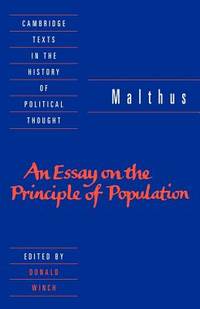
1992Cambridge-9780521429726Cambridge University Press 1992. PAPERBACK. New. Cambridge University Press paperback
1992Cambridge-9780521429726Cambridge University Press 1992. PAPERBACK. New. Cambridge University Press paperback
37691J. Murray. 1827. First Edition 4to xxxvi 227 1pp. 22 lithograph plates Malthus essay running from page 171-180; orig. boards covers detached lacks spine uncut unopened internally a nice clean copy. Malthus's first essay to the Royal Society of Literature in which he explains his theory of the source or cause of exchangeable value. As Patricia James in her biography of Malthus explains 'Anyone wishing to understand Malthus's doctrine that the of a commodity is composed of labour and profit these short essays can be recommended for their comparative simplicity. As is often the case enlightenment comes from a footnote - in this instance at the beginning of the first paper with Malthus's italics:- "The natural and necessary conditions of the supply of commodities are precisely the same as the natural and necessary costs of production when reduced to the simplest elements; but I have preferred the former expression because the term cost if not well guarded is too apt to convey the idea of Money expenditure."' The second paper On the Meaning which is most usually and most correctly attached to the term 'Value of a Commodity' was read two years later on the 7th November 1827. J. Murray. 1827 hardcover
180912840Paris and Geneva: Chez J.J. Paschoud 1809. 3 volumes. First Edition in French. Provenance: With the contemporary engraved bookplate of H. Trouchin and that of the subsequent owner Pierre Sciclounoff. 8vo very handsomely bound in a fine French binding of contemporary half calf over speckled boards spines with gilt ruled bands red morocco title label and green morocco volume label lettered in gilt. xxiii 424 3 ad; 395 3; 392. A very fine and handsome set very clean and sturdy in absolutely period state. The first French edition of Malthus’ landmark work. The translation from the English is by Pierre Prevost probably from the third English edition which was corrected and expanded by Malthus. French editions of Malthus are uncommon and this set is in exceptional condition in its original and contemporary state.<br> Originally written in response to a discussion with the author's father on the perfectibility of society the book was reprinted several times with many alterations and additions as Malthus defended his views against a host of critics.<br> "The central idea of the essay--and the hub of Malthusian theory--was a simple one. The population of a community Malthus suggested increases geometrically while food supplies increase only arithmetically. If the natural increase in population occurs the food supply becomes insufficient and the size of the population is checked by 'misery'--that is the poorest sections of the community suffer disease and famine. Malthus recognized two other possible checks to population expansion: first 'vice'--that is homosexuality prostitution and abortion all totally unacceptable to Malthus; and second 'moral restraint'--the voluntary limitation of the production of children by the postponement of marriage. This was the solution to the population problem that Malthus advocated. The 'Essay' was highly influential in the progress of thought in early nineteenth-century Europe" PMM. Marx Engels Paley Darwin Wallace Keynes and Ricardo were all influenced by Malthus--either working off his ideas or reacting against them. Chez J.J. Paschoud hardcover
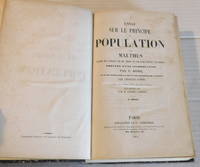
1852101094<p>Paris: Guillaumin et Cie Libraires 1852. 1852. Good. - Octavo 9-5/8 inches high by 6-1/2 inches wide. Hardcover bound into black & white marbled boards backed with a black cloth spine titled & ruled in gilt on the spine. The covers are rubbed & soiled. lvi & 688 pages. There is foxing throughout particularly at the front & rear. Good.</p> Paris: Guillaumin et Cie, Libraires, 1852. hardcover
PJH55320J. P. Aillaud Paris 1820. VG bright set in contemporary slightly worn and scuffed calf bindings with red and black title labels to each spine. 501 452pp. 1st French Edition published same year as the English Edition. Two Volumes. From the collection of Professor Malcolm Deas 1941-2023 an Emeritus Fellow of St Antony's College Oxford and University Lecturer in the Government and Politics of Latin America 1966-2008 J. P. Aillaud (Paris) 1820 unknown
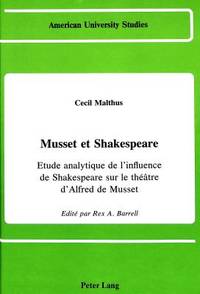
19883700685Peter Lang Publishing Inc 1988. This is an ex-library book and may have the usual library/used-book markings inside.This book has hardback covers. Clean from markings. In good all round condition. No dust jacket. French text. Please note the Image in this listing is a stock photo and may not match the covers of the actual item800grams ISBN:082040490X Peter Lang Publishing Inc hardcover
17163115621716. 4 pp. Small splits at old folds old reinforcement to center fold very good. 4 pp. The bill of one John Boundy as issued by Daniel Malthus 1651-1717 apothecary to Queen Anne and George I and great-grandfather of the economist Thomas Robert Malthus. Items charged include various juleps cordials and draughts linseed oil chamomile flowers marshmallow leaves purging potions King's drops quieting powders etc. Attested paid to estate of Mr. Malthus at end by Tho. Graham and docketed paid £58 July 10 1718. With 4 small circular stamps with the motto of the Earl of Fortescue "Forte Scutum Salus Ducum" "A Strong Shield is the Salvation of Leaders" unknown