3 073 résultats
198152219Place_Pub: Washington DC: GPO 1981. very good. 245 wraps footnotes figures tables Complete subtitle: Hearings on oversight on Monetary Policy Report to Congress pursuant to Public Law 95-523. GPO paperback
198052218Place_Pub: Washington DC: GPO 1980. very good. 279 wraps footnotes figures tables Complete subtitle: Hearings on oversight on Monetary Policy Report to Congress pursuant to Public Law 95-523. GPO paperback
197655626Washington DC: U. S. Government Printing Office 1976. presumed First Edition First printing. Wraps. Good. Senate document 94th Congress 2d Session Report No. 94-755. viii 651 5 pages. Wraps. Figures. Footnotes. Appendices. Glossary. Small tears at spine slight soiling to text staples in front cover small stains on title page. Inscribed to Nancy Brooks by Michael Madigan Staff Counsel and Spencer Davis Staff Press Secretary. In 1973 the Senate Watergate Committee investigation revealed that the executive branch had directed national intelligence agencies to carry out constitutionally questionable domestic security operations. In 1974 Pulitzer Prize-winning journalist Seymour Hersh published a front-page New York Times article claiming that the CIA had been spying on anti-war activists for more than a decade violating the agency's charter. Former CIA officials and some lawmakers including Senators William Proxmire and Stuart Symington called for a congressional inquiry. On January 21 1975 Senator John Pastore introduced a resolution to establish a select committee to investigate federal intelligence operations and determine "the extent if any to which illegal improper or unethical activities were engaged in by any agency of the Federal Government." The Senate approved the resolution 82-4. The final report included 96 recommendations legislative and regulatory designed "to place intelligence activities within the constitutional scheme for controlling government power." The committee recommended strengthening oversight of intelligence activities. Majority Leader Mike Mansfield cautioned the Senate "against letting the affair become a ‘television extravaganza.'" He and Republican Leader Hugh Scott carefully selected committee members balancing experienced lawmakers with junior members and ensuring that members represented a variety of political viewpoints. Mansfield selected Democrat Frank Church of Idaho to serve as chairman. A 16-year member of the Committee on Foreign Relations Church recognized the strategic value of the nation's top intelligence agencies and was also mindful of the need for American institutions to function within the confines of U.S. constitutional law. He had aggressively lobbied to lead the investigation. Republican John Tower of Texas a member of the Armed Services Committee was selected as the committee's vice-chairman. The committee decided that most of its hearings would be held in closed executive session in order to protect intelligence sources and methods. The committee held a series of public hearings in September and October of 1975 to educate the American public about the "unlawful or improper conduct" of the intelligence community highlighting a few carefully selected cases of misconduct. These hearings examined a CIA biological agents program a White House domestic surveillance program IRS intelligence activities and the FBI's program to disrupt the civil rights and anti-Vietnam War movements. These nationally televised events offered the American public an opportunity to learn about the secret operations conducted for decades by U.S. intelligence agencies. The committee faced a formidable task: to conduct a wide-ranging investigation of the nation's most secret agencies and programs and based on those findings write a detailed report including legislative recommendations. All of this work was to be completed within one year later extended to 16 months. After a meeting with President Gerald Ford and his top national security advisors Church and Vice-Chairman Tower secured from the president a pledge that the White House would cooperate with Senate investigators. Staff identified potential programs for study and began requesting documents from intelligence agencies. Though staff did not always receive documents in a timely fashion they enjoyed unprecedented access to materials that had never before been made public. Perhaps the most well-known of these internal reports the CIA's so-called "Family Jewels" outlined the agency's misdeeds dating back to President Dwight Eisenhower's administration. This report as well as those found in other agencies provided road maps that staff investigators used to piece together complicated histories of domestic foreign and military intelligence programs during the Cold War era. Even with a peak staff of 150 however organizing and analyzing these materials proved to be an arduous task. After holding 126 full committee meetings 40 subcommittee hearings interviewing some 800 witnesses in public and closed sessions and combing through 110000 documents the committee published its final report on April 29 1976. Congress approved legislation to provide for greater checks and balances of the intelligence community. In 1978 Congress approved and President Jimmy Carter signed into law the Foreign Intelligence Surveillance Act FISA requiring the executive branch to request warrants for wiretapping and surveillance purposes from a newly formed FISA Court. Today the Church Committee reports and hearings are frequently used by scholars who continue to examine U.S. intelligence activities during the Cold War era. U. S. Government Printing Office paperback
197952216Place_Pub: Washington DC: GPO 1979. very good. 284 wraps notes footnotes tables The unrestricted expansion of the tax exempt bond market through mortgage revenue bonds may impose a revenue loss at a time that the government may be least able to afford it. GPO paperback
200448688Washington DC: GPO 2004. very good. 1578 wraps appendix figures. S. Hrg. 108-633. Officials from Riggs Bank testified that they failed to provide internal controls sound training and effective monitoring to guarantee that the bank complied with Federal laws governing the reporting of large financial transfers and suspicious activity. GPO paperback
200547958Washington DC: GPO 2005. First Edition. First Printing. good. 1745 wraps figures tables appendix covers somewhat worn soiled and crease at back. S. Hrg. 109-185. GPO paperback
197951585Washington DC: GPO 1979. good. 565 Part I only wraps illus. tables appendix small tears to cover edges and to top and bottom spine edges An inquiry into the relationship between individual beneficiaries and the investment policies of their pension funds. GPO paperback
197447365Washington DC: GPO 1974. fair to good. 1250 wraps fold-out chart footnotes tables appendices spine discolored and creased small stains to front cover. Subtitled: Pursuant to S. Res. 60 February 7 1973 A Resolution to Establish a Select Committee of the Senate to Investigate and Study Illegal or Improper Activities in the Presidential Election of 1972. 93d Congress 2d Session Report No. 93-981. GPO paperback
200245370Washington DC: GPO 2002. First Edition. First Printing. good. 2640 total wraps stiff paper covers 2-volume set S. Hrg. 107-618. The record of these major hearings is a treasure trove of data and perspective and contains a large number of exhibits. GPO paperback
1928229208Ottawa: F. A. Acland Printer to the King's Most Excellent Majesty 1928. Hardcover. Very Good. 7 x 10. 338 pages in very good condition. Pages are clean and unmarked. A pocket with 9 maps attached to the back endpaper. Page edges are lightly darkened. Bound in green cloth with fading gilt titles. Lightly worn around the edges. Lightly faded on the spine. SCARCE. VG <br/> <br/> F. A. Acland, Printer to the King's Most Excellent Majesty hardcover
19692601220012United States Government Printing Office Washington D.C 1969. Paperback. Acceptable. 5x0x8. Signed. Inscribed by Judge John Robert Brown on front cover. Softcover. Shelf wear. Spine creased sunned. Scattered markings. vi 727 pages : illustrations ; 23 cm. <br> "John R. Brown was a Federal judge who played a major role in desegregation cases that transformed the South. The Judge John R. Brown Admiralty Moot Court Competition was established shortly before Brown's death and is now held annually sponsored by the University of Texas School of Law. United States Government Printing Office, Washington, D.C paperback
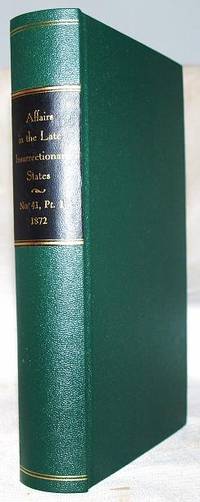
18721504030008GPO 1872-01-01. Hardcover. Good. 0x0x0. The investigation of Congress into the Klu-Klux Conspiracy. Report No. 41 part 1. Hardcover. Rebound in fine modern green cloth. Gold lettering and head and tail lines. Internally some marginal chipping and loss to edges of first nine pages otherwise text in very good condition without markings or wear. Report No. 41 Part 1 from the Senate of the United States 2nd Session of the 42nd Congress Report by the Joint Select Committee of the Senate on the Condition of Affairs in the Late Insurrectionary States. <br><br> Covers the report issued by the Senate on March 10th 1871 on the state of affairs in the southern states that ultimately led to the passage of the Enforcement Act of 1871 to battle corruption within the new state governments and violence on the part of the Ku Klux Klan. This volume also covers an investigation of the economic conditions in the Reconstruction South as well as infrastructure development. From the complete and scarce 1872 Ku Klux Klan reports regarding their rebellious activities. Considered one of the most complete chronicles of the Klan from the Reconstruction Era. This volume contains numerous interviews with prominent citizens local officials victims of Klan activity and other witnesses. The investigation of Klan activity was part of the larger effort to eliminate the Ku Klux Klan altogether with the Enforcement Act of 1871 which was also known as the Civil Rights Act of 1871 or the Ku Klux Klan Act. This act empowered the President to suppress state disorders and suspend the right of habeus corpus in the wake of racial violence and intimidation initiated by the Ku Klux Klan and their supporters. GPO hardcover
1965727046PN. New. 1965. Soft Cover. Date is original print. This is a reprint edition. . PN paperback
20131356205PN. New. 2013. Soft Cover. Date is original print. This is a reprint edition. . PN paperback
198191187Washington DC: U.S. Government Printing Office 1981. Presumed First Edition First Printing. Wraps. Very good. iii 1 230 2 pages. Illustrations. Tabular data. The "Hydroelectric Development in New England" hearing was a pivotal August 1981 session held by the U.S. Senate Committee on Energy and Natural Resources. The hearing addressed the booming "mini-hydro" rush driven by the Public Utility Regulatory Policies Act PURPA and regional disputes over cheap renewable energy The PURPA Boom: Driven by the 1970s oil crises Congress passed PURPA in 1978 to reduce foreign oil dependence. By 1981 this led to a "gold rush" of developers seeking to retrofit finance and construct small-scale hydroelectric plants. The legislation guaranteed a market for the electricity and offered sizable tax credits. The 1981 hearing touched on a major regional crisis. New Hampshire attempted to stop "exporting" relatively inexpensive hydroelectricity generated on the Connecticut River to Massachusetts and Rhode Island in order to lower its own citizens' utility bills. This sparked a legal war that culminated in the 1982 Supreme Court case New England Power Co. v. New Hampshire where the Court ruled that states could not constitutionally restrict the interstate trade of hydro-power. Despite federal tax incentives developers faced severe bottlenecks in trying to build or revive small hydro plants. The hearing focused heavily on accelerating the Federal Energy Regulatory Commission FERC licensing process to encourage development. U.S. Government Printing Office paperback
0331791811.Ghardcover. Good. Access codes and supplements are not guaranteed with used items. May be an ex-library book. hardcover
0656214058.Ghardcover. Good. Access codes and supplements are not guaranteed with used items. May be an ex-library book. hardcover
6203425222.Gpaperback. Good. Access codes and supplements are not guaranteed with used items. May be an ex-library book. paperback
38536949like new. unknown
6200118906.Gpaperback. Good. Access codes and supplements are not guaranteed with used items. May be an ex-library book. paperback
0656370920.Ghardcover. Good. Access codes and supplements are not guaranteed with used items. May be an ex-library book. hardcover
25338Dated by another on reverse: ‘M.S.S. 22d. Apl 1853 / Massachusetts’. On 13 x 7.5 piece of paper cut down from the label of a packet containing a manuscript see the annotation on the reverse. On discoloured paper with glue staining from mount on reverse. Sumner's signature 'C. Sumner' is at top left with the top of the S slightly cropped. The address by Sumner reads 'W. S. Law Magazine / New York / N. Y.' Annotated in pencil on reverse: 'Charles Sumner / M.S.S. 22d Apl 1853 / Massachusetts / Lawyer'. See Image Dated by another on reverse: ‘M.S.S. 22d. Apl 1853 / Massachusetts’. unknown
0266261671.Ghardcover. Good. Access codes and supplements are not guaranteed with used items. May be an ex-library book. hardcover
50485301like new. unknown
50485301-nnew. unknown