[BAGHDAD]Biblio.com
239 résultats
AQ24158s.i.: s.n. s.d. c. 1930 20 leaves of photographic illustrations. Stitched as issued in original publisher’s printed olive-green wrappers. A trifle rubbed creased and marked. A pre-war view book comprised of twenty landscape photographic illustrations of Baghdad including an early image of the American consulate. . Oblong 8vo. [s.n.], [s.d., c. 1930] unknown
1925PHOT0552Baghdad, A. Kerim and Hasso Bros. o.J. (um 1925). Quer-4° (31 x 24 cm). 73 Sepia-Photogravuren auf 50 Tafeln (mit schwarzgedr. Bildunterschriften in Englisch). OPappband m. Kordelbindung, Krokodilhaut nachempfundenen Deckelbezug u. goldgepr. Deckeltitel. Mit stärkeren Gebrauchsspuren, Einband angestaubt, an den Kanten stark abgewetzt, an den Ecken u. Kapitalen bestoßen, flieg. Vorsatz mit Quetschfalte, Tafeln durchgeh. stockfl. Album mit Reproduktionen von Fotografien aus dem Irak. Gezeigt werden neben Ansichten aus Bagdad, Basra und Mossul vor allem Alltagsszenen (Markt, Wäsche, Schiffahrt, Handel u.ä.) sowie Porträts, darunter auch Beduinen u. arabische Scheichs. Kerim wird unter 3 Abbildungen als 'R.A.F. Official Photograph' bezeichnet. - Unter den Ansichten u.a.: Ashar Creek, Whiteley Bridge Ashar Basrah, Bazar Square in Basrah City, The Serai Creek in Basrah City, Sheikh Gazal Market Ashar Basrah, Sug El Dijaj Basrah City, Modern Baghdad the city of Caliphs, The Shrine of Sheikh Omar, the Tomb of Sit Hobaida Kadimain the Holy City, The Golden Domes and Minarets of the Kadimain Mosque, The Maude Bridge, Baghdad from an aeroplane, Fruit Market in Baghdad, Baghdad & The Tigris, the Ruins of Babylon.
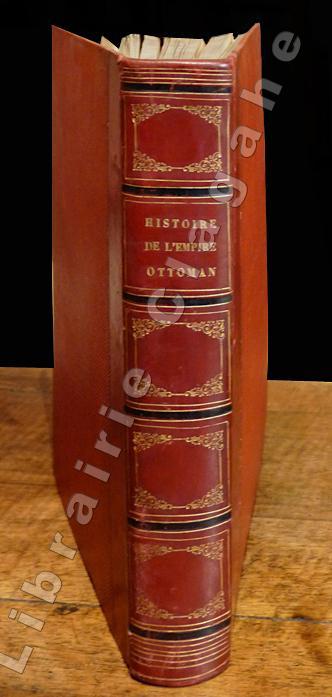
185515126Paris, Garnier-Frères, 1855 ; grand in-8 ; demi-veau glacé rouge sang, dos à faux-nerfs plats noirs à froid, caissons décorés et dorés aux petits fers dans un encadrement de filet doré, titre doré, plats de papier gauffré rouge (reliure de l'époque) ; VII, 528 pp., 18 planches hors-texte finement gravées sur acier d'après Allom, Beutley, Salmon et Leitch, très grande carte dépliante par L. Berthe, lithographiée et coloriée à la main.
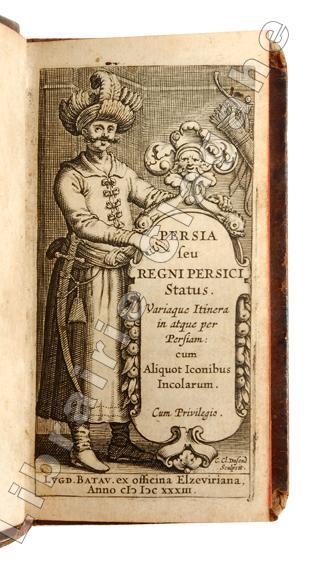
163319068Leyde, Elzevir, 1633 ; in-24, veau havane marbré, mosaïqué d’une pièce rectangulaire formant listel d’encadrement des plats en veau noisette, décorée à froid, fer d’angles à froid, roulette intérieure à froid et fleuron central doré, fer au gland doré au dos, répété, pièce de titre noisette, tranches rouges (reliure ancienne) ; 374 pp. y compris le titre gravé par C. Cl. Dusend, [4] ff. d’index, 8 bois gravés à pleine page, de costumes.
201125330ESan Francisco CA: Privately Published by Robin Williams 2011. First Edition. Original privately printed 131 page play script for Robin Williams’s only Broadway play Bengal Tiger at the Baghdad Zoo written by Rajiv Joseph with Iraqi-Arabic translations by Ammar Ramzi and Raida Fahmi. Signed and inscribed by Robin Williams at the frontispiece black & white photo of himself in character to a member of the crew: “Dale Thank you Robin Williamsâ€. Beautifully bound in full black leather with bright gilt-stamping to the edges and spine and the title in red and orange to the front board 8 5/8 inches by 11 1/8 inches. Beautiful marble endpapers. Fine. Unbeknownst to the many admirers of Robin Williams was that he was a lover of books. Over the years Williams had his own private press specially printing on fine papers and handsomely binding editions of the screenplays of some of the films he appeared in and this his only Broadway play. They were all printed in very small quantities. Williams would sign them and then they would be sent to members of the cast and crew of the productions. As a unique item this is a special opportunity to honor and celebrate Williams’s love of his craft his love of books and his appreciation of the people who helped to bring his art to life. This production of Bengal Tiger at the Baghdad Zoo opened March 31 2011 at the Richard Rodgers Theatre and ran for an impressive 108 performances closing July 3 2011. The play was directed by Moises Kaufman starring Robin Williams Glenn Davis Brad Fleischer Hrach Titizian Sheila Vand Necar Zadegan and Arian Moayed telling the tale of the lives of two American Marines and an Iraqi translator whose lives are forever changed by an encounter with a quick-witted tiger Williams who haunts the streets of war-torn Baghdad attempting to find meaning forgiveness and redemption amidst the city’s ruins. The play earned 3 Tony Award nominations: Best Featured Actor in a Play for Moayed Best Lighting Design for a Play and Best Sound Design of a Play. Privately Published by Robin Williams hardcover
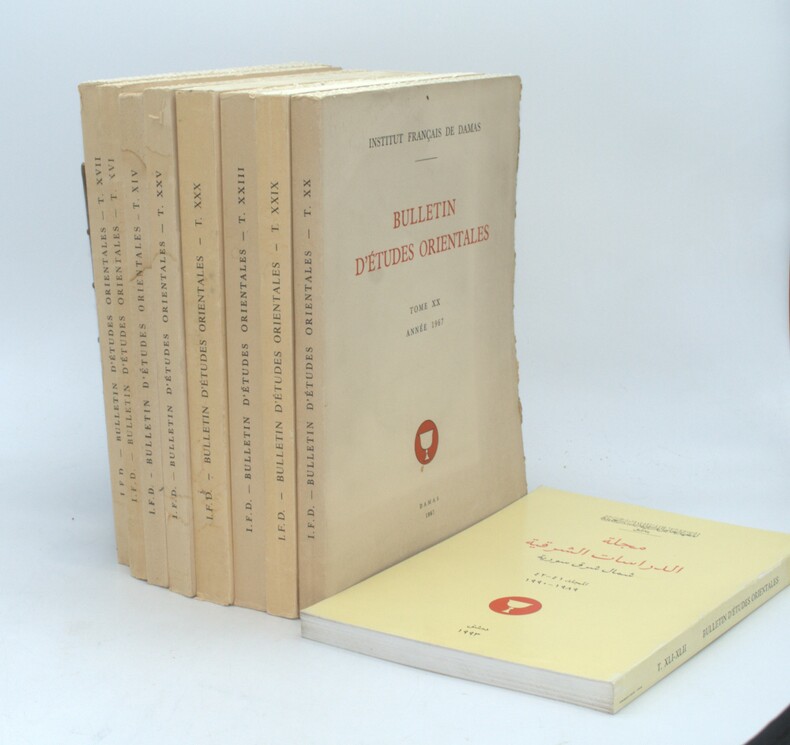
1952PHO-1462Damas , Institut français d’étude arabe de Damas , 1952-1993 , 9 volumes grand in-4 , brochage éditeur . Tomes XIV ,1952-1954 ,Damas, 198 pages. Tome XVI ,1958-1960 ,Damas, 212 pages, dont 78 pages en arabe, 4 planches en fac-similés hors-textes Tome XVII ,1961-1962 ,Damas, 268 pages, 12 planches Tome XX , 1967 , Damas , 211pp. , illustré de 10 planches Tome XXIII ,1970 ,Damas, 311 pages dont de nombreux textes arabes Tome XXV ,1972,Damas, VIII-319 pages, 5 figures, 8 planches, 7 fac-similés et 10 plans hors texte. Tome XXIX, 1977, Damas ,Mélanges offerts à Henri Laoust, volume premier , 278 pages, 5 planches hors-texte Tome XXX ,1978 ,Mélanges offerts à Henri Laoust, second volume ,(suivi d'un répertoire index des Publications de l'Institut de Damas depuis 1929) VIII-293 pages Tome XLI-XLII ,1989-1990. Le Nord-Est Syrien. Damas, 1993, 264 pages dont 65 pages en arabe, 24 photos hors-texte.
1824PHO-2191Paris, Everat, 1824, in-4 (260x210mm), 2ff-LIV-568pp-1ff , avec en fin d’ouvrage la liste des membres de la Société de Géographie, relié demi toile, dos lisse avec étiquette de titre, éditeur et tomaison, frottements aux plats et étiquette usée, vieille mouillure claire en coin, piqures.
2 vols., 8vo., First Edition, with frontispieces and plates; elegantly bound in full dark green crushed morocco, sides with gilt frame border stopped with roundels at corners, backs with raised bands, second and fourth compartments framed and lettered in gilt, all other compartments tooled in gilt, gilt edges, gilt doublures, hand-made endpapers, ribbon markers, a crisp, elegant set ideal as a gift or for presentation. The set comprises Vol.I: 1889-1914 (1958); Vol. II: 1914-1926 (1961). SCARCE.
Very Good Turkish, Ottoman (1500-1928) Contemporary handsome petrol green quarter leather, five raised bands to spine with decorative gilt edges, marbled boards. Roy. 8vo. (24 x 17 cm). In Ottoman script (Old Turkish with Arabic letters. 118 p., 14 unnumbered woodcut plates (one is full of two pages). Hegira: 1314 = Gregorian: 1896. Extremely rare first and illustrated edition of the journey of civil servant Ali Bey, who went from Istanbul to Baghdad and to India through his duty in Düyûn-u Umûmiye [i.e. Ottoman Public Debt Administration] covering the years 1885-1888, vividly describing Baghdad, Musul; and India. In 1884 Ali Bey started his journey as an ex-governor of Trabzon city and a new OPDA officer from Constantinople (Istanbul), and he arrived in Baghdad through Lesbos, Ayvalik, Smyrna (Izmir), Mersin, and Alexandretta (Iskenderun). On their way to Baghdad, they cross the Tigris River on rafts that local people call "Kelek". His descriptions of Baghdad city are very important and first-hand accounts of the region including the details of the walls of the city, hospitals, health organizations, industry, a transportation company on the river, a new settlement near the center of Kadhimiya with a tram line to through the city built. Ali Bey landed on the Indian continent in Karachi (today's Pakistan). He made a detailed description of the big cities that were the British Colony and states that he was influenced by these cities as a Reform period Turkish intellectual. He also describes Islamic India, Parsi traditions, costumes and funerals, Portuguese culture in India, Victoria Garden Zoo, silk weaving factories founded by David Sossoon, who came from Baghdad, architecture, music, theater, etc. List of ills.: General view from Ayvalik, the port of Smyrna (Izmir), the port of Mersin, two panoramas of Diyarbakir and Aleppo cities, the bridge of Musul, "Keleks" on the Tigris, a local woman of Aleppo, Famous water mill of Aleppo, Fortress of Aleppo, Eagles of Parsi people in Bombay, A Parsi family from Bombay, Arcadia ship in Bombay, Straight of Hormuz in Basra. Ali Bey was a playwright originally. He learned French in private lessons and firstly he worked at the Babiâli (The Sublime Port) Translation Office as a clerk, then he became a member of the Health Council and the first secretary of the Directorate of Quarantine. He went to Eastern Anatolia, Iraq, and Japan as an inspector of public debts (1855-88). After his duty as the Governor of Trabzon (1890-93) he became the director of the Office of Public Debts (1890-93), which would last until the end of his life. It is for this reason that he was called Direktör Ali Bey. His first work was published in Diyojen (1869-72), the first humorous review, published by Teodor Kasap. Ali Bey, who was one of the regular writers of this review, wrote plays for the Gedik Pasa Theater, which was founded by the Armenian Güllü Agop and his friends, and wrote scripts adapted from French plays. He gave Turkish diction lessons to the Armenian actors and participated in theater activities. His plays were performed under the authorship 'A Person' to hide his official identity. He explained the meanings of words satirically in his dictionary Lehçetü'l Hakayik (Language of Realities) which he wrote in 1897 and was the first work of its field; the faults of the 19th-century Ottoman Empire were also criticized in this dictionary. Özege 17900.; TBTK 3068.; OCLC 218189547 (One copy in Bayerische Staatsbibliothek), 602878049 (one copy in Universitatbibliothek), 879555766 (Four copies), 56944884.
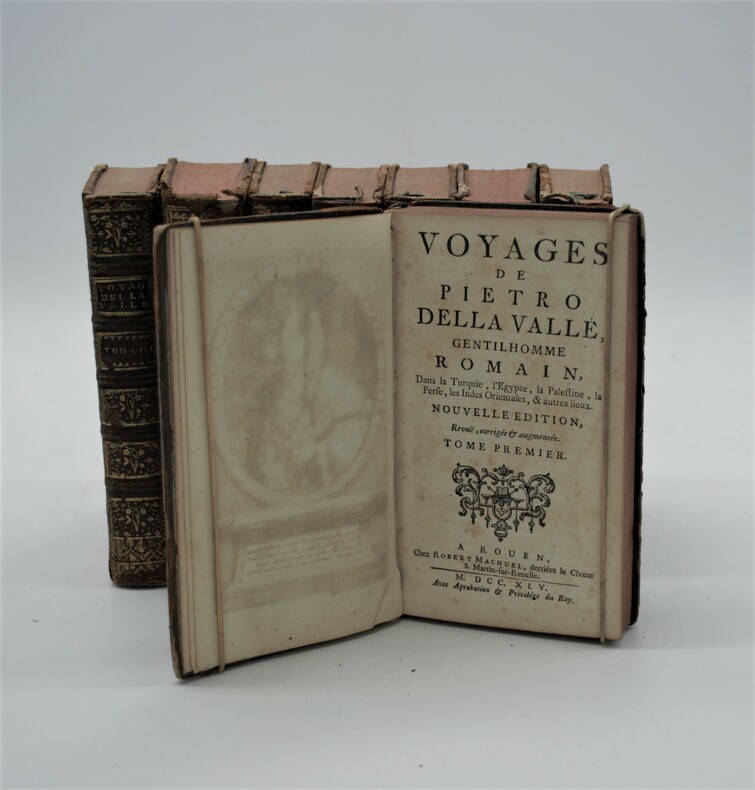
1745PHO-885Paris & Rouen , Nyon & Machuel ,1745. 8 volumes in-12 (170x100), plein veau époque , dos à nerfs avec pièces de titre et tomaison , tranches rouges , défauts d’usage (coiffes arasées , coins usés , reliures frottées , manque au dos Tome 7, etc) , Édition illustrée des portraits de l'auteur et de sa femme morte durant le voyage et 5 plans H.T. et une planche.
Very Good French Original map. Oblong Double Elephant Folio. (96x156 cm). In French. Scale: 1/1.500.000. With explanation of geographical terms in Greek, Turkish, Arabic and Persian; With overview sheet: Aperçu general de la division administrative des provinces asiatiques de l'Empire Ottoman. (Jaar: 2011 - Europeana Collections). French edition of Kiepert's huge map of the Imperial Ottoman territories. "Includes list of geographic terms in eastern languages and notes on administrative divisions. Includes notes on materials the cartographer used to put together the map". (See LC copy). Kiepert, (1818-1899), was born in Berlin. He traveled frequently as a youth with his family and documented his travels by drawing. His family was friends with Leopold von Ranke, who inspired Kiepert's creative endeavors. Kiepert was taught by August Meineke in school. Meineke influenced Kiepert's interest in classical antiquity. He attended Humboldt University of Berlin. He studied history, philology, and geography. He published his first geographical work, with Carl Ritter, in 1840, titled Atlas von Hellas und den hellenischen Kolonien. The atlas focused on ancient Greece. In 1848 his Historisch-geographischer Atlas der alten Welt was published. In 1854, his atlas, Atlas antiquus was released. It was translated into five languages. Neuer Handatlas über alle Teile der Erde was first published in 1855. In 1877 his Lehrbuch der alten Geographie was published, and in 1879 Leitfaden der alten Geographie, which was translated into English (A Manual of Ancient Geography, 1881) and into French. In 1894 he created the first part of a larger atlas of the ancient world titled Formae orbis antiqui. He traveled to Asia Minor four times between 1841 and 1848. He created two maps of the region, including Karte des osmanischen Reiches in Asien, in 1844. Kiepert taught geography at the University of Humboldt-Berlin starting in 1854. He taught at the university until his death. Akyol, article 536.; Dagtekin p. 22 (With detailed bibliography on Kiepert's maps). Rare. Preserved in a frame, will be sent without its frame. A wall map.
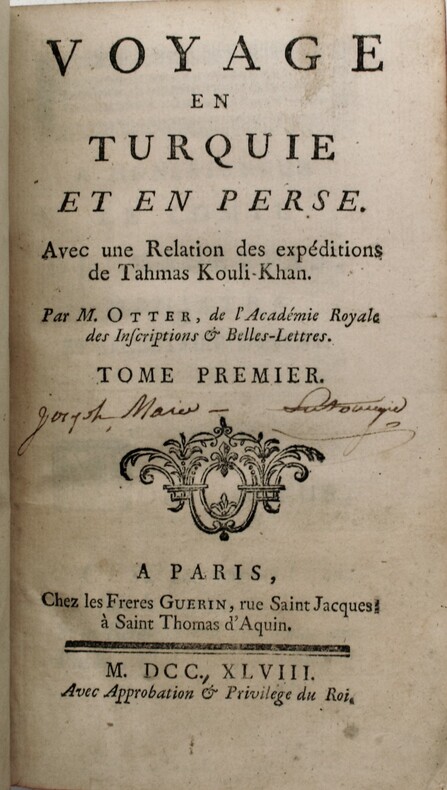
1748PHO-1192Paris , chez les Frères Guerin, 1748.2 volumes in-12 , 6ff-415pp - 386pp , relié plein cuir , dos a nerfs orné avec pièce de titre et tomaison rouge (Tome 2 , reliure pastiche) , tranches différentes .
188788Horsham: The Architectural and Planning Partnership and Mahmood Ali and Partners 1982. Baghdad resurgent - Arabian vernacular architecture meets modern urban planning First and sole edition rare: this the only copy to appear on auction records and we trace just one institutionally at Harvard. This impressively produced report concerns the historic Bab al-Sheikh neighbourhood in the Rusafa district of Baghdad a sensitive site that includes the mausoleum of Abdul-Qadir al-Gilani c. 1077-1166 founder of the Qadiriyya Sufi order. In 1980 the Mayoralty of Baghdad initiated plans to integrate Bab al-Sheikh into a wider development project. Previously some areas had been thoughtlessly levelled to make room for parking lots so local government consulted the distinguished Iraqi architect Rifat Chadirji who opposed random redevelopment without consideration for older structures. To lead the project Chadirji brought in two Britons architects and planners John Warren and Professor Roy Worskett and architect Mahmood al-Ali who had previously made water liability studies in the area alongside "colleagues in Horsham London and Baghdad" foreword. Chadirji remarks that "Warren's planning studies were of remarkable quality and insight as regards the conceptual requirements" Chadirji & Mutschler p. 57. When it came to the Bab al-Sheikh Warren identified for conservation some twenty "houses of quality" as Chadirji calls them and Mutschler remarks that "Bab al-Sheikh is an old residential quarter of great national importance and the problem was to design an economically viable project that would fit the pattern of the old Islamic city with its mosque and buildings Whoever intends to build upon the ground of a millennium-old culture has to combine its Arabian character and variety with the requirements of modern civilization". This report would have been produced for circulation among those most closely connected to the project and not intended for general release. Landscape small folio. Printed on coated paper illustrated throughout with architectural drawings plans and images of architectural models divisional titles printed on deep purple coated paper; separate APP image loosely inserted; text in English. Original screw-post binding nickel-plated screws green morocco-grain cloth covers gilt-lettered and decorated on both covers. A few abrasions to binding paper spines nicked and chipped at ends internally some faint tidemarks peripheral toning and general cockling a few leaves nicked at foot: very good. Rifat Chadirji and Carlfried Mutschler "The Bab al-Sheikh Project Baghdad. In Continuity and Change: Design Strategies for Large-Scale Urban Development" Margaret Bentley Sevcenko ed. Aga Khan Program for Islamic Architecture 1984. hardcover
Very Good Arabic Original brown half leather bindings in Egyptian style, raised six bands to spine, title gilt on the second, volume nos on fourth, and alphabetical with the historical content of the volumes on sixth compartments and "Mahmoud Al-Tawawî" name. Minor foxing on some pages. Overall a very good set. Roy. 8vo. (24 x 17 cm). In Arabic. 14 books are complete set in 7 volumes. Extremely rare first printed edition of the most comprehensive and complete corpus on Baghdad city, which includes Al-Baghdadi's first-hand account of the collection of hadiths, biographies, and his travels in the 11th century Baghdad in traditional "al-râwî" style. Al-Baghdadi is known as a Muslim traveler in the pursuit of knowledge who compiled hadiths and traveled to many Islamic cities. He was born on the 24th ?jumada II, 392 (1002) at Darzidjan, a large village on the west bank of the Tigris below Baghdad. The son of a khatib [i.e. preacher], he began his studies very early and spent his youth traveling in search of ?adith. In this way, he visited Basra, Nishapur, I?fahân, Hamadân, and Damascus. Finally settling in Baghdâd, he held the office of a kha?îb and this was the origin of the name al-Khatîb al-Bag_dadi. After completing his education, he spent more than twenty years of his time writing "Tarikh Baghdad". He finished his corpus in 444 AH [1052-53]. He was a fellow student of Rîsürrüesâ Ibn al-Muslima who was the vizier of the Abbasid caliph Kâim-Biemrillâh. The vizier took Khatib, whom he appreciated in the science of hadith, under his patronage. The Abbasid caliph, therefore, ordered Khatib to be given permission to take hadith lessons from him. Khatib started to narrate hadiths from "Tarikh Baghdad" to his students here in his house near the Nizâmiya Madrasa, on the other hand, he started to read the books for which he had permission to narrate from many teachers, also write the books he planned. Several years after, the Turkish commander Besasiri (?-1060), who was a supporter of the Fatimid Caliph Mustansir-Billâh, entered Baghdad with the encouragement of the Fatimid caliph, deposed the caliph, and killed Ibn al-Muslima. Some members of the Hanbali sect, who had a grudge against Khatib because of what they wrote against some Hanbalis in Tarikh Baghdad, started to disturb him by taking the opportunity to kill the vizier. Therefore, he had to flee to Damascus. In his masterpiece, Khatibi, in addition to his account and descriptions of the city during his time in Baghdad, 7831 figures of people in total who lived or came in Baghdad before 450 (1058), statesmen such as caliphs, viziers, commanders, poets, judges, and other professions. This is an alphabetical work giving information about biographies of these figures, but it starts with the name "Muhammad" referring to the Muslim prophet. The first volume is about the establishment of Baghdad in the pre-Islamic period, its conquest by the Muslims, and its history. This masterpiece of him, published in fourteen volumes, is the most comprehensive corpus written on Baghdad in the Islamic world including the city's topography, history, et alli. Brockelmann, GAL, I, 401; Suppl., I, 563.; H. Gibb, "Islamic Biographical Literature".; F. Rosenthal, A History of Muslim Historiography, Leiden 1968, p. 14, 43. Only one set in OCLC in BnF (Bibliothèque nationale de France): 1198963531.