Livre Rare Book

80 résultats
1969ABE-1565097010668196 PAGES-20,5 CM X 28,5 CM-EN COUVERTURE "LA COURSE AU POUVOIR", GEORGES POMPIDOU EN BUSTE-LA COURSE AU POUVOIR, 4P PAR CATHERINE NAY ET GEORGES SUFFERT, 9 PHOTOS (QUELQUES MOTS SOULIGNES AU STYLO ROUGE)-COLOMBEY LE DERNIER DOMAINE RESERVE 2P, 2 PHOTOS-DE GAULLE VU D'AMERIQUE, 1P PAR JAMES RESTON, DESSIN WAITE THE SUN-FELLINI: "LES ITALIENS NE SONT PLUS DES ITALIENS", 1P, PHOTO-REVOLUTION A L'ITALIENNE, 2P PAR JEAN FRANCOIS KAHN-CANDIDAT POUR FAIRE QUOI?, 1P PAR FRANCOISE GIROUD-MOEURS: LE THEATRE EST DESCENDU DANS LES RUES DE NANCY, 2P, 2 PHOTOS (JACK LANG)-"HAIR" S'ABAT SUR PARIS, 1P PAR GUY MONREAL, PHOTO-CINEMA: LOLA RETROUVEE A LOS ANGELES, PHOTO JACQUES DEMY ET ANOUK AIMEE-TELEVISION: UNE DRAMATIQUE DE REVE: "SALOME", 1P PAR GEORGES SUFFERT, 2 PHOTOS-CONCORDE FREINE PAR LA POLITIQUE, 2P, 5 PHOTOS-UNE GRANDE ENQUETE LES POLICIERS PARLENT
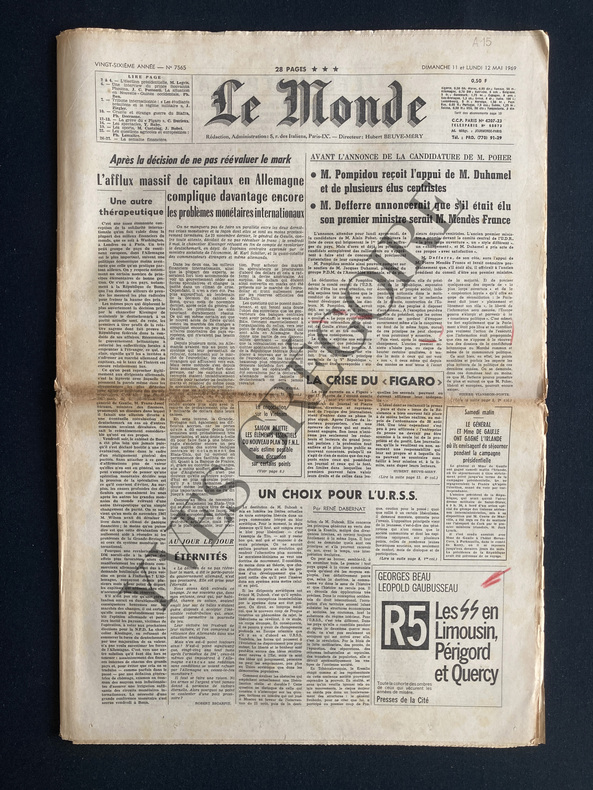
1969ABE-156570705058028 PAGES-35 CM X 50 CM-LA CRISE DU "FIGARO"-LES PREPARATIFS DE L'ELECTION PRESIDENTIELLE, 2P (PASSAGES SOULIGNES AU CRAYON ROUGE SUR 1 ARTICLE)-CRUELLE ET ETRANGE GUERRE DU BIAFRA V LA PAIX DES BRAVES PAR PHILIPPE DECRAENE-LA CRISE DU "FIGARO" HISTOIRE D'UN CONFLIT, 2P-CORRESPONDANCE: "L'ENFANT OBJET", MENIE GREGOIRE-LE CINEMA, PAR YVONNE BABY: AU FESTIVAL DE CANNES JEUNESSE REBELLE DANS UN COLLEGE ANGLAIS, "IF"-UN PROJET DE TELEPHERIQUE DANS LE MASSIF DES CALANQUES OPPOSE LES PROMOTEURS AUX DEFENSEURS DES SITES, CARTE, DEMI PAGE-LEGER MANQUE EN PLIURE CENTRALE DE UNE
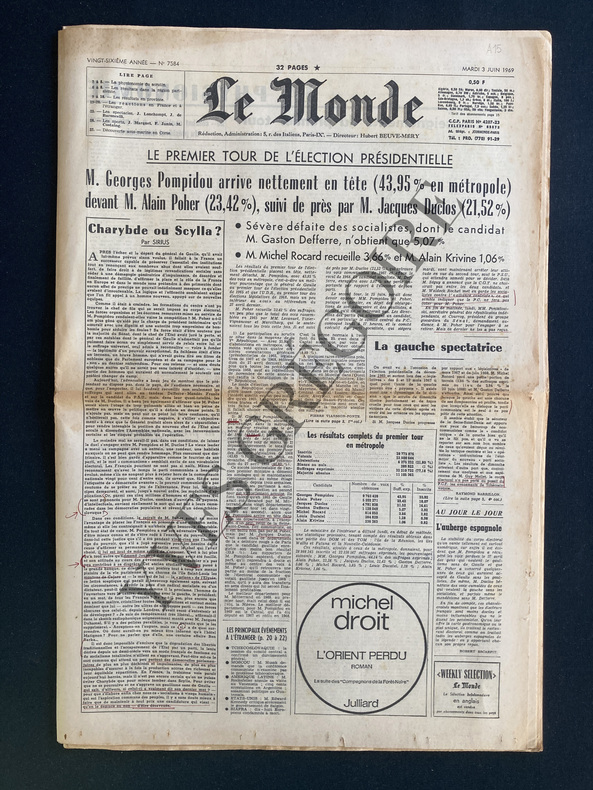
1969ABE-155688174603632 PAGES-35 CM X 50 CM-LE PREMIER TOUR DE L'ELECTION PRESIDENTIELLE-EN CORSE LA DECOUVERTE D'UN CHASSEUR SOUS-MARIN FAIT REPARLER DU "TRESOR DE ROMMEL", SIXIEME DE PAGE-COMPLET
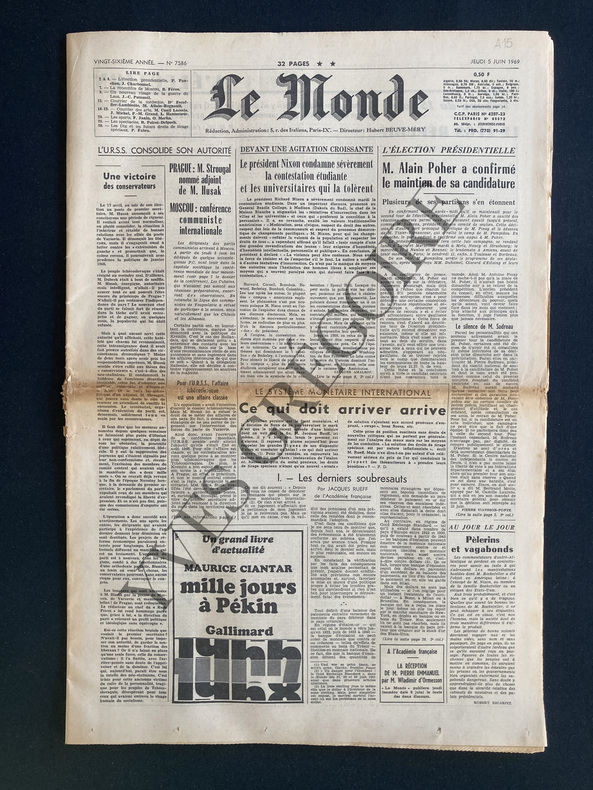
1969ABE-155688298537432 PAGES-35 CM X50 CM-L'ELECTION PRESIDENTIELLE, 2P-DEUX COMEDIENS DISPARAISSENT JANE SOURZA JEAN DENINX-AU MUSEE DES ARTS DECORATIFS L'EROTISME A BLANC DE DELVAUX, TIERS DE PAGE-CYCLISME ET DOPAGE L'AFFAIRE MERCKX DES QUESTIONS SANS REPONSES-COMPLET
1958boz_003896Photographie argentique de 1960 Rwanda. Kibuye vote élection. 27,6 x 21 cm Photographie de presse originale. Détails sur l’état : Les photographies sont en bon état général. Quelques traces d’usure peuvent être observées au dos en raison du stockage et de l’âge des documents, mais rien qui ne nuise à leur lisibilité ou à leur qualité. Elle ne tient pas à plat.
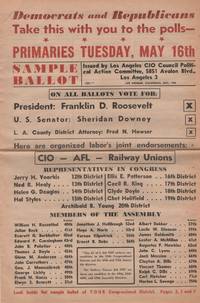
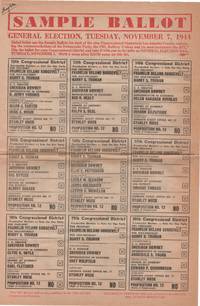
1944204433Los Angeles: Los Angeles CIO Council 1944. Piece of one corner missing; folded once horizontally; evenly toned. Four-page flyer printed on a single bifolium of newsprint approx. 11-1/2 X 16-1/2 inches. Fragile tabloid-style sample ballot for union members with recommendations from organized labor for national and local offices. Los Angeles CIO Council unknown
1944204432Los Angeles: Los Angeles CIO Council 1944. Folded horizontally with slight nick at fold; general toning; neat ink notation in upper corner. Broadsheet single leaf approx. 11 X 16-1/2 inches printed in black and red on newsprint. Remarkably well-preserved fragile newspaper-sized document produced for union members with the recommendations from the Democratic Party the CIO Railway Unions and the AFL. On the verso is a map of the voting districts in the Los Angeles area. Los Angeles CIO Council unknown
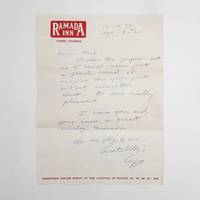
1979375947Casper Wyoming 1979. 8vo. One sheet Ramada Inn letterhead written in blue ink recto only. 8vo. "Dear Mace- Pardon the paper-but as I head home just a quick word of thanks for your part in that successful event-I was really pleased. I hope you and yours have a great Holiday Season. We underlined are going to win. Gratefully George. unknown
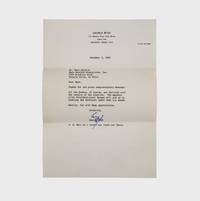
1980375940Washington D.C. 1980. 8vo. Single sheet his personal stationery signed in blue pen recto only. With a large franked envelope White House stationery. 8vo. "Dear Mace Thanks for the great congratulatory message. All the Bushes of course are thrilled with the results of the election. The mandate given President-elect Reagan will aid us in tackling the difficult tasks that lie ahead. Hastily but with deep appreciation. Sincerely George P. S. Well do I recall our lunch out there. unknown
19572110502150412528Hogaku no Tomosha 1957. Soft Cover. Fine. Volume: 1 Hogaku no Tomosha paperback
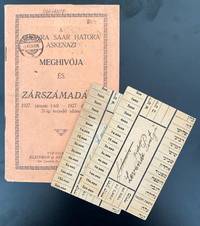
192843241Satu-Mare Szatmar/Satmar Romania: No Publisher The Chevra Sa’ar HaTorah Ashkenazi; printed by Tipográfia Kleinman si Heimlich 1928. 1st edition. Original orange printed paper wrappers 8vo 10 pages. Primarily in Hungarian with 2-page statement & closing speech also in Yiddish. <br> <br> WITH LAID IN: Two aliyah to the Torah Ark pledge cards one for Ephraim Lavii and one for Levende Pinty<br> <br> Title translates roughly as “The Saar Hatora Ashkenazi Society Financial Statement and Closing Speech. For The Period From January 1 1927 To December 31 1927.â€<br> <br> From the strife-ridden year of 1928 in Satu Mare see below a budget report including tables and lists for the Chevra Sa’ar HaTorah Ashkenazi with heartfelt call to action by the President Yosef Chaim Mayer asking the community to support its efforts to raise funds to build a new Beit HaMidrash. The plea is also undersigned by Eli Mandelbaum and by the two gabbais David Spiegel and Yona Weiss. <br> <br> A total of 11 names of leaders of the society are named. <br> <br> Society members are asked for their support in the upcoming election; presumably this is the controversial election of a new chief rabbi which famously split the community and resulted in the appointment of Hasidic Joel Teitelbaum and the creation of the Satmar Dynasty under him. <br> <br> In 1715 when Sathmar became a royal town the Jews were expelled but they began to resettle in the 1820s."In 1841 several Jews obtained the permission to settle permanently in Sathmar; the first Jewish community was formally established in 1849 and in 1857 a synagogue was built. After a great number of traditional Ashkenazic Jews had settled in the town the Jewish community split in 1898 when a supporter of the Hasidic movement was elected chief rabbi into an Orthodox and a Status Quo community led by a Zionist rabbi which erected a synagogue in 1904.<br> <br> In the 1920s there were several Zionist organizations in Satu Mare and the yeshiva one of the largest in the region was attended by 400 students. In 1930 the city had five large synagogues and about 20 shtiebels. In 1928 a conflict within the Orthodox community broke out over the election of a new chief rabbi lasting six years and ending in 1934 with the appointment of the Hasidic rabbi Joel Teitelbaum a traditionalist and anti-Zionist who later re-founded the Satmar Hasidic dynasty in Williamsburg New York. Another Hasidic rabbi Aharon Roth the founder of the Shomrei Emunim and Toldot Aharon communities in Jerusalem was also active in Satu Mare†Wikipedia.<br> <br> We could not locate another copy of this publication anywhere not in OCLC not in KVK not in the Hungarian National Library not in the Romanian National Library and not with a google search. Perhaps a unique surviving copy.<br> <br> Adressee’s name and “Satu Mare†penned on rear cover for mailing stamp clipped out of corner of blank rear wrapper no text loss. Postal cancellation stamp “Satu Mare 5. Feb 1928†on front cover as well as some other ink notations. Paper remains bright and strong about Very Good Condition. Exceedingly Rare with important connection to Satmar Hasidism. B Holo2-163-11-'LG. Satu-Mare [Szatmar/Satmar, Romania]: No Publisher [The Chevra Sa’ar HaTorah Ashkenazi; printed by Tipográfia Kleinman si Heim unknown
19572092902138201014Komei Election Federation 1957. Soft Cover. Fine. Number of pages: 338 pages Size: B6 size Number of books: 1 volume Komei Election Federation paperback
19972092902141203310People's Literature 1997. Soft Cover. Fine. Volume: 1 People's Literature paperback
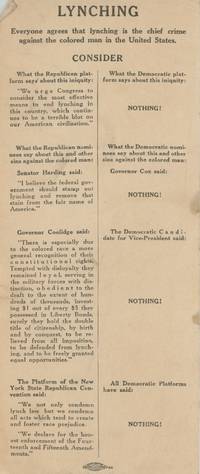
1920List2706Chicago or New York 1920. 6 x 9 inches single sided. Toning several small stains small fold at top left corner; near fine. An anonymous handbill decrying lynching in the United States and advertising the differences in anti-lynching policy between the Republican and Democratic parties. The header states that “Everyone agrees that lynching is the chief crime against the colored man in the United States†and the remainder illustrates the great disagreement over just what to do about it. The left column quotes the Republican platform and its then-nominees Warren G. Harding and Calvin Coolidge who would shortly be elected to office on their support for federal anti-lynching legislation. The right column points out that the Democratic platform and its nominees James M. Cox and Franklin D. Roosevelt all “said: NOTHING!†on this issue. Lynching would not be made a federal hate crime until 2022 nearly 100 years later. As of writing we find no other copies of this handbill in OCLC. unknown
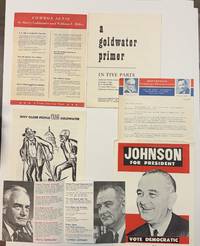
196441882vp 1964. Folio head and shoulders portrait of Lyndon Johnson with "JOHNSON FOR PRESIDENT" and "VOTE DEMOCRATIC" slogans; folded illustrated Goldwater pamphlet contrasting Johnson's "appeasement" with Goldwater's "peace through strength"; multi-colored printed letter from Dean Burch at Republican Campaign Headquarters supporting Goldwater; two illustrated broadsheets issued by Senior Citizens for Johnson and Humphrey "Why Older People FEAR Goldwater"; 20-page folio pamphlet issued by the Democratic National Committee showing the many deficits of Barry Goldwater; "COMMON SENSE by Barry Goldwater and William E. Miller. . . A Team You Can Trust"; broadsheet supporting their candidacy. Very Good plus. unknown
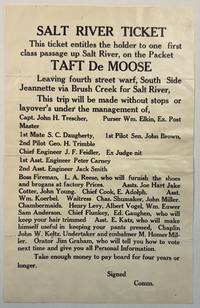
191240330Westmoreland County PA 1912. 4to broadside in bold type faces and fonts. A rather clumsy repair on blank verso to a horizontal fold split. Else Very Good.<br /> <br /> This broadside is a Who's Who of Jeanette Westmoreland County Pennsylvania citizenry. They apparently backed the losers in the three-way 1912 presidential election President Taft; former President Roosevelt who ran on the Bull Moose Ticket.<br /> John H. Trescher Proprietor and co-founder of Jeannette Dispatch. William Elkin postmaster. S. Clark Daugherty Drugs and Books. George H. Trimble Proprietor of Hotel Marian. Peter W. Carney occupation listed as "lab". John "Jack" Smith occupation listed as lab. Lowry A. Reese Shoes. Joseph M. Hart Bartender at Hotel Kramer. Jacob Cotter Bartender at the Miller House. John H. Young Bartender at the Hotel Jeannette. Elias Adolph Proprietor of New McKee. William C. Koerbel of Koerbel Brothers florists and sheet metal workers. Charles S. Shumaker of Shumaker Ringer & Foster. Henry Levy Levy Brothers Clothing and Men's Furnishings. Albert Vogel baker. William Euwer Furniture and Carpets. Edward M. Gaughen barber. Eleazer Katz clerk at Union Clothing Store. John W. Keltz cashier at First National Bank. H. Homer Miller Insurance and Real Estate Funeral Director and Embalmer. Taken from R.L. Polk & Co.'s Greensburg Derry Jeannette and Latrobe Directory for 1913 accessed at Ancestry website August 2024. <br /> Not located on OCLC as of August 2024. unknown
193624942<p>This sheet contains five rough sketches of graphics calling on the workers and voters of America to support Franklin D. Roosevelt's reelection in 1936. They did in record numbers.</p><p><strong>PRESIDENTIAL ELECTION OF 1936.</strong> Typed Document Signed. Artwork by Franz Felix and Ideas and Copy by Richard Barron "Set of Rough Sketches Containing Some Suggested Promotion Ideas to be Used in the 1936 Democratic Presidential Campaign" July 2 1936. 1 p. 12 x 10½ in.</p><p><strong>Excerpts:</strong></p><p>"<em>1. Sounding the call against 'economic royalists' in the spirit of 1776.</em>"</p><p>"<em>2. Appropriating the well-known symbol of violence</em> upraised fist<em> diverting it to peaceful democratic use. To include the farmer phrase the appeal: TOILERS OF AMERICA – UNITE FOR ROOSEVELT.</em>"</p><p>"<em>3. The statue of 'The Thinker' as a symbol of the man today who thinks the toiler with brawn and brain.everyman.</em>"</p><p>"<em>4. Direct appeal to radical labor and leftists in general.</em>"</p><p>"<em>5. Another way of appealing to the working class men and women.</em>"</p><p>"<em>This collaborative effort respectfully submitted for consideration to the Chairman of the Democratic National Committee Mr. James A. Farley.</em>"</p><p><strong>Historical Background</strong></p><p>After unseating incumbent Republican President Herbert Hoover in 1932 President Franklin D. Roosevelt ran for reelection in 1936. His Republican opponent was Governor Alf Landon of Kansas. Although the Great Depression had entered its eighth year Roosevelt's New Deal policies were broadly popular. He won the highest share of the popular and electoral vote since the uncontested 1820 election. Roosevelt attracted more than 60 percent of the popular vote and won the electoral votes of 46 states; Landon won the electoral votes of only Maine and Vermont.</p><p>Democratic Party chairman James Farley had predicted that Roosevelt would lose only Maine and Vermont. After the results of the 1936 election Farley quipped that the nation needed to revise the conventional political wisdom of "As Maine goes so goes the nation" to "As Maine goes so goes Vermont."</p><p>These ideas for campaign imagery employed or modified common images to support Roosevelt's campaign. One drew on the imagery of artist Archibald Willard's 1875 painting <em>The Spirit of '76</em> and employed three figures of workers to match the subjects of Willard's image. Another appropriated the upraised fist as a symbol of violence and repurposed it as a symbol of defiant unity against "<em>economic royalists</em>." A third used an image of <em>The Thinker</em> by French sculptor Auguste Rodin 1840-1917 to appeal to thinking voters. Another image appeals to the fears of radicals that the alternative to Roosevelt is "<em>Reaction</em>."</p><p>Richard Barron and artist Franz Felix submitted these ideas to Democratic National Committee chairman James A. Farley on July 2 1936 three weeks before the Democratic Party held its convention in Philadelphia. There is no evidence that these images were used in the campaign and it is possible that Farley rejected them. At the end of the campaign the Democratic National Committee had a campaign deficit of approximately $850000. To help offset those expenses the treasurer convinced President Roosevelt to sign 2500 brief Forewords which were bound into <em>The Democratic Book 1936</em> and sent to donors of $250. Purchases brought in more than $400000 for the party and led Republicans to charge corrupt practices for allowing corporations to contribute to the campaign by buying copies.</p><p><strong>Franz Felix</strong> 1892-1967 was born in Vienna Austria and developed an ability as a child to draw portraits in charcoal. He studied portraiture in Vienna and immigrated to the United States shortly after World War I. He settled in San Francisco where he established himself as a portrait artist and commercial illustrator. In the late 1920s he moved to New York and established a studio in the suburb of Spring Valley where he produced book and magazine illustrations. During World War II he painted a series of murals of wartime activities of Spring Valley residents.</p><p><strong>James A. Farley</strong> 1888-1976 was born in New York into an Irish Catholic family. After his father died he helped his mother with a small business to support the family. After graduating from Packard Business College in New York City where he studied bookkeeping and other business skills Farley got a job with the U.S. Gypsum Corporation. He served as a Democratic town clerk in Stony Point New York and became chairman of the county's Democratic Party in 1918. He organized upstate Democrats and helped elect Alfred E. Smith as Governor that year. He served in the New York State Assembly in 1923 but was defeated at the next election for supporting the repeal of Prohibition. As chair of the state Athletic Commission Farley fought for the civil rights of African American athletes. Farley founded he General Builders Corporation from smaller firms to become New York City's largest building supply company. Farley directed Franklin D. Roosevelt's narrowly successful New York gubernatorial campaign in 1928 and his reelection in 1930. Farley served as chairman of the New York State Democratic Committee from 1930 to 1944 and helped build the national New Deal coalition that elected Roosevelt to the Presidency four times. In 1932 Farley became the chairman of the Democratic National Committee and in 1933 U.S. Postmaster General. He held both positions until 1940. Farley and Roosevelt broke on the two-term tradition of the Presidency in 1940 and he later helped propose the 22nd Amendment to the U.S. Constitution limiting a person to two elections as president approved by Congress in 1947 and ratified in 1951. Farley became chairman of the board of the Coca-Cola Export Corporation in 1940 and held that position for more than thirty years.</p>
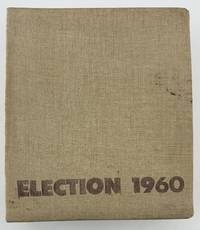
19604337Various locations in and around Chicago Il: likely early November 1960. Very good plus. Title leaf plus 25 leaves illustrated with forty-seven silver gelatin photographs pasted one per leaf or page all about 5.5 x 7.5 inches plus five loose images two duplicates and three other images not pasted in. Square quarto. Contemporary tan cloth custom photograph album metal-hinged spine front cover printed with title reading "ELECTION 1960." Minor wear and soiling to album. Light occasional thumb-soiling to album leaves ownership signature reading "G. Robert Hillman" on title leaf. Photographs in excellent condition. An utterly charming vernacular photograph album assembled during the seminal Presidential Election of 1960 one of the closest presidential elections in United States history which pitted Vice President Richard Nixon against the junior Senator from Massachusetts John F. Kennedy. The album features about fifty original photographs on the campaign trail in Illinois beginning with about a dozen-and-a-half images of Richard Nixon and his local supporters. The photographs capture various angles of Nixon during his stump speech a young boy waving an "I'm for Nixon" handmade sign another young boy with a Nixon button on his coat crowd scenes a large campaign sign for Nixon-Lodge outside a local store and more. One image featuring a mixed crowd of Nixon and Kennedy supporters transitions into the next section of photographs which concentrates on JFK's campaign. The first image in this section is a closeup of a "Kennedy for President" hat followed by four images of JFK's campaign manager Robert Kennedy making a speech three images of Eleanor Roosevelt stumping for Kennedy five images of Lyndon Johnson and his airplane numerous shots of Kennedy supporters and crowd shots outside Chicago Blackhawks stadium. The photographs then feature the inside of Chicago Auditorium where the first three images depict John F. Kennedy - the first shaking hands with Chicago's longtime Mayor Richard Daley and two during his speech likely his speech of November 4 1960 - just four days before Election Day. The final three images show supporters of both candidates.<br /> <br /> The 1960 United States Presidential Election was a watershed moment for the campaign politics of the country. Senator Kennedy won the election with a clear Electoral College margin of 303 to 219. However Vice President Nixon won three more states than Kennedy and lost the popular vote only by about 110000 votes out of more than 68 million votes cast. The election set the course for most of the remainder of the 1960s but left Nixon soured and suspicious that the election had been stolen from him - a feeling he never let go and one with ominous echoes today. As indicated in the present album the 1960 presidential election was passionate on both sides with each candidate drawing large enthusiastic crowds for their appearances.<br /> <br /> The signature on the title leaf of the present album likely identifies the compiler. G. Robert Hillman is a Senior Editor for Politico. Hillman was born in Peoria and grew up on a farm near Flanagan Illinois about a hundred miles from Chicago. He went to college at the University of Illinois at Urbana-Champaign and began his career at Chicago Today and the Chicago Sun-Times. Hillman would have been in middle school during the 1960 election campaign not too precocious for a young man obsessed with politics especially during one of the most heated and media-intensive campaigns of the 20th century. likely early November unknown
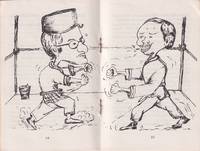
1986222683Johor Bahru.: Partai Sosialis Rakyat Malaysia. Circa1986. Three black and white political cartoons 28pp. 15 x 10pp. Original stapled wrappers little browned a prior owner's name lightly pencilled in red upper wrapper overall in good condition. A short publication issued by the Malaysian People's Party at the time still operating as the Malaysian Socialist People's Party in the lead up to the 1986 election. Within are a few short commentaries on the dysfunction within UMNO with particular interest in the so-called AIDS faction in the party. Scarce; we have only been able to find one institution holding this publication. . Partai Sosialis Rakyat Malaysia. unknown
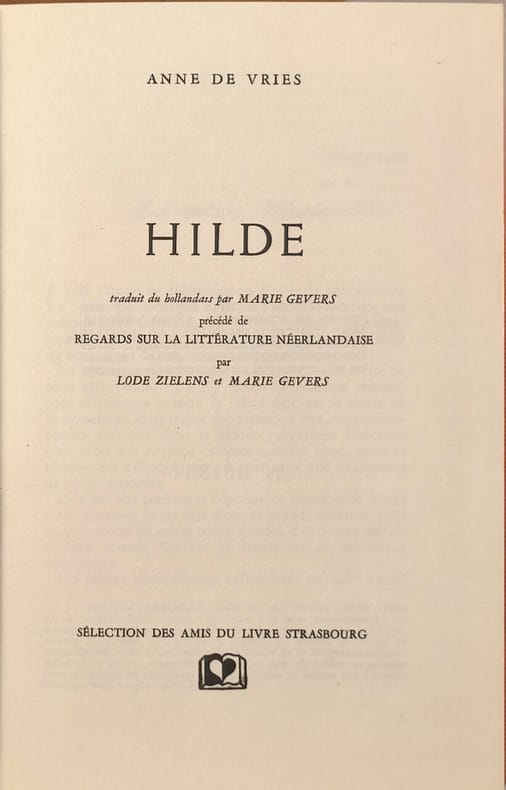
19624190Sélection des Amis du Livre Strasbourg 1962 257 pages in8. 1962. Reliure éditeur pleine toile sous rodhoid. 257 pages.
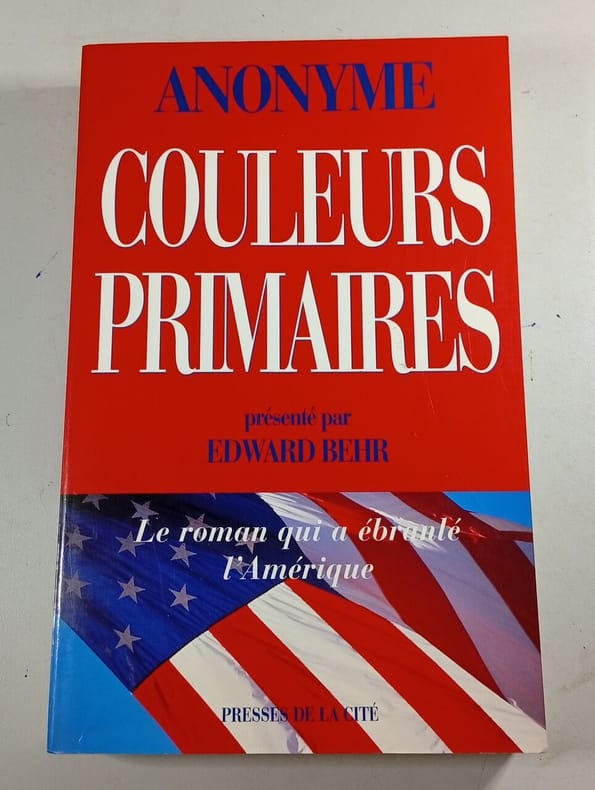
1996500375724Presses de la cité / Document 1996 401 pages in8. 1996. Broché. 401 pages. Le roman qui a ébranlé l'Amérique
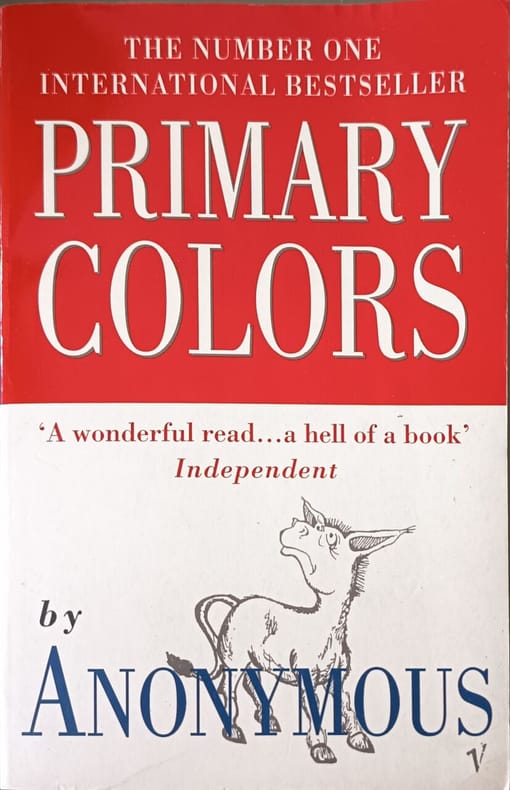
199615629Vintage 1996 384 pages 13x2 4x19cm. 1996. Broché. 384 pages.
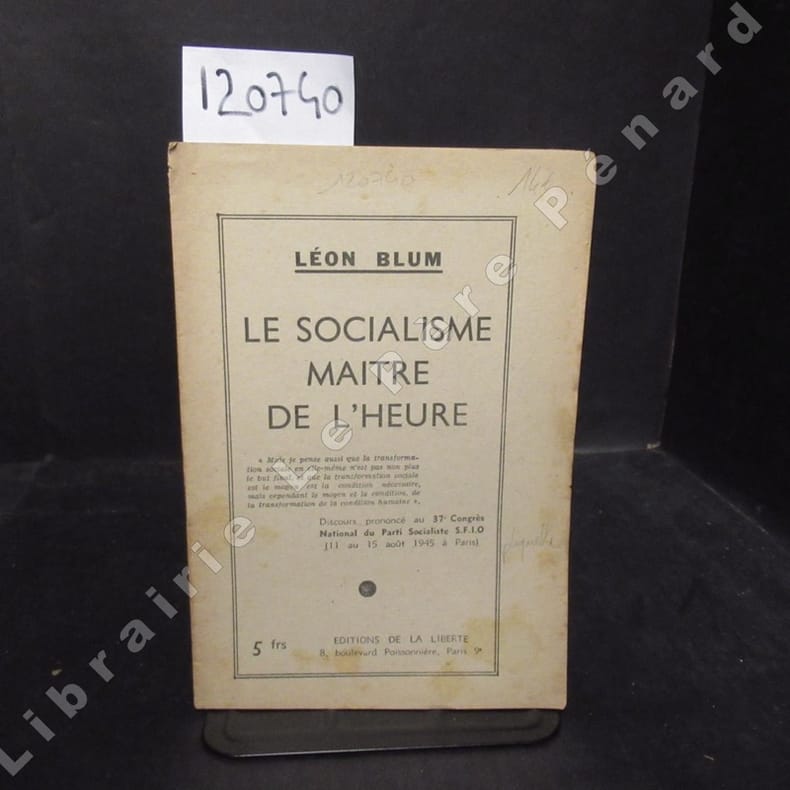
19451207401945 Editions de la Liberté - 1945 - Petit in-8, broché - 14 p.
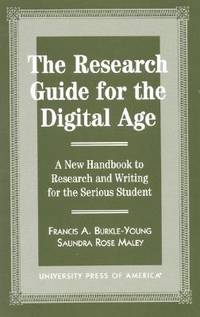
1997SONG0761807799UPA 1997-05-22. Annotated. paperback. Used: Good. 5.36x0.78x8.50. Buy with confidence. Excellent Customer Service & Return policy. UPA paperback
1997DADAX0761807799UPA 1997-05-22. Annotated. paperback. New. 5.36x0.78x8.50. Buy with confidence. Excellent Customer Service & Return policy. UPA paperback