213 résultats
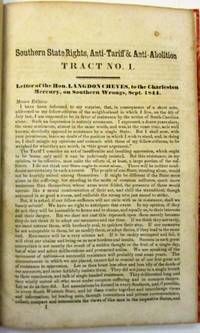
184425849Charleston 1844. 40 pp. Bound in modern quarter red morocco and marbled paper over boards. Minor scattered foxing Very Good plus.<br/><br/> A rare Southern Nationalist tract opposing the election of Henry Clay in 1844 warning of the imminent threat to the South's cherished institution of slavery supporting the Texas annexation and denouncing the North's imposition of protective tariffs. <br/> It begins with Langdon Cheves's Letter opposing separate State secession by South Carolina. Though Northern aggressions-- including the recent rejection of the Treaty to Annex Texas-- and the Tariff are an "insufferable and insulting oppression.I do not think one State ought to resist alone." He urges grass-roots organization to ready the South for mass secession. For this stance Cheves was harshly criticized by Carolinians who urged a go-it-alone policy. His Letter is followed by an early Daniel Webster speech embracing the South's opposition to protective tariffs and support of free trade. John Quincy Adams's Letter illustrates northern "fanaticism" on the slavery issue; Andrew Jackson's Letter of August 1844 supports the annexation of Texas; and James Towles's tract 'The South in Danger' warns against the election of Henry Clay who opposes annexation. <br/>Howes S790 AI 44-5791 and Streeter 1535 each recording a variant issue only. unknown books
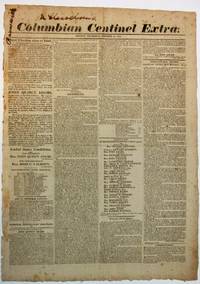
182437247Boston 1824. Elephant folio broadsheet printed in four columns on recto six columns on verso verso consisting of many advertisements several illustrated. 15-1/4" x 21-1/2." Very Good. Ownership signatures at top margin: "Mr. Cleaveland" and "Brunswick."<br/><br/> The Centinel issued this rare Extra to urge the election of John Quincy Adams to the presidency. The list of Adams electors is printed along with the proceedings at the October 27 "Federal Republican Meeting" in Boston "friendly to the election of John Quincy Adams to the Presidency." The Address at that Meeting reviews the other presidential candidates. Henry Clay "is a stranger to your habits and interests." A man of the West "The star of your empire he would have go from your part of it far West." Andrew Jackson places "liberty in danger." Votes for Crawford of Georgia only "tend to make Jackson your President."<br/>Not in American Imprints. Not at the web sites of AAS or MA Hist. Soc. as of November 2020. unknown books
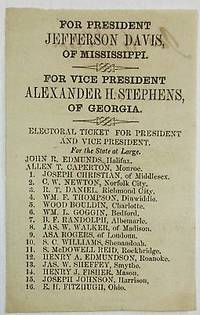
186133882Richmond 1861. Small broadside ticket 3" x 4-3/4". Very good. <br/><br/> A rare Virginia Confederate electoral ticket for the Confederacy's first and only national election: Jefferson Davis for President Alexander Stephens for Vice President. Also listed are two at-large electors and sixteen others by District. <br/>Variant of Parrish & Willingham 5367 5368; Crandall 2744 noting "four variant printings and sizes"; and Hummel 4667-4669. OCLC 58833485 2- U GA Boston Ath. 702707722 1- Yale as of June 2017 different dimensions. unknown books
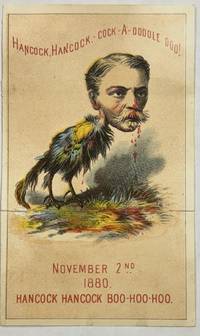
188040342New York: Copyright by Geo. H. Hanks 1880. Metamorphic card 3-1/4" x 5-3/8" fully opened. Richly colored light wear Very Good.<br /> <br /> The unopened illustration depicts a dignified serious Hancock as a rooster in elaborate feathers. But when opened Hancock has lost his feathers is emaciated and bleeding from the mouth. The caption reads "November 2nd. 1880 Hancock Hancock Boo-Hoo-Hoo." Winfield Scott Hancock a decorated Civil War general and a hero of Gettysburg was the losing Democrats' presidential candidate in 1880 opposing Republican James A. Garfield. <br /> The verso entitled 'Rhymes for Young Democrats' brilliantly skewers the overt racism of the Democratic Party. It begins: <br /> "Sing a song of shotguns Pocket full of knives Four-and- twenty black men Running for their lives; When the polls are open Shut the nigger's mouth Isn't that a bully way To make a solid South" <br /> OCLC 32320004 1- Brown as of August 2024. Copyright by Geo. H. Hanks unknown
186133882Richmond 1861. Small broadside ticket 3" x 4-3/4". Very Good. <br /> <br /> A rare Virginia Confederate electoral ticket for the Confederacy's first and only national election: Jefferson Davis for President Alexander Stephens for Vice President. Also listed are two at-large electors and sixteen others by District. <br /> Variant of Parrish & Willingham 5367 5368; Crandall 2744 noting "four variant printings and sizes"; and Hummel 4667-4669. unknown
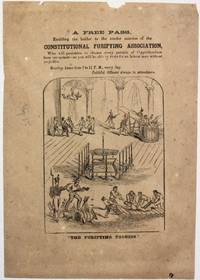
186440035np 1864. Broadside 6.25" x 9" with two-thirds of the sheet consisting of a wood engraving entitled "The Purifying Process." Toned with a few short blank edge chips. Good.<br /> <br /> This scarce political broadside mocks the Copperheads who opposed the Lincoln Administration and the Civil War. The broadside depicts humorous rituals imposed on the Copperheads designed to purge Copperhead-ism from their natures. Weitenkampf and OCLC call this an 1864 broadside with the Lincoln-McClellan election the subject of this piece. <br /> Weitenkampf page 140. OCLC 14137917 4- Lincoln Presidential Library Brown U IL Princeton 1360327631 1- DLC 1085916488 1- AAS as of May 2024. unknown
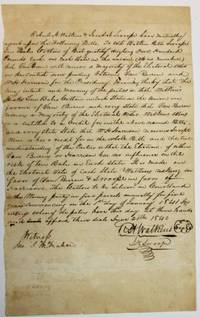
184039023Courtland Lawrence Cty. Alabama 1840. Single page 7-3/4" x 12-3/4." Entirely in ink manuscript. Dated June 20 1840 and signed at the end by Watkins and Swoope with Jno. J. McMahon as witness. Inner edge is irregular. Closed tear no loss repaired expertly at blank bottom margin. Very Good.<br /> <br /> This documents records the terms of a wager on the outcome of the 1840 presidential election. "Watkins betts Swoope Ten Bales Cotton of Best quality weighing Five Hundred Pounds Each on each State in the union 26 in number that Van Buren will receive a majority of the Electoral votes in the contest now pending between Van Buren and Wm. H. Harrison for the Presidency." <br /> In case that's not entirely clear "The true intent and meaning of the parties is that Watkins risks Ten Bales Cotton in each State in the Union in favour of Van Buren and every state that Van Buren receives a majority of the Electoral votes." The bet is made on the electoral vote of each State. Watkins risking in favor of Van Buren & Swoope in favor of Harrison. . . The cotton to be delivered in Courtland to the winning party in five parcels annually for five years commencing on the 1st day of January 1841." <br /> A calculation of States and bales can be seen at the bottom left corner in pencil. <br /> Robert Herndon Watkins 1782-1855 was a farmer in Courtland. Jacob Kuhn Swoope 1800-1841 partnered with his two brothers in the successful Courtland mercantile firm of J & J Swoope in Courtland. John T. McMahon c.1805-1857 was a Courtland commission merchant in the firm of Bierne & McMahon for many years. Saunders Col. James E.: EARLY SETTLERS OF ALABAMA WITH NOTES AND GENEALOGIES New Orleans:1899 accessed online. unknown
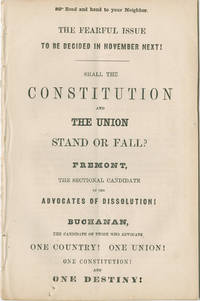
185624482<p>"<i>What a Combination! Seward Greeley Bennet Watson Webb H. Ward Beecher &c. There can be no doubt that this goodly company will speedily be increased by the addition of Fred. Douglass and his black republicans… The only candidate to arrest this tide of demoralization and sectionalism is James Buchanan.</i>"</p><p>This pro-Buchanan election of 1856 pamphlet attacks the first Republican presidential candidate John C. Frémont. Quoting from the speeches and writings of William Lloyd Garrison Horace Greeley Wendell Phillips Salmon P. Chase Henry Ward Beecher William H. Seward Joshua R. Giddings this pamphlet ignores distinctions between abolitionists racial egalitarians more limited opponents just of the expansion of slavery into the territories or those who fought the kidnapping of free African Americans under the Fugitive Slave Law. It paints all with the same broad brush as "Black Republican" extreme abolitionists who were willing to destroy the Union rather than remain in it with slaveholders.</p> <b>ELECTION OF 1856.</b>Printed Document. <i>The Fearful Issue to Be Decided in November Next! Shall the Constitution and the Union Stand or Fall Fremont The Sectional Candidate of the Advocates of Dissolution! Buchanan The Candidate of Those Who Advocate One Country! One Union! One Constitution! and One Destiny!</i> 1856. 24 pp. 5 x 8½ in.<p><b><br /></b></p><p><b>Excerpts:</b></p><p>Before Title: "<i>Read and hand to your Neighbor.</i>"</p><p>"<i>We propose showing by indubitable testimony that John C. Fremont's leading friends are now the open enemies of the Federal Constitution… the enemies of one-half of the States of the Union; the enemies of the laws of Congress; and the enemies to equality of the States.</i>" 3</p><p>"<i>In a speech delivered at the New England Anti-Slavery Convention on the 29th of May 1856 by Wm. Lloyd Garrison we have a flood of light shed on the relation between abolitionism and republicanism which divests the subject of all doubt or uncertainty.</i>" 4</p><p>"<i>William H. Seward was known at the Abolition Convention at Philadelphia… as one of Fremont's warmest supporters. Indeed it is well known that to Chase Seward and Greeley Fremont is mainly indebted for his nomination: they defeated McLean.</i>" 7</p><p>"<i>Nathaniel P. Banks Abolitionist and Disunionist was elected Speaker of the House by a solid sectional vote: he did not get one vote from the South.No man has exhibited such ferocious hostility to the fugitive slave law to the compromise measures and to the Federal Constitution. His speeches full of treason and of war would fill a volume.</i>" 8 and 9</p><p>"<i>Every leading committee has an Abolition Disunionist for chairman and a Disunion majority! There some thirty-five committees in the House… Black Republicans monopolized all the great committees. Thus was the work of Disunion formally begun in the Congress of the United States! This monstrous act unprecedented in all our history was the deliberate work of the men who now surround Fremont.</i>" 10</p><p>"<i>The reverend agitator Ward Beecher is out for Fremont in the last number of his 'Independent.' He is probably next to Garrison and Phillips the most profligate calumniator of the Constitution and the Union.</i>" 19</p><p>"<i>What a Combination! Seward Greeley Bennet Watson Webb H. Ward Beecher &c. There can be no doubt that this goodly company will speedily be increased by the addition of Fred. Douglass and his black republicans. Every Black Republican in Congress from New York is now the earnest advocate of Fremont.</i>" 20</p><p>"<i>We aver that there is not an Abolitionist or Disunionist in Pennsylvania who is not an active and open friend of John C. Fremont for the Presidency. David Wilmot and William F. Johnston lead the motley crew both recreants from the Democratic party because the Democratic party respected the Constitution of the United States and would not desert its injunctions… The only candidate to arrest this tide of demoralization and sectionalism is James Buchanan. It is against him and against the Constitution that this combination has been formed.</i>" 23</p><p>"<i>in the South every vote thrown for Mr. Fillmore is more or less an aid to John C. Fremont to the extent that it may weaken James Buchanan.</i>" 24</p><p>"<i>We would speak of Mr. Fillmore with entire respect. His speech at Albany was patriotic and forcible but it cannot be denied that out of New York in the North all those who pretend to support him will be called upon in the State elections to unite against the Democratic party with the friends of Fremont otherwise known as the Black Republicans.</i>" 24</p><p><b>Historical Background</b></p><p>James Buchanan won with 1.8 million votes and 174 electoral votes from 19 states. Fremont received 1.3 million votes winning 11 northern states with 114 electoral votes. American Party "Know Nothing" candidate and former President Millard Fillmore received 873000 votes winning Maryland's 8 electoral votes. Frémont received no votes at all in 10 of the 14 slave states and fewer than 1200 votes total in the other 4 slave states.</p><p><b>John C. Frémont</b> 1813-1890 "the Pathfinder" was a legendary explorer who achieved military victories in California during the Mexican War. He entered politics as California's first senator and then became the first Republican presidential candidate in 1856. During the Civil War Lincoln removed Frémont from command in Missouri after he unilaterally declared martial law and threatened to confiscate all property including slaves of Southern sympathizers. Lincoln gave Frémont command of an army in western Virginia where he was defeated by Stonewall Jackson in the Battle of Cross Keys. After Frémont refused to serve under General John Pope Lincoln never again gave him a field command contributing to a personal grudge. In 1864 Frémont abandoned his third-party campaign for the presidency in September after Lincoln agreed to remove U.S. Postmaster General Montgomery Blair from office.</p><p><b>Condition</b></p><p>Disbound minor pin holes very good.</p>
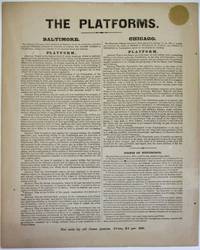
186438115New York: For sale by all News Agents. Price $1 per 100 1864. Broadside 9" x 11 1/2". One margin spot from removal of a gum label light uniform toning. Very Good. Printed in two columns separated by a rule. The Column on the left is headed "Baltimore Platform" for the National Union Republican Party; the right hand column is headed "Chicago Platform" for the Democrat-Copperhead Party. <br /> <br /> A Republican recitation of the Democrats' Platform and the Republicans' Platform in 1864 and an analysis of their 'Points of Difference.' "The Union platform looks to the ending of the war through the defeat and overthrow of the Rebellion while the Democratic contemplates peace through the virtual triumph of the traitors." The broadside exhorts "Freemen of the United States! read mark weigh resolve and VOTE! This is preeminently a contest regarding important principles and measures compared with which personal considerations are of small account." <br /> We conclude that this broadside was printed in New York as the legend "For sale by all News Agents. Price $1 per 100" appears in similar broadside material with a New York imprint.<br /> Sabin 63348. Not in Bartlett. For sale by all News Agents. Price, $1 per 100 unknown
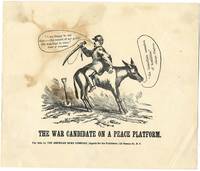
186440123New York: For Sale by the AMERICAN NEWS COMPANY Agents for the Publishers. 121 Nassau St. 1864. Oblong broadside 8" x 9-3/8." Couple of light fox spots not affecting illustration. Very Good.<br /> <br /> The broadside mocks the dissonance in the Democrats' 1864 presidential campaign. Candidate McClellan's acceptance speech supported a continued War Effort; but his Party's platform called for an end to the War. <br /> McClellan sitting backward on a jackass says "I am happy to say that -- the record of my public life was kept in view". The jackass however facing the other direction says quoting from the Chicago Platform "An immediate cessation of hostilities." <br /> Weitenkampf 145. Not in Reilly. OCLC 57744783 2- Boston Ath. NYHS as of June 2024. AAS also owns a copy For Sale by the AMERICAN NEWS COMPANY, (Agents for the Publishers.) 121 Nassau St. unknown
185624482<p>"<i>What a Combination! Seward Greeley Bennet Watson Webb H. Ward Beecher &c. There can be no doubt that this goodly company will speedily be increased by the addition of Fred. Douglass and his black republicans… The only candidate to arrest this tide of demoralization and sectionalism is James Buchanan.</i>"</p><p>This pro-Buchanan election of 1856 pamphlet attacks the first Republican presidential candidate John C. Frémont. Quoting from the speeches and writings of William Lloyd Garrison Horace Greeley Wendell Phillips Salmon P. Chase Henry Ward Beecher William H. Seward Joshua R. Giddings this pamphlet ignores distinctions between abolitionists racial egalitarians more limited opponents just of the expansion of slavery into the territories or those who fought the kidnapping of free African Americans under the Fugitive Slave Law. It paints all with the same broad brush as "Black Republican" extreme abolitionists who were willing to destroy the Union rather than remain in it with slaveholders.</p> <b>ELECTION OF 1856.</b>Printed Document. <i>The Fearful Issue to Be Decided in November Next! Shall the Constitution and the Union Stand or Fall Fremont The Sectional Candidate of the Advocates of Dissolution! Buchanan The Candidate of Those Who Advocate One Country! One Union! One Constitution! and One Destiny!</i> 1856. 24 pp. 5 x 8½ in.<p><b><br /></b></p><p><b>Excerpts:</b></p><p>Before Title: "<i>Read and hand to your Neighbor.</i>"</p><p>"<i>We propose showing by indubitable testimony that John C. Fremont's leading friends are now the open enemies of the Federal Constitution… the enemies of one-half of the States of the Union; the enemies of the laws of Congress; and the enemies to equality of the States.</i>" 3</p><p>"<i>In a speech delivered at the New England Anti-Slavery Convention on the 29th of May 1856 by Wm. Lloyd Garrison we have a flood of light shed on the relation between abolitionism and republicanism which divests the subject of all doubt or uncertainty.</i>" 4</p><p>"<i>William H. Seward was known at the Abolition Convention at Philadelphia… as one of Fremont's warmest supporters. Indeed it is well known that to Chase Seward and Greeley Fremont is mainly indebted for his nomination: they defeated McLean.</i>" 7</p><p>"<i>Nathaniel P. Banks Abolitionist and Disunionist was elected Speaker of the House by a solid sectional vote: he did not get one vote from the South.No man has exhibited such ferocious hostility to the fugitive slave law to the compromise measures and to the Federal Constitution. His speeches full of treason and of war would fill a volume.</i>" 8 and 9</p><p>"<i>Every leading committee has an Abolition Disunionist for chairman and a Disunion majority! There some thirty-five committees in the House… Black Republicans monopolized all the great committees. Thus was the work of Disunion formally begun in the Congress of the United States! This monstrous act unprecedented in all our history was the deliberate work of the men who now surround Fremont.</i>" 10</p><p>"<i>The reverend agitator Ward Beecher is out for Fremont in the last number of his 'Independent.' He is probably next to Garrison and Phillips the most profligate calumniator of the Constitution and the Union.</i>" 19</p><p>"<i>What a Combination! Seward Greeley Bennet Watson Webb H. Ward Beecher &c. There can be no doubt that this goodly company will speedily be increased by the addition of Fred. Douglass and his black republicans. Every Black Republican in Congress from New York is now the earnest advocate of Fremont.</i>" 20</p><p>"<i>We aver that there is not an Abolitionist or Disunionist in Pennsylvania who is not an active and open friend of John C. Fremont for the Presidency. David Wilmot and William F. Johnston lead the motley crew both recreants from the Democratic party because the Democratic party respected the Constitution of the United States and would not desert its injunctions… The only candidate to arrest this tide of demoralization and sectionalism is James Buchanan. It is against him and against the Constitution that this combination has been formed.</i>" 23</p><p>"<i>in the South every vote thrown for Mr. Fillmore is more or less an aid to John C. Fremont to the extent that it may weaken James Buchanan.</i>" 24</p><p>"<i>We would speak of Mr. Fillmore with entire respect. His speech at Albany was patriotic and forcible but it cannot be denied that out of New York in the North all those who pretend to support him will be called upon in the State elections to unite against the Democratic party with the friends of Fremont otherwise known as the Black Republicans.</i>" 24</p><p><b>Historical Background</b></p><p>James Buchanan won with 1.8 million votes and 174 electoral votes from 19 states. Fremont received 1.3 million votes winning 11 northern states with 114 electoral votes. American Party "Know Nothing" candidate and former President Millard Fillmore received 873000 votes winning Maryland's 8 electoral votes. Frémont received no votes at all in 10 of the 14 slave states and fewer than 1200 votes total in the other 4 slave states.</p><p><b>John C. Frémont</b> 1813-1890 "the Pathfinder" was a legendary explorer who achieved military victories in California during the Mexican War. He entered politics as California's first senator and then became the first Republican presidential candidate in 1856. During the Civil War Lincoln removed Frémont from command in Missouri after he unilaterally declared martial law and threatened to confiscate all property including slaves of Southern sympathizers. Lincoln gave Frémont command of an army in western Virginia where he was defeated by Stonewall Jackson in the Battle of Cross Keys. After Frémont refused to serve under General John Pope Lincoln never again gave him a field command contributing to a personal grudge. In 1864 Frémont abandoned his third-party campaign for the presidency in September after Lincoln agreed to remove U.S. Postmaster General Montgomery Blair from office.</p><p><b>Condition</b></p><p>Disbound minor pin holes very good.</p> books
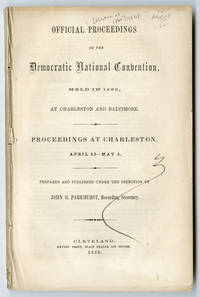
1860WRCAM45168Cleveland: Nevins' Print Plain Dealer Job Office 1860. 188pp. Dbd. Ink pen trial on titlepage. Light wear in fore-edge of titlepage and upper margin of final text leaf. Two text leaves printed on slightly folded paper resulting in obscuration of some text. Good. The official record of a crucially important moment in American politics the 1860 Democratic Conventions at which Stephen A. Douglas won the nomination and faced Republican nominee Abraham Lincoln in the general election. The first convention was held in Charleston in late April and early May and was a rancorous affair. Douglas led the field of nine total candidates at Charleston over the opposition of militant Southern Democrats so-called "Fire Eaters". Despite the fact that fifty-seven separate ballots were held Douglas could not secure the necessary two-thirds majority of delegates. The delegates therefore adjourned and reconvened in Baltimore in June where the committee voted to exclude certain delegates from Louisiana and Alabama who had been disruptive in Charleston. Douglas finally secured the nomination on the second ballot in Baltimore and went on to lose the general election to Lincoln. The present text prints all the proceedings of the Charleston and Baltimore conventions offering a detailed picture of American politics at their most fractious. Nevins' Print, Plain Dealer Job Office unknown books
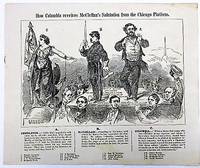
186434855New York 1864. Broadside wood engraving oblong 9-5/8" x 7-7/8". Blank verso uniformly toned Very Good.<br/><br/> "Columbia repudiates Democratic presidential candidate George Brinton McClellan's endorsement of the platform devised at the August 1864 Democratic convention in Chicago. The text below the picture provides the dialogue descriptive notes and identification of the main characters. Columbia: 'What a shame that a man who was educated at my expense and whom I have since honored and petted should have allowed himself to be allured by ambition into such company and upon such a Platform! His Letter cannot conceal his real position nor hide those odious 'planks;' neither can it reconcile me to his traitorous companions. I DISCARD BOTH HIM AND THEM FOREVER'." Reilly <br/> Onlookers include the discredited James Buchanan Fernando Wood Horatio Seymour Clement Vallandigham Franklin Pierce and other Copperheads. <br/>Reilly 1864-22. Weitenkampf 144. OCLC 299946973 2- Lib. Cong. W. Res. Hist. Soc. 881054411 1- UCSB 81099323 1- Am. Phil. Soc. as of April 2018. unknown books
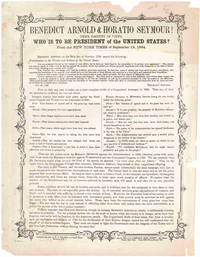
1868WRCAM48472Brooklyn: D.S. Holmes 1868. Broadside 13 x 10 inches. Some small tears chipping and loss at top and right edges. Minor foxing. Very good. Broadside printed for the U.S. Presidential Campaign of 1868 which pitted former New York governor Horatio Seymour against Gen. Ulysses S. Grant. This broadside points out Seymour's Copperhead tendencies and statements made by him in 1864 linking him to similar sentiments made by the notorious traitor Benedict Arnold. Seymour's Copperhead utterances during the war haunted his campaign and he lost decisively to Grant. The text printed here strives to demonstrate: <br> <br> ".the points made by Horatio Seymour against the Administration in 1864 are identical point by point with those made by Benedict Arnold against Washington and the Continental Congress in 1780.The Copperhead chiefs of these times who draw so lavishly upon the sophistries and fallacies of 1780 for the furtherance of their factious designs cannot too well understand that the sequel to all this is endless disgrace. They must not expect to fight the Government with weapons of the Tories and of the blue-light Federalists without sharing the same fate." D.S. Holmes unknown books
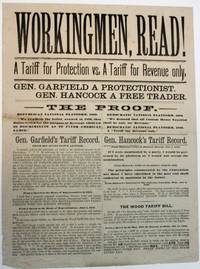
188036539Concord NH 1880. Broadside 11-3/8" x 15-1/4". Printed in a variety of type sizes and fonts. Bit of wrinkling else Very Good. <br/><br/> General James Garfield was the Republicans' 1880 presidential candidate; General Winfield Scott Hancock ran for the Democrats. Garfield's supporters claim here that protective tariffs "favor American labor." Garfield's laudable support for tariffs is contrasted with the views of Hancock and his party. Reduction or elimination of tariffs would "be a movement to equalize wages here with the lowest prevailing in the Old World."<br/> We suggest a New Hampshire imprint because that State's Democratic candidate for Governor Frank Jones is pilloried here for opposing protective legislation.<br/>Not located on OCLC or the online sites of AAS New Hampshire Historical Society or Rauner Library as of April 2020. unknown books
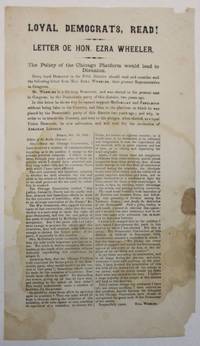
186439322np. Milwaukee Berlin WI 1864. Broadside 6-1/8" x 11." Spotted small chip to blank upper corner. Good.<br /> <br /> Ezra Wheeler Wisconsin Democrat was serving his only term in Congress when he wrote this October 15 letter to his constituents in the Berlin Courant. He retired from Congress at the end of his term.<br /> Lincoln supporters reprinted the letter in this broadside for the edification of voters in Wheeler's Fifth Wisconsin District. Wheeler "cannot support McClellan and Pendleton without being false to his Country and false to the platform on which he was placed by the Democratic party of this district two years ago. . . As a loyal Union Democrat he now advocates and vote for the re-election of Abraham Lincoln." Wheeler explains that a Democratic victory "would inevitably be the separation of the Northern and Southern States and following that probably a division among the Northern States; and finally the destruction of our Government."<br /> We have not located a record of this broadside. <br /> Not located in Sabin Bartlett or on OCLC or the online sites of U WI Libraries AAS LCP Newberry Harvard Yale as of January 2024. unknown
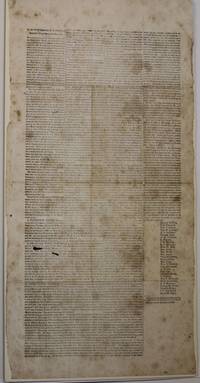
182835196Bangor 1828. Folio broadside 9-1/4" x 20". Matted hinged at upper edge. Printed in three full columns. A few old folds Very Good.<br /> <br /> The Convention met in Bangor on July 9 1828. After endorsing candidates for various State offices the Convention issued and printed its 'Address. to the Electors of the Counties of Somerset and Penobscot' focusing on the upcoming presidential contest. Praising the incumbent John Quincy Adams the Address proclaims "It is sufficient to say of him that talents of the highest order are joined to uncommon attainments. We would ask you to turn from the rantings of demagogues the bold fictions of an irresponsible press. Is not our country moving on peacefully and prosperously in the great march of improvement" <br /> Adams's opponent General Jackson is unsuited for the presidency: "His character has been formed as a military chieftain. He is rash headstrong impetuous and unreflecting-- that he knows no law but his own will." Example after example demonstrates Jackson's unfitness<br /> Not in American Imprints Sabin Wise & Cronin Jackson Adams or on the online sites of OCLC AAS Harvard Boston Athenaeum Bowdoin U Maine as of October 2023. unknown
182835196Bangor 1828. Folio broadside 9-1/4" x 20". Matted hinged at upper edge. Printed in three full columns. A few old folds Very Good.<br/><br/> The Convention met in Bangor on July 9 1828. After endorsing candidates for various State offices the Convention issued and printed its 'Address. to the Electors of the Counties of Somerset and Penobscot' focusing on the upcoming presidential contest. Praising the incumbent John Quincy Adams the Address proclaims "It is sufficient to say of him that talents of the highest order are joined to uncommon attainments. We would ask you to turn from the rantings of demagogues the bold fictions of an irresponsible press. Is not our country moving on peacefully and prosperously in the great march of improvement" <br/> Adams's opponent General Jackson is unsuited for the presidency: "His character has been formed as a military chieftain. He is rash headstrong impetuous and unreflecting-- that he knows no law but his own will." Example after example demonstrates Jackson's unfitness<br/>Not in American Imprints Sabin Wise & Cronin Jackson Adams or on the online sites of OCLC AAS Harvard Boston Athenaeum Bowdoin U Maine as of July 2018. unknown books
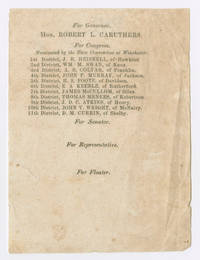
1863WRCAM53688Winchester 1863. Broadside 5 x 3 3/4 inches. Toned minor soiling and wrinkling. Very good. An exceedingly rare Confederate Tennessee state election ticket from 1863 nominating Robert L. Caruthers for governor and eleven others as state senators. In 1863 state elections were due in Tennessee. The state was fractured by war and secession and both Unionists and Confederates expressed the desire to hold elections for state government. Confederate supporters held a convention in Winchester and nominated a governor the State Legislature and members for the Confederate Congress. It was a bit of a fool's errand. <br> <br> Isham G. Harris who still considered himself the governor of Tennessee issued a proclamation calling for the election to be held on the first Thursday in August. Just who voted and how many or how few will probably never be known. According to historians the State Archives in Nashville are scant and inconclusive; returns from only thirty-two counties are found some of which reported the vote of only one civil district. Not a single report was from West Tennessee counties and only eight Middle Tennessee counties made returns. Robert L. Caruthers was elected governor on the face of returns but he was never inaugurated and thus never served a day as governor of Tennessee. No Confederate State Legislature ever convened either. The Confederate Congressmen were the only lucky ones. Those who were elected in 1863 took their seats in Richmond however briefly. <br> <br> George Webb notes this copy in his NOT IN ALLEN bibliography in 2013. Not in Parrish & Willingham. The only other copy or shall we say copies resides at the Library of Virginia in an uncut sheet of six tickets. This will likely be the only copy ever available in the marketplace. WEBB NOT IN ALLEN 199 this copy. unknown books
182334261Raleigh 1823. 15 1 blank pp. Caption title as issued. Disbound. Scattered light and moderate foxing. Good. <br/><br/> Signed at the end in type: "November 1823. CAROLINA." An extremely scarce pro-Calhoun anti-Crawford piece for the 1824 presidential election. When Calhoun decided to seek the presidency in 1824 "both Crawford and Adams the acknowledged front-runners felt betrayed" Crawford because Calhoun had reportedly assured him that he would defer to the older man and wait his turn; and Adams because Calhoun had said that "for the good of the country.the next President should come from the North." Peterson THE GREAT TRIUMVIRATE 116. <br/>Miles 3. Thornton 1750. AI 12071 1- DLC. OCLC 42212191 3- NYHS Duke UNC as of February 2021. unknown books
184439908Towanda PA 1844. Folio broadside 10-1/8" x 21." Printed in four columns each column separated by a rule. Light to moderate foxing light wear. Good. Signed in type at the bottom by thirty disillusioned local Democrats. <br /> <br /> Towanda is the county seat of Bradford County the residence of many of the signers including Judge Edward Herrick the first signer. This evidently unrecorded broadside illustrates the impending split in the Democratic Party along sectional lines over the issue of slavery. <br /> The signers are "steadfast" Democrats distraught that their Party has nominated James K. Polk of Tennessee as its 1844 presidential candidate. Polk known as the "Dark Horse" candidate "was thrust upon the party as the candidate by the intrigues and management of the NULLIFIERS! italics in original. The instructions and pledges of the delegates were disregarded and Mr. V. Buren and the Democratic party betrayed!"<br /> Clay "a statesman of the first order" has always sought to advance the national interest as opposed to parochial concerns. The signers defend his support of protective tariffs and the American System. They applaud his opposition to the annexation of Texas and his warnings that a war with Mexico would result in an expansion of the "odious" system of slavery. <br /> Not in Sabin or American Imprints. Not located on OCLC or the online sites of AAS U Penn U TN as of March 2025. unknown
182334261Raleigh 1823. 15 1 blank pp. Caption title as issued. Disbound. Scattered light and moderate foxing. Good. <br /> <br /> Signed at the end in type: "November 1823. CAROLINA." A scarce pro-Calhoun anti-Crawford piece for the 1824 presidential election. <br /> When Calhoun decided to seek the presidency in 1824 "both Crawford and Adams the acknowledged front-runners felt betrayed" Crawford because Calhoun had reportedly assured him that he would defer to the older man and wait his turn; and Adams because Calhoun had said that "for the good of the country.the next President should come from the North." Peterson THE GREAT TRIUMVIRATE 116. <br /> Miles 3. Thornton 1750. AI 12071 1- DLC. OCLC 42212191 3- NYHS Duke UNC as of December 2024. unknown
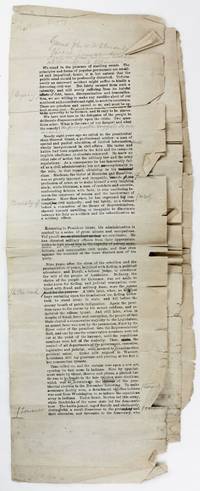
18775770N.p. likely Springfield Il: ca. January 8 1877. Good. Three long galley leaves each approximately 6.5 x 19 inches and printed on rectos only with numerous pencil emendations. Old folds and creases numerous chips and tears to margins pervasive wrinkling making reading a bit challenging at times but with no loss to text. Small portion of third leaf containing the last eight lines of text detached but present. Not in great shape but seemingly unique. A galley proof of a speech by General John A. McClernand in the midst of the contentious Election of 1876 which was so far as we can determine neither delivered nor published. A pencil note at top reveals his authorship and notes the speech was intended to be delivered January 8 at the “Great Citizens Convention†in Springfield Illinois almost certainly in 1877 following the recent election in the Fall of 1876. McClernand was an Illinois contemporary of Lincoln's a Democratic Congressman and War Democrat. He was also an ally of another Illinois politician and Lincoln adversary Stephen A. Douglas. He was appointed a general during the Civil War largely through political maneuvering and was generally considered incompetent. McClernand greatly resented the authority of Grant who finally relieved him of command in June 1863. Following the war McClernand became a leading critic of Congressional Reconstruction as well as the Grant Administration in general. He also chaired the 1876 Democratic National Convention which nominated Tilden for the presidency.<br /> <br /> Here McClernand bitterly attacks Grant his presidential Administration and Reconstruction. According to McClernand Grant's "tastes and habits had been acquired in the field and the camp -- in implicit obedience or absolute command. He knew no other rule of action but the military law and army regulations. As a consequence he has lamentably failed as a civil administrator." As President fraudulently and illegally Grant "joined with Kellog a political adventurer and Durell a federal judge to overthrow the will of the people of Louisiana." Law and order says McClernand "lay prostrate and panting at the feet of her remorseless tyrants." McClernand also assails Grant's highhanded tactics in the other Southern States.<br /> <br /> Now says McClernand "the president and his accomplices have now applied themselves to defeat the will of the people by a parliamentary device. They claimed for the President of the Senate the right and power to count the electoral votes and to declare the result and by implication that that right and power would be so exercised as to count Tilden out of his election and to count Hayes into one." He wasn't wrong. In one of the closest most hotly-contested and highly-controversial elections in American history to put it simply Hayes effectively stole the election by agreeing to remove northern soldiers from the South and end Reconstruction. It would be interesting to know what McClernand thought of the ultimate result -- he didn't get Tilden but he did get the end of Reconstruction.<br /> <br /> "Yet another prominent Illinoian who played a role in the Civil War John Alexander McClernand was born in Breckinridge County Kentucky before moving to Shawneetown Illinois at a young age. Similar to fellow Illinoian Abraham Lincoln McClernand was a largely self-taught lawyer who began practicing in Shawneetown in 1835. Also like Lincoln McClernand served in the Black Hawk War. However McClernand was a staunch Democrat. In 1835 he established the newspaper Shawneetown Democrat. He was active in Democratic politics at both the state and federal level serving in the Illinois House of Representatives and eventually Congress. In Congress McClernand was a stalwart Jacksonian Democrat who strongly disliked abolitionists. He strongly opposed the Wilmot Proviso which banned slavery in the territory gained after the Mexican-American War. He became a key ally of fellow Democrat and Illinoian Stephen A. Douglas helping him pass the Compromise of 1850. As tensions rose approaching the election of 1860 McClernand campaigned for Douglas’s presidency and became a Unionist. After war broke out in the following April McClernand helped raise volunteers for the Union Army. Because Lincoln needed to retain a wide base of support and retain connections with Democrats in Illinois he appointed McClernand a brigadier general on May 17 1861. McClernand’s military career would be defined by an ongoing clash with fellow Illinoian General Ulysses S. Grant. Grant a seasoned West Pointer who served in Mexico was irritated by McClernand a political general with little military experience. Further exacerbating relations was McClernand’s tendency to boast about his exploits and diminish the achievements of other commanders" - American Battlefield Trust's entry on John A. McClernand. ca. January 8 unknown
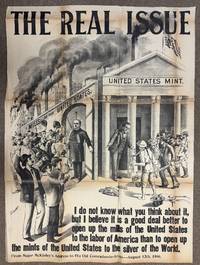
189641421Chicago: Edwards Deutsch & Heitmann 1896. Elephant folio broadside 36" x 48" mounted on linen at time of manufacture. A graphic black-and-white campaign broadside for Republican William McKinley's 1896 presidential contest against Democrat William Jennings Bryan. Early folds with significant wear and splitting along folds including the backing several archival cloth tape repairs on verso. Moderate toning at the fold lines. Good only. <br /> <br /> "McKinley welcomes workers to U.S. mills W.J. Bryan welcomes foreign silver." Library of Congress copy of this print but reprinted in 1900 with the addition of large red type "McKinley was Right in 1896." <br /> Democrat Bryan favoring free coinage of silver and elimination of tariffs welcomes foreigners bringing to the Mint silver from India Germany England Mexico Japan China and elsewhere. Republican McKinley favoring the gold standard and tariffs to protect American industries welcomes prosperous American workers to American mills.<br /> "From Major McKinley's Address to His Old Comrades = In = Arms. - August 12th 1896."<br /> OCLC 20499606 1- Detroit Pub. Lib. as of April 2026. Edwards, Deutsch & Heitmann unknown
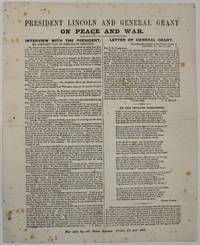
186440032New York: For sale by all News Agents. Price $1 per 100. 1864. Broadside 9 1/2" x 11 1/4". Printed in two columns. Light foxing Old white tape remnants at upper margin of blank verso. Very Good.<br /> <br /> The broadside prints Judge Mills's report of his interview with President Lincoln who strongly defends the use of black troops in the war effort. General Grant's letter to E.B. Washbourne sic reports "The Rebels have now in their ranks their last man. The little boys and old men are guarding prisoners guarding railroad bridges and forming a good part of their garrisons for entrenched positions." Bayard Taylor's poem on the Democrats' presidential nominating convention 'On the Chicago Surrender' is also printed. <br /> "Judge Mills" was Joseph T. Mills of Wisconsin an attorney and judge who had also been a State Assemblyman.<br /> Bartlett 2725. Sabin 41157. Weinstein Against the Tide 141. Not in Monaghan. For sale by all News Agents. Price, $1 per 100. unknown