791 résultats
188844744N.p.: N.p. 1888. Paperback. 8vo. Wrappers. 15pp. Very good. Faint age toning only; strong single vertical fold not weakened. A tight and nice first edition of this surprisingly neutral review of the main candidates -- incumbent Democrat Grover Cleveland and Republican challenger Benjamin Harrison -- and the major issues of the campaign primarily the tariff reduction proposed by Cleveland. Harrison won though Cleveland recaptured the presidency in 1892. Subtitled "A Repeal of Taxes Will Not Lessen the Price to the Consumer. Distribute the Surplus to the States and Relieve the Counties from the Assessment of Taxes for State Purposes. Promote Temperance by Enforcing the Practical Policy of High License and Local Option as Against the Barren Ideality of Prohition or Nothing." Uncommon and in fairly nice condition given the low-quality stock. N.p. paperback
1391963059.Gpaperback. Good. Access codes and supplements are not guaranteed with used items. May be an ex-library book. paperback
1396738614.Ghardcover. Good. Access codes and supplements are not guaranteed with used items. May be an ex-library book. hardcover
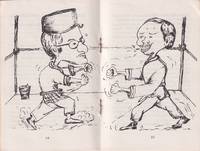
1986222683Johor Bahru.: Partai Sosialis Rakyat Malaysia. Circa1986. Three black and white political cartoons 28pp. 15 x 10pp. Original stapled wrappers little browned a prior owner's name lightly pencilled in red upper wrapper overall in good condition. A short publication issued by the Malaysian People's Party at the time still operating as the Malaysian Socialist People's Party in the lead up to the 1986 election. Within are a few short commentaries on the dysfunction within UMNO with particular interest in the so-called AIDS faction in the party. Scarce; we have only been able to find one institution holding this publication. . Partai Sosialis Rakyat Malaysia. unknown
184840827Washington: Gideon 1848. 8pp caption title as issued. Disbound and lightly foxed. Good. <br /> <br /> Letters from Whigs Caleb Smith of Indiana and Schenck of Ohio tell their fellows that they better vote the Whigs' 1848 presidential ticket despite their dismay at the nomination of Zachary Taylor. The alternative is the Democrat Cass whose election will "lead to large acquisitions of territory upon our Southern borders no restriction upon the extension of slavery.this mad career of conquest. The election of Gen. Cass will secure the complete triumph of the most ultra views of Slavery propagandists." <br /> FIRST EDITION. Wise & Cronin Taylor 27. Not in Sabin Miles Eberstadt Decker LCP. Gideon unknown
193624942<p>This sheet contains five rough sketches of graphics calling on the workers and voters of America to support Franklin D. Roosevelt's reelection in 1936. They did in record numbers.</p><p><strong>PRESIDENTIAL ELECTION OF 1936.</strong> Typed Document Signed. Artwork by Franz Felix and Ideas and Copy by Richard Barron "Set of Rough Sketches Containing Some Suggested Promotion Ideas to be Used in the 1936 Democratic Presidential Campaign" July 2 1936. 1 p. 12 x 10½ in.</p><p><strong>Excerpts:</strong></p><p>"<em>1. Sounding the call against 'economic royalists' in the spirit of 1776.</em>"</p><p>"<em>2. Appropriating the well-known symbol of violence</em> upraised fist<em> diverting it to peaceful democratic use. To include the farmer phrase the appeal: TOILERS OF AMERICA – UNITE FOR ROOSEVELT.</em>"</p><p>"<em>3. The statue of 'The Thinker' as a symbol of the man today who thinks the toiler with brawn and brain.everyman.</em>"</p><p>"<em>4. Direct appeal to radical labor and leftists in general.</em>"</p><p>"<em>5. Another way of appealing to the working class men and women.</em>"</p><p>"<em>This collaborative effort respectfully submitted for consideration to the Chairman of the Democratic National Committee Mr. James A. Farley.</em>"</p><p><strong>Historical Background</strong></p><p>After unseating incumbent Republican President Herbert Hoover in 1932 President Franklin D. Roosevelt ran for reelection in 1936. His Republican opponent was Governor Alf Landon of Kansas. Although the Great Depression had entered its eighth year Roosevelt's New Deal policies were broadly popular. He won the highest share of the popular and electoral vote since the uncontested 1820 election. Roosevelt attracted more than 60 percent of the popular vote and won the electoral votes of 46 states; Landon won the electoral votes of only Maine and Vermont.</p><p>Democratic Party chairman James Farley had predicted that Roosevelt would lose only Maine and Vermont. After the results of the 1936 election Farley quipped that the nation needed to revise the conventional political wisdom of "As Maine goes so goes the nation" to "As Maine goes so goes Vermont."</p><p>These ideas for campaign imagery employed or modified common images to support Roosevelt's campaign. One drew on the imagery of artist Archibald Willard's 1875 painting <em>The Spirit of '76</em> and employed three figures of workers to match the subjects of Willard's image. Another appropriated the upraised fist as a symbol of violence and repurposed it as a symbol of defiant unity against "<em>economic royalists</em>." A third used an image of <em>The Thinker</em> by French sculptor Auguste Rodin 1840-1917 to appeal to thinking voters. Another image appeals to the fears of radicals that the alternative to Roosevelt is "<em>Reaction</em>."</p><p>Richard Barron and artist Franz Felix submitted these ideas to Democratic National Committee chairman James A. Farley on July 2 1936 three weeks before the Democratic Party held its convention in Philadelphia. There is no evidence that these images were used in the campaign and it is possible that Farley rejected them. At the end of the campaign the Democratic National Committee had a campaign deficit of approximately $850000. To help offset those expenses the treasurer convinced President Roosevelt to sign 2500 brief Forewords which were bound into <em>The Democratic Book 1936</em> and sent to donors of $250. Purchases brought in more than $400000 for the party and led Republicans to charge corrupt practices for allowing corporations to contribute to the campaign by buying copies.</p><p><strong>Franz Felix</strong> 1892-1967 was born in Vienna Austria and developed an ability as a child to draw portraits in charcoal. He studied portraiture in Vienna and immigrated to the United States shortly after World War I. He settled in San Francisco where he established himself as a portrait artist and commercial illustrator. In the late 1920s he moved to New York and established a studio in the suburb of Spring Valley where he produced book and magazine illustrations. During World War II he painted a series of murals of wartime activities of Spring Valley residents.</p><p><strong>James A. Farley</strong> 1888-1976 was born in New York into an Irish Catholic family. After his father died he helped his mother with a small business to support the family. After graduating from Packard Business College in New York City where he studied bookkeeping and other business skills Farley got a job with the U.S. Gypsum Corporation. He served as a Democratic town clerk in Stony Point New York and became chairman of the county's Democratic Party in 1918. He organized upstate Democrats and helped elect Alfred E. Smith as Governor that year. He served in the New York State Assembly in 1923 but was defeated at the next election for supporting the repeal of Prohibition. As chair of the state Athletic Commission Farley fought for the civil rights of African American athletes. Farley founded he General Builders Corporation from smaller firms to become New York City's largest building supply company. Farley directed Franklin D. Roosevelt's narrowly successful New York gubernatorial campaign in 1928 and his reelection in 1930. Farley served as chairman of the New York State Democratic Committee from 1930 to 1944 and helped build the national New Deal coalition that elected Roosevelt to the Presidency four times. In 1932 Farley became the chairman of the Democratic National Committee and in 1933 U.S. Postmaster General. He held both positions until 1940. Farley and Roosevelt broke on the two-term tradition of the Presidency in 1940 and he later helped propose the 22nd Amendment to the U.S. Constitution limiting a person to two elections as president approved by Congress in 1947 and ratified in 1951. Farley became chairman of the board of the Coca-Cola Export Corporation in 1940 and held that position for more than thirty years.</p>
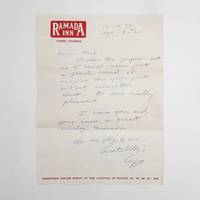
1979375947Casper Wyoming 1979. 8vo. One sheet Ramada Inn letterhead written in blue ink recto only. 8vo. "Dear Mace- Pardon the paper-but as I head home just a quick word of thanks for your part in that successful event-I was really pleased. I hope you and yours have a great Holiday Season. We underlined are going to win. Gratefully George. unknown
1840273086Washington 1840. unbound. 2 pages front and back 10 x 8 inches written by George Folts of Washington City to his brother James at Albany New York October 3rd 1840 concerning their misguided notion that Martin Van Buren the Democratic Party nominee for President would win the State of Ohio in the Presidential election despite the fact that his Whig opponent William Henry Harrison resides there in part: ".We have assurances from the best sources that Ohio will be ours in November.at all events from present appearances our chance seems much the best. All eyes are turned towards the Empire State it is the battle ground if she will prove true to her best interests and all will be well. Mr. Durham the bearer of this formerly of Albany now a Clerk in this office leaves tomorrow. He is a clever fellow and a good Democrat." Note: George Folts received his Clerks job in Washington through the patronage system. Usual folds plus some pencil underlining; very good- condition.<br/> <br/> "We have assurances from the best sources that Ohio will be ours in November"<br/> <br/> unknown
a488791952. Prepared by the Staff of the Senate Minority Policy Committee August 1952. 4to. 119 leaves rectos only spiral bound wraps. University Library stamp on front. VG. paperback
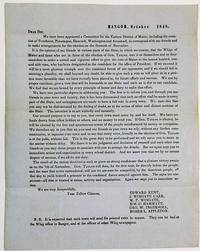
184834421Bangor 1848. Folio sheet folded to 7-3/4" x 10". Printed on first page only; second page blank; third page with a manuscript letter urging the recipient whose last name is Chandler to campaign vigorously for the Taylor-Whig ticket. Very Good.<br /> <br /> A plea to get out the vote for Taylor. "If Gen. Taylor is elected he will be elected by the free and spontaneous action of the people uninfluenced by money or corruption.The signs are auspicious-- all that is wanted is union activity and organization." The printed letter is signed in type by Edward Kent J. Wingate Carr W.P. Wingate Wm. C. Hammatt Geo. W. Ingersoll and Moses L. Appleton.<br /> Not located on OCLC as of June 2026. unknown
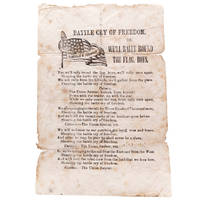
1864351793Philadelphia 1864. 1p. handbill. Woodcut of a Lincoln & Johnson campaign flag. 8-1/2 x 6 inches. Old folds some separations. 1p. handbill. Woodcut of a Lincoln & Johnson campaign flag. 8-1/2 x 6 inches. Scarce campaign handbill from the Election of 1864 with the lyrics to the popular Civil War song Battle Cry of Freedom the patriotic song song written in 1862 by American composer George Frederick Root 1820-1895. unknown
1528404149.Gpaperback. Good. Access codes and supplements are not guaranteed with used items. May be an ex-library book. paperback
185619546Washington 1856. 14 2 blank pp. Disbound partly loosened. Tanned with some foxing and light wear. Good. <br /> <br /> "Principally of his frauds in the purchase of horses in 1846 and 1847 while disbursing officer in California." Cowan. "Carelessness recklessness favoritism and connivance with the claimants." That's the verdict on Fremont. The pamphlet examines "the chief dealings of Colonel Fremont as a disbursing officer during the campaign in California whilst he commanded the volunteers" during 1846-1847. Tables facts figures are produced and analyzed. <br /> FIRST EDITION. Cowan 222. Rocq 16684. Not in Eberstadt Decker. unknown
AQ21433Alnwick: Printed by M. Smith s.d. c.1882 Single leaf broadside. Lightly creased very short tear to one edge central horizontal fold. An apparently unrecorded notice by the Alnwick Board of Health calling on the support of the ratepayers of the area in an upcoming election. The Board makes clear their invaluable contribution in securing authorisation for the construction of a railway branch line between the town and nearby Cornhill. The line was begun in 1884 and completed in 1887. . Dimensions 290 x 440 mm. Printed by M. Smith, [s.d., c.1882] unknown
0526098775.Ghardcover. Good. Access codes and supplements are not guaranteed with used items. May be an ex-library book. hardcover
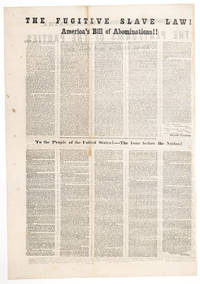
185227980<p><strong>Boston Fugitive Slave Law Printing on Free Soil Party Broadsheet</strong></p><p>"<em>a vote for either of the former candidates is as truly a vote in favor of the sustenance defence and encouragement of American slavery in all its hideousness as a vote for the devil were a vote in favor of sin…</em>"</p><p>This broadsheet prints a summary of the three major party platforms—the "Compromise Democratic" Party the Whig Party and the Free Democratic Free Soil Party—headed with the injunction to "<em>Read Reflect and then Act!</em>" The second page includes the text of the Fugitive Slave Law or "<em>America's Bill of Abominations!!</em>" passed in September 1850 and an editorial by "Alexander" that explains the benefits of the Free Soil Party over the other two parties.</p><p><strong>ELECTION OF 1852. FUGITIVE SLAVE LAW.</strong> Printed Broadsheet <em>Boston Commonwealth</em> Extra July 1852. 2 pp. 25½ x 22 in.</p><p><strong>Excerpts</strong><br />"<em>The Platforms of the Parties. Read Reflect and then Act!</em>" p1</p><p>"<em>The Fugitive Slave Law! America's Bill of Abominations!!</em>" p2</p><p><em>"…Section 6</em></p><p><em>And be it further enacted That when a person held to service or labor in any State or Territory of the United States has heretofore or shall hereafter escape into another State or Territory of the United States the person or persons to whom such service or labor may be due or his her or their agent or attorney duly authorized by power of attorney in writing acknowledged and certified under the seal of some legal officer or court of the State or Territory in which the same may be executed may pursue and reclaim such fugitive person either by procuring a warrant from some one of the courts judges or commissioners aforesaid of the proper circuit district or county for the apprehension of such fugitive from service or labor or by seizing and arresting such fugitive where the same can be done without process and by taking or causing such person to be taken forthwith before such court judge or commissioner whose duty it shall be to hear and determine the case of such claimant in a summary manner; and upon satisfactory proof being made by deposition or affidavit in writing to be taken and certified by such court judge or commissioner or by other satisfactory testimony duly taken and certified by some court magistrate justice of the peace or other legal officer authorized to administer an oath and take depositions under the laws of the State or Territory from which such person owing service or labor may have escaped with a certificate of such magistracy or other authority as aforesaid with the seal of the proper court or officer thereto attached which seal shall be sufficient to establish the competency of the proof and with proof also by affidavit of the identity of the person whose service or labor is claimed to be due as aforesaid that the person so arrested does in fact owe service or labor to the person or persons claiming him or her in the State or Territory from which such fugitive may have escaped as aforesaid and that said person escaped to make out and deliver to such claimant his or her agent or attorney a certificate setting forth the substantial facts as to the service or labor due from such fugitive to the claimant and of his or her escape from the State or Territory in which he or she was arrested with authority to such claimant or his or her agent or attorney to use such reasonable force and restraint as may be necessary under the circumstances of the case to take and remove such fugitive person back to the State or Territory whence he or she may have escaped as aforesaid. In no trial or hearing under this act shall the testimony of such alleged fugitive be admitted in evidence; and the certificates in this and the first fourth section mentioned shall be conclusive of the right of the person or persons in whose favor granted to remove such fugitive to the State or Territory from which he escaped and shall prevent all molestation of such person or persons by any process issued by any court judge magistrate or other person whomsoever.</em></p><p><em>Section 7</em></p><p><em>And be it further enacted That any person who shall knowingly and willingly obstruct hinder or prevent such claimant his agent or attorney or any person or persons lawfully assisting him her or them from arresting such a fugitive from service or labor either with or without process as aforesaid or shall rescue or attempt to rescue such fugitive from service or labor from the custody of such claimant his or her agent or attorney or other person or persons lawfully assisting as aforesaid when so arrested pursuant to the authority herein given and declared; or shall aid abet or assist such person so owing service or labor as aforesaid directly or indirectly to escape from such claimant his agent or attorney or other person or persons legally authorized as aforesaid; or shall harbor or conceal such fugitive so as to prevent the discovery and arrest of such person after notice or knowledge of the fact that such person was a fugitive from service or labor as aforesaid shall for either of said offences be subject to a fine not exceeding one thousand dollars and imprisonment not exceeding six months by indictment and conviction before the District Court of the United States for the district in which such offence may have been committed or before the proper court of criminal jurisdiction if committed within any one of the organized Territories of the United States; and shall moreover forfeit and pay by way of civil damages to the party injured by such illegal conduct the sum of one thousand dollars for each fugitive so lost as aforesaid to be recovered by action of debt in any of the District or Territorial Courts aforesaid within whose jurisdiction the said offence may have been committed…"</em></p><p>"<em>To the People of the United States!—The Issue Before the Nation!</em>" p2</p><p>"<em>We present you this Document for the Campaign in order that its doctrines may be scanned before the minds of men become steeled against the power of just reasoning by the intense zeal and party prejudice of an exciting election. It is a simple and earnest appeal to reason.</em>" p2/c1</p><p>"<em>The Free Democracy will favor the early policy of the country to limit localize and discourage slavery—the separation of national funds from banking institutions cheap postage a moderate revenue—the election of civil officers by the people—such internal improvements as are national and constitutional—the cordial reception of emigrants and exiles from the old world—the grant of the Public Lands free of cost to landless settlers—the immediate repeal of the Fugitive Slave Law—the recognition of the independence of Hayti—an arrangement in future treaties…</em></p><p>"<em>And the said party will oppose the exercise of doubtful constitutional powers—the demand for more slave States new slave territories and the nationalization of slavery—foreign interference with the right of a nation to govern itself.</em>" p2/c2</p><p>"<em>The intrepid Free Democracy have sought the arena of political strife with a determination to oppose each of these powerful clock-work organizations. They publish a platform which presents a point-blank contrast to either and both the others. They claim the support of the people because their policy is founded in Right and Justice; and because the application of that policy to governmental affairs cannot be secured by the triumph of any other party.</em>" p2/c3-4</p><p>"<em>While the attitude of the Free Democracy is that of a general championship of the rights of the humbler classes … its position upon the slavery question affords the great contrast and entitles it to the support of the lovers of Freedom and Right.</em>" p2/c4</p><p>"<em>Whigs and Democrats would sanction slavery by law. The Free Democracy forbid the high-handed endeavor.</em>" p2/c4</p><p>"<em>It follows that a vote for either of the former candidates is as truly a vote in favor of the sustenance defence and encouragement of American slavery in all its hideousness as a vote for the devil were a vote in favor of sin.</em>" p2/c4-5</p><p><strong>Historical Background</strong><br />The author of the editorial may have been Alexander De Witt 1798-1879 a former Democrat who joined the Free Soil Party and was one of the six signatories of the "Appeal of the Independent Democrats" in January 1854 in opposition to the Kansas-Nebraska Act.</p><p>President Zachary Taylor a Whig died in July 1850. His successor Millard Fillmore supported the Compromise of 1850 and enforcement of its stronger Fugitive Slave Law which made him unpopular in the North. At the Whig National Convention in Baltimore the delegates took 53 ballots to choose General Winfield Scott of New Jersey as their presidential candidate.</p><p>At the Democratic convention also in Baltimore it took 48 ballots to select dark-horse choice Senator Franklin Pierce of New Hampshire as their presidential candidate.</p><p>The Free Soil Party which opposed the extension of slavery chose Senator John P. Hale of New Hampshire as their presidential candidate. After the Compromise of 1850 many Barnburner Democrats and Conscience Whigs returned to their parties at the expense of the Free Soil Party.</p><p>With no major policy differences between the Democrats and Whigs the election became a contest of personalities between Scott the anti-slavery war hero of the Mexican War and the pro-slavery Pierce who though eighteen years younger had also served in the war.</p><p>In the election on November 2 1852 Pierce won 50.8 percent of the popular vote carrying 27 states with 254 electoral votes. Scott's 43.9 percent carried only 4 states with 42 electoral votes. Hale attracted 4.9 percent of the popular vote taking no electoral votes.</p><p><strong><em>The Commonwealth</em></strong> 1851-1853 was a newspaper published in Boston daily with occasional supplements under the motto "Circulate the documents<em>.</em>" In 1852 it became the official newspaper of the Free Soil Party in Massachusetts.</p><p>Condition: Very good overall.</p> Boston Commonwealth
186033068Washington City: Issued by the National Democratic Executive Committee 1860. 8pp caption title as issued. Disbound with light wear Good.<br /> <br /> Breckinridge Buchanan's Vice President was the 1860 presidential standard-bearer of the Southern Rights branch of the Democratic Party which had split with Stephen Douglas supporters during the 1860 nominating convention. Douglas had defied Buchanan and broken with him over the Kansas issue. This campaign piece demonstrating Northern support for the Breckinridge-Lane ticket charges the Douglas faction with unfairness hypocrisy and illegal attempts to silence the Southern Democrats at the abortive Democratic Convention at Baltimore. <br /> LCP 4504. Issued by the National Democratic Executive Committee unknown
186040746Washington: National Democratic Executive Committee 1860. 32pp. Folded and untrimmed. Scattered light foxing. Very Good. Caption title as issued.<br /> <br /> The Southern wing of the Democratic Party taking time away from its massive assaults on fellow Democrat Stephen A. Douglas attacks the Constitutional Union Party headed by John Bell of Tennessee. Bell is portrayed as an unprincipled friend of Compromise who often voted with the Abolitionists and is unsound on the Kansas Question and the Dred Scott Decision. <br /> Sabin 7673 ref. Not in Miles LCP. National Democratic Executive Committee unknown
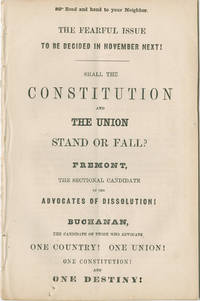
185624482<p>"<i>What a Combination! Seward Greeley Bennet Watson Webb H. Ward Beecher &c. There can be no doubt that this goodly company will speedily be increased by the addition of Fred. Douglass and his black republicans… The only candidate to arrest this tide of demoralization and sectionalism is James Buchanan.</i>"</p><p>This pro-Buchanan election of 1856 pamphlet attacks the first Republican presidential candidate John C. Frémont. Quoting from the speeches and writings of William Lloyd Garrison Horace Greeley Wendell Phillips Salmon P. Chase Henry Ward Beecher William H. Seward Joshua R. Giddings this pamphlet ignores distinctions between abolitionists racial egalitarians more limited opponents just of the expansion of slavery into the territories or those who fought the kidnapping of free African Americans under the Fugitive Slave Law. It paints all with the same broad brush as "Black Republican" extreme abolitionists who were willing to destroy the Union rather than remain in it with slaveholders.</p> <b>ELECTION OF 1856.</b>Printed Document. <i>The Fearful Issue to Be Decided in November Next! Shall the Constitution and the Union Stand or Fall Fremont The Sectional Candidate of the Advocates of Dissolution! Buchanan The Candidate of Those Who Advocate One Country! One Union! One Constitution! and One Destiny!</i> 1856. 24 pp. 5 x 8½ in.<p><b><br /></b></p><p><b>Excerpts:</b></p><p>Before Title: "<i>Read and hand to your Neighbor.</i>"</p><p>"<i>We propose showing by indubitable testimony that John C. Fremont's leading friends are now the open enemies of the Federal Constitution… the enemies of one-half of the States of the Union; the enemies of the laws of Congress; and the enemies to equality of the States.</i>" 3</p><p>"<i>In a speech delivered at the New England Anti-Slavery Convention on the 29th of May 1856 by Wm. Lloyd Garrison we have a flood of light shed on the relation between abolitionism and republicanism which divests the subject of all doubt or uncertainty.</i>" 4</p><p>"<i>William H. Seward was known at the Abolition Convention at Philadelphia… as one of Fremont's warmest supporters. Indeed it is well known that to Chase Seward and Greeley Fremont is mainly indebted for his nomination: they defeated McLean.</i>" 7</p><p>"<i>Nathaniel P. Banks Abolitionist and Disunionist was elected Speaker of the House by a solid sectional vote: he did not get one vote from the South.No man has exhibited such ferocious hostility to the fugitive slave law to the compromise measures and to the Federal Constitution. His speeches full of treason and of war would fill a volume.</i>" 8 and 9</p><p>"<i>Every leading committee has an Abolition Disunionist for chairman and a Disunion majority! There some thirty-five committees in the House… Black Republicans monopolized all the great committees. Thus was the work of Disunion formally begun in the Congress of the United States! This monstrous act unprecedented in all our history was the deliberate work of the men who now surround Fremont.</i>" 10</p><p>"<i>The reverend agitator Ward Beecher is out for Fremont in the last number of his 'Independent.' He is probably next to Garrison and Phillips the most profligate calumniator of the Constitution and the Union.</i>" 19</p><p>"<i>What a Combination! Seward Greeley Bennet Watson Webb H. Ward Beecher &c. There can be no doubt that this goodly company will speedily be increased by the addition of Fred. Douglass and his black republicans. Every Black Republican in Congress from New York is now the earnest advocate of Fremont.</i>" 20</p><p>"<i>We aver that there is not an Abolitionist or Disunionist in Pennsylvania who is not an active and open friend of John C. Fremont for the Presidency. David Wilmot and William F. Johnston lead the motley crew both recreants from the Democratic party because the Democratic party respected the Constitution of the United States and would not desert its injunctions… The only candidate to arrest this tide of demoralization and sectionalism is James Buchanan. It is against him and against the Constitution that this combination has been formed.</i>" 23</p><p>"<i>in the South every vote thrown for Mr. Fillmore is more or less an aid to John C. Fremont to the extent that it may weaken James Buchanan.</i>" 24</p><p>"<i>We would speak of Mr. Fillmore with entire respect. His speech at Albany was patriotic and forcible but it cannot be denied that out of New York in the North all those who pretend to support him will be called upon in the State elections to unite against the Democratic party with the friends of Fremont otherwise known as the Black Republicans.</i>" 24</p><p><b>Historical Background</b></p><p>James Buchanan won with 1.8 million votes and 174 electoral votes from 19 states. Fremont received 1.3 million votes winning 11 northern states with 114 electoral votes. American Party "Know Nothing" candidate and former President Millard Fillmore received 873000 votes winning Maryland's 8 electoral votes. Frémont received no votes at all in 10 of the 14 slave states and fewer than 1200 votes total in the other 4 slave states.</p><p><b>John C. Frémont</b> 1813-1890 "the Pathfinder" was a legendary explorer who achieved military victories in California during the Mexican War. He entered politics as California's first senator and then became the first Republican presidential candidate in 1856. During the Civil War Lincoln removed Frémont from command in Missouri after he unilaterally declared martial law and threatened to confiscate all property including slaves of Southern sympathizers. Lincoln gave Frémont command of an army in western Virginia where he was defeated by Stonewall Jackson in the Battle of Cross Keys. After Frémont refused to serve under General John Pope Lincoln never again gave him a field command contributing to a personal grudge. In 1864 Frémont abandoned his third-party campaign for the presidency in September after Lincoln agreed to remove U.S. Postmaster General Montgomery Blair from office.</p><p><b>Condition</b></p><p>Disbound minor pin holes very good.</p>
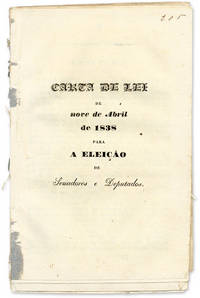
1838609821838. Portugal Election Law. Carta De Lei De Nove De Abril De 1838 Para E Eleicao de Senadores E Deputados Half-title. Porto: Imprensa Constitucional 1838. 33 pp. Folding table. Disbound stab-stitched pamphlet. Light toning foxing to a few leaves early hand-lettered page numbers to upper corners of leaves. $75. The Portuguese law of 1838 governing national elections containing 92 articles with numerous statistical tables relating to district representation. unknown
187215895np 1872. 8pp. Folded with caption title as issued. Light wear trimmed closely at the top without loss of text but affecting several page numbers. Good. Demonstating the abuses heaped upon our great presidents beginning with George Washington and ending with Grant. Charles Sumner whose criticisms of corrupt practices in the first Grant Administration were particularly sharp is excoriated. unknown
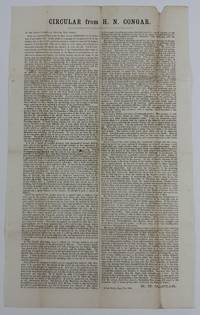
18643721N.p. but most likely Newark N.J. 1864. Good plus. Letterpress broadside printed in two columns 16.5 x 10 inches. Old folds small chip to top outer margin two tiny holes affecting just a few letters. A very rare Unionist broadside supporting the re-election of Abraham Lincoln in the critical presidential contest of 1864. The present broadside was authored in early June 1864 by New Jersey Republican Party stalwart Horace N. Congar an editor diplomat and politician who was at that time serving as U.S. consul to Hong Kong. In this rather stirring broadside which Congar writes from his position in Hong Kong he lauds "the thousands of earnest faithful men who are giving freely of their blood and treasure to the suppression of this infamous rebellion" and "the noble daring the undaunted courage and the determined valour of our brave soldiers of Freedom" and urges that "in November New Jersey will stand in the unbroken rank of States giving their verdict for the Party of Union." He also spends considerable space discussing the clear role of "the social moral and political evil" of slavery as the precipitating event of the Civil War. Congar writes that "the evil it has wrought was as natural as the poisoned breath of the Upas tree." Stated clearly Congar writes "I heartily rejoice at the destruction of slavery" and looks forward to the time when "I shall tread my native land with a newer life if within its boundless domain there shall not be heard the clanking chain or the cry of the suffering and the oppressed."<br /> <br /> "Horace Newton Congar 1817-1893 was a radical republican politician during the midnineteenth century and served on both the state and national levels. Mr. Congar had a great love for his party and hope for its success which is reflected in his writing . Horace Newton Congar was born in Newark on July 31 1817. He married Isabell Reeves and had two children; a daughter Ella and a son Horace Junior. Horace Congar taught school for a while and he studied law in his leisure time. He was admitted to the New Jersey State Bar in 1847 and later Cornelius Boice of Plainfield and Lewis Grove of Newark were his law partners. Congar was a friend of the abolitionist cause and he was one of the founders of the antislavery Free Soil Party in New Jersey. The party slogan ‘Free Soil Free Speech Free Labor and Free Men’ basically described the party platform. Congar later became a delegate from New Jersey to the Republican National Convention in 1848 which was held in Buffalo. He supported the nomination of Van Buren for president and Adams for vice-president" - New Jersey Historical Society.<br /> <br /> A rare and unusual Lincoln campaign broadside with just two physical copies in OCLC at AAS and Middlebury College. unknown
18487855Washington 1848. 8pp caption title as issued. Disbound else Very Good. <br /> <br /> A rare 1848 Democratic campaign pamphlet defending President Polk's vetoes. The veto power says his supporter Andrew Johnson "was established to enable the people to resist and repel encroachments on their rights." Since the country's founding Presidents have exercised the veto only 25 times. <br /> The document also includes Virginia Congressman Bayly's 1848 speech concurring with Johnson; and "Judge Story's Opinion on the Veto" taken from his Commentaries. <br /> Not in Sabin Eberstadt. OCLC 24637860 1- Lancaster Hist. Soc. 976424705 1- U VA as of January 2021. unknown
184819495np 1848. 16pp caption title as issued. Tanned several leaves trimmed closely at the fore-edge with slight loss. Good. A rare 1848 campaign pamphlet attacking Taylor and sketching the biography of Lewis Cass a man "of the highest order of talent" who has filled "almost every grade of office from the lowest to the highest and most responsible in the service of his country. From the first start in life he has been a Democrat. He received the first office he ever held from that great apostle of Democracy Thomas Jefferson in 1807." Taylor by contrast is a "spectacle" as a candidate-- lacking any political opinions and without even a political party to which he can claim loyalty. A General in the Mexican War he nevertheless allowed himself to be the candidate of the Whigs "who have sympathised with the public enemy who have traitorously given him 'aid and comfort' who have voted for the disgrace of their country in Congress by alleging that the war was unconstitutionally commenced." FIRST EDITION. Not in Sabin Miles Eberstadt Decker. Not located in NUC or on OCLC. unknown
184820489Washington 1848. 8pp printed in double columns caption title as issued. Disbound else Very Good. <br /> <br /> A scarce 1848 campaign pamphlet attacking Whig presidential candidate Zachary Taylor who "has no political principles and is perfectly ignorant upon political matters." On the burning issue of the Wilmot Proviso-- whether slavery ought to exist in the territories acquired from Mexico-- Taylor is a hypocrite: "At the North he is represented to be in favor of the Wilmot Proviso." But "at the South his advocates contend that he is opposed.because he is a southern man and a slaveholder and therefore identified with southern interests." <br /> A Louisiana slaveholder Taylor surprised everyone after his election when he supported immediate statehood for California with its anti-slavery Constitution. <br /> Wise & Cronin 44 Taylor. Not in Sabin Miles Eberstadt Decker LCP. unknown