791 résultats
20062090502113716575Not Available 2006. Soft Cover. Fine. The book is in fine condition. Not Available paperback
19362111902158501807Gifu Branch of Japan Seamen's Election 1936. Soft Cover. Fine. Number of pages: 82p. Size: 19cm Gifu Branch of Japan Seamen's Election paperback
0332241831.Gpaperback. Good. Access codes and supplements are not guaranteed with used items. May be an ex-library book. paperback
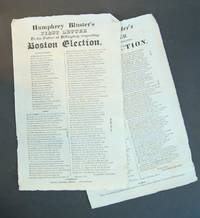
40033Boston: Printed and Sold by Noble Printers 1818. Two folio broadsides 335 x 208 mm printed in one side only fine condition. Two letters heading printed above double-column text in verse. Not recorded by JISC. Boston: Printed and Sold by Noble, Printers, 1818 unknown
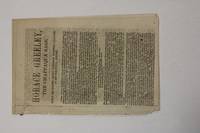
187240016np. 1872. 8pp. Disbound loosened with caption title as issued. Good. <br /> <br /> An anti-Greeley presidential campaign pamphlet. Running as a Liberal Republican in 1872 against Grant Administration corruption and incompetence Greeley unfortunately had a detailed public record demonstrating a mercurial inconsistency on public issues. <br /> As this pamphlet says "Sudden changes of opinion always excite distrust unless they are accompanied by causes so adequate and apparent that the metamorphosis is at once explained." This item shows that Greeley's shifts flunk the test.<br /> Not in Sabin Miles Eberstadt Decker. Not uncommon in institutional holdings according to OCLC. unknown
19572110502150412528Hogaku no Tomosha 1957. Soft Cover. Fine. Volume: 1 Hogaku no Tomosha paperback
19812091502135414764Not Available 1981. Soft Cover. Fine. Number of books: 2 Not Available paperback
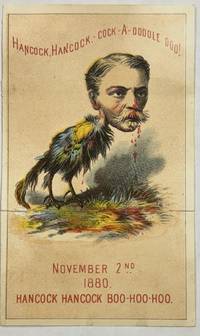
188040342New York: Copyright by Geo. H. Hanks 1880. Metamorphic card 3-1/4" x 5-3/8" fully opened. Richly colored light wear Very Good.<br /> <br /> The unopened illustration depicts a dignified serious Hancock as a rooster in elaborate feathers. But when opened Hancock has lost his feathers is emaciated and bleeding from the mouth. The caption reads "November 2nd. 1880 Hancock Hancock Boo-Hoo-Hoo." Winfield Scott Hancock a decorated Civil War general and a hero of Gettysburg was the losing Democrats' presidential candidate in 1880 opposing Republican James A. Garfield. <br /> The verso entitled 'Rhymes for Young Democrats' brilliantly skewers the overt racism of the Democratic Party. It begins: <br /> "Sing a song of shotguns Pocket full of knives Four-and- twenty black men Running for their lives; When the polls are open Shut the nigger's mouth Isn't that a bully way To make a solid South" <br /> OCLC 32320004 1- Brown as of August 2024. Copyright by Geo. H. Hanks unknown
1334599645.Gpaperback. Good. Access codes and supplements are not guaranteed with used items. May be an ex-library book. paperback
0365702072.Ghardcover. Good. Access codes and supplements are not guaranteed with used items. May be an ex-library book. hardcover
0365702056.Gpaperback. Good. Access codes and supplements are not guaranteed with used items. May be an ex-library book. paperback
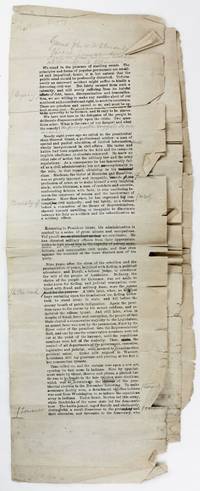
18775770N.p. likely Springfield Il: ca. January 8 1877. Good. Three long galley leaves each approximately 6.5 x 19 inches and printed on rectos only with numerous pencil emendations. Old folds and creases numerous chips and tears to margins pervasive wrinkling making reading a bit challenging at times but with no loss to text. Small portion of third leaf containing the last eight lines of text detached but present. Not in great shape but seemingly unique. A galley proof of a speech by General John A. McClernand in the midst of the contentious Election of 1876 which was so far as we can determine neither delivered nor published. A pencil note at top reveals his authorship and notes the speech was intended to be delivered January 8 at the “Great Citizens Convention†in Springfield Illinois almost certainly in 1877 following the recent election in the Fall of 1876. McClernand was an Illinois contemporary of Lincoln's a Democratic Congressman and War Democrat. He was also an ally of another Illinois politician and Lincoln adversary Stephen A. Douglas. He was appointed a general during the Civil War largely through political maneuvering and was generally considered incompetent. McClernand greatly resented the authority of Grant who finally relieved him of command in June 1863. Following the war McClernand became a leading critic of Congressional Reconstruction as well as the Grant Administration in general. He also chaired the 1876 Democratic National Convention which nominated Tilden for the presidency.<br /> <br /> Here McClernand bitterly attacks Grant his presidential Administration and Reconstruction. According to McClernand Grant's "tastes and habits had been acquired in the field and the camp -- in implicit obedience or absolute command. He knew no other rule of action but the military law and army regulations. As a consequence he has lamentably failed as a civil administrator." As President fraudulently and illegally Grant "joined with Kellog a political adventurer and Durell a federal judge to overthrow the will of the people of Louisiana." Law and order says McClernand "lay prostrate and panting at the feet of her remorseless tyrants." McClernand also assails Grant's highhanded tactics in the other Southern States.<br /> <br /> Now says McClernand "the president and his accomplices have now applied themselves to defeat the will of the people by a parliamentary device. They claimed for the President of the Senate the right and power to count the electoral votes and to declare the result and by implication that that right and power would be so exercised as to count Tilden out of his election and to count Hayes into one." He wasn't wrong. In one of the closest most hotly-contested and highly-controversial elections in American history to put it simply Hayes effectively stole the election by agreeing to remove northern soldiers from the South and end Reconstruction. It would be interesting to know what McClernand thought of the ultimate result -- he didn't get Tilden but he did get the end of Reconstruction.<br /> <br /> "Yet another prominent Illinoian who played a role in the Civil War John Alexander McClernand was born in Breckinridge County Kentucky before moving to Shawneetown Illinois at a young age. Similar to fellow Illinoian Abraham Lincoln McClernand was a largely self-taught lawyer who began practicing in Shawneetown in 1835. Also like Lincoln McClernand served in the Black Hawk War. However McClernand was a staunch Democrat. In 1835 he established the newspaper Shawneetown Democrat. He was active in Democratic politics at both the state and federal level serving in the Illinois House of Representatives and eventually Congress. In Congress McClernand was a stalwart Jacksonian Democrat who strongly disliked abolitionists. He strongly opposed the Wilmot Proviso which banned slavery in the territory gained after the Mexican-American War. He became a key ally of fellow Democrat and Illinoian Stephen A. Douglas helping him pass the Compromise of 1850. As tensions rose approaching the election of 1860 McClernand campaigned for Douglas’s presidency and became a Unionist. After war broke out in the following April McClernand helped raise volunteers for the Union Army. Because Lincoln needed to retain a wide base of support and retain connections with Democrats in Illinois he appointed McClernand a brigadier general on May 17 1861. McClernand’s military career would be defined by an ongoing clash with fellow Illinoian General Ulysses S. Grant. Grant a seasoned West Pointer who served in Mexico was irritated by McClernand a political general with little military experience. Further exacerbating relations was McClernand’s tendency to boast about his exploits and diminish the achievements of other commanders" - American Battlefield Trust's entry on John A. McClernand. ca. January 8 unknown
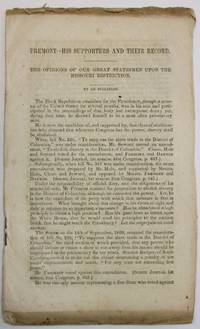
185618521Indianapolis 1856. 16pp disbound. Scattered foxing. Good. <br /> <br /> A Democratic presidential campaign pamphlet. It charges that during the brief time that Fremont "the Black Republican candidate for the Presidency" was a U.S. Senator his votes-- opposing the abolition of slavery in the District of Columbia-- showed him "to be a most ultra pro-slavery man." The hypocritical Republicans "use the language of patriotism and of love for the Union.whilst their votes their acts and their organization lead only to a dissolution and all the evils that must follow." The Know-Nothings are just as bad: they "have waged a cruel and relentless war upon foreigners and members of the Roman Catholic church. These classes have been proscribed." Moreover "Abolitionism and Know-nothingism were allies." <br /> FIRST EDITION. LCP 3837. 112 Eberstadt 150d. Not in Sabin Decker Miles. unknown
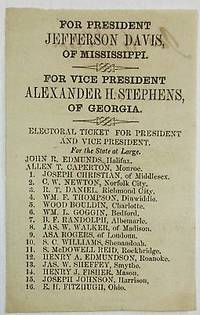
186133882Richmond 1861. Small broadside ticket 3" x 4-3/4". Very Good. <br /> <br /> A rare Virginia Confederate electoral ticket for the Confederacy's first and only national election: Jefferson Davis for President Alexander Stephens for Vice President. Also listed are two at-large electors and sixteen others by District. <br /> Variant of Parrish & Willingham 5367 5368; Crandall 2744 noting "four variant printings and sizes"; and Hummel 4667-4669. unknown
2000014249U.S. Government Printing Office 2000. Good condition Ex-Library Softcover Octavo 2000 1st edition 148 pages. Clear tape is reinforcing the edges of the wraps. Usual library disfigurements otherwise interior is unmarked and solid. NOT A REPRINT! THIS IS THE REAL DEAL!. First Edition. Trade Paperback. Good. 8vo - over 7" - 9" tall. Book. U.S. Government Printing Office Paperback
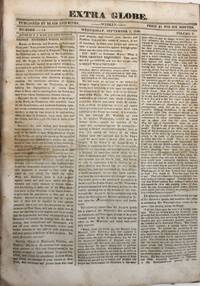
184034201Washington: Blair & Rives 1840. Folio 8 3/4" x 12". 416pp. Nos. 1-27 of Volume VI; May 16 1840 - October 26 1840 plus No. 27 the final issue recording detailed election results from January 1841. Boards detached endpapers filled with local political tickets. Scattered foxing light wear Good.<br /> <br /> A detailed contemporary report of the 1840 presidential campaign from the perspective of this Democratic publication. It begins with the Democrats' National Convention in Baltimore with the speeches proceedings and Address to the People. <br /> A campaign biography of Van Buren the Democrats' candidate and Blair & Rives's as well is included plus discussion of all the issues: slavery abolition internal improvements tariff banks. The Whigs are repeatedly referred to as the 'Federal' Party in order to drive home that the Whigs were descended from the discredited Hartford Convention Federalists. <br /> The Whig candidate William Henry Harrison is "still shrouded in mystery. Blair & Rives unknown
1861ZB579780Washington: 1861. 161 pp issued as 37th Congress 1st Session HMD 4; extraction roughness at spine else very good in self wrappers. - If you are reading this this item is actually physically in our stock and ready for shipment once ordered. We are not bookjackers. Buyer is responsible for any additional duties taxes or fees required by recipient's country. Photos available upon request. Washington: unknown
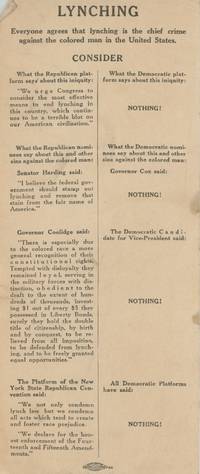
1920List2706Chicago or New York 1920. 6 x 9 inches single sided. Toning several small stains small fold at top left corner; near fine. An anonymous handbill decrying lynching in the United States and advertising the differences in anti-lynching policy between the Republican and Democratic parties. The header states that “Everyone agrees that lynching is the chief crime against the colored man in the United States†and the remainder illustrates the great disagreement over just what to do about it. The left column quotes the Republican platform and its then-nominees Warren G. Harding and Calvin Coolidge who would shortly be elected to office on their support for federal anti-lynching legislation. The right column points out that the Democratic platform and its nominees James M. Cox and Franklin D. Roosevelt all “said: NOTHING!†on this issue. Lynching would not be made a federal hate crime until 2022 nearly 100 years later. As of writing we find no other copies of this handbill in OCLC. unknown
185229127New York 1852. 16pp disbound with archivally reinforced inner margin. Good. <br /> <br /> This pamphlet records a Democratic Party rally during the 1852 presidential contest endorsing "with joyous hearts the names of Franklin Pierce and William R. King as the favored standard bearers of our political faith in the present campaign. In looking over the troubles and darkness which hung around our National Convention the name of Pierce was discovered like an oasis in our desert to cheer and gladden us all." <br /> A variant issue did not print the Kentucky and Virginia Resolutions and omitted that reference from the title. The Resolutions are printed here beginning at the bottom of page 12 and ending in the middle of page 15. Pages 15-16 print the list of Evening Post Documents for the 1852 campaign. <br /> Sabin 89203. OCLC 21984603 5as of July 2012. unknown
185225283New York 1852. 16pp untrimmed uncut and folded. Dusted lightly worn some spine splitting. Good.<br /> <br /> A Democratic Party rally during the 1852 presidential campaign endorsing "with joyous hearts the names of Franklin Pierce and William R. King as the favored standard bearers of our political faith in the present campaign. In looking over the troubles and darkness which hung around our National Convention the name of Pierce was discovered like an oasis in our desert to cheer and gladden us all." <br /> This is a variant printing. Our copy's title ends as noted above; the title of the other issue ends with 'Also Kentucky and Virginia Resolutions of 1798 and 1799.' Our issue does not print those Resolutions. Pages 15-16 print the list of Evening Post Documents for the 1852 campaign. <br /> OCLC 319715221 2as of 7/12. See Sabin 89203 and OCLC 21984603 5 for the other issue. unknown
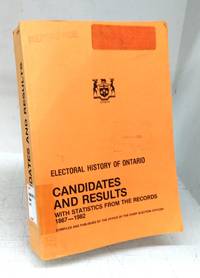
1983146381Toronto ca. 1983. Softcover. ex library-good. 36 668 p. 24 cm. Orange card covers. Ex library with labels outside ink stamps outside and on first leaf. <br/><br/> paperback
0656435836.Ghardcover. Good. Access codes and supplements are not guaranteed with used items. May be an ex-library book. hardcover
1333165617.Gpaperback. Good. Access codes and supplements are not guaranteed with used items. May be an ex-library book. paperback
a13150Municipal election broadside for Frederick W. Lincoln Jr. for Mayor of Boston and related candidates for municipal office Ward 6 1865. VG. . unknown
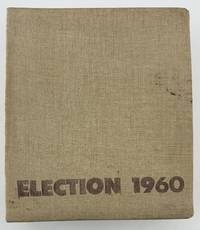
19604337Various locations in and around Chicago Il: likely early November 1960. Very good plus. Title leaf plus 25 leaves illustrated with forty-seven silver gelatin photographs pasted one per leaf or page all about 5.5 x 7.5 inches plus five loose images two duplicates and three other images not pasted in. Square quarto. Contemporary tan cloth custom photograph album metal-hinged spine front cover printed with title reading "ELECTION 1960." Minor wear and soiling to album. Light occasional thumb-soiling to album leaves ownership signature reading "G. Robert Hillman" on title leaf. Photographs in excellent condition. An utterly charming vernacular photograph album assembled during the seminal Presidential Election of 1960 one of the closest presidential elections in United States history which pitted Vice President Richard Nixon against the junior Senator from Massachusetts John F. Kennedy. The album features about fifty original photographs on the campaign trail in Illinois beginning with about a dozen-and-a-half images of Richard Nixon and his local supporters. The photographs capture various angles of Nixon during his stump speech a young boy waving an "I'm for Nixon" handmade sign another young boy with a Nixon button on his coat crowd scenes a large campaign sign for Nixon-Lodge outside a local store and more. One image featuring a mixed crowd of Nixon and Kennedy supporters transitions into the next section of photographs which concentrates on JFK's campaign. The first image in this section is a closeup of a "Kennedy for President" hat followed by four images of JFK's campaign manager Robert Kennedy making a speech three images of Eleanor Roosevelt stumping for Kennedy five images of Lyndon Johnson and his airplane numerous shots of Kennedy supporters and crowd shots outside Chicago Blackhawks stadium. The photographs then feature the inside of Chicago Auditorium where the first three images depict John F. Kennedy - the first shaking hands with Chicago's longtime Mayor Richard Daley and two during his speech likely his speech of November 4 1960 - just four days before Election Day. The final three images show supporters of both candidates.<br /> <br /> The 1960 United States Presidential Election was a watershed moment for the campaign politics of the country. Senator Kennedy won the election with a clear Electoral College margin of 303 to 219. However Vice President Nixon won three more states than Kennedy and lost the popular vote only by about 110000 votes out of more than 68 million votes cast. The election set the course for most of the remainder of the 1960s but left Nixon soured and suspicious that the election had been stolen from him - a feeling he never let go and one with ominous echoes today. As indicated in the present album the 1960 presidential election was passionate on both sides with each candidate drawing large enthusiastic crowds for their appearances.<br /> <br /> The signature on the title leaf of the present album likely identifies the compiler. G. Robert Hillman is a Senior Editor for Politico. Hillman was born in Peoria and grew up on a farm near Flanagan Illinois about a hundred miles from Chicago. He went to college at the University of Illinois at Urbana-Champaign and began his career at Chicago Today and the Chicago Sun-Times. Hillman would have been in middle school during the 1960 election campaign not too precocious for a young man obsessed with politics especially during one of the most heated and media-intensive campaigns of the 20th century. likely early November unknown