VINET, AAntiquariat.de
VICAIRE de PARISMareMagnum
Un mot sur la Constitution
A Paris, Moronval 1814. In-8 en feuillets de 13 pages.
1 369 résultats
19443308350Lausanne, Payot, 1944. LVI, 368 S. OKart. Etwas berieben.
19013312815Heidelberg, 1901. (Nachdruck, Darmstadt 1976). XII, 294 S. OLwd.
A Paris, Moronval 1814. In-8 en feuillets de 13 pages.
181431241Moronval A Paris, Moronval 1814. In-8 en feuillets de 13 pages.
1944013317Imprimé et distribué en France par des Patriotes Français, la quatrième année d'occupation et de terreur nazies. 1944 In-8 En feuilles, couverture.
197034056Paris Fayard 1970 deux volumes en cartonnage éditeur sans les jaquettes, 578 + 764 pp
19233131001München, 1923. 192 S. Interimskarton.
c3817Sans lieu, ni nom, 1869 ; grand in-8°, demi-chagrin rouge de l'éditeur, dos à nerfs, filet pointillé doré sur les nerfs, fleurons et perits fers dorés, plat de toile chagrinée grenat ; 2ff.,LVIpp., 532pp.; rares piqûres, reliure légèrement frottée aux coiffes avec perte des ors aux 2 caissons inférieurs et petites décolorations à la toime des plats; discret ex-dono manuscrit au 1er feuillet de garde.
1391956982.Ghardcover. Good. Access codes and supplements are not guaranteed with used items. May be an ex-library book. hardcover
1865462580Duisburg, Falk und Volmer, 1865. 266 S., 1 Bl., 2 Bl. Anzeigen. Halbleder d. Zeit (berieben). [2 Warenabbildungen]
28 pages. Features: Lovely full-page color ad for Rover fine cars inside front cover; Photo of King and Queen being greeted by Churchill and Mr. Attlee at the saluting-base; Two-page compilation of the "Heraldic" badges of British and Allied formations made famous in the late war; Many photos of famous war leaders and service chiefs celebrating victory; Aftermath of the War - Victory - Consequences and Disappointments - article by Cyril Falls; Nice full-page photo of the King and Queen in horse-drawn carriage amongst cheering crowds; Photos of Montgomery, Churchill, Lord Tedder, Sir Claude Auchinleck, Field Marshal Lord Alexander, Admiral Lord Louis Mountbatten, Marshal Lord Alanbrooke, Lord Portal, Marie-Pierre Loenig, Brig.-Gen. Hartt, Admiral Hewitt, and General McNarney in their parade vehicles; Wonderful photos of V-Day Marchers - the Royal Marines, Royal Navy and R.A.F.; Photos of Overseas Troops in Victory Parade - in the Mall and en route; Photos of overseas troops in Victory Parade - Canadians and Kiwis; Amazing centerfold photo of The King saluting Field Marshal Montgomery as his car passes the saluting station - also visible are Churchill, Mackenzie King, and many other notable personalities; More great photos of V-Day Marchers - Merchant Navy, Women's Forces and C.D. Services - of particular note is the full-page photo of the A.T.S. contingent in a "V" formation as the procession divides at the foot of Constitution Hill; Photos of Units of the Mechanised Column in the parade; Amazing full-page photo from the Admiralty Arch along the beflagged mall with the Indian contingent in the foreground and marching troops as far as you can see into the distance; Photos of troops from Greece, France, U.S.A., China, and Egypt in the parade; The History of Final Victory in Drawings by Bryan De Grineau - 15 images; Back cover photo ad for the New Lancaster 'Ten' car. Somewhat above-average wear. Chip from lower corner of front cover. Some peeling from front cover. A worthy reference copy. Book
336 p. 8vo. Original publisher's cloth binding. Original dust jacket, slightly chipped at extremities. Book of the month club edition. PA 8
336pp. , ports. 22 cm. Hardcover Very good condition
1878462429Leiden, 1878. 172 S. Hlwd der Zeit (Stempel auf Titel, Bibliotheks-Rückenschild).
2860Paris, Correa, 1956. In-8, br, 364p. Non coupé, bon état.
19281169081928 A Paris, G. Douin & Cie - Communications faites à la "Société d'Homoeothérapie de France" - 1928 - In-8, broché - 92 p. - Quelques reproductions photographiques in texte en N&B
18934(S. l., 1797.) broche,sans couvertures,16 p.dernier feuillet un peu derelie,complet,mention IVe edition
19813360579Zürich, Schulthess, 1981. IX, 68 S. OKart.
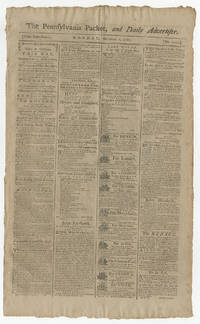
178724135<p><b>U.S. CONSTITUTION.</b>Newspaper. <i>The Pennsylvania Packet and Daily Advertiser</i>. October 1 1787 No. 2700 Philadelphia: John Dunlap and David C. Claypoole including the September 28 resolution of the Confederation Congress to send to the states for ratification the recently completed U. S. Constitution. 4 pp. 12 x 18¾ in. </p><br />"<i>The United States in Congress Assembled. Friday September 28 1787.</i><p><i>CONGRESS having received the Report of the CONVENTION lately assembled in Philadelphia</i></p><p><i>Resolved unanimously THAT the said report with the resolutions and letter accompanying the same be transmitted to the several legislatures in order to be submitted to a convention of delegates chose in each state by the people thereof in conformity to the resolves of the convention made and provided in that case. CHARLES THOMSON Secretary.</i>" p2/c3</p><p>The convention called to revise the Articles of Confederation met in the Pennsylvania's State House in Philadelphia starting on May 25 1787. After many delegates agreed that the Articles could not be sufficiently improved they started to draft an entirely new structure. Maintaining their pledge of secrecy after months of private deliberations over trade defense taxation representation separation of powers the election of a president the slave trade international relations and many other issues the proposed United States Constitution was signed by thirty-nine of the fifty-five delegates on September 17.</p><p>Two days later the Constitution was first published by the <i>Pennsylvania Packet</i>and four other Philadelphia newspapers. The cover letter sent by George Washington president of what came to be called the Constitutional Convention submitting the plan to Arthur St. Clair the President of the Congress of the Confederation in New York was also printed then.</p><p>Congress received and read the proposed Constitution on September 20th. As a sampling of their deliberations William Grayson of Virginia thought it was too weak while Richard Henry Lee of Virginia and Nathan Dane of Massachusetts thought it was too strong.</p><p>On September 27 Virginia's Richard Henry Lee proposed that the Constitution be sent to the executives of each of the states. A Delaware representative quickly added "in order to be by them submitted to conventions of delegates to be chosen agreeably to the said resolutions of the convention." Ten of the twelve states then represented in Congress voted in favor. Before Congress adjourned for the day the majority of Virginia's representatives and a minority of New York's representatives also indicated their support. On September 28 Federalists holding out for a unanimous vote found a way to compromise with anti-Federalists: Congress unanimously resolved to send the Constitution to the states but without any recommendation or approval.</p><p>Arider from New York City arrived in Philadelphia with the resolution that same day.</p><p>George Clymer presented his own resolution to the Pennsylvania Assembly noting that "<i>the late Federal Convention has digested a plan of government for the United States and recommended that it should be referred to the consideration of State Conventions…</i>" After a "<i>very long and animated debate</i>" Clymer's resolution passed by a vote of 43 to 19 and adjourned until 4:00 p.m. But only 44 members returned falling two shy of the necessary quorum. The Assembly's sergeant-at-arms was sent to show the resolution to absent members. Two who still refused to attend were seized by the public dragged through the streets and thrust into the assembly room. The involuntarily completed quorum voted that "<i>it is the sense of great numbers of the grand people of this state already signified in petitions & declarations to this house that the earliest steps should be taken to assemble a convention within the state for the purpose of deliberating and determining on the said constitution.</i>" They called for the election of deputies who would assemble for that purpose "<i>on the third Tuesday of November at the State-house in the city of Philadelphia…</i>" p2/c3-4</p><p>Other articles of interest in this issue include news from Europe and a brief piece against Indians "<i>from the western country</i> who <i>still continue their depredations on the whites…</i>" p2/c3</p><p><b><i>The Pennsylvania Packet or the General Advertiser</i></b>1771-1839 was founded by John Dunlap in late 1771 as a weekly newspaper in Philadelphia though it relocated to Lancaster during the British occupation of Philadelphia in 1777-1778. On May 30 1783 Benjamin Towne turned the <i>Pennsylvania Evening Post</i> into the first daily newspaper in the United States. However with Towne branded a traitor and forced to hawk his own papers on the street the newspaper collapsed the following year. John Dunlap and David Claypoole then made their <i>Pennsylvania Packet</i> the first successful daily on September 21 1784. It underwent numerous name changes in the 1790s until sold in 1800 and renamed <i>Poulson's American Daily Advertiser</i>.</p> John Dunlap and David C. Claypoole books
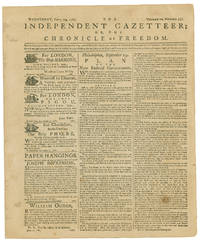
178721085.99<p>"<i>We the People of the United States…</i>"</p><p>This rare complete printing of the Constitution appeared on the first day it was publicly available Wednesday September 19 1787. That same morning the Constitution was published by four other papers the <i>Pennsylvania Packet and Daily Advertiser</i> <i>Pennsylvania Journal Pennsylvania Gazette</i> and <i>Freeman's Journal.</i> The <i>Independent Gazetteer</i>is unique in that it is the only one of the five first-day printings whose type was evidently not used to print another stand-alone edition.</p> <b>U.S. CONSTITUTION.</b>Newspaper. <i>The Independent Gazetteer or the Chronicle of Freedom</i>. Philadelphia: Eleazer Oswald September 19 1787. 4 pp.<p><b><br /></b></p><p><b>Historical Background</b></p><p>This issue of <i>The Independent Gazetteer and Chronicle of Freedom</i> a daily Anti-Federalist newspaper prints the "<i>Plan of the New Federal Government</i>" in full followed by the Federal Convention's resolution submitting the Constitution to Congress and the accompanying transmittal letter. All three are signed in type by George Washington as president of the Convention.</p><p>The Constitution was approved by the Convention on Monday September 17. The text of the official version was set that evening and a very limited number were printed for the use of the delegates. After being drafted in complete secrecy the Constitution was first made public on the morning of Tuesday September 18 when it was read before the Pennsylvania General Assembly. The next morning Wednesday September 19 the five newspapers mentioned above all published the Constitution. It is often assumed that the <i>Pennsylvania Packet</i> was the first public printing as the publishers Dunlap and Claypoole were the official printers to the Constitutional Convention. In fact there is no evidence that the <i>Packet</i> actually was published first or appeared on the streets of Philadelphia that day any earlier than its four rivals. All five are considered first editions with surviving copies of the <i>Packet</i> the most common.</p><p>The dissemination of the Constitution in newspapers is of considerable interest and importance as it was through this medium that most Americans became familiar with the new form of government proposed by the Convention. One careful researcher Leonard Rapport of the National Archives has identified four Philadelphia newspapers which also carried the text of the Constitution on the same day this was after all news of the highest importance and one the Philadelphia <i>Evening Chronicle</i> which may <i>hypothetically</i> have carried the text in an issue dated 18 September "Printing the Constitution" pp. 69-90. But to date no copy of the <i>Evening Chronicle</i> of that date is known to be extant see Rapport's other article "Newspaper Printings of the Constitution".</p><p>The <i>Pennsylvania Packet</i> printing has been accorded primacy for two principal reasons. First the <i>Packet</i>was printed by John Dunlap and David C. Claypoole official printers to the Convention itself. Together as partners or separately Claypoole may originally have been a junior partner they had printed nearly everything issued by Congress since 1775 including the 1776 Declaration of Independence. Second with the exception of the Constitution's six-line preamble "We the people…" the text is <i>entirely printed from the same setting of type used for the official Congressional printing.</i>As Rapport notes the 5000 words of the Constitution represented "nearly one man-day of composition time" for the printer so sensibly to make use of the wider margins of the <i>Packet's</i> larger sheets they reset the preamble in large type with a large capital "W" below the masthead and simply reimposed the rest of their standing type to fit onto the paper's four larger-size pages. The case might be summed up by emphasizing that the present <i>Pennsylvania Packet</i> text of the Constitution was struck from the identical setting of lead type that had printed the sheets of the official Congressional printings sheets that Jacob Shallus calligrapher used when he copied onto parchment the engrossed document to which the delegates signed their names.</p><p>"By October 6 only twenty days after the Federal Convention at least fifty-five of the approximately eighty newspapers of the period had printed the.Constitution." Rapport "Printing the Constitution" p.89. With the text of the Constitution before the people thanks to a free press the great debate on its ratification would begin a debate which continued until ratification by the original thirteen states was completed in 1790 and culminated in 1791 by the adoption of the Bill of Rights. Despite the tremendous changes since 1787 in the nation and the people governed by the Constitution Bernstein meaningfully notes "the evolution of American politics and society continues to be shaped by the Constitution and by the principles and doctrines built into it by the men who drafted it. That the Constitution has worked as well as it has is a tribute to its flexibility and to the foresight of those who created it. That it may still be defective or capable of improvement is a challenge to us to equal the courage imagination and versatility of the Revolutionary generation of Americans" <i>Are We To Be A Nation</i> p.272.</p> Eleazer Oswald books
1953020402Washington: Government Printing Office 1953. xxxiv 1361p. original blue cloth large quarto format. U.S. Congres. 82d 2d Session. Senate document 170. Government Printing Office unknown books
1953020402Washington: Government Printing Office 1953. xxxiv 1361p. original blue cloth large quarto format. U.S. Congres. 82d 2d Session. Senate document 170. Government Printing Office unknown
DG-34-0239949Very Good. unknown
17892601011London: Annual Register 1789. early. hardcover. good. One of the earliest British printings of the US Constitution. Printed for J. Dodsley in Pall-Mall London 1789. Book good wear to covers gutters cracked front free end paper has two tears former owner's name stamp to 2nd front free end paper. Annual Register unknown
193534966Montevideo Imprenta Nacional 1935. Paperback. Good. lii 235p. wrps tall 4to wrps chipped; back wrps and errata leaves marginally chipped and detached. Includes provisional constitution. Montevideo, Imprenta Nacional paperback