50 résultats
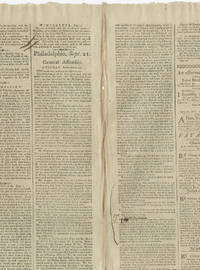
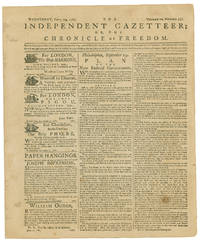
178721085.99<p>"<i>We the People of the United States…</i>"</p><p>This rare complete printing of the Constitution appeared on the first day it was publicly available Wednesday September 19 1787. That same morning the Constitution was published by four other papers the <i>Pennsylvania Packet and Daily Advertiser</i> <i>Pennsylvania Journal Pennsylvania Gazette</i> and <i>Freeman's Journal.</i> The <i>Independent Gazetteer</i>is unique in that it is the only one of the five first-day printings whose type was evidently not used to print another stand-alone edition.</p> <b>U.S. CONSTITUTION.</b>Newspaper. <i>The Independent Gazetteer or the Chronicle of Freedom</i>. Philadelphia: Eleazer Oswald September 19 1787. 4 pp.<p><b><br /></b></p><p><b>Historical Background</b></p><p>This issue of <i>The Independent Gazetteer and Chronicle of Freedom</i> a daily Anti-Federalist newspaper prints the "<i>Plan of the New Federal Government</i>" in full followed by the Federal Convention's resolution submitting the Constitution to Congress and the accompanying transmittal letter. All three are signed in type by George Washington as president of the Convention.</p><p>The Constitution was approved by the Convention on Monday September 17. The text of the official version was set that evening and a very limited number were printed for the use of the delegates. After being drafted in complete secrecy the Constitution was first made public on the morning of Tuesday September 18 when it was read before the Pennsylvania General Assembly. The next morning Wednesday September 19 the five newspapers mentioned above all published the Constitution. It is often assumed that the <i>Pennsylvania Packet</i> was the first public printing as the publishers Dunlap and Claypoole were the official printers to the Constitutional Convention. In fact there is no evidence that the <i>Packet</i> actually was published first or appeared on the streets of Philadelphia that day any earlier than its four rivals. All five are considered first editions with surviving copies of the <i>Packet</i> the most common.</p><p>The dissemination of the Constitution in newspapers is of considerable interest and importance as it was through this medium that most Americans became familiar with the new form of government proposed by the Convention. One careful researcher Leonard Rapport of the National Archives has identified four Philadelphia newspapers which also carried the text of the Constitution on the same day this was after all news of the highest importance and one the Philadelphia <i>Evening Chronicle</i> which may <i>hypothetically</i> have carried the text in an issue dated 18 September "Printing the Constitution" pp. 69-90. But to date no copy of the <i>Evening Chronicle</i> of that date is known to be extant see Rapport's other article "Newspaper Printings of the Constitution".</p><p>The <i>Pennsylvania Packet</i> printing has been accorded primacy for two principal reasons. First the <i>Packet</i>was printed by John Dunlap and David C. Claypoole official printers to the Convention itself. Together as partners or separately Claypoole may originally have been a junior partner they had printed nearly everything issued by Congress since 1775 including the 1776 Declaration of Independence. Second with the exception of the Constitution's six-line preamble "We the people…" the text is <i>entirely printed from the same setting of type used for the official Congressional printing.</i>As Rapport notes the 5000 words of the Constitution represented "nearly one man-day of composition time" for the printer so sensibly to make use of the wider margins of the <i>Packet's</i> larger sheets they reset the preamble in large type with a large capital "W" below the masthead and simply reimposed the rest of their standing type to fit onto the paper's four larger-size pages. The case might be summed up by emphasizing that the present <i>Pennsylvania Packet</i> text of the Constitution was struck from the identical setting of lead type that had printed the sheets of the official Congressional printings sheets that Jacob Shallus calligrapher used when he copied onto parchment the engrossed document to which the delegates signed their names.</p><p>"By October 6 only twenty days after the Federal Convention at least fifty-five of the approximately eighty newspapers of the period had printed the.Constitution." Rapport "Printing the Constitution" p.89. With the text of the Constitution before the people thanks to a free press the great debate on its ratification would begin a debate which continued until ratification by the original thirteen states was completed in 1790 and culminated in 1791 by the adoption of the Bill of Rights. Despite the tremendous changes since 1787 in the nation and the people governed by the Constitution Bernstein meaningfully notes "the evolution of American politics and society continues to be shaped by the Constitution and by the principles and doctrines built into it by the men who drafted it. That the Constitution has worked as well as it has is a tribute to its flexibility and to the foresight of those who created it. That it may still be defective or capable of improvement is a challenge to us to equal the courage imagination and versatility of the Revolutionary generation of Americans" <i>Are We To Be A Nation</i> p.272.</p> Eleazer Oswald books
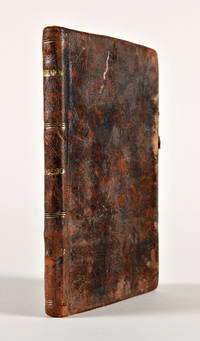
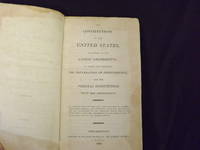
179939795Knoxville 1799. 7 works bound together octavo. 7 3/8 x 4 5/8 inches. First work lacks titlepage contemporary ownership inscription on first leaf present. Light foxing A few leaves trimmed closely at bottom edge affecting text. Contemporary calf spine gilt with red morocco label skillful repair to joints and corners. Housed within a black modern full morocco box.<br/> <br/>Provenance: J. Hamilton two signatures<br/> <br/>Possibly the greatest single volume of early Tennessee material with the second known complete copy of the First Tennessee Constitution in fine original condition.<br/> <br/>Seven works from the earliest pioneer press of Tennessee including the first printing of the National Constitution printed in the state as well as the first State Constitution here in the second known complete copy. Such imprints have not appeared on the market since World War II. In February 1790 North Carolina ceded its western land holdings to the United States. A few months later the area became the newly created Territory of the United States South of the River Ohio. William Blount was appointed territorial governor by President Washington and in 1795 he called a meeting of the territorial legislature to request a referendum for statehood. Thus the state of Tennessee was born on June 1 1796. George Roulstone the first printer in Tennessee began a newspaper in Knoxville in late 1791. The earliest Tennessee imprint noted by McMurtrie is a set of acts passed by the territorial government printed after March 25th 1793. Since then two earlier items have come to light; a broadside owned by Thomas W. Streeter dated Jan. 28 1793 and a broadside dated March 13 1793. The earliest dateable book present here was issued in 1794. The Tennessee State Constitution here in the first of three editions; it was to be revisited in 1835 and 1869 was created by Congress at the time Tennessee was admitted as a state and became effective on June 1 1796 when Tennessee entered the Union. It was not universally well received although Thomas Jefferson described it as the "least imperfect and most republican of the state constitutions." The first leaf and one title have the early ownership inscription of J. Hamilton possibly James Hamilton Jr. congressman and governor of South Carolina who read law in Charleston and was admitted to the bar in 1810. The individual titles are as follows: 1 Acts Passed at the First Session of the General Assembly of the Territory of the United States of America South of the River Ohio. Began and Held at Knoxville on Monday the Twenty Fifth day of August MDCCXCIV. Knoxville: George Roulstone 1794. 3-101pp. Lacks titlepage and preliminary viii pp. containing "Acts and ordinances of the governor and judges.as issued by William Blount." Evans accords this item its own number however so it is possible that it wasn't issued as a part of this copy. Copies noted by ESTC and Allen at Harvard Law the Huntington Library of Congress State Library of Tennessee and University of Tennessee. Allen 7; ESTC W9956; Evans 27724; McMurtrie 5. 2 Acts Passed at the Second Session of the First General Assembly of the Territory of the United States of America South of the River Ohio. Begun and Held at Knoxville on Monday the Twenty Ninth day of June 1795. Knoxville: George Roulstone 1795. 31pp. Copies noted by ESTC and Allen at Harvard Law the Huntington Library of Congress and University of Tennessee. Allen 15; ESTC W5409; Evans 29551; McMurtrie 8. 3 The Constitution of the United States of America. to which is Prefixed the Constitution of the State of Tennessee. Knoxville: Roulstone & Parrington 1799. 30pp. Copies noted by ESTC and Allen at State Library of Tennessee and University of Tennessee lacking titlepage.Allen 45; ESTC W30527; Evans 36404; McMurtrie 30. 4 Acts Passed at the Second Session of the Second General Assembly of the State of Tennessee. Knoxville: Roulstone & Parrington 1798. 70pp. The Table of Contents comprising the last ten pages and present here not present in two of the four recorded copies which may have been issued without it. Copies noted by ESTC and Allen at Library of Congress Harvard Law New York Public Library State Library of Tennessee and University of Tennessee. Allen 38; ESTC W23338; Evans 36403; McMurtrie 27. 5 Acts Passed at the First General Assembly of the State of Tennessee. Knoxville: George Roulstone 1796. 78pp. Copies noted by ESTC and Allen at Library of Congress Knoxville Public Library and University of Tennessee. Allen 21; ESTC W23331; Evans 31277; McMurtrie 21 6 Acts Passed at the Second Session of the First General Assembly of the State of Tennessee. Knoxville: George Roulstone 1796. 13pp. Copies noted by ESTC and Allen at Harvard Law University of Tennessee and Centre College of Kentucky. Allen 22; Bristol B9722; ESTC W23332; McMurtrie 22; Shipton & Mooney 47935. 7 Acts Passed at the First Session of the Second General Assembly of the State of Tennessee. Knoxville: George Roulstone 1797. 120pp. Copies noted by ESTC and Allen at American Antiquarian Society Library of Congress Harvard Law Knoxville Public Library and State Library of Tennessee. Allen 33; ESTC W9891; Evans 32913; McMurtrie 24. These works are essentially unprocurable and this volume provides a rare opportunity to acquire seven significant imprints from the first press in Tennessee. All are of the utmost rarity in any condition.<br/> <br/>Check List of Tennessee Imprints 5 8 30 27 21 22 24. unknown books
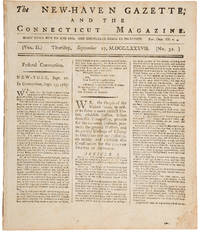
178726098<p>"<i>WE the People of the United States in order to form a more perfect union establish justice insure domestic tranquility provide for the common Defence promote the general welfare and secure the blessings of liberty to ourselves and our posterity do ordain and establish this constitution of the United States of America</i>."</p> <b>CONSTITUTION.</b>Newspaper. <i>The New-Haven Gazette and The Connecticut Magazine</i>. September 27 1787. M.DCC.LXXXVII No 32. Printed and Published by Josiah Meigs. Signed in type by George Washington and the other 38 delegates who signed the Constitution. 8 pp. Quarto 8.625 x 10.125 inches. 249-256 though what should be page 255 is mis-numbered 247 as is the case with the other copies we have seen of this edition. Accompanied by title and index leaves printed slightly later for binding after end of year.<br /><p><b>Historical Background</b></p><p>Having just been approved by the Constitutional Convention on September 17th the complete text of the Constitution was published in the <i>New-Haven Gazette</i>just ten days later along with the transmitting documents conveying the Convention's request that it be laid before Congress and afterwards submitted to "<i>a convention of Delegates chosen in each state by the People thereof.</i>" Resolved that if nine States ratify electors should be chosen for a presidential election and that the machinery of the new government be set in place.</p><p>The Articles of Association Congress in New York debated for two days and a day after this printing officially sent the Constitution to the states for ratification. State ratification conventions would soon pit Federalist against Anti-Federalist in impassioned debates over the implications of the Constitution and its extension of national government power and influence.</p><p>This is the earliest available Connecticut printing of the Constitution. The Connecticut Journal printed it one day earlier but we can find no copies in market sales records of the last 30 years.</p><p>The text of the Constitution is preceded here by George Washington's letter to Congress and followed by the Resolution for ratification. Evans 20563; Lomazow 18b.</p><p><b>Condition</b></p><p>Gathering of four leaves paginated 249-252 and two loose leaves. Mild yellowing with a hint of discoloration and spot or two of foxing; soft crease each vertically and horizontally bisecting all leaves; small handful of faint dampstains at margins of first and final leaf; barely perceptible inked signature at lower corner of recto of first leaf; hint of residue discoloration along center fold where newspaper was removed from bound volume.</p><p>Title and index leaves softly browned and a bit brittle with edges roughened where removed from bound volume; both bisected by soft horizontal crease; faint staining to leaves particularly recto of title; some mild chipping to edges of title-leaf particularly fore-edge with fold starting to split at either end about two inches in from either direction; previous owner inking at recto of both leaves; corners of index leaf creased.</p><p>Newspaper in fine condition remarkably clean and bright with very good title and index leaves. Housed in custom red leather case cover stamped in gilt.</p> books
WRCAM55421Mexico: Imprenta a cargo de Martin Rivera 1823. 466pp. Small octavo. Contemporary mottled Mexican sheep spine gilt. Minor edge wear light scuffing to boards short wormtrack on front board. Small ownership mark reading "JNB" branded on front and rear pastedowns ink ownership signature of "De Francisco Gonzalez de Cossio" on front flyleaf. Internally clean. Very good. This is the first Mexican printing of the United States Constitution accompanied by two important addresses by George Washington. This work was produced in anticipation of Mexican independence from Spain and the U.S. Constitution in particular provided inspiration to the drafters of the constitution of newly-independent Mexico. Written in 1824 it was the first constitution of Mexico as a sovereign state and the constitution under which the colonization of Texas by Americans would take place. It is ample evidence of the transnational influence on the United States Constitution on emerging democracies in this case America's neighbor to the south. <br> <br> All seven articles of the United States Constitution are printed in full in Spanish in a section that is headed by a Federal garland ornament. The names of all the signers are given at the conclusion of the main text. This is followed by a section printing the first twelve amendments entitled here as "Correcciones" an interesting interpretation of the role of constitutional amendments. The final page contains the text of an amendment passed by the House and Senate and signed in print by Senate President pro tem John Gaillard and House Speaker J.B. Varnum prohibiting any American citizen from accepting a title of nobility or honor from a foreign government under threat of losing ones American citizenship and holding any further elective office. This "Titles of Nobility" amendment was passed by Congress in 1810 and came close to ratification by two-thirds of the states in the 1810s but has to this day never been ratified. The inclusion of this amendment is an interesting commentary on the priorities and concerns of Mexican lawmakers. <br> <br> The U.S. Constitution is preceded by two chapters printing addresses by George Washington whose actions following the American Revolution and his two terms as President were influential well beyond the borders of the United States. The first chapter prints Washington's 1796 Farewell Address to the United States "Discurso de Despedida de Washington al Pueblo de los Estados-Unidos". Designed by Washington and his principal advisors in drafting it - James Madison and Alexander Hamilton - as both a valedictory and advice to succeeding generations the address served as a guidepost to Americans from the point of its publication. The Farewell Address would have been of particular interest to the Mexican Constitutional framers. <br> <br> The second section prints Washington's Address to the Continental Army in 1783 "Carta Circular del General Washington a los Gobernadores de los Estados fecha en el Cuartel General de Newburgh 18 de Junio de 1783". In this circular letter General Washington announces his intention to resign his command of the Continental Army and retire into private life. He also expounds in detail on the serious issues facing the nascent United States government. Both of Washington's addresses are printed fully in Spanish as is the constitution. <br> <br> OCLC records just eight actual copies over three records. This is the first copy that we can find in the market in over a century and the first copy we have handled of this first Mexican printing of the United States Constitution. OCLC 24072481 503926127 1097838706. SABIN 16060. PALAU 59641 374086. Imprenta a cargo de Martin Rivera hardcover books
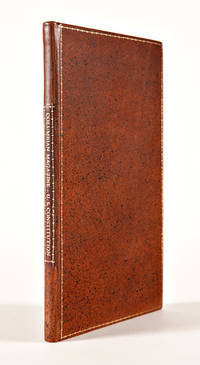
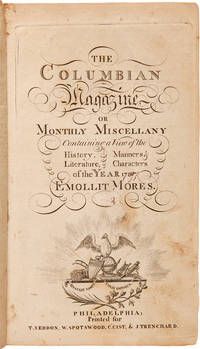
1787WRCAM55477Philadelphia: Printed for Seddon Spotswood Cist and Trenchard 1787. pp.615-674 plus two plates one folding and a folding table of Meteorological Observations. Antique-style calf gilt ornamental border on boards gilt leather label. Moderate foxing and toning. Extensive annotations in light pencil. Very good overall. The first periodical printing of the United States Constitution probably issued within a week of its release as a broadside. The Constitutional Convention ratified its final draft on Monday Sept. 17 1787. The following day Sept. 18 the broadside version issued for members of the Convention was printed by Dunlap and Claypoole the official printers. On Sept. 19 the same printers issued the first public printing of the Constitution in their newspaper THE PENNSYLVANIA PACKET. The present magazine was probably printed late in the week and the final signature containing the Constitution and recent news was probably printed on Saturday Sept. 22. This is the last internal date on the last page and actually refers to an event that took place on the 17th as "Monday last." From a survey of Mott's HISTORY OF AMERICAN MAGAZINES in the period it seems that it was common practice to issue monthly publications by the last week of every month. This issue would seem to have been out and in general circulation by Monday the 24th one week after the end of the Convention. Its version of the Constitution was executed most likely on the 22nd four days after the official broadside and three days after the first public newspaper appearance. This issue also contains the text of John Quincy Adams's Harvard commencement address he finished second in a class of fifty-one which was given in Cambridge on July 18 1787. It is his first published writing. <br> <br> THE COLUMBIAN MAGAZINE was a distinguished publication of the period. Mott calls it one of the best 18th-century American magazines. It began in September 1786 and was well established with Mathew Carey's AMERICAN MUSEUM as one of the two major periodicals then being issued in Philadelphia or for that matter the country at the time. Since the magazine probably had wider circulation than the newspapers issued in Philadelphia it is likely that this printing was one of the chief means of disseminating the Constitution immediately after its first publication. <br> <br> An exceptionally early and important printing of the Constitution. MOTT HISTORY OF AMERICAN MAGAZINES I pp.94-9. EVANS 20280. Wilbur T. Roberts "They Printed the Declaration and the Constitution" in THE MENTOR July 1928 pp.52-54. Leonard A. Rapport "Printing the Constitution" in PROLOGUE: THE JOURNAL OF THE NATIONAL ARCHIVES Fall 1970 pp.69-89. Printed for Seddon, Spotswood, Cist, and Trenchard hardcover books
1787WRCAM55477APhiladelphia: Printed for Seddon Spotswood Cist and Trenchard 1787. 2615-674pp. plus one plate of two. Lacks folding table. Engraved and letterpress titlepages. Later blue wrappers with facsimile of printed volume titlepage mounted on front wrapper. Moderate soiling to wrappers. Minor toning and foxing to text closed marginal repair to one leaf. About very good. The first periodical printing of the United States Constitution probably issued within a week of its release as a broadside. The Constitutional Convention ratified its final draft on Monday Sept. 17 1787. The following day the broadside version issued for members of the Convention was printed by Dunlap and Claypoole the official printers. On September 19 the same printers issued the first public printing of the Constitution in their newspaper THE PENNSYLVANIA PACKET. The present magazine was probably printed late in the week and the final signature containing the Constitution and recent news was probably printed on Saturday September 22. This is the latest internal date on the last page and actually refers to an event that took place on the 17th as "Monday last." From a survey of Mott's HISTORY OF AMERICAN MAGAZINES in the period it seems that it was common practice to issue monthly publications by the last week of every month. This issue would seem to have been out and in general circulation by Monday the 24th one week after the end of the Convention. Its version of the Constitution was executed most likely on the 22nd four days after the official broadside and three days after the first public newspaper appearance. This issue also contains the text of John Quincy Adams's Harvard commencement address he finished second in a class of fifty-one which was given in Cambridge on July 18 1787. It is his first published writing. This copy contains one of the two plates published in this issue lacking the folding plate of the Natural Bridge in Virginia and the folding table of meteorological observations. <br> <br> THE COLUMBIAN MAGAZINE was a distinguished publication of the period. Mott calls it one of the best 18th-century American magazines. It began in September 1786 and was well established with Mathew Carey's AMERICAN MUSEUM as one of the two major periodicals then being issued in Philadelphia or for that matter the country at the time. Since the magazine probably had wider circulation than the newspapers issued in Philadelphia it is likely that this printing was one of the chief means of disseminating the Constitution immediately after its first publication. <br> <br> An exceptionally early and important printing of the Constitution. MOTT HISTORY OF AMERICAN MAGAZINES I pp.94-9. EVANS 20280. Wilbur T. Roberts "They Printed the Declaration and the Constitution" in THE MENTOR July 1928 pp.52-54. Leonard A. Rapport "Printing the Constitution" in PROLOGUE: THE JOURNAL OF THE NATIONAL ARCHIVES Fall 1970 pp.69-89. Printed for Seddon, Spotswood, Cist, and Trenchard unknown books
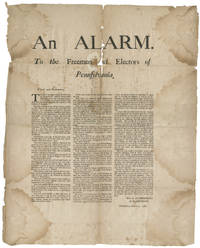
178422886Philadelphia Pa. 1784. No binding. Good. Broadside. An Alarm. To the Freemen and Electors of Pennsylvania. Philadelphia Pa. October 1 1784. 1 p. 16 1/2 x 21 in. Excerpt:Please note that the traditional ""long-style s"" has been standardized.""Friends and countrymen The day is now approaching on which you are to determine whether Pennsylvania shall enjoy a free and just government or be ruled by the arbitrary wills of a few men who have lately composed the majority of the Council of Censors. I shall say nothing to you of their having refused to call a Convention to alter and amend the Constitution. It is well known that most of them disapprove of it; but they have sacrificed their judge-ments to their party resentments. Nor shall I dwell long upon the vast sum of money they have cost the state. Their wages and contingent expences amount to nearly TEN THOUSAND POUNDS. The whole expences of the government for the current year will not fall short of FIFTY THOUSAND POUNDS. One half of this sum might be saved by a few alterations in the Constitution: The remaining half in a few years would open roads to every part of the state and remove the principal obstructions in the navigation of the Schuylkill and Susquehannah. I shall briefly point out in the first place what the late majority of the Censors have done and secondly what they have not done.""Docketed on verso in unknown hand: ""Alarm by the Minority of Anson. October 1 1784.""Historical BackgroundPennsylvania's 1776 Constitution contained an unusual feature: it required a 24-member Council of Censors to be chosen every seven years and tasked with revising the state Constitution. This broadside harangues the current censors who ""refused to call a convention to alter and amend the Constitution"" while showing favoritism and fiscal irresponsibility. ""One of Minority of the Censors"" further chastises his brethren as ""the enemies of liberty and the violators of their own Constitution"" and urges the citizens of Pennsylvania to resist.Among the grievances were ""those settlers at Wioming who have encroached upon your territory and who claim one half the state after the Court of Congress at Trenton had declared their encroachments to be illegal"" and who had ""insulted the dignity of the legislature"" as well as ""refusing to recommend the repeal of the law which robbed the Trustees of the College of Philadelphia of their charter"" and ""refused to recommend the a revision of the test law which is not only contrary to the letter and spirit of the constitution but impolitic unjust inhuman and dangerous to the freedom of every individual in the state.""The Assembly finally called a constitutional convention in 1789 and revised in the Constitution in 1790. The new Constitution created a bicameral legislature elected by a general election of citizens a governor elected for a three-year term a judiciary appointed by the governor and removable through impeachment and protection of rights.Evans 18321; Hildeburn 4418.Condition Unrestored: light dampstaining in margins central vertical tear edges chipped in several places.Sources""Pennsylvania Bar Association Constitutional Review Committee""http://www.pabarcrc.org/history.asp books
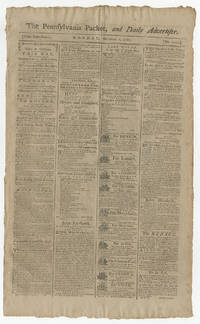
178724135<p><b>U.S. CONSTITUTION.</b>Newspaper. <i>The Pennsylvania Packet and Daily Advertiser</i>. October 1 1787 No. 2700 Philadelphia: John Dunlap and David C. Claypoole including the September 28 resolution of the Confederation Congress to send to the states for ratification the recently completed U. S. Constitution. 4 pp. 12 x 18¾ in. </p><br />"<i>The United States in Congress Assembled. Friday September 28 1787.</i><p><i>CONGRESS having received the Report of the CONVENTION lately assembled in Philadelphia</i></p><p><i>Resolved unanimously THAT the said report with the resolutions and letter accompanying the same be transmitted to the several legislatures in order to be submitted to a convention of delegates chose in each state by the people thereof in conformity to the resolves of the convention made and provided in that case. CHARLES THOMSON Secretary.</i>" p2/c3</p><p>The convention called to revise the Articles of Confederation met in the Pennsylvania's State House in Philadelphia starting on May 25 1787. After many delegates agreed that the Articles could not be sufficiently improved they started to draft an entirely new structure. Maintaining their pledge of secrecy after months of private deliberations over trade defense taxation representation separation of powers the election of a president the slave trade international relations and many other issues the proposed United States Constitution was signed by thirty-nine of the fifty-five delegates on September 17.</p><p>Two days later the Constitution was first published by the <i>Pennsylvania Packet</i>and four other Philadelphia newspapers. The cover letter sent by George Washington president of what came to be called the Constitutional Convention submitting the plan to Arthur St. Clair the President of the Congress of the Confederation in New York was also printed then.</p><p>Congress received and read the proposed Constitution on September 20th. As a sampling of their deliberations William Grayson of Virginia thought it was too weak while Richard Henry Lee of Virginia and Nathan Dane of Massachusetts thought it was too strong.</p><p>On September 27 Virginia's Richard Henry Lee proposed that the Constitution be sent to the executives of each of the states. A Delaware representative quickly added "in order to be by them submitted to conventions of delegates to be chosen agreeably to the said resolutions of the convention." Ten of the twelve states then represented in Congress voted in favor. Before Congress adjourned for the day the majority of Virginia's representatives and a minority of New York's representatives also indicated their support. On September 28 Federalists holding out for a unanimous vote found a way to compromise with anti-Federalists: Congress unanimously resolved to send the Constitution to the states but without any recommendation or approval.</p><p>Arider from New York City arrived in Philadelphia with the resolution that same day.</p><p>George Clymer presented his own resolution to the Pennsylvania Assembly noting that "<i>the late Federal Convention has digested a plan of government for the United States and recommended that it should be referred to the consideration of State Conventions…</i>" After a "<i>very long and animated debate</i>" Clymer's resolution passed by a vote of 43 to 19 and adjourned until 4:00 p.m. But only 44 members returned falling two shy of the necessary quorum. The Assembly's sergeant-at-arms was sent to show the resolution to absent members. Two who still refused to attend were seized by the public dragged through the streets and thrust into the assembly room. The involuntarily completed quorum voted that "<i>it is the sense of great numbers of the grand people of this state already signified in petitions & declarations to this house that the earliest steps should be taken to assemble a convention within the state for the purpose of deliberating and determining on the said constitution.</i>" They called for the election of deputies who would assemble for that purpose "<i>on the third Tuesday of November at the State-house in the city of Philadelphia…</i>" p2/c3-4</p><p>Other articles of interest in this issue include news from Europe and a brief piece against Indians "<i>from the western country</i> who <i>still continue their depredations on the whites…</i>" p2/c3</p><p><b><i>The Pennsylvania Packet or the General Advertiser</i></b>1771-1839 was founded by John Dunlap in late 1771 as a weekly newspaper in Philadelphia though it relocated to Lancaster during the British occupation of Philadelphia in 1777-1778. On May 30 1783 Benjamin Towne turned the <i>Pennsylvania Evening Post</i> into the first daily newspaper in the United States. However with Towne branded a traitor and forced to hawk his own papers on the street the newspaper collapsed the following year. John Dunlap and David Claypoole then made their <i>Pennsylvania Packet</i> the first successful daily on September 21 1784. It underwent numerous name changes in the 1790s until sold in 1800 and renamed <i>Poulson's American Daily Advertiser</i>.</p> John Dunlap and David C. Claypoole books
1791262411Paris: Baudoin 1791. hardcover. near fine. 2 37 4 4 151 82 pages. 12mo handsomely bound in full contemporary mottled calf chipped at top of spine; gilt-stamped spine with leather spine labels; marbled end-papers. Paris: Baudouin Imprimeur de L'Assemblee Nationale 1791.<br/><br/> First written constitution of France. Many different printings appeared within days of the original folio edition this is likely the first 12mo edition. Included in this volume with separate paginations are: Message du Roi a l'Assemblee 13 Set. 1791; Discours et Serment du Roi. 14 Sept 1791; La Declaration des Droits de L'Homme et du Citoyen Includes comparison of the laws of many peoples ancient and modern and particularly the declarations of different American states Paris l'an troisieme de la liberte. Also Bound-in is another copy of the Declaration des Droits de l"Homme Paris: Chez Baudoin 1790.<br/><br/> Baudoin unknown books
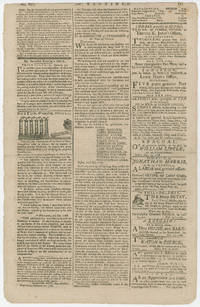
178824836Boston MA 1788. No binding. Condition: Fine. Massachusetts Centinel illustrator. Newspaper. Massachusetts Centinel February 13 1788 Volume VIII pp. 171-174. Boston: Benjamin Russell. 4 pp. 9 5/8 x 14 7/8 in. This newspaper is replete with Constitution-related content including minutes from the debates of Massachusetts' State Ratifying Convention - everything from discourse on standing armies to Fisher Ames' hearkening back to 1775 with "WE MUST UNITE OR DIE"; a poem to Washington on his birthday; a fictional dialogue The Federal Anti-Federalist Returned to His Neighbours; a rare example of one of Benjamin Russell's famed 'Pillars' illustration series; and a great deal of reporting on the popular reception of the news of ratification expressed in particular by an enormous parade and surrounding celebrations. The Massachusetts Centinel employed the Federal Pillars political imagery to announce the ratification of the Constitution by successive states. In this issue the Centinel announces the pending ratification by New Hampshire. "This day the Convention of the State of New Hampshire meet at Exeter for the purpose of erecting another PILLAR to support the great Federal Superstructure; by ratifying the proposed Constitution." On February 6 1788 Massachusetts ratified the United States Constitution by a vote of 187 to 168 the sixth and largest state to do so. Two days later the people of Boston engaged in a grand procession led by the "Mechanicks" and Tradesmen of Boston "to express their approbation of the conduct of the Gentlemen who represented this town in the late Convention" p3/c2. A sampling of the groups of marchers most of whom carried implements and tools of their professions festooned for the occasion as detailed here p4c1-2: 73 Blacksmiths; 43 Shipwrights; 75 Rope-makers with part of a rope-walk on a sled and martial music; 30 Mast-makers; 36 Sail-makers; 34 Ship-joiners; 30 Block-makers pulley makers; 6 Mathematical Instrument Makers makers of navigation equipment etc.; 53 Coopers; 20 Boat-builders; 6 Pewterers; 40 Bakers 50 Shoe-makers; 56 Taylors; 26 Hatters; 20 Ship-builders; 136 Carpenters; 70 Masons; 30 Wheelwrights; 15 Printers; as well as a dozen other tradegroups such Bookbinders; Goldsmiths and Jewelers Saddlers Tobacconists Tanners Curriers Leather-dressers Cabinetmakers Carvers Painters Tinsmiths Coppersmiths and 250 of the "principal merchants in the town." Toward the middle of this assemblage thirteen horses pulled the ship "FEDERAL CONSTITUTION" manned by a crew of thirteen. A subtext of much of this was an emphasis on domestic manufactures as well as a celebration of Boston's power and potential in maritime trade.At this event "WE THE PEOPLE" of Boston "in GRAND PROCESSION MOVING" passed an ordinance to rename Long Lane as Federal Street in commemoration of the site where the convention had sat. The ordinance concluded "GIVEN under our auspices.the FIRST YEAR of OUR real political federal existence.GOD SPEED THE CONSTITUTION!" p1/c1. That night a long boat called "the Old Confederation" which had been exhibited during the parade was drawn to the Common and condemned "as unfit for any further service." The boat was immediately burned "in presence of an applauding concourse of citizens" p3/c2. On February 12 the twelve delegates who represented Boston in the ratifying convention including John Hancock and Samuel Adams responded to the procession in a letter to "the Committee of Tradesmen of the Town of Boston." Excerpt: "We endeavoured that our conduct in the late Convention should be governed by the magnitude of our subject:-And after the most mature deliberation we severally decided according to the best light of our understandings and the dictates of our consciences." "We are happy to find that our decisions have so fully corresponded with the sentiments and wishes of our constituents."<br /> books
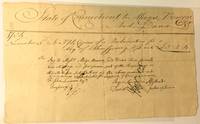
374Connecticut: State of Connecticut to Messrs. Meigs Bowen and Dana 1784. Original Pay Order. Very Good. Manuscript Document SIGNED by Roger Sherman bearing the title of "Assistant" meaning a member of the Upper House of Connecticut viz. in effect a State Senator of Connecticut; one page 12.25" x 7.25" a Pay Order for Messrs. Meigs Bowen and Dana to print "374 copies of a Proclamation for a Day of Thanksgiving."; for which authorization was given by Sherman for payment by John Lawrence Treasurer of Connecticut to said printers of "3 pounds 2 shillings & 4 pence." Roger Sherman April 19 1721 - July 23 1793 was not only a SIGNER of the DECLARATION of INDEPENDENCE July 1776; being a member of the Committee of Five assigned to draft that document; he was also the only man to sign all four of the great state papers of the evolving United States to include the Articles of Association; the Articles of Confederation; and the United States Constitution. Roger was the son of a poor Connecticut farmer who died thus leaving his 19-year old son with the heavy responsibility of caring for his widowed mother siblings and the farm. Apprenticed as a shoe-maker Roger briefly worked in that trade; then--after a few years--as a merchant with his elder brother while constantly teaching himself by independent study. Often he would read a carefully positioned book while cobbling shoes! He conducted his scholarly studies with such intellectual success that--after a few years--he was able to pass the Bar. Thereafter his rise in position and status was continuous: becoming a practicing attorney and soon judge for his County from 1759; becoming in the 1760's the treasurer of Yale University; thereafter sitting on the bench of the Superior Court of Connecticut 1776-1789;more or less concurrently Mayor of New Haven & a member of the Connecticut legislature; and from 1774 a distinguished state delegate to the new United States Continental Congress: serving in one or the other house until his death in 1793. "He always appeared exactly what he was--a man of sound common sense; strong natural powers of mind; of deep thought; of much reflection; of deliberate judgment; and a steady integrity--uniformly seeking to promote the cause of righteousness in the most upright manner" Dwight p.82. In 1783 his duties for Connecticut and the United States Congress tended to overlap. For both during this time of strife he sat on several important committees. For Connecticut in 1783 he and Judge Law were given the legislative task of revising the State Statutes. This Thanksgiving Proclamation appears to be an outgrowth of such efforts. By this relatively late period in American history the Pilgrim practice of consecrating a Day of Prayer and Thanksgiving in the Fall had spread throughout the Colonies. Accordingly as the American Revolution and resistance to Great Britain expanded and led to great public anxiety "Congress issued eight separate national Thanksgiving Proclamations. Congress also issued seven separate proclamations for times of fasting and prayer for a total of 15 official prayer proclamations during the American Revolution." Wikipedia on "Roger Sherman". A recurrent legislative pattern was that significant state documents were used as templates for Congressional ducuments. While our researches have not found the formal text of this Connecticut Thanksgiving proclamation we note that Representative Roger Sherman was an active supporter--along with Elias Boudinot--of the Congressional effort to create a national Day of Thanksgiving shortly after the framing of the Bill of Rights according to the Congressional Record for September 25 1789. As a result a joint committee of both houses encouraged President George Washington to "recommend to the people of the United States a Day of Public Thanksgiving and prayer." "Mr. Roger Sherman justified the practice of thanksgiving on any single event not only as a laudable one in itself but also as warranted by a number of precedents in Holy Writ . . . . This example he thought worthy of a Christian imitation on the present occasion" Wiki op. cit. After the ccngressional resolution was given to President Washington he concurred enthusiastically and issued the first Federal Thanksgiving Proclamation which we quote in part: "Whereas it is the duty of all nations to acknowledge the providence of Almighty God to obey His will to be grateful for His benefits and humbly to implore His protection and favor . . . Now therefore I do appoint Thursday the 26th day of November 1789 . . . that we may all unite to render unto Him our sincere and humble thanks for His kind care and protection" Wiki op. cit. And so it was intermittently observed in November until Thanksgiving was further implemented and sanctified by President Abraham Lincoln who-- in 1863 shortly after the battle of Gettysburg--made Thanksgiving Day a permanent national holiday! Condition: Overall this important document SIGNED by ROGER SHERMAN is in Very Good condition. It has light age-toning or browning with slight wear mild soiling & staining and a few small nicks and abraisions mainly to its edges. Said manuscript has intersecting folds with partial separations and some archival reinforcements to its reverse/verso side. There is a countersignature written across a few letters of Sherman's last name. References: Lewis Henry Boutell The Life of Roger Sherman 2015 ISBN: 978-1505973761 Kindle format. N. Dwight The Lives of the Signers of the Declaration of Independence NY: A.S. Barnes & Co. 1852; pp.76-85; note on the meaning of "Assistant" on page 80. Mark David Hall Roger Sherman and the Creation of the American Republic Oxford Univ. Press 2015 ISBN: 978-0190218706 Kindle format. Huffington Post: http://www.huffingtonpost.com/2013/11/28/thanksgiving-proclamation_n_4078958.html. This article briefly discusses the appearance of George Washington's Thanksgiving Proclamation signed by him on October 3 1789 at a Christie's auction in 2013 where it was estimated to fetch somewhere around $8-$12 million dollars but failed to find a buyer in that range. Wikipedia on "Roger Sherman" accessed in November 2018. State of Connecticut to Messrs. Meigs, Bowen, and Dana unknown books
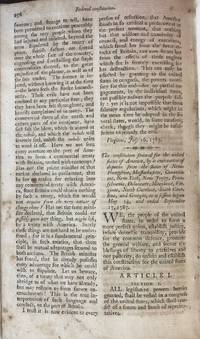
178737045Philadelphia: Printed by Mathew Carey 1787. 3 212-311 1 pp. Widely scattered light foxing; final few leaves with some blank inner margin wear. Pages 276-286 print in Very Good condition the proposed U.S. Constitution claimed as its first magazine printing. Overall Good in modern pale grey paper over boards.<br/><br/> This September issue is credited along with another Philadelphia publication 'The Columbian Magazine' as the first periodical printing of the Constitution of the United States. The prefacing paragraph and Preamble are also printed: "The Constitution framed for the united states of America by a convention of deputies from the states . at a session begun May 14 and ended September 17 1787. We the people of the united states in order to form a more perfect union establish justice." After the Constitution signatures in type of George Washington and other delegates listed by state are printed; followed by Washington's two transmittal letters to the States and Congress's resolution signed in type by Charles Thomson as Secretary "recommending the appointment of state conventions to consider the preceding constitution". <br/> The Constitution is not the only item of importance contained in this September number. It also has an early American printing of Benjamin Franklin's "Information for those who wish to remove to America" first printed privately in Passy in 1784; and several other essays on American commerce politics and culture.<br/>Lomazow 22e. Evans 20194. Printed by Mathew Carey unknown books
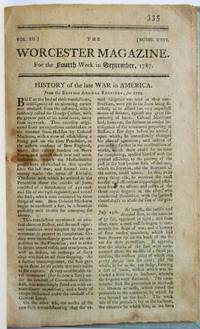
178737046Worcester: Isaiah Thomas 1787. Pages 335-352 with caption title as issued. Upper margins of several leaves trimmed closely shaving portions of several page numbers a couple of printer flaws with effect on a few letters. Good in modern pale grey paper over boards.<br/><br/> This early rare printing of the proposed Constitution-- certainly one of the earliest-- appears at pages 349-352 under the heading "Proceedings of the Federal Convention." Isaiah Thomas started the Worcester Magazine in April 1786. It was "The octavo continuation of Isaiah Thomas' newspaper The Massachusetts Spy necessitated by his opposition to the tariffs on paper and the tax upon advertisements in newspapers which were repealed in April 1788" Lomazow. <br/>Lomazow 20. Evans 20159. Mott 92-93. Isaiah Thomas unknown books
183218408Bogotá: Tipografia de Bruno Espinosa 1832. Small 4to. lvii 1 pp. <br><br>Official printing of the first Colombian constitution after the dissolution of the Republic of Gran Colombia 182230 and the short period of revolving leadership 183032. The constitution decentralized power vesting it in the states which then proceeded to snipe at one another; eventually civil war broke out. In 1842/3 a peace was achieved and in 1843 a new constitution with centralized power was promulgated. Searches of WorldCat locate only six copies in the U.S. <br>Â Â Â Â <br>Â Â Â Â Not in Palau Contemporary calf over paste boards; spine lacking; covers barely holding on. Serious worming to preliminaries and title-page costing letters. Worming in margins of other leaves. An "okay" copy of a scarce and historic constitution. Tipografia de Bruno Espinosa hardcover books
1845700771845. French-Language Account of Louisiana's 1845 Constitutional Convention Louisiana. Constitution of 1845. Foullouze Foulhouze James Reporter. Rapports Officiels Des Devats sic de la Convention la Louisiane. New Orleans: J. Bayon Imprimeur de la Convention 1845. i 460 11 pp. Text in parallel columns. Octavo 9-1/2 x 6-1/4. Later library cloth red and black calf lettering pieces and paper location label to spine endleaves added. Some soiling and light shelfwear some chipping to edges of lettering pieces. Light browning and foxing to text early mark sin pencil to a few passages lower corners lacking from a few leaves with no loss to text library stamp to title page "8049" in early hand to its verso. $1850. Only edition. Louisiana's first constitution was adopted in 1812 its second in 1845. More liberal than its predecessor it expanded white male suffrage established public schools and granted the right of appeal to felons sentenced to death or hard labor. The final 11 pages contain a French translation of the 1845 Constitution. Also issued in English Foullouze's report is not to be confused with the Official Reports of Debates 1844 a different account by an anonymous author. The French edition of Foullouze's report is scarce the English edition in rare. Jumonville Bibliography of New Orleans Imprints 1390. Babbitt Hand-List of Legislative Sessions and Session Laws 150. unknown books
182328505Santiago de Chile: Imprenta Nacional 1823 or 1824. Small 4to 22 cm; 8". 81 1 blank pp. <br><br>Sixth Chilean constitution the first having been the Reglamento para el arreglo de la Autoridad Ejecutiva Provisoria de Chile 1811. The author here was Mariano Egaña 17931846 "one of the two or three best-read Creole intellectuals of the time. . . . but The constitution was far too complex to be applied to Chile or anywhere else" Collier & Sater History of Chile pp. 4849. This constitution and its 277 articles were replaced by the Ensayo Federal de 1826. <br>Â Â Â Â <br>Â Â Â Â Briseño I 74; Palau 59709. 20th-century Spanish sheep. Stitching holes in inner margins. Very clean. A very good copy. Imprenta Nacional unknown books
178721449.18Philadelphia PA 1787. No binding. Fine. Pennsylvania Packet and General Advertiser. Newspaper. Pennsylvania Packet and General Advertiser September 21 1787. John Dunlap Philadelphia Pa. 4 pp. 12 x 18 3/4 in. Pennsylvania's representatives to the Constitutional Convention including Benjamin Franklin present the Constitution to the Representatives of the Pennsylvania State legislature. A contemporary report of the end result of the Philadelphia Convention's efforts over the summer of 1787 less than a week after the Convention concluded. ""Sir we have now the honor to present to this house the plan of government for the United States which has been determined upon by the federal convention. As soon as the speaker had concluded Dr. Franklin rose and delivered a letter from the delegates to the house which being read consisted of a recommendation to the legislature."" p. 2 col. 4Reports on the proposal of the Constitution to Pennsylvania. ""To the Honorable the Representatives of the Freemen of the Commonwealth of Pennsylvania.your petitioners have seen with great pleasure the proposed constitution of the United States and as they conceive it to be wisely calculated to form a perfect union of the states as well as to secure to themselves and posterity the blessings of peace liberty and safety they have taken this method of expressing their earnest desires that the said constitution may be adopted as speedily as possible by the state of Pennsylvania."" p. 3 col.1.Contains a section entitled: ""Origin of the Island of Nantucket. An Indian Tradition."" ""On the west end of Martha's Vineyard are high cliffs of variegated coloured earths known by the name Gayhead.The Indians who live about this spot have a tradition that a certain deity resided there before the Europeans came into America."" p. 3 col.4.Benjamin Franklin 1706-1790 Born in Boston he originally worked as a printer for his older brother. After moving to Philadelphia he started his own newspaper the Pennsylvania Gazette in which he published his ideas in support of American independence. He was very involved in the writing of the Declaration of Independence and during the Revolutionary War was appointed Ambassador to France where he negotiated the important alliance between the two nations. Franklin was also known for his science experiments most notably with regards to electricity.ConditionNear fine books
1783106382<p>Small 8vo modern calf spine in gilt spine label title 2 1 3-257 pp. Rebound A1 cropped only affecting the running head binder stamp on endpaper Some browning and foxing otherwise very good in a near fine modern binding. This is a first Scottish edition of this work originally published in Philadelphia in 1781. There were two London editions prior to this printing. In addition to the Constitutions of the various colonies this work includes a copy of The Declaration of Independence and the Articles of Confederation. As a preface this edition includes two pages of Scottish verse. This appears to be a somewhat scarce edition as the OCLC locates only two copies. Sabin 16091. OCLC. </p> ohn Bryce, books
1795WRCAM11233Philadelphia: Printed and sold by Benj. Franklin Bache 1795. 59pp. Modern half morocco and marbled boards. Minor tanning to text. Very good. The events of the French Revolution were followed with the keenest interest in America. As the excesses in France grew American reaction split along emerging political lines with the Federalists expressing revulsion while the Democrats were more supportive. The French Constitution of 1793 collapsed with the end of the Terror and this new constitution which created the Directory was instituted. This is the first American edition in English of that new constitution published by the Democratic grandson of Franklin Benjamin Franklin Bache. Bache also published an edition in French the same year. It would have keenly interested the politicians of that year both from a party and foreign relations viewpoint. The NUC locates eight copies. EVANS 28694. Printed and sold by Benj. Franklin Bache hardcover books
1802106375<p>8vo period calf rebacked with leather 2 266 pp. Joints cracked rebacking crude some wear to covers paper slightly fragile front endpaper detached other front endpaper with piece missing ink name on front pastedown some darkening to contents; otherwise about very good. This is a rich volume of early American government. In addition to the United Sates Constitution and Declaration of Independence this volume also contains the constitutions of the original states and the ordinances for the government of the North West Territory. Printed under the title is the notation that "This edition contains the constitutions of Vermont Delaware Georgia and Kentucky with the regulations for the government of the territory north west of the river Ohio." This material was not in any other edition. </p> William Duane, books
186318599Cali: Imprenta de Nicolas Hurtado 1863. 12mo. 50 pp. plus wrps. <br><br>The political pendulum swung to the liberals in 1863 and a new constitution was promulgated at Rionegro which was to last until 1886. It renamed the nation the United States of Colombia gave to the states all powers not reserved to the central government contained fully defined individual liberties and guarantees and guaranteed Colombians full religious freedom.<br>Â Â Â Â This states' printing occurred very shortly after the official Bogotá printing as seen by the ownership date of 11 August the document having been approved on 8 May! It is also very rare: We trace no copies via WorldCat and NUC. Further searches of the OPACs of the National Library of Colombia and of the universities of Cali and the Andes failed to locate a copy.<br>Â Â Â Â Provenance: Ownership inscription of B. Núñez dated 11 Aug. 1863 on front wrappers; so too of Simon Arboleda 20th century undated and of J. R. Arboleda dated 29 Aug. 1900. <br>Â Â Â Â <br>Â Â Â Â Not in Palau. Original printer wrappers. Ownership inscriptions on front cover. Private ownership stamps on two pages. A very good copy. Imprenta de Nicolas Hurtado unknown books
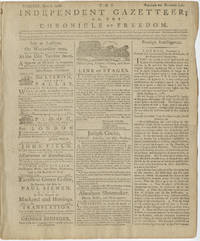
178830007.003Philadelphia PA 1788. No binding. Fine. Independent Gazetteer; or The Chronicle of Freedom. Newspaper. Independent Gazetteer; or The Chronicle of Freedom Philadelphia Pa. May 6 1788. 4 pp. 9 1/2 x 11 1/2 in. The Maryland ratifying convention suggests some amendments along with their approval of the Constitution. ExcerptsFrom page 3:""From the MARYLAND GAZETTE or April 29 1788. The CONVENTION of this state on Saturday last determined to ratify the proposed plan of Federal Government. -YEAS 63 NAYS 11-And then appointed a committee of thirteen members to consider and report amendments to be recommended to the people. -The following amendments were proposed by a member and referred to the committee who are now sitting-And it is hoped that the great and essential rights of the people will be declared and secured.- PROPOSED AMENDMENTS.Wherefore whenever the ends of Government are perverted and public liberty manifestedly endangered and all other means of redress are ineffectual the people may and of right ought to object to reform the old or establish a new Government-that the doctrine of nonresistance against arbitrary power and oppression is absurd slavish and destructive of the good and happiness of mankind. All imposts and duties laid by Congress shall be placed to the credit of the state in which the same be collected. That there shall be no national religion established by law; but that all persons be equally entitled to protection in their religious liberty. That the Supreme Federal Courts shall not admit to fictions to extend its jurisdiction; nor shall citizens of the same state having controversies with each other be suffered to make collusive assignments of their rights to the citizens of another state for the purpose of defeating the jurisdiction of the State Courts; nor shall any matter or question already determined in the State Courts be revived or agitated in the Federal Courts. That Congress have no power to lay a Poll-Tax. That the people have a right to freedom of speech of writing and publishing their sentiments and therefore that the freedom of the PRESS ought not to be restrained and the printing presses ought to be free to examine the proceedings of Government and the conduct of its officers.""From page 2: Protesting the Slave Trade by Boycotting West Indian Produce""A CAUTION.WHEREAS in the year 1787 some vessels were fitted out at the port of Philadelphia for the iniquitous purpose of stealing the inhabitants of Africa from all the endearments of domestic life; one of which vessels has succeeded in obtaining a number of poor blacks and has taken the to a port in the West Indies where they are under the iron hand of oppression. From this shameful traffic this horrid source the proprietors of the vessel have purchased some West India produce which after landing at Wilmington they have brought up to this city and offered for sale. It is a grateful circumstance to the supporters of the common rights of mankind that the virtuous inhabitants of the city reprobate the horrid idea.-A correspondent hopes that the citizens will further testify their disapprobation of the practice by turning with indignation from the purchase of any property thus basely procured by men so lost to the common feelings of humanity; notwithstanding the patriotic convention at which Washington presided have declared that this abominable traffic shall be continued for TWENTY years by the people of America.From page 1:An advertisement with engraving for a ""Line of Stages"" between Philadelphia and New York started by four partners who split off from an established stage line and promising better service. From page 4:An advertisement for another different ""New Line of Stages."" And a report on the creation of a Philadelphia committee for the relief of the nearly 100 Americans captured by Algerian corsairs and Barbary pirates. unknown books
187118311Bogotá: Imprenta i Estereotipia de Medardo Rívas 1871. 12mo. 45 pp. <br><br>The political pendulum swung to the liberals in 1863 and a new constitution was promulgated at Rionegro which was to last until 1886. It renamed the nation the United States of Colombia gave to the states all powers not reserved to the central government contained fully defined individual liberties and guarantees and guaranteed Colombians full religious freedom.<br>Â Â Â Â "Edicion oficial revisada por una comision de la Camara de Representantes compuesta de un miembro por cada estado."<br>Â Â Â Â Uncommon: we locate fewer than half a dozen copies in U.S. libraries. Late 19th- or early 20th-century quarter cloth with marbled paper sides. Ownership mark on rear free endpaper. A very good copy. Imprenta i Estereotipia de Medardo Rívas hardcover books
1789100147<p>8vo later calf backed marbled boards 320 202 pp. Edges and covers rubbed occasional bit of foxing but overall very good. The most important feature of this collection is an early British printing of the United States Constitution p.289-300. Also contains a curious description of two Negro children with some unusual physical markings see p.53-55. Very interesting coverage of a few executions including a woman who was hanged for forgery is also provided.</p> J. Dodsley hardcover books
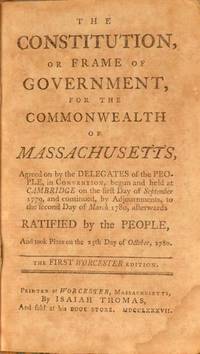
1787768991787. MASSACHUSETTS Constitution of. THE CONSTITUTION OR FRAME OF GOVERNMENT FOR THE COMMONWEALTH OF MASSACHUSETTS . RATIFIED BY THE PEOPLE AND TOOK PLACE ON THE 25TH DAY OF OCTOBER 1780. Worcester Massachusetts: Isaiah Thomas 1787. "The first Worcester edition" stated on the t.p. preceded by three Boston editions 1880-84. 18mo. 107 pp. Worn contemporary binding of leather-backed paper-covered scabbard boards. Approximately half of the lower board is missing. Text leaves are age-browned occasionaly foxed and dampstained in the margin at the bottom fore-corner. The final page has some loss just affecting the final letters in some lines. Sabin 45691. unknown books