[PROPAGANDA FIDE - ALPHABETA].Biblio.com
2 résultats
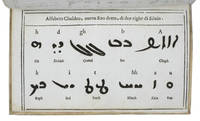
16365CHGGG01U79ORome 1636. Oblong 8vo 11 x 17 cm. Propaganda Fide Contemporary vellum with the spine at the head of the leaves. A complete set of 12 leaves published without a title-page printed on rectos only each page with a frame of double rules and an additional single rule built up from short rules delineating a panel at the head that contains the title of the leaf 10 of the 12 beginning Alfabeto . and showing woodcut 3 or typographic 7 alphabets the latter showing Hebrew meruba & rabbinical Samaritan majuscule and Syriac estrangela & serto types. The other 2 leaves show a woodcut illustration of an inscription in stone and an interpretation of it including a smaller woodcut. 12 ll. Rare publication of the Propaganda Fide in Rome showing alphabets of non-Latin scripts published without a title-page and printed on the rectos only with 7 of the 12 leaves showing alphabets of the Propaganda Fides printing types for Hebrew 3 sizes of meruba square and 1 of rabbinical semi-cursive Samaritan majuscule and Syriac estrangela and serto. The Syriac language bears no relation to modern Syria but is a form of Aramaic spoken by many early Christians in the Middle East and still surviving today. The Propaganda Fide apparently had some of these types cut exclusively for their use and the present publication shows complete alphabets including some variant forms for 6 of the 7 in most cases also with a few words or lines of text it shows only the first half of the alphabet - alaph to kaph - for the very large serto Syriac. This provides an especially valuable overview of the founts.The present publication collates: A-C4 = 12 ll. with quire signatures on leaves 1-2 of each quire each leaf printed on the recto with a title at the head:A1: Alfabeto del protoparente Adamo I. delineato nella libraria Vaticana. woodcut charactersA2: Alfabeto II. di Adamo secondo che riferisce il P. Giacomo Bonavent. Scozese dell'Ordine di S. Francesco di Paolo nel suo alfabetario intitolato Virga aurea. woodcut charactersA3: Alfabeto III. di Adamo cavato dal libro di Lorenzo Schradero stampato in Helmstatt l'anno 1592. woodcut charactersA4: Alfabeto Hebreo detto Soprasilvio. meruba square Hebrew typeB1: Alfabeto Hebreo detto Testo. meruba square Hebrew typeB2:Alfabeto Hebreo detto Garamone. meruba square Hebrew typeB3: Alfabeto Hebreo rabbinico detto Garamone. rabbinical semi-cursive Hebrew typeB4: Lettere cavata dal P. Tomaso da Navara che si trovano sculpite in una pietra piccola posta à piedi del Monte Oreb dove Dio N.S. diede la legge. woodcut of the Mount Horeb inscriptionC1: Analysi dell'antecedente carattere conforme alla dispositione del P. Atanasio Kircher nel Prodromo Copto approvata da' molti. interpretation of the Mount Horeb inscriptionC2: Alfabeto Samaritano detto Testo. majuscule Samaritan type 1636C3: Alfabeto Estranghelo overo Chaldeo antico detto Testo. estrangela Syriac type Coakley S7 1636C4: Alfabeto Chaldeo overo Siro detto di due righe di Silvio. serto Syriac type Coakley W12 large size 1618 bought by the Propaganda Fide 1653Nearly all references describe this book as an oblong 8vo but this appears to be an error. The two copies we have examined are both oblong 4tos with the chain-lines vertical in the oblong leaves and the watermarks divided at the heads of the leaves in the middle of a long edge. Several leaves with the double rule at the foot shaved not effecting the text or quire signatures otherwise in good condition. A rare collection of non-Latin alphabets including the Propaganda Fides Hebrew Samaritan and Syriac types.l Amaduzzi Catalogus librorum . Propaganda Fide 1773 p. 7; Birrell & Garnett 1928 4; Coakley Typography of Syriac W12 & S7; Philologia orientalis 199; D. Stolzenberg Egyptian Oedipus: antiquarianism oriental studies . in the work of Athanasius Kircher Thesis Stanford Univ. 2004 pp. 118 & 121; WorldCat 11 copies in 9 entries. hardcover
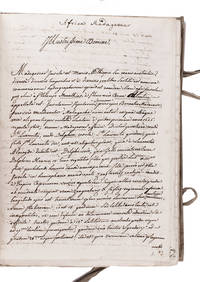
16419A5BDK01U79ORome and perhaps elsewhere 1641. Contemporary Italian sheepskin parchment over flexible boards with 0.5 mm flaps on the fore-edge straight-sewn on 4 alum-tawed supports laced through the joints with a hollow back uncoloured linen ties the smooth spine with contemporary manuscript title Africa Greci Italo Greci . at the head and shelfmark CCXXI at the foot plus later paper spine labels including that with the Phillipps manuscripts number 5580. 4to 28.5 x 21 cm. Collection of manuscript transcriptions of about 30 letters and other documents written in brown ink in several hands on about 20 stocks of mostly or entirely Italian laid paper from Catholic missionaries in or writing about Africa Greece Italy Bosnia and Japan. A large collection of about thirty 18th-century transcriptions of letters and other documents from Catholic missionaries writing from or concerning the missions in Africa including Madagascar Algiers and the Barbary Coast Greece Italy including the Mekhitarist Armenian Catholic monastery on the island San Lazzaro degli Armeni in the Venetian lagoon and Japan. The exact number depends how one defines "one" document. Most of the letters transcribed here were originally written at the time of the Portuguese French and Spanish efforts to suppress the Jesuits in their territories both at home and in their colonies beginning around 1750 and leading to the banning of Jesuits from the Portuguese empire 1759 France 1764 and Spain 1767. The Pope finally dissolved the Jesuit order in 1773 but it was re-established in 1814. The documents from this period some explicitly about attempts to suppress the Jesuits were clearly transcribed when they were still new but the collection also includes transcriptions of older letters and documents.Nearly all concern the Sacra Congregatio de Propaganda Fide "the department of the pontifical administration charged with the spread of Catholicism and with the regulation of ecclesiastical affairs in non-Catholic countries" Catholic encyclopedia. While the Jesuits prior to their suppression were a highly evangelical branch of the Catholic Church the Propaganda Fide was the papal office that coordinated the missionary activities of all the orders. The letters provide good evidence both of the relations between the Catholic Church as a whole and the Jesuit Order and of the Church's efforts to continue their evangelical missionary activities at a time when the Jesuits were no longer able to lead them.The manuscript belonged to Frederick North 1766-1827 5th Earl of Guilford and was bought for Sir Thomas Phillipps 1792-1872 at the 1830 Guilford sale. It was sold in the 1919 Phillipps sale. In very good condition with a few documents showing minor foxing or small stains but most leaves fine. The binding is somewhat rubbed most of the sewing supports have broken at the joints and the cover has come loose from the bookblock at the inside of the front hinge but the sewing and case remain structurally sound. Many of the 30 documents no doubt transcribe originals that have since been lost so the present collection forms an important source for the history of Catholic missionary work in the period for information about the regions where they operated and for the relations of the Church as a whole with the Jesuits.l Evans Catalogue . manuscripts . Guilford 8 December 1830 lot 361; Phillipps manuscripts 5580; Sotheby Bibl. Phillippica 1919 lot 1473. hardcover