[PARLIAMENT]Biblio.com
295 résultats
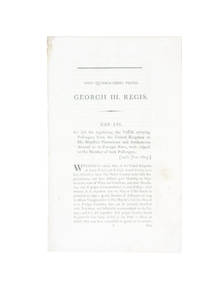
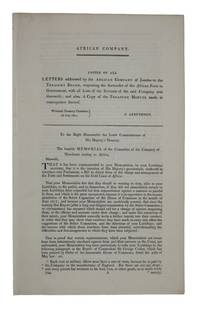
1821AQ27623London: s.n. 1821. 14pp 2. Docket title to verso of terminal leaf. Disbound. Later resewn. Three old horizontal folds. A rare survival of copies of correspondence relating to act to divest the African Company of Merchants of the charge and management of forts and settlements on the Gold Coast of Africa and transfer their control to the Crown. The act that abolished the company was passed in May 1821 and the transfer ownership of eight forts including the notorious Cape Coast Castle was affected on 3rd July the day after these letters were ordered by Commons to be printed. They contain listings of the Company's employees and respective salaries and abstract of annual stipends paid to local Kings and Cabboceers. From the recently dispersed library without any indication of such of British scholar and senior civil servant William St Clair 1937-2021 and presumably used by him in his research for his acclaimed book The Grand Slave Emporium: Cape Coast Castle and the British Slave Trade 2006. OCLC records copies at just two locations Florida and NLW; COPAC adds no further. . Folio. [s.n.] unknown
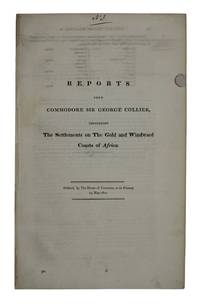
1820AQ27620London: s.n. 1820. 17pp 1. Disbound. Later resewn. Three old horizontal folds sealing wax remnant to title ink-stamp pf the Institute of Historical Research to verso. The second located copy of an annual report submitted by Royal Navy officer Sir George Collier 1774-1824 on the condition of the African Company's forts and settlements. Between 1818 and 1821 Collier commanded the six-ship coast of Africa squadron with a remit to suppress the slave trade a charge he undertook with zeal significantly reducing the traffic of slaves from the continent. In 1820 his work was recognised by election to honorary life membership of the African Institution. From the recently dispersed library without any indication of such of British scholar and senior civil servant William St Clair 1937-2021 and presumably used by him in his research for his acclaimed book The Grand Slave Emporium: Cape Coast Castle and the British Slave Trade 2006. OCLC and COPAC together record a single copy Southampton. . Folio. [s.n.] unknown
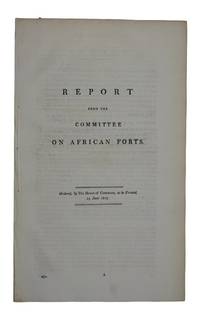
1817AQ27622London: s.n. 1817. 63pp 1. Disbound. Later resewn. Terminal leaf creased. The report of a parliamentary committee appointed to evaluate the condition of the state of trade and establishments of the African Company issued four years prior its ultimate dissolution by the British Government in 1821. With the exception of the major forts such as Cape Coast Castle many British forts were not particularly well defended nor maintained and as such their efficacy as a deterrent to slave traders greatly diminished. Parliament frustrated by this reduced effectiveness pursued a policy of reducing the number of African Company settlements through the abandonment of any upon strict inquiry not found to be of service in a sufficient degree to warrant their expenditure. From the recently dispersed library without any indication of such of British scholar and senior civil servant William St Clair 1937-2021 and presumably used by him in his research for his acclaimed book The Grand Slave Emporium: Cape Coast Castle and the British Slave Trade 2006. OCLC and COPAC together record copies at just six locations California NLW NYPL Senate House Southampton and UoL. . Folio. [s.n.] unknown
1878PCT78VIC97Melbourne: John Ferres Government Printer 1878. 1878. folio. pp. 80. folding lithographed map. several text illus. disbound scattered library rubberstamps. Including the journal of exploration of Port Phillip made by Charles Grimes Surveyor-General of New South Wales 1802-03 together with a copy of his map the order book of Lieutenant-Governor Collins during the stay at Port Phillip 1803-04 and the journal of the Rev. Robert Knopwood Chaplain to the settlement 24 April 1803 to 31 December 1804 &c. cfFerguson 15655. Soft cover. Melbourne: John Ferres, Government Printer, [1878]. Paperback
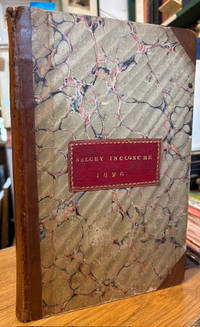
182676430unknown: unknown 1801 / 1821 / 1825 / 1826. 4to. 697-720; 221-224; 1497-1540; 1-30 pp manuscript. Half brown calf over marbled boards with a red leather title label bearing gilt lettering and ruling to the front board. Rubbing to the spine corners and boards. Some chipping and loss to the leather at the spine with a 2cm split at the front hinge. Some offsetting to the text alongside some spots markings and occasional pencil annotations to the Acts of Parliament. With copies of letters of correspondence relating to the use of land within Hanslope Park in Stony Straford dated to 1865 on embossed Hanslope Park paper loosley enclosed. Contains 4 Acts of Parliament relating to the Inclosure of Salcey Forest forming part of the Inclosure Acts of the 18th and 19th century which put previously common land into private ownership with manuscript Commisioner's minutes providing detail on the procedure land claimants and expenses at the rear. The four Acts include: 'An Act for consolidating in one Act certain Provisions usually inserted in Acts of Inclosure; and for Facilitating the Mode of proving the several Facts usually required for the passing of such Acts' from 1801; 'An Act to amend the Law respecting the inclosing of Open Fields Pastures Moors Commons and Waste Lands in England' from 1821; 'An Act for dividing allotting and inclosing the Forest of Salcey in the Counties of Northhampton and Buckingham; and of certain Lands in the Parish of Hartwell in the said County of Northampton' from 1825; and finally 'An Act for Subdividing alloting and inclosing the Allotment directed to be set out by an Act of the last Session of Parliament for inclosing the Forest of Salcey in the Counties of Northampton and Buckingham to the several Owners and Proprietors of Land claiming Rights of Common in and over the said Forest' from 1826. This volume provides a fascinating local insight into this hugely significant period of change in the history of English land ownership. . Very Good. Half Calf. 1826. [unknown] 1801 / 1821 / 1825 / 1826 unknown
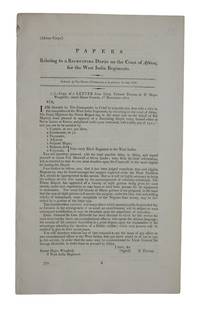
1812AQ27619London: s.n. 1812. 9pp 2. Docket title to verso of terminal leaf. Disbound. Later resewn. Early alternate pagination in manuscript to upper corners. The second located copy a series of dispatches relevant to the establishment of a British Army recruiting station at either Sierra Leone or Gorée. Under the authority of the Prince Regent Brevet Major Wingfield of the 8th West India Regiment was charged with determining the most suitable location for the depot with the assistance of inter alia one sergeant and two corporals 'from every Black Regiment in the West Indies' and that 'such eligible Negroes as may be found amongst the cargoes captured under the Slave Abolition Act should be appropriated to this service'. From the recently dispersed library without any indication of such of British scholar and senior civil servant William St Clair 1937-2021 and presumably used by him in his research for his acclaimed book The Grand Slave Emporium: Cape Coast Castle and the British Slave Trade 2006. OCLC records a single copy UWI; COPAC adds no further. . Folio. [s.n.] unknown
18035000976Edinburgh: printed by Sir D. Hunter Blair & J. Bruce 1803. Folio pp. 1-14 disbound. <p><p>One of the most important amendments to the laws of Transportation formalising the requirement for convict vessels to carry a Surgeon and thus directly responsible for a huge improvement in mortality rates. The Act is also interesting for noting some of the abuses rampant aboard convict transports and other passenger vessels travelling from Britain.</p> <p>The First Fleet had been provisioned by the Admiralty itself and the Surgeons on board led by John White had an excellent record. From the Second Fleet onwards the task was contracted to private companies infamously derelict on the Second Fleet itself and with wildly varying results over the ensuing decade. On several occasions officers colluded to deny the convicts their correct rations so that the surplus could be sold upon arrival at Port Jackson for a handsome profit. A plan to return convicts to naval vessels was scuppered by the ongoing conflict with France.</p> <p>This Act regulated the terms of carrying all passengers free or convict detailing acceptable provisioning and the role of the Surgeon and allowing for a bond of £50 per head to be paid by the owners of any vessel. Although abuses continued aboard the convict transports conditions did improve overall and the casualty rate for convicts sent to New South Wales fell from one in ten between 1795 and 1801 to one in forty-six for the period 1802-1812. One paradoxical result was that British conservatives started to criticise the transports as being too comfortable and therefore a poor deterrent to crime.</p> </p> . printed by Sir D. Hunter Blair & J. Bruce unknown
186156074London Eyre & Spottiswoode 1861. Folio. 2 contemp. hcalf. Spines gilt. Titlelabels with gilt lettering. 8LI228;24692 pp. 3 folded maps Index-map with colouring 2 diagrams 5 plates. Textdiagrams textillustrations in woodcut. Clean and fine. unknown
186156074London, Eyre & Spottiswoode, 1861. Folio. 2 contemp. hcalf. Spines gilt. Titlelabels with gilt lettering. (8),LI,228(24),692 pp., 3 folded maps (Index-map with colouring), 2 diagrams, 5 plates. Textdiagrams, textillustrations in woodcut. Clean and fine.
1809357240London.: Samuel Smith. 1809. Old half tan calf over gray boards raised band gilt spine title on red label. Lower panel of spine missing moderate wear and soiling to covers half-title page wrinkled otherwise very good. 23.5x29x1.8 cm. “An act for raising a certain sum of money by way of annuitles to be attended with the benefit of survivorship in classes.'"" These schemes were used by governments in the 17th 18th and 19th centuries to raise money for the public treasury. This is an accounting of the nominees of the last tontine sponsored by the British government. Rare. weight: 2.1 lb. Samuel Smith. hardcover
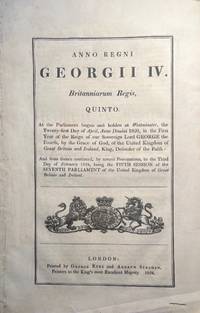
18246000004London: George Eyre and Andrew Strahan 1824. Folio pp ii added general title-page for the parliamentary year 737-756; unbound neat paper spine. <p><p>A crucial landmark in the creation of the Australian Agricultural Company and the first official use of the great company's name. Two months earlier the House of Commons had passed a bill incorporating "The Australian Company of London" which this overrides Ferguson 949.</p> <p>The Australian Agricultural Company or AACo played a huge role in shaping the early Australian economy. From its establishment in 1824 it was responsible for the development and expansion of the Hunter Valley and other regions. Surviving all the rural challenges - including droughts economic depressions and labour shortages - its long-term impact on early Australia was substantial in establishing agriculture as a primary industry and contributing to Australia's economy famously "riding on the sheep's back".</p> <p>AACo continues to be a significant player in today's agricultural sector today as Australia's largest integrated cattle and beef producer owning and operating approximately 7 million hectares of land in Queensland and the Northern Territory. This vast landholding represents roughly 1% of Australia's land mass highlighting the company's substantial presence in the country's agricultural landscape.</p> </p> . George Eyre and Andrew Strahan unknown
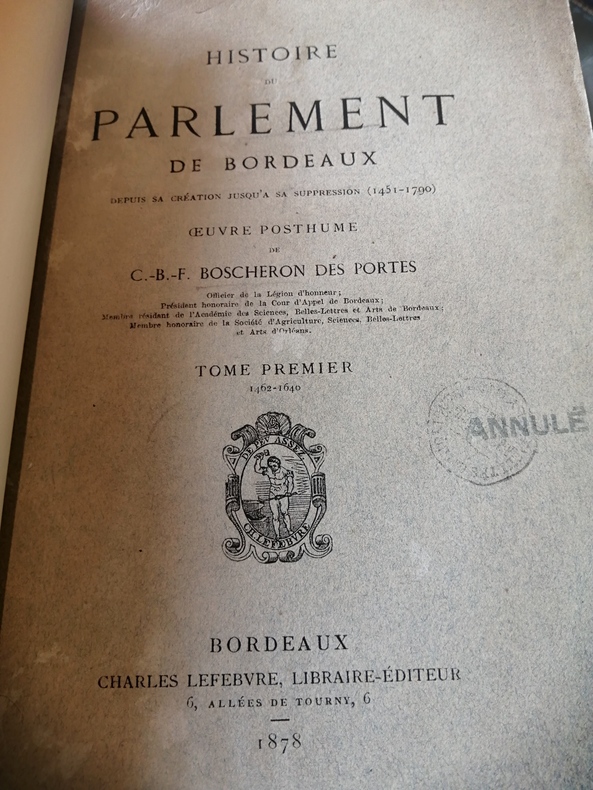
1877LB88Deux volumes in-8° [229*150 mm] , demi-chagrin bleu à coins , dos à nerfs, plats recouverts de placage noyer, remplis en placage de noyer, gardes colorées bleues, ex-libris magnifique, gravé par Haefner, de Robert Folz , médiéviste, sur les contreplats recto des deux vol. Papier vergé , de très rares rousseurs. Couvertures et dos conservés [tampon annulé sur les premières de couverture, tampon de bibliothèque peu lisible , "Institut Catholique de Lyon"] Tome 1 : Page de titre, avis de l'éditeur p. V et VI , introduction p. VII à XVIII, Histoire du Parlement [p.1 à 509] , table des matières p. 511 à 516 [la période couverte par ce premier tome 1462-1640 ] . Remarque : la première de couverture porte le millésime 1878 pour la date de publication, alors que la page de titre mentionne 1877. Tome 2 : Page de titre, Liste des souscripteurs p. V à VII [130 noms dont huit institutions] , Histoire du Parlement et appendice [p.1 à 457] , table des matières p. 459 à 465, table des noms p.467 à 494 [période couverte par le deuxième tome : 1640 à 1790]. Remarque : la première de couverture porte le millésime 1878 pour la date de publication, alors que la page de titre mentionne 1877.
1831elala1146York: James Baxter Printer 1831. 1831. 8vo. pp. 5. text in double columns. modern cloth-backed bds. foxing to title. Rare. Concerning the establishment of a school fund from the sale of Crown lands set aside for the purpose. The committee was chaired by William Morris 1786-1858 who by the late 1820s "had become a recognized authority on the distressing state of schooling in Upper Canada. " DCB VIII p. 640 Fleming 583 Public Archives copy only. Casey I 1334. Not in TPL. Hardcover. York: James Baxter, Printer, 1831. Hardcover
1839elala1150Toronto: Printed At The Patriot Office 1839. 1839. 8vo. pp. 87. old half sheep binding worn spine damaged foxing to outer leaves margins closely trimmed. The first half of the report dated April 30 1839 is concerned with the American involvement in the Rebellion: the raids conducted by sympathizers in the northern states including extensive discussion of the seizure and burning of the steamer Sir Robert Peel. The second half constitutes a commentary on Lord Durhams report. The last four pages contain the draft of an address to the Queen requesting continued support and protection. Fleming 1373. TPL 2334. Casey I 1727. Lande S2250. Toronto: Printed At The Patriot Office, 1839. unknown
181824993London: John Baskett and others printers 1818. 12 works folio. 12 1/2 x 8 inches and smaller. Disbound or stitched<br/> <br/> A fascinating series spanning the whole of the period when whaling was carried out on a successful commercial basis in the waters off Greenland.<br/> <br/> After an abortive start by the South Sea Company between 1724 and 1732 the British whaling fleet operated off Greenland and the Davis Strait throughout the remainder of the 18th century with increasing success due to a large degree to the succession of bounties granted to ship owners by the British Government. The present selection of acts of parliament includes a number concerning the bounty: the first dated 16th January 1732 makes law "that a Bounty will be paid on the Return of every Ship of 200 tons and over imployed by His Majesty's Subjects in the Whale Fishery". For the bounty to be paid certain stringent criteria had to be met; these increased as the century progressed. By the time of the last Act in the present group March 1818 the Greenland whalers were reporting declining catches and were already beginning to turn their attention to other whaling grounds i.e. largely in the Pacific and Antarctic. This group offers and interesting series of snapshots of the industry during its most productive century. The acts comprise: 1. An Act for encouraging the Greenland Fishery. 1732. Stitched later wrappers. Exemption from duty extended for a nine year period. 2. An Act for the further Encouragment of the Whale Fishery carried on by His Majesty's British Subjects. 1733. Stitched later wrappers. The introduction of a bounty for ships over 200 tons. 3. An Act for continuing the several Laws therein mentioned . including granting a further Bounty for all Ships employed in the Whale Fishery during the present War; for exempting Harponers and others . from being impressed. No date but circa 1750. Spine reinforced. The bounty raised by a third other measures to help the trade. 4. An Act for granting a additional Bounty on Ships employed in the Greenland and Whale Fishery for a limited time. No adte but circa 1761. Disbound. The increased bounty confirmed for another five years. 5.An Act for further continuing several Acts . for the Encouragement of the Whale Fishery. 1768. Stitched. 6. An Act for the better Support and Establishment of the Greenland and Whale Fishery. 1771. Stitched. The rules about the amount of bounty to be paid has changed with additional laws concerning vessels of American origin exemption from duty extended to include the Gulf of St. Lawrence certain members of a whaler's crew to be exempt from being pressed into service in the Royal Navy etc. 7.An Act to explain and amend Two Acts made . with respect to the Limits of the Greenland Seas and Davis's Streights . and to enlarge the Time for the Return of the Vessels employed in the Whale Fisheries. 1780. Stitched. 8. An Act for granting an additional Bounty on Ships employed in the Greenland and Whale Fishery for a limited Time. 1782. Disbound. The bounty retained for a further five years. 9. An Act for allowing Vessels employed in the Greenland Whale Fishery to complete their full Number of Men at certain Ports for the Present Season. 1805. Spine strengthened. Whaling ships permitted to call in to ports in Scotland the Orkneys and the Shetland Islands to find men to complete their crews. 10. An Act for allowing until the Signature of Preliminary Articles of Peace Vessels . to complete their full Number of Men at certain ports. 1806. Spine strenghtened. An extension of the previous act. 11. An Act to revive and continue for five years several Laws. 1815. Strengthened spine. Several prvious acts re-confirmed. 12. An Act to amend an Act . so far as it relates to the Oaths thereby required. 1818. Unbound. Concerns the oaths required from owners/captains before the bounty due would be released to them. John Baskett [and others], printers unknown
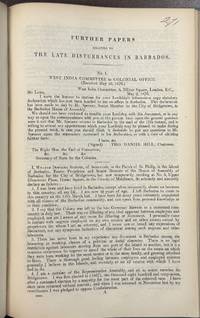
187640713London: Printed by George Edward Eyre and William Spottiswoode 1876. xii 247 1 pp.<br /> bound with FURTHER PAPERS RELATING TO THE LATE DISTURBANCES IN BARBADOS. PRESENTED TO BOTH HOUSES OF PARLIAMENT BY COMMAND OF HER MAJESTY JULY 1876. Printed by George Edward Eyre and William Spottiswoode. 1876. x 220 pp. The two titles bound together in modern two-toned cloth with paper title affixed to front cover. Near Fine.<br /> offered with FURTHER PAPERS RELATING TO THE LATE DISTURBANCES IN BARBADOS. PRESENTED TO BOTH HOUSES OF PARLIAMENT BY COMMAND OF HER MAJESTY FEBRUARY 1877. London: Printed by George Edward Eyre and William Spottiswoode. 1877. iv 66 pp.<br /> bound with FURTHER PAPERS RELATING TO THE LATE DISTURBANCES IN BARBADOS. PRESENTED TO BOTH HOUSES OF PARLIAMENT BY COMMAND OF HER MAJESTY MARCH 1877. London: Printed by George Edward Eyre and William Spottiswoode. 1877. v 1 blank 70 pp. The two titles bound together in modern two-toned cloth with paper title affixed to front cover. Near Fine.<br /> <br /> These books print observations and official dispatches beginning in 1871 that tell the story of the Barbados insurrection beginning in 1876. "Slavery in Barbados was abolished in 1834. . . Despite gaining their freedom in the sense of no longer being 'owned' officially life for plantation workers remained difficult for many years. Perhaps the same children whose parents avoided having them apprenticed became involved 40 years later in the Confederation Riots of 1876. The primary cause of these riots is often cited as the proposed confederation of Barbados and the Windward Islands. However it is very likely that this was one cause of many and the primary reason for unrest and unhappiness was down to pay working and living conditions. The 'despatches' of 1875 describe cases of death by starvation - one of a baby whose mother had had to return to work weeks after giving birth and could not feed her daughter often enough or worked so hard so soon that she could not produce enough milk. According to the rector of the Parish Church this was a common occurrence. . . Cases such as this were the primary causes of unrest in Barbados in the 1870s. These cases illustrate the difficulties faced by the descendants of enslaved African-Caribbeans and the long lasting legacy of the slave trade." online The National Archives essay 'When did plantation workers in Barbados truly become free'. Printed by George Edward Eyre and William Spottiswoode unknown
1838elala1149Toronto: R.Stanton 1838. 1838. 8vo. pp. 91 60. old half chagrin spine & extremities worn retaining original printed wrs. wrs. soiled. imprint date found on fr. wr. The report dated Feb. 13 1838 is largely concerned with the Rebellion: "It cannot but be felt that this traitorous insurrection of a portion of the inhabitants of Upper Canada is an event much to be regretted It has entailed upon the public a very formidable expense the sufferings occasioned by an enterprise of so criminal and desperate a nature to the guilty actors can hardly fail to excite compassion." p. 9 Appended are numerous related documents including proclamations and handbills from William Lyon Mackenzie and from R.J.Sutherland of the Patriot Army the Militia General Order of Dec. 4 1837 official acts resolutions despatches and petitions communications from the American government regarding the capture of the steam-boat Caroline &c. Fleming 1271. TPL 2231. Casey I 1656. Gagnon I 2994. Lande 869. [Toronto]: R.Stanton, 1838. unknown
1857106180London: Great Britain. House of Commons 1857. Broadside. fine. 1 sheetpp. Sheet 25.2 x 32cm. with approximately 180 lines of text in 3 columns. fine Not in Peel. Edward Ellice 1781-1863 was an English merchant and politician who was active in bringing about the union of the NorthWest Company and the Hudson's Bay Company in 1821. An HBC Company executive for whom Fort Ellice was named states here that in his opinion the porposed Committee of Inquiry is necessary due to the uninformed opinions of other Members of Parliament. 1857 Great Britain. House of Commons unknown
184010495Rouen Edouard Frère 1840-1842 Sept volumes in-8 demi chagrin vert, reliure postérieure, dos à nerfs, titre doré, frontispice, xii, 549, 615, 644, 727, 773, 7632 et 749 pages. Dos légèrement insolés, des rousseurs, néanmoins bon état, édition originale.
1829elala1046Quebec: Re-Printed by Order of the House of Assembly of Lower Canada 1829. 1829. 8vo. pp. 2 p.l. 377. partly unopened in later cloth some foxing throughout. The report p. 1-10 is dated July 22 1828 and is followed by minutes of evidence May 8-July 15 1828 pp. 11-328 and an appendix of supporting documents pp. 329-77. Among the witnesses listed on p. iii are Samuel Gale Edward Ellice John Neilson Denis Benjamin Viger amd Austin Cuvillier. The British parliamentary Canada Committee was set up in 1828 to study the grievances of Upper and Lower Canada. "Its major recommendations were that a tax should be imposed on unimproved lands held by speculators; that the laws customs and religion of the French Canadians should be respected that the crown revenues should be surrendered to the colonial Houses of Assembly in exchange for a Civil List; that steps should be taken to sell the Clergy Reserves and to divide the proceeds fairly among all Protestant denominations; and that the revenue from the Jesuits Estates should be used for education." Story p. 145 TPL 1486. Dionne III 217. Lande 385. Sabin 10576. cfGagnon I 2989. Quebec: Re-Printed by Order of the House of Assembly of Lower Canada, 1829. hardcover
190095179London: HMSO 1900. Hardcover as now bound; all were originally issued as softcovers. Good. Modern red cloth. 34 cm. 1 5 p.; 2 iv 59p.; 3 2 folding maps iii 57p.; 4. 51p.; 5. 33p.; 6 9p.; 7 19p.; 8 5p.; 9 43p.; 10 6p.; 11 2 maps both titled Index Plan 147p. Condition of individual papers vary with some chipped edge-wear soiling etc. Some leaves browned and brittle with chipping in railroad report as if high acid paper was used for those leaves. We found various paginations for the final document but our contents seem consistent with most. Original wrappers if any not preserved. HMSO hardcover
1836elala1147<p>Toronto: R.Reynolds Printer 1836. 1836. 8vo. pp. 256 4. original cloth-backed bds. short split in upper front joint covers spotted some scattered light foxing. A scarce and important report. Charles Duncombe a prominent American-born physician and politician in Upper Canada was appointed in 1835 to visit and report upon the systems of education pursued in the United States and to offer recommendations for the educational institutions of Upper Canada. His report pp. 68 in which he stresses the need for practical education and adequate financial support for common schools and teacher education is followed by a lengthy appendix of supporting documentation pp. 69-256. Although Duncombe's proposals were not immediately implemented many would be introduced under the administration of Egerton Ryerson and would form the basis of Ontario educational policy until 1871 i.e. local assessment elective school boards female education the creation of normal schools non-sectarian religious instruction &c. Fleming 1059. Gagnon I 1201. Sabin 21268. TPL 2011. DCB IX pp. 228-32. Hardcover.</p> Toronto: R.Reynolds, Printer, 1836. hardcover
181824993London: John Baskett and others printers 1818. 12 works folio. 12 1/2 x 8 inches and smaller. Disbound or stitched<br/> <br/>A fascinating series spanning the whole of the period when whaling was carried out on a successful commercial basis in the waters off Greenland.<br/> <br/>After an abortive start by the South Sea Company between 1724 and 1732 the British whaling fleet operated off Greenland and the Davis Strait throughout the remainder of the 18th century with increasing success due to a large degree to the succession of bounties granted to ship owners by the British Government. The present selection of acts of parliament includes a number concerning the bounty: the first dated 16th January 1732 makes law "that a Bounty will be paid on the Return of every Ship of 200 tons and over imployed by His Majesty's Subjects in the Whale Fishery". For the bounty to be paid certain stringent criteria had to be met; these increased as the century progressed. By the time of the last Act in the present group March 1818 the Greenland whalers were reporting declining catches and were already beginning to turn their attention to other whaling grounds i.e. largely in the Pacific and Antarctic. This group offers and interesting series of snapshots of the industry during its most productive century. The acts comprise: 1. An Act for encouraging the Greenland Fishery. 1732. Stitched later wrappers. Exemption from duty extended for a nine year period. 2. An Act for the further Encouragment of the Whale Fishery carried on by His Majesty's British Subjects. 1733. Stitched later wrappers. The introduction of a bounty for ships over 200 tons. 3. An Act for continuing the several Laws therein mentioned . including granting a further Bounty for all Ships employed in the Whale Fishery during the present War; for exempting Harponers and others . from being impressed. No date but circa 1750. Spine reinforced. The bounty raised by a third other measures to help the trade. 4. An Act for granting a additional Bounty on Ships employed in the Greenland and Whale Fishery for a limited time. No adte but circa 1761. Disbound. The increased bounty confirmed for another five years. 5.An Act for further continuing several Acts . for the Encouragement of the Whale Fishery. 1768. Stitched. 6. An Act for the better Support and Establishment of the Greenland and Whale Fishery. 1771. Stitched. The rules about the amount of bounty to be paid has changed with additional laws concerning vessels of American origin exemption from duty extended to include the Gulf of St. Lawrence certain members of a whaler's crew to be exempt from being pressed into service in the Royal Navy etc. 7.An Act to explain and amend Two Acts made . with respect to the Limits of the Greenland Seas and Davis's Streights . and to enlarge the Time for the Return of the Vessels employed in the Whale Fisheries. 1780. Stitched. 8. An Act for granting an additional Bounty on Ships employed in the Greenland and Whale Fishery for a limited Time. 1782. Disbound. The bounty retained for a further five years. 9. An Act for allowing Vessels employed in the Greenland Whale Fishery to complete their full Number of Men at certain Ports for the Present Season. 1805. Spine strengthened. Whaling ships permitted to call in to ports in Scotland the Orkneys and the Shetland Islands to find men to complete their crews. 10. An Act for allowing until the Signature of Preliminary Articles of Peace Vessels . to complete their full Number of Men at certain ports. 1806. Spine strenghtened. An extension of the previous act. 11. An Act to revive and continue for five years several Laws. 1815. Strengthened spine. Several prvious acts re-confirmed. 12. An Act to amend an Act . so far as it relates to the Oaths thereby required. 1818. Unbound. Concerns the oaths required from owners/captains before the bounty due would be released to them. John Baskett [and others], printers unknown books
183119854London 1831. FIRST PRINTING. Drop title; with a number of contemporary annotations corrections on Schedules A and B pp. 26-27. Sewn as issued preserved in a folding case. First printing of the final revisions to the Great Reform Bill. This was the second bill put up for a Parliamentary vote. The initial version of the bill March 1831 was rejected by Parliament.<br /> <br /> The Great Reform Bill of 1831 also known as the Reform Act was a significant piece of legislation in the United Kingdom aimed at addressing the deficiencies in the electoral system. Before the bill representation in Parliament was heavily skewed with many industrial cities lacking adequate representation while rural areas held disproportionate power. The bill sought to expand the electorate improve representation and reduce the influence of "rotten boroughs" which were sparsely populated constituencies that had the same voting power as more populous areas.<br /> <br /> The bill proposed to extend the franchise to more men particularly those in the burgeoning middle class and aimed to redistribute parliamentary seats to reflect population changes especially due to the industrial revolution. Although it faced fierce opposition from the House of Lords public pressure and widespread protests highlighted the demand for reform. The rejection of the initial version of the bill led to a wave of public agitation and a second attempt which was again passed by the House of Commons and rejected by the House of Lords. Ultimately this third version passed after the government threatened to create new peers to secure its approval in the House of Lords. <br /> <br /> The Great Reform Bill marked a pivotal moment in British political history laying the groundwork for future electoral reforms and increasing public participation in the democratic process. unknown
1804675531804. The Earliest Accurate Reports of the Proceedings of Parliament": PMM Great Britain. Parliament. Cobbett William 1763-1835 Editor. Cobbett's Parliamentary Debates 1803-1819. London: Printed by Cox and Baylis and Others Primarily T.C. Hansard 1804-1820. 40 of 41 Volumes Lacking Volume 35. Octavo 9-1/4" x 5-3/4". Contemporary three-quarter calf over paper-covered boards gilt fillets and titles to spines spines of Volumes 10 27 and 30 rebacked with recent cloth. Moderate to heavy shelfwear with chipping to spines corners bumped and somewhat worn several joints and hinges cracked or starting a few boards loose. Light toning to texts somewhat heavier in places occasional light foxing. Ex-law school library. Location labels to spines bookplates card pockets and stamps to preliminaries and rear endleaves. $995. First Series first edition. Known as Hansard's Debates after the name of the publisher from 1812 onwards Cobbett's were the "earliest accurate reports of the proceedings in Parliament. They set a new standard for fidelity to the actual speeches. Like his predecessors Cobbett was forced to make a patchwork from speakers' notes and newspaper reports but despite his own prejudices he differed from them in his zeal to be accurate whereas fine writing or party advocacy had earlier been the rule.": Carter and Muir Printing and the Mind of Man Second Edition 268. unknown books