6 711 résultats
1913ZB528180London: HMSO 1913. tall octavo folding map paper wrappers string tied string ties broken or weak library markings else good; published as Colonial Reports -- Annual No. 776. - If you are reading this this item is actually physically in our stock and ready for shipment once ordered. We are not bookjackers. Buyer is responsible for any additional duties taxes or fees required by recipient's country. London: HMSO unknown
1910ZB528183London: HMSO 1910. tall octavo paper wrappers string tied library markings else good; published as Colonial Reports -- Annual No. 651. - If you are reading this this item is actually physically in our stock and ready for shipment once ordered. We are not bookjackers. Buyer is responsible for any additional duties taxes or fees required by recipient's country. London: HMSO unknown
1915ZB528181London: HMSO 1915. tall octavo map paper wrappers string tied library markings else good; published as Colonial Reports -- Annual No. 829. - If you are reading this this item is actually physically in our stock and ready for shipment once ordered. We are not bookjackers. Buyer is responsible for any additional duties taxes or fees required by recipient's country. London: HMSO unknown
13238Without date or place. 6pp. 4to numbered 4-9. Carbon copies on six leaves. In fair condition on aged and creased paper. The account does not appear to have been published and indeed could not have been published during wartime. It may be that it was written for an editor at the Daily Express but the extent of revision and emendation suggests that it was written with an eye to publication after the war. The first page numbered 4 begins after an eight-line deleted passage: 'Reynold's second-in-command is Major Mc.Cormack a whimsical helpful little Northern Irishman with strong Evangelical views. He & the four Chief Press Officers handled me amiably enough; none individually seems responsible for the rows & inconveniences which occur daily. Then there are the Conducting Officers - hearty convivial cavalrymen who wouldn't profess to know much about any periodical but the Field & Country Life. One of them said to me the other night "Hickey . . . . Oh yes I've read your stuff. You do cats in the Sunday Times don't you" Research established that he was referring to Nat Gubbins in the Sunday Express. Some of the reporters find this Bullingdon manner a little overwhelming; others say that they are useful on the job since they are on Christian-name terms with the OC of every unit visited.' At the foot of the first page he begins his description of how 'The King's visit brought the rows & inconveniences to a climax. To begin with elaborate arrangements had been made to keep all news of it secret till after he had returned to England. On the day the King sailed for France it was decided in London to release the news at once after all. But the first that PR in France knew of this decision was hours after the King's arrival when someone happened to be listening in & heard the news on the BBC.' Then the censorship fell into its most jittery mood. We were allowed to say that the news had been left secret till the King's arrival which was obvious. We were not allowed to say that the release came as a surprise to us in France: any hint that deprartmental co-ordination is not 100% perfect is regarded wrongly I think as dangerous. We were not allowed to quote even such amusing details as the pseudonyms by which for secrecy the King had been spoken of beforehand: even among ourselves we had to day "When Mr Harris arrives . . ."; some of the PR staff called him "Mr Big."' He addresses the reader: 'You have heard already of the curious fool arrangement by which glimpses of the King were rationed among the reporters.' He explains that the official description of the 'conference on the day the King lunched with Lebrun & Daladier' was 'not even accurate. There had been no exchange of toasts. There had been only one toast: the King as host had drunk the President of the Republic's health. The reporter put this in his story; found later to his fury that a censor had struck it out writing in instead the smug "Cordial toasts were exchanged".' He discusses the role of the censors. The last page numbered 9 concludes: 'Our reporters are annoyed by all this nonsense & tiresomeness; but its effect on the Americans is likely to be serious. . Red tape presented at least one glowingly pro-British news-agency story of the King's visit from appearing in 1500 newspapers mostly in America. The agency man was away that day. He asked another accredited war reporter to cover the story for him.' From the Driberg papers. See Image. Without date or place. unknown
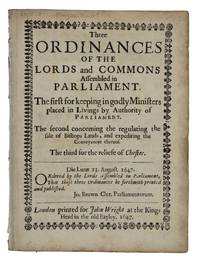
1647AQ20484London: Printed for John Wright 1647. 2 6pp. Disbound. Leaves toned scattered spotting. Three parliamentary pronouncements including edict for the raising of fund to support those impacted by the plague in Chester. . First edition. Quarto. Printed for John Wright unknown
105171 4 and 8 July 1901; all on letterheads of Broadwater Cross Tunbridge Wells. All three items good on lightly-aged paper. All bifoliums. Letter One 1 July 1901: 12mo 4 pp. 42 lines. He is pleased to have received Childers' life of his father published that year. 'I knew your Father well . I was in the House in the Parliaments of 68 & 80 when he had his most serious work'. Praises his 'amazing pluck in going out as he did to Australia Childers was first Vice-Chancellor of the University of Melbourne & in his conduct there in the early days & during the gold discoveries time the story of which in his letters is very curious'. He is interested to learn that he 'had Jewish blood in his veins'. He finds it 'evident that he was very doubtful as to Gladstone's wisdom on several points & in that I agree with him'. He believes that though 'most anxious to help Ireland' he was not 'really happy about Home Rule' wanting to 'separate the Imperial from the Local' which 'could not be done'. Ends: 'Where should we have been in 99 if we had given Ireland over to an Irish Parlmt in 93' Letter Two 4 July 1901: 12mo 4 pp. 33 lines. Having received Childers' reply he is pleased he wrote. Childers' 'Jewish blood' is 'very interesting to me'. Praises Disraeli's comments on the subject in his biography of Lord George Bentinck - 'a most interesting book & written by a most remarkable specimen of that famous nation'. Attacks Gladstone's handling of the Home Rule question. The recipient is 'right that Gladstone acted in a hurry . but he did more - He broke faith with his old friends to whom in Septr 1885 he sent a message utterly opposed to the plans which he developed even before the Election of that year. He was not straight & he had his reward. And he destroyed the Liberal party. - Where is it now' Letter Three 8 July 1901: 12mo 3 pp. 31 lines. He thanks him for 'the Copy of that very remarkable letter - It does the Father credit'. Until the recent case of 'Mr J. E. Backhouse of Darlington' he had 'never heard before of a boy being made a Baronet'. He does not 'altogether agree with your history as to 79-80 - I remember well saying after that terrible Afghan disaster at end of 79 that it would finish the Govmt - that & the Zulu war were too much for the Electors.' 1, 4 and 8 July 1901; all on letterheads of Broadwater Cross, Tunbridge Wells. unknown
15872On letterhead of Rydal House Grosvenor Road Leeds. 12 January 1928. 3pp. 12mo. Bifolium. In good condition on lightly-aged paper. He thanks him for his letter and is pleased to be remembered. 'I have the pleasantest recollections of your kindness and courtesy to an obscure junior and I look back with very pleasant feelings too to the five happy years I spent as a member of the British Museum staff.' He is sorry at the thought of the 'many honored figures' who are no longer there but hopes 'still to find one or two who remember me'. He continues with references to the recipient's 'occasional articles in "Notes and Queries"' and to his 'reminiscence of the good old Quaker miller'. He sometimes meets 'Pollard & J. A. Herbert . at a little religious discussion society' but 'too seldom' meets with 'other old B.M. Colleagues'. On letterhead of Rydal House, Grosvenor Road, Leeds. 12 January 1928. unknown
Paper-covered boards show wear, marks and bumps on corners; tears at top and bottom of spine. 60 pages. Large format: 9"w x 12 1/2"h. The second book in the "This Is" travel series for children by the Czech architect turned children's book illustrator, Miroslave Sasek. Interior pages clean and unmarked; tight binding. Printed in bright colors on heavy, cream colored paper. Previous owner's name sticker.
A clean, unmarked book with a tight binding. 60 pages. Large format: 9"w x 12 1/2"h. The fifth book in the "This Is" travel series for children by the Czech architect turned children's book illustrator, Miroslave Sasek. Printed in bright colors on heavy, cream colored paper. Previous owner's name sticker.
1527938751.Gpaperback. Good. Access codes and supplements are not guaranteed with used items. May be an ex-library book. paperback
0266824196.Ghardcover. Good. Access codes and supplements are not guaranteed with used items. May be an ex-library book. hardcover
1527879828.Gpaperback. Good. Access codes and supplements are not guaranteed with used items. May be an ex-library book. paperback
0331761955.Gpaperback. Good. Access codes and supplements are not guaranteed with used items. May be an ex-library book. paperback
0331762064.Ghardcover. Good. Access codes and supplements are not guaranteed with used items. May be an ex-library book. hardcover
0365835528.Gpaperback. Good. Access codes and supplements are not guaranteed with used items. May be an ex-library book. paperback
1837216153London : H.M.S.O. 1837. First Edition. Paperback. Near fine copy in the original stiff-card wrappers; edges very slightly dust-dulled and toned. Remains particularly and surprisingly well-preserved; tight bright clean and especially sharp-cornered.; 8vo 8"" - 9"" tall; 39 pages; Description: iv 39 p. : tabs. ; 36 cm. Subjects: Great Britain. Parliament. House of Commons -- Poverty -- Poor law -- General Policy and Administration -- 19th century. Reports of committees ; 368. London : H.M.S.O. paperback
1832195864London : H.M.S.O. 1832. First Edition. Paperback. Near fine copy in the original stiff-card wrappers; edges very slightly dust-dulled and toned. Remains particularly and surprisingly well-preserved; tight bright clean and especially sharp-cornered.; 8vo 8"" - 9"" tall; 492 pages; Description: 492 p. : tabs. folding tabs. ; 36 cm. Subjects: France --Economics. Series: Command papers ; Cd. 586. London : H.M.S.O. paperback
1841432671London : H. M. S. O. 1841. 1841 Edition. Hardcover. Very good library copy in gilt-blocked cloth. Spine bands and panel edges somewhat dulled and rubbed as with age. Remains quite well-preserved overall. Subjects; Great Britain. Parliament. House of Commons. London : H. M. S. O. hardcover
Z1-S-038-01283Stationery Office Books. Used - Good. Ships from UK in 48 hours or less usually same day. Your purchase helps support Sri Lankan Children's Charity 'The Rainbow Centre'. Ex-library so some stamps and wear and may have sticker on cover but in good overall condition. 100% money back guarantee. We are a world class secondhand bookstore based in Hertfordshire United Kingdom and specialize in high quality textbooks across an enormous variety of subjects. We aim to provide a vast range of textbooks rare and collectible books at a great price. Our donations to The Rainbow Centre have helped provide an education and a safe haven to hundreds of children who live in appalling conditions. We provide a 100% money back guarantee and are dedicated to providing our customers with the highest standards of service in the bookselling industry. Stationery Office Books unknown
1528581962.Ghardcover. Good. Access codes and supplements are not guaranteed with used items. May be an ex-library book. hardcover
1528506480.Gpaperback. Good. Access codes and supplements are not guaranteed with used items. May be an ex-library book. paperback
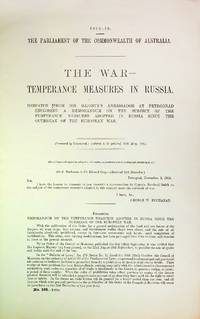
9946Melbourne 1914: Albert J Mullett Govt Printer. Pamphlet. <p>The Parliament of the Commonwealth of Australia. The War - Temperance Measures in Russia.</p> <p><br /> The Parliament of the Commonwealth of Australia<br /> <br /> The War - Temperance Measures in Russia: despatch from his Majesty's Ambassador at Petrograd enclosing a memorandum on the subject of the temperance measures adopted in Russia since the outbreak of the European War<br /> <br /> Melbourne : Albert J Mullett Government Printer for the State of Victoria. No 108 - F6748.<br /> <br /> <br /> Folio 340x210mm cream single leaf printed to both sides 2pp<br /> <br /> When World War I broke out in 1914 almost all of the participant countries including Russia restricted alcohol. Because of the policies noted here closing all liquor outlets and prohibiting the sale of alcohol until the end of the war Russia was able to put its armies in the field much quicker than Germany securing early victories on the Eastern Front. Although the Tsar had been seeking to reduce his empire's reliance on and addiction to vodka spurred on by the Government's absolute control for some centuries of vodka production and distribution for some time in September 1914 he effectively invoked prohibition; making Russia the first prohibition country in the world five years early than the USA. Some scholars now contend that this prohibition and its economic consequences was one of the main causes contributing to the Russian Revolution. Prohibition of State controlled Vodka continued until Stalin came to power in 1924.<br /> <br /> The recipient Sir Edward Grey was the British Foreign Secretary. Why he forwarded it to the Australian Parliament or why it was published in 1915 is unclear; howeverduring World War I temperance and patriotism had become firmly welded together in the public's mind due to increased activism by the temperance movement. In 1915 there was a significant debate about temperance and its importance to the war effort. Bipartisan political and religious support meant that temperance measures but not prohibition were enacted throughout Australia such as early closing hours to 'preserve the empire' and 'support the troops'.<br /> <br /> An intriguing insight into the confluence of war and prohibition. A fine copy.<br /> <br /> § Trove records 1 holding. Only 950 copies were produced.</p> Albert J Mullett, Govt Printer unknown
026596489X.Ghardcover. Good. Access codes and supplements are not guaranteed with used items. May be an ex-library book. hardcover
152814306X.Gpaperback. Good. Access codes and supplements are not guaranteed with used items. May be an ex-library book. paperback
0331463172.Ghardcover. Good. Access codes and supplements are not guaranteed with used items. May be an ex-library book. hardcover