160 résultats
17944700Philadelphia: Pr. & sold by Benjamin Franklin Bache 1794. 8vo 21.5 cm 8.5". 12 pp. <br><br>Sole American edition of Gabriel Bouquier's report on reforming public education in France. The chief aims are to release secondary and higher education from the "hide-bound" ways that the Revolutionary government perceived in the ancient regime and to establish a system for training youths who will be immediately useful to France in commerce exploration mining the military and other nonacademic pursuits. One of the reforms that it is thought will help ensure good instruction is the selection of teachers in public forums by committees of 40 citizens each drawn from a cross-section of citizens. Committee votes are to be open to the public and a clear majority is to be necessary for appointment. <br>Â Â Â Â <br>Â Â Â Â Evans 27001. Removed from a nonce volume now in modern wrappers. Six-digit number stamped on title-page. A little dusty. Pr. & sold [by Benjamin Franklin Bache] unknown books
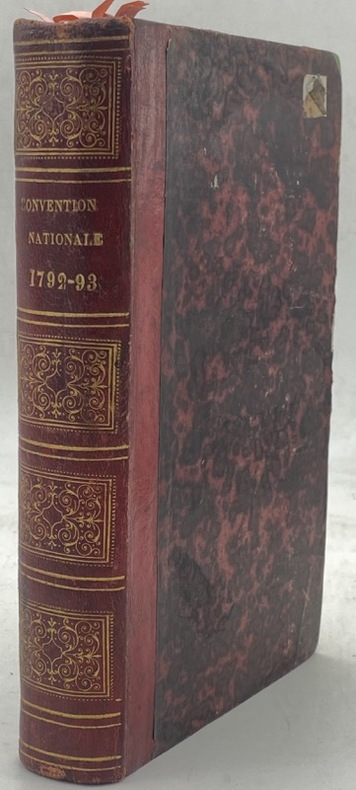
28985Aux Citoyens Dubois Crancé et Gauthier. In-8 en demi-reliure à caissons dorés. Imprimerie Natione en 1793. TBE.
483491793.Petit in-8 demi-relié.91 p. Quelques rousseurs.Demi-reliure ornée,postérieure.Etat satisfaisant.
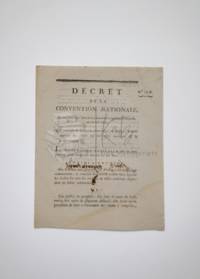
17930010256France. Good with no dust jacket. 1793. Ephemera. On offer is a fine example of a decree passed by the revolutionary government of France in the months preceding the Reign of Terror. The document is titled Decret de la Convention National. It is dated 23rd day of the first month of Year 2 which corresponds to October 14th 1793. The decree numbered 1718 lays out the law regarding divorce. An excerpt follows: qui authorise le conjoint demande en divorce a faire apposerles scelles sur les effects mobiliers de la communaute. Translation: which authorizes the spouse petition for divorce to have affixed the seals on the household effects of the community. The decree then goes on to specify the process: en formant une demande en divorce. S'il existe une communaute le conjoint demandeur pourra faire apposer les scelles fur tous les meubles et effects mobiliers dependant de ladite. Translation: by filing for divorce. If there is a community the applicant spouse may have the seals affixed to all the furniture and household effects belonging to that community. For a historian or legal scholar this is an excellent example of how new laws were formulated in the days following the overthrow of the French monarchy and government. For a gender studies program it offers an interesting sense of the rights of women in the heady days of the revolution. This is a printed document measuring 9.25 inches by 7.25 inches. It consists of one sheet of paper folder to create four pages on two of which is printed the decree. The paper is in very good condition and the printing is clear. ; 9.25" x 7.25"; 4 pages; Signed by Author . unknown
1793340COMPLET . Grasse: Imprimerie de Guichard, Fils, An II de la république In- 8 ( 22X 14 cm ) reliure cartonnée postérieure et muette . V-XXXII pp. - 224 pp. Suivies des 12 Tables ( non paginées) pour réduire les anciennes Mesures de longueur , de superficie, de capacité des anciens Poids, en Mesures et Poids du nouveau système décrété par la Convention nationale . 1p. Remarque, 1p. Errata. - 2 planches dépliantes dont celle du RAPPORT DU GRAVE OU NOUVEAU POIDS AVEC LES DIFFERENTS POIDS QUI ETOIENT EN USAGE DANS LA REPUBLIQUE.
232846Paris, 1792 10 pièces en un vol. in-8, demi-basane cerise, dos lisse orné de filets et caissons dorés, coins en vélin vert (reliure du XIXe siècle). Mouillures claires, importantes en début de recueil.
18634035Bogotá: Impr. de la Nación 1863. 8vo. 1 f. 86 pp. vii pp. <br><br>The period 184080 in Colombian political history was characterized by swings between ascensions of the Liberals and of the Conservatives the Liberals ruling without serious challenge in the last two decades of that period.<br>Â Â Â Â This publication contains the Constitution of 1863 as ratified by the Ríonegro Convention as well as most of the other legislation that the Convention adopted. The constitution incorporated many anti-clerical measures including separation of Church and state; full freedom of worship even for non-Catholics; suppression of religious orders; prohibition of corporate ownership of real property which amounted to prohibition of Church ownership of property; and governmental supervision of worship. The document also thoroughly decentralized power and made each state a virtual law unto itself.<br>Â Â Â Â In an attempt to curb the power of Gen. Mosquera the presidency was made an office of two-year duration and immediate re-election or succession was barred.<br>Â Â Â Â Important and rare: NUC Pre-1956 fails to locate any copies and WorldCat finds only two copies. Removed from a volume of pamphlets and now in later wrappers. Ownership mark eradicated from title-page. => A very good copy of a rare item. Impr. de la Nación unknown books
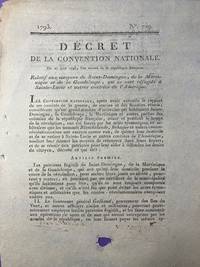
17933635Côte-d’Or 1793. Côte-d’Or imprint dated in Paris 21 June 1793. Folio broadside ca. 27 × 20 cm printed on one leaf verso with official manuscript certifications and signatures. Unbound as issued. Tanned and dusted at the upper edge. A natural paper flaw at lower blank margin from the original pulp quality not later damage. Minor toning and light edge wear. Otherwise in fine condition. Côte-d’Or imprint dated in Paris 21 June 1793. Folio broadside ca. 27 × 20 cm printed on one leaf verso with official manuscript certifications and signatures. Unbound as issued. <p><br /> Rare Revolutionary decree regulating the status and military integration of Caribbean refugees during the Haitian Revolution.<br /> <p><p><br /> Official decree issued by the French National Convention during a critical stage of the Haitian Revolution concerning citizens of Saint-Domingue Martinique and Guadeloupe who had fled their homes amid revolutionary turmoil and taken refuge in Saint Lucia and neighboring territories in the Americas. This decree sheds light on a lesser-known aspect of the Haitian Revolution: the experience of refugees whose political allegiance remained uncertain. While many also went to Martinique the United States or France the Convention saw their regulation and possible reintegration as a pressing issue. Enacted in Paris on 26 June 1793 it was subsequently printed locally in the department of Côte-d’Or for recording and public posting by municipal authorities.<br /> <p><p><br /> The decree distinguishes between counter-revolutionary émigrés and those who fled only to escape violence while remaining loyal to the Republic. Loyal refugees were required to present municipal certificates attesting to their civic virtue civisme and to the circumstances of their flight. Once certified they could be employed by General François-Thomas Galbaud du Fort governor of the Îles du Vent Windward Islands and other officials for land or naval service organized into volunteer companies with the same pay and conditions as regular troops. Registers of their names and origins were to be maintained and sent to the Convention while copies of the decree were to be forwarded to the governments of the United States inviting them to inform French refugees there of its provisions.<br /> <p><p><br /> The decree was issued at a moment when tensions in Saint-Domingue were reaching a breaking point. In June 1793 white royalist planters and free men of color were struggling for control of Cap-Français while formerly enslaved insurgents under leaders such as Toussaint Louverture were gaining strength in the northern plains. On 20–22 June 1793 violent clashes erupted when Governor Galbaud attempted to rally white colonists and other loyalists culminating in a catastrophic fire that destroyed much of the city and drove thousands into exile.<br /> <p><p><br /> Amid this upheaval and with Britain and Spain preparing to invade France’s Caribbean colonies the Convention sought to act preemptively. The decree provided a framework to identify and integrate loyal refugees turning them into a military and political resource rather than a potential threat. It reflects the Convention’s urgent effort to secure both manpower and allegiance stabilizing its Caribbean possessions at a moment of extreme vulnerability.<br /> <p><p><br /> Signed in print in Paris on 26 June 1793 by Collot d’Herbois president of the Convention and leading Montagnard Charles Delacroix and secretaries Gossuin and P. A. Laloy and certified in manuscript by two officials of the Côte-d’Or on 14 July 1793 confirming its registration and promulgation within the department.<br /> <p><p><br /> The decree is scarce both in institutions and the market. We have not located another copy of this Côte-d’Or imprint and RBH records only two copies sold at auction.<br /> <p><p><br /> A rare survival illustrating how Revolutionary France sought to balance loyalty military needs and colonial governance during the upheavals of 1793 and the Haitian Revolution.<br /> <p>. unknown
1794199<p>CONVENTION NATIONALE. COMITÉ MILITAIRE. REGLEMENT POUR L'ORDRE DU TRAVAIL ET LA POLICE INTÉRIEURE DU COMITÉ MILITAIRE. ARÊTÉS DU COMITÉ MILITAIRE IMPRIMÉS En vertu de l'article 31 du décret du 7 Fructidor l'an deuxième de la République française une et indivisible. Extrait du registre des procès-verbaux des séances. A PARIS DE L'IMPRIMERIE NATIONALE. Brumaire l'an III. 1794 In-8vo. 32 pages. Disbound trimmed resewn using original sewing stations. Two copies were located at the Bibliothèque Nationale de France and the British Library respectively. Condition is good.</p><p>Sixteen members of the Comité Militaire established in this operational manual the details of the organization of la police intérieure including arms military hospitals oversight training of troops establishment of the hierarchy of the gendarmerie nationale artillery fortifications frontier security military buildings housing and equipping troops convoys relays equipping horsemen and surveillance of the armed forces in Paris.</p><p>A chronology follows the details of the legislative proceedings about the organization of troops police and military tribunals as well as for the gendarmerie required by the department of Paris; also the provisioning of the corps-de-gardes of Paris and the extensive legislative summaries concerning the force armée of Paris and the military transports. </p>The manual is signed by Gossuin president Dubois-Crancé secrétaire. DE L’IMPRIMERIE NATIONALE books
173000Paris, 1792-1793 in-8, cartonnage papier orange, titre manuscrit au dos (rel. de l'époque).