9 résultats
1891372491891 Numéro 189 - 15 septembre 1938 - in-8 broché - Ed. Les Editions Rieder, Paris
189820034Samedan, Tar Simon Tanner, 1898. In-8 broché de [6]-537 pages.
1872G88454Bruxelles/ Paris, Muquardt/ Sandoz & Fischbacher 1872 xv + 251pp., 22cm., br.muette moderne, texte frais et sans rousseurs, bon état, G88454
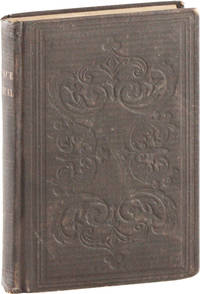
184756398Boston: American Peace Society 1847. First Edition. First printing. Brown cloth blindstamped titled in gilt; pink endpapers; 252pp. Presentation bookplate of the American Peace Society to front pastedown. Straight tight and unfaded paper lightly browned with occasional spots pencil notes to endpapers: Very Good.<br /> <br /> The structure and outline of the book are very similar to Thomas Upham's Manual of Peace reprinted with an introduction by Beckwith in 1842 but the text is substantively different. SABIN 4262. American Peace Society unknown
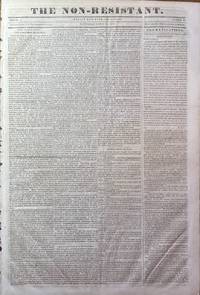
183936794Boston: N. E. Non Resistant Society 1839. Newspaper. Very good. Newspaper. 4 pages. Complete. Approximately 11.75" x 17". Slightly irregular at the blank spine. <br /> <br /> Several articles and letters inside pertaining to "Consequences of War" with Great Britain and other similar pieces. This paper was also an anti-Slavery paper. <br /> <br /> From wikipedia: The New England Non-Resistance Society was an American peace group founded at a special peace convention organized by William Lloyd Garrison in Boston in September 1838.1 Leading up to the convention conservative members of the American Anti-Slavery Society and the American Peace Society expressed discomfort with Garrison's philosophy of "non-resistance" and inclusion of women in public political activities. After conservative attendees opposing Garrison walked out of the convention in protest those remaining formed the New England Non-Resistance Society.citation needed<br /> <br /> The Society condemned the use of force in resisting evil in war for the death penalty or in self-defense renounced allegiance to human government and because of the anti-slavery cause favored non-union with the American South.citation needed The New England Non-Resistance Society was one of the more radical of the many organizations founded by William Lloyd Garrison adopting a Declaration of Sentiments of which he was the principal author pledging themselves to deny the validity of social distinctions based on race nationality or gender"2 refusing obedience to human governments and opposing even individual acts of self-defense.3 In the Society's Declaration of Sentiments Garrison wrote "any person without distinction of sex or color who consents to the principles of this Constitution may become a member and be entitled to speak at its meetings."1 The Society rejected loyalty to any human government; one historian has described the Non-Resistance Society's "basic outlook as that of philosophical anarchism".45. N. E. Non Resistant Society unknown
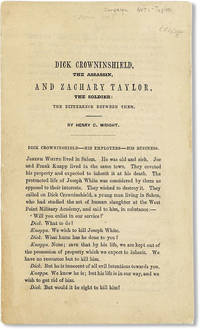
184845010Edinburgh: H. Armour n.d. but 1848. First U.K. Edition. 12mo 18cm.; publisher's side-stitched self-wrappers; 11pp. Light dust-soil tiny soil spot to rear wrapper else Very Good to Near Fine. Anti-Zachary Taylor pamphlet issued by the pacifist and marriage reform advocate Henry C. Wright 1797 - 1870 during Taylor's successful 1848 bid for the presidency. Here the author compares Taylor's career to that of Richard Crowninshield's 1804-1830 who was hired in 1830 to murder the 82-year-old captain and former slave trader Joseph White. H. Armour unknown
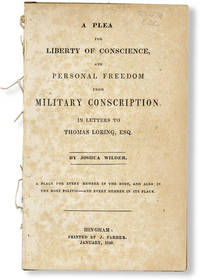
184049178Hingham MA: J. Farmer 1840. First Edition. 12mo 17.5cm.; removed; 45pp. Some foxing to preliminaries else Very Good and sound. Errata printed on p. 46. Uncommon statement advocating the principles of conscientious objection to military conscription composed in a series of six letters. Wilder concludes that "The Conscriptive Military Laws of the State are not only injurious to all whom they oppressively effect but also like all of Nature's Laws far more injurious to those who covet to themselves some exclusive easements or indulgences" p. 35. An uncommon work; about ten copies appear in OCLC no other copies traced in commerce. SABIN 103983. J. Farmer unknown
184055353Boston: Whipple & Damrell for the American Peace Society 1840. First Edition. First printing. Octavo 24cm. In original dark brown cloth blind-stamped on boards titled in gold on spine; plain endpapers; xiii vi xii 13 14-706pp. A straight tight copy spine sunned rubbed at extremities with inch-long crack to base of lower joint; minor foxing throughout but otherwise bright: Very Good. <br /> <br /> In the 1830s the American Peace Society held an essay contest "on the subject of a Congress of Nations" judged by John Quincy Adams James Kent and Daniel Webster iii v. This volume collected the best essays as well as Ladd's own contribution--intended as a summary of rejected essays but in fact an outline of his own concept of a "congress and a supreme court of nations" modeled on the American government. This scheme was "mainly reponsible for engendering the international peace movement of the mid-nineteenth century under the leadership of Elihu Burritt" ANB. Ladd's essay was also published separately in 1840 as An Essay on a Congress of Nations priority unknown; see American Imprints 40-3846. See Brock Pacifism in the United States p.487. AMERICAN IMPRINTS 40-5565. Whipple & Damrell for the American Peace Society unknown
184286607Newcastle & London: J. Barker / Charles Gilpin 1842. First Edition. First impression. Penny pamphlet 19cm x 12cm. Sewn self-wrappers; 24pp. Sewing perished; mild wear at corners; still complete and Very Good. Publisher's imprint printed vertically at bound edge of first page of text. <br /> <br /> A tract on pacifist non-resistance with strong anti-statist content - a clear presentation of the proto-anarchist Christianity of militant pacifist-abolitionists of the era of which Wright and Barker were exemplars. Wright 1797-1870 a defrocked Presbyterian minister would become one of the most radical American voices for abolitionism and pacifism in the years before the Civil War even being ejected from the American Anti-Slavery Society for espousing too radical an abolitionist viewpoint. Joseph Barker 1806-1875 a British controvertialist clergyman who like Wright had been rejected by his denomination was in many ways Wright's analogue in Great Britain espousing a militant interpretation of Christ's teachings that repudiated all entities that survived upon compulsion of their members - including enslavement marriage most religion and government itself. Barker would later relocate to the United States where he became a leader of the abolitionist cause in Ohio before returning to England just prior to the outbreak of the Civil War. The present pamphlet very scarce; not traced in commerce with only five physical holdings noted in OCLC. J. Barker / Charles Gilpin unknown