MAX GALLOLivre Rare Book

10 résultats
1552185451552 broché - 15.5x24 - 491 pp - éditions ROBERT LAFFOND - 1969 - Illustrations -
15989841Argentorati/ Strassburg 1598. Andreas Rietschius 8°. br. Alte Drucke unknown
15459473-071Giolito De Ferrari: In Vinegia Appresso Gabriel 1545. Half Leather Hard Cover. Acceptable. Leather and marbled paper hardcover with gold gilt lettering on spine. 1.25 x .5" tear on a front section of the leather near the spine rectangular shaped. Bookplate pasted down inside front cover. Title page has bottom 3/4" cut neatly off horizontally. First 8 pages have a dampstain on the outer edge of the margin resulting in discoloration but no wrinkling. Rear endpage has residue from a previously removed paste down of some sort. Can send photos. Size: 4 1/2 x 6 1/2 <br/> <br/> In Vinegia Appresso Gabriel hardcover
159039319Vinegia: Presso Altobello Salicato 1590. 8vo 14.8 cm 5.8". 8 148 ff. <br><br>First Catholic-approved edition of Franco's Dialogi piacevoli. During the Counter Reformation most of the "ingrato e faticoso lavoro" as described by the Dizionario Biografico degli Italiani of censoring texts that the Church found objectionable was carried out anonymously; Dominican priest and prolific editor Giovannini was one of the few whose name was associated with his work. His expurgated productions achieved notable success this title alone was republished in six other editions by 1609.<br>Â Â Â Â Author Franco 151570 led quite the interesting life first as Pietro Aretino's secretary and then as his nemesis before being hanged by the Inquisition though the present radically altered version of his work might suggest otherwise. Ugo Rozza reports that Giovannini chose to omit Franco's eulogy for Erasmus and further that the "rewriting was a travesty of Franco's thought: the explicit anti-Roman polemic in the original was => perverted into an apologia for doctrine and for the most orthodox sentiments" "Italian Literature on the Index" Church Censorship and Culture in Early Modern Italy. Indeed in a twist showing how radically confusing to readers and "the record" censorship could be Giovannini's revisions here were so extensive that he later decided to publish the work under his own name rather than Franco's!<br>Â Â Â Â Of the two Salicato printings of 1590 this offering is distinguished by a dedication from Giovannini to Annibale Ruccelai instead of the later dedication to Bernardo Brandimarte and Bartolomeo Lovaria. The text in Italian is neatly printed in single columns using mostly italic and some roman type with several decorative and historiated initials as well as head- and tailpieces; Salicato's printer's device appears on the title-page.<br>Â Â Â Â Provenance: From the library of American collector Albert A. Howard small booklabel "AHA" at rear. <br>Â Â Â Â <br>Â Â Â Â Adams F954; Brunet II 1377; EDIT16 CNCE 79848; Graesse II p. 628. On Franco & Giovannini see: Treccani online. Rebacked 18th-century speckled calf spine with gilt-lettered red leather label raised bands ruled in gilt covers framed in gilt double fillets; extremities rubbed original leather showing fine cracks free endpapers chipped with a few pencilled notations. All edges speckled red. Light age-toning and mostly faint marginal waterstaining a few other stains; four leaves with uneven edges or marginal paper flaws from manufacture. Booklabel as above evidence of partially removed bookseller label; title-page with small ink dashes five leaves with mostly illegible ink notes occasionally offsetting in an early hand. => Intriguing particularly in comparison with Franco's original. Presso Altobello Salicato hardcover books
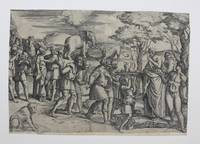
1554P4147Italy c. 1554-61. Very Good margins trimmed a few short marginal tears. . Notes: A fine engraving illustrating the scene from the book of Genesis where Abraham returns from defeating king Chedorlaomer and is meeting with Bera the king of Sodom when Melchizedek comes and praises Abraham while giving him Bread and Wine. <br><br>Giovanni Battista Franco before 1510 – 1561 was an Italian Mannerist painter and printmaker in etching active in Rome Urbino and Venice in the mid 16th century. Image Size : 260x385 mm 10.24x15.16 Inches Platemark Size : Paper Size : 490x640 mm 19.29x25.20 Inches Coloring: Sepia Medium: Copper Engraving Categories: Religious Christianity; Old Masters; unknown
1596175753Venetia 1596. Vellum. Good siginificant soiling and finger smudging here and there also instances of practice penmanship and scriving on margins and backs of plates soiling to vellum covers. Full limp vellum Title-page followed by 2 sheets numbered 3 and 4 then by plates which begin with 5. Appears to be lacking plates 91011141526333536373940 but no signs of removal. Last plates is numbered 45. text is in Italian. Extremely scarce no copies found in auction records or for sale. Worldcat locates 3 copies and calls for 41 plates. Engraved t.p. within historiated border followed by plate representing emblematic view of Venice./ Writing specimens include those of Curione Sopranini Testa Cortese and Cresci. hardcover books
1596175753Venetia 1596. Vellum. Good siginificant soiling and finger smudging here and there also instances of practice penmanship and scriving on margins and backs of plates soiling to vellum covers. Full limp vellum Title-page followed by 2 sheets numbered 3 and 4 then by plates which begin with 5. Appears to be lacking plates 91011141526333536373940 but no signs of removal. Last plates is numbered 45. text is in Italian. Extremely scarce no copies found in auction records or for sale. Worldcat locates 3 copies and calls for 41 plates. Engraved t.p. within historiated border followed by plate representing emblematic view of Venice./ Writing specimens include those of Curione Sopranini Testa Cortese and Cresci. hardcover
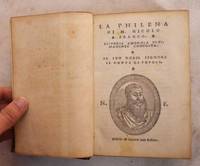
1547189717Mantoua: Per Iacomo Ruffinelli Venetiano 1547. Leather bound. Good heavy shelfwear to leather boards front cover loose pages age toned but clean and clear. Brown leather boards with gilt spine lettering; all edge gilt bw illustrated title page; 470 pp. Text is in Italian. Woodcuts: title vignette is oval medallion portrait of the author flanked by his initials "N" and "F"; portrait repeated on verso of leaf 2 at end; printer's device in colophon Ruffinelli's figure of Fortune holding a wind-filled sail standing atop a dolphin with motto "Te invita portum inveniam". Includes Franco's preface addressed to Giuseppe Cantelmo conte di Popoli dated April 4 1547 in Mantua. Per Iacomo Ruffinelli Venetiano hardcover
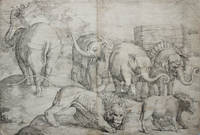
153012820Italia 1530. 342x495mm. 13½x19½". Italia 1530-1560. Grabado. 342 x 495mm. Primera estado. Corto del margen inferior. Grado generalmente atribuido a Battista Franco supuestamente sobre dibujos de Giulio Romano para ilustrar los tapices encargados por Francisco I conteniendo la historia de Escipión Africano. unknown
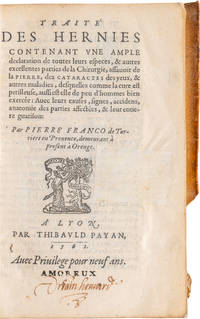
1561954Lyon: Thibauld Payan 1561. Second edition of Franco's most famous work greatly expanding the 1st 1556 with 25 new woodcuts 22 instruments and 3 skeletons. 8vo 175 x 119mm pp. 34 554 2. Contemporary ink ownership inscription to the title page title with old paper restoration 30mmx40mm to blank right margin paper reinforcements to lower margin of G2 ‘F2’ T6 Bb8 Ii2 worming to the final 26 leaves not effecting text errata with a 28mmx44mm piece of the lower blank margin removed and the whole page laid down some very minor sporadic foxing and browning else internally clean very good. Bound in contemporary vellum remnants of from an old manuscript chipped at the lower rear corner lacking the ties toned else very good. Only 3 other copies at auction in at least 85 years. Norman 828. Pierre Franco's "Traité des Hernies" is a groundbreaking work in the history of medicine originally published in 1556 and greatly expanded in this second edition from 1561. Franco one of the most innovative surgeons of the Renaissance despite his humble origins made significant contributions to the field of operative surgery elevating it from the hands of charlatans and itinerant 'cutters' and bringing it back into the realm of respected medical practice.<br /> <br /> Born to a poor family in Provence Franco never received formal university education—a remarkable detail considering his impact. Instead he trained as a barber-surgeon a less prestigious position that provided extensive practical experience. Franco's importance stems from several groundbreaking achievements. The Traité represents the first comprehensive text dedicated entirely to hernias and their surgical treatment. Franco meticulously documented various types of hernias and standardized their classification when most practitioners relied on unstructured knowledge passed through apprenticeship.<br /> <br /> Franco introduced new techniques and instruments such as performing the first documented suprapubic lithotomy removal of bladder stones in 1556 on a child when traditional approaches proved impossible a technique that eventually became standard practice. He also refined techniques for cataract treatment perfecting the "couching" method and pioneering early forms of lens extraction. His work on hernia surgery was particularly groundbreaking as he developed a method for performing herniotomies without castration a common practice at the time.<br /> <br /> Unlike many contemporaries who deferred to ancient authorities Franco prioritized direct observation and experience. By publishing in French rather than Latin he made surgical knowledge accessible to practicing surgeons without classical education. The detailed work on specific procedures laid the groundwork for surgical specialization and the woodcuts in this expanded second edition featuring 25 new illustrations not found in the first edition documented specialized instruments many of Franco's own design serving as prototypes for surgical tool development well into the 19th century.<br /> <br /> Franco's systematic approach established standards that elevated the reputation of surgery as a legitimate medical discipline. He directly influenced later surgical giants including Ambroise Paré who acknowledged Franco's contributions. This 1561 edition represents a crucial moment in the development of modern surgery documenting techniques that established principles that remain relevant in contemporary surgical practice nearly five centuries later.<br /> <br /> “… influential in bringing operative surgery back into the realm of regular surgical practice recapturing it from the ignorant hands of charlatans and itinerant ‘cutters'â€. Thibauld Payan unknown